Analysis of the Influence of EDM Parameters in Micro Hole
Drilling of Titanium Wrought Alloy
Gosavi Vaibhav Y.
*, Phafat Nitin G.
Department of Mech Engg, JNEC, Aurangabad, 431003, India.
* Corresponding author. Tel.: +919579442391; email: [email protected] Manuscript submitted November 22, 2015; accepted March 18, 2016.
Abstract: The selection of adequate manufacturing conditions is one of the most important aspects to take into consideration in the Electrical Discharge Machining (EDM) of hard to cut metals, as these conditions are the ones those have decisive effect on important machining characteristics as: Material Removal Rate (MRR), Electrode Wear Rate (EWR) and the machining accuracy as: Overcut (OC), Taper (T). In this work, a study was carried out on the influence of the factors as: Current (I), Capacitance (C), Pulse on time (Ton) and Pulse off time (Toff) over the listed technological characteristics. The experiments were performed on titanium wrought alloy (VT-20) machined with hollow brass electrode. Accordingly, to obtain the optimal machining conditions techniques like Design of Experiments (DOE) and ANOVA were used. The Experimental results showed that using appropriate machining parameters; the diameter variation between entrances and exit of micro hole can be improved. Considerable amount of re-solidified material and burr were observed at high values of current which leads to secondary discharge and made significant effect on electrode wear. It was also observed that lower range of current and pulse on time gives better topographical condition for micro holes.
Key words: Micro EDM, ANOVA, Secondary discharge.
1.
Introduction
production [10, 11]. Electrode wear is another problem in EDM drilling, particularly in case of smaller and higher aspect ratio micro holes [11]. Moreover, a common problem of micro EDM during machining of deep micro holes is the circulation of dielectric and removal of debris from inter-electrode gap which increases overcut and result into tapered hole [12]. In this work, a study focused on the EDM drilling of titanium wrought alloy, whose field of applications is being increasing in aerospace industry. Consequently, an analysis on the influence of capacitance, current, pulse on time and off time over technological variables as the material removal rate, electrode wear rate, overcut and taper was performed. This was done with Design of Experiment (DOE) and techniques such as multiple linear regression analysis. Mathematical models were created, that made it possible to explain the variability associated with each of the technological variables studied in this work.
2.
Experimentation
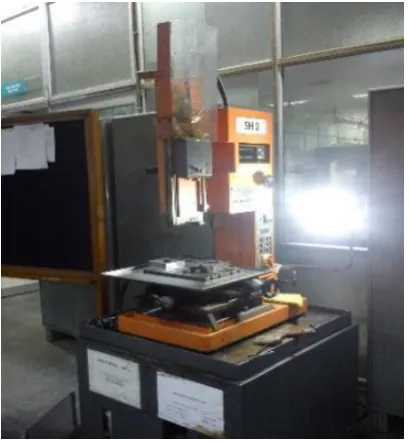
Experiments were performed for through micro hole machining using charmills robodrill machine shown in Fig 1. Rotary hollow tubular copper electrode of diameter 500 µm was fed downward into the workpiece under servo control. The EDM oil was circulated as a dielectric fluid and injected through the tubular electrode. The electro-conductive titanium wrought alloy (VT-20) was selected for study as, it has drawn special attention in aerospace industry, due to its excellent properties. [13]
Fig. 1. Micro EDM machine
Central composite half design (CCD) with 31 run was used to design experiments with an alpha value of 2. The working ranges of selected process variables were determined to fix their levels and to develop the design matrix. This was achieved by conducting preliminary experiments by using one variable at a time approach for the selection of parameter ranges. A large number of trial runs have been conducted at different machining parameters. The upper level of a factor was coded as +2 and the lower level as -2, the coded values for intermediate values were calculated from the following equation:
Xi=
𝑋 − Xmin
Xmax − Xmin … (1)
is the lower limit of the variable and Xmax is the upper limit of the variable.
X1=ln 0.32 − ln 0.26ln C −ln 0.26 , X2=ln 20 −ln 19ln I −ln 19 , X3=ln Tln 20 −ln 16on−ln 16, X4=ln Tln 20 − ln 16off−ln 16 … (2)
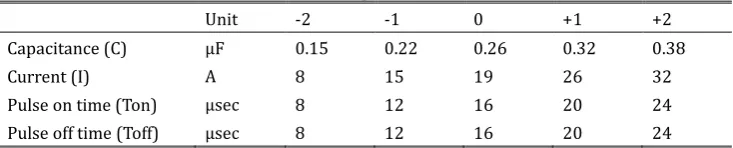
The coded values for intermediate levels have been calculated using equation (2). The selected process parameters of the experiment with their limits, units and notations, are given in Table 1.
Table 1. The Arrangement of Channels
Unit -2 -1 0 +1 +2
Capacitance (C) µF 0.15 0.22 0.26 0.32 0.38
Current (I) A 8 15 19 26 32
Pulse on time (Ton) µsec 8 12 16 20 24
Pulse off time (Toff) µsec 8 12 16 20 24
Experiments were conducted as per the design matrix and effect of process parameters on individual response was analyzed. MRR and EWR are used to evaluate machining performance while OC and T were used to evaluate machining accuracy. In this work, the MRR and EWR values were calculated by the weight difference of the workpiece and electrode, before and after undergoing the EDM process. The overcut of the micro-holes is the distance between the diameter of the machine hole and the electrode diameter that was measured with optical microscope. As the hole became taper, the overcut was taken from the average of entrance and exit side of the micro-holes. Difficulty in removing debris from inter electrode gap increases with increasing aspect ratio that causes secondary discharge and arching to side walls of holes. As a result the hole entrance becomes larger than exit. Taper angle of micro hole is measured as:
Ɵ = tan−1(𝐷𝑡𝑜𝑝− 𝐷𝑏𝑜𝑡𝑡𝑜𝑚)
2ℎ … (3)
where, Ɵ is taper angle, Dtop is entrance diameter, Dbotton is exit diameter and h is machining depth. [14]
3.
Result and Discussion
Results are drawn based on experimental observations and analysis carried out with optical microscope images and the effect of selected process parameters on output is discussed. As EDM is thermal erosion process, increase in discharge energy accelerates thermally activated wear mechanisms. The discharge energy (E) per pulse can be expressed as
E = VpIPTon
1
Ton+ Toff … (4)
𝐸 = 𝑉𝑝𝐼𝑃ɳ … (5)
where, Vp = the voltage of a single pulse, Ip = the current of single pulse, Ton = pulse on time, Toff = the pulse off time and ɳ = duty cycle.
of pulse off time. Since the pulse off time is needed sufficiently depending on power of a single pulse.
𝐸 =1
2𝐶𝑉2 … (5)
where, C = capacitance and V = gap voltage.
Capacitor controls pulse frequency of charging and dis-charging. Therefore, the performance of the micro-EDM is also influenced by the capacitance [16].
Analysis of Material Removal Rate
3.1.
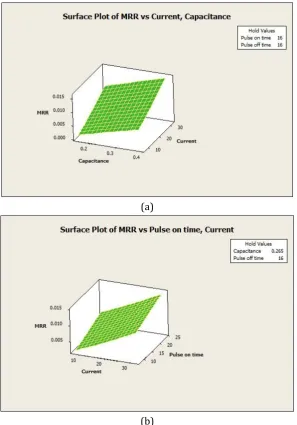
The effect of different process variables on MRR is shown in Fig. 2 (a) and (b) with response surface plots. It was observed that with the increase in capacitance, current and pulse on time MRR increases, while it decreases with increase in pulse off time. The increase in MRR with the increase in discharge current is due to the fact that the spark discharge energy goes beyond the dielectric strength to facilitate the action of melting and vaporization, and progressing the large impulsive force in the spark gap, thereby increasing the MRR. Therefore, the larger current results in deeper craters which increases the material removal.
(a)
(b)
Proportional increase in MRR was observed with increase in capacitance. Premature sparking due to the change in capacitance results into variation in MRR. Pulse off time is the waiting interval time period during two pulses, it is the duration of time in which no machining takes place and it allows the melt material to vaporize and to escape from machining zone, hence increase in pulse off time results into decrease in MRR.
Analysis of Electrode Wear Rate
3.2.
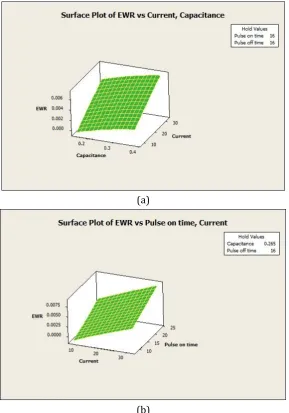
The effect of different process variables on EWR is shown in Fig. 3 (a) and (b) with response surface plots. It was observed that EWR increases initially with increase in capacitance and then decreases at higher capacitance. This is because, at low capacitance the time to charge the capacitor to full storage of energy is less. Hence time to charge capacitor is less compared to the time taken by electrode to achieve sparking gap. Whereas at high capacitance, the time to charge capacitor is higher and it is greater compared to the time taken to achieve the sparking gap. It result into variation of EWR with respect to capacitance. Proportional increase in EWR was observed with increase in, current and pulse on time, while it decreases with increase in pulse off time. Machining time reduces drastically with increase in discharge energy at the same time large amount of electrons are removed from electrode surface that result into simultaneous electrode wear.
(a)
(b)
Fig. 3. Response surface plots for the interaction effects of input parameters on EWR
well as due to the mechanical vibrations (shocks) generated by metal particles from the work material. Imperfections in the microstructure of electrode material also leads to electrode wear. The EDM process has byproducts such as debris and gaseous bubbles which fill the discharge gap, causing changes of gap conditions. Abnormal sparks such as arcing and short circuit results due to concentration of debris in this narrow discharge zone, resulting in extensive electrode wear.
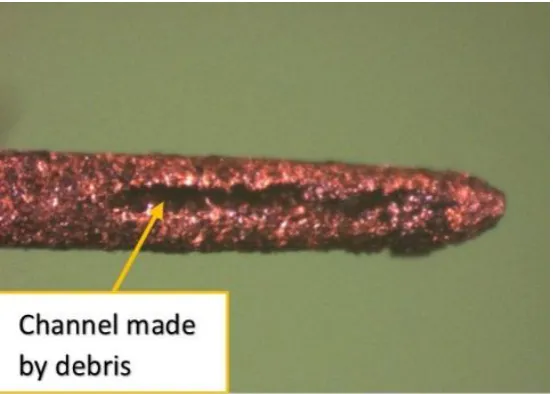
In deep hole drilling, the electrode wear is comparatively higher than conventional micro EDM. The reason behind increase in electrode wear is due to increase in difficulty to remove the debris from machining zone with increase in aspect ratio. If debris are not removed properly, they causes secondary discharge in inter-electrode gap as a result electrode wears with increase in secondary discharge. Fig 4 show electrode wear due to secondary discharge in case of deep hole drilling.
Fig. 4. Electrode wear due to secondary discharge
It can be seen that debris made channel inside the electrode to escape from machine zone under the dielectric pressure but with increased depth, flushing pressure become insufficient to remove debris and causes electrode wear. So with increase in discharge energy secondary discharge increases and results in electrode wear.
Analysis of Overcut
3.3.
(a)
(b)
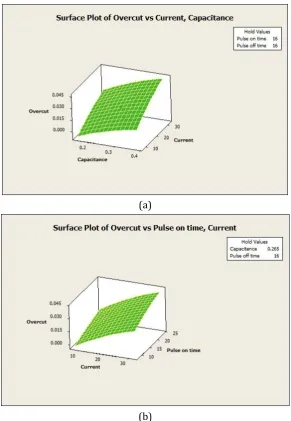
Fig. 5. Response surface plots for the interaction effects of input parameters on overcut
Analysis of Taper
3.4.
(b)
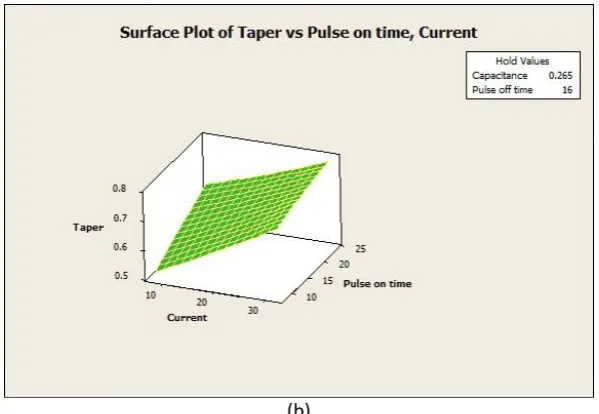
Fig. 6. Response surface plots for the interaction effects of input parameters on taper
The effect of different process variables on taper is shown in Fig. 6 (a) and (b) with response surface plots. It was observed that with the increase in capacitance, current and pulse on time taper increases while it decreases with increase in pulse off time. The main reason for tapered hole is secondary sparking and arcing at the side walls of micro-holes. This phenomenon causes the entrance of micro holes to be larger and smaller hole at exit side. Smaller hole can be observed at exit side, as at the end of the drilling operation, the dielectric fluid escape through the hole exit. This reduces the total number of erosion particles suspended in the dielectric and hence reduces lateral secondary erosion. Also with increased discharge energy, electrode wears rapidly and takes hemispherical shape at the end. The tapered shape of electrode get replicated over workpiece which result into tapered hole. Therefore, the larger discharge energy results into increased taper.
4.
Development of Mathematical Model
RSM is used to obtain the regression equation for MRR, EWR, OC and T that are influenced by process parameters namely capacitance, current, pulse on time and pulse off time. Using the experimental results obtained against all the set experimental conditions and ANOVA was followed, the following first order (linear) model has been developed for selected technological characteristics. Final model equations for MRR, EWR, OC and T in terms of coded values are:
ln(𝑀𝑅𝑅) = −0.0076 + 0.0256𝑋1+ 0.0003𝑋2+ 0.0002𝑋3− 0.0001𝑋4 … (6)
ln(𝐸𝑊𝑅) = −0.0070 + 0.0106𝑋1+ 0.0002𝑋2+ 0.0002𝑋3− 0.00005𝑋4 … (7)
ln(𝑂𝑣𝑒𝑟𝑐𝑢𝑡) = −0.0385 + 0.099𝑋1+ 0.0012𝑋2+ 0.0009𝑋3− 0.0003𝑋4 … (8)
ln(𝑇𝑎𝑝𝑒𝑟) = 0.312 + 0.619𝑋1+ 0.0074𝑋2+ 0.0056𝑋3− 0.00279𝑋4 … (9)
These are the first order model. By substituting above equations into equation (2), the model finally can be expressed as: MRR = 1.161X10.1233X20.001148X30.001121X40.000578 … (10)
EWR = 1.0617X10.051X20.001X30.001X40.0002 … (11)
Overcut = 445583.08X10.4812X20.0038X30.0041X40.0015 … (12)
5.
Analysis Based on Optical Microscope Images
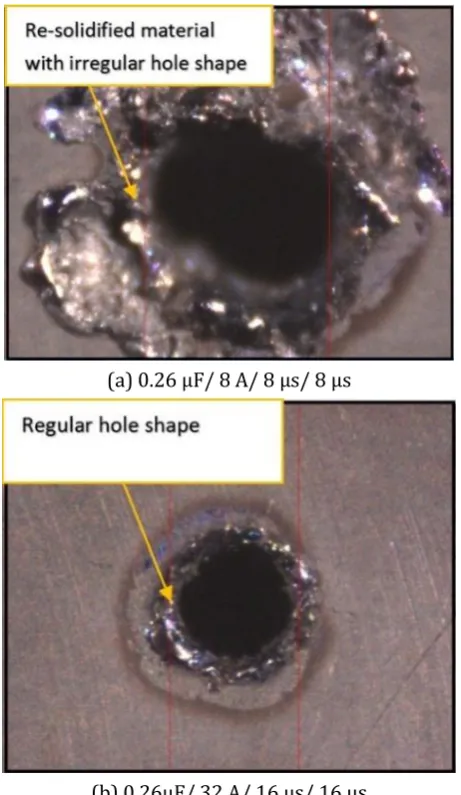
The effect of parameters on micro-hole shape can be clearly observed from images of machined holes under different parametric combination. After analyzing all images, the effect of each parameter has been identified individually and it was found that, lower range of peak current and pulse on time, gives better topographical condition of micro holes. Fig. 7 shows Images of machined micro holes under two different parametric combination.
(a) 0.26 µF/ 8 A/ 8 µs/ 8 µs
(b) 0.26µF/ 32 A/ 16 µs/ 16 µs
Fig. 7. Holes shapes at high and low values of current, using 500 µm diameter brass electrodes.
removed by each electrical discharge. As brass has a much lower melting point than other electrode material, it is possible to state that more material was melted and removed, therefore larger debris and melted material could float and re-solidified in the working zone.
6.
Conclusion
This work deals with the micro hole machining under different parameter combinations with micro EDM. The influence of operating parameters on the final output was investigated. Based on the findings, the conclusions can be drawn as:
1. In the case of MRR, the most influential factor was current, followed by the capacitance, the pulse on time, while the pulse off time was relatively insignificant at the considered confidence level. The MRR increased, as would logically be expected, when current and pulse on time were increased, while an increase in pulse off time brought about a decrease in MRR.
2. In the case of EWR, it was seen that the current was the most influential, followed by capacitance, the pulse on time and the pulse off time. It was found that with increase in secondary discharge, electrode wear increases. Due to insufficient flushing condition in high aspect ratio drilling, it was found that debris made channel and cause electrode wear.
3. In the case of the overcut, the most influential factors were current, followed by the capacitance, the pulse on time and the pulse off time. With increase in current and capacitance increase in overcut was observed.
4. Finally, in case of taper, it was observed that the most influential factor was once again current, followed by the pulse on time, the capacitance and the pulse off time. The experiments with higher electrode wear value shows higher overcut as a result of tapered shape attained by electrode during the machining.
5. From the observations, lower range of peak current and pulse on time, gives better topographical condition of micro holes.
Acknowledgment
This work was supported by IGTR and JNEC Aurangabad.
References
[1] Tai, T. Y., Masusawa, T., & Lee, H. T. (2007). Drilling micro holes in hot tool steel by using micro-electro discharge machining. Materials Transactions, 48(2), 205-210.
[2] Yan, B. H., Wang, A. C., Huang, C. Y., & Huang, F. Y. (2002). Study of precision micro-holes in borosilicate glass using micro EDM combined with micro ultrasonic vibration machining. International Journal of Machine Tools & Manufacture, 42, 1105–1112.
[3] Fleischer, J., Masuzawa, T., Schmidt, J., & Knoll, M. (2004). New applications for micro-EDM. Journal of Materials Processing Technology 149, 246–249.
[4] Ferraris, E., Castiglioni, V., Ceyssens, F., Annoni, M., Lauwers, B., & Reynaerts, D (2013). EDM drilling of ultra-high aspect ratio micro holes with insulated tools. CIRP Annals-Manufacturing Technology 62, 191–194.
[5] Yu, Z. Y., Zhang, Y., Li, J., Luan, J., Zhao, F., & Guo, D. (2009). High aspect ratio micro-hole drilling aided with ultrasonic vibration and planetary movement of electrode by micro-EDM. CIRP Annals - Manufacturing Technology 58, 213–216.
[7] Diver, C., Atkinson, J., Helml, H. J., & Lib, L. (2004). Micro-EDM drilling of tapered holes for industrial applications. Journal of Materials Processing Technology, 149, 296–303.
[8] Tong, H., Li, Y., Zhang, L., & Li, B. Q. (2013). Mechanism design and process control of micro-EDM for drilling spray holes of diesel injector nozzles. Precision Engineering 37, 213–221.
[9] Mahdavinejad, R., A., & Mahdavinejad, A. ED machining of WC-CO. Journal of Materials Processing Technology, 162-163, 637-643.
[10] Gwo-Lianq C., & Yin C. (2006). Study on vibration-EDM and mass punching of micro-holes. Journal of Materials Processing Technology 180, 151–160.
[11] Gwo-Lianq C., Ying-Jeng E. W., & Shun-Feng L. (2006). Development of a micro-punching machine and study on the influence of vibration machining in micro-EDM. Journal of Materials Processing Technology 180, 102–109.
[12] Gao, C. S., & Liu, Z. X. (2003). A study of ultrasonically aided micro-electrical-discharge machining by the application of workpiece vibration. Journal of Materials Processing Technology 139, 226–228. [13] Vaibhav, G.,Nitin, P., & Sudhir, D. (2015). Investigation of effect of process parameters in micro hole
drilling. International Journal of Modern Trends in Engineering and Research, 2(6,)583-587.
[14] Jahan, M. P., Wong, Y. S., & Rahman, M. (2012). Evaluation of the effectiveness of low frequency work piece vibration in deep-hole micro-EDM drilling of tungsten carbide. Journal of Manufacturing Processes 14, 343-359.
[15] SeongMin, S., HanSeok, L., Kumar, A. S., & Rahman, M. (2007). Influences of pulsed power condition on the machining properties in micro EDM. Journal of Materials Processing Technology 190, 73–76.
[16] Jong, H. J., & Won, T. K. (2010). Optimization of EDM process for multiple performance characteristics using Taguchi method and Grey relational analysis. Journal of Mechanical Science and Technology, 24 (5),
1083~1090
Vaibhav was born in Satana district in Maharastra, India. He has obtained Bachelor of engineering and Master's Degree in Production and manufacturing Engineering from KKWIEER, Nasik and JNEC, Aurangabad, Maharastra, India in the year 2012 and 2015 respectively. He has 3 year experience and working as assistant professor in JNEC, Aurangabad, Maharastra, India. His area of interest is advance manufacturing processes and micro machining.
Nitin was born in Akola district in Maharastra, India. He has obtained Bachelor of