17 Trans. Phenom. Nano Micro Scales, 4(2): 17-27, Winter - Spring 2016 DOI: 10.7508/tpnms.2016.02.003
Numerical Study of Bubble Separation and Motion Using Lattice Boltzmann
Method
E. Sattari1, M. Aghajani Delavar1,*, K. Sedighi1
1Faculty of Mechanical Engineering, Babol Noshirvani University of Technology, Babol, , I. R. Iran
Received 9 March 2015; revised 12 July 2015; accepted 10 October 2015; available online 28 June 2016
ABSTRACT: In present paper acombination of three-dimensional isothermal and two-dimensional non-isothermal Lattice Boltzmann
Method have been used to simulate the motion of bubble and effect of wetting properties of the surface on bubble separation. By combining these models, three-dimensional model has been used in two-dimension for decreasing the computational cost. Firstly, it has been ensured that the surface tension effect and Laplace law for two-density ratio 50 and 1000 have been properly implemented. Secondly, by simulation of static droplet in different conditions wettability, integrity applied equations has been investigated.Thirdly, effect of governing dimensionless numbers such as Etvos number and Morton number on Reynolds number and terminal shape of bubble have been investigated.Different flow patterns in various dimensionless numbers have been obtained and by changing the dimensionless number, terminal change of bubble’s shape has been seen. Finally, the impact of wettability of surface on departure of bubble from wall under buoyancy force in different dimensionless numbers has been studied.
KEYWORDS: Etvos Number; Inamuro Model; Lattice Boltzmann Method; Morton Number; Two Phase Flow; Wettability
INTRODUCTION
In scientific point, many phenomena in daily life are two-phase or multiphase, for example, the raindrops motion; dust particles motion in the air or the wave motion on the sea surface, and its failure modes are examples of two-phase issuesoccurs in nature. Two-phase fluid with many application uses in industrial issues, for example, uses in boilers. In boilers, combination of water and vapor as a two-phase fluid has an important role in boiler design. In addition,two-phase fluid with main application is used in nuclear reactor design. As well as designing advanced tools like rocket engines, water purifier and blood pumping machines needdetailed knowledge in dynamic of multi-phase flow. Checking the bubble motion in fluids in many applicationsis used in petroleum and chemical industries and it is because of the mixture of gas and liquid broadly in these industries.The physical mechanism of two-phase flow is very complex. Thus, clear perception of two-phase flow mechanisms is not available. The numerical investigation in two-phase flows is significant due to disability of experimental investigations to access to the physical parameters in the bubble and droplet. Thus, numerical investigation is preferable for this phenomenon.The lattice Boltzmann method is almost new numerical techniques based on kinetic theory, whichis used for investigation of fluid flows.In Comparison with the traditional CFD, LBM has some advantages such as easy process, simple and efficient implementation for parallel computation, simple
us
*Corresponding Author Email: [email protected]
Tel.: +989124957294; Note. This manuscript was submitted on March 9, 2015; approved on July 12, 2015; published online June 28, 2016.
and efficient implementation for parallel computation, simple and strong handling of complex geometries, etc. There are various versions, which provided for two-phase flows using Lattice Boltzmann method.
Gunstensen et al [1] presented a multi component model based on two dimensional lattice-gas hydrodynamics. In their model two-particle distribution functions, red and blue, were introduced for studying two different fluids. Shan and Chen [2] offered a method for multicomponent and multiphase flows with regard microscopic interaction. Swift et al [3] proposed a model for multiphase and multicomponent flows by using free energy approach. The main advantage of this model is the ability to include multi component and non-ideal thermodynamics of fluid in isothermal.
It is worth mentioning that, in the all listed LBM two-phase models, the density ratio is intended less than 10, while in fact density ratio is more than 10 at most of the liquid-gas systems. Main problem in numerical solution of two-phase flow with large density ratio is numerical instability in interface.
Inamuro et al [4] offered a new model based on free energy approach for two-phase flow with high density ratio and investigated motion of a single bubble and many bubbles under buoyancy force in three dimensions(3D) simulation. Inamuro et al [5] used their method to study rising of two droplet and their coalescence in a vertical and horizontal rectangular channel.
In another study, Inamuro et al [6] employed this model to simulate coalescence of two droplet with equal diameter with initial velocity in 3D and also two droplet withunequal
E. Sattari et al.
18 Nomenclature
E Etvos number
specific heat (Jkg-1K-1)
Greek Symbols diameter (nm) Δx spacing of square lattice d grashof number Δt time step in the scale of LBM
ℎ gravitational acceleration (m.s-2) μ dynamic viscosity (kgm-2s-1)
g height of the enclosure (m) ν kinematic viscosity (m2s-1)
H thermal conductivity (Wm-1K-1) θ Contact angle
ci
Nusselt number ρ density(kgm-3)
Ei pressure (kg m-1s-2)
ρl Density of liquid
p
dimensionless pressure ρg Density of gas
fi
Rayleigh number ζ direction normal gi Richardson number σ interfacial tension
hi Reynolds number Subscripts Re Prandtl number α coordinate
kf temperature (K) β coordinate
P0
dimensional x and y components of velocity i Particle Counters
u, v
dimensionless velocities f fluid U,V
reference velocity l liquid M
dimensional coordinates g gas x, y dimensionless coordinate 0 reference
diameter in 3D [7]. Inamuro [8] carried out simulation of a set of bubbles in a branch channel, this geometry was utilized as a cooling system in air conditioning system. Yan and Zu [9] simulated horizontal movement of two bubbles with initial velocity in 3D channel. Yoshino and Mizutani [10] studied contact angel by adding thewettability condition to Inamuro[4] method. Yan and Zu[11]investigated the final shape of droplet on surface in different wettability and also they studied the final shape of droplet on partial wetting surface in 3D. in [12] Yan and Zu studied rising two bubbles, their coalescence and shape of droplet on partial wetting surface. Later on making some changes on the original model was used by Tanaka [13-14] for two dimensional and reactive flows. Tanaka et al.[13] simulated dynamic treatment of droplet on solid surface. Moreover, they used this model for investigation of boiling process[14]. Sattari et al. [15] by combining Tanaka [13] and Inamuro’s model [4], investigated nucleate pool boiling and transient boiling in 2D.
In addition to Inamuro[4], Lee and others have presented their proposed method in two-phase fluid flows with high density difference[16-19]. One of the technologies that are now widely used in the industries of textile, automobile, light industry, shipbuilding and aviation has many applications, are self-cleaning surfaces. Based on several studies, high hydrophilic and hydrophobic surfaces have this type of property.
This phenomenon occurs as a droplet place on these surfaces.Although the effect of contact angle on a droplet on the surface and its evaporation have been studied[9-13, 17, 18].
In this paper, for the first time the effect of the surface wetting properties on the motion of bubble, in the case of
washing machines with steam mechanismis studied. Inamuro model[4] is a 3D model so has high computational cost, Tanaka [14]added derivative of pressure tensor term to Inamuro[4] model for simulation of boiling in two dimensions and it increases computational cost in twodimensions.
In this study, firsta combined model is presented by implementation of Inamuro[4] and Tanaka[14]methods. After that, this model was used to ensure the proper functioning of the effect of surface tension. For this purpose, two testshave been conducted: the first test was related to a two dimensional square bubble,placed in a liquid.
In the second test, two circular bubbles have been placed side by side and their approach was modeled. After that the Laplace law has been checked, and then the effect sof dimensionless numbers for a bubble rising by bouncy force have been investigated. Endmost rising of bubble have been modeledfrom surfaces with different wet properties in different dimensionless numbers.
Methodology
In the present paper, the combined method that has been introduced in pervious study [15], is employed for 2D simulation. In this paper, three distribution functions have been used. fi, gi and hi to calculate order parameter which
distinguishes two phases, a predicted velocity and pressure, respectively.
(
,
)
c( , )
i i i
f x c x t
t
f x t
(1)(
,
)
c( , )
i i i
Trans. Phenom. Nano Micro Scales, 4(2) 17-27, Winter - Spring 2016
19 1
*
1
( ) ( ) ( )
1 3
( )
n n n
i i i i
h
i
c i
h x c x h x h x h
u
E x
x
x
(3)
, and ℎ are equilibrium distribution functions. ΔX is spacing of square lattice and Δt is time step in the scale of LBM during which particles travel in lattice spacing. Equilibrium distribution functions in equation (1-3) are obtained by following equations:
2
0 3
( )
c
i i i f i i
i f i i
f H F p k E c u
x
E k G c c
(4)3 9
1 3
2 2
3
3 4
1
3
2 1
( )
2
i iy
G
c
i i i i i
i i i
i i
g g
i i i i
g E c u u u c c u u
u u
E x c c E c
x u
g x
u u
x E c
x x x
k k
E G c c F
x
(5)
( )
c n
i i
h
E P x
(6)For reading more detailed, see our pervious study [15]. Wetting boundary condition
When gas and liquid interface placedon a solid wall, a finite constant contact angle is indicated as wettability of system, which is caused by balance of surface tension forces. To apply these conditions, Yoshino’s model[10] which is resulted from combining methods of Briant [20] and Inamuro [4], is employed. In this model, the finite-difference of the order parameter on the boundary is obtainedby:
2 2
0 1 2
0
1
3 4
2
(7)
where, ζ is the direction normal to the wall. In this correlation, the first term on the right hand side is attained by a forward finite-difference scheme; the second term is calculated by a standard centered finite-difference scheme.
In addition, the third term is obtained by a backward finite-difference scheme, to wit:
2 1 0
2
1
3 4 .
2
z
(8)
RESULTS
Validation of two phase solution
Since the most important and sophisticated part of an analysis oftwo-phase flow is related to dynamic interface between two fluids, first step for the demonstrating accuracy of the flow simulation is checking this issue. Two tests werecarried out for this issue. In the first test, deformation of a two dimensional square bubble that has been placed in filled environment of liquid has been shown. According to effects of surface tension between two fluids, the bubble tends to change to steady state with the lowest interface. According to simulation results shown in Figure 1, bubble shape has changed by passing the time and became like a circle. This issue shows the effects of surface tension, which are important part of two-phase flow analysis, are properly. This test has used as a credit of two-phase solution by Mousavi et al. [21] . This test has been done for large density ratio(1000). As Inamuro in [4]mentioned, increasing of density ratio leads to increasing the iterationnumbers to achievedesired results.As Figure 2 shows, deformation occurred in moreiterations.
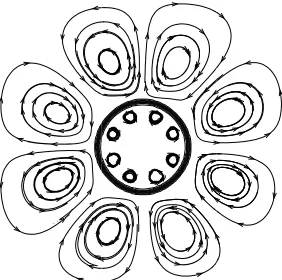
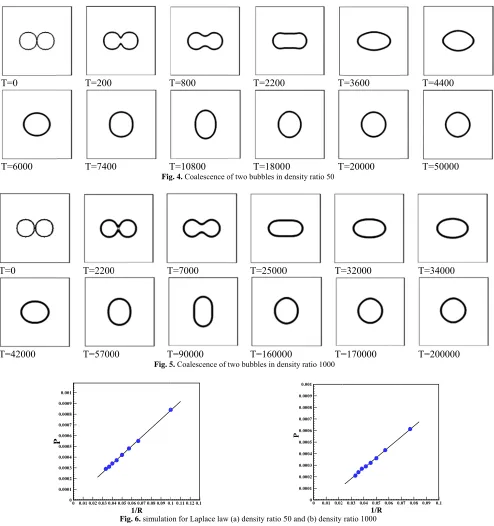
For a static bubble, the velocity must be zero at all points in equilibrium condition. However, in two-phase numerical methods, a spurious nonphysical velocity is created around the bubble near the interface. Indeed today, the numerical methods are improving for decreasing this spurious velocity [22]. Because of this spurious non-physical velocity in numerical methods, weak vortices are created around the droplet and bubble, near interface these velocitieshave been called parasitic flow. Figure 3 shows parasitic flows around a bubble in an equilibrium condition in one of the performed simulations. In second test, two circular bubbles with same diameter L/3 have been located adjacent to each other. In this simulationthe distance between two bubbles, density and viscosity are equal to 0/05, 1 and 0.01, respectively. Due to effects of surface tension and Van der Waals forces, these bubbles approach and finally a circular larger bubble is created. The results of this simulation have been shown in Figures (4-5). This test has been used as a credit of two phases solution[19, 21].
Laplace law
Laplace law represents the correlation between inner Pin
and outer pressure Pout of bubble with interfacial tension σ
between two fluids. Based on Laplace law there is a formula for a two dimensional bubble[1]:
in out
P P
R
i f e a c p
T=0
T=6400
T=0
T=32000
Surface te isothermal flo fluids.
Therefore, i exists between and outside th conditions with
Figure 6 sh pressure has be
T
T
T=800
T=4000
F
ension during ws is one of it can be conc n the pressure he bubble with hout changing hows the perfo een satisfied ni
T=800
T=8000
Fig. 1. a square d
T
00 T
Fig. 2. a square dr
g the comp the constant p luded that a li
difference be the inverse ra its properties. ormed simulati icely the Lapla
E. Satta
T=1600
T=14200 droplet deformatio
T=2400
T=54000
roplet deformation
Fig. 3. the para
pressibility a properties of tw inear relationsh etween the insi adius in the sam
ion and obtain ace law in Latti
ari et al.
20
T=
T=1 on at lattice time st
T=4000
T=6000
n at lattice time ste
asitic flow around
and wo hip ide me ned ice
Boltzm two-pha Indepe To d the firs grids a tension differen
=2400
16000
teps for density dif
T
0 T
eps for density diff
a bubble
mann Method. ase solution in endence of me do this, two di st test, Laplace and note that n so the values
nt grids. In
T=4800
T=17000 fference 50
T=16000
T=70000
fference 1000
This test has n [1, 3, 19, 21]
esh
ifferent tests h e law has been
the related sl s have been ob second test,
T=5
T=5
T=24000
T=10000
been done as .
have been perf n performed fo lop is equal t btained and co
three differ
5600
0000
0
00
s credit of
2 f t r d
T
T
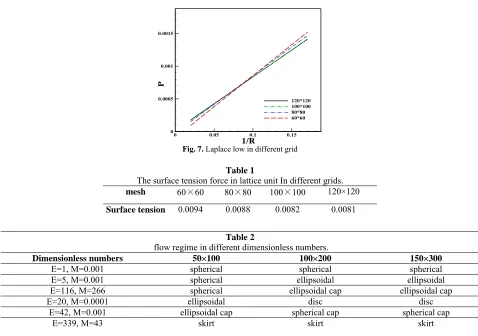
200×100, 100× final regimes h test have been results, sugge domain, becau 100×100 and 1
T=0
T=6000
T=0
T=42000
P
×50, 300×150 have been com n shown in Figu sted grid num use of the equa 120×120 grids.
T=200
T=7400
T=2200
T=5700
P
0 0.01 0.02 0.03 0.0
0 0.0001 0.0002 0.0003 0.0004 0.0005 0.0006 0.0007 0.0008 0.0009 0.001
Trans. Pheno
have been use mpared. The re
ure 7 and Tabl mber is 100 fo
ality of surface .
T
0 T
Fig
0 T
00 T
Fig. 5
Fig. 6. simulatio 1/R 04 0.05 0.06 0.07 0.08 0.09 0.
om. Nano Micro
ed and the bubb esults of the fi le 1, due to the for length of t e tension force
T=800
T=10800
g. 4. Coalescence o
T=7000
T=90000
5. Coalescence of t
on for Laplace law .1 0.11 0.12 0.1
Scales, 4(2) 17-2
21 ble irst ese the e in
The the fina changin previou and flow equal. I to avoid
T=2200
T=1800
of two bubbles in d
T=25000
T=16000
two bubbles in den
w (a) density ratio 5
27, Winter - Spr
results of seco al shape of the ng of dimensi us works. How
w regimes in 2 In this paper 2 d increasing th
T
0 T
density ratio 50
0 T=
00 T=
nsity ratio 1000
50 and (b) density
P
0 0.01 0.02
0 0.0001 0.0002 0.0003 0.0004 0.0005 0.0006 0.0007 0.0008 0.0009 0.001
ring 2016
ond test have e bubble is not
ionless numbe wever, the fina 200×100,300×2 200×100 grid h he computation
T=3600
T=20000
=32000
=170000
ratio 1000 1/R
2 0.03 0.04 0.05 0.06 0
been shown in t true in grid 5 ers in compar al shapes of t 200 grids are c have been use nal cost.
T=4400
T=50000
T=34000
T=200000
.07 0.08 0.09 0.1
n Table 2; 50×100 by rison with the bubble completely ed in order
0
E. Sattari et al.
22
Fig. 7. Laplace low in different grid
Table 1
The surface tension force in lattice unit In different grids. 120×120 100×100
80×80 60×60
mesh
0.0081 0.0082
0.0088 0.0094
Surface tension
Table 2
flow regime in different dimensionless numbers.
150×300 100×200
50×100 Dimensionless numbers
spherical spherical
spherical E=1, M=0.001
ellipsoidal ellipsoidal
spherical E=5, M=0.001
ellipsoidal cap ellipsoidal cap
spherical E=116, M=266
disc disc
ellipsoidal E=20, M=0.0001
spherical cap spherical cap
ellipsoidal cap E=42, M=0.001
skirt skirt
skirt E=339, M=43
Rising bubble
In this section, the bubble motion in a fluid-filled environment has been investigated. The dimensionless numbers of this phenomenon are Morton(M=gul(ρl-ρG)/
σ3), Etvos (Eo=g(ρ
L-ρG)D2/σ) and Reynolds numbers
(Re=ρLDV/μL) which V is final velocity of the bubble and
D is the initial diameter of the bubble.
The opposite boundaries have the periodic boundary conditions. The grid 100×200 has been used. The initial diameter of the bubble has been 30-lattice unit.
Behavior comparison of bubble in two dimensions has been indicated that bubble deformation is a function of Etvos and Morton numbers [4] . According to the terminal shape of bubble which are different in different dimensionless numbers, various patterns of flow in two-phase flow are divided to six major groups are shown in Figure 8 : 1)spherical, 2)ellipsoidal, 3)ellipsoidal cap, 4)disk, 5)spherical cap, 6)skirt [4] . The results have been represented in dimensionless time T=t/tn with tn= /
where t is number of iteration. When the bubble moves upward, at first, the bubble starts to move due to density difference with the surrounding fluid leads to buoyancy force.
The Drag force on the bubble is because of the bubble motion in the fluid and if the bubble does not burst, will reach to the constant velocity and shape. In this mode, buoyancy force is equal to fluid drag force and the bubble
continues to move with the same constant velocity.
In Figure 8 in right column, density linear contour with velocity vectorshave been drawn for related dimensionless numbers when the shape of bubble is stable and in left column, movement and shape of the bubble have been drawn in different dimensionless times. As seen in Figure 8, the shape of the bubble is the same for each of the regimes in last dimensionless times due to equivalence between buoyancy and drag force and stable bubble. Of course, the flow is unstable in Figure 8f and the bubble bursts and some parts of it separate after T=5 as shown in Figure 8.f. As seen in Figure 8, bubble deformation is such as concavity in the bottom of the bubble. In the lower part of the bubble, it should balance itself with the pressure inside of the bubble, because of the hydraulic pressure so convexity in liquid and concavity inside the bubble has been formed.
The higher pressure difference creates the larger vortex around the bubble and as a result, deformation of bubble is more. In Figure 8a almost the mentioned area has not been formed so the shape of bubble is stable. From Figure 8b onward have been increased size this area so bubble deformation have been increased. Figure 8a bubble deformation is not large but as is evident from the definition of dimensionless numbers, with the increasing of Etvos number as shown in Figures (8-a) and (8-b) buoyancy
1/R
P
0 0.05 0.1 0.15
0 0.0005 0.001 0.0015
f m E d c n l n
h r
force has been more. Also th Etvos number deformation, i causes the incr number causes less effect on number conne seen on Figure According t has been sho required time f
(a)
n increased and he surface ten because the s in other hand reasing of defo s increasing of n bubble defo ects with the su es 8(d-e).
o different dim own by chan
for passing the
a) Eo=1,M=10-3
d)Eo=20,M=10-4
(
Trans. Pheno
d thus deforma nsion decrease surface tension , increasing o ormation, incre f bubble defor ormation beca urface tension mensionless tim
nging dimensi e length of the
4
Fig. 8. D
(b)
Fig
om. Nano Micro
ation of bubble es by increasi n is resistance of Etvos numb easing of Mort rmation but ha ause the Mort in power 1/3 mes in Figure 8
onless numbe channel has be
b)
e)E Different flow regim
(c) g. 9. streamlines at
Scales, 4(2) 17-2
23 e is
ing to ber ton ave ton as , it ers, een
changed termina In T been ca In F plotted. only in been fo Bubble In the F in comp
Eo=5, M=10-3
Eo=42,M=10-3
me in different dim
t different dimensi
27, Winter - Spr
d and this re al Reynolds.
able 3, the ter alculated. Figure 9, strea
. In the first th nside the bubbl formed under e trail leads to t
Figure 10, the o pared to Inamu
mensionless numb
(d)
ionless number
ring 2016
epresents the c rminal Reynol amlines for th hree cases, vor le but after Fig the bubble th turbulent flow
obtained result uro’s three dim
c)Eo=
f) Eo= bers
(e)
change in vel lds number va hese bubbles h rtices have bee gure (9-d) vor hat called bub around the bub ts are in good a mensional study
116,M=266
=43,M=339
locity and alues have have been en formed rtices have bble trail. bble.
agreement y [4] .
C p a r f c c Contact angle For validati placed on bot surface. Simu surface, Figure and the height If the base a respectivelythe following equa 2
(4
8
H
R
H
The measu calculated from
arctan 2(
Fig.10. comp
Fig. 11. D
Calculated Reyn 1-1 1-2 4.62 21.9 As it is note calculatedregio
es
ion of wall b ttom wall with ulated droplet e 11, can be ca
of the droplet. and the height e droplet radi ation (Figure 1
2
)
L
H
ured contact m the following
( ) L R H
parison of result of dimensio
Displaythe contact
Ta
nolds number co Fig 2 1-3 95 7.63 ed in[99], due t
ons with densi
boundary cond h respect to p contact angle alculated by me t of droplet def ius is obtaine
1) [23] :
angle in the g equation[23]
f this study, , and nal study [4]
angle,Baseandheig
able 3
orresponds to the gure 1.
1-4 105.08 to the fact that ity gradient. F
E. Satta
dition, a drop properties of t e with the w easuring the ba fine by H and ed by using t
(
e simulation :
(
d Inamaru’s three
ghtdrops [23]
e different states 1-5 1-6 93.47 34.8 in this method For uniformity
ari et al.
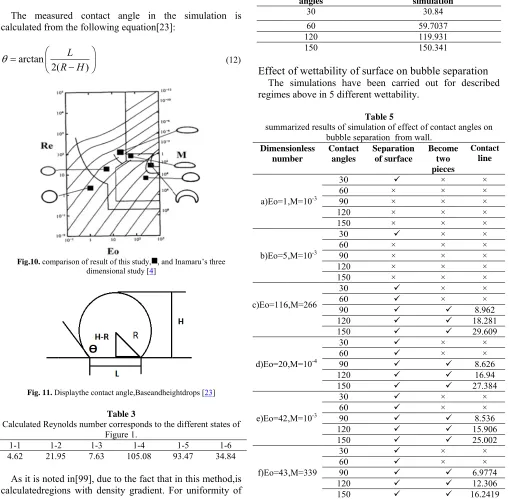
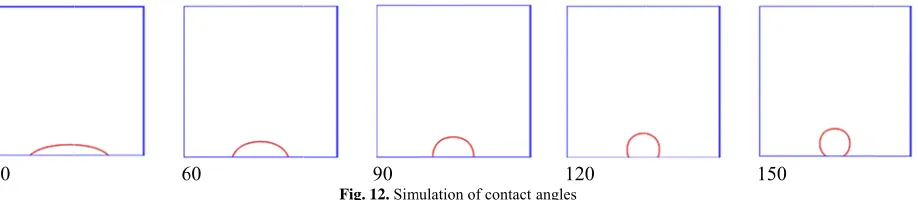
24 plet the wall ase L, the 11) is 12) of 6 84 d,is of results, the sep a dropl enclosu compar angles v is very negligib com Des Effect The regimes summ Dimens num a)Eo=1 b)Eo=5 c)Eo=116 d)Eo=20 e)Eo=42 f)Eo=43 boundary den arating bounda let with initial ure with a leng red desired con values from th y little differen ble amount of
mpares the desira contact angl
sirable values o angles 30 60 120 150 of wettability
simulations h s above in 5 di
marized results of bubb sionless mber Con ang ,M=10-3 30 60 90 12 15 ,M=10-3 30 60 90 12 15 6,M=266 30 60 90 12 15 0,M=10-4 30 60 90 12 15 2,M=10-3 30 60 90 12 15 3,M=339 30 60 90 12 15
nsity has been ary of two flui l diameter 40 gth of 200 grid ntact angle valu he simulations. nce between th error is accept
Table 4
able values of th les obtained from
Angle v f
y of surface o have been car ifferent wettabi
Table 5
f simulation of e le separation fro
tact gles
Separat of surfa
0
0 × 0 × 20 × 50 ×
0
0 × 0 × 20 × 50 ×
0
0
0
20
50
0
0
0
20
50
0
0
0
20
50
0
0
0
20
50
considered ρ= ids. Figure 12 grid units in d units. In Tab ues and obtain .As it can be s hese two valu
able.
e contact angle a m the simulation
values obtained simulation 30.84 59.7037 119.931 150.341 on bubble sepa
rried out for ility.
ffect of contact om wall. tion ace Become two pieces × × × × × × × × × × × × × × × × × ×
=ρl+ρg/2 at
illustrates n a square
h r i f t o o h t b o h o b F t a i t b w
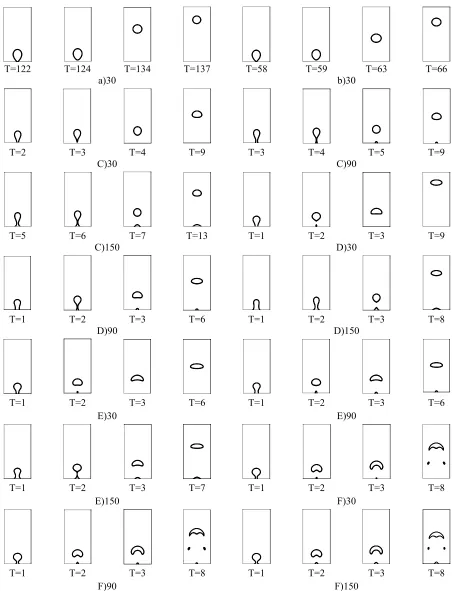
highly hydr hydrophobic(1 results have be In addition, in Figure 13. from the surfa the final shape of 30 degrees, of the bubble hydrophobic c surface that fo tends to stick bubble tends t occurs for Fig hydrophilic,bu other cases, b buoyancy for Finally, the bu to two pieces a attached bubb increases. As terminal shape section, itcan bubble is indep According t wall by incre
30
rophilic (30°),
20°) and hig
een summarize the examples In cases wher ace, the final sh e of the droplet
which surface is similar to th conditions (i. for a droplet i
it when a bub to separate from
gures 13(a-b) ubble detaches by increasing rce and overc ubble detaches
and some of it le to the wall
seen from th e of bubble wi
be concluded pendent of surf to Table 5, rem easing gravity
6
Trans. Pheno
hydrophilic(6 ghly hydropho d in Table 5. of simulations re, bubble can hape of bubble t in the same st e is hydrophilic he final shape
e. angle 150 is hydrophilic bble has been
m it and vice v only in the s from the sur Etvos number comes the su from the surfa remains on the with increasin he Figure 13, ith obtained re d that termin face properties mained surface force increas
60
om. Nano Micro
60°), neutral(90
obic (150°). T
have been giv nnot be separat e is in contrast tate. i. e. in ang c, the final sha
of the droplet 0 degrees). T and the drop placed on it, t versa. Separati mode of high rface and in t rdue to the hi urface adhesio ace but it becom e surface. Area
ng contact ang , due to simi esults in pervio
al shape of t .
eof bubble on t ses and in equ
90
Fig. 12. Sim
Scales, 4(2) 17-2
25 0°),
The ven ted t to gle ape t in The plet the ion hly the igh on. me a of gle ilar ous the the ual angles increasi Conclu In th dimens dimens Inamur density results filled w bubbles compar causes flow reg on the wettabi surface obtaine of surfa bubble increasi increase increasi length o
mulation of contact
27, Winter - Spr
Figure 13f ha ing contact ang usion
his paper, Inam ional coordi ional Tanaka ro’s model. Th y ratio of abou tests of a squ with liquid we
s and Laplace ring the results changing in gr gimes occur an
flow regime ility condition e investigated a ed contact ang face on bubble
is independ ing Etvos num es and lengt ing contact an of line contact
120
angles
ring 2016
as lowest of it gles increases i
amuro’s model ination by a’s model his method can ut 1000 in two uare bubble in ere valid and p e law for dens s, changing in ravity and surf nd Etvos numb
than the Mo n of surface f
and results show les. Investigat e separation sh dent of prop mber probabili th of line ngles in equal
increases.
1
t and in each it.
lhas been use combining t and three-di n be safely use
dimensional d n an environm putting togethe
sity ratio 50,1 dimensionless face tension. So ber have a grea orton number. for a placed d
w very good ac ion of effect w hows terminal
erties of sur ity of bubble
contact decre l dimensionles
150
group by
d in the two-mensional ed to high due to the ment which er the two 10000. By s numbers o different ater impact Different droplet on ccuracy in wettability l shape of rface. By
. E. Sattari et al.
26
T=122 T=124 T=134 T=137 T=58 T=59 T=63 T=66
a)30 b)30
T=2 T=3 T=4 T=9 T=3 T=4 T=5 T=9
C)30 C)90
T=5 T=6 T=7 T=13 T=1 T=2 T=3 T=9
C)150 D)30
T=1 T=2 T=3 T=6 T=1 T=2 T=3 T=8
D)90 D)150
T=1 T=2 T=3 T=6 T=1 T=2 T=3 T=6
E)30 E)90
T=1 T=2 T=3 T=7 T=1 T=2 T=3 T=8
E)150 F)30
T=1 T=2 T=3 T=8 T=1 T=2 T=3 T=8
Trans. Phenom. Nano Micro Scales, 4(2) 17-27, Winter - Spring 2016
27 REFERENCES
[1] AK. Gunstensen, DH. Rothman, S. Zaleski, G Zanetti .:Lattice Boltzmann model of immiscible fluids,
Physical Review A 43 (1991) 4320-4327.
[2] X. Shan, H. Chen: Lattice Boltzmann model for simulating flows with multiple phases and components, Physical Review E 47 (1993) 1815-1819.
[3] M. R. Swift, W. Osborn, J. M. Yeomans: Lattice Boltzmann simulation of nonideal fluids, Physical Review Letters 75(1995) 830-833.
[4] T. Inamuro, T. Ogata, F. Ogino: Numerical simulation of bubble flows by the lattice Boltzmann method, Future Generation Computer Systems 20(2004) 959-964.
[5] T. Inamuro, T. Ogata, S. Tajima, N. Konishi: A lattice Boltzmann method for incompressible two-phase flows with large density differences, Journal of Computational Physics 198 (2004) 628-644. [6] T. Inamuro, S. Tajima, F. Ogino: Lattice Boltzmann
simulation of droplet collision dynamics, International journal of heat and mass transfer 47(2004) 4649-4657.
[7] B. Sakakibara, T. Inamuro: Lattice Boltzmann simulation of collision dynamics of two unequal-size droplets, International journal of heat and mass transfer 51(2008) 3207-3216.
[8] T. Inamuro: Lattice boltzmann methods for viscouse fluid flows and two-phase fluid flows, Computational Fluid Dynamics. Springer: India (2008) 3-16.
[9] Y.Y. Yan, Y.Q. Zu : LBM simulation of interfacial behaviour of bubbles flow at low Reynolds number in a square microchannel, Computational Methods in Multiphase Flow V. New Forest: WIT Press, 2009. [10] M. Yoshino, Y. Mizutani: Lattice Boltzmann
simulation of liquid–gas flows through solid bodies in a square duct, Mathematics and computers in simulation 72(2006) 264-269.
[11] Y. Yan, Y. Zu: A lattice Boltzmann method for incompressible two-phase flows on partial wetting surface with large density ratio, Journal of Computational Physics 227 (2007) 763-775.
[12] Y.Y. Yan,Y.Q. Zu: Numerical modelling of bubble coalescence and droplet separation, in Computational Methods in Multiphase Flow IV (2007) 227-237.
[13] Y. Tanaka, Y. Washio, M. Yoshino, T. Hirata: Numerical simulation of dynamic behavior of droplet on solid surface by the two-phase lattice Boltzmann method, Computers & Fluids 40 (2011) 68-78.
[14] Y. Tanaka, M. Yoshino, T. Hirata, Lattice Boltzmann simulation of nucleate pool boiling in saturated liquid, Communications in Computational Physics 9(2011)1347-1361.
[15] T. Lee: Effects of incompressibility on the elimination of parasitic currents in the lattice Boltzmann equation method for binary fluids, Computers & Mathematics with Applications 58(2009) 987-994.
[16] T. Lee, C.L. Lin: A stable discretization of the lattice Boltzmann equation for simulation of incompressible two-phase flows at high density ratio, Journal of Computational Physics206(2005) 16-47.
[17] T. Lee, L. Liu: Lattice Boltzmann simulations of micron-scale drop impact on dry surfaces, Journal of Computational Physics 229(2010) 8045-8063. [18] H. Zheng, C. Shu, Y.T. Chew: A lattice Boltzmann
model for multiphase flows with large density ratio, Journal of Computational Physics 218 (2006) 353-371.
[19] E. Sattari, M. A. Delavar, E. Fattahi, K. Sedighi: Numerical investigation the effects of working parameters on nucleate pool boilin, International Communications in Heat and Mass Transfer 59(2014)106-113.
[20] A. Briant, A. Wagner, J. Yeomans: Lattice Boltzman simulations of contact line motion. I. Liquid-gas systems, Physical Review E 69(2004)031602. [21] S. M. Tilehboni, K. Sedighi, M. Farhadi, E. Fattahi:
Lattice Boltzmann Simulation of Deformation and Breakup of a Droplet under Gravity Force Using Interparticle Potential Model, International Journal of Engineering-Transactions A: Basics 26(2013)781-794.
[22] T. Seta, K. Okui: Effects of truncation error of derivative approximation for two-phase lattice Boltzmann method, Journal of Fluid Science and Technology 2(2007)139-151.
[23] H. Huang, D. T. Thorne, M. G. Schaap, M. C. Sukop: Proposed approximation for contact angles in Shan-and-Chen-type multicomponent multiphase lattice Boltzmann models, Physical Review E 76(2007)066701 1-6.