International Journal of Finance and Managerial Accounting, Vol.1, No.2, Summer 2016
37
With Cooperation of Islamic Azad University – UAE BranchThe effect of the budget slack creation and budget
internal control by managers on maximization of utility
function in budgetary participation
Hossein Etemadi
Associate Prof, Faculty of Accounting group, Tarbiat Modares University, Tehran, Iran
E-mail: [email protected]
Saeed Sirghani
MSc. Student of Accounting, Tarbiat Modares University, Tehran, Iran
ABSTRACT
When evaluating of the senior manager’s performance is based on the achieving to budget and they have responsibility to report the capacity of resources which are in their part too; it is possible to create budget slack and effect on their performance evaluation by providing pessimistic and conservatively estimates or manipulated information of income and expenses. So, Senior Manager and Budget Manager try to maximize their utility by using of budget slack tools and internal control system, respectively. The aim of this study is to investigate the effect of budget slack creation and budget internal control by managers on their utility by means of game theory. Hypotheses were tested by panel data of financial statements and Manager’s ethical attitude of 56 manufacturing company of Tehran Stock Exchange between 1021 and 1022. The main and subs hypothesis were analysis, by best response function method and Mann-Whitney test. Base on the results, if the internal control of budget is weak, the strategy of budget slack creation by senior manager would maximize his utility. Also, if the senior manager looking for create the budget slack, the strategy of budget internal control by budget manager would maximize his utility. Otherwise, the mentioned strategies have no significant effects on their utility.
Keywords:
1. Introduction
Regarding production resource constraints, the utilization of production capacities can be economical if it is managed in a very reasonable manner. Now, optimum allocation of resources is necessarily receiving increasing attention due to the recent economic status of the country. Obligations imposed by losses resulting from liabilities, capital markets, employees and beneficiaries merit moral considerations concerned with financial reporting and information disclosure. However, few studies have been conducted to assess losses resulting from incorrect dissemination of budget information in different sections of a firm causing budgetary slack (Tavakoli & Etemadi, 2007). In the budgeting process, budgetary slack may occur in two ways. Senior managers may either understate revenues or overstate costs. On the other hand, the senior managers may overstate their resource requirements by setting cost and expense targets at higher levels compared to actual needs. Both result in less profit for the organization and budget management (Widanaputra & Mimba, 2014).
The basic idea underlying management motives refers to relating senior manager’s revenue to the performance measurement criterion and thus, bringing about improvements to the shareholders’ and budget managers’ status (Magee, 1980) and provide a rationale for participation in budgeting. In order to deal with conflict of interests and align senior managers’ and budget managers’ interests, most firms apply budget-based performance evaluation. In this regard, managers who could reach or surpass due budget earnings received their rewards (Laing, 2009).
When senior managers’ performance is evaluated based on a budget-oriented criterion, and managers’ responsibilities include presenting the applicable capacities and resources, there is a possibility that they influence performance evaluation (Baerdemaeker & Bruggeman, 2015). Furthermore, the managers who misleadingly give their information select a capacity of resources which they have no problem with achieving. In fact, they mislead the company over optimum allocation of resources (Waller & Bishop, 1990).
According to budgeting issues analysis, it is supposed that senior and budget managers’ information about uncontrollable situations is the same. However, such a view cannot be totally realistic and acceptable. Since the process of budget setting
under uncertainty could be thought of as “top-down” budgeting, where the senior manager sets the goals without consulting the budget manager, since senior manager can more easily get access to the needed information, for instance the status of repairing equipment, actual capacities, different levels of education, etc. These issues lead to budgeting slack and lack of motivation (Magee, 1980); therefore, participation in budgeting provides senior managers with asymmetrical information which can influence their performance evaluation.
The managers’ participation in budgeting maygive them the opportunity for budgeting slack and manipulating information related to revenues and costs through pessimistic and conservative estimations.
Due to this potential conflict, budget manager makes a play for gaining more interests and minimizing his conflict of interests with the senior managers. For this purpose, the budget manager needs to implement a strong internal control system and prevent senior managers from manipulating and incorrect disclosure of the information.
Therefore, it is alleged that on the one hand, senior managers may tend towards budgeting slack in order for utility maximization, or may refuse to take part in budgeting slack with regard to moral values. On the other hand, through the application of a strong or weak internal control system, the budget manager may make decisions on trust or distrust to the accuracy of the disseminated information.
The present study aims to determine maximum mutual utility in conflict between senior manager and budget managers through the application of gameplay patterns to assess the reasonability of players’ (senior and budget managers) decision-makings in a strategic environment to deal with conflict of interests.
As a matter of fact, this study determines maximum utility function for senior and budget managers through budgeting slack strategies and internal control systems to design a gameplay pattern. In this regard, research hypotheses can be listed in the following manner:
1) All division managers are called senior managers in this study. They employ two strategies of creating and not creating the budgetary slack.
of the company and shareholders. Through the application of a strong or weak internal control system, the budget managers make decisions on trust or distrust to the accuracy of the disseminated information by the senior manager.
3) Regarding the fact that the execution of this study requires successive years, the effects of the gameplay pattern’s duplication cannot be observed. In fact, the results of each data analysis are independent of its previous years.
2. Literature Review
Theoretical background: As a fundamental premise inpositive accounting theory (PAT), people attempt to achieve utility maximization. This premise originates in neoclassical economics and is built on a foundation of positive accounting theory. Due to the presence of this fundamental premise and the conceptual framework applied by Jensen in agency theory, it can be alleged that positive accounting theory is rooted in agency theory. Putting emphasis on contract and agency theories in economics, Watts and Zimerman have modeled conflict between different groups. Contract theory deals with the contract requirements which should be considered between the parties when information asymmetry occurs (Mehrani&Karami, 2015; Roodposhti, 2010).
When senior managers get access to specific information which can be concealed from budget manager and other administrators, they may present misleading information to maximize their utility function. According to agency theory, budgetary slack can be considered as an expense imposed on the company, since making decision on the allocation of resources could be done on the basis of inaccurate information and under the desirable level of utility (Saghafi & Saraf, 2010).
Conflict analysis can be conducted through the application of games theory. Information asymmetry and uncertainty are the main features of the games in this theory. Moreover, in this game both players are supposed to be reasonable people who try to obtain maximum utility, exactly the same as individual decision-making theory. The slight difference can be noticed in complexity of the games theory, since the players should simultaneously consider their opposite party’s reaction besides uncertainties about probable responses (Kiasari & Abdi, 2015).
Scholars such as Onsi (1973) have found that if managers are in desirable working conditions, they will not tend towards budgetary slack. These conditions affect their budgetary participation and lower budgetary slack creation. Kaman (1976) stated that budgetary participation may decrease budgetary slack. Onsi (1973) and Merchant (1985) found a negative significant correlation between budgetary participation and budgetary slack.
According to agency-theory-based studies assessing budgetary slack, if senior managers are aware of organizational and working environment, participation in budgeting allows them to present different information and remarks to their superior authorities (Baiman, 1982; Baiman&Ivas, 1983; Magee, 1980). Furthermore, if the manager know that their rewards are dependent upon reaching due amount of budget, they may disseminate misleading information to gain the budget and improve their performance evaluation (Dank, 1993; Waller, 1988). Thus, participation in budgeting provides managers with the opportunity of creating budgetary slack (Dank, 1993; Loka, 1988; Yang, 1985).
Mention must be made though that some studies have been accomplished to enhance budget flexibility and present methods to overcome budgeting game with regard to budgetary slack (Herngern& Foster, 2003). Managers whoare involved in a budgeting game may choose a misleading gameplay pattern motivated by self-interest and risk-averseness (Li Hang & Ling Chen, 2009).
Wan (2014) carried out a research entitled cooperation and game between producers and managers based on the linear contract. In this study, the cooperative game model was constructed based on the principal-agent theory. Under the conditions of Nash equilibrium and linear contract, he calculated the net income of the client, the total risk and welfare of the agents when the agents had the cooperation or not. The result showed that the correlation coefficient between their output had a direct relationship with the cooperation.
managers. They found evidence that managers who played economic games tended to have positive attitudes towards the budgetary process, while those who played devious games did not.
Furthermore, Wang (2010) did a research with regard to game analysis of stakeholders in financial conflicts of interest. Liu (2006) discussed the Government and the Enterprise concerning interest game and moral game. Jiao (2010) examined conflict of interest game and the Legal Solutions.
Kiasari and Abdi (2015) investigated the strategic gameplay between manager and shareholder. In this way, they found the equilibria in their conflicts and showed how they maximized their interests through the gameplay. They utilized the data from 87 companies and found a combination of low profit management and high corporate governance under the weak Nash conditions.
Tavakoli and Etemadi (2007) conducted a research about the influence of participative budgeting on their performance. They also examined the effect of job-relating information on this relationship and found that participation in budgeting greatly affected the managers’ access to the job-relating information and improved their performance.
Regarding previous players’ strategies, the current study have considered two strategies of creating and not creating the budgetary slack for senior manager, and two strategies of strong and weak internal control system for budget manager.
In this study, the players successively play and reach the outcomes of their play. These kinds of games are called dynamic games (Abdoli, 2011). When the outcomes are not known, even for one of the players, it will be considered as a dynamic game with incomplete information.
Due to the fact that the game in this study is a kind of dynamic game with incomplete information, its extended form can be seen in Figure 1.
Regarding the extended form of the game, the strategic form can be seen in Figure 2. This study hypothesizes that the point (UBMBS1,IC1, USMBS1,IC1)
shows Nash equilibrium state, since senior manager employs budgetary slack to get more interests and presents a distorted image of resources capacities. On the other hand, budget manager chooses the strong internal control system strategy to deal with the risk of
In the strategic form, senior manager (SM) may choose either creation of budgetary slack (BS1) or
non-creation of budgetary slack (BS2). And budget
manager may apply either strong internal control system (IC1) or weak internal control system (IC2).
The point they intersect, the strategy is called the combined strategy which brings about utility for players. For instance, USMBS1,IC1 refers to the senior
manager’s interests when senior manager and budget manager respectively choose BS1 and IC1.
The present study aims to assess the influence of budgetary slack and internal control system in maximizing utility function in their game. Players get an equilibrium called Nash equilibrium. Nash equilibrium, as a well-known concept in solving the problems in games theory, stands for a solution concept of a non-cooperative game involving two or more players, in which each player is assumed to know the equilibrium strategies of the other players, and no player has anything to gain by changing only his or her own strategy. A strategy may be dominant due to its more outcomes, while others are called dominated strategies.
Research hypotheses: Regarding the aforementioned, if there is a dominant strategy when playing, they naturally choose it and thus, the combination of their new selected strategies is called dominant strategy equilibrium (Abdoli, 2011). Taking previous studies and senior manager’s motivations for maximizing utility and interests into consideration, this study hypothesizes that BS1 and IC1 reach their
maximum level of utility, and both strategies are dominant. Thus, the main objective of this study is assessing the existence or non-existence of maximum utility in the point of Nash equilibrium, and the main hypothesis is written as follows:
Main hypothesis:The combination of BS1 and IC1 in senior-budget mangers’ game has dominant Nash equilibrium.
According to games theory, Nash equilibrium point can be determined through investigating all paths which may be chosen by applying other strategies based on the best response strategy.
If SM chooses BS1, there will be no difference in BM’s utility for choosing both IC1 and IC2 strategies.
If SM chooses BS2, there will be no difference in BM’s utility for choosing both IC1 and IC2 strategies.
If BM chooses IC1, there will be no difference in SM’s utility for choosing BS1 and BS2.
If BM chooses IC2, there will be no difference in SM’s utility for choosing BS1 and BS2.
3. Methodology
the research has consisted of all listed companies on Tehran Stock Exchange. Statistical sampling and data collection have been carried out through a questionnaire. The questionnaire was emailed to 313 production companies from 13 industries which were present in the stock market by the end of 2014. Over a two-week period, only 87 questionnaires returned among which 73 questionnaires were usable. Having called some companies, 33 questionnaires were filled and finally, 106 questionnaires received from 56 production companies among listed companies on Tehran Stock Exchange. Owing to the fact that mean of work experience was more than fiveyears, it could be assumed that the managers’ responses to the questions associated with budgetary slack have been in common during the last five years. Number of observations for 56 companies over a five-year period has been 280.
Data collection has been accomplished through the database of lib.seo.ir, Tadbirpardaz and RahavardNovin software, and a questionnaire. Data analysis and hypothesis testing have been conducted through the application of Excel and SPSS software, Mann-Whitney test, and best response function. Regarding the results, research hypotheses were rejected or confirmed.
Research variables Budgetary slack (B_Slackit)
Real measurement of budgetary slack is so difficult. Thus, budgetary slack tendencies are applied in this study as self-report criteria to examine real budgetary slack. Slack tendencies have been measured through three scales proposed by kern (1993) and adapted to Merchant study (1985). Theses scales have been ranked based on a rating Likert-type scale using seven Likert items (1=strongly disagree; 7= strongly agree). Factor analysis using Varimax Rotation has been applied to measure budgetary slack. Total variance of 64.621% showed the validity of these three factors. Cronbach’s alpha equalled 0.834 and proved the reliability of factors. Therefore, if the responses’ mean is nearer to ‘strongly agree’, zero shows budgetary slack; while if the responses’ mean is nearer to ‘strongly disagree’, one shows non-existence of budgetary slack.
Internal control system
Having examined the independent auditors’ reports, all weak points associated with auditing and internal control systemswere observed. Due to the fact
that only weak points are mentioned in auditing agendas for internal control systems, this study also considers all weak points relating internal control system strategies as significant weak points. Total number of significant weak points in auditing reports was extracted from listed companies on Tehran Stock Exchange. Therefore, significant weak points in this study refers to the points had been mentioned in auditing reports and can be dealt with during the fiscal year; however some points remain unresolved (Hajiha&Hosseinnezhad, 2015). As a result, if this variable is strongly and internally controlled, it equals zero, and if is weakly controlled, it equals one. Budget manager’s interests (utility-outcome) (UBM
) The company’s annual return (from eight months before the fiscal year and four months after that) is considered as a criterion for the shareholders’ utility. Senior manager’s interests (utility-outcome) (USM
) It refers to the board bonus divided into the annual net profit (Kiasari& Abdi, 2015)
USMBS1,IC1
It refers to the utility of senior manager who selects budgetary slack and causes budget manager to choose strong internal control system strategy.
USMBS1,IC2
It refers to the utility of senior manager who selects budgetary slack and causes budget manager to choose weak internal control system strategy.
USMBS2,IC1
It refers to the utility of senior manager who does not select budgetary slack and causes budget manager to choose strong internal control system strategy. UBMBS2,IC2
It refers to the utility of senior manager who does not select budgetary slack and causes budget manager to choose weak internal control system strategy.
UBMBS1,IC1
It refers to the utility of budget manager who selects strong internal control system strategy and causes senior manager to choose budgetary slack.
UBMBS2,IC1
It refers to the utility of budget manager who selects strong internal control system strategy and causes senior manager not to choose budgetary slack. UBMBS1,IC2
UBM BS2,IC2
It refers to the utility of budget manager who selects weak internal control system strategy and causes senior manager not to choose budgetary slack.
Statistical method
Regarding the results of sub hypotheses, main hypothesis testing becomes possible. SPSS software and Mann-Whitney test have been utilized in order for examining mean differences between two target populations.
According to Osborne (2004), In terms of the main hypothesis testing through sub hypotheses, the following stages should be conducted to measure Nash equilibrium through best response method:
First, find the best response function of each player. The best reaction of player i (in order to maximize utility) to other players’ strategies can be written in the following manner:
( ) { ( ) ( )
} (1)
The above definition shows the player i's best response to BRi(a-i). In other words, if the opponent
selects a-i, or player i thinks that the opponent chooses a-i, player i’s reaction will be as mentioned above (Abdoli, 2012).
Second, assess the combination of strategies (Nash equilibrium).
Nash equilibrium stands for each strategy fitting Function (2).
(
)
(2)In this stage, game outcomes are stressed and players’ violations are assessed. If players are satisfied with their outcomes and do not tend towards violation, Nash equilibrium is confirmed. Otherwise, it is not.
4. Results
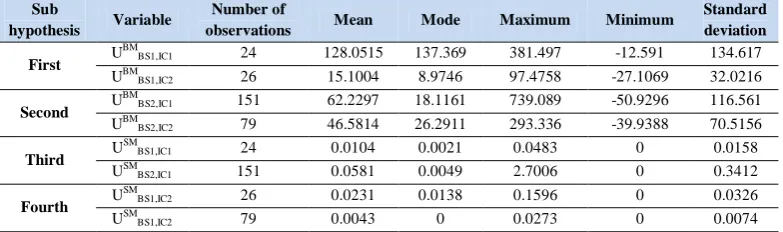
Descriptive statistics of research variables include senior and budget managers’ utility each of which may occur in four different modes (Table 1). These modes are different in 280 companies due to various levels of internal control system strategies and budgetary slack. Total number of observations for (IC1, BS1), (IC2,
BS1), (IC1, BS2), and (IC2, BS2) are respectively 24,
26, 151, and 79.
Results of descriptive statistics indicate that for instance when budgetary slack and strong internal control strategies are applied, mean of senior manager’s utility equals 0.0104 (USM
BS1,IC1); and if
weak internal control strategy is utilized (USMBS1,IC2), it
equals 0.0231.Furthermore, it can be alleged that when budgetary slack and strong internal control strategies are applied (UBMBS1,IC1), mean of budget manager’s
utility equals 128.0515; while when weak internal control strategy is used (UBMBS1,IC2), it equals 15.1004.
Table (1)-Descriptive statistics
Standard deviation Minimum Maximum Mode Mean Number of observations Variable Sub hypothesis 134.617 -12.591 381.497 137.369 128.0515 24 UBM BS1,IC1 First 32.0216 -27.1069 97.4758 8.9746 15.1004 26 UBM BS1,IC2 116.561 -50.9296 739.089 18.1161 62.2297 151
UBMBS2,IC1 Second 70.5156 -39.9388 293.336 26.2911 46.5814 79
UBMBS2,IC2
0.0158 0 0.0483 0.0021 0.0104 24 USM BS1,IC1 Third 0.3412 0 2.7006 0.0049 0.0581 151
USMBS2,IC1
0.0326 0 0.1596 0.0138 0.0231 26
USMBS1,IC2 Fourth 0.0074 0 0.0273 0 0.0043 79
USMBS1,IC2
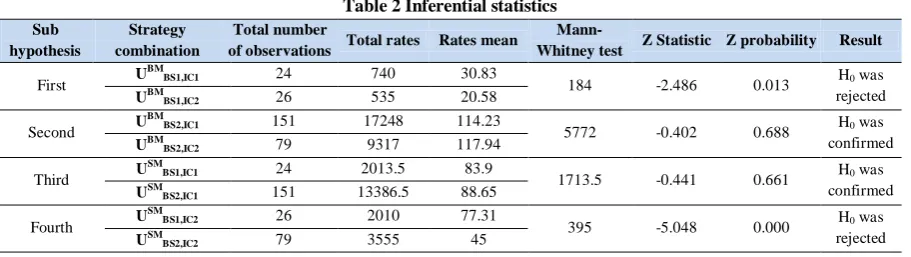
Having described research variables, sub hypotheses were examined to provide the conditions of testing the main hypothesis. Then, the main hypothesis could be confirmed or rejected. Sub hypotheses were
Mann-Whitney test associated with each sub hypothesis are presented in Table 2.
First hypothesis testing: In this hypothesis, H0
shows the status in which mean of two strategies applied by budget manager equals while senior manager chooses budgetary slack. Regarding the probability of Z in Table 2 (0.013) which is less than 0.05, it can be said that H0 is rejected, since as a result
of senior manager’s tend towards budgetary slack, budget manager’s interests will be different choosing strong internal control strategy (IC1) or weak internal control strategy (IC2). The strong internal control strategy, in proportion to the weak internal control strategy, brings about more return for the budget manager. Thus, in order to make a quantitative comparison between the strategies based on best response theory, the values of earning interests from IC1 and IC2 strategies are respectively 2 and 1 for the budget manager.
UBMBS1,IC1=2 BM
BS1,IC2=1 (3)
Second hypothesis testing: In this hypothesis, H0
shows the status in which mean of two strategies applied by budget manager equals while senior manager does not choose budgetary slack. Regarding the probability of Z in Table 2 (0.688) which is more than 0.05, it can be said that H0 is confirmed, and the
budget manager’s interests will be the same choosing strong internal control strategy (IC1) or weak internal control strategy (IC2). Thus, if senior manager does not tend towards budgetary slack, the values of earning interests from IC1 and IC2 strategies are the same (1) for the budget manager.
UBMBS2,IC1=1 UBMBS2,IC2=1 (4)
Third hypothesis testing: In this hypothesis, H0
shows the status in which mean of two strategies applied by senior manager equals while budget manager chooses strong internal control strategy. Regarding the probability of Z in Table 2 (0.661) which is more than 0.05, it can be said that H0 is
confirmed, and the senior manager’s interests will be the same choosing creation and non-creation of the budgetary slack. Thus, if budget manager chooses strong internal control strategy, the values of earning interests from IC1 and IC2 strategies are the same (1) for the senior manager.
USMBS1,IC1=1 U
SM
BS2,IC1=1 (5)
Fourth hypothesis testing : In this hypothesis, H0
shows the status in which mean of two strategies applied by senior manager equals while budget manager chooses weak internal control strategy. Regarding the probability of Z in Table 2 (0.000) which is less than 0.05, it can be said that H0 is
rejected, and senior manager’s interests will be different choosing creation or non-creation of budgetary slack when budget manager has selected weak internal control strategy. Thus, regarding mean of achieved findings, if budget manager chooses weak internal control strategy, senior manager gains more return through the application of budgetary slack, rather its non-application. Therefore, the values of earning interests from BS1 and BS2 strategies are respectively 2 and 1 for the senior manager.
USMBS1,IC2=2 USMBS2,IC2=1 (6)
Table 2 Inferential statistics Sub
hypothesis
Strategy combination
Total number
of observations Total rates Rates mean
Mann-Whitney test Z Statistic Z probability Result
First U
BM
BS1,IC1 24 740 30.83
184 -2.486 0.013 H0 was
rejected UBMBS1,IC2 26 535 20.58
Second U
BM
BS2,IC1 151 17248 114.23
5772 -0.402 0.688 H0 was
confirmed UBM
BS2,IC2 79 9317 117.94
Third U
SM
BS1,IC1 24 2013.5 83.9
1713.5 -0.441 0.661 H0 was
confirmed USMBS2,IC1 151 13386.5 88.65
Fourth U
SM
BS1,IC2 26 2010 77.31
395 -5.048 0.000 H0 was
Having assessed the results of sub hypotheses testing, the main hypothesis was analyzed to examine the combination of budgetary slack (BS1) and strong internal control strategy (IC1) in senior-budget managers’ game, and investigate the dominant Nash equilibrium. Before examining each player’s best response, the mathematical functions (7) and the final matrix (Figure 3) are presented.
(7)
N = {SM,BM}
SSM = {BS1, BS2}
SBM = {IC1, IC2}
S = SSM × SBM = {(BS1, IC1), (BS1, IC2), (BS2, IC1), (BS2, IC2)}
USM (BS1, IC1) = U SM
BS1, IC1 = 1 UBM (BS1,
IC1) = U BM
BS1, IC1 = 2
USM (BS1, IC2) = USMBS1, IC2 = 2 UBM (BS1,
IC2) = UBMBS1, IC1 = 1
USM (BS2, IC1) = USMBS2, IC1 = 1 UBM (BS2,
IC1) = UBMBS2, IC1 = 1
USM (BS2, IC2) = U SM
BS2, IC2 = 1 UBM (BS2,
IC2) = U BM
BS2, IC2 = 1
According to Osborne (2004), in order to find Nash equilibrium through best response function, and test the main hypothesis through sub ones, the following stages are needed.
First stage
Budget manager’s best response
According to the first and second sub hypotheses, if BS1 is applied by the senior manager, IC1 will be more appropriate for the budget manager; while if BS2 is utilized by the senior manager, IC1 and IC2 are better strategies for the budget manager.
( ) { } ( )
( ) { } ( )
Thus for the budget manager, IC1 is more appropriate than the utility strategy IC2; and the dominant strategy is weak.
( ) ( ) ( )
Senior manager’s best response
According to the third and fourth sub hypotheses, if IC1 is applied by the budget manager, BS1 and BS2 will be more appropriate for the senior manager; while if IC2 is utilized by the budget manager, BS1 is better for the senior manager.
( ) { } ( )
( ) { } ( )
Thus for the senior manager, BS1 is more appropriate than BS2, and the dominant strategy is weak.
Second stage
Strategies combination (Nash equilibrium)
Research methodology affirms that each strategy which can be true in function 2 can be regarded as the Nash equilibrium. Thus, regarding the final matrix, all strategies combinations can be examined:
1. BS1,IC1
This combination includes two strategies of the creation of budgetary slack (BS1) and strong internal control system (IC1) in the senior manager’s best response; while it includes two strategies of strong internal control system (IC1) and the creation of budgetary slack ((BS1) in the budget manager’s best response resulting from Function (2).
( ) ( )
( ) ( )
In this combination, none of the senior and budget managers tend towards violation, since if in this condition the budget manager chooses IC2 instead of IC1, the utility will be lost (dominant strategy). On the other hand, if IC1 is chosen by budget manager, the senior manager’s utilities will be the same for both BS1 and BS2 strategies, and there will be no violation motivation (weak dominant strategy). Thus it can be alleged that this combination of strategies indicates weak dominant Nash equilibrium.
2. BS1,IC2
This combination includes two strategies of the creation of budgetary slack (BS1) and weak internal control system (IC2) in the senior manager’s best response; while two strategies weak internal control system (IC2) and the creation of budgetary slack ((BS1) do not exist in the budget manager’s best response. Thus Function (2) is not confirmed.
( ) ( )
( ) ( )
In this combination, if the senior manager chooses BS1, the budget manager can get more utilities through selecting IC1 rather than IC2 and thus, the budget manager may be motivated to violate this strategy which is called the dominant strategy. On the other hand, if IC2 is chosen by the budget manager, BS2 will be more appropriate than BS1 for the senior manager. As a result, the senior manager is not
motivated to violate this strategy (the dominant strategy). Thus it can be alleged that this combination of strategies cannot be considered asthe Nash equilibrium.
3. BS2,IC1
This combination includes two strategies of the non-creation of budgetary slack (BS2) and strong internal control system (IC1) in the senior manager’s best response; while it includes two strategies of strong internal control system (IC1) and the non-creation of budgetary slack ((BS2) in the budget manager’s best response resulting from Function (2).
( ) ( )
( ) ( )
In this combination, none of the senior and budget managers tend towards violation, since if the senior manager chooses BS2, the budget manager receives the same utility for both IC1 and IC2 strategies. Moreover, if IC1 is applied by the budget manager, the senior manager gets the same utility from BS1 and BS2 strategies. Thus it can be alleged that this combination of strategies indicates weak dominant Nash equilibrium.
4. BS2,IC2
In this combination, two strategies of non-creation of budgetary slack (BS2) and weak internal control system (IC2) do not exist in the senior manager’s best response; while both exist in the budget manager’s best response. As a result, Function (2) is not approved.
( ) ( )
( ) ( )
Main hypothesis explanation : According to the main hypothesis in this study, the combination of BS1 and IC1 strategies (creation of budgetary slack and strong internal control system) demonstrates the dominant Nash equilibrium. Considering the results of sub hypotheses testing, it can be stated that (BS1,IC1) origins in two dominant strategies. The senior manager hopes that the budget manager selects IC2, thus s/he chooses BS1; and BS1 becomes the dominant strategy in proportion to BS2. Furthermore, the budget manger hopes that the senior manager chooses BS1, thus s/he chooses IC1 and thus, IC1 becomes the dominant strategy in proportion to IC2. But if the budget manager chooses IC1, the senior manager gains the same utility by choosing both strategies. This combination demonstrates a weak dominant strategy for Nash equilibrium; therefore, the main hypothesis is confirmed.
5. Discussion and conclusion
Senior managers’ participation in budgeting provides them an opportunity to affect their performance through the achieved asymmetrical information. The present study has hypothesized that senior and budget managers can get the equilibrium through the creation of budgetary slack and strong internal control system strategies, since the senior manager applies the strategy of budgetary slack to obtain more interests and attempts to present a distorted image of the company capacities. On the other hand, the budget manager chooses the strong internal control system strategy to deal with the budgetary slack imposed by the senior manager.
Research hypotheses have been examined in all strategies combinations and it has been found that through combining the senior manager’s budgetary slack and the budget manager’s strong internal control system, both players can achieve interests. This combination is regarded as the weak dominant Nash equilibrium. When the senior manager applies the non-creation of budgetary slack, the budget manager is indifferent to changing strategies. But when the senior manager chooses the creation of budgetary slack, the budget manger is more satisfied with employing strong internal control system strategy. Furthermore, when the budget manger chooses the strong internal control system theory, the senior manager is indifferent to changing strategies. But when the budget manager selects weak internal control system strategy, the
senior manager is more satisfied with the creation of budgetary slack.
When combining budgetary slack and weak internal control strategies, Nash equilibrium does not exist, since the budget manager obtains more interests through changing the strategy and selecting strong internal control system strategy. Nash equilibrium neither existed in the combination of the non-creation of budgetary slack and weak internal control system strategies, since the senior manager can get more interests through changing strategy and selecting the strategy of the creation of budgetary slack.
As it has been supposed, senior managers in listed companies on Tehran Stock Exchange have applied budgetary slack through pessimistic and conservative estimations, manipulation of information associated with revenues and costs. In this regard, budget managers try to prevent from budgetary slack by the utilization of strong internal control system strategies.
According to Kiasari and Abdi (2015) and Wan (2014), Conflict and cooperation both are indications of a cooperative game. Moreover, the results of this study demonstrate the effectiveness of managers’ participation in budgeting in their performance evaluation. This finding is consistent with Tavakoli and Etemadi’s (2007) findings. Regarding the fact that games theory has been applied in the present study, it cannot be easily compared to other studies analyzing conflicts between senior and budget managers. Results of the game analysis indicate that budget manager and all members of the budget committee are recommended for minimizing the conflict of interests between senior managers and the company.
Finally, it is suggested that other scholars enhance the number of players and strategies in different strategical environments and analyze the existing conflicts between different groups such as company-auditor and/or company/tax inspector in the future studies.
References
1) Abdoli, Gh. (2012). Games theory and its applications (cooperative, evolutionary and incomplete information games), SAMT Publication, 978-964-530-840-5.
Iranian Accounting and Auditing Review, volume 22, issue 2, 221-242.
3) Baiman, S. (1982). Agency research in managerial accounting: A survey. Journal of Accounting Literature, 154–213.
4) Baiman, S., & Evans, J. H., III. (1983). Pre-decision information and participative management control systems. Journal of Accounting Research, 371–395.
5) Baerdemaeker, Jolien De; Brugge man, Werner (2015), “The impact of participation in strategic planning on managers’ creation of budgetary slack: The mediating role of autonomous motivation and affective organizational commitment”, Management Accounting Research, 29, 1–12.
6) Cammann, C. (1976). Effects of the use of control systems. Accounting, Organizations and Society, 1, 301–313.
7) Cheng-Li Huang, Mien-Ling Chen (2009), Relationships among budgetary leadership behavior, managerial budgeting games, and budgetary attitudes: Evidence from Taiwanese corporations”. Journal of International Accounting, Auditing and Taxation 18. 73–84 8) Collins, F, Almer, E & Mendoza, R (1999),
Budget Games and Effort: Differences Between the United States and Latin America, Journal of International Accounting, Auditing & Taxation, 8(2):241–267.
9) Dunk, A. (1993). The effect of budget emphasis and information asymmetry on the relation between budgetary participation and slack. The Accounting Review, 400–410.
10) Hajiha, Z. &Hosseinnezhad, S. (2015). Effective elements in weaknesses with an emphasis on budgeting internal control, The Financial Accounting and Auditing Researches, 7th year, issue 26, 119-137.
11) Horngren, C. T., Datar, SM., & Foster, G. (2003).Cost accounting: A managerial emphasis (11th ed.). Prentice Hall.
12) IslamiBidgoli, Gh.R. &EhteshamRasi, R. (2011). The application of games theory when evaluating invests in stock, JFKSA, issue 11, 95-123. 13) Jiao, J. (2010). Conflict of Interest Game and the
Legal Solutions. Forward 14) Position, (15): 61–64.
15) Karami, Gh.R. &Mehrani, S. &Seyedhosseini, S.M. &Jahromi, M. (2015). Accounting Theory, 978-964-157-287-9
16) Kren, L. (1993). Control system effect on budget slack. Advances in Management Accounting, 2, 109–118.
17) Laing, G. (2009). Budgeting Games: An Analysis of Budgetary Participation in Statutory Authorities, Journal of Economic and Social Policy, 12 (2).
18) Liu, Z. Y. (2006). The Government and the Enterprise: Interest Game and Moral Game. Political Studies, 5: 121–128.
19) Lukka, K. (1988). Budgetary biasing in organizations: Theoretical framework and empirical evidence. Accounting, Organization and Society, 13, 281–301.
20) Magee, R. P. (1980). Journal of Accounting Research, Equilibria in budget participation. 551– 573.
21) Merchant, K. (1985). Budgeting and the propensity to create budgetary slack. Accounting, Organizations and Society, 10, 201–210.
22) Nouri, H., & Parker, R. J. (1998). The relationship between participation and job performance: The roles of budget adequacy and organizational commitment. Accounting, Organizations and Society, 25(5–6), 74–91.
23) Onsi, M. (1973). Factor analysis of behavioral variables affecting budgetary slack. The Accounting Review, 535–548.
24) Osborne, M. J. (2004). An Introduction to Game Theory. New York: Oxford University Press. 25) Rahnama Roodposhti, F. (2010). Accounting and
Finance Schools and Theories, Including Theories, Hypotheses, Models, Techniques, Tools. Tehran: Islamic Azad University. (in Persian)
26) Saghafi, A. &Saraf, F. (2010).The role of vertical exchange of information during the process of budgeting (operative budgeting). Accounting Knowledge and Research, issue 23.
28) Wan, X. (2014). Cooperation and Game between Producers and Managers Based On the Linear Contract. Journal of Applied Mathematics, 2014 (2014): 1-7.
29) Wang, H. P. (2010). Game analysis of stakeholders in financial conflicts of interest. Modern Business Trade Industry, (8): 159-160. 30) Waller, W. S. (1988). Slack in participating
budgeting: The joint effect of a truth-inducing pay scheme and risk preferences. Accounting, Organizations and Society, 13, 87–98.
31) Waller, W. S., & Bishop, R. A. (1990). An experimental study of incentive pay schemes, communication and intrafirm resource allocation. The Accounting Review, 65(4), 812–836. 32) Widanaputra, N.P.S.H. Mimba, (2014), “the
influence of participative budgeting on budgetary slack in composing local governments’ budget in Bali province”, Procedia - Social and Behavioral Sciences 164, 391 – 396.