A
pplied
R
esearch on
E
nglish Language
V. 7 N. 1 2018 pp: 319-344 http://uijs.ui.ac.ir/are
DOI: http://dx.doi.org/0.22108/are.2018.112373.1340
___________________________________________
*Corresponding Author. Authors’ Email Address:
1
E. Tavakoli ([email protected]),2 M. R. Amirian ([email protected]),3 T. Burner ([email protected])
Operationalization of Formative Assessment in Writing: An Intuitive
Approach to the Development of an Instrument
Elaheh Tavakoli
1, Mohammad Reza Amirian
2*, Tony Burner
3Mohammad Davoudi
4, Saeid Ghaniabadi
51
PhD Candidate, Hakim Sabzevari University, Sabzevar, Iran
2
Assistant Professor, Hakim Sabzevari University,Sabzevar, Iran
3
Professor, University of South-Eastern Norway
4
Assistant Professor, Hakim Sabzevari University, Sabzevar, Iran
5
Assistant Professor, Hakim Sabzevari University, Sabzevar, Iran
Received: 2018/08/04 Accepted: 2018/10/07
Abstract: The current study aimed to develop a Formative Assessment of Writing (FAoW)
instrument through operationalizing Black and Wiliam‟s (2009) Formative Assessment (FA) and Hattie and Timperley‟s (2007) feedback model. Following intuitive approach of scale
construction (Hase & Goldberg, 1967), a comprehensive review of the literature was
undertaken, and 30 Likert scale items were devised. The items tapped students‟ experiences of
FA practices in writing classrooms and their attitudes towards the helpfulness of each practice.
In a focused group interview, the items were intuitively classified by three experts of writing
and assessment based on the five components of FA (clarifying criteria, evidence on students‟
learning, feedback to move learners forward, peer assessment and autonomy) and in three
stages (“Where the learner is going/Pre-writing, “Where the learner is right now/Writing and “How to get there/ Post-writing”). The expert interviews resulted in revisions and 20 additional
items. They also agreed that items in FAoW instrument corresponded with the theoretical
frameworks of FA as well as the three stages of feedback.
320 Applied Research on English Language, V. 7 N. 1 2018
ARE
L
Introduction
Historically, students‟ writing performance has been tested summatively, usually in the form
of a grade, which suggests how much they achieve retrospectively (Lee, 2007). FA, however,
has a prospective trend and sends subtle messages to the learner and the teacher on what
needs to improve and how. Research on second language (L2) writing over the past two
decades has not seen enactment of a wide range of Formative Assessment (FA) practices by
teachers, especially in the English as a Foreign Language (EFL) context (Burner, 2015).
Much of the research in writing has focused on summative assessment, peer assessment or
the effectiveness of teachers‟ feedback (Lee, 2003, 2011a). Far too little attention has been
paid so far to operationalize the theoretical FA frameworks and writing models by
accumulating a comprehensive list of formative feedback practices in writing. Carless (2007)
similarly referred to this gap and the existing challenges in implementing the theoretical
insights of FA from the literature.
In higher education, Yorke (2003) agrees that FA is weakly understood and
insufficiently theorized. Similarly Bennett (2011, p. 5) admits that, “the term, „formative
assessment‟, does not yet represent a well-defined set of artefacts or practices.” In his
viewpoint, a meaningful definition of FA requires a theory of action and concrete
instantiations. His example of Keeping Learning on Track (KLT) Program (ETS, 2010) offers
such a definition as it revolves around „one big idea and five key strategies‟ (Bennett, 2011,
p. 9). More specifically, it is based on Black and Wiliam (1998b, 2009) and the idea that in
FA students and teachers should use learning evidence to adapt teaching and learning to meet
learning needs (ETS, 2010). Bennett (2011) calls for more work like that to push the field of
FA forward.
The current study, therefore, aimed to develop FAoW instrument for higher education
based on FAoW theoretical framework which was developed by integrating Black and
Wiliam‟s (2009) FA theoretical framework with Hattie and Timperley‟s (2007) model of
feedback. In doing so, the researchers decided to address EFL learners as their role in FA has
been undermined in comparison with the teachers‟.
Despite the quintessential role of the learners, FA has been mainly studied from the
perspective of teachers since teachers are usually identified to be a more reliable source of
Operationalization of Formative Assessment in Writing: An Intuitive Approach to the Development of an Instrument 321
information for learning which is not documented sufficiently in the literature (Yorke, 2003).
There are some studies on students‟ experience and perception of FA through questionnaires
which rely on key principles of FA, such as establishing learning targets, sharing assessment
criteria, questioning, feedback, self-assessment and peer assessment (e.g. Black and Wiliam,
1999; Brookhart, 2001; Clarke, Timperley, & Hattie, 2003). However, students‟ experiences
of FA practices which are implemented by their teachers in writing classrooms have been
investigated to a little extent. The results of the present study, hence, contribute to the
understanding of teachers‟ FAoW by developing an instrument to measure FA practices
before, while, and after writing tasks. The instrument will also measure the students‟ attitudes
towards helpfulness of these practices.
Given the insufficient research on the construct of FAoW particularly in the EFL
contexts, it was initially essential to theoretically define the construct and operationalize it by
developing an instrument. This was the aim of this study and it has been conducted
concurrently with another factor structuring validation study (Tavakoli, Amirian & Burner,
under review).
Writing and Formative Assessment Instruments
Some educational scholars have targeted the role of FA in promoting students‟ writing
performance through interviews and/or surveys (e.g. Burner, 2015; Keen, 2005; Lee, 2011b;
Lee & Coniam, 2013; Mak & Lee, 2014; Naghdipour, 2016; 2017). Many of these studies,
however, are case studies with a narrow focus on students‟ attitudes towards some FA
practices in a writing course. They introduce a set of FA practices to investigate the impact of
FA on students‟ learning (Burner, 2015; Lee, 2011b) or teachers‟ perception of FA (Keen,
2005).
Keen (2005), for instance, suggested a sequence for teaching writing based on students‟
engagement, reflection approach and FA. His article was mainly a discussion of his work
with a group of 26 postgraduate trainee English teachers at the University of Manchester who
were asked to provide their analysis of students‟ writing assessment through the following
suggested sequences of FA framework:
1. Enable students to respond to a particular writing challenge with appropriate
supports such as task specifications; peer discussion; sharing assessment criteria with
students; providing opportunities for students to apply them to their own or their peers‟
322 Applied Research on English Language, V. 7 N. 1 2018
ARE
L
2. Identify strengths and achievements in students‟ writing (text, word or phrase level);
3. Enable students to share strengths and achievements by reading out sections of their
writing to the whole class or small groups;
4. Enable students to identify strengths as well as shortcomings in their own writing
and in that of others, discussion about how to develop strengths and how to overcome
weaknesses;
5. Enable students to apply their learning through redrafting; or using teacher/ student
modeling for example;
6. Provide new writing challenges with carefully phrased assessment criteria;
7. Enable students‟ increasing independence as writers, for example through continuing
peer assessment and self-assessment.
The teachers deployed the findings from assessment at the preparation stage as well as
devising the follow-up lesson. They benefitted from peer or student self-assessment to enable
students address the strengths, achievements and shortcomings of their own and their peers‟
writing. Although this list of FA practices was a thorough collection of FA practices
providing an overall framework of teaching writing, Keen (2005) did not unify them under a
theoretical framework similar to Black and Wiliam‟s (2009).
In another study, which was limited to error feedback in a writing program, Lee (2003)
designed a questionnaire and piloted it with a small group of secondary English teachers. The
questionnaire mainly asked about (1) teachers‟ existing error feedback practice, (2) their
perspectives on error feedback and (3) their perceived problems. It consisted of two
open-ended and thirteen closed-open-ended items only on error feedback practices such as selective error
feedback, coded marking, and underlining for direct error correction or indirect hints.
Although her questionnaire also included activities after marking students‟ writing such as
conferencing, reviewing common errors in class and error log, it did not tap at a unified
framework of how feedback could be utilized formatively to promote students‟ autonomy in
writing.
Four years later, Lee (2007) provided a framework for teaching writing formatively
through illustrating the following writing instructional unit based on FA principles:
-Planning writing (identifying goals and designing pedagogical materials to realize
them)
-Teaching writing according to the goals and applying assessment criteria in self- and
Operationalization of Formative Assessment in Writing: An Intuitive Approach to the Development of an Instrument 323
-Multiple drafting of writing with every draft followed by students‟ self- and peer
assessment, and students‟ assessment in the subsequent drafts is followed by teacher
assessment all based on assessment criteria. Teacher provides written and oral feedback
to the whole class or individual students at conferences. Teacher identifies students‟
strengths and weaknesses and suggests ways to improve. Students revise drafts by
acting upon teacher feedback.
-Final draft is assessed by teacher and students reflect upon teacher‟s feedback and set
goals for further development
-Plan the next writing again on the basis of information gathered from the assessment
and areas where students need help.
Lee‟s previous studies (2003, 2007) did not devise an instrument to measure FA in EFL
writing classroom; however, she used an innovative questionnaire in her case study (2011b)
which was subsequently used by many other researchers in the field of writing assessment
(e.g. Naghdipour, 2017). To identify the attitudes of the teacher‟s students towards FA before
and after the writing course based on FA, Lee (2011b) developed a questionnaire which
consisted of 25 items with five-point scales. The teacher‟s FA practices encompassed
multiple drafting, longer prewriting, feedback forms based on pre-established assessment
criteria, self/peer evaluation and withholding scores/grades. Although Lee (2011b) described
these FA practices in details and embedded many of FA practices in her questionnaire, she
did not expand on its construction nor its validity or reliability indices, probably due to the
limited number of students (n=14).
Most recently, Burner (2015) developed another questionnaire to investigate how four
female teachers and their 100 students in Norway responded to FA in EFL writing classes.
Although he maintained that there was no one definition of FAoW in the literature, to come
to an overall picture of EFL students‟ perceptions of this construct in in his questionnaire, he
formulated items within the holistic approach of FAoW based on FA (useful feedback,
negative effects of grades, self-assessment, student involvement) and writing assessment in
EFL (text revision/multiple drafting, writing practice). In contrast to the typical “I can do”
statements which focused on individual cognitive domains, he used relational/interactional
phrases. A Cronbach‟s value of 0.71 indicated a relatively high internal consistency and
reliability which was a proof of the scale items measuring the construct of FAoW.
James and Pedder‟s (2006) factor analysis was conducted on section A of Secondary
324 Applied Research on English Language, V. 7 N. 1 2018
ARE
L
McCormick, James and Pedder (2006). The section measured teachers‟ classroom assessment
practices through 30 double scaled Likert items with three underlying dimensions, namely
making learning explicit, promoting learning autonomy and performance orientation. It was
later employed and validated by the Assessment for Learning in International Contexts
(ALIC) project in the International context (Warwick, Shaw, & Johnson, 2015). The full
questionnaire had initially been developed from the operationalized conceptual and empirical
insights in the literature on classroom assessment practices and values, teachers‟ professional
learning and school management. The items in the first section were constructed with a
particular interest in the relationship between assessment and learning and from the teachers‟
perceptions and views on assessment practices. The items required the teachers to tell, with
reference to their own practices, whether particular practices were never true, rarely true,
often true or mostly true. They were also asked to respond to the value scale, indicating how
important they felt any given practice was in creating opportunities for students to learn. The
elements of classroom assessment were identified with a focus on purposes, goals and
functions as any classroom activity intended or actually used to meet learning needs (Black,
Harrison, Lee, Marshall, & Wiliam, 2003). The basis for item construction had been
specifically the four major categories of questioning, feedback, sharing criteria and
self-assessment, which had been identified in the review of research by Black and Wiliam (1998a,
1998b). As section A of Secondary School Staff questionnaire had been designed in line with
10 principles of assessment for learning (ARG, 2002) and Torrance and Pryor‟s (1998, p. 153) typology of „convergent‟ and „divergent‟ assessment, it was utilized in the construction
of FAoW in this research.
It seems that the existing accounts have failed to develop a comprehensive instrument
for FAoW which is inclusive of FA practices in all the stages of writing, pre, while, and post
writing. This gap in the FAoW instrument is felt more noticeably when the literature in Iran
is reviewed.
Most of the scales in the abovementioned studies measure teachers‟ classroom
assessment, FA or assessment of writing in general. A number of researchers in the Iranian
EFL context (e.g., Elahinia, 2004; Ghoorchaei, Tavakoli, & Nejad Ansari, 2010;
Javaherbakhsh, 2010; Moradan & Hedayati, 2011; Mosmery & Barzegar, 2015; Nezakatgoo,
2005; Sharifi & Hassaskhah, 2011) investigated assessment of writing, but not FAoW. Most
of these studies employed the available assessment questionnaires in the literature without
Operationalization of Formative Assessment in Writing: An Intuitive Approach to the Development of an Instrument 325
construct, the consensus was on the beneficial effect that alternative forms of assessment had
on improving students‟ writing ability. When the implementation of various forms of FA is
explored for writing classrooms, however, the most frequent methods among teachers of
adult and young adult learners are found to be limited to writing essays and dictation. Other
forms of FA, such as portfolios, journals, and self/peer-assessment, are reported by Iranian
teachers to be never or rarely used (Ketabi, 2015).
Naghdipour (2017) is one of the few scholars who incorporated FA in a university EFL
writing course in Iran and through a pre- and post- study questionnaire mainly developed
after Lee (2011b), investigated the changes in students‟ attitudes and beliefs toward writing
and formative assessment. The questionnaire had 20 Likert scale statements and was
translated into Persian. It was administered together with the English version to ensure
understanding; its reliability analysis showed a relatively high degree of internal consistency
(Cronbach‟s alpha of 0.82). Students completed and returned the surveys in the classroom Comparison of the participants‟ scores prior to and after the FA intervention revealed an improvement in various aspects of Iranian undergraduate students‟ writing and development
of their positive attitudes towards writing as well as FA.
Reviewing the above-mentioned studies revealed that most of the researchers opt for
case studies and incorporated some of the FA strategies into a writing course. The literature
on classroom FA lacks reliable instruments which can target the common FA practices of
writing performances in an EFL context like Iran. It seems that the available instruments and
questionnaires have not been informed by strong theoretical frameworks of FA, writing and
feedback. Given the crucial need for developing a FAoW instrument and operationalizing its
constructs, the researchers in this study aimed to design a FAoW instrument through intuitive
approach (Hase & Goldberg, 1967) which will be elaborated in the following.
Intuitive Approach
For the development of FAoW instrument (see Appendix I), from the four available common
approaches, i.e. (a) Internal (e.g., factor analytic), (b) External (e.g., group discriminative),
(c) Intuitive rational and (d) intuitive theoretical introduced by Hase and Goldberg (1967), we
utilized both the intuitive rational and the intuitive theoretical approaches. In the intuitive
rational approach, the researcher has some dimensions of the construct in mind, and based on
intuitive understanding of these dimensions, he attempts to select items which he believes
will relate to the dimensions. In the intuitive theoretical approach, on the other hand, item
326 Applied Research on English Language, V. 7 N. 1 2018
ARE
L
In the current study, Black and Wiliam‟s (2009) theory of FA along with Hattie and Timperley‟s (2007) model of feedback were initially utilized by researchers to define and
operationalize the new theoretical construct of FAoW with five underlying FA components
and three stages of writing feedback. After the theoretical approach, writing domain experts
were asked to judge the correspondence between the five FAoW components and the
operationalized FAoW practices which had been drawn from the literature. This was
conducted based on the experts‟ intuitive judgments. In the following sections, the five components of Black and Wiliam‟s (2009) FA model, the three stages of writing feedback (Hattie & Timperley, 2007) and the experts‟ correspondence of FAoW items with these two
theoretical frameworks will be elaborated in details.
Components of Formative Assessment of Writing
The construction of FAoW instrument was guided by item selection in the literature and
then by Black and Wiliam‟s (2009) theory of FA since their model outlined the cyclic
nature of FA and targeted both teachers and learners (particularly by including
peer-assessment). It was introduced to compensate for the shortcomings in earlier models
(Shirley, 2009). Earlier models, according to Shirley (2009), did not outline a cycle of
formative assessment but rather described certain elements of effective formative
assessment. Although earlier models of FA (e.g. Black & Wiliam, 1998a, 1998b, 2006)
emphasized that formative assessment would not be formative without leading to changes
in instruction and without enhancing learning, they did not address this need (Black &
Wiliam, 2009). Black and Wiliam (2009, p. 5) wrote that their earlier works,
did not start from any pre-defined theoretical base but instead drew together a
wide range of research findings relevant to the notion of formative assessment.
Work with teachers to explore the practical applications of lessons distilled
therefrom (Black et al. 2002, 2003) led to a set of advisory practices that were
presented on a pragmatic basis, with a nascent but only vaguely outlined
underlying unity.
Hence Black and Wiliam‟s unified theoretical framework (2009) defined FA within broader
theories of pedagogy by relating FA to cognitive acceleration and dynamic assessment, and
to some models of self-regulated learning and classroom discourse. They drew together five
FA activities introduced in earlier works (Black et al., 2003; Wiliam, 2007), namely sharing
self-Operationalization of Formative Assessment in Writing: An Intuitive Approach to the Development of an Instrument 327
assessment and finally, formative use of summative tests. These five activities revolve around
three key questions in FA: where are the learners going, where are they now and how can the
gap between the first two questions be filled? (Wiliam & Thompson, 2007). Table1 illustrates
how the above-mentioned researchers crossed the three processes with the three agents:
teacher, peer and learner.
Table 1. Aspects of Formative Assessment (Black & Wiliam, 2009, from Wiliam & Thompson,
2007)
Where the learner is going. Where the learner is right now. How to get there.
Teacher
1. Clarifying learning intensions and criteria for
success
2. Engineering effective classroom discussions and other
learning tasks that elicit evidence of students‟
understanding
3. Providing feedback that moves learners
forward
Peer
Understanding and sharing learning intensions and
criteria for success
4. Activating students as instructional resources for one another
Learner
Understanding learning intensions and criteria for
success
5. Activating students as the owners of their own learning
Hattie and Timperley‟s (2007) model of feedback was also used in the development of FAoW construct since their description of effective feedback through the notions of „feed up,
feedback and feed forward‟ taps the main function of FA. They certified the main purpose of
feedback as reducing “discrepancies between current understandings and performance and a goal” (p. 86). They introduced several agents to provide feedback and fill this gap
(e.g., teacher, peer, book, parent, self, experience).
Design of FAoW Instrument
Firstly, by reviewing the literature and identifying the salient dimensions of FA, a theoretical
model (based on Black and Wiliam, 2009) was selected as the foundation of the instrument
development. Secondly, the item pool of teachers‟ formative assessment practices was drawn
from the available instruments in the literature. Since the construct of FAoW has not been
operationalized in any instruments with a unified theoretical framework, the researchers had
to utilize the existing instruments on FA practices, assessment of writing and writing
feedback separately (e.g., Lee, 2003, 2007, 2011b; Keen, 2005; James & Pedder, 2006;
Bremner, 2014; Mak & Lee, 2014). The articles with a questionnaire on classroom
328 Applied Research on English Language, V. 7 N. 1 2018
ARE
L
Wiliam, 1998a & b) and FAoW (Burner, 2015; Lee, 2011b) were identified. The item pool
was provided by the first author through accumulating all the items and removing the
redundant similar practices. The initial list of potential items to measure FAoW consisted of
30 items. In the focused-group interview session, the three experts read the items and decided
if it could be associated with the components of FAoW framework or the feedback model.
In this study, we used the terms experience and item interchangeably as every item in the
instrument was a different FAoW practice which was reported by the participants to have
been experienced in their writing classes always, often, rarely or never.
The next stage of developing the instrument was having a three-hour focused group
interview with three domain experts and requesting them to judge the redundancy, face
validity, content validity and language clarity of each experience. It is recommended by
survey specialists (e.g. Dornyei, 2003) that the questionnaire design phase be preceded by a
small scale qualitative study (e.g., focus group interviews) to provide more reliable
information on the relevant points and issues. The experts, in this study, were selected based
on purposeful sampling; all of them held a PhD in Teaching English as a Foreign Language
(TEFL) and had at least ten years of experience in teaching and assessing writing at
universities and language schools. They had all published scholarly articles in the field of
language assessment and writing. The experts were also asked to give their suggestions of the
construct under each experience based on Black and Wiliam‟s (2009) framework and Hattie
and Timperley‟s (2007) feedback model.
At this stage, the experiences which did not show the consensus of the three experts,
based on the five FA constructs and the three stages of feedback in the aforementioned
theoretical frameworks, were identified and modified. Multi-dimensional experiences were
broken into several experiences which resulted in an instrument with 50 statements, each
with two scales (experience and attitude). The experience scale consisted of four-point Likert
scale experiences (never, rarely, often, and always) and required the students to determine
how often they had experienced each FA practice in their writing classrooms. The attitude
scale required them to show how much they believed each practice could improve their
writing by choosing one of the five Likert points (very helpful, helpful, neither helpful nor
unhelpful, unhelpful and very unhelpful).
In order to tap the design of the instrument based on a writing model in addition to a
FA model, the researchers implemented the feedback component of Hattie and Timperley‟s
Operationalization of Formative Assessment in Writing: An Intuitive Approach to the Development of an Instrument 329
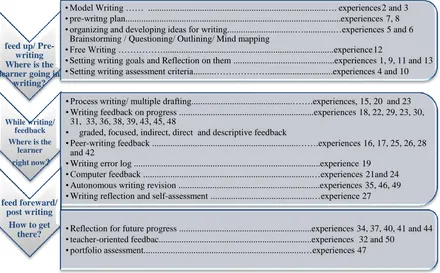
feedback model, i.e. „feed up, feedback and feed forward‟. Figure 1 shows the writing
practices in the following three stages.
Feed up/ Pre-writing Stage
Thirteen experiences tapped writing stage activities such as model-writing,
pre-writing planning, setting pre-writing goals, organizing and developing pre-writing ideas, free
writing, setting writing goals and reflection on them and setting writing assessment
criteria. These writing activities relate to „feed up‟, which is defined as „the goals one
lays down to achieve. Students set attainable goals so that they understand what they
are working towards in the „feed up‟ stage (i.e., where they are going) (Hattie &
Timperley, 2007, p. 86).
Feedback/ While Writing Stage
In line with Mak and Lee (2014) and based on Hattie and Timperley‟s model,
„feedback‟/ while writing stage guided the second set of writing activities which
specified what progress is being made towards the goal. They included writing
practices such as process-writing/ multiple drafting, writing feedback on progress,
peer-writing feedback, peer-writing error log, computer feedback, autonomous peer-writing revision,
writing reflection and self-assessment. Thirty experiences were placed under this
construct and tapped a variety of feedback (e.g. graded, focused, indirect, direct and
descriptive) which can be given from various sources (e.g. peers, teachers and the
learners). This stage of writing corresponded with „where the learner is right now‟ principle of FA and implied the learners‟ prior progress.
Feed Forward/ Post Writing
„Feed forward‟/post writing stage encompassed those writing practices which could
lead students for their future improvement such as reflection for future progress,
teacher oriented feedback and portfolio assessment. As Mak and Lee (2014) confirm,
this stage of writing covers writing practices which give students a direction of what
they are to achieve in the future, and the writing activities provide students with a
330 Applied Research on English Language, V. 7 N. 1 2018
ARE
L
Figure 1. Writing constructs tapped by FAOW instrument in three stages
For developing the item bank, the researchers did their best to collect the possible practices
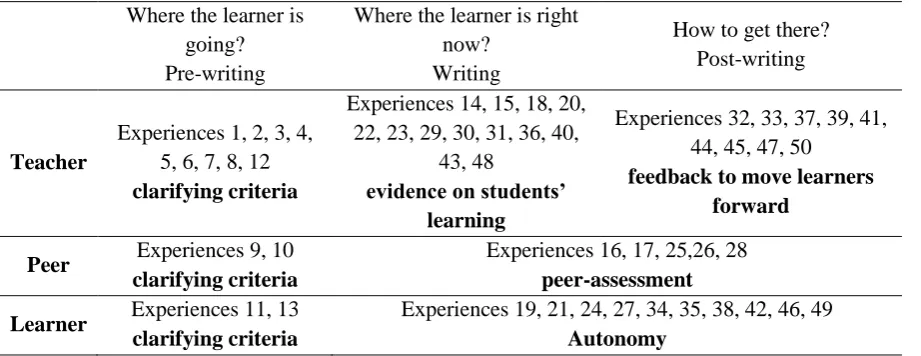
for assessing students‟ writing tasks and classify them based on the aforementioned theoretical models. Black and Wiliam‟s (2009) five salient dimensions of FA (see Table 2)
and feedback model of Hattie and Timperley (2007) (see figure 1) consequently guided the
researchers in extracting the experiences, modifying and finally classifying them into five FA
constructs and three writing stages.
FAoW instrument tapped various writing practices which teachers should consider
when they assess students‟ writing assignments. Weigle (2007, p. 200) asserts that the process of writing “involves reflection, discussion, reading, feedback, and revision, and ones‟
best work is usually not produced in a single draft within 30 or 60 minutes.” In addition to
reflection, questioning, feedback, revision and multiple drafting practices in FAoW
instrument, in-class/ timed writing and out-of-class writing (experiences 7 and 13) were
highlighted by Weigle (2007, p. 201) as “complementary sources of information about
students‟ writing abilities.” She also referred to portfolio assessment (experience 47 in
FAoW instrument) as a helpful writing practice which integrates assessment and instruction
and teachers can utilize to identify students‟ progress.
Overall, the final FAoW instrument had 13 experiences with pre-writing FA practices
such as clarifying goals and assessment criteria, model writing, free-writing, brainstorming
feed up/ Pre-writing Where is the learner going in
writing?
• Model Writing …… ...…. experiences2 and 3 • pre-writng plan...experiences 7, 8
• organizing and developing ideas for writing...…...…experiences 5 and 6 Brainstorming / Questioning/ Outlining/ Mind mapping
• Free Writing ………...experience12
• Setting writing goals and Reflection on them ...experiences 1, 9, 11 and 13 • Setting writing assessment criteria...………...experiences 4 and 10
While writing/ feedback Where is the
learner right now?
• Process writing/ multiple drafting...…….experiences, 15, 20 and 23 • Writing feedback on progress ...experiences 18, 22, 29, 23, 30,
31, 33, 36, 38, 39, 43, 45, 48
• graded, focused, indirect, direct and descriptive feedback
• Peer-writing feedback ...…….experiences 16, 17, 25, 26, 28 and 42
• Writing error log ...experience 19 • Computer feedback ...…experiences 21and 24 • Autonomous writing revision ...experiences 35, 46, 49 • Writing reflection and self-assessment ...…experience 27
feed foreward/ post writing
How to get
there? • Reflection for future progress ...experiences 34, 37, 40, 41 and 44 • teacher-oriented feedbac...experiences 32 and 50
Operationalization of Formative Assessment in Writing: An Intuitive Approach to the Development of an Instrument 331
and planning for writing. The writing stage encompassed 13 experiences of FA practices such
as multiple drafting, various feedback from peers and teacher, self-assessment and use of
other non-human sources like computer software. The experiences aim at teachers assessing
the students‟ current level of writing and more in line with summative function of
assessment. To assess writing more formatively and know what practices could move the
learners forward in their writing and make them autonomous in self and peer assessment, 24
experiences were finalized focusing mainly on identifying and reflecting on strengths and
weaknesses, and planning for progress.
Experts’ Interview
After focus group interviews with the domain experts, half of the initial experience items
(4, 8, 17, 18, 25, 26, 27, 28, 29, 30, 31, 33, 35, 39, 48 in Appendix I) remained intact, but the
other 15 underwent three changes. Firstly, seven experiences were judged to be
multidimensional and in need of breaking down to distinct experiences. For instance, “I
spend much time on pre-writing activities (e.g. asking questions, making notes,
mind-mapping, free-writing, brainstorming, sharing ideas orally in small groups)” was broken
down to six experiences, each one targeting a distinct pre-writing activity (experiences 5, 6,
7, 10, 11 and 12 in Appendix I).
Secondly, eight experiences were fine-tuned in terms of wording and some ambiguous
key words (experiences 1, 2, 3, 9, 16, 22, 30 and 38). Two of the experts, for instance, insisted
that the term qualitative feedback in the original draft, “My teacher gave me comparative
qualitative feedback on my progress in writing.” needed more clarifications which led to the inclusion of two examples “compared to your last writing, this one is better/worse” or “You did
better/worse in this writing because…” (See item 43 in Appendix I).
Finally, the experts concurred that two components (4 and 5 in Table 1) had not been
adequately targeted in the original draft and that it was crucial to include more experiences to
measure recent FAoW practices in line with the computer assisted assessment. They
consequently added 12 more experiences (experiences 13, 19, 21, 24, 32, 34, 42, 45, 46, 47,
49 and 50 in Appendix I) to the original draft based on the literature and particularly their
own personal knowledge and experience. The experiences which were introduced as the
result of interview with experts mainly comprised of assessment by keeping an error log,
frequency chart, computer software, applications and learning autonomy (the fifth component
332 Applied Research on English Language, V. 7 N. 1 2018
ARE
L
experiences which were associated with the five dimensions in the following framework of
FAoW (Table 2).
Table 2. FAoW framework, experience and construct matching by experts
Where the learner is going? Pre-writing
Where the learner is right now?
Writing
How to get there? Post-writing
Teacher
Experiences 1, 2, 3, 4, 5, 6, 7, 8, 12
clarifying criteria
Experiences 14, 15, 18, 20, 22, 23, 29, 30, 31, 36, 40,
43, 48
evidence on students’ learning
Experiences 32, 33, 37, 39, 41, 44, 45, 47, 50
feedback to move learners forward
Peer Experiences 9, 10
clarifying criteria
Experiences 16, 17, 25,26, 28
peer-assessment
Learner Experiences 11, 13 clarifying criteria
Experiences 19, 21, 24, 27, 34, 35, 38, 42, 46, 49
Autonomy
The domain experts also agreed that the three stages (pre, while and post writing)
corresponded with the three key questions of “where are the learners going”, “where are they now” and “how can the gap between the first two questions be filled” (Wiliam & Thompson,
2007), and that they had to be practiced in a cycle for implementing FAoW. In other words,
they agreed that for practicing FAoW, assessment criteria and goals should be clarified in
prewriting, feedback should be given in various stages and on several drafts by teachers and
peers in the writing stage and even post writing. The teachers‟ and learners‟ understanding
should be utilized as the objectives in the next instructions. As such, learners can be more
independent and ultimate goal of FA can be more easily achieved.
Discussion
In the current study, the first priority was to develop an instrument based on Black and
Wiliam‟s (2009) model of FA and Hattie and Timperley‟s (2007) feedback model to
operationalize the construct of FAoW. EFL domain experts came to consensus on the five
dimensions underlying all the items in the instrument, though they extended the instrument
with 30 experiences to 50 due to 12 experiences which were judged to be multidimensional.
Implementation of these practices in a writing program can probably better be clarified by the
comparison of the empirical studies in the literature which were conducted based on three
stages of pre, while and post writing. Naghdipour (2017) is our bases for this comparison for
Operationalization of Formative Assessment in Writing: An Intuitive Approach to the Development of an Instrument 333
As it was pointed out earlier, not much has been done to operationalize the construct of
FAoW in EFL contexts in EFL contexts (Lee & Coniam, 2013). The literature has not
documented what practices construct of FAoW actually entails; however, there are some
studies in the literature that implemented FA in writing classrooms particularly in three stages
of prewriting, writing and post writing (e.g. Lee, 2011b; Lee & Coniam, 2013; Mak & Lee,
2014; Naghdipour, 2017).
The development of FAoW instrument based on feed up, feedback and feed forward
practices is probably consistent with Naghdipour‟s (2017) case study with a three-session
modular instruction. Although Naghdipour (2017) did not aim to develop an instrument to
operationalize the construct of FAoW, he used a FA attitude questionnaire based on Lee‟s (2011a) which revealed undergraduates‟ positive attitude towards the three-session modular instruction of writing based on Black and Wiliam‟s (2009) five FA strategies. His empirical
research is similar to this research in many ways.
His pre-writing stage of instructional tasks based on model essays, brainstorming and
pooling of ideas, (see Naghdipour & Koç, 2015, for an overview) is in accordance with many
of the FAoW practices in feed up stage under the construct of clarifying criteria. In the
writing stage and over the course of the semester, his research participants wrote three typed
drafts for each essay (descriptive, narrative, expository, and argumentative); the second was a
draft in response to the peer-assessment and the third draft was revisions in response to the
teacher assessment. At this stage in his research, some of the FAoW practices under the
second and the third constructs of our FAoW framework such as multiple drafting and
process writing, peer and self-assessment were utilized. FAoW instrument in this research
has more practices in the second stage of FA writing programs which were not employed in
Naghdipour‟s (2017) intervention. They encompassed preparing error log, employment of applications and software and various forms of feedback on students‟ writing progress such
as graded feedback, focused and unfocused feedback, direct and indirect feedback and
descriptive feedback. Whole-class feedback (known as overall feedback/ feedback in plenum
in our FAoW instrument), conferencing and discussion on the most common issues in
students‟ papers were the FA practices that Naghdipour employed in the post writing stage of
his intervention.
The construct of FAoW is not indispensable from Wiliam‟s (2001)
teaching-learning-evaluation cycle and Ruiz-Primo and Furtak‟s (2006) ESRU (Elicit question, Student
334 Applied Research on English Language, V. 7 N. 1 2018
ARE
L
information is collected about students‟ learning and is compared to teachers‟ expectations
and ultimately action is taken to move students towards those goals. What most FA models
have in common is the cyclic nature, where information from feedback is injected back into
the instruction process and the main goal is to fill the gap between students‟ current level and
expected goals. The construction of FAoW instrument based on the aforementioned model in
three stages can probably correspond with task representation when Wolfersberger (2013)
refines the construct of classroom-based writing assessment. He defines task representation
as the “writer‟s conceptualization of the requirements of the assessment task … a mental model of the finished written product” (p. 50). He asserts that it is a process in which writers
need to take the necessary steps to create the final written product that meets the assessment
criteria which had been set prior to writing and assessment feedback based on which they
performed. FAoW is similarly a construct which starts with setting criteria for success in
prewriting stage, incorporating a set of feedback received through different sources during
writing and ultimately achieving the expected goals autonomously by knowing the future
trend for learning in post-writing stage. This is a cyclic process with feedback as its central
component and can repeat for every writing task to lead to autonomy in writing (Hattie &
Timperley, 2007).
Limitations of FAoW Instrument and Pedagogical implications
The FAoW is a broad field and can include any classroom activity as long as it aims to
improve future performance. Multidimentionality of FAoW, which was due to encompassing
both writing skills and FA practices, was an inevitable problem for the researchers who
aimed to develop the instrument for measuring this construct by devising each experience to
tap a single dimension. The researchers benefitted from both feedback model and FA as the
theoretical foundation and sought to connect writing with FA, which made the job
demanding.
FAoW instrument in this study was developed as part of a Ph.D project with the main
aim to investigate teachers‟ implementation of FAoW practices in EFL classrooms and it is
tested for its factor structuring; moreover, the instrument will have the potential to be utilized
by other teachers in writing classrooms as an operationalized model which can contribute to
the utilization of FA. The developed instrument can be used as a guideline for the teachers in
both EFL and international contexts on how to practice FA. The results of this study can
Operationalization of Formative Assessment in Writing: An Intuitive Approach to the Development of an Instrument 335
in a formative way and are mainly concerned with showing learners their current state of
learning rather than the future goals; the developed instrument can subsequently pave the way
for them to implement FA in their writing classrooms utilizing the strategies prior, while and
after the writing stage. FAoW instrument is a collection of FA practices which can be utilized
by writing program developers in addition to teachers and students.
References
Assessment Reform Group. (2002). Assessment for learning: 10 principles. Research based principles
to guide classroom practice. London, UK: Author. Available from
http://languagetesting.info/features/afl/4031afl principles.pdf
Bennett, R. E. (2011). Formative assessment: A critical review. Assessment in Education: Principles,
Policy & Practice, 18(1), 5-25.
Black, P., Harrison, C., Lee, C., Marshall, B., & Wiliam, D. (2003). Assessment for learning: Putting
it into practice. Maidenhead: Open University Press.
Black, P., McCormick, R., James, M., & Pedder, D. (2006). Learning how to learn and assessment for
learning: A theoretical inquiry. Research Papers in Education, 21, 119-132.
Black, P., & Wiliam, D. (1998a). Assessment and classroom learning. Assessment in Education, 5(1),
7-73.
Black, P., & Wiliam, D. (1998b). Inside the black box: Raising standards through classroom
assessment. Phi DeltaKappan, 80, 139-148.
Black, P., & D. Wiliam. (1999). Assessment for learning: Beyond the black box. Cambridge,
University of Cambridge, Assessment Reform Group.
Black, P. & Wiliam, D. (2006). Assessment for learning in the classroom. In J. Gardner (Ed.),
Assessment and learning (pp. 9-25). London: Sage.
Black, P., & Wiliam, D. (2009). Developing the theory of formative assessment. Educational
Assessment, Evaluation and Accountability, 21(1), 5.
Bremner, A. L. (2014). Teachers’ knowledge of formative assessment initial instrument validation
study, (Doctoral dissertation, Boise State University).
Brookhart, S. M. (2001). Successful students' formative and summative uses of assessment
information. Assessment in Education: Principles, Policy & Practice, 8(2), 153-169.
Burner, T. (2015). Formative assessment of writing in English as a foreign language. Scandinavian
Journal of Educational Research, 1-23.
Carless, D. (2007). Conceptualizing pre‐emptive formative assessment, Assessment in Education:
336 Applied Research on English Language, V. 7 N. 1 2018
ARE
L
Clarke, S., Timperley, H., & Hattie, J. (2003). Unlocking Formative Assessment – Practical strategies
for enhancing pupils' learning in the primary & intermediate classroom (NZ ed.). Auckland,
New Zealand: Hodder Moa Beckett.
Elahinia, H. (2004). Assessment of writing through portfolios and achievement tests. Unpublished
Master thesis, Teacher Training University, Iran.
ETS (Educational Testing Service). (2010). About the KLT program. Princeton, NJ: Author.
http://www.ets.org/Media/Campaign/12652/about.html (accessed December 17, 2010).
Ghoorchaei, B. Tavakoli, M. & Nejad Ansari, D. (2010). The impact of portfolio assessment on
Iranian EFL students‟ essay writing: A process-oriented approach. GEMA Online Journal of
Language Studies, 10 (3), 35-51.
Hase, H. D. & Goldberg, L. G. (1967) Comparative validity of different strategies of constructing
personality inventory scales, Psychological Bulletin, 67, 231–248.
Hattie, J., & Timperley, H. (2007). The power of feedback. Review of Educational Research, 77(1),
81-112.
James, M., & Pedder, D. (2006). Beyond method: Assessment and learning practices and values. The
Curriculum Journal, 17(2), 109-138.
Javaherbakhsh, M. R. (2010). The impact of self-assessment on Iranian EFL learners‟ writing skill.
English Language Teaching, 3(2), 213-218.
Keen, J. (2005). Assessment for writing development: Trainee English teachers‟ understanding of
formative assessment. Teacher Development, 9(2), 237-254.
Ketabi, S. (2015). Different methods of assessing writing among EFL teachers in Iran. International
Journal of Research Studies in Language Learning, 5(2), 3-15.
Lee, I. (2003). L2 writing teachers‟ perspectives, practices and problems regarding error feedback.
Assessing Writing, 8(3), 216-237.
Lee, I. (2007). Assessment for learning: integrating assessment, teaching, and learning in the
ESL/EFL writing classroom. The Canadian Modern Language Review, 64(1), 199-213.
Lee, I. (2011a). Bringing innovation to EFL writing through a focus on assessment for learning,
Innovation in Language Learning and Teaching, 5(1), 19-33.
Lee, I. (2011b). Formative Assessment in EFL Writing: An Exploratory Case Study, Changing
English: Studies in Culture and Education, 18(1), 99-111.
Lee, I., & Coniam, D. (2013). Introducing assessment for learning for EFL writing in an assessment
of learning examination-driven system in Hong Kong. Journal of Second Language Writing,
22(1), 34-50.
Mak, P., & Lee, I. (2014). Implementing assessment for learning in L2 writing: An activity theory
Operationalization of Formative Assessment in Writing: An Intuitive Approach to the Development of an Instrument 337
Moradan, A., & Hedayati, N. (2011). The impact of portfolios and conferencing on Iranian EFL
writing skill. Journal of English Language Teaching and Learning, 8, 115-141.
Mosmery, P., & Barzegar, R. (2015). The effects of using peer, self, and teacher-assessment on
Iranian EFL learners‟ writing ability at three levels of task complexity. International Journal of
Research Studies in Language Learning, 4(4), 15-27.
Naghdipour, B., & Koç, S. (2015). The evaluation of a teaching intervention in Iranian EFL writing.
The Asia-Pacific Education Researcher, 24, 389-398.
Naghdipour, B. (2016). English writing instruction in Iran: Implications for second language writing
curriculum and pedagogy. Second Language Writing Journal, 32, 81-87.
Naghdipour, B. (2017). Incorporating formative assessment in Iranian EFL writing: A case study. The
Curriculum Journal, 28 (2), 283-299.
Nezakatgoo, B. (2005). The effects of writing and portfolio on final examination scores and mastering
mechanics of writing of EFL students. Unpublished Master thesis, Allame Tabtba'i University,
Tehran, Iran.
Ruiz-Primo, M.A, & Furtak, E.M. (2006) Informal Formative Assessment and Scientific Inquiry:
Exploring Teachers' Practices and Student Learning. Educational Assessment, 11, 3-4, 237-263.
Sharifi, A., & Hassaskhah, J. (2011). The role of portfolios assessment and reflection on process
writing. Asian EFL Journal, 13(1), 192-229.
Shirley, M. L. (2009). A model of formative assessment practice in secondary science classrooms
using an audience response system, (Unpublished doctoral thesis). College of Education and
Human Ecology, the Ohio State University. U.S.
Tavakoli, E. Amirian, M.R., Burner, T. (under review). Factor Structure of Formative Assessment of
Writing: Confirmatory Study on Iranian EFL Students (Manuscript submitted for publication).
Torrance, H., & Pryor, J. (1998). Investigating formative assessment: Teaching, learning and
assessment in the classroom, Philadelphia, PA Open University Press.
Warwick, P., Shaw, S., & Johnson, M. (2015). Assessment for learning in international contexts:
Exploring shared and divergent dimensions in teacher values and practices. The Curriculum
Journal, 26(1), 39-69.
Weigle, S. C. (2007). Teaching writing teachers about assessment. Journal of Second Language
Writing, 16(3), 194-209.
Wiliam, D. (2001). Level best? Levels of attainment in national curriculum assessment. London:
Association of Teachers and Lecturers.
Wiliam, D. (2007b). Content then process: Teacher learning communities in the service of formative
338 Applied Research on English Language, V. 7 N. 1 2018
ARE
L
Wiliam, D., & Thompson, M. (2007). Integrating assessment with instruction: What will it take to
make it work? In C. A. Dwyer (Ed.), the future of assessment: Shaping teaching and learning
(pp. 53–82). Mahwah, NJ: Erlbaum.
Wolfersberger, M. (2013). Refining the construct of classroom-based writing-from-readings
assessment: The role of task representation. Language Assessment Quarterly, 10(1), 49-72.
Yorke, M. (2003). Formative assessment in higher education: Moves towards theory and
Operationalization of Formative Assessment in Writing: An Intuitive Approach to the Development of an Instrument 339
Appendix I
FAoW/ Formative Assessment of Writing (Students’ Experience)
Thank you very much for agreeing to complete this questionnaire. Your responses to this
instrument will tell us very useful things indeed about Assessment practices in relation to
writing classrooms.
Please read each statement and then,
For practice scale, think about how often or rarely you experienced each assessment
practices in your writing classes/lessons.
For attitude scale, focus on how helpful you believe each practice has been for improving
your writing. (If there is a practice you have never experienced, please choose an answer
under attitude to show your opinion if it were practiced.)
Gender: Female ……… Male ……….. Age: … years
How long have you been learning English in language school/ university?…... years (…. Terms)
Your Education: Diploma………. Bachelor……. Master‟s (student or graduate) PhD (student or graduate) …….
Where have you learned English writing (at the level of paragraph and essay) so far?
Private Language school ……….. University …… Both ……..
Have you ever taken a purely writing course (For example writing courses at the
university), what courses have they been?
Advanced Writing ……. Essay Writing ………… Letter Writing ……..Only writing
lessons at the language school ……
Writing for IELTS, TOEFL and Other Standard Tests ……Other
340 Applied Research on English Language, V. 7 N. 1 2018
ARE
L
(Experience)
How often did your teacher(s) use each assessment practice in your writing class (es)?
(Attitude)
How much do you believe each one could or would improve your writing?
alwa
ys often
Ra re ly Nev er ver
y helpful helpful
neit her helpfu l no r un helpfu l un hel pful ver y un helpful
Assessment Strategies BEFORE writing
1. My teacher clearly talked about the learning
goals of the writing task before I started writing.
2. The teacher used a sample of good writing to
teach me how I should write.
3. My teacher compared and contrasted one high
quality and one low quality writing samples to help me know the writing goals.
4. To help me know what a good writing needs, my
teacher explained her assessment criteria ( یاه رایعم
یبایشزرا) before I started writing; She/he talked about
what he/she assessed in each writing task.
5. Before writing, my teacher asked questions about
the topic of writing task and we could share our ideas with each other.
6. My teacher asked me to give her/him an outline
or mind map with my writing (outline or mind map is a plan or map which shows how ideas are arranged and organized in writing; for example what is the main idea, what are the supporting ideas, the concluding sentence, etc).
7. My teachers gave me a planning time in class
before I started to write (planning time is time for
thinking about topic, what to write and how).
8. My teacher asked me to write my ideas on a draft
(سیون شیپ) and plan them before I started writing
the main writing task.
9. Before I started writing, I understood the goals of
the writing lesson and the criterion based on which
my writing was to be assessed.
10. My teacher wanted me to work with my
classmate(s) and discuss the writing goals and
criteria for success before I started writing.
11. Before I started writing, my teacher wanted me
to think deeply about the purpose of the writing lesson and criteria for success.
12. As the first stage of writing, my teachers wanted
me to quickly write down all the ideas and
thoughts that came to my mind (i.e. free writing).
13. My teacher has wanted me and my classmates to
write at least one of the writing tasks inside the
Operationalization of Formative Assessment in Writing: An Intuitive Approach to the Development of an Instrument 341
(Experience)
How often did your teacher(s) use each assessment practice in your writing class (es)?
(Attitude)
How much do you believe each one could or would improve your writing?
a lwa y s o ft en Ra re ly Nev er v er y helpful helpful neit her helpfu l no r un helpfu l un hel pful v er y un helpful
Assessment Strategies DURING Writing
14. My teachers wanted me to write in different
stages; they wanted me to plan, write the first draft, revise and edit it.
15. I usually wrote the writing tasks in ONE draft
and delivered it without revising.
16. My teachers asked us to exchange our writing
papers with our classmates and give feedback or
comments in the class or at home.
17. My teacher spent part of the class time on
having us read our classmate‟s writing and assess
them.
18. My teacher let me know how well I perform in
relation to my previous performances.
19. My teachers asked us to keep a list of the errors we made in different language areas and their
number during the term (error log).
20. My teacher asked us to write in several drafts
and deliver all of them (from the first draft of free writing to the last revised edited writing) to him/her.
21. I was asked by my teacher to type my writing
samples and use the feedback from Microsoft
Word Processor on grammar or spelling.
22. My teacher gave me descriptive feedback
about my current level of writing (e.g. they say
orally or write on my paper that I need to work more on one aspect of my writing).
23. My teacher gave us the topic and asked us to
write and deliver the finalized copy the next time.
24. My teacher introduced some applications or
software which helped me get feedback when I wrote.
Assessment Strategies AFTER Writing
25. We assessed each other’s writing tasks at
home.
26. With the help of a marking sheet ( زا یتسیل
هدش نییعت شیپ زا یبایشزرا یاهرایعم), we assessed each
other’s writing tasks in pairs or in groups.
27. My teachers asked me to silently read my own
writing in the class and think about it, assess and revise it.
342 Applied Research on English Language, V. 7 N. 1 2018
ARE
L
29. In giving feedback to my writing, each time my
teachers focused on a certain error type (e.g. only
errors of a certain grammatical structure, or only vocabulary, etc.) instead of detailed marking of all
kinds of errors (content, language, and
organization,…)
30. My teacher didn‟t correct my writing errors and simply underlined or used question marks next to them.
(Experience)
How often did your teacher(s) use each assessment practice in your writing class (es)?
(Attitude)
How much do you believe each one could or would improve your writing?
Alwa y s O ft en Ra re ly Nev er v er y helpful helpful neit her helpfu l no r un helpfu l un hel pful v er y un helpful
31. My teachers gave different codes to my different error types (e.g. Gr for grammatical error and WW for wrong word) and make me think more and correct them
32. My teacher planned her/his next writing
lesson based on our frequent errors in our writing.
33. My teachers commented on my weaknesses
over the course to show if I improved each aspect
or not.
34. My teacher asked me to think more on the most
frequent error in my error log (a record of the number of errors I made in different areas of
language). I was asked to overcome those errors
in my next writing.
35. My teachers asked me to revise my writing
(ندرک حلاصا) after I received feedback from them or
my classmates. I was asked to return my revised writing.
36. My teachers talked to me about my
present/current writing level.
37. My teacher talked with the class about how we
could improve our writing in the future
performances.
38. I could compare my performance during the
course and see myimprovement.
39. My teachers to assess every piece of my
writing performances to let me know my improvement during the term.
40. My teachers let me individually ( تروص هب
یدارفنا) know what I should improve in my writing.
41. My teachers gave overall feedback to all the
students‟ writing (سلاک لک هب یلک دروخزاب) and let us
Operationalization of Formative Assessment in Writing: An Intuitive Approach to the Development of an Instrument 343
classmates think about them toimprove them.
43. To show my progress in writing, my teachers
gave me comparative qualitative feedback
(یاهسیاقم یفیک دروخزاب for example: “compared to your
last writing, this one is better/worse” or “You did better/worse in this writing because……”).
44. My teachers highlighted my strengths ( طاقن
ندرک حضاوو هتسجرب ار تبثم e.g. a good vocabulary, a
good supportive sentence,…) and encouraged me to use them more in my next writing performance.
45. The purpose of my teacher in assessing my
writing has been showing me how much I
improved my writing over time.
46. My teachers helped me become independent in
assessing my own writing.
47. In order to know my progress in writing in one
semester, my teachers made me a writing portfolio
(a collection of each of my writing samples during the course for showing my improvement over time).
48. To help me know my current level in writing,
my teachers gave letter grades (e.g. A, B, C, …)
to my writing tasks.
49. I could become independent in writing skill
when I used the criteria to assess my own writing.
50. My teacher changed her teaching writing
(سیردت یاوتحم ای و شور) after she/he understood what
344 Applied Research on English Language, V. 7 N. 1 2018