https://doi.org/10.3926/jiem.2743
Continuous Improvement Enablers: Defining a New Construct
Lidia Sánchez-Ruiz , Beatriz Blanco , Raquel Gómez-López Universidad de Cantabria (Spain)
[email protected], [email protected], [email protected]
Received: September 2018 Accepted: November 2018
Abstract:
Purpose: Continuous improvement is a means of promoting and working through business excellence. However, due to the complexity of the implementation process, many companies fail. Some authors consider that this is partly due to the lack of studies which develop and validate theoretical constructs in order to push theory in the CI field. Therefore, this study aims at identifying and better understanding the factors that could act as enablers when implementing a CI initiative by designing and analyzing a new theoretical construct.
Design/methodology/approach: After conducting a rigorous literature review and consulting a group of experts, Rasch Measurement Theory was used in order to validate the construct and rank the enablers. Findings: After validating the construct, a hierarchy of priority was obtained, being the following enablers the most important ones: establishing clear objectives, training, recognizing the achievements and learning from the CI process itself and motivation.
Practical implications: Identifying the key enablers could help those companies that are about to start with the implementation process. Additionally obtaining a general classification could help managers to make good decisions and handle these enablers, fostering the most important ones.
Originality/value: This paper provides additional evidence regarding the main enablers that an organization that decides to implement CI can foster. Additionally, as far as authors are concerned, this is the first paper that defines a theoretical construct concerning continuous improvement enablers. Going one-step further, this paper obtains a hierarchy of priority, identifying the main enablers according to managers’ opinions.
Keywords: continuous improvement, kaizen, enabler, construct, rasch
To cite this article:
1. Introduction
At present, companies are operating in an extremely complex and dynamic environment. This fact forces companies to implement good practices that allow them to be competitive and survive in the global marketplace (de Jager, Minnie, de Jager, Welgemoed, Bessant & Francis, 2004; Gómez-López, López-Fernández & Serrano-Bedia, 2017; Laugen & Boer, 2008; Quesada-Pineda & Madrigal, 2013). Companies have a wide range of improvement approaches at their disposal to do it (Kettinger & Grover, 1995) and continuous improvement (CI) is one of them. In fact, many authors consider CI a must for those companies that desire to achieve business excellence (de Leede & Kees Looise, 1999; Al-Khawaldeh & Sloan, 2007).
CI has been widely studied. During the last decade it seems that the number of publications on this subject has suffered several ups and downs, however, Álvarez-García, Durán-Sánchez and del Río-Rama (2018) recently stated that the interest in the subject is going up. It should be said that in their study the concept of Kaizen is understood as a synonym of CI. The authors of this paper agree with that interpretation due to the fact that, as Newitt (1996) explained Kai means Change while Zen means Good, so Kaizen could be understood as continuous improvement and innovation.
Throughout this broad trajectory the concept has been defined by multiple authors. Thus, Deming (1982) defined CI as improve constantly and forever the system of production and service (Principle 5 of transformation). Similarly, Masaaki Imai, who was one of the pioneers in this field and developed several works about it (Imai, 1997), defined CI as progressive improvement involving everyone in the company (including both workers and managers) (Imai, 1986).
Among the last decade, the definition of Chang (2005) should be mentioned. According to this author, the CI cycle consists of establishing customer requirements, meeting the requirements, measuring success, and continuing to check customers’ requirements to find areas in which improvements can be made.
For its part, Cuatrecasas (2005) mentioned that CI consists of the slow but constant improvement of the environment we work in, of the workstation, and the achievement of small improvements in processes, departments, people… The huge scope of CI could be seen in this last definition. Not only could CI be focused on improving performance indicators related to processes, but also on improving working conditions so that, for instance, employees work under better conditions.
More recently, Bhuiyan, Baghel and Wilson (2006) defined CI as a culture of sustained improvement aimed at eliminating waste in all organizational systems and processes, and involving all organizational participants. This definition introduces a new twist by underscoring the importance of eliminating wastes.
On the basis of all the above, it could be seen that, due to the countless number of existing definitions, there is not a unique and commonly accepted definition of the concept of CI.
Therefore, in order to unify the ideas contained in the previous definitions, and always adopting a holistic approach, the authors consider that continuous improvement could be defined as the incremental process of improvement in the company done with the participation of all the staff. It could be seen that, according to the authors, two important characteristics should be highlighted: incremental change and people involvement. This perspective, with a holistic approach (company wide perspective), will be the one taken into consideration for the rest of the paper. Not only has the concept of CI been extensively studied, but other topics related to CI have been developed along the extensive literature about CI (Prajogo & Hong, 2008).
On the contrary, the less developed topics were innovation and factors. Regarding the topic of innovation, it includes those research projects which deal with the relationship between CI and innovation. Meanwhile, the topic about factors is mainly focused on the analysis of barriers, enablers, drivers, benefits and disadvantages derived from CI. Among them, this study is framed within this last topic: factors.
From the authors’ point of view, a factor could be defined as any element (policy, person, initiative, behavior, tool…) that affects the implementation. These factors could negatively affect and hinder the implementation process (barrier) or they could positively affect and facilitate it (enablers).
From the practitioners’ point of view, it should be highlighted that CI is a phenomenon of vital importance for companies in the current environment (McLaughlin, Bessant & Smart, 2008; Singh & Singh, 2012). Nonetheless, despite the fact that the great majority of companies are perfectly aware of the importance of CI, many businesses find it complex to implement CI practises. Several authors consider that this is partly due to the lack of practical theory about CI (Caffyn & Grantham, 2003; Haims, 1998).
This gap is even wider in Europe. Due to the study of CI was initially started and developed in the USA and Japan, research in Europe should still be reinforced (Corso, Giacobbe, Martini & Pellegrini, 2007). Although it is true that some efforts have already been done in this direction, for instance the 2nd CINet survey launched in 2003 (Continuous Innovation Network, 2016) which was conducted in different European and non-European countries, more empirical research should be developed in certain European countries. This is the case of Spain where the number of companies practising CI is still limited (Albors & Hervas, 2007) so that research in this field, although increasing, is in an earlier stage that in other countries (Sabater & García, 2011).
Additionally, many studies are descriptive case studies and there is a lack of studies which develop and validate theoretical constructs (Carnerud, Jaca & Bäckström, 2018; Laugen & Boer, 2008; Martini, Gastaldi, Corso, Magnusson & Laugen, 2012) in order to push theory in the CI field.
Based upon the foregoing, this study tries to cover this gap by designing and validating a new construct. Specifically, the ultimate aim of this study is to identify and better understand the factors that could act as enablers when implementing a CI initiative by designing and analyzing a new theoretical construct.
Additionally, we consider that a strength of this work is the fact of having a large sample of companies (109) from different sectors. Therefore, it is an ideal complement to other recently published works focused on smaller populations, both by number and/or by target sector (González-Aleu, Van Aken & Keathley-Herring, 2017; Jaca, Viles, Mateo & Santos, 2012; Jurburg, Viles, Tanco & Mateo, 2017; Sisson & Elshennawy, 2015).
To achieve this goal, first a new theoretical construct called “Ease to implement CI initiatives” is designed and proposed. Secondly, once the construct has been validated, the main enablers are identified and ranked.
This paper contributes to the existing literature in several ways. First and foremost, it provides additional evidence regarding the main enablers that an organisation that decides to implement CI can promote. Second, from the practitioners´ point of view, identifying the key enablers could help those companies that are about to start with the implementation process. Additionally obtaining a general classification could help managers to make good decisions and handle these enablers, fostering those that have been said to be the most important ones by other companies that have successfully implemented CI. Finally, as far as authors are concerned, this is the first paper that defines a theoretical construct concerning continuous improvement enablers. Moreover, going one-step further, this paper will obtain a hierarchy of priority, identifying the main enablers according to managers’ opinions.
2. Literature Review about Continuous Improvement Enablers
As mentioned above, implementing CI initiatives is an arduous process, full of challenges (Boer, Berger, Chapman & Gertsen, 2017; Hyland, Becker, Sloan & Jorgensen, 2008; Middel, Weegh & Gieskes, 2007). In fact, several studies stated that the majority of CI initiatives within Europe and USA died within a few years (Jorgensen, Boer & Gertsen, 2003; Raj & Attri, 2010). This is the reason why the study of success and failure factors is a key topic in the field (Aloini, Martini & Pellegrini, 2011). Specifically, the authors consider that identifying and analysing CI enablers may be useful in order to ease the implementation process, an idea that was already raised by McIvor (2016) in his study about process improvement and by Dowlatshahi and Hooshangi (2010) in their study about ISO 9001 implementation.
CI enablers are any mechanisms, procedures, structures, policies… which serve to encourage the CI behaviours (Caffyn & Grantham, 2003). It could be a positive attitude, a specific practice or certain resources.
As a first step, a literature review aimed at identifying the main enablers included in previous studies was carried out. First, a literature review was conducted by using the Web of Science database. Specifically, three criteria were applied: type of document: scientific paper; period of time: 1980-2011; and topic: continuous improvement. In order to focus the topic, two keywords were used: “continuous improvement” and/or “kaizen”. The authors consider that by using two broad concepts, the review would be more complete. Finally, 1090 papers were found. Similarly, as the research is based in Spain, it was considered appropriate to replicate the review with the same structure using Dialnet database, which is specialised in Hispanic literature. In this case, 275 papers were identified.
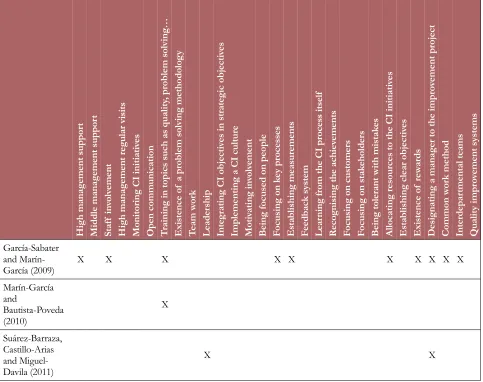
The next step consisted of analysing the content of the papers, in this case, trying to identify those ones that focus on the topic on enablers. Table 1 summarises the main results obtained from the analysis. It could be seen that, despite the high quantity of initial studies, the number of papers focus on CI enablers is not such wide taking into consideration that the period of analysis spans 30 years.
According to the results shown in Table 1, the most analysed enablers are: high management support, training, and open communication. On the opposite side, there are several enablers which are only mentioned once. This is the case of integrating CI objectives in strategic objectives, focusing on key processes, being tolerant with mistakes or focusing on stakeholders, among others.
From the authors’ point of view, it can be seen that the paper by García-Sabater and Marín-García (2009) is the one which integrates more enablers, in total 10; followed by the works of Middel et al. (2007) and Warwood and Roberts (2004) with 8 enablers each. The rest of the papers include very few enablers, there are even some papers that only analyse one enabler.
Moreover, most of the studies are descriptive case studies and there is a lack of studies which develop and validate theoretical constructs in order to push theory in this field (Laugen & Boer, 2008; Martini et al., 2012).
H ig h m an ag em en t s up po rt M id dl e m an ag em en t s up po rt St af f in vo lv em en t H ig h m an ag em en t r eg ul ar v is it s M on it or in g C I in it ia tiv es O pe n co m m un ic at io n T ra in in g in to pi cs s uc h as q ua lit y, p ro bl em s ol vi ng … E xi st en ce o f a pr ob le m s ol vi ng m et ho do lo gy T ea m w or k L ea de rs hi p In te gr at in g C I ob je ct iv es in s tr at eg ic o bj ec tiv es Im pl em en ti ng a C I cu ltu re M ot iv at in g in vo lv em en t B ei ng fo cu se d on p eo pl e F oc us in g on k ey p ro ce ss es E st ab lis hi ng m ea su re m en ts F ee db ac k sy st em L ea rn in g fr om th e C I pr oc es s it se lf R ec og ni si ng th e ac hi ev em en ts F oc us in g on c us to m er s F oc us in g on s ta ke ho ld er s B ei ng to le ra nt w it h m is ta ke s A llo ca ti ng r es ou rc es to th e C I in it ia tiv es E st ab lis hi ng c le ar o bj ec tiv es E xi st en ce o f re w ar ds D es ig na ti ng a m an ag er to th e im pr ov em en t p ro je ct C om m on w or k m et ho d In te rd ep ar tm en ta l t ea m s Q ua lit y im pr ov em en t s ys te m s
Upton (1996) X
Dale, Boaden, Wilcox, and
McQuater (1997) X
Kaye and
Anderson (1999) X X X X X X X
Berling (2000) X X X
Marsh (2000) X X
Khoo and Tan
(2002) X X X X X X
Rich and
Bateman (2003) X X X X X X X
Beheshti and
Lollar (2003) X X
Warwood and
Roberts (2004) X X X X X X X X
Bhuiyan, Baghel and Wilson
(2006) X X X
Wu and Chen
(2006) X
Middel et al.
(2007) X X X X X X X X
Suárez-Barraza and Ramis-Pujol
(2008) X X X X X
Albors-Garrigós, Hervás-Oliver and Segarra-Oña (2009)
H ig h m an ag em en t s up po rt M id dl e m an ag em en t s up po rt St af f in vo lv em en t H ig h m an ag em en t r eg ul ar v is it s M on it or in g C I in it ia tiv es O pe n co m m un ic at io n T ra in in g in to pi cs s uc h as q ua lit y, p ro bl em s ol vi ng … E xi st en ce o f a pr ob le m s ol vi ng m et ho do lo gy T ea m w or k L ea de rs hi p In te gr at in g C I ob je ct iv es in s tr at eg ic o bj ec tiv es Im pl em en ti ng a C I cu ltu re M ot iv at in g in vo lv em en t B ei ng fo cu se d on p eo pl e F oc us in g on k ey p ro ce ss es E st ab lis hi ng m ea su re m en ts F ee db ac k sy st em L ea rn in g fr om th e C I pr oc es s it se lf R ec og ni si ng th e ac hi ev em en ts F oc us in g on c us to m er s F oc us in g on s ta ke ho ld er s B ei ng to le ra nt w it h m is ta ke s A llo ca ti ng r es ou rc es to th e C I in it ia tiv es E st ab lis hi ng c le ar o bj ec tiv es E xi st en ce o f re w ar ds D es ig na ti ng a m an ag er to th e im pr ov em en t p ro je ct C om m on w or k m et ho d In te rd ep ar tm en ta l t ea m s Q ua lit y im pr ov em en t s ys te m s García-Sabater and
Marín-García (2009) X X X X X X X X X X
Marín-García and Bautista-Poveda (2010) X Suárez-Barraza, Castillo-Arias and Miguel-Davila (2011) X X
Table 1. Continuous improvement enablers
3. Research Method
3.1. Construct Design
After identifying the enablers, a new theoretical construct named “Ease to implement CI initiatives” was designed. In order to define the construct, the process proposed by Martini et al. (2012) was followed.
According to these authors, in order to develop a common theory of CI, the following steps should be followed: problem formulation, theory building, research design and problem solving. In this study, a gap has been identified (problem formulation); existing literature was reviewed and experts were consulted in order to design a new theoretical construct (theory building); a survey was conducted among companies which successfully practised CI in order to obtain real data about this topic (research design); and finally several analysis were done in order to validate the construct (problem solving).
First, in-depth interviews were carried out with the experts. They had to evaluate whether the items included in the construct were appropriate. All the changes they proposed were included in the construct and, after that, the new construct was shown to all of them again. This process was repeated until they all agreed with the content of the construct. The process lasted for a year (2011-2012).
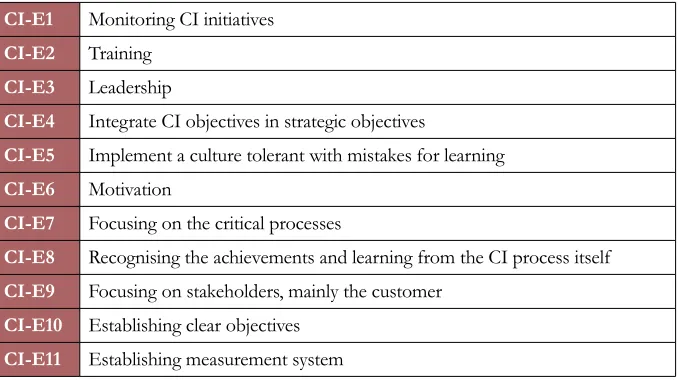
Finally, based on the opinion and knowledge of the experts, the construct “Ease to implement CI initiatives” was integrated by 11 items, listed in Table 2.
CI-E1 Monitoring CI initiatives
CI-E2 Training
CI-E3 Leadership
CI-E4 Integrate CI objectives in strategic objectives
CI-E5 Implement a culture tolerant with mistakes for learning
CI-E6 Motivation
CI-E7 Focusing on the critical processes
CI-E8 Recognising the achievements and learning from the CI process itself
CI-E9 Focusing on stakeholders, mainly the customer
CI-E10 Establishing clear objectives
CI-E11 Establishing measurement system *CI-E stands for “CI enabler”
Table 2. Survey – Continuous improvement enablers
3.2. Survey: Scope and Sample
Once the construct was defined, a survey was conducted. The scope of the study was limited to the Autonomous Community of Cantabria (a region in the north of Spain). Therefore, the target population was limited to Cantabrian companies over 20 employees that practised CI. The fact of establishing a minimum number of employees is due to the fact that, based on authors’ experience, companies under 20 employees do not usually implement CI, as the effort needed might not be compensated. This idea was later reinforced due to, after conducting the survey, it could be verified that only 18% of the companies with 20 to 49 employees practised CI, which is the lowest percentage (see Table 4).
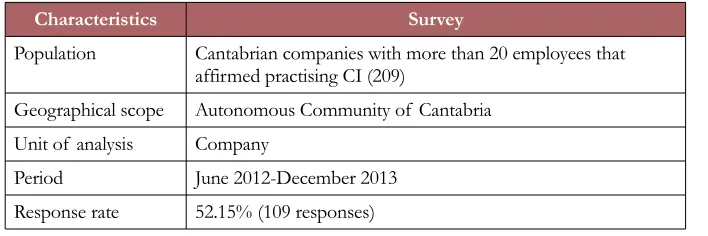
In order to identify our target population, first, all Cantabrian companies with more than 20 employees (808) were asked whether they practised CI. Among them, 209 responded positively. The technical record of the first survey is included in Table 3. Additionaly, Table 4 summaries the distribution by size of those companies that affirmed practising CI.
Those companies that affirmed practicing CI were sent a second questionnaire about different CI aspects. The technical record of the second survey is included in Table 5. Regarding the enablers, companies were asked to value whether the 11 enablers integrating the designed construct (Table 2) had been important for them or not. In order to value the items a five-point Likert scale was used (1 – it was not an important enabler- to 5- it was an important enabler).
Characteristics Survey
Population Cantabrian companies with more than 20 employees (808) Geographical scope Autonomous Community of Cantabria
Unit of analysis Company
Period November 2011- June 2012
Response rate 37% (299 responses)
Table 3. Technical record – 1st survey
Size Population Companies thatpractice CI % of companies thatpractise CI
20 to 49 536 97 18.07%
50 to 99 155 49 31.61%
100 to 199 71 28 39.44%
200 to 499 34 27 79.41%
500 to 999 7 5 71.43%
1000 to 4999 3 2 66.67%
More than 5000 2 1 50%
Total 808 209
Table 4. Distribution by size of those companies that affirmed practicing continuous improvement
Characteristics Survey
Population Cantabrian companies with more than 20 employees that affirmed practising CI (209)
Geographical scope Autonomous Community of Cantabria Unit of analysis Company
Period June 2012-December 2013
Response rate 52.15% (109 responses)
Table 5. Technical record -2nd survey
3.3. Rasch Measurement Theory
Data treatment was done by using Rasch Measurement Theory (RMT). It is important to highlight that this is an incredibly rich methodology whose use is not spread in the management area yet, although its use is constantly increasing over time due to its rigour and its wide range of applications. In fact, although it is true that confirmatory factor analysis (CFA) is traditionally used in this kind of analysis, Salzberger and Koller (2013) already proved that Rasch Measurement Theory is the most adequate measurement approach for doing it, even better than CFA.
Therefore, the authors consider that the application of RMT in this paper will provide a new perspective to a mature research topic as CI. In fact, the current work is one of the first ones that uses these measurement methods in the quality management field, specifically in the CI area of research.
This methodology offers a wide range of analysis (construct validation, items ranking, subjects ranking, differential item functioning analysis…) and is said to be extremely useful when working with Likert scales.
reality that we are interested in. In those cases, it is very common to use Likert scales to value those items. The scores obtained from the Likert scales cannot be considered measurements due to they are ordinal scores and, in order to consider them a measurement, they should have an additive structure, a characteristic that only interval variables have. RMT, initially developed by George Rasch (1960), solves this problem by transforming ordinal variables into interval variables.
It is based on three main principles: unidimensionality (a construct is unidimensional when all the items are referred to the same construct or latent variable so they can be located in the same lineal construct with the subjects); invariance (the results are independent from the samples of subjects and items used); and additivity.
When it comes to transform the ordinal variables into interval variables, the Theory is based in the following statement: “persons who are more able/more developed have a greater likelihood of correctly answering all the items in the observation schedule. And, easier items are more likely to be answered/reached correctly by all persons” (Bond & Fox, 2007, p.28).
The mathematical expression of the model is derived from this idea and it can be consulted in any of the handbooks about the methodology (see (Alagumalai, Curtis & Hungi, 2005; Bond & Fox, 2007; Von Davier & Carstensen, 2007).
Taking the aim of this study into consideration, and due to a Likert scale is used to value the different items of the defined construct, RMT was considered to be the most appropriate methodology in this study. The associated software Winsteps 3.75 (Linacre, 2012) was used in this study.
4. Results
4.1. Construct Validity
As a first step, it is important to validate the construct defined by the panel of experts. In order to validate the construct, the following checks should be carried out:
• Construct dimensionality: dimensionality is a necessary condition to use RMT so, first, the dimensionality of the construct must be checked. As well as methodological reasons, this check is interesting when new constructs are defined because it allows affirming that the definition is correct.
• Global reliability and validity of measures: RMT allows checking that the measurements obtained are reliable and valid. A measure is valid when it measures what is supposed to be measuring. In addition, in the RMT case, a measure is reliable when it has a high ability of reproducibility.
• Individual reliability and validity of measures: this methodology offers the possibility of analysing individually the reliability and validity of each surveyed company and each item (enabler).
Table 6 summaries the main characteristics of these validation analysis: the objectives, the reference values and the analysis for this study.
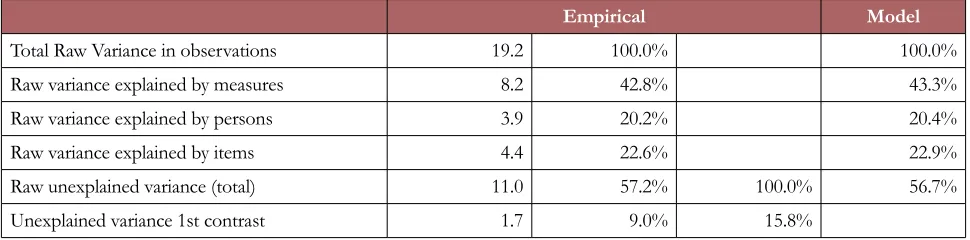
As mentioned in Table 6, in this case, reliability and validity analysis (Table 7) showed that, globally, measurements were valid and consistent. Additionally, construct dimensionality analysis showed that the new construct meets the requirements established in the methodology manual and, as a result, it can be considered to be unidimensional (Table 8).
Analysis Dimensionality analysis Global reliability and validityof measures Individual reliability and validity ofmeasures
Objective
It analyses whether all items are measuring the same construct or not. That is, whether the construct could be considered
unidimensional.
Rasch Model allows checking that the measurements obtained are reliable and valid. According to Rasch Measurement Theory, a measure is valid when it measures what is supposed to be measuring. In addition, a measure is reliable when it has a high ability of reproducibility (that is, if another sample is used, results will be robust).
Rasch Model offers the possibility of analysing individually the reliability and validity of each surveyed person and each item.
Requirements
a) The eighenvalue of the unexplained variance of the first contrast has to be less or equal to 2. / b) The percentage of unexplained variance by the first contrast has to be lower than the percentage of raw variance explained by items.
a) INFIT and OUTFIT MNSQ should be between 0.5 and 1.5./ b) INFIT and OUTFIT ZSTD should be between -2.0 and 2.0. / c) Reliability should be between 0.7 and 1 (optimum). / d) Correlation should be 1 for persons and -1 for items.
a) INFIT and OUTFIT MNSQ should be between 0.5 and 1.5./ b) INFIT and OUTFIT ZSTD should be between -2.0 and 2.0./ c) Reliability should be between 0.7 and 1 (optimum).
References Linacre (2012) Febles-Acosta, 2008; Linacre, 2012; Oreja, 2005 Febles-Acosta, 2008; Linacre, 2012; Oreja, 2005
Suitability in this study
It could be concluded that the construct is
unidimensional. See Table 8.
It could be concluded that the measurements are globally valid and reliable. See Table 7.
In this case 12 companies showed validity problems so they were removed from the final sample. This removal would not affect results as the invariance principle, which Rasch Measurement Theory is based in, establishes. Therefore, analysis were done based on 97 responses. (Due to the size of the table it has not been included but could be sent under request). Regarding the items, all of them had valid and reliable measurements. Table 6. Summary of validity checks (Authors)
Infit Outfit
Reliability Correlation
MNSQ ZSTD MNSQ ZSTD
Persons 0.81 -0.7 0.79 -0.7 0.86 0.96
Items 0.95 -0.5 0.97 -0.4 0.91 -1.00
Table 7. Reliability and validity measures (Authors)
Empirical Model
Total Raw Variance in observations 19.2 100.0% 100.0%
Raw variance explained by measures 8.2 42.8% 43.3%
Raw variance explained by persons 3.9 20.2% 20.4%
Raw variance explained by items 4.4 22.6% 22.9%
Raw unexplained variance (total) 11.0 57.2% 100.0% 56.7%
Unexplained variance 1st contrast 1.7 9.0% 15.8%
4.2. Ranking of Continuous Improvement Enablers
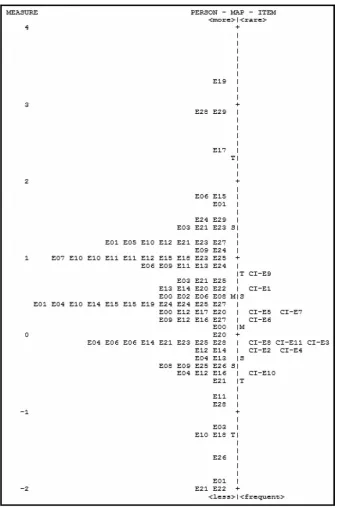
Once the construct was validated, we could proceed with additional analysis, thus a hierarchy of priority of CI enablers was obtained. The results from the Winsteps software are shown in the variable map (Figure 1).
The vertical dotted line in the middle of Figure 1 represents the construct “Ease to implement CI initiatives”. On the left side of the vertical line, companies are represented by an identification code (EXX); whereas on the right side of the vertical line items are ranked (CI-EX). It is important to highlight that the units of the variable map are expressed in logits (which is the unit RMT obtains after transforming ordinal variables into interval variables). In this case, the scale goes from -2 logits to 4 logits. Having said that, in the following lines, a more detailed description of Figure 1 is included.
In the left side of Figure 1, companies are positioned. The position of each company is not based on a unique enabler, it is set based on the responses of each company to all the items. This is the reason why all items should be analysed together not independently, because, as Caffyn and Grantham (2003) highlighted, companies are not affected by a unique enabler but by a combination of them. Having said that, companies on the top have scored higher the enablers from the survey. If we take into consideration that companies were asked to answer the survey based on their own experience, it could be said that companies on the top are likely to have found the implementation process easier than those located on the bottom because, in general, they found or they were able to implement and put into practice more enablers. Thus, the company located at the top (E19) is the one that valued the selected enablers higher. On the contrary, company E22 and company E21 are the ones that scored lower the enablers.
In the right side of Figure 1, items are located. In contrast with what happens with companies, the most important enabler is the one located at the bottom (CI-E10) which means that the majority of companies agree that item E10 “establishing clear objectives” is key when implementing CI. However, the least important enabler is the item located at the top (CI-E9: “focusing on stakeholders, mainly the customer”) which means that only some of the companies consider it an enabler.
Finally, it is interesting to briefly mention the relationship between both parts of the Figure (companies and items). How are they related? How could they be interpreted? In general, all the companies located above the score of an item are likely to have scored it higher than those located under the item. In this specific study, this means that companies located above an item consider it important, whereas companies located under the item consider it less important or unimportant. For instance, following the example of the item CI-E9, it could be said that company E17 (located above the item) considers it important. However, company E20 (located below the item) considers it less important than company E17; equally company E03 considers item CI-E9 more important than company E20.
This comparative analysis could also be done for the whole group by comparing the average of the companies with the average of the items (the location of the average is represented by an “M” in Figure 1). In this case, the average of the items is lower than the average of the companies, therefore, it could be said that in general companies consider all the enablers important, although, of course, some are more important than others.
For ease of data analysis, the final hierarchy of enablers derived from the variable map have been included in a list (Table 9) where enablers are classified from highest to lowest importance.
CI-E10 Establishing clear objectives
CI-E2 Training
CI-E4 Integrate CI objectives in strategic objectives
CI-E8 Recognising the achievements and learning from the CI process itself
CI-E3 Leadership
CI-E11 Establishing measurement system
CI-E6 Motivation
CI-E5 Implement a culture tolerant with mistakes for learning
CI-E7 Focusing on the critical processes
CI-E1 Monitoring CI initiatives
CI-E9 Focusing on stakeholders, mainly the customer
5. Discussion and Practical Implications
With regard to the literature review, two essential points should be highlighted. First, the literature review showed that there is not a solid theory concerning the topic of CI enablers, which hinders a constant advance in the field. This result is similar to the finding of Martini et al. (2012) who proposed to innovate in the way CI research is accomplished in order to build new theory as a universal theory of CI is lacking. Second, it is important to note that current papers are mainly descriptive and have mainly focused on the analysis of the effect of the enablers independently. These findings highlight the need for further research in order to design and analyse a new theoretical construct with a holistic approach.
Regarding the empirical analysis, the results showed that the proposed construct “Ease to implement CI initiatives” is valid and reliable, which means that the selection of items is correct and the construct could be applied to other population/samples. Additionally, this study obtained a general rank of enablers. This rank could help those companies that want to implement CI in the future, as it offers a general view of the most important factors they have to promote, equally highlighting the practises and behaviours that should be avoided. First, companies should established clear objectives related to the CI implementation so that everybody in the company knows what the final aim of the project is and everybody works through it. This result is similar to the finding of Dale et al. (1997) and Upton (1996).
Training is a means to establish a common language of work (de Jager et al., 2004) and is the second most important enabler for the companies of our sample. It, therefore, eases the following stages of the process as all employees involved in the CI initiative employ the same concepts. Moreover, through training, the objectives and implications of CI could be explained so that employees understand why CI is necessary in the current business environment (Albors-Garrigós et al., 2009; Middel et al., 2007; Rich & Bateman, 2003; Suárez-Barraza & Ramis-Pujol, 2008) and what their role in the whole process is. On the contrary, misunderstandings may appear and CI could be seen as a control system (Dale et al., 1997) and resistance to change may appear (Bounabri, El Oumri, Saad, Zerrouk & Ibnlfassi, 2018; Sanchez-Ruiz, 2014; Taherimashhadi & Ribas, 2018). The third most important enabler is Integrating CI objectives in strategic objectives. This is a very important point that other authors have also identified in their studies. In fact, lack of integration is defined as an important barrier for CI implementation (Jun, Cai & Peterson, 2004). At this point, the role of managers should be highlighted (Das, Kumar & Kumar, 2011). As Taherimashhadi and Ribas (2018) and Bounabri et al. (2018) highlighted, managers sometimes expect short-term success and this is not compatible with the process needed to adapt the company culture in order to assure a sustainable change. Therefore, not only are managers responsible for giving CI the importance it deserves as a long-term strategy (Carmona-Márquez, Leal-Millán, Vázquez-Sánchez, Leal-Rodríguez & Eldridge, 2016), they should also allocate time and human resources to this initiative.
Recognising the achievements and learning from the CI process itself has been also identified as a key enabler that agrees with the results of Khoo and Tan (2002) and García-Sabater and Marín-García (2009) who described rewards as a means to encourage staff participation.
Motivation has already been mentioned as an important factor to start and maintain a CI program. If staff is not motivated, they would not take part in the process and, as de Jager et al. (2004) stated, staff involvement is a key element to guarantee the success of the implementation process.
Other factors such as focusing on the critical processes, monitoring CI initiatives, and focusing on stakeholders (mainly the customer) are enablers that have been identified by companies of the sample as the least important enablers of the general rank. This result may be due to the fact that, although each company has to know which their key processes are, this is not consider as enabler itself, that is, this fact does not foster CI. In fact, companies sometimes apply CI in less important processes in order to fulfil other objectives. For instance, sometimes CI is applied in front office processes that, in spite of being less critical, allow the company to show to their customers that they are involved in an improvement program. Similarly, companies may select an area or process that can be easily improved in order to show the usefulness of CI to their workers and, in turn, increase their motivation. Similarly, the fact that enablers as monitoring CI initiatives or focusing on stakeholders were the least important enablers according to companies’ opinion is a surprising result due to, on the one hand, as we stated before, establishing objectives, measuring indicators and, therefore, monitoring are key tasks when implementing CI. On the other hand, companies should never forget their customers and what they really value as it was seen in Chang’s (2005) definition. Actually, customers and, in general stakeholders (suppliers, employees...) may be an interesting source of ideas to improve.
6. Conclusions, Limitations and Future Lines
This paper falls within the CI field. In particular, it aims at identifying and better understanding the factors that could act as enablers when implementing a CI initiative by designing and analyzing a new theoretical construct. To achieve this goal, first a new theoretical construct called “Ease to implement CI initiatives” was designed and proposed. Secondly, once the construct was validated, the main enablers were identified and ranked.
In order to fulfil the above-mentioned objectives, first, a literature review was carried out. It allowed the authors to identify 29 enablers. Among them, a group of experts (academics and practitioners) selected 11 enablers in order to propose a new theoretical construct named “Ease to implement CI initiatives”. Rasch Measurement Theory was applied in order to validate that construct. A rigorous process which included several analysis (individual reliability and validity of measures, global reliability and validity of measures and unidimensionality) was followed.
Once the theoretical construct was validated, a survey was conducted among companies that have implemented CI initiatives. From their responses, a rank of the enablers was obtained, identifying the most important ones according to their opinions and own experiences.
Based on the results, it is important to make practitioners aware that before starting a CI initiative they should focus their efforts on three main aspects. First, they should establish clear objectives (what does the company want to achieve by implementing CI? What are the short-term and long-term objectives?). Secondly, all employees should be trained in CI aspects in order to avoid potential misunderstandings and/or conflicts in the following stages. Finally, CI should receive the attention it deserves and might be integrated with the other strategic objectives of the company.
These results are perfectly consistent with the definition of CI that was taken as the basis for this work. It highlighted two characteristics of the CI: incremental change and people involvement.
In relation to the first of the highlighted characteristics, incremental change, it is complicated (if not impossible) to carry out incremental improvements if CI does not extend over time. Results show that in no case should it be understood as a punctual or sporadic action; on the contrary, it must be understood as a strategic objective.
On the other hand, although it has just been briefly analysed in this study, the positioning of companies has also been obtained, based on the importance they gave to the enablers. It is important to remember that all this has been done from a holistic perspective, analysing the effect of the set of enablers and not just one. It would be unrealistic to think that companies are only influenced by an enabler in isolation and that there are no influences between them.
Knowing the positioning of companies can be very useful for developing future research lines. For instance, companies with very good / bad ratings could be identified and in-depth interviews could be conducted with them in order to know their experiences. The information they can share is undoubtedly very useful for other companies that want to join the implementation of the CI.
Finally, a couple of limitations should be noted. First, due to the geographical scope of the study, results should be treated with caution. In future research, increasing the sample will be advisable in order to expand our research. Similarly, due to surveyed companies are already committed with CI, it would be interesting to increase the scope of the study, including companies that have not implemented CI yet or companies that failed. Moreover, due to a theoretical construct has been validated, it would be interesting to use it in other studies based in other regions and countries in order to extend the theory of the field. Additionally, as significant differences have been identified, we suggest doing more research about their root causes.
Declaration of Conflicting Interests
The authors declared no potential conflicts of interest with respect to the research, authorship, and/or publication of this article.
Funding
This work was financially supported by the Spanish Ministry of Education (FPU Grant).
References
Alagumalai, S., Curtis, D.D., & Hungi, N. (2005). Applied Rasch Measurement: A Book of Exemplars. The Netherlands: Springer-Verlag. https://doi.org/10.1007/1-4020-3076-2
Albors-Garrigós, J.; Hervás-Oliver, J.L.; Segarra-Oña, M. del V. (2009). Análisis de las prácticas de mejora continua en España: barreras y facilitadores. Economía Industrial, (373), 185-195. Available at:
https://dialnet.unirioja.es/servlet/articulo?codigo=3108061
Albors, J., & Hervas, J.L. (2007). CI practice in Spain: its role as a strategic tool for the firm. Empirical evidence from the CINet survey analysis. International Journal of Technology Management, 37(3/4), 332.
https://doi.org/10.1504/IJTM.2007.012267
Al-Khawaldeh, K., & Sloan, T. (2007). Continuous improvement in manufacturing companies in Jordan. International Journal of Technology Management, 37(3-4), 323. https://doi.org/10.1504/IJTM.2007.012266
Aloini, D., Martini, A., & Pellegrini, L. (2011). Effectiveness of different development paths in continuous improvement: empirical results from a (new) methodological approach. Int. J. Technology Management J. Technology Management, 55(12), 6-27. Available at:
https://s3.amazonaws.com/academia.edu.documents/45995145/Effectiveness_of_different_development_p20160527-28612-1nwnrz3.pdf?
AWSAccessKeyId=AKIAIWOWYYGZ2Y53UL3A&Expires=1526408951&Signature=kTK4szFPgZt0qNTCi9EXgYiM %2Bd
g%3D&response-content-disposition=inli
Álvarez-García, J., Durán-Sánchez, A., & del Río-Rama, M. C. (2018). Systematic bibliometric analysis on Kaizen in scientific journals. TQM Journal. https://doi.org/10.1108/TQM-12-2017-0171
Berling, C. (2000). Continuous improvement as seen from groups and “improvement agents”. Total Quality Management, 11(4-6), 484-489. https://doi.org/10.1080/09544120050007797
Bhuiyan, N., Baghel, A., & Wilson, J. (2006). A sustainable continuous improvement methodology at an aerospace company. International Journal of Productivity and Performance Management, 55(8), 671-687.
https://doi.org/10.1108/17410400610710206
Boer, H., Berger, A., Chapman, R., & Gertsen, F. (2017). CI Changes from Suggestion Box to Organisational Learning: Continuous Improvement in Europe and Australia. Aldershot: Ashgate Publishing Ltd. Available at:
https://www.taylorfrancis.com/books/9781351772549 https://doi.org/10.4324/9781315198286
Bond, T., & Fox, C. (2007). Applying the Rasch model: Fundamental measurement in the human sciences. New Jersey: Lawrence Erlbaum Associates. Available at: https://www.taylorfrancis.com/books/9781135602659
Bounabri, N., El Oumri, A.A., Saad, E., Zerrouk, L., & Ibnlfassi, A. (2018). Barriers to ISO 9001 implementation in moroccan organizations: Empirical study. Journal of Industrial Engineering and Management, 11(1), 34-56.
https://doi.org/10.3926/jiem.2412
Caffyn, S., & Grantham, A. (2003). Fostering Continuous Improvement within new product development processes. International Journal of Technology Management, 26(8), 843. https://doi.org/10.1504/IJTM.2003.003393 Carnerud, D., Jaca, C., & Bäckström, I. (2018). Kaizen and continuous improvement – trends and patterns over 30
years. TQM Journal. https://doi.org/10.1108/TQM-03-2018-0037
Carmona-Márquez, F.J., Leal-Millán, A.G., Vázquez-Sánchez, A.E., Leal-Rodríguez, A.L., & Eldridge, S. (2016). TQM and business success. International Journal of Quality & Reliability Management, 33(3), 361-379.
https://doi.org/10.1108/IJQRM-04-2014-0050
Chang, H.H. (2005). The influence of continuous improvement and performance factors in total quality organization. Total Quality Management & Business Excellence, 16(3), 413-437.
https://doi.org/10.1080/14783360500053790
Continuous Innovation Network (2016). The Second CINET Survey. New York: McGraw-Hill. Available at: http://www.continuous-innovation.net/research/past-projects/2nd-survey.html
Corso, M., Giacobbe, A., Martini, A., & Pellegrini, L. (2007). Tools and abilities for continuous improvement: what are the drivers of performance? International Journal of Technology Management, 37(3-4), 348.
https://doi.org/10.1504/IJTM.2007.012268
Cuatrecasas, L. (2005). Gestión integral de la calidad: implantación, control y certificación. Spain: Ediciones Gestión 2000. Available at: http://www.sidalc.net/cgi-bin/wxis.exe/?
IsisScript=UCC.xis&method=post&formato=2&cantidad=1&expresion=mfn=052901
Dale, B.G., Boaden, R.J., Wilcox, M., & Mcquater, R.E. (1997). Total quality management sustaining audit tool: Description and use. Total Quality Management, 8(6), 395-408. https://doi.org/10.1080/0954412979406
Das, A., Kumar, V., & Kumar, U. (2011). The role of leadership competencies for implementing TQM. International Journal of Quality & Reliability Management, 28(2), 195-219. https://doi.org/10.1108/02656711111101755
de Jager, B., Minnie, C., de Jager, J., Welgemoed, M., Bessant, J., & Francis, D. (2004). Enabling continuous improvement: a case study of implementation. Journal of Manufacturing Technology Management, 15(4), 315-324. https://doi.org/10.1108/17410380410535017
de Leede, J., & Kees Looise, J. (1999). Continuous improvement and the mini‐company concept. International Journal of Operations & Production Management, 19(11), 1188-1202. https://doi.org/10.1108/01443579910291087
Deming, W.E. (1982). Out of the crisis. Cambridge: Center for Advanced Engineering Study.
Febles Acosta, J. (Coord). (2008). Los Modelos de Rasch en Administración de Empresas. Aplicaciones avanzadas. Santa Cruz de Tenerife: Fundación FYDE-Caja Canarias.
García-Sabater, J., & Marín-García, J. (2009). Facilitadores y barreras para la sostenibilidad de la mejora continua: Un estudio en proveedores del automóvil de la Comunidad Valenciana. Intangible Capital, 5(2), 183-209. Available at: https://upcommons.upc.edu/handle/2099/7605
Glover, W.J., Farris, J.A., Van Aken, E.M., & Doolen, T.L. (2011). Critical success factors for the sustainability of Kaizen event human resource outcomes: An empirical study. Intern. Journal of Production Economics, 132, 197-213. https://doi.org/10.1016/j.ijpe.2011.04.005
Gómez-López, R., López-Fernández, M.C., & Serrano-Bedia, A.M. (2017). Implementation barriers of the EFQM excellence model within the Spanish private firms. Total Quality Management & Business Excellence, 28(7-8), 695-711. https://doi.org/10.1080/14783363.2015.1106314
Gómez-López, R., Serrano-Bedia, A.M., & López-Fernández, M.C. (2016). Motivations for implementing TQM through the EFQM model in Spain: an empirical investigation. Total Quality Management & Business Excellence, 27(11-12), 1224-1245. https://doi.org/10.1080/14783363.2015.1068688
González-Aleu, F., Van Aken, E.M., & Keathley-Herring, H. (2017). Bibliometric analysis of research design characteristics in continuous improvement projects in hospitals. In Proceedings of the International Conference on Industrial Engineering and Operations Management (2-8).
Haims, M. (1998). Theory and practice for the implementation of “in-house”, continuous improvement participatory ergonomic programs. Applied Ergonomics, 29(6), 461-472. Available at:
https://www.sciencedirect.com/science/article/pii/S000368709800012X https://doi.org/10.1016/S0003-6870(98)00012-X Hyland, P., Becker, K., Sloan, T., & Jorgensen, F. (2008). CI in the work place: does involving the HRM function
make any difference? International Journal of Technology Management, 44(3-4), 427. https://doi.org/10.1504/IJTM.2008.021048
Imai, M. (1986). Kaizen: The key to Japan’s competitive success. New York: McGraw-Hill.
Imai, M. (1997). Gemba Kaizen: A commonsense, Low-Cost approach to Management. New York: McGraw-Hill.
Jaca, C., Viles, E., Mateo, R., & Santos, J. (2012). Components of sustainable improvement systems: Theory and practice. TQM Journal, 24(2), 142-154. https://doi.org/10.1108/17542731211215080
Jorgensen, F., Boer, H., & Gertsen, F. (2003). Jump‐starting continuous improvement through self‐assessment. International Journal of Operations & Production Management, 23(10), 1260-1278. https://doi.org/10.1108/01443570310496661
Jun, M., Cai, S., & Peterson, R. (2004). Obstacles to TQM Implementation in Mexico’s Maquiladora Industry. Total Quality Management & Business Excellence, 15(1), 59-72. https://doi.org/10.1080/1478336032000149108
Jurburg, D., Viles, E., Tanco, M., & Mateo, R. (2017). What motivates employees to participate in continuous improvementactivities? Total Quality Management and Business Excellence, 28(13-14), 1469-1488.
https://doi.org/10.1080/14783363.2016.1150170
Kaye, M., & Anderson, R. (1999). Continuous improvement: The ten essential criteria. International Journal of Quality & Reliability Management, 16(5), 485-509. https://doi.org/10.1108/02656719910249801
Kettinger, W.J., & Grover, V. (1995). Special Section: Toward a Theory of Business Process Change Management. Journal of Management Information Systems, 12(1), 9-30. https://doi.org/10.1080/07421222.1995.11518068
Khoo, H.H., & Tan, K.C. (2002). Critical success factors for quality management implementation in Russia. Industrial and Commercial Training, 34(7), 263-268. https://doi.org/10.1108/00197850210447255
Marín-García, J., & Bautista-Poveda, Y. (2010). The implementation of a continuous improvement project at a Spanish marketing company: A case study. International Journal of Management, 27(3), 593. Retrieved from: http://search.proquest.com/openview/f1e483291b01e874b62c13c904fd9004/1?pq-origsite=gscholar&cbl=5703
Martini, A., Gastaldi, L., Corso, M., Magnusson, M., & Laugen, B.T. (2012). Continuously innovating the study of continuous innovation: from actionable knowledge to universal theory in continuous innovation research. International Journal of Technology Management, 60(3-4), 157. https://doi.org/10.1504/IJTM.2012.049439
Marsh, J. (2000). Herramientas para la mejora continua. Madrid: Asociación Española de Normalización y Certificación. McIvor, R. (2016). An analysis of the application of process improvement techniques in business process outsourcing.
International Journal of Quality & Reliability Management, 33(3), 321-343. https://doi.org/10.1108/IJQRM-04-2014-0045 McLaughlin, P., Bessant, J., & Smart, P. (2008). Developing an organisation culture to facilitate radical innovation.
International Journal of Technology Management, 44(3-4), 298. https://doi.org/10.1504/IJTM.2008.021041
Middel, R., Weegh, S.O., & Gieskes, J. (2007). Continuous improvement in The Netherlands: a survey-based study into current practices. International Journal of Technology Management, 37(3/4), 259.
https://doi.org/10.1504/IJTM.2007.012262
Newitt, D.J.H. (1996). Beyond BPR & TQM-Managing through processes: Is Kaizen ehough? In Beyond TQM and Re-Engineering-Managing Through Process (3/1).
Oreja, J R. (2005). Introducción a la medición objetiva en Economía, Administración y Dirección de Empresas: El Modelo de Rasch. Spain: Instituto Universitario de la Empresa (IUDE) de la Universidad de La Laguna.
Prajogo, D., & Hong, S. (2008). The effect of TQM on performance in R&D environments: A perspective from South Korean firms. Technovation, 28(12), 855-863. Available at:
https://www.sciencedirect.com/science/article/pii/S0166497208000746 https://doi.org/10.1016/j.technovation.2008.06.001
Quesada-Pineda, H.J., & Madrigal, J. (2013). Sustaining continuous improvement: A longitudinal and regional study. International Journal of Engineering BUsiness Management, 5, 43. Available at: https://hrcak.srce.hr/160986
https://doi.org/10.5772/56860
Raj, T., & Attri, R. (2010). Quantifying barriers to implementing Total Quality Management (TQM). European Journal of Industrial Engineering, 4(3), 308. https://doi.org/10.1504/EJIE.2010.033333
Rasch, G. (1960). Probabilistic models for some intelligence and attainment tests. Chicago: The University of Chicago Press. Rich, N., & Bateman, N. (2003). Companies’ perceptions of inhibitors and enablers for process improvement activities. International Journal of Operations & Production Management, 23(2), 185-199. https://doi.org/10.1108/01443570310458447 Sabater, J.J.G., & García, J.A.M. (2011). Can we still talk about continuous improvement? Rethinking enablers and
inhibitors for successful implementation. International Journal of Technology Management, 55(1-2), 28. https://doi.org/10.1504/IJTM.2011.041678
Salzberger, T., & Koller, M. (2013). Towards a new paradigm of measurement in marketing. Journal of Business Research, 66(9), 1307-1317. https://doi.org/10.1016/j.jbusres.2012.02.030
Sanchez-Ruiz, L. (2014). Implementation of control and continuous improvement techniques in business process. University of Cantabria.
Sanchez, L., & Blanco, B. (2014). Three decades of continuous improvement. Total Quality Management and Business Excellence, 25(9-10). https://doi.org/10.1080/14783363.2013.856547
Sisson, J., & Elshennawy, A. (2015). Achieving success with Lean: An analysis of key factors in Lean transformation at Toyota and beyond. International Journal of Lean Six Sigma, 6(3), 263-280. https://doi.org/10.1108/IJLSS-07-2014-0024
Suárez-Barraza, M.F., Castillo-Arias, I., & Miguel-Dávila, J.A. (2011). La aplicación del Kaizen en las organizaciones mexicanas. Un estudio empírico. Revista Globalización, Competitividad y Gobernabilidad, 5(1), 60-74. Retrieved from: http://www.redalyc.org/html/5118/511851326007/
Suárez-Barraza, M.F., & Ramis-Pujol, J. (2008). Aplicación y Evolución de la Mejora Continua de Procesos en la Administración Pública. Revista Globalización, Competitividad y Gobernabilidad, 2(1), 74. Available at:
https://gcg.universia.net/article/view/332
Taherimashhadi, M., & Ribas, I. (2018). A model to align organizational culture to lean culture. Journal of Industrial Engineering and Management, 11(2), 207-221. https://doi.org/10.3926/jiem.2511
Upton, D. (1996). Mechanisms for building and sustaining operations improvement. European Management Journal, 14(3), 215-218. Available at: http://www.academia.edu/download/26271654/workingpaper.pdf
https://doi.org/10.1016/0263-2373(96)00002-3
Von Davier, M., & Carstensen, C.H. (2007). Multivariate and mixture distribution Rasch Models. Extensions and applications. New York: Springer Science + Business Media LLC. https://doi.org/10.1007/978-0-387-49839-3
Warwood, S.J., & Roberts, P.A.B. (2004). A survey of TQM success factors in the UK. Total Quality Management, 15(8), 1109-1117. https://doi.org/10.1080/1478336042000255460
Wu, C.W., & Chen, C.L. (2006). An integrated structural model toward successful continuous improvement activity. Technovation, 26(5-6), 697-707. Retrieved from: https://www.sciencedirect.com/science/article/pii/S0166497205000805
Journal of Industrial Engineering and Management, 2019 (www.jiem.org)
Article’s contents are provided on an Attribution-Non Commercial 4.0 Creative commons International License. Readers are allowed to copy, distribute and communicate article’s contents, provided the author’s and Journal of Industrial Engineering and