ISSN: 2286-2668 © College of Management (NUPSPA) & Tritonic Books
Simulation Models of Human Decision-Making Processes
Nina RIZUN
Alfred Nobel University, Dnipropetrovsk, Ukraine 18 Naberezhna Lenina St., Dnipropetrovsk, 49000, Ukraine
Yurii TARANENKO
Alfred Nobel University, Dnipropetrovsk, Ukraine 18 Naberezhna Lenina St., Dnipropetrovsk, 49000, Ukraine
Abstract. The main purpose of the paper is the presentation of the new concept of human decision-making process modelling using an analogy with the Automatic Control Theory. From the authors' point of view this concept allows to develop and improve the theory of decision-making in terms of the study and the classification of specificity of the human intel-lectual processes in different conditions. Literature shows that the main distinguishing fea-ture between the Heuristic / Intuitive and Rational Decision-Making Models is the presence of so-called phenomenon of “enrichment” of the input information with human propensity, hobbies, tendencies, expectations, axioms and judgments, presumptions or bias and their justification. In order to obtain additional knowledge about the basic intellectual processes, as well as the possibility of modelling the decision results in various parameters character-izing the decision-maker, a complex of simulation models was developed. These models are based on the assumptions that: basic intellectual processes of the Rational Decision-Making Model can be adequately simulated and identified by the transient processes of the propor-tional-integral-derivative controller; basic intellectual processes of the Bounded Rationality and Intuitive Models can be adequately simulated and identified by the transient processes of the nonlinear elements. The taxonomy of the most typical automatic control theory elements and their compliance with certain making models with a point of view of decision-making process specificity and decision-maker behavior during a certain time of professional activity was obtained.
Keywords: human decision-making process, automatic control theory, proportional-inte-gral-derivative controller, nonlinear elements.
Introduction
achieved, because it depends on many different and difficult elements – both on the problem statement side, and considering the personal making-decision style and experience.
The term “decision-making” in different sources was defined as a process in following editions: “the procedure of reducing the gap between the existing situ-ation and the desired situsitu-ation through solving problems and making use of
op-portunities” (Saroj, 2009); “the transformation of knowledge and information
into managerial action” (Weick, 1979; March, 1991).
Human decision-making process has been the subject of active research from several perspectives:
– from a psychological perspective, it is necessary to examine individual DMP in the context of a set of needs, principles and preferences they are driven by;
– from a cognitive perspective, the DMP must be regarded as a continu-ous process integrated in the interaction with the environment and forming the recognize patterns as a yield of their professional activity; – from a normative perspective, the analysis of individual DMP is
con-cerned with the logic (rational) foundation of decision making (Kahne-man & Tversky, 1974).
From the managerial perspective for effective decision-making process, a per-son must be able to forecast the outcome of each option of decision-making task (DMT), and taking into account all these items, determine the best op-tion for that particular situaop-tion (Reason, 1990). At the same time, dynamic environment, rapid technological change and great uncertainty in most com-panies’ environments create increasingly challenging working conditions
for decision-makers. Decisions must often be made under substantial time
limitation (Simon, 1997), in highly complex and fuzzy circumstances (Weick, 2001), with a lack or an excess of information and uncertainty or risk. Profes-sional decision-makers must respond instantly and satisfactorily in the base of available knowledge and time interval (Wagner, 1986), use the reliable infor-mation or only experience and feeling (Hammond, 1996).
Therefore, the specificity of the human DMP strongly depends on the
techniques in order to transform the input of the given particular decision task into the right course of action.
In this paper authors offers a new concept of human DMP modelling using the analogy with automatic control theory, which should help to find answers to the following research questions:
1. How does specificity of the decision task influence an aptitude of deci-sion-makers using the particular decision-making model?
2. What basic intellectual processes underlie the distinguishing character-istic of the different decision-making models?
For this purpose the following hypotheses was proposed:
1. The basic intellectual processes of the Rational Decision-Making Model
can be adequately simulated and identified by the transient processes of
the proportional-integral-derivative (PID) controller.
2. The basic intellectual processes of the Bounded Rationality and Intuitive
Models can be adequately simulated and identified by the transient
pro-cesses of the nonlinear elements.
Fundamental decision-making models
Presently the most widely-spread scientific approach is the one that marks
out three main decision-making models (MDM): Rational Decision-Making
Model, Bounded Rationality Model and Intuitive Model (Allard, 2003). The
following researches are dedicated to these models’ brief analysis and struc-turing.
The rational model
People generally use a rational decision-making model when (Towler, 2010): they are not under heavy time pressure; conditions are relatively stable and goals are clear; they do not have a great deal of relevant experience; the problem is computationally complex.
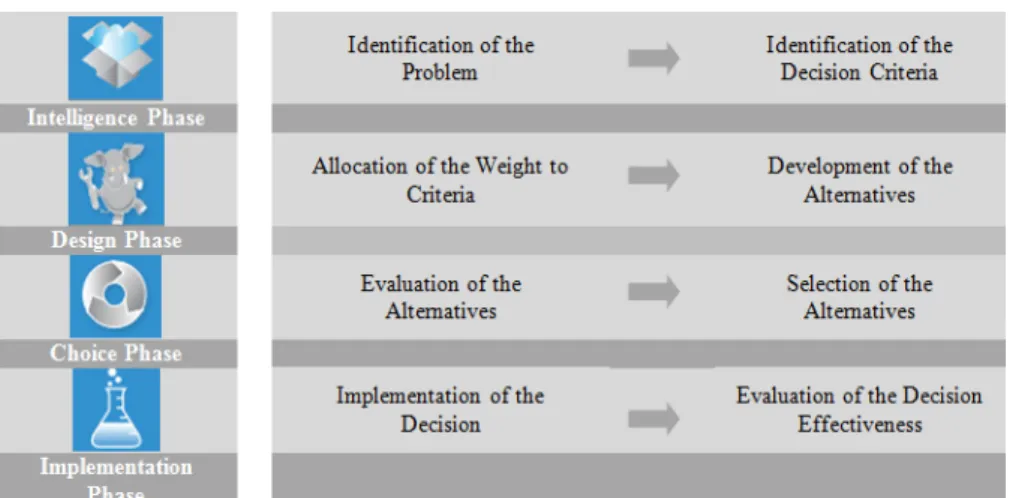
Figure 1. Decision Making Process of Rational Model
The bounded rationality (heuristic) model
The term Bounded rationality was invented by Herbert Simon (1997, 2009) to
describe the decision maker who would like to make the best decisions but normally settles for less than the optimal (Lunenburg, 2010).
Proponents of bounded rationality (Luck, 2009) very often correlate it with “adaptive toolbox” – as the tried and tested strategy set which people use to
solve DMT and to meet the demands of MD environments. These strategies
are commonly named heuristics – simple MD patterns which are used as sim-plification rules for stopping the options search.
In contrast to complete rationality in decision-making, bounded rationality
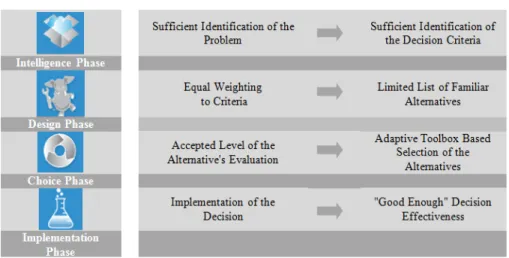
Figure 2. Decision Making Process of Bounded Rationality Model
The main ideas of Bounded Rationality Model implementation steps are the
following:
1. Decisions are based on an incomplete and inadequate comprehension of the essence of the problem being faced. Usually it causes responses in the forms of: reducing the problem to a level at which it can be re-ally understood and satisfaction type of seek solutions (Nielsen, 2011; Lunenburg, 2010).
2. Decision makers never succeed in generating all possible alternative so-lutions for consideration. They construct simplified models that extract the essential features from problems without capturing all of their com-plexity.
3. Alternatives are always evaluated incompletely. Following along famil-iar paths, the decision maker proceeds to review alternatives only until s/he identifies an option that is “good enough” – one that meets an ac-ceptable level of performance.
4. The final solution represents a satisfying choice rather than an optimal one.
Informed intuition model
Intuition represents: “a quick apprehension of a decision situation based on past experiences and the reinforcement associated with these experiences, which is devoid of conscious thought” (Lunenburg, 2010; Luck, 2009); “a cog-nitive conclusion based on a decision maker’s previous experiences and emo-tional inputs” (Pratt, 2007); “a tacit form of knowledge that orients decision making in a promising direction” (Policastro, 1999).
The root of the intuitive DM already exists in cognitive processes of informa-tion collecinforma-tion; knowledge structure; emoinforma-tional awareness of decision mak-ers (Ju et al., 2007). But exactly the experience is considered as a result of the decision-makers’ cognitive processes. In a certain real situation the decision maker will pick up cues and indicators that gives him/her so-called scenarios – recognize patterns as a yield of their professional activity.
In regard to the knowledge structure – classically knowledge of the
decision-makers can be divided into explicit knowledge and tacit knowledge. Mostly
explicit knowledge (“knows-what” or systematic knowledge) is technical or ac-ademic data / information described in formal language, like manuals, math-ematical expressions, copyright and patents (Smith, 2001). Tacit knowledge is practical, action-oriented knowledge or “know-how” based on practice,
acquired by personal experience, seldom expressed openly, often resembles
intuition and made up of mental models, values, beliefs, perceptions, insights and assumptions (Smith, 2001).
Emotional memory refers to the experience of decision-makers leaving the signs in the decision makers’ spirit space (Ju et al., 2007), which determine the quality of decision-making and grows from mistakes.
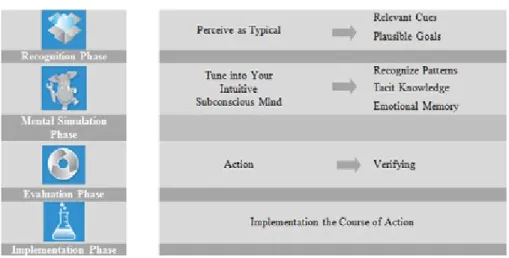
Figure 3. Decision-Making Process of Informed Intuitive Model
Decision-making process simulation model
Taxonomy of decision-making models
Taking into account the considered and structured Decision-Making Models (DMM) and for answering the following question “How does specificity of the decision task influence an aptitude of decision-makers using the particular decision making model?”, the author has suggested the taxonomy of DMM based on the following groups of measurement (Luck, 2009; Beach & Mitch-ell, 1978):
– existing situation (Capacities), which describes the specificity of the DMT;
– techniques of knowledge and information transformation for DM,
de-fined by the existing capacities of the DMT;
– right course of the DM action (Choice) as the consequence of using the particular techniques (Table 1).
Table 1. Taxonomy of the decision-making models
Indicators Decision-Making Models
Rational Bounded Rationality Intuitive Capacities
Information Complete Incomplete Arguable
Speed Deliberate Rapid Instant
Goal Clear Fuzzy Competing
Indeterminacy Certainty Risk Uncertainty
Techniques
Problem Processing Problem Solving Problem Resolution Problem Finding
Accuracy High Enough Low
Tools Value Heuristic Judgment
Options Difference Weighted Acceptable Indistinguishable Situational Awareness Details Patterns, Clusters Big Picture
Accountability Statistics, Analytical Tools Pre-Formulated Rules simulations, FeelingsPerception, Mental
Experience Not necessarily Embedded in Direct Habit Embedded in Direct Experience Emotional Level Emotion Free Legitimate Role for Emotions Emotionally Associative
Effort Requires Cognitive Effort Requires Developed a Range of Successful Adaptive Strategies Appears Effortless Choice
Metrics Numerative Good enough Failure or Success
Time Horizon Present The Near Future Future
Level of Detail Detailed Grouped Aggregate
Decisions Formulation Prescriptive Suggested Descriptive
Nature Objective Subjective “Gut Feeling” Based
Conscious Level Conscious Traditional Unconscious
Creativity Creativity Free Creativity Free Creative
Decisions Optimal Satisfied More Relevant
Simulation models of the decision-making processes
The decision-making model taxonomy and the authors' concept of analogy
between DMT and automatic control theory allow answering to the following question: What basic intellectual processes underlie the distinguishing
charac-teristic of the different decision-making models?
Simulation model of the rational decision-making processes
contour of the control with feedback loop, used for maintaining the set point
values of the measured parameter PV. Mathematical form of the PID
algo-rithm is:
(1)
The authors suggest the concept of interpretation of human intellectual
pro-cesses (HIP) within the making-decision as a process of correspondence (main-tenance) to the adjusted (required) set point level of the set problem solving
(op-timal, sufficient solution) (Rizun, 2013).
In this view the authors proposed the hypothesis that: the basic HIP of the
Ra-tional Decision-Making Model could be adequately simulated and identified by
the transient processes of the proportional-integral-derivative (PID) controller.
On the first step the following interpretation of the terms of the mathematical expression of the PID-controller as of the simulation model of HIP during the test task solving was developed:
Terms characterizing the DMP quantitatively:
!
"
!
"
– error (mismatch): the measure of difference between the current vari-ant of task solution (process variable) at the moment t and optimal (sufficient, acceptable) solution (desired set point). For the specified DMT j is suggested to be considered as the difference between the received#
$"
!
!
and maximum%&'
#
number of points for the task:(2) (
)
– integral gain: the measure of degree of problem domain awareness(PDA). For the specified DMT j is suggested to be considered as the indicator of correspondence of the accumulated in the process of professional activity
explicit knowledge for required for the level :
(3) *
)
– derivative gain: the pace of making logical operations for processingthe information. For the specified DMT j is suggested to be considered as the indicator of relative speed of DM – ratio of actual time (
!
$+ ) time ofcarry-ing out the DMP to the optimal (reference) time (
!
,+ ). It depends on humanphysiological abilities as well as on the practical experience of DM.
-!
.
#
#
-!
.
(4) Term, that characterize the DMP qualitatively:
/
)
– proportional gain: according to the theory of automatic controlde-pends on the current error
"
"
!
!
and compensates the current error propor-tionally to its value. For the specified DMT j the proportional gain is suggested to be considered as the difference between of the currently used individual'spersonal features +
$
(01 to achieve a given measure of DMT solution and
re-quired +
,
(01
one:, (5)
In the second stage, in order to analyze the possibility of using the PID-con-troller to interpret the features of intellectual processes of DM, the authors developed a simulation model, allowing to receive the transient response of the transfer function of an individual. For this purposes the authors have sug-gested that: the simulation of Rational Decision-Making Model as a process of performing a certain number of stages of logical analysis of the problem by de-composing the original problem into simpler components and gradual approxi-mation to the desired solution could be accomplished by using harmonic
expo-nentially damped cosine signal
'
.
!
-
5
"
J!
234.
O
!
-
.For this purposes the authors have suggested that: the simulation of Rational Decision-Making Model as a process of performing a certain number of stages of logical analysis of the problem by decomposing the original problem into simpler components and gradual approximation to the desired solution could be accomplished by using harmonic exponentially damped cosine signal.
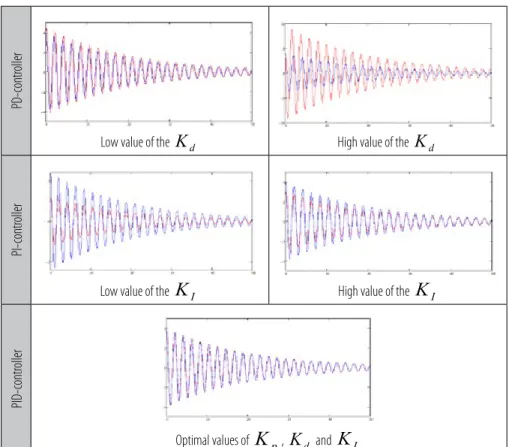
In order to extend the possibilities of study, the authors considered the vari-ants, when the values of derivative or integral gains are equal to zero, that in the Automatic Control Theory is meet to the PI- and PD- controller. The re-sults of a DMP simulation using the analogies with transient processes of PI-, PD- and PID-controllers are shown in Fig. 4
+ , + $
*
!
!
)
+ +
+
/
(01
$(01
,
PD-con
troller
Low value of the
)
* High value of the)
*
PI-con
troller
Low value of the
)
( High value of the)
(
PID-con
troller
Optimal values of
)
/,)
* and)
(Figure 4. The results of a DMP simulation using the analogies with transient processes of PI-, PD- and PID-controllers
On the third step analysis of the transient response was carried out, which determined the following conclusions:
1. A common feature of transient characteristics of the PI-, PD- and PID-controllers as a simulation model of DMP is to attempt to repeat the signal corresponding to the Rational Decision-Making Model with varying degrees of accuracy and implementation speed of a given amount of logical steps of data processing relatively to a specific DMT. 2. The repetition of the input signal accuracy is determined by the values
of the following configuration parameters PI-, PD- and
PID-control-lers: degree of problem domain awareness, pace of making logical op-erations and individual's personal features.
but not a consequence of the creative (subjective) approach to the task solving.
Thus, the authors propose to accept the following hypothesis: the basic HIP of the Rational Decision-Making Model could be adequately simulated and
identi-fied by the transient processes of the PID-controller.
Then, the classification of the DM strategies using the analogy with the PI-, PD- and PID- controllers can be the following (Table 2):
– PD-controller – the minimum cost strategy. Due to the major
compo-nent of this controller is derivative gain, as the main cost criterion could
be adopted the value of the DM time %67
! !
) +
, + $
* o . Absence of the
integral gain component indicates that this strategy characterizes the style of quick receiving the solutions of the simple routine problems;
– PI-controller – the maximum benefit strategy. Due to the major
com-ponent of this controller is integral gain, as the main benefit criteri-on could be adopted the value degree of problem domain awareness
(quality of solution) . Absence of the
derivative gain component indicates that this strategy characterizes style of measured receiving the full solutions of the deep problems;
– PID-controller – the maximum utility strategy. As the main criterion
could be adopted the value of the benefit cost-benefit ratio – maximum probability of corresponds of the individual combination of speed and level of assimilation problem area in conjunction with the individual's personal features to the required parameters of a DMT".!-o%&'. This strategy characterizes the style of receiving the optimal solutions of the certain problems.
Simulation model of the heuristic and intuitive decision-making processes
Continuing the analogy between HIP and the Automatic Control Theory, the authors proposed the following required analysis and verification the precon-ditions and hypothesis:
Precondition:
On the one hand, form the Automatic Control Theory it is well-known that
the signal passing through the nonlinear elements, “enriched” by additional
harmonic components defined by the parameters of this elements. On the
other hand, a person, using for making-decision in unprogrammed, precari-ous and often stressful situation, his/her own experience and intuition (sub-jective vision, feeling of the current and future situation) alters input infor-mation, “enriched” by new subjectively formed components (decision) on the basis of their own knowledge, professional experience (skills) of the deci-sions adoption and implementation and the current state of psycho-physical activity.
Then, the phenomena of DMP that are classified as Heuristic (Bounded
Ratio-nality) and Intuitive Decision-Making Models were conceptualized by the
au-thors as: the set of HIP techniques in order to transform the input with missing, untrustworthy, inconsistent, “noisy” or not capable of interpretation information of the given particular decision task into the right course of action, “burdened by individual heritage” or “enriched” in the form of own propensity, hobby, tendency,
expectation, axioms and judgment, presumption or bias and their justification.
In this regard, the authors nominated the following hypothesis:
The basic intellectual processes of the Heuristic (Bounded Rationality) and
Intui-tive Decision-Making Models can be adequately simulated and identified by the
transient processes of the nonlinear elements.
In order to analyze the possibility of using nonlinear elements (NE) for the interpretation of the features of intellectual processes of decision-making, the authors have developed a simulation model in which:
– as a template of input signal X(t) was used the harmonic exponentially damped sinusoidal signal;
– for considering the structural scheme of NE was using the following rules: X-axis is taken as the scale of measuring the degree of decision rationality, the axis Y-axis – a scale of measuring the degree of prob-lem's uncertainty:
Heuristic (bounded rationality) decision-making models
“Arbitrary”.Theresults (Fig. 5) of a DMP simulation as the transient characteristics of the NE – “two-po-sition relay” – were interpreted by authors as follows:
1. The decision, have made using this style, is invariant with respect to the different circum-stances of time and place.
2. Nonlinear element “two-position relay” is proposed to define by term “Arbitrary”, thus emphasizing the style's features, which are the result of automatism of perception, thinking, behavior, and which determine the reproducing the one unique familiar solution in the situation, which was identified as a typical.
3. Degree level of the uncertainty exception in the output signal Y(t) is determined by value of the parameter |b|.
“Principles”. The results (Fig. 6) of a DMP simulation as the transient characteristics of the NE – “saturation” – were interpreted by authors as follows:
1. On the DMP, on the phases and levels, which were identified by individual as
non-compli-ance with the rational DMM, the “heuristics” are used as a “framework” for limiting the depth of analysis of the problem.
2. Nonlinear element “saturation” is proposed to define by term “Princi-ples”, thus emphasizing the style's features, which are the result of pres-ence the individual's scipres-ence-based theories and principles (heuristics) of DM in the conditions of incomplete information, semi-structural task statement and fuzzy goal.
3. As identification of the fact of the reducing the DMT uncertainties, this style provides the justified use of Rational DMM.
4. Degree level of the uncertainty exception in the output signal Y(t) is determined by value of the parameter |b|, the borders of possibility of using a Rational DMM – by value of the parameter &.
5. DMP has a tendency and retains elements of discretion (rationality).
“Anchoring”. Theresults (Fig. 7) of a DMP simulation as the transient characteristics of the NE – “backlash” – were interpreted by authors as follows:
1. Nonlinear element “backlash” is proposed to define by term “Anchoring”, thus emphasizing
the presence of professionally reinforced preferences (justified bias), that consistently violates the rules of rational choice и allow you to
duce the depth of analysis of the problem in order to make decisions in the conditions of incomplete information, semi-structural task, fuzzy goal and rapid time.
2. If it is necessary (and possible) individual can provide the maximum compliance with Rational DMM.
3. Degree of depth analysis of the problem in the output signal Y(t) is
determined by the parameter &.
4. Provided making the acceptable decision under time constraint.
Thus, the proposed as identifiers of the DMM the NE “two-position relay”,
“saturation” and “backlash” can correspond to the three types of strategies:
– Arbitrary – Automatic making-decision style, in the implementation of
which the phenomenon of “enrichment” of the input signal by unique invariant familiar solution (heuristics) is observed, confirmed by re-peated successful use in the course of professional activities. Applicable for solving the problems, on the one hand, cannot be solved using a logical algorithm, on the other hand – do not require creative and fl exi-ble approach when taking into account the peculiarities of the proexi-blem;
– Principles – Bounded Rational making-decision style, in the
implemen-tation of which the phenomenon of “enrichment” of the input signal was observed, which is the ability to identify the degree of uncertainty of the problem, determines the need (appropriateness) at a certain stage use the science - and evidence -based theories and principles (heuris-tics) of solving the problems, enabling DMP closer to the Rational. Ap-plicable for solving the problems that have a low degree of uncertainty;
– Anchoring – Experimentally Bounded Rational making-decision style,
in the implementation of which observed the phenomenon of “enrich-ment” of the input signal, which is the ability to identify the complex of characteristics of the original problem – the degree task uncertainty
and the level of the time constraints, that predetermines the need for
flexible use of proven presumptions of decision-making. Applicable for solving the problems in situations which characterized by a low degree of uncertainty and time constraints
Intuitive decision-making models
“Common senses”. The results (Fig. 8) of the DMP
simulation as the transient characteristics of the NE – “deadband” – were interpreted by authors as follows:
1. Nonlinear element “deadband” is proposed to
define by term “Common senses”, thus emphasizing the presence of own axioms and judgments, enabling DM under uncertainty and risk, as well as a limited time, and based on common sense, recognize the key aspects that need analysis, intuitively perceiving the other as a “big picture”.
2. Latitude of the intuitive perception of the situation by “big picture” in the output signal Y(t) is determined by parameters of the nonlinear ele-ment – by so-called deadband&.
3. Provided making the acceptable (brings the success) decision under time constraint.
4. DMP retains the elements of discretion
(rationality).-“Empirical”. The results (Fig. 9) of the DMP
simula-tion as the transient characteristics of the NE –
“dead-band with saturation” – allowed offering a variant of
their interpretation as a consequence of the high level of professionalism, allows using the combined type of strategy, namely:
1. On the phases and levels, in which were identified the high uncertainty of problem is realized the “Arbitrary” strategy by adopting a unique solution.
2. Moving to the “Common senses” strategy by using based on own em-pirical experience axioms and judgments, which make the possibility on stages, characterized by an average degree of uncertainty, to evaluate the situation, using the theory of “big picture”.
3. Nonlinear element “deadband with saturation” is proposed to define by term “Empirical”, thus emphasizing the presence of individual strate-gies of behavior as an impact of accumulated empirical tacit knowl-edge, emotional memory and “behavioral prejudice”.
4. Latitude of the intuitive perception of the situation by “big picture” in the output signal Y(t) is determined by parameters of the NE – the so-called deadband &, the degree of development of “behavioral bias”, which eliminate the rationality fact – by parameter 8.
5. DMP retains the elements of the simplified discretionary (rationality), acceptable in the decision within the limited time.
“Preference”. The results (Fig. 10) of a DMP simulation
as the transient characteristics of the NE – “three-po-sition relay without deadband” – were interpreted by authors as follows:
1. Nonlinear element “three-position relay without deadband” is
pro-posed to define by term “Preference”, thus emphasizing the presence
of adaptive intuitive automatism characterized by the possibility of thinking by “too big picture” and use a set of unambiguous preferred solutions for DM under conditions of high uncertainty and strict time limit.
2. Latitude of the intuitive perception of the situation by “too big picture” in the output signal Y(t) is determined by parameters of the NE – the so-called deadband &, the degree of development of “preferences”, which eliminate the rationality fact – by parameter 8 .
3. In the DMP absent the elements of the discretionary (rationality).
“Trial and Error”. The results (Fig. 11) of the DMP
simulation as the transient characteristics of the NE – “two-position relay with deadband” – were interpreted by authors as follows:
1. Nonlinear element “two-position relay with deadband” is proposed to define by term “Trial and Error”, thus emphasizing the presence of style's features, based on the “Gut Feeling” and results of emotional memory, and which realizes by two solutions – Failure or Success. 2. Latitude of the intuitive perception of the situation by “big picture” in
the output signal Y(t) is determined by parameters of the nonlinear ele-ment – the so-called deadband &, the degree of development of “ ex-haustive trial “, which eliminate the rationality fact – by parameter 8 . 3. In the DMP absent the elements of the discretionary (rationality).
Ac-ceptable for making emergency decisions.
Figure 10, а
Figure 11, а
Figure 10, b
Thus, the proposed identifiers of the DMM nonlinear elements “deadband”, “three-position relay without deadband” and “two-position relay with dead-band” can correspond to the three types of strategies:
– Common sense – intuitive strategy in the bases of the Own Judgment,
in the implementation of which the phenomenon of “enrichment” of the input signal by accumulated in the course of professional activities axioms and judgments was observed, allows to think in terms of “big picture” and to perform the modelling of possible outcomes, using the strategy of mental simulations. Applicable for solving problems charac-terized by an average degree of uncertainty and time constraints;
– Empirical – intuitive strategy in the bases of the Own Experience, in the
implementation of which the phenomenon of “enrichment” of the input signal by using the “author” behavior strategies was observed, which has the flexible response to the specifics of the situation as a whole and its individual stages of the decomposition analysis. These “author” be-havior strategies are the result of the presence of great deal of relevant experience – complex of the tacit knowledge, emotional memory and “behavioral prejudice”. Applicable for solving the complex nonstructur-al problems characterized by dynamic conditions and ambiguous gononstructur-als, as well as having an average degree of uncertainty and time constraints;
– Preference – Semi-Automatic making decision style, in the
implemen-tation of which the phenomenon of “enrichment” of the input signal by possibility of adaptive application of their own propensity, hobby, tendency, expectation. Applicable for solving the problems in situations characterized by increased uncertainty and tight time limit;
– Trial and Error – intuitive strategy in the bases of the “Gut Feeling”, in
the implementation of which the phenomenon of “enrichment” of the input signal by usage of the personal “know-how” based on signs in the decision makers' spirit space was observed. It is applicable for solving the problems in situations characterized by extreme conditions of com-plete uncertainty and the need for immediate decision-making.
Thus, the authors propose to accept the following hypothesis: the basic intel-lectual processes of the Heuristic (Bounded Rationality) and Intuitive
Decision-Making Models can be adequately simulated and identified by the transient
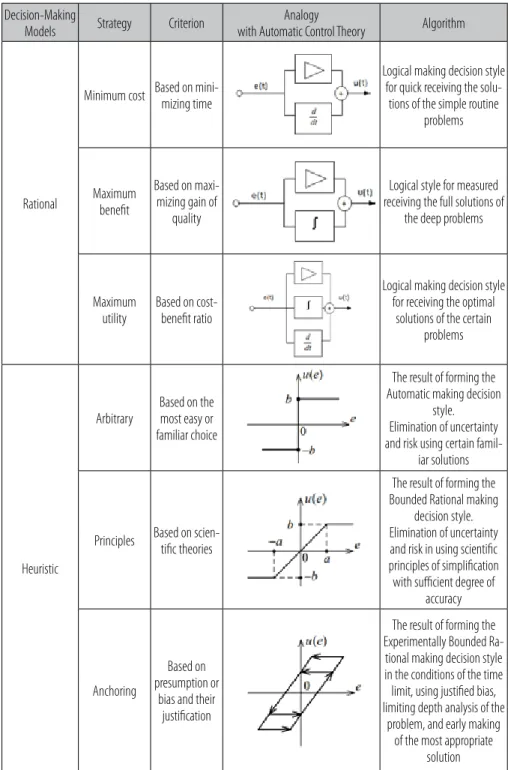
pro-cesses of the non-linear elements. The results of Simulation Modelling of the
Table 3. The Taxonomy of the automatic control theory elements depending on the decision-making models
Decision-Making
Models Strategy Criterion with Automatic Control TheoryAnalogy Algorithm
Rational
Minimum cost Based on mini-mizing time
Logical making decision style for quick receiving the
solu-tions of the simple routine problems
Maximum benefit
Based on maxi-mizing gain of
quality
Logical style for measured receiving the full solutions of
the deep problems
Maximum
utility Based on cost-benefit ratio
Logical making decision style for receiving the optimal
solutions of the certain problems
Heuristic
Arbitrary Based on the most easy or familiar choice
The result of forming the Automatic making decision
style. Elimination of uncertainty and risk using certain
famil-iar solutions
Principles Based on scien-tific theories
The result of forming the Bounded Rational making
decision style. Elimination of uncertainty and risk in using scientific principles of simplification with sufficient degree of
accuracy
Anchoring
Based on presumption or
bias and their justification
The result of forming the Experimentally Bounded Ra-tional making decision style in the conditions of the time limit, using justified bias, limiting depth analysis of the
problem, and early making of the most appropriate
Intuitive
Common sense axioms and Based on judgment
The result of forming the intuitive strategy in the bases
of the Own Judgment. Characterized by the ability to highlight key points of the
problem situation and think by “big picture”
Empirical Based on exist-ing knowledge
The result of forming the intuitive strategy in the bases
of the Own Experience. Characterized by the ability to think by “big picture”, but, if it is supported by his own experience, using empirical principles of simplification
Preference
Based on pro-pensity, hobby,
tendency, and expectation
The result of forming the Semi-Automatic making
decision style via certain preferred solutions due to thinking by “too big
picture”
Trial and Error exhaustive trialBased on
The result of forming the intuitive strategy in the bases
of the “Gut Feeling”. Characterized by the ability to think based in the results of emotional memory, which
realizes two solutions – Failure or Success
Concluding remarks
The conclusions of the experiments allow developing and improving the
theo-ry of decision-making in terms of the study and classification of specificity of the HIP in different conditions. Thus, it was found that the main distinguish-ing feature between the Heuristic / Intuitive from Rational Decision-Makdistinguish-ing Models is the presence so-called phenomenon of “enrichment” of the input signal by the own experience of decision-maker, as well as internal sensations (sometimes in the absence of logic) of certain decision steps correctness.
deci-sion results in various parameters characterizing the decideci-sion-maker, the au-thors propose a complex of simulation models of decision-making techniques using analogies with the Automatic Control Theory.
As a result of the experiments taxonomy of the most typical Automatic Con-trol Theory elements and their compliance with certain decision-making
models with a point of view of DMP specificity and on decision-maker
be-havior during a certain time of professional activity was obtained.
References
Allard, C.R. et al. (2003). Antecedents of Effective Decision Making: A
Cog-nitive Approach. Research Memoranda 045. Maastricht: METEOR, Maastricht
Research School of Economics of Technology and Organization.
Bai Ju et al. (2007). Intuitive Decision Theory Analysis and the Evaluation Model. Management Science and Engineering, 1(2), 63-67.
Beach, L.R. et al. (1978). A Contingency Model for the Selection of
Deci-sion Strategies. Academy of Management Review, 3, 439-449.
Luck, C. (2009). Intuitive and Rational Approaches to Decision Making in Education. Doctoral Dissertation. University of Hull..
Smith, E.A. (2001). The Role of Tacit and Explicit Knowledge in the Work-place. Journal of Knowledge Management, 5(4), 311-321.
Lunenburg, F.C. (2010). The Decision Making Process. National forum of
educational a MD administration and supervision journal, 27(4), 1-12.
Hammond, K.R. (1996). Human Judgment and Social Policy: Irreducible
Uncertainty, Inevitable Error, Unavoidable Injustice. New York: Oxford Uni-versity Press.
Hastie, R., and Dawes, R.M. (2001). Rational Choice in an Uncertain
World: The psychology of judgment and decision making. Thousand Oaks:
Sage Publications.
Reason, J. (1990). Human Error. New York: Cambridge University Press.
Lamb, CJ., and Lachow I. (2006). Reforming Pentagon Strategic Decision-making. Washington, D.C.: Institute for National Strategic Studies.
March, J.G. (1991). Exploration and Exploitation in Organization Learn-ing. Organization Science, 2.
Pratt M.G. et al. (2007). Exploring Intuition and its Role in Managerial Decision Making. Academy of Management Review, 32(1).
Policastro E. (1999). Intuition. In M.A. Runco and S.R. Pritzker (Eds.), Encyclopaedia of creativity, 2, (pp. 89-93). San Diego: Academic Press.
Rizun, N.O. (2013). Development of Methods and Models of Inaccuracy Minimization of the Machine-to-Human Interaction in Automated Systems of Professional Readiness Level Diagnostics. “Nauchniy Visnyk NMU”, No 2.
Saroj, K.A. (2009). Decision Making: Meaning and Definition. Retrieved from http://www.excellentguru.com/index.php.
Simon, H.A. (1997). Models of bounded rationality: Empirically Grounded Economic Reason. Cambridge: MIT Press.
Simon, H.A. (2009). Economics, Bounded Rationality, and the Cognitive Revolution. Northampton: Edward Elgar Publishing.
Towler M. (2010). Rational Decision Making: An introduction. New York: Wiley.
Tversky, A., and Kahneman, D. (1974). Judgment under Uncertainty: Heu-ristics and Biases, Science, 185(4157), 1124-1131.
Wagner, R.K. et al. (1986). Tacit Knowledge and Intelligence in the Everyday World in Practical Intelligence: Nature and Origins of Competence in the Every-day World. New York: Cambridge University Press.
Weick, K.E. (2001). Making Sense of the Organization. Oxford: Blackwell