Volume 5, Issue 4, 2018, pp. 200-209 Available online at www.jallr.com ISSN: 2376-760X
* Correspondence: Rawabi Majid Alalwani, Email: rawabimajid gmail.com © 2018 Journal of Applied Linguistics and Language Research
A Contrastive Study of Using Euphemism in English and Arabic
Jawaher Ali Almufawez
Yanbu University College, Saudi Arabia
Rawabi Majid Alalwani*
Yanbu University College, Saudi Arabia
Hana Altalhi
Yanbu University College, Saudi Arabia
Abstract
This study supplied some insights into cross-cultural distinction realization by analyzing English and Arabic euphemism. It aimed to show different types of euphemism and how it is interpreted differently across cultures. In addition, the analysis was between Saudi dialect and American dialect. The researchers used questionnaire which was posted on the social media and they gave it to their family and friends. The study tried to answer the question: what are the differences and similarities of using euphemism in Saudi Arabia and America and what are the types of euphemism? The result of this study discussed many aspects like: cultural and religious beliefs and values.
Keywords: Contrastive study, Euphemism, English, Arabic
INTRODUCTION
The main purpose of language is to communicate with others. People communicate using many words. These words can affect people’s lives, so they have to choose their words carefully. Sometimes, some of them become more polite in their speech to avoid hurting others. Oxford Online Dictionary (2000) defines polite as "having or showing behavior that is respectful and considerate of other people." One type of politeness is using a euphemism. This research is a contrastive study between Arabic speakers (Saudi) and English speakers (American). The purpose of this study was to show the similarities and differences in both languages.
LITERATURE REVIEW
In this part, there is an overview of the key concepts of the study and the previous studies.
Key concepts
something unpleasant.” The word “euphemism” is derived from Greek. The prefix “eu-” means “good, well”; the stem “pheme” means “speak”; the suffix “-ism” means “action or result”. The word means “speaking well of…”, “good speech” , and “words of good omen”. All societies have their own euphemisms which depend on their cultures. However, there is a term called dysphemism which is the opposite of euphemism. Noman (2013) defines dysphemism as “ an expression with connotations that are offensive either about the denotatum or to the audience, or both, and it is substituted for a neutral or euphemistic expression for just that reason.”(Dysphemism, Para.1).
English Language: English language is an Indo- European language which is the third most widely used language in the world. It is spoken as a native language by many countries; like: the United States and the United Kingdom. However, some countries deal with it as a foreign or a second language. Immigrants affected American culture which led to affect English language. These effects may change the way of being polite. Cambridge Online Dictionary (1999) defines euphemism in English language as "a word or phrase used to avoid saying an unpleasant or offensive word which pronounced as /ˈjuː.fə.mɪ.zəm/." Arabic Language: Arabic is the most spoken language within the Semitic language group and one of the most widely spoken languages in the world. It is spoken by more than 422 million people. Arabic language was affected by the Islamic religion. Islam asks people to be more polite. For example,{اًنْسُح ِساَّنلِل اوُلوُق َو}"speak fair to the people" (Quran Israa:53, King Fahad edition), and the prophet Mohammad said, “ةقدص ةبيطلا ةملكلاو" "And the good word is a charity "show how using euphemisms in Arabic language is very common and required by their religion and culture. Noman (2013) said that euphemism in Arabic language known as (luṭf) and its derived from (laṭa:fah) which are to be kind. Euphemism is translated into Arabic as (luṭf atta’bi:r) “kind expression” or (ḥusun atta’bi:r) “nice expression”. (Euphemisms, Para2).
Previous Studies
A study was done by Ghaleb Rabab’ah (2012) which had the topic of Euphemism in Saudi Arabic and British English. It had two groups of participants. The first group was Saudi college students which included 75 male and 75 female of (+Secondary Education) level. They were from King Saud University, Faculty of Arts. The second group was British college students which included 75 male and 75 female of (+Secondary Education) level. They were from the University of Hull's, Faculty of Arts. It was a quantitative study since it used two open questionnaires. One was for the Saudi participants, and the other was for the British participants. The participants were asked about their gender and open conversational question about death, lying and bodily functions. The result of this study was no relation between the use of euphemism and gender. Also, the Saudis and the British used taboos for death and lying question, but not for bodily functions. Also, Saudi Arabic had more euphemistic expression than British English.
cross-sectional survey, there were 19 doctors described their preferred use of ‘obese’ term. In the experimental study, there were 449 patients from West London they completed a set of ratings about their beliefs about the term ‘obese’ or the doctors’ preferred euphemism. The result of that, using the term obese was avoided by doctors. The most commonly used euphemism was ‘your weight may be damaging to your health’. Patines, who were not obese, affected by the term obese. However, Patines, who were obese, showed more upsetting from the euphemism word.
Another study was conducted by Sarab Kadir Mugair (n.d) to analyze euphemism and dysphemism in English and Arabic with special reference to political discourse. This study happened at Diyala University, Iraq. The type of this study is quality. Based on some examples, the researcher discussed three features which distinguish political euphemism from others. This distinguish was in pragmatics how political euphemism violates all maxims of Grice’s cooperative principle. It was discussed dysphemism and in which way its formation process was similar and different from euphemism. The result of this study was Arabic and English languages couch euphemisms mainly in three figures of speech: metonymy, synecdoche, and circumlocution. In addition, both languages borrowed from other languages as a euphemistic process. Metonymy was the fundamental figure of speech of euphemisms and it was mainly formed in both languages for the sake of euphemisms. English and Arabic euphemisms had more resemblances and fewer distinctions. This showed that euphemism was a universal phenomenon in natural languages and it was expected that most of similarities and differences between English and Arabic may possibly be found among other natural languages.
METHODOLOGY
Participants
The Saudi participants were 20 persons, representing many levels of education. It included 25% male and 75% female. Their ages were between 20 until 60. The American participants were 20 persons, representing many levels of education. It included 50% male and 50% female. Their ages were between 20 until 60.
Instrument
The research tool used in this contrastive study was a questionnaire. A questionnaire was shared among the participants. It was designed by the researchers to gather information about people' speech towards using euphemism in their daily life. The questionnaire contained 9 topics. The researchers designed two version of questionnaire one in English and the other in Arabic.
Data Collection Procedures
The researchers designed two questionnaires to examine English and Arabic euphemisms. The researchers published the questionnaires among the native speakers in both languages. They gave the questionnaire to their family and friends. Also, they posted it on the social media. After they got more than 300 responses, they analyzed the response by dividing them into two main groups and the two main groups were divided into two sub-groups.
COMPARISON AND ANALYSIS OF DATA
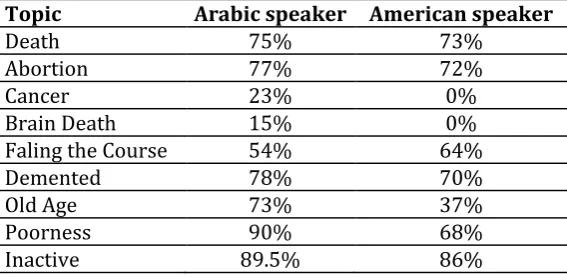
The result of this study was divided into two main groups and each group was divided into two sub-groups according to the responses to the questionnaire. It was divided into the ability to use a euphemism as a phrase or as a phrase with other things, and disability to use euphemism which divided into two groups either the participants used dysphemism kindly, or they used it alone. This table shows the percentages for using euphemisms in both languages.
Table 1. The percentages of using euphemisms in both languages
Topic Arabic speaker American speaker
Death 75% 73%
Abortion 77% 72%
Cancer 23% 0%
Brain Death 15% 0% Faling the Course 54% 64%
Demented 78% 70%
Old Age 73% 37%
Poorness 90% 68%
The Ability to Use Euphemism
a- Using Euphemism as Word or Phrase:
Cambridge Online Dictionary (1999) defines euphemism as “a word or phrase used to avoid saying an unpleasant or offensive word.” Therefore, using the euphemism as a word or a phrase is the main type of euphemism.
Examples of using euphemism as a word or a phrase:
1. I’m sorry that I have to give you some sad news but your relative has passed away 2. I have some terrible news for you. I’m so sorry to tell you this, but so-and-so has
passed away.
3. You have miscarried 4. You didn’t pass
5. Someone cannot afford. he/ she is low on funds right now
6. هراوجب هذخاو هبحا هللا "God loved that person, so he took that person next to him" 7. هنجلا لها نم كنينج " your fetus is one of the people who will be in the paradise"
8. ثيبخلا هلاج كبيرق هنا هلوقب فسلال " Unfortunately, I will tell him that your relative has the malignant disease"
9. ةليوط ةدم مانيفوس " he will sleep for a long time"
10- هبعص هيلام فورظب رمي انبحاص"Our friend is going through difficult financial circumstances"
Some of these responses were attached to other words or phrases; like: I am sorry or I have some bad/terrible news. Also in Arabic, they used some religious phrases; like هبحا هللا /Allah ahbuh/ " God loved that person" or ةنجلا لها نم وه/min 'ahl aljana/ "one of the people who will be in the paradise ." In English, the participants used passed away instead of dying, miscarried instead of abortion, did not pass instead of failed and low on funds instead of poor. In Arabic, the participants used ثيبخلا(the malignant disease) instead of ناطرسلا( cancer), ليوط مون(a long sleep ) instead of يغامدلا توملا( brain death ) and ةبعص ةيلام فورظ (difficult economic conditions) instead of ريقف( poor ). The researchers noticed that Saudi participants used more than 7 euphemistic expressions for the death topic, but American participants used one euphemistic expression.
Table 2. Euphemistic expressions for the death topic
Topics Saudi’s euphemism American’s euphemism
Death "he left the world ايندلا نم لحر" Passed away
هراوجب هذخا هللا
" God took that person next to
him" -
هللا هراتخا
" God chose him" -
هللا ديب رامعلاا
" ages in God’s hand " -
b- Using Euphemism as a Phrase with Other Things (changing situations, giving information or looking for positiveness):
Examples of using euphemism as a phrase with other things:
1. I would say I have bad news for you, probably tell them to sit down and tell them that their relatives has passed away.
2. I would tell her to calm down first and then I would tell her that her relative passed away.
3. I'm afraid that we weren't able to save your fetus but you are young enough and health enough to have more children.
4. I would say hey I saw the grades and unfortunately you did not get a passing grade. 5. I would suggest to my friends that we only ask him to chip in 10 riyals and the rest
of us divide the real cost (I would say because so-and-so is on a tight budget). 6.
كلذل انل رقتسم تسيلو ربعم راد ايندلا لك نم ىفوت بهذ هبرل ميحرلا انلكو يف اذه قيرطلا كلذل ديرا نا كربخا نا كبيرق دق هراتخا هللا ىهتناو هدعوم يف هذه ايندلا وجرأف نا بستحت رجلاا يف هتوم انإو هلل نإو هيلإ نوعجارلا .
"The world is like a road and not a stable for us, so everyone who died went to his merciful Lord. We are all in this way. I want to tell you that your relative has been chosen by God to go out from this world .Ask for reward and We are of God, and to Him we return. "
7. يبستحاو ِكل ًائينه همايقلا موي اعيفش يكل نوكيل نا كنينج هللا راتخا كلذل انثعب لبق بوتكم ايندلا هذه يف يش لك رجلاا. “Every things in life was written before we come. God chose your fetus to be your intercessor atthe Day of Judgment. Ask for reward."
8. كضوعيسو هللا ءاش نا كل ريخ هيف هوه هملعي ببسل كنينج ذخا دقو همكحب يطعيو ذخاي، ذخلااو يطعملا هوه هللا ريخ لكب "God is the giver and taker. He takes and gives for wisdom. He took your fetus for a good reason that he knew. He will compensate you with all the best"
9. ثيبخلا ضرملا هباصاف هنأش عفري نا دارا هللا دنع بوبحم صخش وه "God love this person. He wanted to raise up his position. This person has the malignant disease"
10. لصفلا اذه تيدعام هياجلا لوصفلا يدعت هللاءاش نإ ريخ كضوعي هللا" May Allah reward you with good. You will pass the coming semesters if you do not pass this semester."
In some examples, the participants tried to change the person’s position before telling the bad news. For example, if the person was standing the participants would ask him to sit down. Also, the participants gave the person some information before telling him the bad news to have an idea and to be less surprised; like: I saw the grades and unfortunately or ذخلااو يطعملا وه هللا "God is the giver and taker"/allah hu almueti walakhidh /. Also, some of the participants told the person about the positive things about this news; like: يكل نوكيل همايقلا موي اعيفش"to be your intercessor atthe Day of Judgment" / liakun likay shafieana yawm alqiamih/. Moreover, some of the participants gave a solution; like: I would suggest to my friends that we only ask him to chip in 10 riyals and the rest of us divide the real cost.
Disability to Use Euphemism
a- Using Dysphemism Kindly:
Some participants did that because they knew how the dysphemism words are so hard; therefore, they tried to use polite words to make their speech kind. This matter happens in all cultures around the world.
Example of using dysphemism kindly:
1. I’m sorry to inform you about this, but unfortunately the fetus has died. 2. I have some terrible news. I’m sorry to tell you this, but so/and-so has cancer. 3. I have some news that is sad but I'm sorry to inform you that your child/father is
clinically brain dead
4. فسلاا عم يغامد يفوتم " Unfortunately so/and-so is brain dead"
5. ايغامد تيم مكنبا نا مكرابخا دوا فسلال " Unfortunately I want to tell you that your son is brain dead"
These responses showed how participants, who differ in languages and cultures, started with the same word “sorry” or “asif” to be kind at the beginning in their response then they used the dysphemism words which are written by a bold font. This matter happened because the participants may do not have enough knowledge of their language. Also, these euphemistic words may not be known in their cultures and societies, but they are existed in languages. The table below shows the dysphemism words with the euphemistic words in both languages.
Table 3. Dysphemism words with the euphemism words in both languages
Dysphemism Words Arabic Euphemism English Euphemism Brain dead (mut damaghi) ةبوبيغghybwb Coma
Died (mut) ىفوتtawafaa Passed away Cancer (sartan) ثيبخلاalkhabith The malignant disease
It is very difficult to say “brain dead” or “ mut damaghi” to the patient’s family, but it is less difficult to say “coma” or “ ghybwb”. It is considered a problem when people do not know the euphemistic words in their first language. Ignorance of euphemismtic words may cause many problems for people. It may hurt and bother other. The researchers noticed that, although American participants have euphemistic words for the word cancer, they did not use at all. However, almost all Saudi participants used euphemistic words. That happened because American participants associate malignant with a medical purpose.
b- Using Dysphemism Alone
In this part, people used dysphemism words without trying to be kind. This happened for many reasons. It might happen because the participants, who lack kindness word in their life, cannot produce euphemistic words.
Examples of using dysphemism alone:
1. Your family member has died. His body is still alive, but he is no longer here. 2. I would just tell them they failed.
3. I would say that I did not expect him to be so old
6. ايغامد تيم هنا انفشتكا ضيرملاو هللا ديب رامعلااو هباجتسا هيفامو انيلع يللا انيوس "We did what we should do, but no response. Ages in God's hands and we discovered that the patient is brain dead"
The researchers noticed, when the participants used dysphemism words alone, their speeches became stronger and may affected people in a bad way, but it did not mean the participants wanted to be rude. In this respond “wadiha almustashfaa ally fi altayif“, it is so difficult to say that for someone who has a demented sister. In addition, this respond showed how the speaker did not care about the topic and s/he only wanted to give a solution. In the Brain Death topic, one of the participants said, “suiuna ally ealayna wamafih aistijabuh wal'iiemar biad allah walmarid aiktashafna 'anah mayit dimaghy.” This respond is so hard from the doctor to patient’s family. It showed how the doctor told them the bad news without caring about family’s feelings. Also, this is not acceptable from doctors because they should be more kind to pass these things to people. Also, the same thing happened with one of the American participants when s/he responded “Your family member has died. His body is still alive, but he is no longer here.”
After all, the researchers noticed some important points: First, Saudi speakers used many religious phrases to deliver the bad news; like: saying نوعجار هيلا ناو هلل نا/ 'iina lilah wa'an 'iilayh rajieun/ "We are of God, and to Him we return." Second, both languages have a euphemism, but one of them used it more the other one. For example, Saudi speakers used a euphemism in topics more than the American speakers and vice versa. Third, when the participants did not have the ability to use a euphemism, Saudi speakers might lie to avoid hurting others. However, the American speakers said the bad news honestly.
The researchers would have a better chance to make this contrastive study deeply, but some of the participants did not answer those topics. They replied many sentences such as:
1. 1.بعص ًادج اذه رملاا هللاو "This matter is so difficult" 2. قيلعت نودب "No comment"
3. هسفنب ملعي نا ىلا رظتنأس لوقلا عيطتسا لا "I cannot say anything I will wait for him to know from another person"
4. I’ve never had an experience like this. I do not know how to inform 5. I’m not sure to say that
6. This is hard because I have no experience in the matter.
That showed how some people do not have the ability to use their language when they have to pass bad news; that is considered a big problem. All languages serve and give many euphemistic words that make a speech more acceptable. It is so bad when people are ignorant of euphemistic words in their language. Because of that, they avoided answering those questions.
CONCLUSION
probably would use dysphemism with polite expressions. Third, both languages often used a euphemism in similar ways. The differences can be summarized in four points. First, Saudi speakers used many religious phrases to deliver the bad news. Second, in some topics, American speakers used a euphemism more than Saudi speakers. Third, if Saudi speakers had a disability to use a euphemism, they would lie to avoid hurting people. Forth, if American speakers had a disability to use a euphemism, they would say the bad news clearly.
REFERENCES
English language. (n.d.). In Wikipedia. Retrieved December 10, 2017, from https://en. wikipedia.org/wiki/English_language
Euphemism. (1999). Cambridge Online Dictionary. Retrieved https://dictionary. cambridge.org/dictionary/english/euphemism?fallbackFrom
=british-grammar&q=euphemisms
Lugha earabia. (n.d.). In Wikipedia. Retrieved December 10, 2017, https://ar.wikipedia.org/wiki/%D9%84%D8%BA%D8%A9_%D8%B9%D8%B1%D8%A 8%D9%8A%D8%A9
Mugair, S. K. (2014). A Comparative Study of Euphemism and Dysphemism in English and Arabic with Special Reference to Political Discourse. Journal of Advances in Linguistics, 4(1). Polite.(2000).. Retrieved https://en.oxforddictionaries.com/
definition/polite Oxford Online Dictionary
Rabab’ah, G., & Al-Qarni, A. M. (2012). Euphemism in Saudi Arabic and British English. Journal of Pragmatics, 44(6-7), 730-743.
Tailor, A., & Ogden, J. (2009). Avoiding the term ‘obesity’: an experimental study of the impact of doctors’ language on patients’ beliefs. Patient education and counseling, 76(2), 260-264.
Tawalbeh, A., & Al-Oqaily, E. (2012). In-directness and politeness in American English and Saudi Arabic requests: A cross-cultural comparison. Asian Social Science, 8(10), 85.
APPENDIX A
There are many undesirable utterance and phrases that are mostly replaced by other desirable instances in certain social situations due to the individuals’ willingness to be polite and inoffensive. please state the phrases that you personally use in the following situations. (not what you will do)
Topic 1: Death \ You have been informed that a friend’s relative has died. You want to pass this information to your friend. How would you say that?
Topic 2: Abortion \ Imagine that you are a doctor and your patient lost her fetal. How would you say that for her?
Topic 3: Cancer \ You have been informed that a friend's relative has cancer. You want to pass the information to your friend. How would you say that?
Topic 4: Brain Death \ Imagine that you are a doctor. You have a patient who has brain death. How would you say that for his family?
Topic 6: Demented \ A friend's sister has a problem in her mind ( demented). You want to tell him about a place that deals with patients who are like his sister. What would call that place?
Topic 7: Old age \ You met your friend’s father and you were surprised because his age is more than 70. Your friend asks you why you were surprised. What would you say to him? Topic 8: Poorness \ You have a project with your friends and all of you have to pay a lot of money You know that your friend does not have money because he is not rich. How would you say that to your friends?
Topic 9: Inactive\ Imagine that you are a teacher. You have a student who is inactive and his grade is always bad. You want to tell his parents about his level. How would you say that?
APPENDIX B
نأب صخشلا ةبغرل ًارظن ةيعامتجلاا فقاوملا يف هلادبتسا متي ام ًابلاغ و هلوق ذبحُم ريغلا ملاكلا و تارابعلا نم ديدعلا كانه ذؤم ريغ و بذهم نوكي .
ًلاضف تارابعلا هذهل داتعملا كمادختسلا ًاقفو ةيلاتلا ةلئسلاا نع بجا ، : عوضوم ١ : توملا / ؟هل كلذ لوقتس فيكف ،هربخت نا ديرتو يفوت دق كقيدص بيرق نا تملع دق
عوضوم ٢
: ضاهجلاا /
؟كلذب اهربختس فيك ،اهنينج تدقف كتضيرم و بيبط كنا ليخت
عوضوم ٣
: ناطرسلا ضرم /
نا تملع دق ؟هل كلذ لوقتس فيكف هربخت نا ديرتو ناطرسلا ضرم هيدل كقيدص بيرق
عوضوم ٤ : ًايغامد توملا /
؟كلذب هلها ربختس فيكف ًايغامد تيم ضيرم كيدلو بيبط كنا ليخت
عوضوم ٥ : يساردلا لصفلا يف قافخلاا /
فيكف كلذب هربخت نا ديرتو يساردلا لصفلا يف قفخا دق كقيدص نا تملع دق
لذ لوقتس ؟ هل ك
عوضوم ٦ : يلقع لتخم /
ةيلقع ةلكشم كقيدص تخا ىدل (
ًايلقع ةلتخم )
ىضرم عم لماعتلا هنكمي ناكم نع هربخت نا ديرتو
؟ناكملا كلذ ىلع قلطتس اذامف اهتاذ ةلكشملا مهيدل
عوضوم ٧ : زوجعلا / زواجتي هرمع و نسلا ريبك هناب تأجافت و كقيدص دلاو تلباق ٧٧
مل كقيدص كلأس و هنس ،ئجافتم تنك اذا
؟هيلع بيجتس اذامف
عوضوم ٨
: رقفلا / كلمي لا كئاقدصا دحا نا فرعت تنا و لاملا نم ريثكلا مكعورشم بلطتيو عورشم مكيدل كئاقدصاو تنا
؟هنع كئاقدصا ربختس فيكف ،عفدي ىتح لاملا
عوضوم ٩
: لسكلا / يرتو ةئيس ًامئاد هتاملاعو طيشن ريغ بلاط كيدلو ملعم كنا ليخت فيكف، هاوتسم نع هيدلاو ربخت نا د