R E V I E W
Open Access
H. pylori
exploits and manipulates innate and
adaptive immune cell signaling pathways to
establish persistent infection
Anne Müller
1*, Mathias Oertli
1and Isabelle C Arnold
1,2Abstract
Persistent infection with the gastric bacterial pathogenHelicobacter pyloricauses gastritis and predisposes carriers to a high gastric cancer risk, but has also been linked to protection from allergic, chronic inflammatory and autoimmune diseases. In the course of tens of thousands of years of co-existence with its human host,H. pylorihas evolved elaborate adaptations that allow it to persist in the hostile environment of the stomach in the face of a vigorous innate and adaptive immune response. For this review, we have identified several key immune cell types and signaling pathways that appear to be preferentially targeted by the bacteria to establish and maintain
persistent infection. We explore the mechanisms that allow the bacteria to avoid detection by innate immune cells via their pattern recognition receptors, to escape T-cell mediated adaptive immunity, and to reprogram the immune system towards tolerance rather than immunity. The implications of the immunomodulatory properties of the bacteria for the prevention of allergic and auto-immune diseases in chronically infected individuals are also discussed.
Keywords:immune evasion, innate immune signaling, immunomodulation, persistent infection
Innate immune receptor recognition of H. pylori
Innate immune cells as well as epithelial cells forming a first barrier to infection detect invading pathogens via their conserved microbial structures, the so-called patho-gen-associated molecular patterns (PAMPs). Examples of PAMPs include microbial nucleid acids, and cell wall and flagellar components such as peptidoglycan, lipopolysac-charide (LPS), lipoproteins and flagellins [1]. PAMPs are recognized by at least four distinct classes of innate immune or pattern recognition receptors (PRRs) that are present either on cytoplasmic and endosomal membranes (Toll-like receptors, TLRs, and C-type lectin receptors, CLRs) or in the cytosol (NOD-like receptors, NLRs, RIG-like receptors, RLRs). Generally speaking, the ligation of TLRs, CLRs or RLRs results in the activation of pro-inflammatory transcription factors in the nucleus; in contrast, most NLRs are involved in the assembly of multi-protein complexes termed “inflammasomes”,
which process pro-IL-1band pro-IL-18 to generate the mature, bioactive cytokines [2] (summarized in Figure 1).
PRRs are present not only on hematopoietic cells, but also on gastric epithelial cells which form a first line of defense againstH. pyloriinfection [3,4]; therefore, many of the seminal studies in the field have focused on examining
H. pylorirecognition by epithelial cells. In particular, TLR4, 5 and 9 have been detected immunohistochemically on gastric epithelial cells inH. pylori-infected as well as uninfected patients, which in principle allows these cells to sense and respond to the infection [3,4]. Interestingly,
H. pyloridiffers from other gastrointestinal pathogens in that it has evolved to largely avoid recognition by PAMPs.
H. pylori flagellin is a poor ligand of TLR5 [5] due to mutations in the TLR5 recognition site of the N-terminal D1 domain of flagellin [6]. Indeed, mutating residues 89-96 of the strongly recognizedSalmonellaflagellin to the correspondingH. pyloriflaA sequence abolishes TLR5 recognition [6]. The bacterium’s LPS consists predomi-nantly of the tetra-acylated lipid A variety, which is known to exhibit 1000-fold reduced bioactivity as compared to
E. coliLPS [7]. H. pyloriLPS activates the TLR4/MD-2 * Correspondence: [email protected]
1
Institute of Molecular Cancer Research, University of Zürich, Zürich, Switzerland
Full list of author information is available at the end of the article
Mülleret al.Cell Communication and Signaling2011,9:25 http://www.biosignaling.com/content/9/1/25
complex, but this has only been shown in vitroin cells overexpressing the complex [4]. Rather than being a strong TLR4 ligand,H. pyloriLPS is thought to activate TLR2 on gastric epithelial cells, but again this has only been demonstratedin vitrousing ectopic expression of the TLR [8,9]. Animal and cell culture experiments suggest that TLR2 ligands (LPS or other) indeed exist inH. pylori and relatedHelicobacterspecies [9-11], and can bind to TLR2 and activate NF-B in epithelial cells [9]. However, the net effects of TLR2 ligation are anti-rather than pro-inflammatoryin vivoas evidenced by lowerH. pylori colo-nization levels and more severe immunopathology in gene-targeted mice lacking TLR2 [11]. WhileH. pylori DNA activates TLR9 expressed on dendritic cells (DCs)in
vitro[10], TLR9-/-mice do not differ from wild type mice in their ability to control H. pylori infections [11].
H. pylori’s 5’-triphosphorylated RNA can be sensed by the intracellular receptor RIG-1 and triggers type I interferons in DCs [10], but the role of this response in the control of the infection and the infection-associated pathology has to date not been explored.H. pylorifurther possesses fucosy-lated ligands for the C-type lectin receptor DC-SIGN [12]. However, in contrast to the mannosylated DC-SIGN ligands ofMycobacterium tuberculosis, which activate sig-naling downstream of DC-SIGN and trigger pro-inflam-matory cytokine production, the DC-SIGN ligands of
innate immune detection by the host’s arsenal of PRRs, thereby preventing innate and adaptive immunity and ensuring its persistence.
NOD1 signaling contributes to anti-H. pylori defense mechanisms
As mentioned earlier, the NLRs NOD1 and NOD2 recog-nize peptidoglycan metabolites of various pathogenic bacteria [13,14] and induce the transcription factor B to activate immune response genes [15]. Indeed, NOD1 was among the first PRRs shown to recognize an
H. pylori-derived PAMP, i.e. its peptidoglycan [16], and has since attracted considerable attention. In their initial study, Ferrero and colleagues showed that peptidoglycan recognition by NOD1 was dependent on the expression of a functional Cag pathogenicity island (PAI)-encoded type IV secretion system (T4SS) and resulted in NF-B activation [16]. More recently, the same group demon-strated that MAP kinases and the AP1 transcription fac-tor were also activated upon peptidoglycan recognition by NOD1 [17]. NOD1 activation by cagPAI+H. pylori was further shown to be required for production of beta-defensins by gastric epithelial cells, which contributes to the bactericidal activity of cell culture supernatants againstH. pylori[18].H. pyloripeptidoglycan delivery to cytosolic NOD1 via the T4SS occurs at cholesterol-rich microdomains referred to as lipid rafts, which contain high local concentrations of the T4SS receptora5b1 integrin [19]; both cholesterol and a5b1 integrin are required for the T4SS-dependent delivery of peptidogly-can [19]. Although it was initially believed that peptido-glycan delivery occurs exclusively via the T4SS [16], Kaparakiset al. now provide evidence that outer mem-brane vesicles prepared fromcagPAI-H. pylori
can also target peptidoglycan to cytosolic NOD1, and that intra-gastric delivery of peptidoglycan via outer membrane vesicles is sufficient to trigger innate and adaptive immune responses in mice [20].
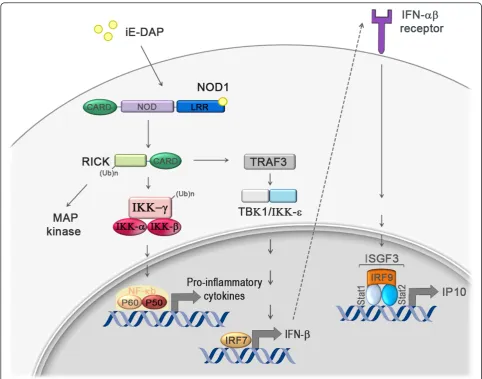
A novel pathway downstream of NOD1 was recently elucidated in an elegant study by Watanabeet al., who were able to link NOD1 signaling to the production of type I interferons and to the control ofH. pyloriinfection [21]. Upon binding to its specific ligand, iE-DAP, NOD1 was shown to induce the sequential activation of the serine threonine kinase RICK, the TNF-associated factor 3 (TRAF3), the kinases TBK1 and IKKε, and ultimately the transcription factor IFN regulatory factor 7 (IRF7) [21]. IRF7 in turn induces IFN-bproduction, which leads to activation of the heterotrimeric transcription factor com-plex IFN-stimulated gene factor 3 (ISGF3) and the subse-quent production of more IFN-b. Mice lacking the IFN-b receptor exhibit increased susceptibility toH. pylori infec-tion, thereby phenocopying the defect of NOD1-deficient mice and suggesting that this pathway participates in host
defenses againstH. pylori[21]. The complete pathway is summarized in Figure 2. The study by Watanabeet al. refutes previous work showing that Nod1 activation induces NF-B activity; at least in epithelial cells, the authors found no or minimal NF-B activation upon Nod1 ligation by iE-DAP [21]. Another interesting recent study by Liuet al. showed that NOD1 and NOD2 are tar-gets of the immunomodulatory glycoprotein olfactomedin 4 (OLFM4) in the context ofH. pylori infection [22]. OLFM4 is an NF-B target gene and associates directly with both NOD proteins, thereby creating a negative feed-back loop that impairsH. pylori-induced NF-B activation. OLFM4 knockout mice exhibited reducedH. pyloriloads and enhanced gastric immune cell infiltration compared to wild type animals, suggesting that OLFM4 acts as nega-tive regulator of H. pylori-specific, NOD-mediated immune responses [22].
Inhibition of T-cell signaling and proliferation by theH. pylorivirulence factors VacA and
g-glutamyl-transpeptidase
CD4+ MHC class II-restricted T-cells are absolutely required for the control of experimentalH. pylori infec-tions and for the development of vaccine-induced protec-tive immunity [23-25]. It therefore does not come as a big surprise thatH. pylorihas evolved virulence factors in the course of its 60.000+ years of co-existence with the human host [26] that allow it to suppress T-cell-mediated immunity. Seminal work by Haas, Cover, Bal-dari and their co-workers identified the vacuolating cyto-toxin (VacA) as a key factor in theH. pylori-mediated inhibition of human T-cells [27-29]. VacA had initially been identified due to its ability to induce vacuolization of epithelial cells [30]. Haas, Cover, Baldari and collea-gues extended these original findings to show that VacA inhibits cell proliferation by interfering with the T-cell receptor/interleukin-2 (IL-2) signaling pathway at the level of the Ca2+-calmodulin-dependent phosphatase cal-cineurin [27-29]. VacA thus prevents the nuclear translo-cation of the T-cell transcription factor NFAT, a global regulator of T-cell responses, resulting in downregulation of IL-2 gene transcription [27,28]. In subsequent studies, Haas and co-workers identifiedb2 (CD18) integrin to be the relevant receptor for VacA on human T-cells [31]. The authors were able to show that VacA exploits the recycling of lymphocyte function-associated antigen-1 (LFA-1; an integrin heterodimer on T-cells consisting of ab2 subunit associated with the CD11a asubunit) to become internalized by migrating human T-cells. LFA-1-deficient Jurkat T cells were resistant to vacuolation and IL-2 modulation, and genetic complementation restored their sensitivity to VacA [31]. A recent study further showed that VacA uptake depends on protein kinase C-mediated serine/threonine phosphorylation events,
Mülleret al.Cell Communication and Signaling2011,9:25 http://www.biosignaling.com/content/9/1/25
presumably of a specific threonine in theb2/CD18 cyto-plasmic tail [32].
An alternative mechanism of T-cell suppression has been proposed by Gerhard and co-workers, who provided evidence in 2005 that human T-cell proliferation is blocked byH. pyloriwithout accompanying effects on NFAT activation or cytokine production [33]. The authors postulated at the time that a secreted low-mole-cular-weight protein distinct from VacA arrests antigen-activated T-cells in the G1 phase of the cell cycle by interfering with G1 cyclin-dependent kinase activity [33]. The authors later demonstrated through a biochemical approach that the secretedg-glutamyl transpeptidase (GGT) ofH. pyloriis the responsible factor for inhibition of T-cell proliferation; mutagenesis of GGT abrogated
the inhibitory effect of the bacteria and recombinantly expressed GGT enzyme showed anti-proliferative activity [34]. The authors concluded from measuring reduced levels of c-Myc and phosphorylated c-Raf protein that GGT induces cell cycle arrest by disrupting the Ras sig-naling pathway [34].
H. pylori infection induces“tolerogenic”DCs and regulatory T-cells with suppressive activity
T-cells (Tregs) in infected humans, and that the deple-tion of Tregs improves immunological control over the infection and enhances vaccine-induced protective immunity in mouse models [35-38]. The degree to which the infected host generates H. pylori-specific Tregs appears to depend largely on the age at the time of infec-tion [35]. Mice that are experimentally infected as adults with virulentH. pyloriharboring the Cag pathogenicity island-encoded T4SS mentioned earlier rapidly develop gastritis and gastric cancer precursor lesions manifesting histologically as atrophic gastritis, intestinal metaplasia and epithelial hyperplasia [35]. In contrast, mice that are exposed toH. pyloriduring the neonatal period are pro-tected against the development of such lesions, despite the fact that they are colonized at much higher levels than their adult-infected counterparts. The difference in
H. pyloricolonization and the associated pathology is clo-sely linked to dramatic differences in local as well as sys-temic immune responses to the bacteria between the age groups. Neonatally infected mice develop immunological tolerance to the infection, which prevents them from generatingH. pylori-specific T-helper responses and pro-tects them from developing T-cell driven immunopathol-ogy.H. pylori-specific immunological tolerance depends on regulatory T-cells; their systemic depletion breaks tol-erance and sensitizes mice to gastric immunopathology [35]. Whether immunological tolerance develops in humans infected early enough withH. pyloriremains a matter of speculation. A study showing that infected chil-dren, but not adults, preferentially generate regulatory T-cell responses to the infection argues in favor of the tol-erance model [39].
Above and beyond their role in preventing immuno-pathological gastric T-helper responses to the infection, Tregs are crucial mediators of the protection against allergen-induced asthma that is conferred by H. pylori infection in mice [40] and humans [41-44]. In infected mice subjected to an experimental protocol inducing airway inflammation and hyper-responsiveness through sensitization and challenge with ovalbumin, the protec-tion against asthma can be abrogated by Treg depleprotec-tion [40]. Conversely, asthma protection can be transferred from infected to uninfected mice by highly purified population of Tregs [40]. The exact mechanism of the suppression of H. pylori-specific or of allergen-specific effector T-cells by H. pylori-induced regulatory T-cells is not well understood; the secretion of suppressive Treg cytokines such as IL-10 and TGF-b, but also contact-dependent mechanisms of effector T-cell suppression can be envisioned. It is of interest to note in this context that H. pyloriinfection seems to be inversely correlated not only with asthma, but also with chronic inflamma-tory conditions of the small and large intestine. Several
epidemiological studies have pointed out this
association, looking at both ulcerative colitis and Crohn’s disease patient populations [45,46]. Recent experimental evidence supports this concept; in a model ofSalmonella typhimurium-induced colitis, concomitant
H. pylori infection alleviated disease symptoms [47]. Protection against this form of colitis was attributed to reduced Th17 responses in the gut under conditions of co-infection, and coincided with the production of immunomodulatory (Treg-derived?) IL-10 in the mesen-teric lymph nodes of the co-infected mice [47].
Inducible Tregs (iTregs; in contrast to“natural”, thy-mus-derived nTregs) differentiate in the periphery as a result of their priming by dendritic cells (DCs) with “tolerogenic” rather than immunogenic properties [48]. Tolerogenic DCs convert naive T-cells into FoxP3+Tregs through antigen presentation in the absence of co-stimula-tory signals or cytokines, either alone or in combination with the production of soluble and membrane-bound tol-erogenic factors such as IL-10, TGFb, retinoic acid, and programmed death ligands [48,49]. Tolerogenic properties have been attributed to immature DCs that have taken up antigen, but have not simultaneously been exposed to TLR or NLR ligands; such DCs are believed to acquire a semi-mature state characterized by high levels of MHCII, but low or no expression of co-stimulatory molecules or pro-inflammatory cytokines [48,49]. It is tempting to speculate based on the characteristic paucity of TLR and NLR ligands that is a hallmark ofH. pylorithat the pathogen has evolved precisely to avoid DC maturation, and to thereby promote Treg rather than T-effector responses. Experimental evidence for such Treg skewing comes from
in vitroexperiments with bone-marrow-derived DCs, which showed thatH. pylori-experienced DCs appear to preferentially prime Treg over Th17 responses [50] and fail to produce pro-inflammatory cytokines [51]. The model of a predominantly tolerogenic role of DCs in the context ofH. pyloriinfection is further corroborated by the demonstration that vaccine-induced protective immu-nity can be improved by systemic DC depletion [36] and by our finding that the lungs of neonatally infected mice subjected to experimental asthma induction are populated by semi-mature (and presumably tolerogenic) DCs [40].
B-cells exhibit immunoregulatory rather than protective properties in the context ofH. pylori infection
H. pylori-infected patients are characterized by high serum titers to H. pyloriantigens, and serology is routi-nely used to diagnose the infection. Being a mucosal pathogen,H. pylori was initially suspected of triggering potentially protective mucosal IgA responses. However, early studies with mice lacking B-cells (μMT-/-mice) or antibodies (IgA-/-) revealed that vaccine-induced protec-tive immunity develops equally well in wild type and
Mülleret al.Cell Communication and Signaling2011,9:25 http://www.biosignaling.com/content/9/1/25
B-cell or antibody-deficient mice [24,52,53]. The results challenged the dogma that extracellular mucosal patho-gens are controlled by antibodies and was confirmed again in a recent study introducing a novel and very effective new adjuvant derived from mycobacterial cell walls [36]. Subsequent work by Lycke and colleagues demonstrated that antibodies are not only dispensable forH. pyloriclearance, but may even have detrimental effects on the human host [52].μMT-/- mice lacking
B-cells altogether spontaneously reduceH. pylori burdens, but develop accelerated and aggravated gastritis [52]. Gene-targeting of the IL-10 and IgA-encoding genes synergizes to clear the infection, i.e. IL-10-/-/IgA-/-mice clear H. pyloriinfections better than IL-10-/- mice, both under conditions of experimental infection of naive as well as previously vaccinated mice [54]. The combined results show rather unequivocally that B-cells impair rather than promote immunity toH. pylori.
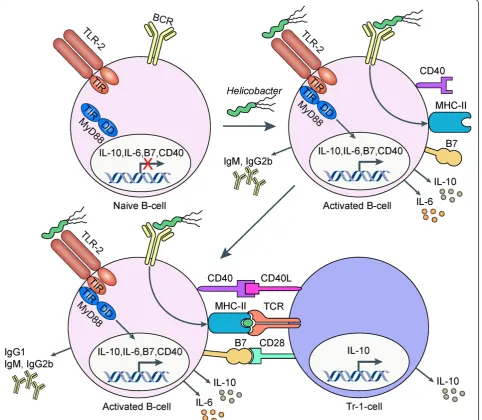
We have recently attempted to elucidate the signaling pathways that play a role in B-cellular immunosuppression in the context ofH. pyloriinfection. Interestingly, we found that B-cells exposed toHelicobacterextract pro-duced large amounts of the regulatory cytokine IL-10 [11]. B-cell recognition ofHelicobacterand the associated IL-10 production was entirely dependent on TLR2 and Myd88, as B-cells from the respective knock-out mice did not pro-duce IL-10.Helicobacter-exposed B-cells further acquired the ability to efficiently induce IL-10 production in co-cul-tured, naive CD4+T-cells, thereby converting the T-cells to T-regulatory-1 (Tr1)-like cells with suppressive activity.
In vivostudies using conditional knock-out mouse strains revealed that IL-10 production by T-cells, but not B-cells, was essential for the suppression of excessive gastric immunopathology. On the other hand, B-cells lacking Myd88 or TLR2 -in contrast to wild type B-cells- were incapable of preventing the characteristic infection-asso-ciated immunopathology of Myd88-/-or IL-10-/-strains when adoptively co-transferred with Tr1 cells [11]. Taken together, the results (summarized in Figure 3) suggest that the B-cell/Tr-1 cell axis is essential for balancing the con-trol ofHelicobacterinfection with the prevention of exces-sive T-cell-driven gastric immunopathology.
Conclusions
H. pylorihas co-evolved with its human host for at least 30.000 years [55]. In contrast to most other bacterial pathogens, which temporarily cause virulent disease but are then rapidly cleared upon the onset of a pathogen-spe-cific adaptive immune response,H. pyloripersists in its host for decades, if not for life. This extraordinary ability to thrive in the face of a robust and vigorous local and sys-temic immune response is due to elaborate evolutionary adaptations ofH. pylorithat allow the bacteria to not only escape detection by pattern recognition receptors on innate immune cells, but to also evade adaptive immunity. The immunomodulatory properties of the pathogen repro-gram the immune system towards immunological toler-ance and assist the bacteria in establishing persistent infection. A byproduct ofH. pylori-specific immunomodu-lation and immune tolerance is evident in Western socie-ties that have largely eliminated the infection due to reduced transmission rates, frequent use of antibiotics in childhood and better sanitation. In these populations, the rates of asthma, allergies and other chronic inflammatory and auto-immune diseases have reached epidemic propor-tions; the inverse correlation of the incidence of such dis-eases andH. pylori infection rates is striking and deserves further investigation. A better understanding of the signal-ing pathways and molecular players targeted byH. pylori to manipulate the host immune response and establish and maintain persistence will be instrumental for improv-ing rational H. pylori vaccine design and possibly for
exploitingH. pylori’s protective properties for asthma and allergy prevention and treatment.
Acknowledgements
Work in the laboratory of A.M. is supported by the University of Zurich Research Priority Program in Systems Biology, the Swiss National Science Foundation and the Swiss and Zurich Cantonal Cancer Leagues.
Author details
1
Institute of Molecular Cancer Research, University of Zürich, Zürich, Switzerland.2Sir William Dunn School of Pathology, University of Oxford,
Oxford, UK.
Authors’contributions
AM wrote the manuscript; ICA and MO contributed the figures. All authors have read and approved the final manuscript.
Competing interests
The authors declare that they have no competing interests.
Received: 28 July 2011 Accepted: 1 November 2011 Published: 1 November 2011
References
1. Ishii KJ, Koyama S, Nakagawa A, Coban C, Akira S:Host innate immune receptors and beyond: making sense of microbial infections.Cell Host Microbe2008,3:352-363.
2. Brodsky IE, Monack D:NLR-mediated control of inflammasome assembly in the host response against bacterial pathogens.Semin Immunol2009,
21:199-207.
3. Schmausser B, Andrulis M, Endrich S, Lee SK, Josenhans C, Muller-Hermelink HK, Eck M:Expression and subcellular distribution of toll-like receptors TLR4, TLR5 and TLR9 on the gastric epithelium in Helicobacter pylori infection.Clin Exp Immunol2004,136:521-526.
4. Ishihara S, Rumi MA, Kadowaki Y, Ortega-Cava CF, Yuki T, Yoshino N, Miyaoka Y, Kazumori H, Ishimura N, Amano Y, Kinoshita Y:Essential role of MD-2 in TLR4-dependent signaling during Helicobacter pylori-associated gastritis.J Immunol2004,173:1406-1416.
5. Gewirtz AT, Yu Y, Krishna US, Israel DA, Lyons SL, Peek RM Jr:Helicobacter pylori flagellin evades toll-like receptor 5-mediated innate immunity.J Infect Dis2004,189:1914-1920.
6. Andersen-Nissen E, Smith KD, Strobe KL, Barrett SL, Cookson BT, Logan SM, Aderem A:Evasion of Toll-like receptor 5 by flagellated bacteria.Proc Natl Acad Sci USA2005,102:9247-9252.
7. Moran AP, Lindner B, Walsh EJ:Structural characterization of the lipid A component of Helicobacter pylori rough- and smooth-form lipopolysaccharides.J Bacteriol1997,179:6453-6463.
8. Smith MF Jr, Mitchell A, Li G, Ding S, Fitzmaurice AM, Ryan K, Crowe S, Goldberg JB:Toll-like receptor (TLR) 2 and TLR5, but not TLR4, are required for Helicobacter pylori-induced NF-kappa B activation and chemokine expression by epithelial cells.J Biol Chem2003,278:32552-32560. 9. Chaouche-Drider N, Kaparakis M, Karrar A, Fernandez MI, Carneiro LA,
Viala J, Boneca IG, Moran AP, Philpott DJ, Ferrero RL:A commensal Helicobacter sp. of the rodent intestinal flora activates TLR2 and NOD1 responses in epithelial cells.PLoS One2009,4:e5396.
10. Rad R, Ballhorn W, Voland P, Eisenacher K, Mages J, Rad L, Ferstl R, Lang R, Wagner H, Schmid RM,et al:Extracellular and intracellular pattern recognition receptors cooperate in the recognition of Helicobacter pylori.Gastroenterology2009,136:2247-2257.
11. Sayi A, Kohler E, Toller IM, Flavell RA, Muller W, Roers A, Muller A: TLR-2-activated B cells suppress Helicobacter-induced preneoplastic gastric immunopathology by inducing T regulatory-1 cells.J Immunol2011,
186:878-890.
12. Gringhuis SI, den Dunnen J, Litjens M, van der Vlist M, Geijtenbeek TB:
Carbohydrate-specific signaling through the DC-SIGN signalosome tailors immunity to Mycobacterium tuberculosis, HIV-1 and Helicobacter pylori.Nat Immunol2009,10:1081-1088.
13. Chamaillard M, Hashimoto M, Horie Y, Masumoto J, Qiu S, Saab L, Ogura Y, Kawasaki A, Fukase K, Kusumoto S,et al:An essential role for NOD1 in Mülleret al.Cell Communication and Signaling2011,9:25
http://www.biosignaling.com/content/9/1/25
host recognition of bacterial peptidoglycan containing diaminopimelic acid.Nat Immunol2003,4:702-707.
14. Girardin SE, Boneca IG, Carneiro LA, Antignac A, Jehanno M, Viala J, Tedin K, Taha MK, Labigne A, Zahringer U,et al:Nod1 detects a unique
muropeptide from gram-negative bacterial peptidoglycan.Science2003,
300:1584-1587.
15. Kim YG, Park JH, Shaw MH, Franchi L, Inohara N, Nunez G:The cytosolic sensors Nod1 and Nod2 are critical for bacterial recognition and host defense after exposure to Toll-like receptor ligands.Immunity2008,
28:246-257.
16. Viala J, Chaput C, Boneca IG, Cardona A, Girardin SE, Moran AP, Athman R, Memet S, Huerre MR, Coyle AJ,et al:Nod1 responds to peptidoglycan delivered by the Helicobacter pylori cag pathogenicity island.Nat Immunol2004,5:1166-1174.
17. Allison CC, Kufer TA, Kremmer E, Kaparakis M, Ferrero RL:Helicobacter pylori induces MAPK phosphorylation and AP-1 activation via a NOD1-dependent mechanism.J Immunol2009,183:8099-8109.
18. Grubman A, Kaparakis M, Viala J, Allison C, Badea L, Karrar A, Boneca IG, Le Bourhis L, Reeve S, Smith IA,et al:The innate immune molecule, NOD1, regulates direct killing of Helicobacter pylori by antimicrobial peptides. Cell Microbiol12:626-639.
19. Hutton ML, Kaparakis-Liaskos M, Turner L, Cardona A, Kwok T, Ferrero RL:
Helicobacter pylori exploits cholesterol-rich microdomains for induction of NF-kappaB-dependent responses and peptidoglycan delivery in epithelial cells.Infect Immun2010,78:4523-4531.
20. Kaparakis M, Turnbull L, Carneiro L, Firth S, Coleman HA, Parkington HC, Le Bourhis L, Karrar A, Viala J, Mak J,et al:Bacterial membrane vesicles deliver peptidoglycan to NOD1 in epithelial cells.Cell Microbiol 12:372-385.
21. Watanabe T, Asano N, Fichtner-Feigl S, Gorelick PL, Tsuji Y, Matsumoto Y, Chiba T, Fuss IJ, Kitani A, Strober W:NOD1 contributes to mouse host defense against Helicobacter pylori via induction of type I IFN and activation of the ISGF3 signaling pathway.J Clin Invest120:1645-1662. 22. Liu W, Yan M, Liu Y, Wang R, Li C, Deng C, Singh A, Coleman WG Jr,
Rodgers GP:Olfactomedin 4 down-regulates innate immunity against Helicobacter pylori infection.Proc Natl Acad Sci USA2010,
107:11056-11061.
23. Akhiani AA, Pappo J, Kabok Z, Schon K, Gao W, Franzen LE, Lycke N:
Protection against Helicobacter pylori infection following immunization is IL-12-dependent and mediated by Th1 cells.J Immunol2002,
169:6977-6984.
24. Ermak TH, Giannasca PJ, Nichols R, Myers GA, Nedrud J, Weltzin R, Lee CK, Kleanthous H, Monath TP:Immunization of mice with urease vaccine affords protection against Helicobacter pylori infection in the absence of antibodies and is mediated by MHC class II-restricted responses.J Exp Med1998,188:2277-2288.
25. Sayi A, Kohler E, Hitzler I, Arnold I, Schwendener R, Rehrauer H, Muller A:
The CD4+ T cell-mediated IFN-gamma response to Helicobacter infection is essential for clearance and determines gastric cancer risk.J Immunol2009,182:7085-7101.
26. Linz B, Balloux F, Moodley Y, Manica A, Liu H, Roumagnac P, Falush D, Stamer C, Prugnolle F, van der Merwe SW,et al:An African origin for the intimate association between humans and Helicobacter pylori.Nature
2007,445:915-918.
27. Gebert B, Fischer W, Weiss E, Hoffmann R, Haas R:Helicobacter pylori vacuolating cytotoxin inhibits T lymphocyte activation.Science2003,
301:1099-1102.
28. Boncristiano M, Paccani SR, Barone S, Ulivieri C, Patrussi L, Ilver D, Amedei A, D’Elios MM, Telford JL, Baldari CT:The Helicobacter pylori vacuolating toxin inhibits T cell activation by two independent mechanisms.J Exp Med2003,198:1887-1897.
29. Sundrud MS, Torres VJ, Unutmaz D, Cover TL:Inhibition of primary human T cell proliferation by Helicobacter pylori vacuolating toxin (VacA) is independent of VacA effects on IL-2 secretion.Proc Natl Acad Sci USA
2004,101:7727-7732.
30. Cover TL, Blaser MJ:Purification and characterization of the vacuolating toxin from Helicobacter pylori.J Biol Chem1992,267:10570-10575. 31. Sewald X, Gebert-Vogl B, Prassl S, Barwig I, Weiss E, Fabbri M, Osicka R,
Schiemann M, Busch DH, Semmrich M,et al:Integrin subunit CD18 Is the T-lymphocyte receptor for the Helicobacter pylori vacuolating cytotoxin. Cell Host Microbe2008,3:20-29.
32. Sewald X, Jimenez-Soto L, Haas R:PKC-dependent endocytosis of the Helicobacter pylori vacuolating cytotoxin in primary T lymphocytes.Cell Microbiol13:482-496.
33. Gerhard M, Schmees C, Voland P, Endres N, Sander M, Reindl W, Rad R, Oelsner M, Decker T, Mempel M,et al:A secreted low-molecular-weight protein from Helicobacter pylori induces cell-cycle arrest of T cells. Gastroenterology2005,128:1327-1339.
34. Schmees C, Prinz C, Treptau T, Rad R, Hengst L, Voland P, Bauer S, Brenner L, Schmid RM, Gerhard M:Inhibition of T-cell proliferation by Helicobacter pylori gamma-glutamyl transpeptidase.Gastroenterology
2007,132:1820-1833.
35. Arnold IC, Lee JY, Amieva MR, Roers A, Flavell RA, Sparwasser T, Muller A:
Tolerance rather than immunity protects from Helicobacter pylori-induced gastric preneoplasia.Gastroenterology2011,140:199-209. 36. Hitzler I, Oertli M, Becher B, Agger EM, Muller A:Dendritic Cells Prevent
Rather Than Promote Immunity Conferred by a Helicobacter Vaccine Using a Mycobacterial Adjuvant.Gastroenterology2011,141:186-196. 37. Lundgren A, Stromberg E, Sjoling A, Lindholm C, Enarsson K, Edebo A,
Johnsson E, Suri-Payer E, Larsson P, Rudin A,et al:Mucosal FOXP3-expressing CD4+ CD25high regulatory T cells in Helicobacter pylori-infected patients.Infect Immun2005,73:523-531.
38. Lundgren A, Suri-Payer E, Enarsson K, Svennerholm AM, Lundin BS:
Helicobacter pylori-specific CD4+ CD25high regulatory T cells suppress memory T-cell responses to H. pylori in infected individuals.Infect Immun2003,71:1755-1762.
39. Harris PR, Wright SW, Serrano C, Riera F, Duarte I, Torres J, Pena A, Rollan A, Viviani P, Guiraldes E,et al:Helicobacter pylori gastritis in children is associated with a regulatory T-cell response.Gastroenterology2008,
134:491-499.
40. Arnold IC, Dehzad N, Reuter S, Martin H, Becher B, Taube C, Muller A:
Helicobacter pylori infection prevents allergic asthma in mouse models through the induction of regulatory T cells.J Clin Invest2011,
121:3088-3093.
41. Blaser MJ, Chen Y, Reibman J:Does Helicobacter pylori protect against asthma and allergy?Gut2008,57:561-567.
42. Chen Y, Blaser MJ:Inverse associations of Helicobacter pylori with asthma and allergy.Arch Intern Med2007,167:821-827.
43. Chen Y, Blaser MJ:Helicobacter pylori colonization is inversely associated with childhood asthma.J Infect Dis2008,198:553-560.
44. Reibman J, Marmor M, Filner J, Fernandez-Beros ME, Rogers L, Perez-Perez GI, Blaser MJ:Asthma is inversely associated with Helicobacter pylori status in an urban population.PLoS One2008,3:e4060. 45. Pronai L, Schandl L, Orosz Z, Magyar P, Tulassay Z:Lower prevalence of
Helicobacter pylori infection in patients with inflammatory bowel disease but not with chronic obstructive pulmonary disease - antibiotic use in the history does not play a significant role.Helicobacter2004,
9:278-283.
46. Sladek M, Jedynak-Wasowicz U, Wedrychowicz A, Kowalska-Duplaga K, Pieczarkowski S, Fyderek K:[The low prevalence of Helicobacter pylori gastritis in newly diagnosed inflammatory bowel disease children and adolescent].Przegl Lek2007,64(Suppl 3):65-67.
47. Higgins PD, Johnson LA, Luther J, Zhang M, Sauder KL, Blanco LP, Kao JY:
Prior Helicobacter pylori infection ameliorates Salmonella typhimurium-induced colitis: Mucosal crosstalk between stomach and distal intestine. Inflamm Bowel Dis17:1398-408.
48. Maldonado RA, von Andrian UH:How tolerogenic dendritic cells induce regulatory T cells.Adv Immunol2010,108:111-165.
49. Kretschmer K, Apostolou I, Hawiger D, Khazaie K, Nussenzweig MC, von Boehmer H:Inducing and expanding regulatory T cell populations by foreign antigen.Nat Immunol2005,6:1219-1227.
50. Kao JY, Zhang M, Miller MJ, Mills JC, Wang B, Liu M, Eaton KA, Zou W, Berndt BE, Cole TS,et al:Helicobacter pylori immune escape is mediated by dendritic cell-induced Treg skewing and Th17 suppression in mice. Gastroenterology2010,138:1046-1054.
51. Wang YH, Gorvel JP, Chu YT, Wu JJ, Lei HY:Helicobacter pylori impairs murine dendritic cell responses to infection.PLoS One2010,5:e10844. 52. Akhiani AA, Schon K, Franzen LE, Pappo J, Lycke N:Helicobacter
53. Garhart CA, Nedrud JG, Heinzel FP, Sigmund NE, Czinn SJ:Vaccine-induced protection against Helicobacter pylori in mice lacking both antibodies and interleukin-4.Infect Immun2003,71:3628-3633.
54. Akhiani AA, Stensson A, Schon K, Lycke NY:IgA antibodies impair resistance against Helicobacter pylori infection: studies on immune evasion in IL-10-deficient mice.J Immunol2005,174:8144-8153. 55. Moodley Y, Linz B, Yamaoka Y, Windsor HM, Breurec S, Wu JY, Maady A,
Bernhoft S, Thiberge JM, Phuanukoonnon S,et al:The peopling of the Pacific from a bacterial perspective.Science2009,323:527-530.
56. Watanabe T, Asano N, Kitani A, Fuss IJ, Chiba T, Strober W:NOD1-Mediated Mucosal Host Defense against Helicobacter pylori.Int J Inflam
2010:476482.
doi:10.1186/1478-811X-9-25
Cite this article as:Mülleret al.:H. pyloriexploits and manipulates innate and adaptive immune cell signaling pathways to establish
persistent infection.Cell Communication and Signaling20119:25.
Submit your next manuscript to BioMed Central and take full advantage of:
• Convenient online submission
• Thorough peer review
• No space constraints or color figure charges
• Immediate publication on acceptance
• Inclusion in PubMed, CAS, Scopus and Google Scholar
• Research which is freely available for redistribution
Submit your manuscript at www.biomedcentral.com/submit Mülleret al.Cell Communication and Signaling2011,9:25
http://www.biosignaling.com/content/9/1/25