21
Year Classes: an eLearning Journey for
Students and Staff
Osu Lilje, Mary Peat
Corresponding author osu,[email protected]
School of Biological Sciences, The University of Sydney, Sydney NSW 2006, Australia
Keywords: eLearning, large classes, human biology
Abstract
This paper reports on a journey that has seen the remodelling and redevelopment over a ten year period of a first year human biology course. The students enrolled in the current course are enrolled in many different degree programs (about 15) and thus come with different expectations and aspirations. The course was first introduced in 1996 as a second semester course that not only assumed the knowledge from a prior first semester tertiary level biology course but also the benefit of a semester of tertiary study where the emphasis was student-centred rather than teacher-directed. It is currently a first semester course and additional help is being added to provide for the transition from school to university.
The move from a fully face-to-face to a blended learning environment started in 1998 with the replacement of one lecture a week with an independent student activity that could be done anywhere and at anytime. Then, in response to student requests, more of the content of the curriculum was presented in the online environment with an emphasis on blending the face-to-face activities with the online components, using these online components to direct the overall learning activities.
Evidence that indicates we are providing a supportive blended learning environment is reported here.
International Journal of Innovation in Science and Mathematics Education 18(2) 21-31, 2010
Introduction
22
The effective implementation of eLearning into a course so that it enhances the learning experience is an issue that must be grappled with by all educators (Moni, Moni, Poronnik & Lluka, 2007; Salmon, 2005). Blending tradition with online activities requires careful evaluation (Lilje, Krishnan & Peat, 2007). Evaluation of the eLearning resources developed and research on the effectiveness of their use in first year biology at the University of Sydney has been standard practice (Franklin, Peat & Lewis, 2003; Lilje, Breen, Lewis & Yalcin, 2008a and b; Lilje et al., 2007; Peat 2000; Peat, Franklin, Devlin & Charles 2005).
Prior to 1996 the first year biology courses at the University of Sydney were traditionally delivered each week by three face-to-face lectures and a three hour laboratory class. There has never been provision for tutorials or discussion workshops or other student-centred activities outside the laboratory classroom because of large student numbers. The courses have gradually changed from being primarily teacher-centred to student-centred. This has largely come about by the change in teaching philosophy over the last two decades and the strategic incorporation since 1996 of one of the first virtual learning environments in science teaching (Peat, Taylor & Fernandez, 2002). In addition student numbers have doubled during this time (from 632 enrolments in 1997 to 1404 in 2009).
With increasing availability of stable information technology, along with student pressure to increase flexibility and choice for them, and a desire on our part to provide more student-centred learning activities, our first year human biology course has undergone a series of major changes across the years to better provide for the diversifying needs of incoming students in the twenty first century. The first change consisted of replacing one face-to-face lecture with instructions for a weekly independent study module (ISM) that was paper-based, and incorporated into the laboratory manual. This reduced the time on campus required by students to complete the course. The second change embraced the use of the (then new) University learning management system (WebCT) and provided for an online component (HBOnline) that acted as a navigational and directional system within the course for the students. The third change addressed an important generic graduate attribute by providing students with an interactive online tool to help them develop better scientific writing skills.
This paper tells the story of these developments; what they are; why we did them; and, what research evidence we have to support our assertion that we have provided a richer, more supportive, and student-centred learning environment.
The developments
Independent Study Module
The ISM was introduced in response to student comments and requests to provide independent materials and to reduce the face-to-face component of the unit. In addition the University requires us to provide for the development of a set of articulated generic skills that include personal skills of self-management, flexibility and independent learning. The ISM material was paper-based, and incorporated into the laboratory manual which was provided at the beginning of the course. Students were given a set of activities to complete before going to each week’s classes and while this gave students more choice as to when they did the work it did not necessarily give them a better learning environment that encouraged engagement with and deep processing of the materials.
23
approriate class. Students were divided as to whether the flexibility of studying the materials in their own time was useful, 45% agreeing it was useful, 25% unsure and 30% disagreeing that it was useful. This may have been related to the number of students with other commitments, such as paid work. Only 52% of students agreed that the flexible learning modules supported their learning, with 34% being uncertain, and this probably correlates with the fact that only 30% regularly completed the modules prior to the relevant class. Open-ended responses to being asked how the flexible modules helped them, included “very helpful, if you did it” and “better than lecture as you had to sit down and think about the subject” (Peat, Franklin & Mackay-Wood, 1998).
In a subsequent review of the course, and in response to favourable comments by students about online learning, it was decided to move the ISM and other legacy materials to the online learning environment.
HBOnline
The development of online material in 2005 was modelled to complement the online environment of WebCT which had been adopted at the University. The main aims were to: convert content rich, linear print courseware into online courseware which supported authentic case-based learning and incorporated additional online learning resource materials; increase the flexibility of the learning environment; enhance student participation in coursework materials; provide timely and constructive feedback; and, monitor students’ progress through the courseware. The development, known as HBOnline, included legacy materials from paper-based laboratory notes and ISMs along with new developments such as case studies. The development of HBOnline and its early use by students has been previously described (Lilje, Lewis, Yalcin, Scott, Melville & Peat 2005). The re-engineering of existing materials provided the opportunity to clarify the expected learning outcomes, with an emphasis on students developing responsibility and independence as learners and gaining experience with: observing and recording; asking relevant questions; making decisions and forming conclusions on the basis of observations; scientific reporting; and, using computers. One of the key features of HBOnline made possible by WebCT is that the online materials constantly refer to activities in the lab and lectures, and the paper-based materials all refer to the online materials. We believe this gave a greater linkage between the various parts of the course.
24
Table 1: Comparison of the use of resources (n=42)
Percentage of responses from students who completed/attempted the materials
Did not use/ Did not do (%)
Not useful Useful Extremely useful
HBOnline
2 7 41 52
Self-assessment modules
31 7 69 24
Crossword puzzles 34 67 33 0
Mid course practice exam 48 0 59 41
Special Lectures 2 27 61 12
Practical class notes 0 5 83 12
Lecture notes 0 2 52 46
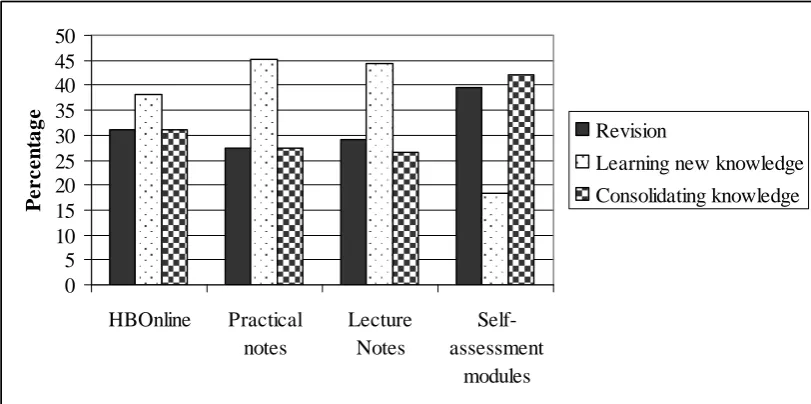
These survey data show that students were using the new HBOnline resource and viewed it as an important part of their learning strategy. In addition the survey asked students which of three categories best represent their use of the resources. The results are shown in Figure 1.
Figure 1: Use of learning resources for supporting learning and understanding
HBOnline was used equally for revision, learning new knowledge and consolidating knowledge, reflecting the aims of developing the module. By contrast, the self-assessment modules (available at that time through WebCT but not within HBOnline) were used mainly for revision and consolidation of knowledge, and the practical and lecture notes used mainly for learning new knowledge.
Continuing investigation into student use of HBOnline (Lilje et al., 2007) with a new cohort of students provided comparative data that indicated there was little difference in use and perceptions of usage between two cohorts of students. The strong evidence of engagement with the resource is a clear measure of how well this online resource had been integrated into the curriculum.
0 5 10 15 20 25 30 35 40 45 50
HBOnline Practical notes
Lecture Notes
Self-assessment
modules
P
erc
en
ta
g
e
Revision
Learning new knowledge
25
In an attempt to see if there was any correlation between usage of HBOnline and the development of better scientific writing skills, answers to the same two questions in the final examination paper for the students in 2004 (before the introduction of HBOnline), 2005 and 2006 were subjected to a SOLO (Structure of the Observed Learning Outcome) taxonomic evaluation (Biggs & Collis, 1982). The use of SOLO enabled the scoring of answers in five levels, with 0 (zero) indicating the lowest level or pre-structural response and 4 (four) an extended abstract response. Figure 2 (previously described in Lilje & Peat, 2007) shows the distribution of SOLO scores as percentages for examination answers for the three cohorts of students.
Figure 2: Distribution of SOLO scores for examination answers
There appears to be no apparent trend, and it is of interest that the students in 2006 all gained at least a credit overall in the course whilst scoring at a lower SOLO level compared with the students in 2004 and 2005 (some of whom gained only a pass overall in the course). This led to a rethink about the support that might be needed for incoming students to develop scientific writing skills and was thus the driver for the third change, the development of ORWET.
ORWET
A significant component of the course has always been the writing of a scientific report. Student comments about their discontent about writing a report and the marking of it led to the third major change to the course. Students indicated they were not experienced enough to write within the genre we required. In addition, with large numbers of people marking the report (often up to 20 people), there has been an undercurrent of concern by both the students and the course organising staff about the equality of the marking. As we couldn’t change the number of people marking or the fact that our students enter tertiary study with a disparate range of experiences between them, an online writing tool was conceived. The tool, Online Report Writing Evaluation Tool (ORWET), was developed with two audiences in mind. The first is the group of markers. The tool aims to help increase staff awareness and interpretation of the marking criteria for the scientific report. The second audience consists of the students and their part of the tool is used to help them understand what is required in a scientific report and gives them opportunities to learn by critiquing reports using a set of marking criteria. One of the aims of this two-sided tool was to allow for better alignment of student and staff expectations about assessment through formative activities, where examples of different standards are marked against a common set of criteria as discussed by Rust, Price & O’Donovan (2003) and O’Donovan, Price & Rust (2004). Also the development of the tool provided us with a technological response to the need for supporting (a large number of) students within their own learning journey. Aspects of the development of this tool have been
0 5 10 15 20 25 30 35 40 45
0 1 2 3 4
SOLO levels
26
described in Lilje et al. (2008a) and Lilje et al. (2008b). The tool was first introduced to students in 2008.
In brief, the ORWET structure utilises the quiz function of WebCT. It is made up of three modules or exercises which are based on one of three experiments that are rotated from year to year as part of the summative scientific report writing assessment in the course. Within each module there are four components, the Introduction, Materials and Method, Results and Discussion. There are a number of versions of each component to provide varying quality for the students. Students are provided with a set of marking criteria and then, using the quiz function of WebCT, they are asked to mark the components of a module and receive a mark for their effort along with feedback.
Early use of this tool has been evaluated. There are about 40 casual staff involved in teaching within the program and from their perspectives the tool is considered to be very useful especially for those new to marking. In discussion with staff (after using the tool in 2007 and before its counterpart was launched to students in 2008) minor changes were made to the overall design and various identified inconsistencies were corrected. From the perspective of the developers of ORWET, the marking process in 2007 and 2008 was compared. It was seen to be consistent with no significant difference between the markers’ means and the class means for 2007 and 2008 (one-sample student’s t-test, t(14)=0.47, two-tailed p=0.6, t(11)=2.06, two-tailed p=0.6 respectively) (Lilje et al., 2008b). This provides strong evidence of consistency in marking across a large group of markers, thus addressing one of the major concerns by both markers and students.
A different story emerges from the student survey. Students clearly did not like the tool (for the detail of responses see Lilje et al., 2008a). Even if the students thought the tool was useful to their learning and understanding of the structure of a biology report, they did not like using it. Using a Likert–scale survey students were asked questions about the purpose of the tool, its content, its user friendliness, legibility of the instructions, feedback provided by the tool and also about their personal confidence level about writing scientific reports. Open-ended responses to two questions (“What are the strengths of the tool” and “How could the tool be improved”) have provided a vast body of feedback to the developers of the tool. The 2008 users of the tool provided more written information on how to improve the tool than its strengths, although it was noted that the higher achieving students were more positive of the tool than others, possibly reflecting their ability to work more independently. Interestingly very few negative comments were made about the technical aspects of the tool and this was reinforced from demographic data that indicated access to the tool was mainly done from home (72% of the respondents), via Broadband (96%) and with no technical difficulties (92% of students). Students are obviously very switched on and very competent with the technology. Improvement suggestions were more to do with the design of the content and the perceived lack of instructions as to how to use the tool.
27
received formative feedback on their sample report marking there was also a summative mark for using ORWET. The summative mark for ORWET was calculated differently from 2008. In 2008, the summative mark was calculated as a percentage based on the mark received by the student for how accurately the samples were marked. In 2009, students were given a fixed percentage if their marking was at least 50% accurate. In addition an entire sample scientific report was presented to students for marking rather than fragments of different reports (as was the case in 2008). These changes acknowledged the many comments from students about how we could improve our presentation of the ORWET exercises for their use.
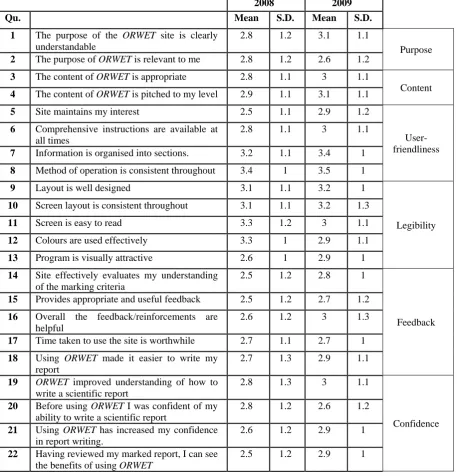
Table 2: 2008 and 2009 student responses (meanSD) to Likert scaled questions
2008 2009
Qu. Mean S.D. Mean S.D.
1 The purpose of the ORWET site is clearly understandable
2.8 1.2 3.1 1.1
Purpose
2 The purpose of ORWET is relevant to me 2.8 1.2 2.6 1.2
3 The content of ORWET is appropriate 2.8 1.1 3 1.1
Content
4 The content of ORWET is pitched to my level 2.9 1.1 3.1 1.1
5 Site maintains my interest 2.5 1.1 2.9 1.2
User-friendliness
6 Comprehensive instructions are available at all times
2.8 1.1 3 1.1
7 Information is organised into sections. 3.2 1.1 3.4 1
8 Method of operation is consistent throughout 3.4 1 3.5 1
9 Layout is well designed 3.1 1.1 3.2 1
Legibility
10 Screen layout is consistent throughout 3.1 1.1 3.2 1.3
11 Screen is easy to read 3.3 1.2 3 1.1
12 Colours are used effectively 3.3 1 2.9 1.1
13 Program is visually attractive 2.6 1 2.9 1
14 Site effectively evaluates my understanding of the marking criteria
2.5 1.2 2.8 1
Feedback
15 Provides appropriate and useful feedback 2.5 1.2 2.7 1.2
16 Overall the feedback/reinforcements are helpful
2.6 1.2 3 1.3
17 Time taken to use the site is worthwhile 2.7 1.1 2.7 1
18 Using ORWET made it easier to write my report
2.7 1.3 2.9 1.1
19 ORWET improved understanding of how to write a scientific report
2.8 1.3 3 1.1
Confidence
20 Before using ORWET I was confident of my ability to write a scientific report
2.8 1.2 2.6 1.2
21 Using ORWET has increased my confidence in report writing.
2.6 1.2 2.9 1
22 Having reviewed my marked report, I can see the benefits of using ORWET
2.5 1.2 2.9 1
28
2008 cohort, and as such we can make comparisons of their questionnaire data. Table 2 provides a comparison of the student’s responses to the 22 Likert-style questions. Whilst there is little difference in the means for each response there is a trend towards a more positive perception of the tool by students.
Other responses to the questionnaire indicated that the majority of 2008 and 2009 students entering their first semester of tertiary education had already developed IT skills such as word processing, email and general computer skills. The students were encouraged to continue to enhance these skills as well as adding skills of communicating through a discussion board, using databases and WebCT. Students’ rating of ORWET as useful or extremely useful for learning and understanding the structure of a biological report had increased from 50% in 2008 to 55% in 2009. The changes made in 2009 to the way ORWET was introduced and presented to students through a blended format appears to have impacted positively on students’ perceptions of the tool.
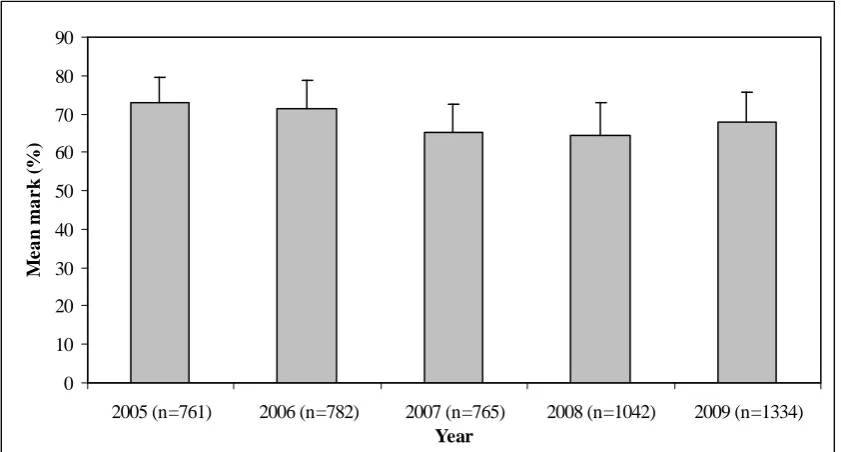
The mean mark of the summative scientific report activity for 2008 and 2009 Human Biology students was consistent with previous years (Figure 3). Student performance in the summative activity was not detrimentally affected by the changes made over the years from completely traditional, face-to-face feedback (2005-2007); to completely online feedback (2008); to blending of traditional and online feedback (2009). There is no evidence to suggest the blending and use of ORWET has had a detrimental impact on student performance in the summative scientific report writing activity.
Figure 3: Distribution of scientific report marks (2005 – 2009)
It was clear that even though the majority of students in both years (2008 and 2009) had the basic IT skills needed to use online learning resources, students still needed support and guidance on how to use online learning resources during their transition from more traditional learning (paper-based) to the online environment (ORWET). The learning expectations of students are determined by their experiences (Becker, Kehoe & Tennent, 2007, Kirkwood & Price, 2005). In the case of students in human biology this has been largely dependent on traditional modes of learning. It is therefore important to reassure and develop students’ learning expectations, especially during the transition period between secondary to tertiary education, by supplementing rather than substituting traditional modes of learning with new
0 10 20 30 40 50 60 70 80 90
2005 (n=761) 2006 (n=782) 2007 (n=765) 2008 (n=1042) 2009 (n=1334) Year
Me
a
n
m
a
r
k
(%
29
technologies (Becker et al., 2007; Kirkwood & Price, 2005). The results indicate that despite the positive impact of the tool on students learning, the perceptions of the students need to be addressed by further integrating traditional modes of learning. It was observed in a survey conducted by Becker et al. (2007) of undergraduate “Generation Y” students that despite their familiarity with technologies, students still favoured a blending of traditional and online course delivery.
In conclusion, the results of the ORWET study over two years indicate that the changes implemented for 2009 have resulted in positive learning outcomes. Further work needs to be done to determine whether the skills students develop through ORWET can be directly linked to those needed to complete the summative scientific report.
Summary of curriculum changes
This is a story of curriculum redesign across a decade of changing goal posts at the University of Sydney. The drivers to the changes have included increase in student numbers taking a first year course on Human Biology, increase in the diversity of these incoming students with respect to academic achievement, prior biology experience, etc and also an increase in the different degree programs the students are enrolled in; along with a decrease in the number of permanent people involved in providing pastoral care to the students (associated with an increase in casualisation of staffing for large first year classes). As each change was implemented evidence was collected to evaluate the efficacy of the change and to fine tune it.
This current journey spans a period of time that has seen many changes to the way in which on-campus universities have provided for their students. External drivers have demanded better teaching, more flexible arrangements to support students during their degree, incorporation of new teaching paradigms and production of graduates able to “hit the ground running” and satisfy the (changing) needs of employers. One of the drivers to change the way we teach has been the ongoing development and increasing stability of the online environment. This particular journey in first year biology has been greatly influenced by the provision at the University of a centrally managed and maintained learning management system with the provision for each year with competitive applications for eLearning development support. The development of HBOnline was a centrally supported eLearning strategic project in 2004 which provided a project management framework to the academic developer (OL) as well as educational and online design. HBOnline was developed to provide an online resource that could give directions to the students about what to do each week and to provide some interactive learning experiences that could be used at any time as well. It was hoped that HBOnline was positioned as the central learning point with lectures and lab classes extending the HBOnline experience. Research into the use of the resource and its effectiveness gave invaluable feedback to the developers of the course.
The most recent development has been to help support scientific writing using an online tool. This replaces the face-to-face help no longer available due to changes to staffing levels for the course (outside the control of the course coordinator). The tool was designed to help students understand the structure of a piece of scientific writing by ‘marking’ some examples using a set of criteria, so that they could then write up a class experiment using the same set of criteria. The research on the use of the tool has enabled some fine tuning. The development of
30
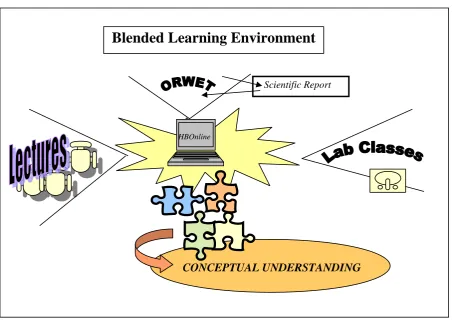
The initial focus was on HBOnline being central to the learning environment, and the subsequent development of ORWET is seen as an important addition to the online support. This is illustrated in Figure 4.
Figure 4: The blended learning environment in the Human Biology course
Investigations on the use and perceptions of use of both HBOnline and ORWET have led us to a better understanding of the ways in which students learn, but are continuing to open new doors for us to look into. Whilst we have provided a richer, more supportive, student-centred learning environment, we still need to ask the question “What evidence do we have, if any, that shows these interventions lead to more active engagement and deeper learning?” The final curriculum change was not so much to do with curriculum but to do with student readiness for tertiary study. The course was moved from second semester to first semester thus changing the academic background prior to this course and the preparedness of students to achieve academically in an independent manner. Time will tell if this was an appropriate “curriculum” change.
Acknowledgments
The authors would like to thank Karen Scott and Lynette Melville from Sydney eLearning for their advice and support in the development of HBOnline, Alison Lewis for her help with the content development of both HBOnline and ORWET, Virginia Breen for her review of and content additions to ORWET and Aida Yalcin and her online development group from Biological Sciences for the development of ORWET. Financial support for the development of ORWET was provided by a University of Sydney Teaching Improvement Grant in 2007.
CONCEPTUAL UNDERSTANDING HBOnline
Scientific Report
31
References
Becker, K., Kehoe, J. & Tennent, B. (2007) Impact of personalised learning styles on online delivery and assessment. Campus-wide Information Systems, 24(2), 105-119.
Biggs, J.B. & Collis, K.F. (1982) Evaluating the Quality of Learning. The SOLO Taxonomy (Structure of the Observed Learning Outcome), Academic Press, New York.
Franklin, S., Peat, M. & Lewis, (2003) A. Non traditional interventions to stimulate discussion: The use of games and puzzles. Journal of Biological Education, 37(2), 79-84.
Kirkwood, A. & Price, L. (2005) Learners and learning in the twenty-first century: what do we know about students’ attitudes towards and experiences of information and communication technologies that will help us design courses? Studies in Higher Education, 30(3), 257-274.
Lilje, O., Breen, V., Lewis, A. & Yalcin, A. (2008a) A pilot study on the impact of an online writing tool used by first year science students. In: Proceedings of the Symposium Visualisation and Concept Development, October 2-3, UniServe Science, Sydney. 54-59.
Lilje, O., Breen, V., Lewis, A. & Yalcin, A. (2008b) The structure, use and impact of the staff version of ORWET. In: Proceedings of the Symposium Visualisation and Concept Development, October 2-3, UniServe Science, Sydney. 188-192.
Lilje, O., Krishnan, S. & Peat, M. (2007) Use and perceptions of a blended learning resource: Are student perceptions reflected in their performance? In 10th Pacific Rim First Year in Higher Education Conference: regenerate, engage and experiment, 4-6 July 2007, QUT Gardens Point Campus. http://www.fyhe.qut.edu.au .
Lilje, O., Lewis, A., Yalcin, A., Scott, K.M., Melville, L. and Peat, M. (2005) Re-engineering of Human Biology Course content for WebCT-based online activities. Poster at HERDSA July 2005.
Lilje, O. and Peat, M. (2006) Use and perceptions of use of a blended learning resources: Are students engaging with the materials? In: 9th Pacific Rim First Year in Higher Education – engaging Students Conference, 12-14 July 2006, Gold Coast Australia http://www.fyhe.qut.edu.au/past_papers/2006/Papers/Lilje.pdf.
Lilje, O. & Peat, M. (2007) Use of traditional and elearning components in a blended learning environment. In: Proceedings of the Symposium Science Teaching and Learning Research, September 27 & 28, 2007, UniServe Science, Sydney. 177-180.
Moni, R.W., Moni, K.B., Poronnik, P. and Lluka, L.J. (2007) An eConference to assess human biology in large, first-year classes. Biochemistry and Molecular Biology Education, 35(4), 255-262.
O’Donovan, B., Price, M. & Rust, C. (2004) Know what I mean? Enhancing student understanding of assessment standards and criteria. Teaching in Higher Education 9(3), 325-335.
Nigam, A. and Joshi, V. (2007) Science education through open and distance learning at higher education. Turkish Online Journal of Distance Education, 8(4), 20-33.
Peat, M. (2000) Towards furst-year biology: A vitual learning environment. Educational Technology and Society 3, 203-207.
Peat, M., Franklin, S., Devlin, M. and Charles, M. (2005) Revisiting the impact of formative assessment opportunities on student learning. Aistralian Journal of Educational Technology, 21(1), 102-117.
Peat, M., Franklin, S. & Mackay-Wood, R. (1998) First Year Biology Teaching Development Group Annual Report, 1998.
Peat, M., Taylor, C. & Fernandez, A. (2002) From Informational Technology in biology teaching to Inspirational Technology: Where have we come from and where are we going? Australian Science Teachers’ Journal, 48 (2), 6-11.
Rust, C., Price, M. & O’Donovan, B. (2003) Improving students’ learning by developing their understandinf of assessment criteria and processes. Assessment & Evaluation in Higher Education 28(2), 147-163.