Chapter 04 – Atomic Structure
Topics 02 and 12 from the IB HL Chemistry Curriculum
2.1
The atom
(1 Hour)
Assessment Statement Obj Teacher’s Notes
2.1.1 State the position of protons, neutrons and electrons in the atom.
1
2.1.2 State the relative masses and relative charges of protons, neutrons and electrons.
1 The accepted values are:
relative relative mass charge proton 1 +1 neutron 1 0 electron 5 × 10⁻⁴ −1
2.1.3 Define the terms mass number (A), atomic number (Z) and isotopes of an element.
1
2.1.4 Deduce the symbol for an isotope given its mass number and atomic number.
3 The notation that should be used to identify an isotope involves the mass number as a superscript and the nuclear charge number as a subscript: AZ X,
for example, 126 C.
2.1.5 Calculate the number or protons, neutrons and electrons in atoms and ions from the mass number, atomic number and charge.
2
2.1.6 Compare the properties of the isotopes of an element.
3
2.1.7 Discuss the use of radioisotopes. 3 Examples should include 14C in Radiocarbon dating, and 131I and 125I as Medical Tracers.
Aim 8: Students should be aware of the dangers to living things of radioisotopes but also justify their usefulness with the examples above.
Dalton's model of the atom
One of the first great achievements of chemistry was to show that all matter is built from about 100 elements. The elements cannot be broken down into simpler components by chemical reactions. They are the simplest substances and their names are listed in your IB Data booklet. Different elements have different chemical properties but gold foil, for example, reacts in essentially the same away as a single piece of gold dust. Indeed if the gold dust is cut into smaller and smaller pieces, the chemical properties would remain essentially the same until we reached an atom. This is the
The modern idea of the atom dates from the beginning of the 19th century. John Dalton noticed that the elements hydrogen and oxygen always combined together in fixed proportions. To explain this observation he proposed that:
All matter is composed of tiny indivisible particles called atoms.
Atoms cannot be created or destroyed.
Atoms of the same element are alike in every way.
Atoms of different elements are different.
Atoms can combine together in small numbers to form molecules.
Using this model we can understand how elements react together to make new substances called compounds. The compound water, for example, is formed when
two hydrogen atoms combine with one oxygen atom to produce one water molecule. If we repeat the reaction on a larger scale with 2 × 6.02 × 1023 atoms of hydrogen and 6.02 × 10²³ atoms of oxygen, 6.02 × 10²³ molecules of water will be formed. This leads to the conclusion that 2 g of hydrogen will react with 16 g of oxygen to form 18 g of water. This is one of the observations Dalton was trying to explain.
Dalton was the first person to assign chemical symbols to the different elements.
Following his example, the formation of water (described above) can be written using modern notation:
2 H + O → H2O
But what are atoms really like? It can be useful to think of them as hard spheres but this tells us little about how the atoms of different elements differ.
To understand this, it is necessary to probe deeper.
The first indication that atoms were destructible came at the end of the 19th century when the British scientist J. J. Thomson discovered that different metals produce a stream of negatively charged particles when a high voltage is applied across two electrodes. As these particles, which we now know as electrons, were the same regardless of the metal, he
suggested that they are part of the make-up of all atoms.
Rutherford's model of the atom
Ernest Rutherford (1871-1937) and his research team working at Manchester University in England, tested Thomson's model by firing alpha particles at a piece of gold foil. If Thomson's model was correct, the alpha particles should either pass straight through or get stuck in the positive “sponge”. Most of the alpha particles did indeed pass straight through, but a very small number were repelled and bounced back. Ernest Rutherford recalled that “It was quite the most incredible thing that has happened to me. It was as if you had fired a (artillery) shell at a piece of tissue paper and it came back and hit you.”
The large number of undeflected paths led to the conclusion that the atom is mainly empty space. Large deflections occur when the positively charged alpha particles collide with and are repelled by a positively charged nucleus. The fact that only a small number of alpha particles bounce back, suggests that the nucleus is very small.
Sub-atomic particles
A hundred years or so after Dalton first proposed his model, experiments showed that atoms are themselves made up from smaller or sub-atomic particles. These particles are described by their relative masses and charges which have no units.
Particle Relative Mass Relative Charge
proton 1 +1
electron 0.0005 −1
Bohr model of the hydrogen atom
*he Danish physicist Niels Bohr pictured the hydrogen atom as a small “solar system”, with an electron moving in an orbit or energy level around the positively charged nucleus of one proton. The electrostatic force of attraction between the oppositely charged sub-atomic particles prevents the electron from leaving the atom. The nuclear radius is 10−15 m and the atomic radius 10−15 m, so most of the volume of the atom is empty space.
The fact that neutrons are not electrically charged is crucial for the stability of nuclei of later elements, which have more than one proton. Without the neutrons, the positively charged protons would mutually repel each other and the nucleus would fall apart.
Atomic number and mass number
We are now in a position to understand how the atoms of different elements differ. They are all made from the same basic ingredients, the sub-atomic particles. The only difference is the recipe – how many of each of these sub-atomic particles are present in the atoms of different elements. If you look at the Periodic Table, you will see that the elements are each given a number which describes their relative position in the table. This is their atomic number. We now know that the atomic number is the defining property of an element as it tells us something about the structure of the atoms of the element. The atomic number is defined as the number of protons in the atom.
As an atom has no overall charge, the positive charge of the protons must be balanced by the negative charge of the electrons. The atomic number is also equal to the number of electrons.
The electron has such a very small mass that it is essentially ignored in mass calculations. The mass of an atom depends on the number of protons and neutrons only. The mass number is defined as the number of protons plus the number of neutrons in an atom. An atom is identified in the following way:
A
X
X = Symbol of element A = Mass numberZ Z = Atomic number
We can use these numbers to find the composition of any atom.
number of protons (p) = number of electrons = Z
Consider an atom of aluminum:
27
Al
Neutrons = 27 – 13 = 14 Protons = 1313 Electrons = 13
An aluminum atom is made from 13 protons and 13 electrons. An atom of gold, on the other hand, has 79 protons and 79 electrons. Can you find gold in the Periodic Table?
Isotopes
Find chlorine in the Periodic Table. There are two numbers associated with the element as shown below.
How can an element have a fractional relative atomic mass if both the proton and neutron have a relative mass of 1? One reason is that atoms of the same element with different mass numbers exist so it is necessary to work within an average value. To have different mass numbers, the atoms must have different numbers of neutrons – both the atoms have the same number of protons as they are both chlorine atoms. Atoms of the same element with different numbers of neutrons are called isotopes.
The isotopes show the same chemical properties, as a difference in the number of neutrons makes no difference to how they react and so they occupy the same place in the Periodic Table.
Chlorine exists as two isotopes, 35CIand 37Cl. The average relative mass of the isotopes is however not 36, but 35.45. This value is closer to 35, as there are more 35Cl atoms in nature – it is the more abundant isotope. In a sample of 100 chlorine atoms, there are 75 atoms of 35CIand 25 atoms of the heavier isotope, 37Cl.
To work out the average mass of one atom we first have to calculate the total mass of the hundred atoms:
total mass = (75 × 35) + (25 × 37) = 3550
average mass = total mass ÷ number of atoms = 3550 ÷ 100 = 35.5
The two isotopes are both atoms of chlorine with 17 protons and 17 electrons .
35
CI; number of neutrons = 35 − 17 = 18
37
Although both isotopes essentially have the same chemical properties, the difference in mass does lead to different physical properties such as boiling and melting points. Heavier isotopes move more slowly at a given temperature and these differences can be used to separate isotopes.
Exercise:
State two physical properties other than boiling and melting point that would differ for the two isotopes of chlorine. (Hint: A physical property of a substance can be measured without changing the chemical composition of the substance – a difference in the number of neutrons is not a different physical property.)
Uses of radioisotopes
The stability of a nucleus depends on the balance between the number of protons and neutrons. When a nucleus contains either too many or too few neutrons, it is radioactive and changes to a more stable nucleus by giving out radiation. This may be of several different forms which differ in ionization and penetration abilities. Alpha particles, emitted by nuclei with too many protons to be stable, are composed of two protons and two neutrons. Beta particles, emitted by nuclei with too many neutrons, are electrons which have been ejected from the nucleus owing to neutron decay. Gamma rays are a form of electromagnetic radiation.
Radioactive isotopes can be used, for example, to:
generate energy in nuclear power stations
sterilize surgical instruments in hospitals
preserve food
fight crime
detect cracks in structural materials.
They can be used either to kill or save human life. Some examples of their uses are discussed below.
Carbon-14 dating
The most stable isotope of carbon, 12C, has six protons and six neutrons. Carbon-14 has eight neutrons, which is too
many to be stable. It can reduce the neutron-to-proton ratio when a neutron changes to a proton and an electron. The proton stays in the nucleus but the electron is ejected from the atom as a beta particle.
14
C
→
14N
+
0e
6 7 −1
Carbon-14 Nitrogen-14 Beta Particle
The relative abundance of carbon-14 present in living plants is constant as the carbon atoms are continually replenished from carbon present in carbon dioxide in the atmosphere. When organisms die, however, no more carbon-14 is
absorbed and the levels of carbon-14 fall owing to nuclear decay. As this process occurs at a regular rate, it can be used to date carbon-containing materials. The rate of decay is measured by its half-life. This is the time taken for half the atoms to decay. The carbon-14 to carbon-12 ratio falls by 50% every 5730 years after the death of a living organism, a time scale which allows it to be used in the dating of archaeological objects.
Cobalt-60 used in radiotherapy
lodine-131 as a medical tracer
Radioisotopes have the same chemical properties as any other atom of the same element and so they play the same role in the body. Their positions, unlike other isotopes, however, can be monitored by detecting radiation levels, making them suitable as medical tracers. Iodine-131, an emitter of both beta and gamma rays, can be used in the form of the compound sodium iodide to investigate the activity of the thyroid gland and to diagnose and treat thyroid cancer. It has a short half-life of eight days so it is quickly eliminated from the body. Another isotope of iodine, iodine-125, is used in the treatment of prostate cancer. Pellets of the isotope are implanted into the gland. It has a relatively longer half life of 80 days which allows low levels of beta radiation to be emitted over an extended period.
Despite the benefits, there are dangers arising from the use of unstable isotopes. Living organisms can be seriously affected if they are exposed to uncontrolled radiation which may result from excessive use in treatments or their release into the environment. There is a need for close international cooperation to ensure that the same high safety standards are applied both within and across borders.
Ions
The atomic number is defined in terms of number of protons because it is a fixed characteristic of the element. The number of protons identifies the element in the same way your fingerprints identify you. The number of protons and neutrons never changes during a chemical reaction. It is the electrons which are responsible for chemical change. Chapter 11 will examine how atoms can lose or gain electrons to form ions. When the number of protons is no longer balanced by the number of electrons, these particles have a non-zero charge. When an atom loses electrons it forms a positive ion or cation as the number of protons is now greater than the number of electrons. Negative ions or anions
are formed when atoms gain electrons. The magnitude of the charge depends on the number of electrons lost or gained. The loss or gain of electrons makes a very big difference to the chemical properties. You swallow sodium ions, Na1+, every time you eat table salt, whereas (as you will discover in Chapter 08) sodium atoms, Na, are dangerously reactive.
An aluminium ion is formed when the atom loses three electrons. There is no change in the atomic or mass numbers of an ion because the number of protons and neutrons remains the same.
27
Al
3+ Neutrons = 27 – 13 = 14 Protons = 1313 Electrons = 13 – 3 = 10 = Electrons have been lost.
Oxygen forms the oxide ion when the atom gains two electrons.
16
O
2− Neutrons = 16 – 8 = 8 Protons = 8Worked example:
Identify the sub-atomic particles present in an atom of 226Ra.
Solution
The number identifying the atom is the atomic number. We can find the atomic number from the IB Data booklet. We have Z = 88 and A = 226
In other words, number of protons (p) = 88 number of electrons (e) = 88
number of neutrons (n) = 226 − 88 = 138
Worked example:
Most nutrient elements in food are present in the form of ions. The calcium ion 40Ca2+ for example, is essential for healthy teeth and bones. Identify the subatomic particles present in the ion.
Solution
We can find the atomic number from the IB Data booklet. We have Z = 20 and A= 40
In other words, number of protons (p) = 20 number of neutrons (n) = 40 − 20 = 20
As the ion has a positive charge of 2+ there are 2 more protons than electrons number of electrons = 20 − 2 = 18
Worked example:
Identify the species with 17 protons, 18 neutrons and 18 electrons.
Solution
The number of protons tells us the atomic number. Z = 17 and the element is chlorine: Cl.
The mass number = p + n = 17 + 18 = 35: 35Cl
Zumdahl, 5th Edition contains information relevant to this topic in Chapter 02. You should take some time to review the approach outlined in that textbook.
IB Examiner Hints:
Learn the definitions of all the terms identified in the assessment statements. The atomic number, for example, is defined in terms of the number of protons, not electrons.
A common error is to misunderstand the meaning of physical property. A difference in the number of neutrons is not a different physical property. A physical property of a substance can be measured without changing the chemical composition of the substance.
Exercises:
Use the Periodic Table to identify the sub-atomic particles present in the following species.
Species No. of Protons No. of Neutrons No. of Electrons 7
Li
1
H
14
C
19
F1−
56
Fe3+
Isoelectronic species have the same number of electrons. Identify the following isoelectronic species by giving the correct symbol and charge. You will need a Periodic Table. The first one has been done as an example.
Species No. of Protons No. of Neutrons No. of Electrons 40
Ca2+ 20 20 18
18 22 18
19 20 18
17 18 18
Which of the following contain more electrons than neutrons?
99N105
Which species contains 16 protons, 17 neutrons, and 18 electrons?
A. 32S1− B. 33S2− C. 34S1− D. 35S2−
05N104
Information is given about four different atoms:
atom neutrons protons
W 22 18
X 18 20
Y 22 16
Z 20 18
Which two atoms are isotopes?
A. W and Y B. W and Z C. X and Z D. X and Y
98N105
The atomic and mass numbers for four different nuclei are given in the table below. Which two are isotopes?
atomic number mass number
I. 101 258
II. 102 258
III. 102 260
IV. 103 259
02N104
Isotopes are elements with
A. the same atomic number and the same number of neutrons. B. the same mass number but a different number of neutrons. C. The same atomic number but a different number of neutrons.
D. different atomic and mass numbers but the same number of neutrons.
97N102
When cathode rays strike a solid target, X-rays are generated. Henry Moseley used the energies of such X-rays to establish that
A. the atomic number is a fundamental property of an atom. B. most of the mass of an atom is in its nucleus.
C. isotopes differ in the number of neutrons they contain. D. electrons may occupy only certain energy levels.
97M101
A beam containing two different kinds of particles is passed through an electric field with the results shown in the diagram below. What particles could be responsible for pathways 1 and 2?
A. 1 – electron 2 – proton
B. 1 – neutron 2 – electron
C. 1 – proton 2 – electron
2.2
The mass spectrometer
(1 Hour)
Assessment Statement Obj Teacher’s Notes
2.2.1 Describe and explain the operation of a mass spectrometer.
3 A simple diagram of a single beam mass spectrometer is required. The following stages of operation should be considered: vaporization, ionization, acceleration, deflection and detection.
Aim 7: Simulations can be used to illustrate the operation of a mass spectrometer.
2.2.2 Describe how the mass spectrometer may be used to determine relative atomic mass using the 12C scale.
2
2.2.3 Calculate non-integer relative atomic masses and abundance of isotopes from given data.
2
Principles of the mass spectrometer
The masses of the different isotopes and their relative abundance can be measured using a mass spectrometer.
The mass spectrometer has five basic operations:
Vaporization: A vaporized sample is injected into the instrument. This allows the individual atoms of the element to be analyzed.
Ionization: the atoms are hit with high-energy electrons which knock out electrons, thus producing positively charged ions:
X(g) + e− → X+(g) + 2 e−
Acceleration: the positive ions are attracted to negatively charged plates. They are accelerated by an electric field and pass through a hole in the plate.
Deflection: the accelerated positive ions are deflected by a magnetic field placed at right angles to their path. The amount of deflection is proportional to the charge/mass ratio. Ions with smaller mass are deflected more than heavier ions. Ions with higher charges are deflected more as they interact more effectively with the magnetic field.
Detection: positive ions of a particular mass/charge ratio are detected and a signal sent to a recorder. The strength of the signal is a measure of the number of ions with that charge/mass ratio that are detected.
Relative atomic masses of some elements
The mass spectrometer can be used to measure the mass of individual atoms. The mass of a hydrogen atom is 1.67 × 10⁻²⁴ g and that of a carbon atom is 1.99 × 10⁻²³ g. As the masses of all elements are in the range 10−24 to 10−22 g and these numbers are beyond our direct experience, it makes more sense to use relative values. The mass needs to be recorded relative to some agreed standard.
As carbon is a very common element which is easy to transport and store because it is a solid, its isotope, 12C, was chosen as the standard in 1961. This is given a relative mass of 12 exactly as shown below.
Element Symbol Relative atomic mass
carbon C 12.011
chlorine Cl 35.453
hydrogen H 1.008
iron Fe 55.845
Standard isotope Symbol Relative atomic mass
carbon-12 12C 12.000
Mass spectra
The results of the analysis by the mass spectrometer are presented in the form of a mass spectrum. The horizontal axis shows the
mass/charge ratio of the different ions on the carbon-12 scale and the relative abundance of the ions is shown on the vertical axis.
The mass spectrum of gallium on the right shows that in a sample of 100 atoms,
60 have a mass of 69 and 40 have a mass of 71. We can use this information to calculate the relative atomic mass of the element.
total mass = (60 × 69) + (40 × 71) = 6980
average mass = total mass ÷ number of atoms = 6980 ÷ 100 = 69.80
Worked example:
Deduce the relative atomic mass of the element rubidium from the data given in the figure on the right.
Solution
Consider a sample of 100 atoms.
total mass = (85 × 77) + (87 × 23) = 8546
relative atomic mass = average mass of atom
= total mass number of atoms
= 8546 = 85.46 100
Worked example:
Solution
Consider a sample of 100 atoms. Let x atoms be 10B atoms. The remaining atoms are 11B.
number of 11B atoms = 100 – x
total mass = 10x + (100 – x)11 = 10x + 1100 – 11x = 1100 – x
average mass = total mass ÷ number of atoms = (1100 – x) ÷ 100
According to the Periodic Table, the relative atomic mass of boron is 10.81.
10.81 = 1100 − x 100
1081 = 1100 − x
x = 1100 − 1081 = 19.00 The abundances are 10B = 19.00% and 11B = 81.00%
Zumdahl, 5th Edition contains information relevant to this topic in Chapter 03. You should take some time to review the approach outlined in that textbook.
IB Examiner Hints:
Memorize the diagram of a mass spectrometer, as found on page 13 of this resource. Know the identity of each step in the mass spectrometry process, and the conditions in which they occur (electric vs. magnetic field and so on).
Exercises:
Which ion would be deflected most in a mass spectrometer?
A. 35Cl1+ B. 37Cl1+ C. 37Cl2+ D. (35Cl37Cl)1+
What is the same for an atom of phosphorus-26 and an atom of phosphorus-27?
Use the Periodic Table to find the percentage abundance of neon-20, assuming that neon has only one other isotope, neon-22.
The relative abundances of the two isotopes of chlorine are shown in this table:
Isotope Relative abundance
35
Cl 75%
37
Cl 25%
Use this information to deduce the mass spectrum of chlorine gas, Cl2.
01M121
The separation of ions in a mass spectrometer depends on
A. only the charge on the ions. B. only the mass of the ions.
C. the mass and the charge of the ions. D. only the velocity of the ions.
02M105
Copper consists of the isotopes 63Cu and 65Cu and has a relative atomic mass of 63.55. What is the most likely composition?
63
Cu 65Cu
A. 30% 70%
B. 50% 50%
C. 55% 45%
2.3
Electron arrangement
(1 Hour)
Assessment Statement Obj Teacher’s Notes
2.3.1 Describe the electromagnetic spectrum. 2 Students should be able to identify the ultraviolet, visible and infrared regions, and to describe the variation in wavelength, frequency, and energy across the spectrum.
2.3.2 Distinguish between a continuous spectrum and a line spectrum.
2
2.3.3 Explain how lines in the emission spectrum of hydrogen are related to electron energy levels.
3 Students should be able to draw on energy level diagram, show transitions between different energy levels and recognize that the lines in a line spectrum are directly related to these differences. An understanding of convergence is expected. Series should be considered in the ultraviolet, visible and infrared regions of the spectrum. Calculations, knowledge of quantum numbers and historical references will not be assessed.
Aim 7: Interactive simulations modeling the behaviour of electrons in the hydrogen atom can be used.
2.3.4 Deduce the electron arrangement for atoms and ions up to Z = 20.
3 For example, 2.8.7 or 2,8,7 for Z = 17.
Electron arrangement
Some elements give out light of a distinctive color when their compounds are heated in a flame or when an electric discharge is passed through their vapor. For instance, copper compounds give off a green color when heated in flame, whereas sodium compounds give off an orange color. Analysis of this light has given us insights into the electron arrangements within the atom. To interpret these results we must consider the nature of electromagnetic radiation.
The electromagnetic spectrum
Electromagnetic radiation comes in different forms of differing energy. Gamma rays, as we have already discussed, are a particularly high energy form and the visible light we need to see the world is a lower energy form. All
The number of waves which pass a particular point in 1 s is called the frequency (f); the shorter the wavelength, the higher the frequency. Blue light has a higher frequency than red light.
The precise relation is c = f ∙ λ
White light is a mixture of light waves of differing wavelengths or colors. We see this when sunlight passes through a prism to produce a continuous spectrum.
Visible light forms only a small part of the electromagnetic spectrum. Infrared waves have a longer wavelength than red light and ultraviolet waves a shorter wavelength than violet. The complete electromagnetic spectrum is shown below.
High Energy Low Energy
Line spectra
When white light is passed through hydrogen gas, an absorption spectrum is produced. This is a line spectrum with some colors of the continuous spectrum missing. If a high voltage is applied to the gas, a corresponding emission line spectrum is produced.
The colors present in the emission spectrum are the same as those that are missing from the absorption spectra. As different elements have different line spectra they can be used like barcodes to identify unknown elements. They give us valuable information about the arrangements of electrons in an atom.
Evidence for the Bohr model
into lower levels is in the form of electromagnetic radiation. One packet of energy (quantum) or photon, is released for each electron transition. Photons of ultraviolet light have more energy than photons of infrared light. The energy of the photon is proportional to the frequency of the radiation.
The energy of the photon of light emitted is equal to the energy change in the atom: ΔEelectron = ΔEphoton
It is also related to the frequency of the radiation by Planck's equation: Ephoton = h∙f
(This equation and the value of h (Planck's constant) are given in the IB Data booklet.) This leads to ΔEelectron = h∙f
This is a very significant equation as it shows that line spectra allow us to glimpse the inside of the atom. The atoms emit photons of certain energies which give lines of certain frequencies, because the electron can only occupy certain orbits. The energy levels can be thought of as a staircase. The electron cannot change its energy in a continuous way, in the same way that you cannot stand between steps; it can only change its energy by discrete amounts. This energy of the atom is quantized. The line spectrum is crucial evidence for quantization: If the energy were not quantized, the emission spectrum would be continuous.
The hydrogen spectrum
The pattern of the lines in the following figure gives us a picture of the energy levels in the atom.
The lines converge at higher energies because the energy levels inside the atoms are closer together. When an electron is at the highest energy n = ∞, it is no longer in the atom and the atom has been ionized. The energy needed to remove an electron from the ground state of each atom in a mole of gaseous atoms, ions, or molecules is called the ionization energy. Ionization energies can also be used to support this model of the atom.
Building atoms using the Bohr model
The chemical properties of an atom are dependent on the way its electrons are arranged. We are now in a position to explore the structures of the atoms beyond hydrogen. Building the atoms of these elements is like stacking a bookcase. Each energy level can hold a limited number of electrons. In the ground state, electrons are placed in the lowest energy level first and, when this becomes complete, we move on to the second energy level and so on.
The helium atom, 4He, has two protons, two neutrons and two electrons. A diagram of an atom of helium-4 is found on the right. The protons and neutrons form the nucleus and the two electrons both occupy the lowest energy level.
The first energy level is now full as it can hold only two electrons. For the atom of the next element, lithium, we must use the second energy level. The distribution of the electrons in lithium can be summarized as 2,1. This means 2 electrons in the first energy level, and 1 in the second level.
Now, for sodium we need to use the third energy level.
Neon 2,8 Sodium 2,8,1
Although the picture becomes more complicated for higher elements, this method can be followed to find the electron arrangement for elements up to and including calcium as shown in the table below. The third energy level becomes stable when it has eight electrons at argon and the fourth energy level starts to fill at potassium. Potassium has the electron arrangement 2,8,8,1 and calcium is 2,8,8,2.
Element Electron arrangement Element Electron arrangement
1H 1 11Na 2,8,1
2He 2 12Mg 2,8,2
3Li 2,1 13Al 2,8,3
4Be 2,2 14Si 2,8,4
5B 2,3 15P 2,8,5
6C 2,4 16S 2,8,6
7N 2,5 17Cl 2,8,7
8O 2,6 18Ar 2,8,8
9F 2,7 19K 2,8,8,1
10Ne 2,8 20Ca 2,8,8,2
Patterns in successive ionization energies
Additional evidence for electron arrangements in atoms comes from looking at patterns of successive ionization
energies. The first ionization energy is the energy needed to remove one mole of electrons from the ground state of one mole of the gaseous atom. For example, for aluminum we have the equation below and the following figure:
Al(g) → Al1+(g) + e−
Al(g)
→
Al+(g) + e−The second ionization energy corresponds to the change:
Al1+(g) → Al2+(g) + e−
The third ionization energy corresponds to the change:
Al2+(g) → Al3+(g) + e−
The graphs show two key points.
There is an increase in successive ionization energies. The first ionization energy involves the separation of an electron from a singly charged ion and the second the separation of an electron from a doubly charged ion. The process becomes more difficult as there is increasing attraction between the higher charged positive ions and the oppositely charged electron.
There are jumps when electrons are removed from levels closer to the nucleus. The first three ionization energies involve the removal of electrons from the third level. An electron is removed from the second level for the fourth ionization energy as shown below. This electron is closer to the nucleus and is more exposed to the positive charge of the nucleus. It needs significantly more energy to be removed .
Ion Electron arrangement
Energy level from which next electron is removed when ionized
Al 2,8,3 third
Al1+ 2,8,2 third
Al2+ 2,8,1 third
Al3+ 2,8 second
Worked example:
Which is not a valid electron arrangement?
A. 2,8 B. 2,3 C. 2,7,2 D. 2,8,8,1
Solution
C. Electrons fill the energy levels in order so an atom with 11 electrons would first fill the second level (8 electrons) before filling the third.
Worked example:
Deduce the electron arrangement of the Na+ and O2− ions.
Solution
The Periodic Table shows that a sodium atom has 11 electrons. It forms a positive ion by losing one electron: 2, 8.
Zumdahl, 5th Edition contains information relevant to this topic in Chapter 07. You should take some time to review the approach outlined in that textbook.
IB Examiner Hints:
Memorize the electromagnetic spectrum from page 19 of this resource. Know the relative positions of gamma rays, X-rays, UV rays, visible light, IR, microwaves, and radio waves, as well as the relationships between wavelength, frequency, and energy.
Exercises:
How many energy levels are occupied when silicon is in its ground state?
A. 2 B. 3 C. 4 D. 8
The first four ionization energies for a particular element are 738, 1450, 7730 and 10550 kJ mol−1 respectively. Deduce the group number of the element.
A. 1 B. 2 C. 3 D. 4
03N104
Which statement is correct for the emission spectrum of the hydrogen atom? A. The lines converge at lower energies.
B. The lines are produced when electrons move from lower to higher energy levels.
C. The lines in the visible region involve electron transitions into the energy level closest to the nucleus. D. The line corresponding to the greatest emission of energy is in the ultraviolet region.
05N106
Which statement is correct about a line emission spectrum?
98M106
Which electron transition in a hydrogen atom releases the most energy?
A. n = 2 → n = 1 B. n = 4 → n = 2 C. n = 6 → n = 3 D. n = 7 → n = 6
97M102
Which one of the following best supports the concept that electrons in atoms may have only certain energies (i.e. are quantized)?
A. Emission spectrum of mercury B. Mass spectrum of isotopes C. Oil drop experiment
D. Scattering of α particles by gold foil
12.1 Electron configuration
(3 Hours)
Assessment Statement Obj Teacher’s Notes
12.1.1 Explain how evidence from first ionization energies across periods accounts for the existence of main energy levels and sub-levels in atoms.
3
12.1.2 Explain how successive ionization energy data is related to the electron configuration of an atom.
3 Aim 7: Spreadsheets, databases and modeling software can be used here.
12.1.3 State the relative energies of s, p, d, and f orbitals in a single energy level.
1 Aim 7: Simulations can be used here.
12.1.4 State the maximum number of orbitals in a given energy level.
1
12.1.5 Draw the shape of an s orbital and the shapes of the px, py, and pz orbitals.
1
12.1.6 Apply the Aufbau principle, Hund’s rule, and the Pauli exclusion principle to write electron configurations for atoms and ions up to Z = 54.
The Bohr model of the atom discussed in the previous section was originally proposed to explain the emission spectrum of hydrogen. This model is a simplification, however, as it does not explain the spectral lines of atoms with more than one electron. To develop the model of the atom further, we need to reconsider the nature of the electron.
A closer look at successive ionization energies
To understand the limitations of the Bohr model of the atom, we will take a closer look at the successive ionization energies of aluminum discussed earlier. We saw that the 2,8,3 pattern in successive ionization energies reflects the electron arrangement of the atom. Now we will consider the fourth to eleventh ionization energies in more detail. These correspond to the removal of the eight electrons in the second energy level.
The jump between the ninth and tenth ionization energies shows that the eleventh electron is more difficult to remove than we would expect from the pattern of the six previous electrons. This suggests that the second energy level is divided into two sub-levels. The 2s sub-level can hold a maximum of two electrons, and the 2p sub-level can hold six electrons.
Sub-levels of electrons
This result can be generalized; the nth energy level of the Bohr atom is divided into n sub-levels. For example, the fourth level (n = 4) is made up from four sub-levels. The letters s, p, d and fare used to identify different sub-levels. The number of electrons in the sub-levels of the first four energy levels are shown in the table below.
Level Sub-Level Maximum number of electrons in sub-level
Maximum number of electrons in level
n = 1 1s 2 2
n = 2 2s 2 8
2p 6
n = 3
3s 2
18
3p 6
3d 10
n = 4
4s 2
32
4p 6
4d 10
We can see from the table that:
each main level can hold a maximum of 2n2 electrons; the 3rd energy level, for example, can hold a maximum of 18 electrons (2 × 32 = 18)
s sub-levels can hold a maximum of 2 electrons
p sub-levels can hold a maximum of 6 electrons
d sub-levels can hold a maximum of 10 electrons
f sub-levels can hold a maximum of 14 electrons.
These patterns can only be understood if we treat the electron as a wave and not a particle. This is another result of the quantum theory developed at the beginning of the 20th century.
Waves and particles models
In this chapter we have already discussed the two models traditionally used to explain scientific phenomena: the wave model and the particle model. The power of these models is that they are based on our everyday experience, but this is also their limitation. We should not be too surprised if this way of looking at the world breaks down when applied to the atomic scale. We saw earlier that light could either be described by its frequency – a wave property – or by the energy of individual particles (called photons or quanta of light) which make up a beam of light. The two properties are related by Planck's equation E = hf. You may be tempted to ask which model gives the “true” description of light. We now realize that neither model gives a complete explanation of light's properties – both models are needed. The diffraction, or spreading out, of light that occurs when light passes through a small slit can only be explained by a wave model. The scatter of electrons that occurs when light is incident on a metal surface is best explained using a particle model.
In a similar way, quantum theory suggests that it is sometimes preferable to think of an electron (or indeed any particle) as having wave properties. The diffraction pattern produced when a beam of electrons is passed through a thin sheet of graphite demonstrates the wave properties of electrons. The description we use depends on the phenomena we are trying to explain. To understand the sub-levels in an atom it is useful to consider a wave description of the electron.
The Uncertainty Principle
One fundamental problem with the Bohr model is that it assumes the electron's trajectory can be precisely described. This is now known to be impossible as any attempt to measure its position will disturb its motion. The act of focusing radiation to locate the electron gives the electron a random “kick” which sends it hurtling off in a random direction.
s atomic orbitals
We have seen that the first energy level is made up from the 1s sub-level. Although we cannot know the position of the electron exactly, we can give a picture of where it is likely to be. To highlight the distinction between this wave description of the electron and the circular orbits of the Bohr atom, we say the electron occupies a 1s orbital.
The dots in the diagram on the right represent locations where the electron is most likely to be found. The denser the dots, the higher the probability that the electron occupies this region of space. The electron can be found anywhere within a spherical space surrounding the nucleus. An atomic orbital is a region around an atomic nucleus in which there is a 90% probability of finding the electron.
The s sub-levels at other levels are similarly made up from spherical s orbitals. The 2s orbital, for example, has the same symmetry as a 1s orbital but extends over a larger volume. Electrons in a 2s orbital are, on average, further from the nucleus than electrons in 1s orbitals and so are at higher energy.
p atomic orbitals
d and f atomic orbitals
The d sub-levels are made up from five d atomic orbitals and are shown in the diagram below.
Electron spin and the Pauli Exclusion Principle
The atomic orbitals associated with the different energy levels are shown in the following figure. The relative energies of the 4s and 3d atomic orbitals are chemically significant and are discussed later.
We saw earlier that each level can hold a maximum of 2n2electrons. There are n2atomic orbitals available at the nth level. There are, for example, nine (3 × 3) atomic orbitals in the n = 3 level. So each orbital can hold a maximum of two electrons. This is because electrons in an atomic orbital behave as though they spin, in either a clockwise or anti-clockwise (counter-anti-clockwise) direction. Two electrons can only occupy the same orbital if they have opposite spins.
The Pauli Exclusion Principle formalizes this information. It states that no more than two electrons can occupy any one orbital, and if two electrons are in the same orbital they must spin in opposite directions.
Exercises:
List the 4d, 4f, 4p, and 4s atomic orbitals in order of increasing energy.
Aufbau Principle: Electrons-in-boxes
The electron configuration of the ground state of an atom of an element can be determined using the Aufbau Principle,
which states that electrons are placed into orbitals of lowest energy first. Boxes can be used to represent the atomic orbitals with single-headed arrows to represent the spinning electrons. The electron configurations of the first five elements are shown in the following figure. The number of electrons in each sub-level is given as a superscript.
Element:
Electrons -in- boxes:
Electron
configurations:
1s
1
1s
21s
22s
11s
22s
21s
22s
22p
1The next element in the Periodic Table is carbon. It has two electrons in the 2p sub-level. These could either pair up, and occupy the same p orbital, or occupy separate p orbitals. Following Hund's third rule, we can place them in separate orbitals because this configuration minimizes the mutual repulsion between them. As the orbitals do not overlap, the two 2p electrons are unlikely to approach each other too closely. The electrons in the different 2p orbitals have parallel spins, as this is found to lead to lower energy. The electron configurations of carbon and nitrogen are shown below.
Element: Carbon Nitrogen
Electrons -in- boxes:
Electron
configurations:
1s
2
2s
22p
21s
22s
22p
3The 2p electrons begin to pair up for oxygen, and the 2p sub-shell is completed for neon.
Exercise:
Worked example:
State the full electron configuration of arsenic and deduce the number of unpaired electrons.
Solution
The atomic number of arsenic gives the number of electrons: Z = 33
So the electronic configuration is: 1s2, 2s2, 2p6, 3s2, 3p6, 3d10, 4s2, 4p3 (Note: The 3d sub-level is often written with the other n=3 sub-levels as it falls below the 4s orbital, once the 4s orbital is occupied.
The three 4p orbitals each have an unpaired electron.
Number of unpaired electrons = 3
The worked example asked for the full electron configuration. Sometimes it is convenient to use an abbreviated form, where only the outer electrons are explicitly shown. The inner electrons are represented as a noble gas core. Using this notation, the electron configuration of arsenic is written [Ar] 3d10 4s2 4p3, where [Ar] represents 1s2 2s2 2p6 3s2 3p6.
The electron configurations of the first 30 elements are tabulated below.
Element Configuration Element Configuration Element Configuration
1H 1s1 11Na 1s22s22p63s1 21Sc [Ar]3d14s2
2He 1s2 12Mg 1s22s22p63s2 22Ti [Ar]3d24s2
3Li 1s22s1 13Al 1s22s22p63s23p1 23V [Ar]3d34s2
4Be 1s22s2 14Si 1s22s22p63s23p2 24Cr [Ar]3d54s1
5B 1s22s22p1 15P 1s22s22p63s23p3 25Mn [Ar]3d54s2
6C 1s22s22p2 16S 1s22s22p63s23p4 26Fe [Ar]3d64s2
7N 1s22s22p3 17Cl 1s22s22p63s23p5 27Co [Ar]3d74s2
8O 1s22s22p4 18Ar 1s22s22p63s23p6 28Ni [Ar]3d84s2
9F 1s22s22p5 19K 1s22s22p63s23p64s1 29Cu [Ar]3d104s1 10Ne 1s22s22p6 20Ca 1s22s22p63s23p64s2 30Zn [Ar]3d104s2
Three points should be noted:
• the 3d sub-level is written with the other n = 3 sub-levels as it falls below the 4s orbital, once the 4s orbital is occupied (i.e. for elements after Ca)
• chromium has the electron configuration [Ar] 3d54s1 • copper has the electron configuration [Ar] 3d104s1.
chromium with a half full d sub-level is relatively stable as it minimizes electrostatic repulsion, with six singly occupied atomic orbitals. This would be the expected configuration using Hund's rule if the 4s and 3d orbitals had exactly the same energy. Half-filled and filled sub-levels seem to be particularly stable: the configuration for copper is similarly due to the stability of the full d sub-level.
Exercises:
Identify the sub-level which does not exist.
A. 5d B. 4d C. 3f D. 2p
Which is the correct order of orbital filling according to the Aufbau Principle?
A. 4s 4p 4d 4f B. 4p 4d 5s 4f C. 4s 3d 4p 5s D. 4d 4f 5s 5p
State the full ground-state electron configuration of the following elements.
V _________________________________________ K _________________________________________
Se _________________________________________ Sr _________________________________________
Determine the total number of electrons in d orbitals in a single iodine atom.
A. 5 B. 10 C. 15 D. 20
Identify the excited state (i.e. not a ground state) in the following electron configurations.
A. [Ne] 3s2 3p3 B. [Ne] 3s2 3p3 4s1 C. [Ne] 3s2 3p6 4s1 D. [Ne] 3s2 3p6 3d1 4s2
Deduce the number of unpaired electrons present in the ground state of a titanium atom.
Electron configuration of ions
As discussed earlier, positive ions are formed by the loss of electrons. These electrons are lost from the outer sub-levels. The electron configurations of aluminum ions as electrons are successively removed are shown in the table below.
Ion Configuration Ion Configuration Ion Configuration
Al 1s22s22p63s23p1 Al1+ 1s22s22p63s2 Al2+ 1s22s22p63s1
Al3+ 1s22s22p6 Al4+ 1s22s22p5 Al5+ 1s22s22p4
Al6+ 1s22s22p3 Al7+ 1s22s22p2 Al8+ 1s22s22p1
Al9+ 1s22s2 Al10+ 1s22s1 Al11+ 1s2
Worked example:
A graph of some successive ionization energies of aluminum is shown on the right.
(a) Explain why there is a large increase between the ninth and tenth ionization energies.
(b) Explain why the increase between the sixth and seventh value is greater than the increase between the fifth and sixth values.
Solution
(a) The ninth ionization energy corresponds to the change:
Al8+(g) → Al9+(g) + e−
Al8+ has the configuration: 1s2 2s2 2p1. The electron is removed from a 2p orbital. The tenth ionization energy corresponds to the change:
Al9+(g) → Al10+(g) + e−
Al9+ has the configuration: 1s2 2s2. The electron is removed from a 2s orbital. Electrons in a 2s orbital are of lower energy. They are closer to the nucleus and experience a stronger force of electrostatic attraction and so are more difficult to remove.
(b) The sixth ionization energy corresponds to the change:
Al5+(g) → Al6+(g) + e−
Al5+ has the configuration: 1s2 2s2 2p4 (1s2 2s2 2px2 2py1 2pz1). The electron is removed from a doubly occupied 2p orbital.
The seventh ionization energy corresponds to the change:
Al6+(g) → Al7+(g) + e−
An electron in a doubly occupied orbital is repelled by its partner which has the same negative charge and so is easier to remove than electrons in half-filled orbitals, which do not experience this force of repulsion.
Al5+: 1s2 2s2 2px2 2py1 2pz1 Al6+: 1s2 2s2 2px1 2py1 2pz1
When positive ions are formed for transition metals, the outer 4s electrons are removed before the 3d electrons.
For example:
Cr: [Ar] 3d5 4s1 Cr3+: [Ar] 3d3
The electron configuration of negative ions is determined by adding the electron into the next available electron orbital.
S: 1s22s22p63s23p4 S2−: 1s22s22p63s23p6
Worked example:
State the ground-state electron configuration of the Fe3+ ion.
Solution
First find the electron configuration of the atom.
Fe has 26 electrons: 1s22s22p63s23p64s23d6
As the 3d sub-level is below the 4s level for elements after calcium: 1s22s22p63s23p63d64s2
Remove three electrons – two electrons from the 4s sub-level and one electron from the 3d sub-level.
Exercises:
State the full ground-state electron configuration of the followinq ions.
O2− _________________________________________ Cl1− _________________________________________
Ti3+ _________________________________________ Cu2+ _________________________________________
State the electron configuration of the following transition metal ions by filling in the boxes below. Use arrows to represent the electron spin.
Ion 3d 4s
Ti2+ Fe2+ Ni2+ Zn2+
The successive ionization energies (in kJ mol−1) for carbon are tabulated below.
1st 2nd 3rd 4th 5th 6th
1086 2352 4619 6220 37820 47280
Explain why there is a large increase between the fourth and fifth values.
Electronic configuration and the Periodic Table
We are now in a position to understand the structure of the Periodic Table: • elements whose outer electrons occupy an s sub-level make up the s block • elements with outer electrons in p orbitals make up the p block
• the d and f blocks are similarly made up of elements with outer electrons in d and f orbitals.
The position of an element in the Periodic Table is based on the occupied sub-level of highest energy in the ground-state atom. Conversely, the electron configuration of an element can be deduced directly from its position in the Periodic Table.
For example, francium is in the seventh period. It therefore has the electronic configuration: [Rn] 7s1. Iodine in the fifth period has the configuration: [Kr] 5s2 4d10 5p5. Placing the 4d sub-level before the 5s gives: [Kr] 4d10 5s2 5p5.
Exercises:
Use the Periodic Table to find the full ground-state electron configuration of the following elements.
Cl _________________________________________ Nb _________________________________________
Ge _________________________________________ Sb _________________________________________
Identify the elements which have the following ground-state electron configurations.
[Ne] 3s2 3p2 ________________________ [Ar] 3d5 4s2 ________________________
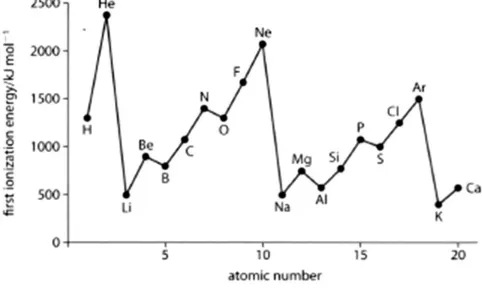
The periodic arrangement of the elements is also reflected by patterns in first ionization energies, as illustrated in the figure below. There is a general increase from left to right across a period, as the nuclear charge increases. As the electrons are removed from the same main energy level, there is increase in the force of electrostatic attraction between the nucleus and outer electrons. There is then a decrease to a lower level at the start of the next period as a new energy level, which is further from the nucleus, is occupied. The departures provide further evidence for the existence of sub-shells. This is explored in the worked example.
Worked example:
Further evidence for the existence of sub-shells comes from a study of first ionization energies.
(a) In Period 2 there is a decrease in first ionization energies between Be and B, and in Period 3 there is a decrease between Mg and AI. Explain this drop in ionization energies between Group 2 and Group 3 elements.
(b) In Period 2 there is a decrease in first ionization energies between N and O, and in Period 3 a decrease between P and S. Explain the drop in ionization energies between Group 5 and Group 6 elements.
Solution
(a) The Group 2 elements have the electron configuration ns2. The Group 3 elements have the electron configuration ns2 np1. The electron removed when the Group 3 elements are ionized is a p electron, the electron removed when the Group 2 elements are ionized is an s electron. Electrons in p orbitals are of higher energy and further away from the nucleus than s electrons.
(b) Group 5 elements have the configuration: ns2npx1npy1npz1. Group 6 elements have the configuration:
ns2npx2npy1npz1. For Group 6 elements, the electron is removed from a doubly occupied 2p orbital. An electron in a
Zumdahl, 5th Edition contains information relevant to this topic in Chapter 07. You should take some time to review the approach outlined in that textbook.
IB Examiner Hints:
The electrons in the Bohr model occupy orbits, which are circular paths. An orbital, which is a wave description of the electron, shows the volume of space in which the electron is likely to be found.
Note the abbreviated electron configuration using the noble gas core is not acceptable when asked for the full electron configuration.
Exercises:
Sketch a graph to show the expected pattern for the first seven ionization energies of fluorine.
The first ionization energies of the Period 3 elements Na to Ar are given in Table 7 of the IB Data booklet.
(a) Explain the general increase in ionization energy across the period.
(b) Explain why the first ionization energy of magnesium is greater than that of aluminum.
Only a few atoms of element 109, meitnerium, have ever been made. Isolation of an observable quantity of the element has never been achieved, and may well never be. This is because meitnerium decays very rapidly through the emission of alpha particles.
(a) Suggest the electron configuration of the ground-state atom of the element.
(b) There is no g block in the Periodic Table as no elements with outer electrons in g orbitals exist in nature or have been made artificially. Suggest a minimum atomic number for such an element.
03M105
What is the electron configuration for an atom with Z = 22?
A. 1s22s22p63s23p63d4 B. 1s22s22p63s23p64s24p2 C. 1s22s22p63s23p63d24p2 D. 1s22s22p63s23p64s23d2
01M122
The electronic configuration of chromium (Cr) is
A. 1s22s22p63s23p63d44s2. B. 1s22s22p63s23p63d54s1. C. 1s22s22p63s23p63d6. D. 1s22s22p63s23p63d14s5.
00N106
A solid element, X, contains unpaired electrons in its atoms and forms an ionic chloride, XCl2. Which electron
configuration is possible for element X?
97M104
The first four ionization energies of an element X are 740, 1450, 7730, and 10470 kJ mol−1. The formula for the stable ion of X is most likely to be
A. X1+ B. X2+ C. X3+ D. X4+
98N106
Which ionization requires the most energy?
A. Na(g) → Na+(g) + e− B. Na+(g) → Na2+(g) + e− C. Mg(g) → Mg+(g) + e− D. Mg+(g) → Mg2+(g) + e−
04M105
What is the total number of p orbitals containing one or more electrons in germanium (atomic number 32)?
A. 2 B. 3 C. 5 D. 8
01N105
In which of the following ground state electron configurations are unpaired electrons present? I. 1s22s22p2
II. 1s22s22p3 III. 1s22s22p4
A. II only B. I and II only C. II and III only D. I, II, and III
98N107
Which one of the following atoms in its ground state has the greatest number of unpaired electrons?
Chapter 04 Review Questions:
How many valence electrons are present in an atom of an element with atomic number 16?
A. 2 B. 4 C. 6 D. 8
Consider the composition of the species W, X, Y and Z below. Which species is an anion?
Species Protons Neutrons Electrons
W 9 10 10
X 11 12 11
Y 12 12 12
Z 13 14 10
A. W B. X C. Y D. Z
What is the correct sequence for the processes occurring in a mass spectrometer?
A. vaporization, ionization, acceleration, deflection B. vaporization, acceleration, ionization, deflection C. ionization, vaporization, acceleration, deflection D. ionization, vaporization, deflection, acceleration
(a) Evidence for the existence of energy levels in atoms is provided by line spectra. State how a line spectrum differs from a continuous spectrum.
(b) On the diagram below draw four lines in the visible line spectrum of hydrogen.
Low
energy
High energy
Define the term isotope. (2)
A sample of argon exists as a mixture of three isotopes. • mass number 36, relative abundance 0.337% • mass number 38, relative abundance 0.0630% • mass number 40, relative abundance 99.6% Calculate the relative atomic mass of argon.
State the number of electrons, protons and neutrons in the ion 56Fe3+.
electrons: _____ protons: _____ neutrons: _____
State a physical property that is different for isotopes of an element. (1)
Chlorine exists as two isotopes, 35CI and 37Cl. The relative atomic mass of chlorine is 35.45. Calculate the percentage abundance of each isotope. (2)
State the full electron configuation for argon. (1)
How many electrons are there in all the d orbitals in an atom of xenon?
A. 10 B. 18 C. 20 D. 36
For the elements of Period 3 (Na to Ar) state and explain:
(a) the general trend in ionization energy (2)
(b) any exceptions to the general trend (4)
A sample of germanium is analyzed in a mass spectrometer. The first and last processes in mass spectrometry are vaporization and detection.
(a) (i) State the names of the other three processes in the order in which they occur in a mass spectrometer. (2)
(ii) For each of the processes named in (a) (i), outline how the process occurs. (3)
(b) The sample of germanium is found to have the following composition:
Isotope 70Ge 72Ge 74Ge 76Ge
Relative Abundance / % 22.60 25.45 36.73 15.22
(i) Define the term relative atomic mass. (2)
(ii) Calculate the relative atomic mass of this sample of germanium, giving your answer to two decimal places.
98M202
In December 1994 a team of European scientists synthesized element 111 by bombarding a bismuth target for several days with a beam of nickel atoms.
209
Bi
+
64Ni
→
271X +
particles
83 28 111
(a) Identify the particle(s) emitted during this synthesis. (1)
(b) Specify the number of protons and neutrons which would be present in one atom of element 111. (2)
(c) If element 111 forms ions with a +1 charge, determine the number of electrons present in one mole of these ions. (2)
(d) Write the electron configuration for a nickel atom, in the standard form. (1s22s2… etc.) (1)
(e) Give a possible charge for a stable nickel ion and outline your reasoning. (2)
Actual IB Questions with Complete Grading Markschemes:
The following questions are followed by the actual rubrics used to grade them. Answer each question to the best of your ability on a separate piece of paper. Then, look at the rubric, to see where you lost points.
Question A:
(a) Naturally occurring samples of boron contain two different isotopes of boron with relative isotopic masses of 10.0 and 11.0. (6)
(i) Give the number of protons and neutrons in the nucleus of both atoms and also their full electronic structures. How would their physical and chemical properties compare?
(ii) Calculate the percentages of each isotope in naturally occurring boron.
(b) The successive ionization energies for boron are given below in kJ mol−1. (6)
1st 2nd 3rd 4th 5th
799 2420 3660 25000 32800
(i) Explain the reason why there is a large increase between the third and fourth values.
(ii) Explain the reason why the increase between the first and second ionization energies is more than the increase between the second and third ionization energies.
(iii) State, with reasons, how the value for the second ionization energy of carbon would compare with that of the second ionization energy of boron.
Question B:
Use the modern theory of the atom to answer each of the following.
(a) List the d, f, p, and s orbitals in order of increasing relative energy. (2)
(b) Give the number of each type of orbital d, f, p, and s at each energy level. (2)
(c) Describe the changes which occur when hydrogen produces a line spectrum. (2)
(d) Explain why the electron configuration of the nitrogen atom is written as N: 1s22s22p12p12p1 rather than N: 1s22s22p22p12p0. Write the electron configuration of titanium. (3)
(e) (i) Name the instrument used to determine the atomic masses of the two naturally occurring isotopes of gallium. Briefly describe each step involved in the operation of the instrument. (6)
(ii) A certain sample of gallium contains 60% Ga-69 and 40% Ga-71. Give the nuclear structures of these isotopes and calculate the relative atomic mass of gallium in this sample. (4)
(f) Explain the difference in the two values of ionization energy for each of the following pairs: (6)
(i) the 1st ionization energy of beryllium is 900 kJ mol−1 whereas the 2nd ionization energy of beryllium is 1757 kJ mol−1.
(ii) The 1st ionization energy of aluminum is 577 kJ mol−1 whereas the 1st ionization energy of magnesium is 736 kJ mol−1.