Evaluation and Use of an Online Data
Acquisition and Content Platform for
Physiology Practicals and Tutorials
Dane A. Kinga,b, Isabel A. Arnaizb, Clare Gordon-Thomsonb, Nicholas Randalb and Sharon M. Herkesb
Corresponding author: [email protected]
aDepartment of Biomedical Sciences, Faculty of Medicine and Health Sciences, Macquarie University, NSW 2109,
Australia
bDiscipline of Physiology, School of Medical Sciences, University of Sydney, Sydney, NSW 2006, Australia
Keywords: physiology practicals, student-centered learning, blended learning, learning analytics, student evaluations
International Journal of Innovation in Science and Mathematics Education, 24(5), 24-34, 2016.
Abstract
The blended learning approach to teaching allows educators to incorporate multiple learning resources whilst making courseware available to students outside the traditional classroom setting. An online platform that interfaces easily with a range of biological and clinical equipment for real-time data acquisition was introduced for laboratory-based practicals and associated tutorials for all intermediate/second year undergraduate physiology courses. The traditional paper-based notes across the intermediate physiology curriculum were converted to custom interactive, online modules delivered using a blended approach to learning. An advantage of incorporating online elements, particularly in the practical/laboratory context, was the opportunity to collect learning analytics to gauge student engagement with practical learning. Online delivery of content also facilitated the delivery of evaluation surveys to gauge student satisfaction with converted courseware. The purpose of this study was twofold: (1) to examine the usage pattern of students during delivery of one module of the online practical courseware, ‘Electrophysiology of the Nerve’, over the first two years of its implementation; and (2) to gather evidence of the impact of the platform on student engagement and learning outcomes. Data analysis and positive student feedback from surveys demonstrate that the new online system improved student engagement and active participation in practical activities.
Introduction
The incorporation of mobile technology into teaching contexts has become more widespread, and student expectations for electronic delivery of information have increased (Hedberg, 2006). Online learning platforms afford many advantages for improving teaching practice, particularly through the application of blended learning approaches (Paechter, Maier & Macher, 2010). Laboratory-based classes within biological and medical sciences could benefit from online or blended delivery, but the technical issues of facilitating data acquisition, reliance on specialised hardware and complex data analysis, have limited this approach in this context. More recently, interactive online delivery platforms with capabilities for data acquisition have become available (Dantas & Kemm, 2008).
stimulating. As the practical course content is integrated and the equipment used is complex, it was often necessary to deliver a lengthy, teacher-driven introduction at the start of class to facilitate students’ understanding of content, equipment setup and use, and information critical for safe and successful conduct of experiments. Technical staff were required before and during the practical session for equipment preparation, including loading of settings, and for troubleshooting difficulties with equipment. Students performed their experiments in large groups (limiting individual hands-on engagement with the equipment). Opportunities for viewing recorded data and performing analyses were largely confined to the practical session, as this relied on specialised software that was not readily available outside of the laboratory classroom. Students were required to either make written observations in their notebooks or take screenshots/photos of the recordings displayed on their computers. Increasing student enrolment numbers compounded this situation.
The opportunity to introduce an interactive, online delivery platform to our second year physiology students coincided with the opening of a new venue, the Charles Perkins Centre (CPC). The CPC teaching precinct can seat large groups of students in its flexible dry spaces, up to 240 students in its wet laboratory, and has a gymnasium suitable for experiments in exercise physiology. Computers are made available to each student for use during practical and tutorial sessions, which are loaded with software specific for online data acquisition and content delivery systems. Additional equipment, including analog-to-digital signal convertors (PowerLabs), transducers and connectors, was purchased together with multiple user licenses for the online program. LabTutor® was chosen as this program interfaces easily with a range of equipment used in the biomedical and clinical sciences and enables recording and data acquisition in real-time.
To address the shortcomings of the traditional presentation of practical classes and best utilise the new equipment and technology provided, we undertook a project of designing multiple, interactive blended learning modules across the second year undergraduate physiology curriculum. Over the course of the project, paper-based notes for practicals and tutorials across the curriculum were systematically transitioned to blended learning formats. Evidence for the benefits of a blended approach to teaching and learning has been previously reported for human biology (Lilje & Peat, 2010), and also for physiology (Zimmerman & Eckert, 2010; Felder et al., 2013). In our program, each practical session was modularised with each module consisting of a pre-practical and practical lesson. Additional online components such as a post-practical lesson were also incorporated in some modules. Each module focused on a particular body system.
Pre-practical lessons were designed using a flipped classroom/student-driven learning model, which has been shown to improve student learning (Ng, 2014), including students in physiology (Tune, Sturek, & Basile, 2013). Each pre-practical lesson covers the relevant theory and equipment setup information to prepare students for the practical session. Practical lessons include the methodology for the students to effectively perform experiments and provide each student with an immersive, hands-on learning experience incorporating real-time data acquisition. Follow-up tutorial classes (facilitated by teachers) were attended by students to review completed active learning tasks relating to the practical lesson, and these benefited from students having the opportunity to access, review and analyse/re-analyse their own experimental data and biological recordings in dry classrooms (i.e. outside of the wet laboratory). Optional student review of relevant content was provided in interactive, online post-practical lessons.
and tutorial questions were embedded in the lessons to test student understanding. Availability of lesson content (including recordings and data sets) was achieved through individual online accounts.
The LabTutor® platform selected for this project provides opportunities for collecting analytical usage data and for incorporating evaluative questions into specific lessons. Our aim, therefore, was to determine online student usage and engagement with our newly developed platform, using the module ‘Electrophysiology of the Nerve’ as an example, and to gather student feedback regarding their learning experience over the first two years of the platform’s implementation.
Methods
Product Acquisition
Multiple user licenses for the LabTutor® online program, as well as additional PowerLabs and accessory equipment, were purchased from ADInstruments, NSW, Australia.The conversion of paper-based notes to interactive, blended learning modules was undertaken during the first year of the platform’s introduction. Modules were made available to students undertaking their second year of undergraduate coursework in physiology. Content design and authorship was undertaken by a team consisting of teaching academics within the discipline together with a technical platform designer. Training in LabTutor® authoring was provided by ADInstruments.
Lesson Development
Online modules for practical-based, physiology courses were rolled-out to student cohorts (approximately 30-270 students per cohort) enrolled in the Faculties of Medicine, Science and Engineering (Bioengineering). In the first two years of operation, 175 lessons were developed and delivered—yielding over 24,000 records of student usage. Key modules covered
electrophysiology of the nerve, cardiovascular responses to exercise, electrocardiograms, skeletal muscle mechanics, sensory and motor systems, pulmonary respiration, blood glucose regulation, endocrine systems and diuretics. The online nature of this platform allows analysis of usage data captured for each student, providing insights into student usage patterns including the times and duration of engagement with materials. The results presented in this paper focus on the usage over the first year of the platform’s implementation (Year 1), where modules were developed and released to students using a just-in-time approach, as well as the subsequent year (Year 2) having had an opportunity to refine the modules based on informal student feedback.
Each module was structured to have pre-practical and practical lesson components (with some modules also having optional post-practical lessons), which were custom-designed from existing paper-based notes to be delivered using a blended approach. Existing material was integrated with new colour images, drag-and-drop labelling exercises, formative quizzes, interactive text and embedded multimedia (e.g. sound and video files), which was either produced within the department or gathered from a wide range of sources. Additional supplementary information was hyperlinked to pop-up windows to allow students to engage with content to a degree of detail matching their individual learning needs.
amounts of theory were placed in the practical lesson, while questions to facilitate application of theory to the experiments formed the basis for the tutorial class that followed.
Platform Operation and Lesson Presentation
Students and staff were provided with individual online accounts and access to the lessons and modules related to their physiology course. The students were required to complete their pre-practical lesson, which could be accessed from home, before they could preview the pre-practical lesson. The practical work of recording and collecting data was undertaken in class where students logged on in small groups of up to 4 students, or alone, depending on equipment availability. Students could revisit their work in subsequent classes and from home.
Student Usage Data and Learning Analytics
The administration side of LabTutor® allows for the analysis of certain student usage
information. This includes the dates of first and last access to lessons and time actively spent in lessons (i.e. time-on-task). This information was compared to the timing of practical classes and related assessments. All data presented in this study was collected with the approval of the
Human Research Ethics Committee of the University of Sydney (HREC 2015/071). Owing to the non-identifiable nature of the data presented and negligible risk to participants, a waiver of consent was granted for this study. Student usage patterns were tracked in the online platform and the data analysed for quantitative evaluation of student engagement with courseware. The significance of observed differences in median values was tested using Kruskal-Wallis tests (GraphPad Prism v6), followed by pairwise comparisons using Dunn’s multiple comparison tests; p < 0.05 was considered significant.
Student Evaluation Surveys
In the second year of implementation of the LabTutor® platform, two simple, open-ended questions were routinely incorporated into every lesson, which asked:
• In a few words indicate what you most enjoyed in this lesson • In a few words indicate what could be improved in this lesson
Student responses to each question were qualitatively analysed by examining the frequency of particular words or phrases; this informed the categories that were subsequently used to classify and count the responses. See Table 2 for the categories of the student’s perceptions of the online lessons.
‘Electrophysiology of the Nerve’: a Representative Module
Due to the large volume of student usage data collected over numerous lessons, a representative module, ‘Electrophysiology of the Nerve’, was selected for detailed analysis in this study. This module has a typical structure consisting of pre-practical, practical and post-practical lessons, and was offered to three different cohorts of second year/intermediate-level physiology
Results
Evaluation of the Usage Patterns for the ‘Electrophysiology of the Nerve’ Module
The median start date for pre-practical lessons preceded the median start date for the practical lessons by 1-2 days for all six cohorts (not shown). The access period, i.e. the number of days between when a student started and last accessed a lesson, is shown for the pre-practical, practical and post-practical lessons for all student cohorts in Table 1. The median access period for the pre-practical and post-practical lessons was consistently 1 day for all student cohorts (with limited variability within each cohort). This result indicates that most students only
accessed the pre-practical and post-practical lessons during a single day, and did not re-visit this material at a later date. In contrast, the median access period for the practical material varied between the cohorts studied, with considerable variability in the access period within each cohort.
Table 1. Access period of the Pre-Practical, Practical and Post-Practical lessons (that comprise the ‘Electrophysiology of the Nerve’ module) for the six student cohorts studied over the first two calendar years since system implementation. The number of students who accessed each lesson over a period of more than one day is also expressed as a fraction of the cohort (representing the proportion of students ‘revisiting’ the lesson at a later date). ND denotes that ‘no data’ was collected. Cohort Z was comprised of students from an advanced stream.
Pre-Practical Practical Post-Practical
Year Cohort
Median access period (#days) Inter-quartile range (#days) Proportion of students revisiting (%) Median access period (#days) Inter-quartile range (#days) Proportion of students revisiting (%) Median access period (#days) Inter-quartile range (#days) Proportion of students revisiting (%)
1 X1 1 0 23
(n=54/236) 8.0 63.00
84
(n=196/233) 1 0
8
(n=2/26)
Y1 1 1 (n=53/194)27 8.0 3.00 (n=169/188)90 1 0 (n=2/27)7
Z1 1 0 17
(n=5/30) 6.5 6.75
83
(n=25/30) 1 0
6
(n=1/16)
2 X2 1 1 28
(n=72/259) 8.0 8.50
83
(n=216/259) ND ND ND
Y2 1 1 28
(n=63/227) 1.0 33.25
48
(n=107/224) ND ND ND
Z2 1 0 20
(n=8/41) 1.0 0.00
12
(n=5/41) 1 0
17
(n=2/12)
Both years
All
cohorts 1 1
26
(n=255/987) 8.0 29.50
74
(n=718/965) 1 0
9
(n=7/81)
(A) Cohort X in Year 1, X1 (B) Cohort X in Year 2, X2
(C) Cohort Y in Year 1, Y1 (D) Cohort Y in Year 2, Y2
(E) Cohort Z in Year 1, Z1 (F) Cohort Z in Year 2, Z2
Figure 1: Histograms of access period (measured in days) for the ‘Electrophysiology of the Nerve’ Practical lesson for the six student cohorts studied over the first two calendar years since system implementation. The timing of follow-up face-to-faces classes and key assessments and other learning activities have been marked with dotted lines. Abbreviations: neuromuscular junction practical class (NMJ prac). N.B. the timing of assessments relative to the start of the Practical lesson varied between cohorts and years.
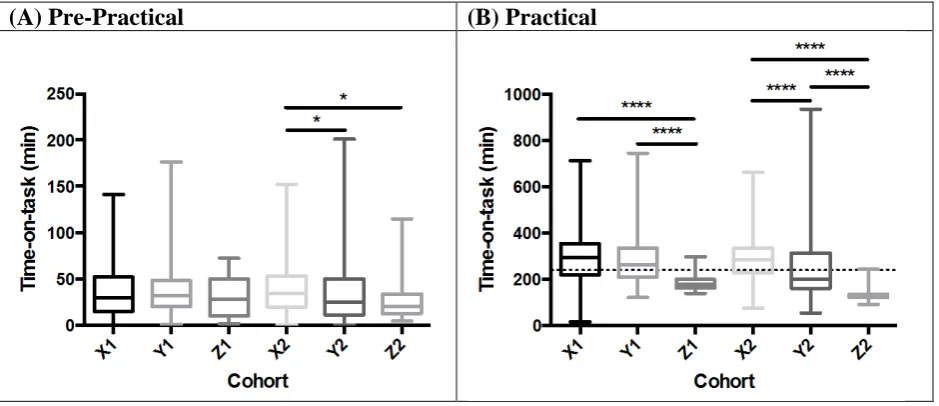
data was available regarding the post-practical lesson for cohorts X and Y in Year 2. Students generally spent greater than the scheduled class duration viewing and interacting with the practical lesson material (Figure 2B), except for the students in the advanced stream (cohort Z). The Z cohort typically had a significantly reduced time-on-task when compared to other cohorts (Figure 2).
(A) Pre-Practical (B) Practical
Figure 2: Box and whisker plots of time on task (measured in min) for the ‘Electrophysiology of the Nerve’ Pre-Practical and Practical lessons, panels A and B respectively. The boxes in each figure enclose the interquartile range, the whiskers enclose the full range, and the unbroken line within each box represents the median value. The median time on task varied significantly between the six cohorts for the Pre-Practical [Kruskal-Wallis test (6 groups, 986 values) = 17.64, approx. p < 0.01] and Practical [Kruskal-Wallis test (6 groups, 975 values) = 171.9, approx. p < 0.0001] lessons. Pairwise differences were tested using Dunn’s multiple comparison tests (p < 0.05, *; p < 0.0001, ****). The dotted line in Panel B indicates the class time allocated to the Practical.
Student Feedback from Evaluation Surveys
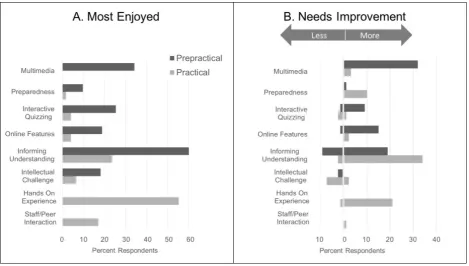
Student engagement with the lessons of the ‘Electrophysiology of the Nerve’ module was evaluated using simple open-ended questions at the completion of each lesson (Figure 3). The student responses to what they most enjoyed in the pre-practical and practical lessons were counted in the following categories: ‘multimedia’, ‘preparedness’, ‘interactive quizzing’, ‘online features’, ‘informing understanding’, ‘intellectual challenge’, ‘hands-on experience’ and
‘staff/peer interaction’ (Figure 3A). Key areas of improvement were identified by students as preferring more or less within the same categories (Figure 3B).
Figure 3. Qualitative analysis of student open-ended responses in the evaluation surveys of ‘Electrophysiology of the Nerve’ Pre-Practical (dark bars) and Practical (light bars) lessons. Student responses to questions: (A) “In a few words indicate what you most enjoyed in this lesson”; and (B) “In a few words indicate what could be improved in this lesson” were sorted into the categories shown on the y-axes. Categories were based on the representative words or phrases used by students and are detailed in Table 2.
Table 2. Representative words or phrases, and the context in which they were used, by students in the evaluation surveys were allocated to categories listed in column one and are shown in Figure 3. Abbreviations: multiple choice question (MCQ); short answer question (SAQ).
Categories of
student responses Representative words or phrases Context
Multimedia Visuals, diagrams, figures, videos, audio files Multimedia as an aid to understanding
Preparedness Prepared, confident, knowing what was going to happen, visualise
Materials allowed students to feel well prepared for class
Interactive quizzing
Interactive, exercises, MCQs, SAQs, feedback, questions
Interactivity of formative exercises and questions; variety of activities; opportunity to receive feedback
Online features Accessibility, structure, modules, layout, pop-ups, hyperlinks
Modular structure of lessons; Content layering via pop-ups and hyperlinks and the platform accessibility
Informing understanding
Informative, relevant, clear, understand, amount of information
General informative nature of the materials presented (content & quizzing); relevance, volume and clarity of content
Intellectual challenge
Easy to understand, just right level, easy, hard, difficult
Degree of detail—too easy, just right, too hard; Ability to comprehend content and/or answer questions
Hands-on
experience Practical, hands-on, tissue, nerve, laboratory
Working with biological tissues, scientific equipment and data; being in a laboratory Staff/peer
interaction Demonstrators, tutors, interacting with staff
Discussion
Paper-based notes used to support laboratory-based practicals in physiology courses were converted to electronic modules and delivered using a blended approach to teaching and learning via the LabTutor® platform. This transition to blended delivery, supported by an appropriate data acquisition system, has allowed us to meet our students’ expectations surrounding flexibility and accessibility of course materials. Furthermore, this system has created greater opportunities for our students to engage in student-paced, student-driven learning. The theory supporting similar student-driven learning models is reviewed by Ng (2014). Our students now have more opportunities to study wherever and whenever it is convenient and for as long as they choose.
Quantitative Analysis of Student Usage Data
The usage patterns of an exemplar module, ‘Electrophysiology of the Nerve’, by second year physiology students over the first two years of the platform’s implementation show that our students are revisiting course content, experimental data and results, as well as formative quizzes and exercises to support their learning.
Our data analysis shows that students are accessing pre-practical lessons in preparation for practical classes (as planned) and appreciable proportions of student cohorts are revisiting lessons, particularly practical lessons, over multiple days. The timing of students revisiting practical lessons and its agreement with other assessment tasks and learning activities (refer to Figure 1), indicates that students are not simply taking advantage of the greater accessibility of notes and laboratory records—but value these online materials as a learning resource to prepare for assessment tasks. Surprisingly, the trend was for students to revisit the practical lesson where conceptual and theoretical material was limited (rather than the pre-practical lesson). Our follow-up tutorial classes can now be designed with the knowledge that students can and do access the biological signals and experimental data recorded in practical lessons. This was not possible previously, when paper-based notes were used. The nature of the tutorial class work has since changed, becoming more data-centric and providing a more authentic research experience.
Pre-practical and post-practical lessons have no allocated class time. We note, however, that students spent appreciable amounts of time in self-directed learning using these materials to bookend their blended practical experiences. For instance, the median time-on-task for the pre-practical lesson was 30 min across the six cohorts studied (refer to Figure 2A). For pre-practical lessons, the total time spent interacting with courseware generally exceeded the allocated class time. It was observed that some students were spending many hours engaged with practical lesson material (usually over a period of several days), however this was not the case for advanced cohorts (refer to Figure 2B). Advanced students also had an apparently lower revisit rate, accessing lessons over a more limited date range (refer to Table 1). This may reflect a reduced requirement for consolidation of content among these students. The academic threshold for entry into an advanced unit is substantially higher than the comparable non-advanced cohorts; hence these students will generally possess a more complete understanding of fundamental concepts with demonstrated effective study habits. This prior learning and strong conceptual foundation framework may allow them to engage more efficiently with the practical lesson, particularly when small groups are drawn from this homogeneous high-achieving student population.
Qualitative Analysis of Student Evaluation Data
teaching. Results from the pre-practical lesson indicated that students most enjoyed the inclusion of informative content, multimedia (such as audio, video and colour images), and interactive features (such as drag-and-drop labeling exercises and formative quizzes). An example of a student response was, “ ... the best part of the pre-practical were [sic] the figures provided (they supported the information very well)”. Multimedia, which is not accessible in conventional paper text-based formats, seems to appeal to most types of learners and allows for the effective conveyance of complex technical and theoretical content.
Students perceived the content delivered in their lessons as valuable to their learning, and felt better prepared for the in-class practical tasks having completed the pre-practical lesson, remarking that,
“I liked how it tested my knowledge. I feel more prepared for the practical and by extension will be able to gain more from the practical as I feel I have a better understanding of what is required …”. The higher level of understanding and preparedness fostered by the online pre-practical lessons appears to have facilitated more positive student-teacher interactions during practical classes (reflected in student evaluations). Student responses have been encouraging, for example—“I enjoyed the practicals very much. They were very interactive and helped in the learning process.”
It is notable that the majority of students acknowledged their enjoyment of the hands-on nature of the practical class, which was supported by the online lesson material. This outcome is consistent with the aim of the blended teaching methodology—where face-to-face and online experiences interface to create a richer learning environment that neither online nor face-to-face delivery could achieve independently of one another.
In the first year of implementation, 8 and 14% of students indicated that no improvements were necessary for the pre-practical and practical lessons, respectively. In the subsequent year, following refinement of lessons, these statistics, which indicate the proportion of satisfied students, increased to 30 and 27%. Refinements included: (1) reducing the content load, and (2) improving the structure of the practical lesson. Unavoidable technical difficulties with some equipment and biological variability in tissue responses appeared to frustrate some students. Students from another tertiary institution using LabTutor® perceived that their knowledge in physiology had improved following a transition from a paper-based format (Felder et al., 2013).
In addition, staff enjoyed positive outcomes related to increased student and teacher preparedness and the efficient conduct of classes. Incorporating equipment settings and detailed descriptions of equipment into the practical notes has reduced the technical burden of class preparation. This has created a learning environment where a high degree of equipment setup may now be carried out by students rather than by technical staff. Training of teaching staff has become simplified as staff can also use online content similarly to students.
Limitations and Future Directions
Some limitations were encountered during this project, such as the enormous amount of intellectual effort and time required for the conversion of the paper-based notes. This required a dedicated team of individuals with multiple skills in: instructional design, teaching pedagogy, content development, LabChart® and equipment testing, and web and software authoring. However, the final positive outcomes of this project in terms of student engagement and satisfaction far outweigh these limitations.
format and have proven to be easily transferable when creating additional modules appropriate for physiology courses across a range of faculties. Within our discipline, this new teaching approach has been mostly adopted or easily adapted to suit the teaching requirements of multiple courses, easing the burden of developing additional lessons.
Conclusions
Analysis of student usage patterns recorded by the LabTutor® laboratory learning management system highlighted features that can be compared and contrasted between student cohorts. Analysis of student usage of the ‘Electrophysiology of the Nerve’ module by cohorts of second year physiology students over the first two years since the platform’s implementation demonstrated that this new online system improved student engagement and active participation during practical classes, with a significant proportion of students revisiting online lessons beyond designated class times (with the exception of students from advanced cohorts). A high degree of self-directed learning was evidenced by the substantial time-on-task recorded in excess of allocated class time, in addition to time spent on pre-practical and post-practical lessons. Future studies may explore the relationship between usage data and student learning outcomes in greater detail.
Students also responded favourably to the conversion of paper-based notes to a modularised, electronic format. Students provided positive feedback in evaluation surveys on the online features of the module studied, such as its interactivity, multimedia components, and the advantage of using the content to inform their understanding and better prepare for the practical class. The use of this learning platform facilitated a rich hands-on practical experience that was rated positively by students. We anticipate similar findings when analysing the quantitative and qualitative data collected for other modules that we have translated from paper-based to electronic format for blended delivery.
Acknowledgements
The authors thank Miriam Frommer who was involved in the production of the original paper-based notes, Michael Morris and Meloni Muir who contributed to course development, Hala Bishay and Adel Mitry for technical assistance with equipment, and Haydn Allbutt for the videos of equipment setup procedures. We are grateful for the technical and development support provided by ADInstruments, and to Margot Day for contract negotiation.
References
Dantas A.M., & Kemm, R.E. (2008). A blended approach to active learning in a physiology laboratory-based subject by an e-learning component. Advances in Physiology Education, 32, 65-75.
Hedberg, J.G. (2006). E-learning futures? Speculations for a time yet to come. Studies in Continuing Education, 28(2), 171-183.
Felder, E., Fauler, M. & Geiler, S. (2013). Introducing learning/teaching in a physiology course for medical students: acceptance by students and subjective effect on learning. Advances in Physiology Education, 37, 337-342.
King, D., Arnaiz, I., Gordon-Thomson, C., Herkes, S., & Randal, N. (2015). Evaluation and use of an online data acquisition and content platform for delivery of physiology practicals and tutorials [Abstract]. Proceedings of the Australian Conference on Science and Mathematics Education, (pp. 40-41). Perth, Australia: Curtin University. Lilje, O., & Peat, M. (2010). Teaching human biology to large first year classes: an eLearning journey for students
and staff. International Journal of Innovation in Science and Mathematics Education, 18(2), 21-31.
Ng, W. (2014). Flipping the science classroom: exploring merits, issues and pedagogy. Teaching Science: 60(3), 16-27.
Tune, J.D., Sturek, M., & Basile, D.P. (2013). Flipped classroom model improves graduate student performance in cardiovascular, respiratory and renal physiology. Advances in Physiology Education, 37(4), 316-320.