
13.2 Hydrocarbon Compounds
6
0
0
Full text
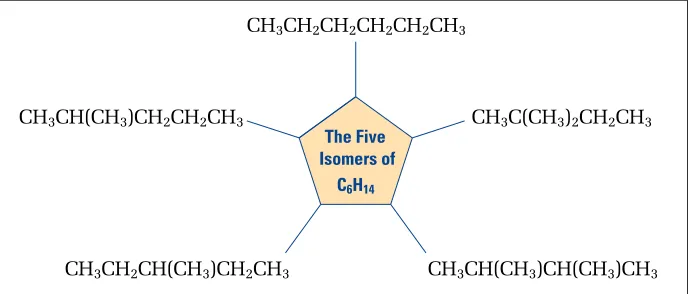
(2) Representing Structures and Bonding. Math. You have written chemical formulas for inorganic compounds such as ammonia, NH3 , and calcium carbonate, CaCO3 . As well, you have represented these compounds using Lewis diagrams, and perhaps other models. Such compounds are fairly small, so they are easy to represent using these methods. Many organic compounds — such as methane, CH4 , and ethanol, C2H6O — are also fairly small. With patience, you might even figure out how to draw a Lewis diagram for cholesterol, C27H46O! Most hydrocarbons and other organic compounds are quite large, however. They are also structurally complex. Therefore chemists have devised other methods to represent them, as explained below.. LINK. Graph the data in the table below. Note: Bond energy is the amount of energy that is needed to break a chemical bond.. Some Average Bond Energies Bond. Bond energy (kJ/mol). C. C. 346. Using Expanded Molecular Formulas to Represent Hydrocarbons. C. C. 610. One method that chemists use to represent a large molecule is the expanded molecular formula. This type of formula shows the groupings of atoms, and it often gives an idea of molecular structure. For example, the chemical formula for propane is C3H8 . This formula tells you that propane contains three carbon atoms and eight hydrogen atoms. It gives no clue, though, about the way in which the atoms are bonded together. Propane’s expanded molecular formula is CH3CH2CH3 . As you can see from this formula, the expanded molecular formula gives a clearer idea of atomic arrangement. It implies that a CH3 group is attached to a CH2 group, which is attached to another CH3 group. Writing expanded molecular formulas becomes more helpful when you are dealing with larger hydrocarbons. For example, C6H14 is a component of gasoline. It is also used as a solvent for extracting oils from soybeans and other edible oil seeds. Depending on how the carbon and hydrogen atoms are bonded together, C6H14 can have any of the five structural arrangements shown in Figure 13.5. Each arrangement has a different name.. C. C. 835. Si. Si. 226. Si. Si. 318 (estimate). C. H. 413. Si. H. 318. Infer a relationship between the stability of a compound and bond energy. Then suggest a reason why there are many more carbon-based compounds than silicon-based compounds.. CH3CH2CH2CH2CH2CH3. CH3CH(CH3)CH2CH2CH3. CH3CH2CH(CH3)CH2CH3 Figure 13.5. The Five Isomers of C6H14. CH3C(CH3)2CH2CH3. CH3CH(CH3)CH(CH3)CH3. Expanded molecular formulas for five structural arrangements of C6H14. Keep in mind that all five of these arrangements have the same chemical formula: C6H14 . Compounds that have the same formula, but different structural arrangements, are called isomers. Hexane, for example, is one isomer of C6H14 . You will learn more about isomers as you study this chapter.. Chapter 13 The Chemistry of Hydrocarbons • MHR. 539.
(3) CHEM FA C T The number of isomers of an organic compound increases greatly as the number of carbon atoms increases. For example, C5H12 has three isomers, C6H14 has five isomers, and C8H18 has 18 isomers. C30H62 , a large hydrocarbon, has over four billion isomers!. The expanded molecular formulas of C6H14 give you a better idea of the arrangement of the carbon and hydrogen atoms in its five possible isomers. You can use other methods as well, however, to represent hydrocarbons and other organic compounds. These methods are outlined below. Using Structural Models to Represent Hydrocarbons A structural model is a three-dimensional representation of the structure of a compound. There are two kinds of structural models: ball-and-stick models and space-filling models. Figure 13.6 shows ball-and-stick models for the five isomers of C6H14 . Notice that they show how the carbon and hydrogen atoms are bonded within the structures.. CH3CH2CH2CH2CH2CH3. CH3CH(CH3)CH(CH3)CH3. The Five Isomers of C6H14. CH3CH(CH3)CH2CH2CH3. CH3C(CH3)2CH2CH3. CH3CH2CH(CH3)CH2CH3 Figure 13.6 C6H14 can have any one of these five structural arrangements. How do the ball-and-stick models compare with the expanded molecular formulas for C6H14? How does each isomer differ from the rest?. 540 MHR • Unit 5 Hydrocarbons and Energy.
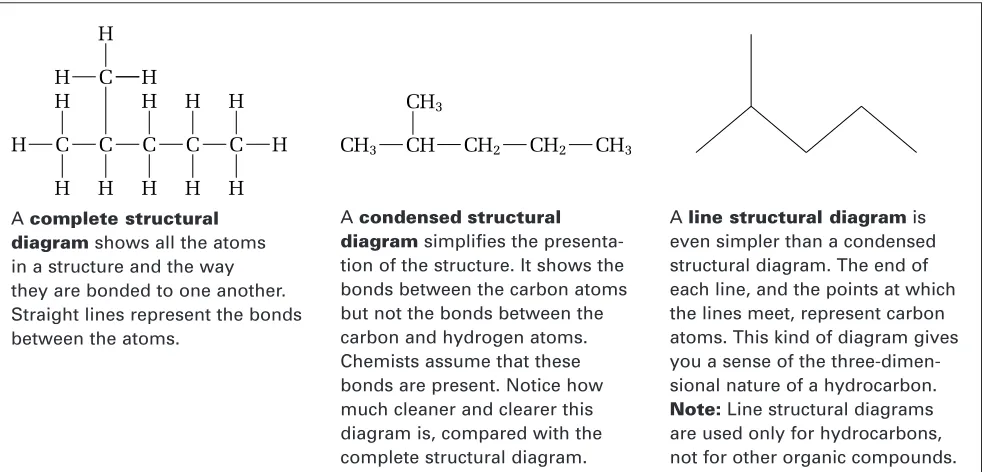
(4) A space-filling model, such as the one in Figure 13.7, also shows the arrangement of the atoms in a compound. As well, it represents the molecular shape and the amount of space that each atom occupies within the structure.. Figure 13.7. Electronic Learning Partner. To see an animation comparing structural diagrams with molecular formulas, go to your Chemistry 11 Electronic Partner now.. A space-filling model for hexane, one of the isomers of C6H14. Using Structural Diagrams to Represent Hydrocarbons A structural diagram is a two-dimensional representation of the structure of a compound. (In some chemistry textbooks, structural diagrams are called structural formulas.) There are three kinds of structural diagrams: complete structural diagrams, condensed structural diagrams, and line structural diagrams. As you can see in Figure 13.8, each serves a specific purpose in describing the structure of a compound. In the next investigation, you will have an opportunity to make your own models of the isomers of several organic compounds.. H. H. H H. C. H H. H. H. C. C. C. C. C. H. H. H. H. H. CH3. H. A complete structural diagram shows all the atoms in a structure and the way they are bonded to one another. Straight lines represent the bonds between the atoms.. Figure 13.8. CH3. CH. CH2. CH2. CH3. A condensed structural diagram simplifies the presentation of the structure. It shows the bonds between the carbon atoms but not the bonds between the carbon and hydrogen atoms. Chemists assume that these bonds are present. Notice how much cleaner and clearer this diagram is, compared with the complete structural diagram.. A line structural diagram is even simpler than a condensed structural diagram. The end of each line, and the points at which the lines meet, represent carbon atoms. This kind of diagram gives you a sense of the three-dimensional nature of a hydrocarbon. Note: Line structural diagrams are used only for hydrocarbons, not for other organic compounds.. Comparing complete, condensed, and line structural diagrams. Chapter 13 The Chemistry of Hydrocarbons • MHR. 541.
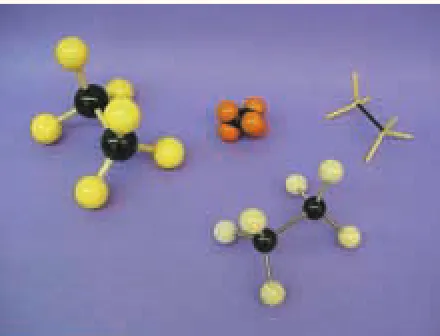
(5) S K I L L. F O C U S. Predicting Analyzing and interpreting Communicating results. Modelling Organic Compounds Figure 13.6 showed you that an organic compound can be arranged in different structural shapes, called isomers. All the isomers of a compound have the same molecular formula. In this investigation, you will make two-dimensional and three-dimensional models of isomers. Your models will help you explore the arrangements of the atoms in organic compounds.. Modelling concepts. Procedure 1. Construct three-dimensional models of the. three isomers of C5H12 . Use your predictions to help you. As you complete each model, draw a careful diagram of the structure. Your diagram might be similar to the one below.. Question How do models help you visualize the isomers of organic compounds?. Predictions Predict the complete, condensed, and line structural diagrams for the three isomers of C5H12 . Then predict the complete and condensed structural diagrams for the four isomers of C3H9N .. Materials paper and pencil molecular modelling kit. 2. Repeat step 1 for each isomer of C3H9N .. Analysis 1. In what ways were your completed models. similar to your predictions? In what ways were they different? 2. How do the models of each compound help. you understand the concept of isomers?. Conclusion 3. How accurately do you think your models. represent the real-life structural arrangements of C5H12 and C3H9N ?. Applications 4. In earlier units, you considered how the. These representations of the hydrocarbon ethane, C2H6, were made using different modelling kits. Your school may have one or more of these kits available.. structure and polarity of molecules can affect the boiling point of a compound. For each compound you studied in this investigation, predict which isomer has the higher boiling point. Explain your prediction. 5. Construct models for C7H16 . How many. isomers are possible?. 542 MHR • Unit 5 Hydrocarbons and Energy.
(6) Section Wrap-up The names of the isomers of hydrocarbons and other organic compounds are quite different from the names of inorganic compounds. For example, go back to the structural diagrams shown in Figure 13.8. They all represent the same isomer of C6H14 . Its name is 2-methylpentane. Now look at Figure 13.9. It shows the names and condensed structural diagrams for the four other isomers of C6H14 . Why do these names look so different from the names of inorganic compounds? Scientists have devised a systematic way to communicate all the possible atoms and structures for each organic compound— all in its name! In the next section, you will learn the rules for naming hydrocarbons. You will also learn how to interpret the information that hydrocarbon names communicate.. CHEM FA C T When is an isomer not an isomer? When it is exactly the same compound! The hydrocarbon C6H14 has only five isomers. Examine these two representations for one of them, hexane. CH3. CH2. CH2. CH2. CH2. CH2. CH3. hexane. CH2. CH3. 3-methylpentane. CH. CH3. 2,3-dimethylbutane. CH2. CH3. 2,2-dimethylbutane. CH3 CH3. CH2. CH. CH3 CH3. CH CH3 CH3. CH3. C. CH2. CH2. CH2. CH2. CH3. CH3. CH2 CH3. CH3. CH2. CH2. You might think that these are different isomers, but they are actually the same. The structure on the bottom is just a bent version of the structure on the top. Think about a length of chain. You can lay it out straight, or you can bend it. The chain is still a chain in either case. It just looks different. Naming a compound helps you recognize the difference between a true isomer and a structure that just looks like an isomer.. CH3. Figure 13.9. Four of the five isomers of C6H14. Section Review 1. Identify the three properties of carbon that allow it to form such a great variety of compounds.. 2. Chose one of the hydrocarbon molecules in this section to represent, using as many different kinds of models as you can. Identify each model you used.. 3. You have seen the expanded molecular formulas and condensed structural diagrams for the five isomers of C6H14 . Draw the complete and line structural diagrams for each of these isomers.. 4. C Draw the complete, condensed, and line structural diagrams for the isomers of C5H12 . How many true isomers did you draw? (See the ChemFact above to help you interpret this question.). 5. C Many organic compounds contain elements such as oxygen, nitrogen, and sulfur, as well as carbon and hydrogen. For example, think about ethanol, CH3CH2OH. Draw complete and condensed structural diagrams for ethanol. Can you draw a line structural diagram for ethanol? Explain your answer.. K/U. I. C. Chapter 13 The Chemistry of Hydrocarbons • MHR. 543.
(7)
Figure

Related documents
The molecular structure of I with displacement ellipsoids drawn at the 50% probability level, hydrogen atoms omitted
All hydrogen atoms were observed in difference Fourier maps. The H atoms were refined using a riding model with a C —H distance of 0.99 Å for the methylene carbon atoms, 0.98 Å for
Hydrogen atoms were clearly identified in difference syntheses, refined at idealized positions riding on the carbon atoms with isotropic displacement parameters U iso (H) = 1.2U(C
The molecular structure of the title molecule with the atom-numbering scheme. Hydrogen bond is shown as dashed line.. Hydrogen bonds are shown as dashed lines. Hydrogen atoms
Intermolecular hydrogen bonds link two cations and two anions into a centrosymmetric cluster. The atoms involved in the hydrogen bonding form a planar octagonal arrangement in
A possible approach to understanding the stereochemistry of olefin insertion would be to model the carbon-hydrogen or carbon-carbon bond- forming transition states of a group
The nitrogen atoms in hydrogen bonds act as proton acceptors whereas the carbon atoms participate in hydrogen bonding as both proton donors and acceptors.. In addition
The oxygen atom of the carbonyl group can form hydrogen bonds with water molecules, therefore, aldehydes and ketones with less carbon atoms show appreciable solubility in water..
