Issues
ISSN: 2146-4138
available at http: www.econjournals.com
International Journal of Economics and Financial Issues, 2017, 7(4), 86-95.
Evaluating the Effect of Religious Capital on the Costs for
God’s Sake by Comparing the Position Generator and Resource
Generator Instruments
Morteza Ezzati
1*, Nazanin Afshinfar
21Tarbiat Modares University, Tehran, Iran, 2Department of Economics, Payam Noor University, Zahedan, Iran.
*Corresponding author. Email: [email protected]
ABSTRACT
One of the important defined factors affecting the religious behaviors is religious capital for which some indicators have been created. Position generator and resource generator are two cases of such indicators. According to reviews, the effect of this factor on the religious-based behaviors is positive. However, the explanatory variables of various indicators - in addition to reliability and validity - can also be a benchmark for their excellence. Based on the conducted studies, the costs for God’s sake is a function of the religious capital. The present study experimentally estimated the effect of religious capital on the costs for God’s sake in both separate and comparative forms to analyze the two techniques of position generator and resource generator. The statistical population was the households in the city of Zahedan. The statistical sample was 500 households in 2015. The data was collected in 2016 through interviews and questionnaires. The analysis was performed using econometrics in Eviews software. The findings showed that the religious capital had a positive effect on the costs for God’s sake in these households. However, the explanatory variable of position generator was higher. This means that the imported variable of this indicator created a higher meaningfulness for the model. Furthermore, the variable coefficients of the position generator indicators were still significant in the separation of up and down position religious capital, and the variable coefficients of the resource generator indicators were not significant at 10% confidence level.
Keywords: Costs for God’s Sake, Religious Capital, Position Generator, Resource Generator
JEL Classifications: C32, O13, O47
1. INTRODUCTION
The concept of religious capital in its raw form has been imported to the economy literature more than 30 years ago and it seems that
it is one of the most important factors, which increases the costs
for God’s sake. Based on religious teachings, the human needs to
expense their assets in this world to meet the needs of life after the
death. Theoretically, spending these assets in this way depends on various factors, the most important of which are belief, religious capital, revenue, age, and so on.
People with high revenue can be motivated to allocate some of
their revenue to charity for God’s sake so that the essential needs of
the low-income groups can be met by the scientific understanding
of the various aspects and ways to spread these public costs and
correct planning based on scientific findings. Several studies have
been conducted in the field of religious capital, but the present
discussion is a new topic. Nevertheless, studies have been done
in the field of religious capital with some methods.
One challenge of religious reviews is measuring the religious characteristics of individuals. One of the important defined factors affecting the religious behaviors is religious capital for which some indicators have been created. Position generator and resource generator are two of these indicators. According to reviews, the effect of this factor (religious capital) on the religious-based behaviors is positive. However, along with reliability and validity,
explanatories of various indicators can also be a benchmark for their excellence. Based on the conducted studies, the costs for
In addition, the effect of religious capital on the costs for God’s
sake has not been reviewed and also results of these two methods have not been comparatively analyzed.
This paper attempts to create an indicator of religious capital by the two mentioned methods after reviewing the literature. The data are collected using a questionnaire and their correlation with the costs
for God’s sake is estimated in separate models. Then, the results of the models are compared. In this paper, the analytical method
is explained after reviewing the literature. Then, estimations and analysis are performed. After comparing the results of the analysis,
the conclusions are summarized.
2. REVIEW OF LITERATURE
Four categories of religious capital, position generator, resource generator, and costs for God’s sake are reviewed.
2.1. Religious Capital and Costs for God’s Sake
There are economic articles in the field of religious capital with raw concept which date back to more than 30 years ago (Dadger and Ezzati, 2002). Scientific studies have also been done in this regard. It can be said that most of the reviews with the capital approach are observed in Iranian investigations. However, these
studies are not of the same kind.
Ezzati and Agheli (2008. p. 1-17) analyzed the effect of religious capital on economic growth from a theoretical perspective. They
estimated an econometric model of panel data for the provinces
of Iran. Ezzati (2009. p. 367-395) in a paper entitled “the effect of religious capital on consumption” analyzed the subject from a theoretical perspective. Ezzati and Shafiee (2012. p. 63-92) evaluated the effect of financial markets and religious capital according to Islamic teachings. Sadeghi et al. (2013. p. 61-84) estimated the function of charity by incorporating the capital religious according to Islamic teachings. Ezzati and Baghcheghi (2015) in a paper entitled “the analysis of religious social capital on innovation based on the position generation” studied the effect of religious social capital on innovation of Tarbiat Modarres
University students.
Ezzati and Mozayani (2016) in a paper entitled “designing the indicator and evaluating religious social capital based on the position generation” tried to create indicators for measuring and analyzing the religious social capital among PhD students at Tarbiat Modarres University. In this study, at first, the indicator was created. Then, the questionnaire was filled and statistical methods and regression analysis were performed. The findings showed that access to the sources of religious social capital among
men, married people and students of humanities, economics, and
management was higher.
Also, Ezzati (2005. p. 106-108) in an experimental review
analyzed the Muslim consumer behavior and estimated the
religious cost function by collecting a statistical questionnaire. Kia'alhoseini (2010. p. 205-212) evaluated the factors affecting the religious costs in urban household income decides of Iran from 1882 to 2005. Lashkari and Mehrparsa (2014. p. 113-128)
created an indicator for belief based on a questionnaire with 23 questions and investigated the relationship between belief in God
and consumer behavior.
According to this review, there are few studies concerning the effect of religious capital on the costs for God’s sake; furthermore, in these few studies, the religious capital measurement methods
have not been used at the micro level. More importantly, the two
mentioned methods have not been applied in any study measuring religious capital.
2.2. Position Generator
Position generator (Lin and Dumin, 1986) is a tool, which is used to
measure the social capital at the individual level. This approach is
highly focused on the existence of social resources on the networks rather than the links (Lin and Dumin, 1986; Lin et al., 2001).
In the position generator, a questionnaire is used and a list of a few positions is given to the respondent who is asked whether family members, friends, and acquaintances have such positions. Accordingly, the respondent access to social resources is evaluated. The use of these techniques is easy and fast, which enables the researcher to design questionnaires appropriate for different groups. Of course, the designer must have a clear vision of the prestige of social resources for developing the questionnaire. To distinguish religious capital from social capital in the questionnaire, religious positions are provided. Religious rather
than social positions - measured in social capital - are provided.
This is done through questions about the positions such as “Do you know the head of a charity institution?” or “Do you know a priest?” and similar questions dealing with other religious positions. Thus,
the respondent access to social resources is evaluated. It should
be noted that the questionnaire of position generator used in this
study is based on the conducted research in Netherlands (Boxman
et al., 1991; Moerbeek, 2001; Van Der Gaag, 2005) and Germany (Volker, 1995; Volker and Flap, 1999). These kinds of research have used non-religious positions (jobs) in the questionnaire. The basic question asks whether the respondent knows anyone in each position. “Know someone” in this questionnaire means that the
respondent can remember the name and is able to talk easily with
the position holder when facing him. Subsequently, the respondent is asked to determine the position of the acquaintances, friends, or
family members. Correct interpretation of the distinction between
acquaintances, friends and family members is up to the respondent (Van Der Gaag, 2004).
2.3. Resource Generator
Surveying social networks in the Netherlands was the most outstanding research conducted using this tool in 1999 and 2000. Another instance of using this kind of generator may be seen in a research named “creation and efficiency of social capital, social capital in labor markets and education” conducted in 2003 (Gaag and Snijders, 2005. p. 18). Another study employing this method was in the research program of “social factors necessary for healing crisis” in 2003 in England. In addition, the resource generator has been used in connected lives surveying in 2005 in Canada.
2.4. Costs for God’s Sake
Ezzati (2005. p. 106-108), in an experimental review, analyzed the Muslim consumer behavior and estimated the religious costs function via collecting a statistical questionnaire. Kia'alhoseini (2010. p. 205-212) evaluated the same topic in a paper entitled “factors affecting the religious costs in urban household income deciles of Iran from 1882 to 2005.” Lashkari and Mehrparsa (2014. p. 113-128) created an indicator for belief based on a questionnaire with 23 questions and investigated the relationship between belief
in God and consumer behavior.
3. RESEARCH METHODOLOGY
The population under study in this research included the households of Zahedan and the collected data of cost and revenue were related
to 2015. The data were collected from the heads of households in 2015. The reason for selecting this population was that Zahedan as one of the major great cities of Iran in which diversity is frequently seen, can be a good striking case for Islamic religious
reviews. This research involved a case study of owners of free
jobs of Zahedan’s central region due to their greater independence leading to their responding more freely and this population was the cluster. Our review sample included 486 households using the Cochran statistic. In the study, questionnaire tools were used. The questionnaire was distributed to the members of population and collection was followed-up when at least 500 complete responses
on the basis of our review were achieved.
SPSS software was used in the statistical analysis. This data
analysis was performed using Eviews econometrics software.
Initially, the data related to the research variable were entered into the software and then, the models were tested.
4. RESULTS AND DISCUSSION
In this paper, the position and resource generators were applied to measure the religious capital. Initially, the statistical characteristics of the sample and the different aspects of the questionnaire are explained. Then, questionnaire data for religious capital (with position and resources generators tools) are analyzed and the findings are presented. The effects of some exogenous variables on the religious capital are studied as well. Finally, results are
compared with the estimates.
4.1. Characteristics of the Statistical Sample
The sample characteristics are shown in Table 1. As can be seen, 40.2% were self-employed, 35.8% were employed, and 24% were
retired workers of which 23.6% had second free jobs, 0.8% second job, and 75% were without any second job. Most of respondents had a bachelor’s degree (31.4%), 8.2% were graduate students and 11% had seminary education. Respondents’ age was between 24 and 79 years old (their average age was 45 years old).
4.2. Questionnaire
The questionnaire consisted of four parts. The first part was related to the general information of respondents that were written in the questionnaire: In answering questions, you would not need
to write your name and the information would not be published.
The second part dealt with revenues and costs of households in
2015. In this part, the respondent should announce his average
monthly and annual revenues and costs as well as non-continuous annual costs of the household.
The third part concerned position generator, which included 20 questions. The position generator questionnaire in this study was
based on results of research conducted in the Netherlands (Boxman
et al., 1991; Moerbeek, 2001; Gaag, 2005) and Germany (Volker, 1995; Volker and Flap, 1999). In the process of developing the questionnaire, the items were tailored to local conditions in the country and they were given to professors and experts in human sciences for the validity. Finally, 20 jobs were included in the final questionnaire. The final questionnaire was distributed among 20 residents as pre-test and it became finalized after resolving some uncertainties. In this part of the questionnaire, it was assumed that these jobs were a good representation of all religious jobs in the country that access to them provided the possibility of creating religious sources. In this questionnaire, the general question was whether the respondent knew someone in any of these jobs. “Know someone” in this questionnaire meant that the respondent could
remember the name of the position holder and when facin him
was easy to talk to him. Subsequently, the respondent was asked to determine the position of the acquaintances, friends, or family members (Volker, 1995). Correct interpretation of the distinction among acquaintances, friends, or family members were given over to the respondent (Gaag, 2005).
Answers were graded to analyze the results: (0) No person, (1) acquaintance, (2) friend, (3) family. According to this ascending ranking of links, each answer took a higher score. If the respondent had chosen both options of acquaintance and friend, friend would be the option for analyzing and score two would then be given and
if friend and family members were both chosen, family members
would be the option for analyzing and so score three would be given to it.
The fourth part of the questionnaire was related to resource generator questions. This part had 20 questions. The results were
analyzed and scored in the same way as in part 3.
4.3. Religious Capital Estimation Using Position Generator
Appendix Table 1 in the summarizes the responses to the position generator questionnaire. Since the statistical population
jobs that have more access to some specific jobs with higher prestige. As can be seen, most frequent “yes” answers belonged to Board of Trustees of the mosque (45.8%), director of a religious authority (42.6%), the mighty spiritual (41.8%) and the least frequent “yes” answers belonged to family members of a source of imitate (religious reference), or senior scientific cleric (8.6%), office of source of imitate (9.2%) and source of imitate (10.4%). In other words, the greatest access was to the members of the Board of Trustees of the mosque and the least
access was to family members of a source of imitate, or senior cleric science.
4.4. Religious Capital Estimation Using Resource Generation
Appendix Table 2 in the summarizes the responses to the resource generator questionnaire. Some questions on this questionnaire
asked whether the respondent knew someone with the mentioned
features. As can be observed in the table, the highest number of “yes” answers belonged to the person who gave the Khums and Zakat for poor people (77%) and the lowest number of “yes” answers belonged to acquaintances with someone publishing religious book or contents (13.4%).
On the other hand, the average response can be surveyed, which shows the respondent link to the job owner (position generator) and
the mentioned characteristics (these have been normalized so that
zero means no link and one means a very strong link). The results can be seen in Appendix Tables 3 and 4. It can be observed that the deepest link in the position generator was respectively between respondents and job owners, Board of Trustees of the mosque and clergy or mighty person to answer the religious questions (strong ties). The lowest link was between family members of a source
of imitate, or senior scientific cleric and source of imitate office member or sources of emulation (weak ties). The deepest link in the resource generator was between acquaintances with someone to go to religious ceremonies, paying Khums, Zakat, and costs for religious vow (strong ties). The lowest link was between acquaintances with someone who publishes religious book or
contents, meets the emulation, and seminary education. Various
studies have showed that having weak ties for instrumental actions (actions that their main function is to obtain direct benefits of socio-economic) is useful and the strong ties for statement actions
(actions that their main function is to share interests and create a
sense of participation) are applied.
4.5. Religious Position Prestige
To make the answers countable, jobs’ prestige and characteristics should be determined. The prestige of religious professions was measured using a questionnaire. For this purpose, a questionnaire of religious jobs was prepared and sent to 11 experts of humanities
and social sciences and they were asked to determine the public
view of the credibility and prestige of these jobs for any job title. In the end, the average score given to each job was considered as the prestige of the job, presented in Appendix Table 4 (Volker, 1995). It can be seen that the religious goods store owner with an average score of 6 had the lowest prestige and source of imitate with an average score of 16.83 had the highest prestige (minimum and maximum scores are 1 and 20, respectively). Given that the average score is from 1 to 20, the mentioned characteristics and jobs can be classified into three categories of low prestige (mean 1-8), average prestige (mean 8-13), high prestige (mean 13-20). The final column of the table represents the prestige of each job. As can be seen, there were three jobs in the high category, 12 jobs in the average category, and 5 jobs in the low category.
Table 3: General information of religious capital scales (position generator)
Indicator Average Standard deviation Coefficient of variation*
High prestige religious capital 1.43 2.05 1.43
Low prestige religious capital 1.68 2.15 1.27
Religious capital (total accessed prestige) 8.11 8.82 1.08
*Coefficient of variation is defined as standard deviation divided by the average
Table 2: Reliability of indicators using Cronbach’s alpha coefficient (resource generator)
Indicator Cronbach’s alpha coefficient Standardized Cronbach’s alpha Number of items
High prestige religious capital 0.789 0.797 5
Low prestige religious capital 0.732 0.734 3
Religious capital (total accessed prestige) 0.925 0.923 20
Table 1: The reliability of the indicators using Cronbach’s alpha coefficient (position generator)
Indicator Cronbach’s alpha coefficient Standardized Cronbach’s alpha Number of items
High prestige religious capital 0.8 0.8 5
Low prestige religious capital 0.77 0.77 3
Religious capital (total accessed prestige) 0.90 0.90 20
Table 4: General information of religious capital scales (resource generator)
Indicator Average Standard deviation Coefficient of variation
High prestige religious capital 2.68 3.11 1.16
Low prestige religious capital 2.43 2.42 0.99
4.6. High and Low Prestige Religious Capital
On the basis of the findings of position generator questionnaire and prestige, the religious capital can be measured. According to the studies in the field of social capital and through defining “high prestige social capital” and “low prestige social capital”
concepts based on scale of access to measure the individual
social capital, these two concepts can be used in the field of social capital (because religious capital is a form of social capital). In other words, high prestige social capital represents the access to religious business owners with high credibility and prestige for the person, which is grouped into the instrumental category from a functional view. Low prestige social capital refers to access to resources that can be made by business owners with low prestige. This type of religious capital deals with actions, which are known as declared actions. On the other hand, the concept of “total accessed prestige” is used as an indicator and the main scale of the social capital. The total accessed prestige is the social capital volume scale, which is calculated as the cumulative prestige of
all jobs available to individuals. This indicator can also be used
for the religious capital.
Reliability of these indicators was investigated with Cronbach’s alpha coefficients in SPSS software. Tables 1 and 2 show the values of the coefficients for high prestige social capital, low prestige social capital, and total religious capital.
Based on the analysis of Cronbach’s alpha reliability coefficient, since the reliability coefficient of the questionnaire is higher than 0.7, it may be said that the tool had a good reliability and the reliability would be reduced by removing any of the questions.
Based on the findings obtained from the analysis of Cronbach’s alpha reliability coefficient, the reliability coefficient was in the range of 0.73-0.92. It can be said that the tool had a good reliability and each of the questions had a good contribution in reliability. Tables 3 and 4 show the general information of three scales of religious capital that was obtained from questionnaires.
5. MODELING
At first, we introduce the model. Then, we assess the relationships using the techniques of position generator and resource generator, and compare the findings with two methods. The relationships between variables are expressed in the econometric equation framework by using Eviews software.
5.1. Model Variables
Muslims observe the religious rules associated with Islamic teachings. Some of these rules are incorporated into the framework of costs for God’s sake. Therefore, along with the costs of living in this world, Muslims have other costs that can be called religious costs or costs for God’s sake. Of course, the
costs for God’s sake have a rather wider scope. Here, a part of costs for God’s sake, which is placed within the framework of
payments for the benefit of others, was isolated for discussion.
Thus, we attempted to assess the operational definition variables and data. It should be noted that all data of this study
were collected via questionnaire and the statistical population
consisted of Zahedan citizens. The research was conducted on
the financial year of 2015.
5.1.1. Costs for God’s sake
In addition to costs for the life of this world, everyone has costs for the life after death and for God’s sake. Costs for God’s sake have a
rather wide scope incorporating all obligatory and recommended
payments, services and etc. that people do for others or themselves. However, a part of these costs is paid by people without the consent
of God or reward; but here the part of the costs for God’s sake are discussed that is for others and its value after paying becomes zero for the payer. These costs include the sum of the following costs. • Helping those affected by natural disasters in the country • Helping those affected by natural disasters or wars abroad • Zakat of production
• Zakat al-fitr • Khums
• Atonement, rejection of oppression, prayer wages and similar
payments
• Annual paid charity
• Donating property and paying grants to others (family and non-family)
• Helping charities (private and public) and charity celebrations • Helping other entities (headquarters of Friday Prayers, Red
Crescent, etc.)
• Helping delegations, Husseiniyahs and similar institutions and religious rituals
• Helping mosques and dedication to holy places
• The cost of religious ceremonies at home (mourning, meals, receptions and other costs)
• Eid al-Adha sacrifice
• Votive sacrifice of Imam Hussain (AS), disadvantaged and other religious days
• Sacrifice for buying a house or car, heal the sick, weddings,
birthdays and other types of victims
• Lending load or money without interest (loan) to others • Interest-free loan bank deposit.
The cost of buying prayer rug, rosary, prayer tents and other equipment and the cost of preparing Quran, Mafatihul Jenan, Quran keeper or other books of prayer and pilgrimage.
5.1.2. Revenue
One of the important factors affecting the cost of this world as well as costs for God’s sake is the revenue. According to Islamic teachings, religious taxes is an increasing function of the revenue.
These taxes can increase the function of costs for God’s sake and they may be increased by increase in the revenue. In this study,
the annual household revenue in 2015 was asked from the head
of the household and considered as a criterion. It is expected that the revenue increases the costs in this world as well as the costs for God’s sake.
5.1.3. Asset
Another factor affecting the amount of everyone’s costs is his
asset. Meanwhile, the costs for God’s sake are a part of costs and the costs for God’s sake is expected to increase by increase in the
as the representative measure of assets. Determining the value of housing assets is also difficult; so, the individuals’ house area is
considered as their asset.
5.1.4. Age of household head
Another factor affecting the costs for God’s sake is age. Based on the theory about the religious costs, people see themselves closer to death, afterlife and the punishments and rewards as their age increases and consequently they make more attempts to ensure that life. Thus, they pay higher costs for God’s sake. In this study, the age of individuals was asked and the values were inserted for the age variable in the model.
5.1.5. Religious capital
Based on the theory, the costs for God’s sake increase as the
religious capital increases. Accordingly, a part of questionnaire in this study included the position generator questions to measure the religious capital. The position generator questionnaire is based on the conducted research in Netherlands (Boxman et al., 1991; Moerbeek, 2001; Van Der Gaag, 2004) and Germany (Volker, 1995; Volker and Flap, 1999), used for the social capital. However, in this study, the position generator questionnaire was based on Ezzati and Mozayani (2016) and a special questionnaire was made for the religious capital. Similar to the mentioned work, a questionnaire was prepared for the resource generator and the religious capital was also measured by this tool. To measure religious capital, each tool contained 20 questions. In part 3 of this paper, creating indicators and their measurement are fully
described.
5.1.6. Second job
Having a second job can have a positive effect on the revenue and also can lead to spending more time in work; this may cause religious people to pay some more costs to compensate the lost
time for God’s sake. On this basis, a second job can increase the costs for God’s sake.
5.1.7. Religion
Being Shia or Sunni can create different behaviors due to certain
different beliefs. It can be expected that Sunnis have more types
of these costs due to some beliefs, such as generalized zakat, inter religious payments, etc.
5.1.8. Number of household members
Increasing the number of household members can increase the costs of living in this world. Thus, assuming a constant revenue, it reduces the costs for God’s sake. Nevertheless, increasing the
number of family members can increase the number of revenue owners and thus the household revenue.
Based on what was said, the explanatory variables of this study
were revenue (Ry), age (Ag), Education (Ed), second job (Sj), assets (Fo), religion (Re), number of household members (Nh), and accessed religious capital (Tp, Hp, and Pl). The dependent variable was the costs for God’s sake in households (Ri), which was
measured based on two indicators with two separated indicators
in separated models. Initially, the general model was estimated. Then, non-significant variables were excluded from the model and the model was estimated with significant variables. By separating the total religious capital in high prestige religious capital and low prestige religious capital, each of them became significant in the equation and were modeled in the dependent variable position.
Then, the model was estimated. These four models were estimated
for both position generator and resource generator (Volker, 1995).
The overall shape of the model was as follows:
Ri = C + C(1) Ag + C(2) Fo + C(3) Ry + C(4) Ed + C(5) Sj + C(6) Re + C(7) Nh + C(8) p
The dependent variable of all models was the costs for God’s sake.
5.2. Models and Results for Religious Capital with Position Generator
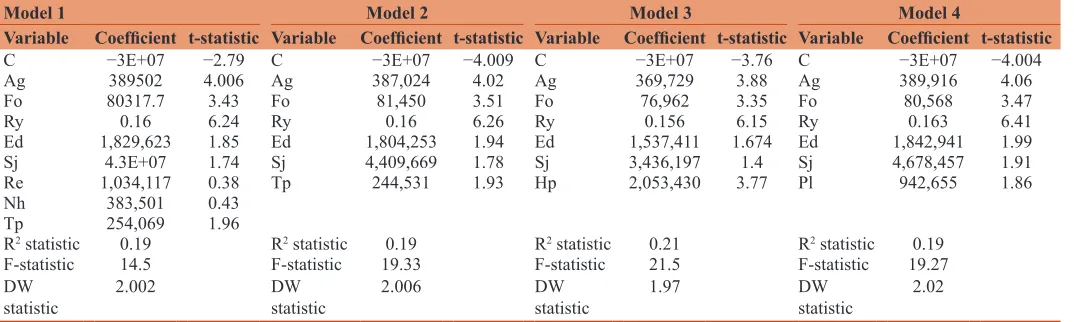
We estimated four models to estimate the effect of religious capital (through position generator method) on the costs for God’s sake. Variables and results are given in Table 5. The first
model was the linear model with the dependent variable of total
religious capital.
As can be seen in Table 5, the results of model estimation showed that age, asset, annual revenue, education, second job, and total accessed prestige were significant and other variables, i.e., the number of household members and religion were not significant. To increase the accuracy, the model was estimated once again by eliminating non-significant variables.
Table 5: The results of the position generator model
Model 1 Model 2 Model 3 Model 4
Variable Coefficient t-statistic Variable Coefficient t-statistic Variable Coefficient t-statistic Variable Coefficient t-statistic
C −3E+07 −2.79 C −3E+07 −4.009 C −3E+07 −3.76 C −3E+07 −4.004
Ag 389502 4.006 Ag 387,024 4.02 Ag 369,729 3.88 Ag 389,916 4.06
Fo 80317.7 3.43 Fo 81,450 3.51 Fo 76,962 3.35 Fo 80,568 3.47
Ry 0.16 6.24 Ry 0.16 6.26 Ry 0.156 6.15 Ry 0.163 6.41
Ed 1,829,623 1.85 Ed 1,804,253 1.94 Ed 1,537,411 1.674 Ed 1,842,941 1.99
Sj 4.3E+07 1.74 Sj 4,409,669 1.78 Sj 3,436,197 1.4 Sj 4,678,457 1.91
Re 1,034,117 0.38 Tp 244,531 1.93 Hp 2,053,430 3.77 Pl 942,655 1.86
Nh 383,501 0.43
Tp 254,069 1.96
R2 statistic 0.19 R2 statistic 0.19 R2 statistic 0.21 R2 statistic 0.19
F-statistic 14.5 F-statistic 19.33 F-statistic 21.5 F-statistic 19.27
DW
statistic 2.002 DW statistic 2.006 DW statistic 1.97 DW statistic 2.02
As shown in Table 5, all variables along with the religious capital were statistically significant in this model. Accordingly, each of these variables had a positive effect on increasing the costs for
God’s sake.
High prestige religious capital was separately included in Model 3. Model 4 included the low prestige religious capital. As seen in Table 5, this variable became significant by entering high prestige religious capital with position generator and it had a positive effect on costs for God’s sake. High prestige religious capital in position generator refers to jobs that have higher prestige and power and are more influential in society.
Model 4 included the low prestige religious capital. As seen in Table 5, low prestige religious capital with position generator became significant in the model and it had a positive effect on costs for God’s sake. Therefore, the results of the position generator indicated that high prestige religious capital, low prestige religious capital, and total religious capital had a significant positive effect on the costs for God’s sake. Total religious capital also had a positive effect. Accordingly, it can be concluded that regarding the models and measurement methods of religious capital, total religious capital had a positive effect on the costs for God’s sake, but the effect of high prestige religious capital was higher.
5.3. Resource Generator
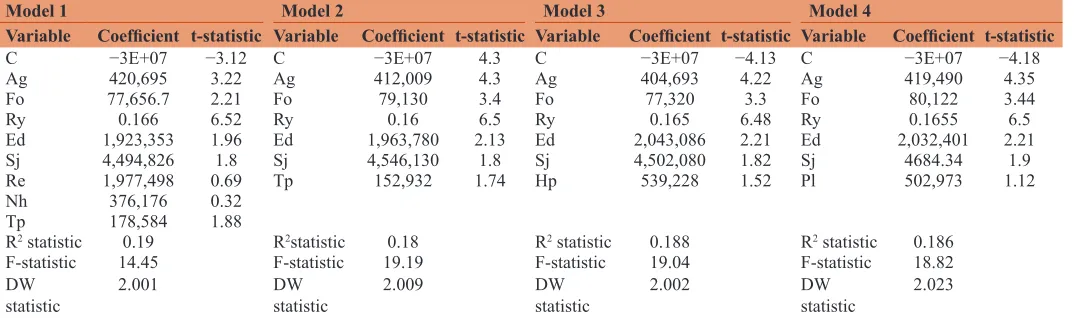
Four models were adopted to estimate the effect of religious capital (through resource generator measurement method) on the costs for God’s sake. Comparison of results is given in Table 6. The first model covered the total religious capital. The results of this model showed that age, infrastructure, net income, education, second job, and total accessed prestige were significant variables. The number of household members and the religion variables were not significant.
In order to increase the accuracy of the model, we estimated it
again by eliminating non-significant variables. All variables had a significant positive effect on costs for God’s sake. The overall results of the model with religious capital based on the position generator were similar except that the significance coefficient of religious capital variable and the explanatories of this model were lower in this technique. High prestige religious capital and
low prestige religious capital were also included in the model separately. This estimation showed that the measured high prestige religious capital was not significant with the resource generator. However, this effect was positive and significant at a level of about 15%, but it was not statistically valid.
The fourth model was estimated by low prestige religious capital (Pl) via using the resource generator. The result is shown in the final column of Table 6. This estimation showed that the measured low prestige religious capital was not significant with the resource generator. However, this effect was also positive, but
not statistically valid.
5.4. Evaluating and Comparing Results of Resource Generator and Position Generator Techniques
It should be noted that these indicators measure the accessed social
religious capital based on the definition and design. All indicators measure the whole religious capital, but the level of all resources or positions is not equal in the society. Accordingly, based on the social prestige, the resources or positions were divided into several categories (low, medium, and high prestige in this part), and the
values were separately listed in the estimation.
After the general estimation of the corresponding regression model
with the dependent variable of the costs for God’s sake, we tried
two techniques. By using the position generator, we came to the conclusion that religion and the number of household members were not statistically significant and then they should be removed from the model. By eliminating these variables, the model was estimated again. The findings indicated that the religious capital had a significant positive effect on costs for God’s sake. In addition, we found out that revenue, assets, age, education, and second job had a significant positive effect on the costs for God’s sake. We obtained the same results in estimating the model by the resource generator; however, the estimated model involving the resource generator yielded less significant result. That is, the effect of religious capital assessed by the resource generator was an increase in the explanatoriness of the model by slightly more than 1% while the religious capital variable assessed by the position generator indicator suggested an increase in the explanatoriness of the model by nearly 3% (i.e., about twice as high). The size is obvious in the
R2 statistic differences between the two models.
Table 6: The results of the resource generator model
Model 1 Model 2 Model 3 Model 4
Variable Coefficient t-statistic Variable Coefficient t-statistic Variable Coefficient t-statistic Variable Coefficient t-statistic
C −3E+07 −3.12 C −3E+07 4.3 C −3E+07 −4.13 C −3E+07 −4.18
Ag 420,695 3.22 Ag 412,009 4.3 Ag 404,693 4.22 Ag 419,490 4.35
Fo 77,656.7 2.21 Fo 79,130 3.4 Fo 77,320 3.3 Fo 80,122 3.44
Ry 0.166 6.52 Ry 0.16 6.5 Ry 0.165 6.48 Ry 0.1655 6.5
Ed 1,923,353 1.96 Ed 1,963,780 2.13 Ed 2,043,086 2.21 Ed 2,032,401 2.21
Sj 4,494,826 1.8 Sj 4,546,130 1.8 Sj 4,502,080 1.82 Sj 4684.34 1.9
Re 1,977,498 0.69 Tp 152,932 1.74 Hp 539,228 1.52 Pl 502,973 1.12
Nh 376,176 0.32
Tp 178,584 1.88
R2 statistic 0.19 R2statistic 0.18 R2 statistic 0.188 R2 statistic 0.186
F-statistic 14.45 F-statistic 19.19 F-statistic 19.04 F-statistic 18.82
DW
statistic 2.001 DW statistic 2.009 DW statistic 2.002 DW statistic 2.023
Moreover, the built-in variables of the estimated model using the resource generator had not an acceptable significance by separating the low and high prestige religious capital. Also, these estimated
models demonstrated that the explanatories of the model with the
position generator was greater for the upper and lower prestige. Therefore, it can be said that measuring the social religious capital with the position generator can have a higher explanatories than that with the resource generator. Accordingly, it may be stated that the position indicator is more efficient.
6. CONCLUSION
This paper aimed at evaluating the effect of the religious capital
and other variables on the costs for God’s sake. Moreover, the
religious capital effect measured by two techniques of position and resource generator was compared. The results of this evaluation were shown within the framework of eight models. Measuring the religious capital via these two techniques suggested the religious
capital has a positive effect on the costs for God’s sake. In addition,
revenue and age, as the two important factors of the theory of Islamic behavior, were shown to have a significant positive effect on the costs for God’s sake. These results confirm the theory of economic behavior in a religious context.
Estimations suggested that a higher level of education increases the costs for God’s sake. This finding is not consistent with the findings of some studies. This may be explained in this way that
since revenue is closely correlated with education in our society
and education increases the social understanding as well as other
factors, it can increase the costs for God’s sake.
The findings indicated that the second job had a positive effect
on the costs for God’s sake. This may be caused by two reasons.
One reason is that revenue increases by having a second job and
then the costs for God’s sake increase as revenue increases. The second reason is that people have to allocate more time to their
work having a second job so that less time remains for them to spend for God’s sake. Religious people who believe in life after death want to have a better life after death by spending time and money for God’s sake; thus, when they have less time to spend
for God’s sake to provide for the life after death, they are forced
to allocate more money for this purpose. Accordingly, the cost for God’s sake is increased by having a second job.
By comparing the two indicators of position and resource generators, which measure the religious capital, it can be concluded that position generator is more efficient for the
explanatoriness of households’ payment behavior in the costs
for God’s sake. This efficiency is the case in all indicators of this
study and in the separation of high and low prestige religious
capital as well.
REFERENCES
Boxman, E., de Graaf, P.M., Flap, H.D. (1991), The impact of social and human capital on the income attainment of Dutch managers. Social Networks, 13, 51-73.
Dadger, Y., Ezzati, M. (2002), The relationship between religion consumer behavior in other religions (other than Islam). A Useful Letter, 8(31), 71-100.
Ezzati, M. (2005), Estimation of religious expenditures function (expenditure for God’s sake) in Muslims. Quarterly Journal of Economics, 18, 89-115.
Ezzati, M., Aagheli, L. (2008), Religious capital: Nature, elements, and effects, the first conference on Islamic economics and economic development. Ferdowsi University of Mashhad, 1387, 1-17. Ezzati, M., Baghcheghi, M. (2015), Analysis of the impact of social
religious capital on innovation (in the Tarbiat Modarres University PhD students). Parliament and Strategy, 22(84), 255-301.
Ezzati, M., Mozayani, A.H. (2016), Designing an instrument for measuring religious capital using the position generator model (a case study of PhD students of Tarbiat Modarres university). International Journal of Humanities and Social Science, 11(6), 63-67.
Ezzati, M., Shafiee, A. (2012), Estimating the effect of financial markets and religious capital on the charity in Iran. Journal of Islamic Economics Research, 12(46), 63-92.
Gaag, M.P.J. (2005), Measurement of Individual Social Capital, PhD. Dissertation, University of Groningen.
Gaag, M.P.J., Appelhof, G.J., Webber, M. (2012), Ambiguità nelle risposte al position generator. Sociologia e Politiche Sociali, 15(2), 113-141. Kia, A.H., Seyed, Z. (2010), Estimating the function of average religious
costs in an urban household in Iran. Qom: Islamic Economics Journal, 35, 193-216.
Lashkari, M., Mehrparsa, Z. (2014), Effect of Belief in God on Consumer Behavior. Journal of Islamic Economic Studies, 6(2), 113-128. Lin, N., Dumin, M. (1986), Access to occupations through social ties.
Social Networks, 8, 365-385.
Lin, N., Fu, Y., Hsung, R. (2001), The position generator: Measurement techniques for social capital. In: Lin, N., Cook, K., Burt, R.S., editors. Social Capital: Theory and Research. New York: Aldine De Gruyter.
Moerbeek, H. (2001), Friends and Foes in the Occupational Career. Nijmegen: PhD. Dissertation.
Sadeghi, H., Ezzati, M., Shafiee, A. (2013), Estimation of charity function in Iran. Journal of Economic Research (Sustainable Development), 13(2), 61-84.
Soleimani, M. (2013), Measuring Social Capital among Elites in Tehran Province, PhD. Dissertation, Tarbiat Modares University.
Appendix Table 1: Summarizes of position generator questionnaire in the field of religious capital
Do you know anyone who is in each of the following
positions? The number of yesN (%) AcquaintancesThe number of people you knowFriend Family members
N (%) N (%) N (%)
Source of imitate 52 (10.4) 41 (8.2) 11 (2.2) 0 (0)
Senior cleric 84 (16.8) 69 (13.8) 12 (2.4) 3 (0.6)
Representative cleric 71 (14.2) 49 (9.8) 15 (3) 7 (1.4)
Director cleric 142 (28.4) 109 (21.8) 24 (4.8) 9 (1.8)
Source of Imitate Office Manager 46 (9.2) 31 (6.2) 14 (2.8) 1 (0.2)
Director of a Charity 174 (34.8) 95 (19) 59 (11.8) 20 (4)
Director of a Board 213 (42.6) 100 (20) 85 (17) 28 (5.6)
Director of Hosseiniyeh 194 (38.8) 99 (19.8) 63 (12.6) 32 (6.4)
Director of a loan institution 185 (37) 77 (15.4) 66 (13.2) 42 (8.4)
Prayer leader 203 (40.6) 153 (30.6) 34 (6.8) 16 (3.2)
Friday prayer 114 (22.8) 77 (15.4) 34 (6.8) 3 (0.6)
Board of Trustees 229 (45.8) 133 (26.6) 77 (15.4) 19 (3.8)
Caravan Manager 172 (34.4) 88 (17.6) 61 (12.2) 23 (4.6)
Store owner 125 (25) 58 (11.6) 40 (8) 27 (5.4)
Author 56 (11.2) 23 (4.6) 19 (3.8) 14 (2.8)
Mighty cleric 209 (41.8) 129 (25.8) 55 (11) 25 (5)
Seminary student 114 (22.8) 57 (11.4) 30 (6) 27 (5.4)
Master cleric 123 (24.6) 76 (15.2) 40 (8) 7 (1.4)
Immediate family members of a source of imitate or senior cleric 43 (8.6) 33 (6.6) 7 (1.4) 3 (0.6)
Religious School Director 98 (19.6) 64 (12.8) 16 (3.2) 18 (3.6)
Appendix Table 2: Summarizes of resource generator questionnaire in the field of religious capital
Do you know anyone who is in each of the following positions? The number
of yes AcquaintancesThe number of people you knowFriend Family members
N (%) N (%) N (%) N (%)
Khums and Zakat 385 (77) 194 (38.8) 103 (20.6) 88 (17.6)
Answering religious questions 337 (67.4) 211 (42.2) 85 (17) 41 (8.2)
Religious book gifts 199 (39.8) 96 (19.2) 68 (13.6) 35 (7)
Monetary help to the needy 340 (68) 133 (26.6) 118 (23.6) 89 (17.8)
Knowing someone with seminary education 159 (31.8) 91 (18.2) 44 (8.8) 24 (4.8)
Working with heavenly reward 347 (69.4) 15 (30) 113 (22.6) 84 (16.8)
The cost of a religious vow 357 (71.4) 144 (28.8) 120 (24) 93 (18.6)
Printing religious books 67 (13.4) 43 (8.6) 22 (4.4) 2 (0.4)
Getting help for religious resources 202 (40.4) 110 (22) 69 (13.8) 23 (4.6)
Religious books loan 245 (49) 136 (37.2) 82 (16.4) 27 (5.4)
Lectures in religious ceremonies 478 (55.6) 166 (33.2) 74 (14.8) 38 (7.6)
Meet the source of imitate 81 (16.2) 54 (10.8) 15 (3) 12 (2.4)
Member of a charity institute 155 (31) 75 (15) 44 (8.8) 36 (7.2)
Religious Board Member 208 (41.6) 93 (18.6) 85 (17) 30 (6)
Learning Quran 273 (54.6) 151 (30.2) 76 (15.2) 46 (9.2)
Invitation to religious rituals 319 (63.8) 121 (24.2) 131 (26.2) 67 (13.4)
Participation in religious behavior 286 (57.2) 119 (23.8) 95 (19) 72 (14.4)
Discussion of religious topics 264 (52.8) 143 (28.6) 82 (16.4) 39 (7.8)
Providing a place for religious ceremonies 303 (60.6) 113 (22.6) 131 (26.2) 59 (11.8)
Going to religious ceremonies 349 (69.8) 87 (17.4) 109 (21.8) 153 (30.6)
Appendix Table 3: Link severity of resource generator questionnaire in the field of religious capital
Do you know anyone who is in each of the following
positions? severityLink Do you know anyone who is in each of the following positions? severityLink
Khums and Zakat 0.132 Lectures in religious ceremonies 0.85
Answering religious questions 0.108 Meet the source of imitate 0.24
Religious book gifts 0.67 Member of a charity institute 0.54
Monetary help to the needy 0.127 Religious Board Member 0.70
Knowing someone with seminary education 0.50 Learning Quran 0.88
Working with heavenly reward 0.125 Invitation to religious rituals 0.11
The cost of a religious vow 0.131 Participation in religious behavior 0.105
Printing religious books 0.18 Discussion of religious topics 0.84
Getting help for religious resources 0.63 Providing a place for religious ceremonies 0.101
Religious books loan 0.76 Religious School Director 0.153
Appendix Table 4: Link severity of position generator questionnaire in the field of religious capital
Link severity Do you know anyone who is in each of the following
positions? Link
severity Do you know anyone who is in each of the following
positions?
0.30 Friday prayer
0.126 Source of imitate
0.68 Board of Trustees
0.204 Senior cleric
0.55 Caravan Manager
0.20 Representative cleric
0.43 Store owner
0.36 Director cleric
0.206 Author
0.124 Source of Imitate Office Manager
0.62 Mighty cleric
0.54 Director of a Charity
0.39 Seminary student
0.70 Director of a Board
0.35 Master cleric
0.64 Director of Hosseiniyeh
0.11 Immediate family members of a source of imitate or senior
cleric 0.67
Director of a Islamic loan institution
0.30 Religious School Director