June 2017, Vol. 5, No. 1, pp. 1-16 ISSN: 2374-2380 (Print), 2374-2399 (Online) Copyright © The Author(s). All Rights Reserved. Published by American Research Institute for Policy Development DOI: 10.15640/jpbs.v5n1a1 URL: https://doi.org/10.15640/jpbs.v5n1a1
Development and Validation of the High Capacity Model of Resilience and Well-being
Scale 21 (H-CAP 21)
Timothy H. Barclay, Ph.D
1& Raymond Duff Barclay, Ph.D.
2Abstract
The research on resilience has been hampered from a lack of a specific definition that can operationalized for measurement. The High Capacity Model of Resilience and Well-Being (H-CAP21) is a new theoretical model that defines specific traits that create states of resilience and well-being for use as a screening tool in clinical and non-clinical settings. Norming was completed across two studies with a total population of 1442 participants comprised of a clinical population of inpatient psychiatric patients and a non-clinical population of adult mid-career graduate students. A four-factor model represented by a 21-item scale was confirmed as a best fit. Individual subscales yielded alpha’s from .75-.92, convergent validity with the Resilience Scale and discriminatory validity with and Obsessive Passion subscale and the Beck Depression Inventory-II. Criterion-related validity exhibited a positive directional relationship between the subscales with the criterion (cumulative GPA) and significant correlations with the overall scale score and commitment subscale. However, the remaining subscales did not reach a level of significance with the criterion. Further exploration of the H-CAP 21 will expand the type and setting of the populations the instrument is assessed with to include clinical populations, military applications, self-regulation, and motivation. The H-CAP 21 is believed to have clinical utility as a psychometrically sound screening tool.
Keywords: Resilience, well-being, positive psychology, mental illness
The concept of resilience and well-being has flourished in the past decades and continues to receive significant attention. This increase in research has resulted in a ubiquitous constructwhere resilience and well-being have been associated with multiplecontent domains and outcomes. However, an operational definition that identifies individual, social, and therapeutic aspects is lacking (Lightsey, 2006; Reid & Botterill, 2013; Windle, Bennet, & Noyes, 2011). Generally, resilience and well-being are associated with the presence of positive emotions, the absence of negative emotions, and the subjective evaluation of satisfaction and fulfillment one has toward their life (Duckworth, Steen, & Seligman, 2005).
The Need for a Defined Assessment
The broadness and ambiguity of definitions for resilience and well-being remains a hurdle for operationalizing these constructs into a testable theory and clinical format. Toward that end, the High Capacity Model of Resilience and Well-being (H-CAP) was created through an attempt to answer the following questions: What are the curative factors that make people better who struggle with mental disorders? What makes people able to achieve their goals in life? How are people able to rise above their circumstances and achieve success? What creates psychological resilience? What are the buffers against mental disorders? The answer to these questions was discovered through a review of the positive psychology literature. The literature discusses many traits that contribute to states of resilience and well-being.
1 [email protected], Liberty University, Department of Psychology,1971 University Blvd. Lynchburg, VA 24551, USA.
However, in researching the origin of these traits they either explicitly or implicitly mentioned or referred to being hopeful (Frank, 1968, 1975; Menninger, 1959; Stotland, 1969) engagement in goal seeking and obtaining behavior (Deci & Ryan, 2000; Locke & Lathem, 1990) the quality of relationships (Özen, Sümer, & Demir, 2010; Pierce, Sarason, & Sarason, 1990, 1991) and motivation (Deci & Ryan, 2000; Locke & Latham, 1990; Vallerand, 1997, 2007). In reviewing the current research on the topic of resilience and well-being, we define them as a set of attributes that consist of Hope, Commitment, Accountability, and Passion. The model is signified with the acronym (H-CAP) which translates into High Capacity. We believe this title accurately reflects the relationship of well-being to resilience which is the ability to function at a higher capacity. Resilience also exhibits ties to well-being (Fava & Tomba, 2009). Well-being is defined with many of the same attributes such as Hope (Kemer & Atik, 2012; Sahin et al,. 2012) social support [Accountability] (Kemer & Atik, 2012; Mota & Matos, 2015; Ryff, 1989) purpose and meaning, personal growth [Passion], self-acceptance, and mastery [Commitment] (Ryff, 1989).
Research indicates that the ability for individuals to generate positive emotions in difficult times, and in general, are more resilient (Ong, Bergeman, Bisconti & Wallace, 2006; Tugate & Fredrickson, 2004). Positive emotions create a state of mind that allows the individual to see alternatives and take advantage of opportunities (Algoe, Fredrickson, & Chow, 2011).
H-CAP Scale Development
In order to test the theory that resilient people have a greater capacity for Hope, Commitment, Accountability, and Passion, these traits needed to be measured. The outcome of this process was the development of the High Capacity Model of Resilience and Well-being Scale 21 (H-CAP 21). Although there are many well established instruments that measure hope, goal seeking and obtaining behavior, quality of relationships, and motivation/passion, The H-CAP 21 brings these constructs together under a single instrument. The H-CAP 21 has four subscales, Hope is measured using nine items, Commitment is measured using three items, Accountability is measured using four items, and Passion is measured using five items for a total of 21 items. The purpose of the H-CAP 21 is to measure how much of a given trait someone has compared to the other traits. The goal is to create a balance among the traits. Used in a treatment or practical setting, one can measure these traits as they pertain to a particular goal (aspects of their life they want to change). Goal achievement then is based upon their resilience and the strength and balance in which these traits are engaged. Current psychological techniques can be used to foster these traits individually and collectively. Therefore, within a clinical setting, the focus is not on pathology and symptom alleviation per say but the development of hopefulness, commitment to specific behaviors, accountable relationships, and passion. As these are being achieved, symptom alleviation occurs on its own.
A principle that guided the development of the H-CAP 21 scale was to adapt items from currently available assessments that measure the same or similar constructs with good reliability and validity. The task from that point was to review the instruments individually to determine which items with the highest factor loadings best fit the definition of the constructs of the H-CAP 21 scale. These items were then adapted as needed. The scale items for the H-CAP 21 are answered using a 5 point Likert-scale that range from Not True to Very True.
Hope.Hope has many definitions. However, they mainly center on one central theme being that hope is a coping mechanism and motivator (Wang, 2000). It is characterized as anticipation that something will be achieved and or attained. Stotland’s (1969) work on hope influenced much of the current research. He proposed hope as being action oriented with an emphasis on expectation.
One may consider the constructs of Commitment, Accountability, and Passion to be included within hope. As noted, Snyder et al. (1996) defines “hope as a cognitive set comprising agency (belief in one's capacity to initiate and sustain actions) and pathways (belief in one's capacity to generate routes) to reach goals. (p.321)” Multiple studies have questioned whether agency thinking combined with pathways thinking truly characterizes the average person’s understanding of hope (Bruininks & Malle, 2005; Tong, et al., 2010). Similar to these studies, a recent study conducted by Tong, et al. (2010) found via multiple cross-cultural studies that only Snyder’s agency items (state and trait) were positively related to hope. Additionally, they note that the agency items (for both trait and state versions) do not seem to be measuring perceived capacity for executing goals-related actions. Tong, et al. (2010) note that their findings are consistent with past studies (e.g., Bruininks & Malle, 2005; Feldman, et al., 2009) that highlight agency is more reflective of cognitive expectations related to the feasibility of attaining a specified outcome and not necessarily the actual capacity to generate the means to pursue the goal.
Tong, et al. (2010) mention that agency type thinking represents more of what is thought of when individuals think of hope in general and as they put it into operation in their circumstances from both a cognitive and behavioral aspect. Given these findings, the capacity for hope reflected in the H-CAP 21 appears congruent with this definition as reflected in the wording of the items measuring this construct. It is intended to assess the propensity of an individual to pursue long-term goals as part of a commitment to persevere or grit in pursuing these goals in addition to the agency of the individual. These two subscales along with accountability and passion (obsessive vs. harmonious) create the structure of the H-CAP 21. In the H-CAP model, hope is defined simply as a state of mind that is characterized by the belief that one is capable of engaging in the means to obtain a goal in spite of current circumstances that serve as encouragement (which is the feeling component). Initial items were designed to reflect agency type processes to measure hope and were derived from the Hope Scale, The Herth Hope Scale and the Beck Hopelessness Scale.
Commitment. Commitment is defined as an obligation to act regardless of emotion. It may becoupled with emotion; however, it more appropriately reflects behavior toward a defined goal (Duckworth et al., 2007; Locke et al., 1988). Commitment at this level refers to a commitment to engaging in proactive behaviors regardless of emotion. Snyder et al. (2000) describes a form of commitment in his hope theory in the form of Agency Thoughts. Agency thinking is thoughts of determination and persistence. It serves as the motivational factor that moves the person toward the desired goal. Because behavior is linked to mood, when proactive behaviors are engaged and monitored, the tendency is to move toward the defined goal (Sturmey, 2009; Kanter et al., 2008).
In developing items for this scale, the nature of the items focused on the cognitive mindset that one may have that would predict their current level of commitment to engage in proactive behaviors. The thought behind this rationale is that those endorsing items that reflect a sense of obligation and perseverance will have an easier time changing current non-productive behavior to more proactive behaviors. The Grit Survey as developed by Duckworth, Peterson, Matthews, and Kelly (2007) provides a measure of perseverance and passion for long-term goals. Their initial study showed that grit was able to predict goal achievement beyond talent. Similarly, Commitment as defined in the High Capacity Model is interested in measuring one’s commitment to proactive, goal directed behavior in the form of this same perseverance. Items were selected from the Grit Survey that loaded on the element of perseverance.Similarly, items were also adapted from the Goal Perception Questionnaire that provides a measure of perseverance, effort, and obligation (Ingledew et al., 2010).
Accountability. Accountability is defined as the willingness to accept responsibility for one’s actions. The acceptance of responsibility occurs at an individual level but also incorporates relationships with others for support in that one must give permission to others allowing them to hold the individual accountable in working toward a goal. This requires the creation of supportive relationships with like-minded people. It also involves relinquishing the right to assign blame. The items that define the construct of Accountability are new items that have not been used or adapted from previous questionnaires. However, the definition of the construct was adapted from the works of Peersen, Gudjonsson, and Sigurdsson (2000) Blame Attribution; Pierce (1994) The Quality Relationships Inventory; and Wood and Winston (2007) Leader Accountability.
It allows an individual to experience strong motivation and emotion toward an activity but is controlled by the individual. The activity or activities are engaged in without contingencies and allows for the experiencing of positive appreciation for self and the activity. Obsessive Passion is the pursuit of an activity based on the need for self-worth. The activity itself becomes a defense and protective function when the person is compelled to engage in a behavior for the fulfillment of an intrinsic need. The activity thus controls the individual. The Passion Scale has demonstrated reliability and validity though a number of studies (Rousseau et al., 2002; Vallerand et al., 2006). The items in the passion sub-scale for this instrument have been modified by substituting the reference to a particular activity for “current role in life.” This modification was made in order to capture their level and type of passion for their current life circumstances as a whole and passion for life in general.
The use of these traits within therapeutic settings evolved out of a means to help patients achieve specific goals they had for themselves within therapy and also life. Regardless of what they sought to accomplish, they needed to have hope that it could be achieved. They also needed to be committed to engage in the behaviors necessary to make their hope realized. In dealing with mental illness, a commonly shared experience is interpersonal relationship difficulties (Veiel, Kühner, Brill, & Ihle, 1992; Keitner et al. 1995). In order to achieve what one sets out to do, this will require them to repair and/or create accountable relationships in line with their committed behaviors and hopes. Lastly, they needed to develop a harmonious passion for their goal and new role in life. In order to achieve the desired outcome and have well-being and resilience, all four traits must be in existence and in harmony with each other. Take one of them away, and although a specific goal may be achieved, a state of well-being will not. The theory behind this model is that resilient people have a greater capacity for well-being and display greater degrees of hope, committed behaviors, quality relationships, and passion. It does not mean that individuals high in these traits do not go through emotionally difficult times, but they process these events differently and with less reactive emotion and negative behavior (Carver, 1998; Fredrickson, 1998, 2001).
Methods
The initial scale had 50 items generated from the literature covering the dimensions hypothesized as relevant for a high capacity forresilience and well-being. There were slight editorial changes to item language to ensure consistency in style and voice across items.
Initial Item Assessment, Selection and Cross-Validation
We undertook an investigation to validate the multi-dimensional H-CAP model. In Study 1, we identified and assessed a pool of items for which the major purpose was to develop a draft multidimensional measure of resilience and well-being. The proposed H-CAP dimensions in the initial study includedHope, Commitment, Accountability,Passion (Harmonious), Passion (Obsessive). The study has been approved by the Liberty University Institutional Review Board and have been performed in accordance with the ethical standards as laid down in the 1964 Declaration of Helsinki (1996) and its later amendments.
A focus on broad trait-level agency, e.g., belief in one's capacity to initiate and sustain actions (hope) and perseverance of effort, e.g., capacity to sustain and be resolute in one’s commitment to realizing some future outcome when challenged which includes a commitment to engage in right behaviors in the face of adversity (commitment) (Duckworth & Quinn, 2009; Tong, et al., 2010); The third theme that informs the theoretical structure is the degree someone is responsive and accountable to the expectations of oneself and others in driving one toward a goal. The final theme that supports the development of the H-CAP structure posits that well-being is promoted by an individual’s capacity for maintaining a passion that is in harmony with one’s internalized needs and not in response to external pressures. This leads to sustained commitment toward a goal via healthy behaviors and motivations rather than heightened stressors from external pressures or obsessiveness in goal driven behavior at the expense of balanced, healthier behaviors.
The final version of the H-CAP confirmed nineHope items assessing agency type thinking. Items were derived from the Beck Hopelessness Scale (Beck & Steer, 1988; Beck, Weissman, Lester, &Trexler, 1974) and the Hearth Hope Index (Expectancy factor) (Hearth, 1992). The second dimension represents the capacity to sustain a commitment to specific behaviors necessary to realize a goal (Duckworth & Quinn, 2009; Tong, et al., 2010). The final confirmed version of the Commitment subscale contains 3 items adapted from the Short Grit Scale (Perseverance factor) (Duckworth & Quinn, 2009).
These first two dimensions aim to create a measurement structure that taken together measure an individual’s Capacity for Hope or maintaining hopeful behavior in context irrespective of external and impeding influences. According to Tong et al. (2012), hope has pragmatic and not ideal connotations if it can be realized as part of an overarching view by an individual that some important goal can be attained, even without the belief in oneself to generate the means to obtain it (Farran et al., 1995; McGeer, 2004; Pettit, 2004). The third dimension measures accountability and has four items which are new and not adapted from other scales. The Accountability subscale represents the capacity for an individual to create and maintain relationships with others of like mind to help influence them positively toward their goals. Items also connote responsibility for behaviors and trust.
They were also created through the understanding of how relationships influence behaviors, particularly that of overcoming (resilience) and well-being (Drummet et al., 2003: Ozbay, et. al., 2007; Sarason et al., 2001; Simmons & Yoder, 2013. Harmonious Passion is the final dimension and is represented by five items in the confirmed model. The Harmonious Passion construct represents one’s locus of motivation. Motivation can be driven by external means where one uses behaviors and roles to achieve in inward influence which is described as obsessive passion. This is compared to a locus where outward behaviors and roles are directed from an already stable and established inward state which is referred to as harmonious (Mageau & Vallerand, 2007; Mageau et al., 2009).
Convergent, Divergent and Criterion Validity Assessments
Convergent Validity: Resilience Scale
The purpose of the 25-item Resilience Scale (Wagnild &Young, 1993) is “to identify the degree of individual resilience, considered a positive personality characteristic that enhances individual adaptation” (pg.167).
At the time of publishing, Windle et al., (2011) noted there was not a “gold standard” resilience measure, they ranked the Resilience Scale (Wagnild &Young, 1993) as one of the strongest measures (6 out of 7 score) and cited it as the most widely used resilience instruments and one of the few scales that had been assessed across age ranges and developmental stages (children, adolescents, post-adolescents an older adults). Additionally, Wagnild’s (2009) metanalysis of the scale reported findings from 12 different studies and highlighted that there were no significant age-related differences, relationships between the scale and variables such as forgiveness, stress, anxiety, health promoting activities were supported strengthening the evidence for construct validity, and internal reliability findings were in the acceptable to high ranges (.72 to .94).
Discriminant Validity: Beck Depression Inventory- II
Initially, there were questions about whether the BDI was an appropriate measure to assess depression among all populations such as college students (Steer & Clark, 1997). Steer and Clark (1997) note that Beck, Steer, and Brown (1996) first addressed these questions when they upgraded the BDI to the Beck Depression Inventory-II (BDI-II). They pursued additional psychometric work on the BDI-II to further assess and confirm that self-reported depression scores among college students as measured by the BDI II are comparable with that found in psychiatric patients meeting diagnostic criteria for severe clinical depression (Steer & Clark, 1997).
As such, the BDI-II was used to assess convergent and divergent validity with respect to the H-CAP 21. A high capacity for well-being and resilience is expected to converge with minimal ranges and diverge with the higher score ranges.
Discriminant Validity: Obsessive Passion Subscale
Vallerand’s (2008, 2010) Obsessive subscale is used to discriminate between those who derive their passion(s) from extrinsically-derived motivators. Obsessive passion is hypothesized as being created from a lack of self-fulfillment, social pressure, unsupportive environments, and need for social acceptance (Vallerand et al, 2009). Obsessive passion results in undertaking “invested” activities to defend, protect and/or substitute a need for ego-affirming views of self-worth that result in less than optimal functioning (pg. 605). The H-CAP 21 utilizes items from Vallerand’s (2003, 2008, 2010) Harmonious Passion subscale which focuses on an individual’s ability to internally monitor and regulate their own behavior through intrinsically derived goal-driven motivators that promote healthy identify development and well-being.
Individuals who experience obsessive passion feel obliged to undertake tasks and when they are not achieved they lose self-esteem and create competition with those internally-derived passions that are more harmonious with an individual’s deeper commitments, sense of purpose and notion of self that are more likely to bring about well-being (Mageau et al., 2011). The H-CAP 21 does not require incorporation of the Obsessive scale because its purpose is not to present a dualistic model of passion. The Harmonious scale on the H-CAP 21 along with the subscales Accountability, Commitment and Hope aims to assess the degree a person can draw upon resiliently and flexibly engage in healthy, positive, internally-derived goals-driven activities that are more autonomously regulated (Vallerand, et al., 2009). Harmonious passion is juxtaposed against obsessive passion which is ego-centric, premised on external social pressures and emanates from self-protective maladaptive behaviors or social relationships and result in negative outcomes such as rumination, rigid persistence, or conflict with other important life-domains (Mageau et al., 2009). The absence of harmonious passion would infer in the H-CAP structure that the participant does not have sufficient passion of the harmonious-type to support a healthy approach to well-being maintenance. They may exhibit traits of resilience, however, well-being is compromised. Although initial exploratory factor analytic and group difference models did not exhibit findings sufficient to require our inclusion of the obsessive subscale in the H-CAP 21 measure for subsequent testing. Our expectations for the convergent and discriminant properties of the Obsessive subscale is that moderate correlations will exist between the Harmonious subscale (Vallerand et al., 2008 found r =.53, p<.001) and low (r<.20) to non-significant correlational findings pertaining to the Hope, Commitment and Accountability subscales.
For criterion-related validity, we used the self-reported cumulative grade point averages (GPA) reported at the time of participation. We postulated that a participant who evidences an agency-derived hope, commitment, accountability and intrinsically-derived passion would also have a strong relationship to key educational outcomes. This would correlate with generalized findings that indicate students with high subjective well-being and low experience of psychopathology have higher GPAs (Antaramian, 2015; Steinmayr et al., 2016).
Participants
Table 1 Demographic Information
Group
(N=1,178)
Gender Male 31 28.1
Female 836 71.0
Missing 11 .9
Race American Indian 1 .9
Asian 10 .8
African American/Black 179 15.2
Native American/Hawaiian 8 .7
White 947 80.4
Missing 23 2.0
Ethnicity Hispanic 68 5.8
Not Hispanic 1086 92.2
Missing 24 2.0
Age 16-24 157 13.3
25-39 439 37.3
40-59 477 40.5
60+ 64 5.4
Missing 41 3.5
Class Standing Freshman 100 8.5
Sophomore 103 8.7
Junior 124 10.5
Senior 287 24.4
Graduate Student 550 46.7
Missing 14 1.2
Cumulative GPA range 4.0 193 16.4
3.5-3.9 472 40.1
3.0 - 3.4 241 20.5
2.5-2.9 145 12.3
2.0-2.4 50 4.2
1.5-1.9 24 2.0
Missing 53 4.5
Results Group Differences and Norms
Table 2 presents the norms for the H-CAP 21 overall and subscales, Obsessive scale, Resilience Scale, and BDI-II. TABLE 2
Norms of the High Capacity Model of Resilience and Well-being Scale (H-CAP21), Resilience Scale and the Beck Depression Inventory-II
N Vali
d N
Mean SE SD Min 25th
percentile 50th percentil e 75th percentil e
Max Skewness SE Kurto
sis
SE
HCAP21 1114 1024 85.66 0.338 10.8
3 40.0 0
80.00 87.00 93.00 105.00 -0.67 0.07
6
0.71 0.153
Hope 1114 1086 37.93 0.161 5.30 11.0
0
35.00 38.00 42.00 45.00 -0.93 0.07
4
1.26 0.148
Commitment 1114 1098 12.78 0.051 1.69 5.00 12.00 13.00 14.00 15.00 -0.67 0.07
4
0.56 0.148
Accountability 1114 101
16.00 0.093 3.08 4.00 14.00 16.00 19.00 20.00 -0.76 0.07
4
0.23 0.147
Harmonious Passion
1114 1071 18.69 0.117 3.84 5.00 17.00 19.00 21.00 25.00 -0.64 0.07
5
0.60 0.149
Obsessive Passion
1114 1094 6.52 0.082 2.70 3.00 4.00 6.00 8.00 15.00 0.61 0.07
4
-0.16 0.148
Resilience Scale
1071 993 141.76 0.534 16.8
4 63.0 0
131.00 143.00 154.00 175.00 -0.72 0.07
8
1.06 0.155
BDI-I 1053 740 8.19 0.262 7.12 0.00 3.00 7.00 11.00 43.00 1.45 0.09
0
The norms include the number of participants with responses (N), the valid sample with complete scale and subscale responses, means, standard deviations, minimum and maximum, quartiles, and the skewness and kurtosis calculated on the valid sample. Many of the respondents indicated in their responses that they generally had a positive view of their health and wellness, resiliency and psychological well-being (positively skewed for the negatively worded BDI items). At the end of the survey, we included a few select items to report their age, gender, race and ethnicity (Hispanic or non-Hispanic), class level (freshman, sophomore, junior, senior and graduate student) and cumulative graduate point ranges (GPA). Mean differences were assessed for key groupings using advanced analysis of variance procedures (ANOVA). There were significant main effects detected for a few of the scales/subscales.
Results of the analysis showed race differences for the Hope subscale (F = 2.564, df = 4, p = .05), Harmonious Passion subscale (F = 2.622, df = 4, p = .05), H-CAP 21 (F = 2.920, df = 4, p = .05), Obsessive Scale (F = 5.293, df = 4, p = .001)and Resilience scale (F = 3.238, df = 4, p = .05). Hispanic and non-Hispanics exhibited no significant differences for the scales.
The only significant mean difference for gender was the Obsessive scale (F = 8.676, df = 1, p = .003) and there were no significant differences for class level. Cumulative GPA range differences included the Commitment subscale (F = 7.367, df = 5, p = .001) and the BDI-II (F = 4.694, df = 5, p = .001). There were significant differences for age ranges (p = .05) with the exception of the Obsessive scale (p = .05).
Exploratory Factor Analysis
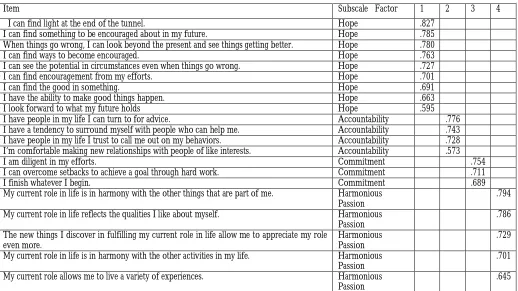
An exploratory factor analysis (EFA) was conducted to assess the relationship of the items to the proposed dimensions. The EFA yielded a strong four-factor solution explaining greater than 60.51% of the variance (Table 3). There was one item that had a factor loading below the proposed cutoff threshold (Accountability subscale: “I need other people to help me obtain my goals.”). We removed the item from the H-CAP and re-ran the EFA procedure and found the instrument explained 62.52% of the variance with the Hope factor accounting for the largest proportion of variance at 39.57% (Eigenvalue=8.3). The EFA yielded very strong item to factor loadings on both the structure and pattern matrices with only one item solidly in the fair range (Accountability: “I’m comfortable making new relationships with people of like interests.”) and one item in the good range (Hope: “I look forward to what my future holds.”). All other items were in the very good to excellent ranges.
TABLE 3 Principal axis factoring with oblique rotation (structure matrix) for the HCAP-21
Item Subscale Factor 1 2 3 4
I can find light at the end of the tunnel. Hope .827
I can find something to be encouraged about in my future. Hope .785
When things go wrong, I can look beyond the present and see things getting better. Hope .780
I can find ways to become encouraged. Hope .763
I can see the potential in circumstances even when things go wrong. Hope .727
I can find encouragement from my efforts. Hope .701
I can find the good in something. Hope .691
I have the ability to make good things happen. Hope .663
I look forward to what my future holds Hope .595
I have people in my life I can turn to for advice. Accountability .776
I have a tendency to surround myself with people who can help me. Accountability .743
I have people in my life I trust to call me out on my behaviors. Accountability .728
I’m comfortable making new relationships with people of like interests. Accountability .573
I am diligent in my efforts. Commitment .754
I can overcome setbacks to achieve a goal through hard work. Commitment .711
I finish whatever I begin. Commitment .689
My current role in life is in harmony with the other things that are part of me. Harmonious Passion
.794
My current role in life reflects the qualities I like about myself. Harmonious
Passion
.786
The new things I discover in fulfilling my current role in life allow me to appreciate my role even more.
Harmonious Passion
.729
My current role in life is in harmony with the other activities in my life. Harmonious
Passion
.701
My current role allows me to live a variety of experiences. Harmonious
Passion
Confirmatory Factor Analysis
We conducted a confirmatory factor analysis (CFA) to test the hypothesis whether the factorial structure hypothesized and revealed in the EFA would exist between the items and their underlying latent constructs (i.e., Hope, Commitment, etc.). The reliabilities (Cronbach’s α) were also assessed for the model overall and in the context
of the model. To examine the latent dimensionality of the H-CAP, we assessed the item’s “fit” by constraining each item to its respective dimensions and assessing the dimensions as a first-order structure (all dimensions are equally correlated). We estimated a one-level four factor model using EQS (version 6.2). Following the standards set forward
by Bentler and Wu (2002) and Kline (2005) model fit was evaluated using the χ2, root mean square error of approximation (RMSEA) the standardized root mean residual (SRMR) and the comparative fit index (CFI). The subscales of the H-CAP 21 showed good internal consistency with the alpha coefficient at .92.
The Hope subscale showed the strongest coefficient (.91) followed by Harmonious Passion (.85), Accountability (.80) and Commitment (.75). The often cited work of Bentler and Wu (2002) note that models yielding a RMSEA of 0.06 or lower combined with a SRMR of 0.09 or lower are considered acceptable and a preference for models exhibiting an RMSEA of 0.06 or lower with an SRMR values less than 0.05 (Byrne, 1998; Diamantopoulos & Siguaw, 2000). A CFI approximating a value of 0.95 is typically recognized as indicative of very good fit (Hooper, et al., 2008; Hu & Bentler, 1999). The four-factor first-order model had an excellent confirmatory fit (Model 1: χ2 = 752.23, df=183, p<.001; χ2= 4.11; RMSEA=0.056; SMR was 0.94, the SRMR= .050; CFI=.942). Although subscales
are significantly correlated, the excellent model fit suggests that the subscales of the H-CAP 21 are distinguishable measures of a capacity for resilience and well-being.
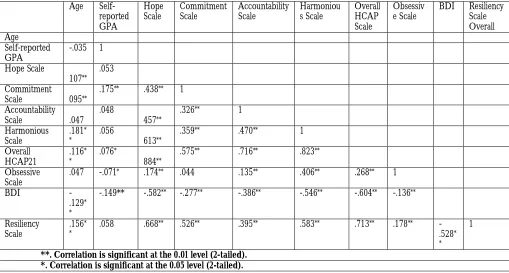
A closer examination of the inter-correlations among the H-CAP 21 subscales (Table 4) exhibit mild to modest correlations between all subscales except Hope and Harmonious Passion which is moderately strong (Cohen, 1988). This reinforces the subscales as representing relevant yet distinguishable constructs.
Table 4 Convergent, divergent and criterion validity for the High Capacity Model of Resilience and Well-being (HCAP-21)
Age
Self-reported GPA Hope Scale Commitment Scale Accountability Scale Harmoniou s Scale Overall HCAP Scale Obsessiv e Scale
BDI Resiliency
Scale Overall Age
Self-reported GPA
-.035 1
Hope Scale
107**
.053
Commitment
Scale 095**
.175** .438** 1
Accountability
Scale .047
.048
457**
.326** 1
Harmonious Scale .181* * .056 613**
.359** .470** 1
Overall HCAP21 .116* * .076* 884**
.575** .716** .823**
Obsessive Scale
.047 -.071* .174** .044 .135** .406** .268** 1
BDI
-.129* *
-.149** -.582** -.277** -.386** -.546** -.604** -.136**
Resiliency Scale
.156* *
.058 .668** .526** .395** .583** .713** .178**
-.528* *
1
**. Correlation is significant at the 0.01 level (2-tailed). *. Correlation is significant at the 0.05 level (2-tailed).
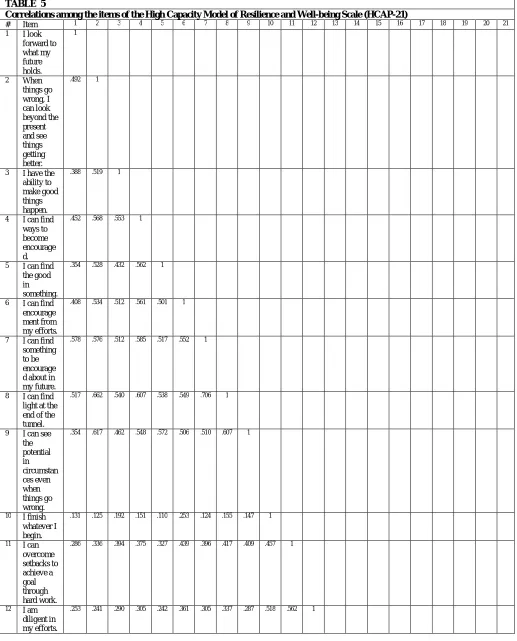
TABLE 5
Correlations among the items of the High Capacity Model of Resilience and Well-being Scale (HCAP-21)
# Item 1 2 3 4 5 6 7 8 9 10 11 12 13 14 15 16 17 18 19 20 21
1 I look forward to what my future holds.
1
2 When
things go wrong, I can look beyond the present and see things getting better.
.492 1
3 I have the
ability to make good things happen.
.388 .519 1
4 I can find ways to become encourage d.
.452 .568 .553 1
5 I can find the good in something.
.354 .528 .432 .562 1
6 I can find encourage ment from my efforts.
.408 .534 .512 .561 .501 1
7 I can find something to be encourage d about in my future.
.578 .576 .512 .585 .517 .552 1
8 I can find
light at the end of the tunnel.
.517 .662 .540 .607 .538 .549 .706 1
9 I can see the potential in circumstan ces even when things go wrong.
.354 .617 .462 .548 .572 .506 .510 .607 1
10 I finish
whatever I begin.
.131 .125 .192 .151 .110 .253 .124 .155 .147 1
11 I can
overcome setbacks to achieve a goal through hard work.
.286 .336 .394 .375 .327 .439 .396 .417 .409 .457 1
12 I am
diligent in my efforts.
13 I have
people in my life I can turn to for advice.
.319 .226 .228 .301 .174 .231 .326 .324 .218 .151 .186 .242 1
14 I have a
tendency to surround myself with people who can help me.
.300 .210 .238 .289 .213 .281 .306 .278 .230 .203 .240 .244 .592 1
15 I’m
comfortabl e making new relationshi ps with people of like interests.
.346 .304 .332 .398 .336 .318 .402 .378 .323 .121 .269 .239 .392 .456 1
16 I have
people in my life I trust to call me out on my behaviors.
.252 .202 .198 .237 .193 .224 .301 .311 .259 .179 .208 .240 .574 .521 .442 1
17 My current
role in life is in harmony with the other activities in my life.
.275 .366 .338 .422 .319 .374 .357 .393 .354 .204 .228 .270 .313 .318 .341 .331 1
18 The new
things I discover in fulfilling my current role in life allow me to appreciate my role even more.
.397 .425 .364 .479 .397 .442 .474 .496 .432 .181 .324 .311 .324 .337 .372 .310 .583 1
19 My current
role in life reflects the qualities I like about myself.
.342 .366 .341 .436 .289 .388 .388 .403 .325 .151 .281 .267 .244 .280 .304 .226 .508 .560 1
20 My current
role allows me to live a variety of experience s.
.307 .309 .292 .316 .255 .311 .321 .341 .322 .166 .245 .219 .253 .266 .291 .233 .392 .479 .549 1
21 My current
role in life is in harmony with the other things that are part of me.
.334 .392 .351 .427 .321 .376 .379 .402 .338 .130 .249 .225 .291 .286 .308 .269 .593 .531 .623 .516 1
Convergent validity. We hypothesized that an association would exist between each of our H-CAP subscales and the Resilience Scale. Results are presented in Table 4 and exhibit Pearson correlations at .668 (p<.001) for Hope, .526 (p<.001) for Commitment, .395 (p<.001) for Accountability, .583 (p<.001) for Harmonious and .713 (p<.001) overall for the H-CAP. All four subscales and the instrument’s overall score have moderate to strong correlations, thereby acceptable convergence was obtained for the H-CAP with the Resilience subscale.
Discriminant validity. We used the BDI-II and the Obsessive Passion subscale to test discriminant validity. Findings exhibit that each of our H-CAP subscales had strong, negative correlations with the BDI-II score. The Pearson correlations were -.582 (p<.001) for Hope, -.277 (p<.001) for Commitment, -.386 (p<.001) for Accountability, -.546 (p<.001) for Harmonious and -.604 (p<.001) overall for the H-CAP. The Obsessive Passion subscale findings fell into expected ranges. The Pearson correlations for this scale were .174 (p<.001) for Hope, .044 (p<.001) for Commitment, .387 (p<.001) for Accountability, .135 (p<.001) for Harmonious and .286 (p<.001) overall for the H-CAP. We contend discriminant validity was obtained for the H-CAP.
Criterion-related validity. Pearson correlations exhibited a positive correlation for all subscales and self-reported cumulative GPA, but the relationship did not reach a level of significance for the Hope, Accountability or Harmonious Passion subscales. The Commitment subscale and the overall H-CAP score had a significant correlation with self-reported cumulative GPA, .095 (p<.001) and the overall H-CAP score, .076 (p<.001), respectively (See Table 4). Criterion-related validity was generally inconclusive for the H-CAP. Although correlational findings were in the appropriate direction, we did not achieve a strong association for each subscale. We had expected the criterion validity findings would reflect levels akin to those found in Anataramian (2015) and Steinmayr et al. (2016), but we did not find as strong of a relationship. Steinmayr, et al. (2016) found the relationship to academic outcomes was a function of orientation as mediated by metacognitive self-regulation. We do not have an instrument assessing goal-orientations or other mediating variables such as self-regulation and this possibly influenced relationship to the criterion. However, the Commitment subscale is believed to provide an aspect of goal seeking and attaining behavior which may be why the relationship was significant for this subscale. It is also worth noting that the majority of participants were above the age of 25 with 40% being between the ages of 40-59. Over 46% were also graduate students. Individuals that represent this demographic would be expected to have higher degrees of commitment. With 77% of the population having a GPA over 3.0, another explanation of why significance was not found on the remaining subscales is most likely due to a lack of variation between GPA. Having a sample that represents more traditional first year students may have provided a broader range of GPA which may have led to significance.
We also recognize that self-reported criterion, especially those related to academic progress, can be inflated or deflated dependent upon the state of mind of the participant. To ascertain the degree the H-CAP relates to an academic criterion we may need to assess using the actual student academic record. Additionally, we may also need to incorporate other criterion such as those found in performance (athletics, health and wellness).
Discussion
As mentioned, resilience and well-being have many definitions and/or components. However, from a clinical and practical standpoint, it is necessary to refine these definitions so they can be operationalized and measured. Until this is done, resilience and well-being will remain obscure. It is a common belief that resilience and well-being can be created. This is the over-arching goal of psychotherapy; to adjust and live a better quality of life. Theorists and researchers have created many techniques over many decades to achieve this outcome. However, positive psychology research has shown that the absence of symptomology alone does not equate to well-being (Diener & Lucas, 2000; Duckworth et al., 2005) or resilience. Researchers and clinicians have long wrestled with questions such as, what are the curative factors that make people better who struggle with mental disorders. What makes people able to achieve their goals in life? How are people able to rise above their circumstances and achieve success? What creates psychological and spiritual resilience? What are the buffers against mental disorders? Francis Galton and Williams James asked similar questions and examined the abilities of the individual and what leads to their success.
traits outlined in the H-CAP model and H-CAP 21 Scale answers this mandate and include both individual difference and situational factors such as social support. The expression of Hope, Commitment, Accountability, and Passion are both behavioral and emotional. Those with the ability to express such positive emotions are more likely to rate themselves higher in well-being and resilience (Ong et al., 2006; Tugate & Fredrickson, 2004).
The purpose of this research was to understand and identify the elements that correlate with resilience and well-being and to validate an instrument that measures these traits. Such an instrument can be useful in many settings. Overall, the H-CAP 21 has very good psychometric properties. EFA confirmed a strong four factor model explaining 62.25% of the variance. Factor loadings were very strong with all items in the very good to excellent range and one item being in the fair range. CFA confirmed that items had a strong relationship to their specific construct, hope, commitment, etc. The individual subscales yielded alpha’s from .75-.92. The four factor model had an overall excellent fit. The H-CAP 21 subscales was convergent with the Resilience Scale with moderate to strong correlations and showed divergence with the BDI-II. In this study, resilience and well-being was predicted to impact GPA. Criterion validity confirmed the direction of the relationship between GPA and the H-CAP 21 overall score and commitment subscale. However, we had variance between subscales in their relative strength of association to the criterion. We will need to consider diversifying the criterion in terms of measurement contexts and types as well as what factors might mediate the relationship (self-regulation, commitment, etc.) between high capacity for well-beingand various criteria.
The strongest factor of the model is Hope with an alpha coefficient of .92 followed by Harmonious Passion, .82, Accountability, .80, and Commitment, .75. It is believed that the Hope construct is as high as it is because hope is the foundation for resilience and well-being and the items used to measure this trait is well documented in the literature. While it was able to be shown that Hope is linked to Commitment, Accountability, and Passion, these traits as defined and measured are not as well researched. Items used to measures these constructs, particularly in the area of Commitment and Accountability are relatively new. This is a limitation of the study, however, further research is being conducted to refine these areas in an effort to increase their reliability. However, overall, the instrument shows to be a very good tool that can measure aspects resilience and well-being and contributes to the literature by defining and refining what we believe to be foundational traits to resilience and well-being.
Initial hypotheses were confirmed that degrees of hopefulness, commitment to goal-seeking and obtaining behavior, accountable relationships, and harmonious passion do reflect a direct relationship with resilience and well-being. Compared to the Resilience Scale, we believe that H-CAP 21 can be an instrument of equal expectation. While the sample size we used was large and diverse, further research is currently broadening the sample population to include military personnel for the purpose of identifying at-risk individuals susceptible to PTSD. The H-CAP 21identifies items that measure the capacity for resilience and well-being and can be part of an overall model of intervention creating resilience and well-being through strengthening ones sense of Hope, Commitment, Accountability, and Passion.
Compliance with Ethical Standards
The authors have nothing to disclose and the study was not funded. The study has been approved by the Liberty University Institutional Review Board and have been performed in accordance with the ethical standards as laid down in the 1964 Declaration of Helsinki (1996) and its later amendments.
References
Algoe, S. B., Fredrickson, B. L., & Chow, S. M. (2011). Emotions research. In K. N. Sheldon, T. B. Kashdan, & M. F. Steger (Eds). Designing positive psychology: Taking stock and moving forward. New York, NY: Oxford University Press. American Psychiatric Association. (2013). Diagnostic and statistical manual of mental disorders (5th ed.). Washington, DC:
Author.
Antaramian, S. (2015). Assessing psychological symptoms and well-being: Applications of a dual factor mental health model to understand college student performance. Journal of Psychoeducational Assessment, 33(5), 419-429
Beck, A. T., & Steer, R. A. (1988).Manual for the Beck Hopelessness Scale San Antonio, TX: Psychological Corporation
Beck, A.T., & Steer, R.A. (1993). Beck Anxiety Inventory Manual. San Antonio, TX: Psychological Corporation.
Beck, A.T., Steer, R.A., & Brown, G.K. (1996). Manual for the Beck Depression Inventory-II. San Antonio, TX: Psychological Corporation.
Beck, A. T., Weissman, A., Lester, D., &Trexler, L. (1974). The measurement of pessimism. Journal of Consulting and Clinical Psychology, 42, 861–865.
Bentler, M. (2013). Structural equations program manual. Multivariate Software, Inc.
Bruininks, P., & Malle, B. F. (2005). Distinguishing hope from optimism and related affective states. Motivation and Emotion, 29, 327-355.
Brown, T. A. (2006). Confirmatory factor analysis for applied research. New York: The Guilford Press.
Byrne, B.M. (1998), Structural Equation Modeling with LISREL, PRELIS and SIMPLIS: Basic Concepts, Applications and Programming. Mahwah, New Jersey: Lawrence Erlbaum Associates.
Cohen, J. (1988). Statistical power analysis for the behavioural sciences. Hillside. NJ: Lawrence Earlbaum Associates.
Demir, M., Özdemir, M., & Weitekamp, L. A. (2007). Looking to happy tomorrows with friends: best and close friendships as they predict happiness. Journal of happiness studies, 8, 243-271.
Diamantopoulos, A., Siguaw, J. A., & Siguaw, J. A. (2000). Introducing LISREL: A guide for the uninitiated. Sage.
Diener, E. (2000). Subjective well-being: The science of happiness and a proposal for a national index. American Psychologist, 55, 34-43.
Diener, E. & Lucas, R. E. (2000). Subjective emotional well-being. In Handbook of emotions, (ed. M. Lweis & J. M. Haviland-Jones), pp. 325-337. New York: Guilford.
Drummet, A. R., M. Coleman, et al. (2003). Military families under stress: Implications for family life education.Family Relations, 52(3), 279-287.
Duckworth, A. L., Peterson, C., Matthews, M. D., & Kelly, D. R. (2007). Grit: Perseverance and passion for long-term goals. Journal of Personality and Social Psychology, 92(6). 1087- 1101.
Duckworth, A. L. &Quinn, P. D. (2009). Development and validation of the Short Grit Scale (Grit-S). Journal of Personality Assessment, 91, 166-174.
Duckworth, A. E. Steen, T. A., & Seligman, M. E. P. (2005). Positive psychology in clinical practice. Annual Reviews of Clinical Psychology, 1, 629-651.
Dyce, J. A. (1996). Factor structure of the Beck Hopelessness Scale. Journal of Clinical Psychology, 52(5), 555-558. Earvalino-Ramirez, M. (2007). Resilience: a concept analysis. Nursing Forum, 42(2), 73 – 82.
Fava, G. A. & Tomba, E. (2009). Increasing psychological well-being and resilience by psychotherapeutic methods. Journal of Personality, 77(6), 1903-1934.
Feldman, D. B., Rand, K. L., & Kahle-Wrobleski, K. (2009). Hope and goal attainment: Testing a basic prediction of hope theory. Journal of Social and Clinical Psychology, 28(4), 479 – 497.
Fredrickson, B. L. (2001). The role of positive emotions in positive psychology: The broaden-and-build theory of positive emotions. American Psychologist, 56, 218–226.
Fredrickson, B. L. (1998). What good are positive emotions? Review of General Psychology.2, 300–319. Frank, J. D. (1968). The role of hope and psychotherapy. International Journal of Psychiatry, five, 383-395. Frank, J. D. (1975). The faith that heals. The Johns Hopkins Medical Journal, 137, 127-131.
Herth, K, (1992). Abbreviated instrument to measure hope: development and psychometric evaluation. Journal of Advanced Nursing, 17, 1251-1259.
Hooper, D., Coughlan, J. and Mullen, M. R. (2008). Structural Equation Modelling: Guidelines for Determining Model Fit. The Electronic Journal of Business Research Methods 6(1), 53 – 60.
Hu, L., & Bentler, P. M. (1999). Cutoff criteria for fit indexes in covariance structure analysis: Conventional criteria versus new alternatives. Structural Equation Modeling, 6, 1–55.
Huang, C., & Chen, J. H. (2015). Meta-Analysis of the Factor Structures of the Beck Depression Inventory–II. Assessment, 22(4), 459-472.
IBM Corp.Released (2012). IBM SPSS Statistics for Windows, Version 21. IBM Corp., Armonk, N.Y., USA.
Ingledew, D. K., Wray, J. L., Markland, D., & Hardy, L. (2010). Work-related goal perceptions and effective well-being. Journal of Health Psychology, 10(1), 101-122.
Kanter, J. W., Manos, R. C., Busch, A. M., & Rusch, L. C. (2008). Making behavioral activation more behavioral. Behavioral Modification, 32(6), 780-803.
Keitner, G. I., Ryan, C. E., Miller, I. W., Kohn, R., Bishop, D. S., & Epstein, N. B. (1995) Role of the family in recovery and major depression. American Journal of Psychiatry 152, 1002-1008.
Kline, R. B. (2005). Principles and practice of structural equation modeling (2nd ed.). New York: Guilford Press.
Lightsey, O. R. (2006). Resilience, meaning, and well-being. The Counseling Psychologist, 34(1), 96–107. doi:10.1177/0011000005282369
Mageau, G. A., Carpentier, J., & Vallerand, R. J. (2011). The role of self‐esteem contingencies in the distinction between obsessive and harmonious passion. European Journal of Social Psychology, 41(6), 720-729.
Mageau, G. A. & Vallerand, R. J. (2007). The moderating effect of passion on the relation between activity engagement and positive affect. Motivation and Emotion, 31, 312-321.
Mageau, G. A. & Vallerand, R. J., Charest, J., Salvy, S. J., Lacaille, N., Bouffard, T., & Koestner,
R. (2009). On the development of harmonious and obsessive passion: The role of autonomy support, activity specialization, and identification with the activity. Journal of Personality, 77(3), 601-644,
Maguen, S. Turcotte, D. M. Peterson, A. L., er al: (2008). Description of risk and resilience factors among military medical personnel before deployment to Iraq. Military medicine, 173, 1-9.
McDowell, I. (2006). Measuring health: a guide to rating scales and questionnaires. Oxford University Press.
McGeer, V. (2004). The art of good hope. Annals of the American Academy of Political & Social Science, 592, 100-127. Menninger, K. (1959). The academic lecture on hope. The American Journal of Psychiatry, 109, 481-491.
Miquelon, P. & Vallerand, R. J. (2008). Goal motives, well-being, and physical health: An integrative model. Canadian Psychology, 49(3), 241 – 249.
Mota, C. P. & Matos, P. M. (2015). Adolescents in institutional care: Significant adults, resilience and well-being. Child Youth Care Forum, 44, 209-224.
Ong, A. D, Bergeman, C. S., Bisconti, T. I……. & Wallace, K. A., (2006). Psychological resilience, positive emotions, and successful adaption to stress in later life. Journal of Personality and Social Psychology, 91, 730-749. doi: 10. 1037/0022-3514. 91. 4. 730.
Özen, A., Sümer, N., & Demir, M. (2010). Predicting friendship quality with rejection sensitivity and attachmen,t security. Journal of Social and Personal Relationships, 28(2), 163-181.
Ozbay, F., D., Johnson, C., Dimoulas, E., Morgan, C. A., D., Charney,D., &Southwick, S. (2007). Social support and resilience to stress: from neurobiology to clinical practice. Psychiatry4,35-40. Peersen, M., Gudjonsson, G. H., & Sigurdsson, J. F. (2000). The relationship between general and
specific attribution of blame for a “serious” act and the role of personality. Nordic Journal of Psychiatry, 54(1), 25-29. Peterson, C. (2000). The future of optimism. American Psychologist, 55, 44-55
Pettit, P. (2004). Hope and its place in mind. Annals of the American Academy of Political & Social Science,592, 152-165. Pierce, G. R. (1994). The quality of relationships inventory: Assessing the interpersonal context of social support.In B. R.
Burleson, T. L. Albrecht, & I. G. Sarason (Eds.). Communication of social support: messages, interactions, relationships, and community (pp. 247-266). Thousand Oaks, CA: Sage
Pierce, G. R., Sarason, I. G., & Sarason, B. R. (1990). Integrating social support perspectives: working models, personal relationships, and situational factors. In S. Duck (Ed.) with R. C. Silver. Personal relationships and social supports (pp.173-189). Newbury Park, CA: Sage.
Pierce, G. R., Sarason, I. G., & Sarason, B. R. (1991). Gen. and relationship-based perceptions of social support: Are to constructs better than one? Journal of Personality and Social Psychology, 61(6), 1028-1039.
Preacher, K.J., & MacCallum, R.C. (2003). Repairing Tom Swift’s electric factor analysis machine. Understanding Statistics, 2, 13-43.
Ried, R., & Botterill, L. C. (2013). The multiple meanings of “resilience”: An overview of the literature. Australian Journal of Public Administration, 72(1), 31-40.
Rousseau, F. L. & Vallerand, R. J. (2008). An examination of the relationship between passion and subjective well-being and older adults. International Journal of Aging and Human Development, 66(3), 195 – 211.
Rousseau, F. L., Vallerand, R. J., Ratelle, C. F., Mageau, G. A., & Provencher, P. J. (2002). On the validation of the Gambling Passion Scale (GPS). Journal of Gambling Studies, 18, 45-66.
Ryff, C. D. (1989). Happiness is everything, or is it? Explorations on the meaning of psychological well-being. Journal of Personality and Social Psychology, 6, 1069-1081
Sahin, M., Aydin, B., Sari, S. V, Kaya, S., & Pala, H. (2012). The role of hope and the meaning in life in explaining subjective well-being. Kastamonu Education Journal, 20(3), 827-836.
Sarason, B. R., Sarason, I. G., & Gurung, R. A. R. (2001). Close personal relationships and health outcomes: A key to the role of social support. In B. R. Sarason & S. W. Duck(Eds.), Personal relationships: Implications for clinical and community psychology. NewYork: Wiley. Seligman, M. E. P. (1991). Learned optimism. New York: Knopf.
Seligman, M. E. P. & Csikszentmihalyi, M. (2000). Positive psychology: An introduction. American Psychologist, 55(1), 5– 14. Seligman, M. E. P., Parks, A. C., & Steen, T. (2004). A balanced psychology and a full life. Philosophical transactions of the Royal
Society, 359, 1379 – 1381.
Scheier, M. F. & Carver, C. S. (1985). Optimism, coping, and health: Assessment and implications of generalized outcome expectancies. Health Psychology, 4, 219-247.
Simmons, A. & Yoder, L. (2013). Military resilience: A concept analysis. Nursing Forum, 48(1), 17-25.
Snyder, C. R. (1989). Reality negotiation: From excuses to hope and beyond. Journal of Social and Clinical Psychology, 8, 130-157. Snyder, C. R (1994b). Hope and optimism. In V. S. Ramachandren (Ed.). Encyclopedia of human behavior (Vol.2, pp. 535-542).
Snyder, C. R. et al., (1996). Development and validation of the State Hope Scale. Journal of personality and social psychology, 70(2), 321-335.
Snyder, C. R. (2002). Hope theory: Rainbows in the mind. Psychological Inquiry, 13(4), 249-275.
Snyder, C. R., Ilardi, S. S., Cheavens, J., Michael, S. T., Yamhure, L., & Sympson, S. (2000). The role of hope and cognitive-behavior therapies. Cognitive therapy and research, 24(6), 747-762.
Steinmayr, R., Crede, J., McElvany, N., & Wirthwein, L. (2016). Subjective well-being, test anxiety, academic achievement; Testing for reciprocal effects. Frontiers in Psychology, 6, 1-13.
Steer, R. A., & Clark, D. A. (1997). Psychometric properties of the Beck Depression Inventory-II with college students. Measurement and Evaluation in Counseling and Development, 30, 128-137.
Stotland, E. (1969). The psychology of hope. San Francisco: Jossey-Bass.
Sturmey, P. (2009). Behavioral activation is an evidence-based treatment for depression. Behavior Modification, 33, 818-829. Tong, E. M. W., Fredrickson, B. L., Chang, W., & Lim, Z. X. (2010). Re-examining hope: The roles of agency thinking and
pathways thinking. Cognition and Emotion, 24(7), 1207-1215.
Tugate, M. M. & Fredrickson, B. L. (2004). Resilient individuals use positive emotions to bounce back from negative emotional experiences. Journal of Personality and Social Psychology, 86, 320-333. doi: 10. 1037/0022-3514. 86. 2. 320
Vallerand, R. J. (2010). On passion for life activities: The dualistic model of passion. Advances in experimental social psychology, 42, 97-193.
Vallerand, R. J. (1997). Toward a hierarchical model of intrinsic and extrinsic motivation. In M. P. Zanna (Ed.), Advances in experimental social psychology (pp. 271-359). New York: Academic
Vallerand, R. J. (2007). A hierarchical model of intrinsic and extrinsic motivation for sport and physical activity. In M. S. D. Hagger & N. L. D. Chatzisarantis (Eds.), self-determination theory and exercise and sport (pp. 255-279). Champaign, I L: Human Kinetics.
Vallerand, R. J. (2008). On the psychology of passion: in search of what makes people's lives worth living. Canadian Psychology, 49(1), 1 – 13.
Vallerand, R. J. (2010). On passion for life activities: The dualistic model of passion. Advances in experimental social psychology, 42, 97-193.
Vallerand, R. J., Rousseau, F. L., Grouzet, F. M. E., Dumais, & A., Grenier, S., & Blanchard, C. B. (2006). Passion and support: A look at the termination and affect his experiences. Journal of Sport & Exercise psychology, 28, 454-478.
Veiel, H. O. F., Kuhner, C., Brill, G. &, Ihle, W. (1992) Psychosocial correlates of clinical depression after psychiatric in-patient treatment:methodological issues and baseline differences between recovered and non-recovered patients. Psychological Medicine. 22, 415-42.
Wagnild, G. M. (2009). A review of the Resilience Scale. Journal of Nursing Measurement,17, 105–113.
Wagnild, G. M., & Young, H. M. (1993). Development and psychometric evaluation of the Resilience Scale. Journal of Nursing Measurement, 1, 165–178.
Wang, C.H. (2000). Developing a concept of hope from a human science perspective. Nursing Science Quartly, 13(3). 248-251.
Windle, G., Bennett, K. M., & Noyes, J. (2011). A methodological review of resilience measurement scales. Health and quality of life outcomes, 9(1), 1.
Wood, J. A. & Winston, B. E. (2007). Development of three scales to measure leader accountability. Leadership and Organization Development Journal, 28(2), 167-185