Vol.8 (2018) No. 6
ISSN: 2088-5334
A Proposed Model for Virtual Fitting Room Based on Usability and
Profound Emotional Elements
Syazwan Noordin
#1, Noraidah Sahari Ashaari
#2, Tengku Siti Meriam Tengku Wook
#3 #Center for Software Technology and Management, Faculty of Information Science and Technology, Universiti Kebangsaan Malaysia, Bangi, 43600, Malaysia
E-mail: [email protected], [email protected], [email protected]
Abstract—Technological advancement has evolved the way business is conducted. Companies around the globe venture into e-commerce to reach more customers apart from the traditional retails and marketing approaches. Nowadays, almost everything could be found sold via the internet regardless of size, usage, price and etc. The challenge of e-commerce channel is coming from its inability to provide a practical ways in giving the customers the sense of trying before purchase which is crucial for some product type namely clothing. This paper presents the issues in the e-commerce clothing industry, namely fitting issues and problems encountered in existing Virtual Fitting Room (VFR) applications. These issues include usability and lack of a profound emotional stimulant within existing applications. A systematic procedure of searching related literature on VFR is done based on several identified criteria from the established online repository. The extensive search result is then filtered based on the identified criteria once again to obtain the suitable model to be further studied. This study reviewed five VFR-related models, with the results confirming the issues of usability and profound emotional elements in each model. This study also proposed a new VFR model based on the Unified Theory of Acceptance and Use of Technology (UTAUT), which consists of usability and profound emotional constructs. These elements were mainly included to solve the identified problems and to provide guidelines for a design solution, which is usable, useful, and delightful.
Keywords— kansei engineering; usability; virtual fitting room.
I. INTRODUCTION
The e-commerce platform has become one of the main determinants of the way people spend their money and how companies conduct their business. According to an eMarketer research report, the e-commerce industry will enjoy consistent growth from 18% to 25% every year with the worldwide transaction set to reach 4 Trillion USD by the year 2020 [1]. The rapid expansion of this industry brings benefits for both business and online customers, but there is still one aspect that could be amended to maximize the potential of the e-commerce platform. Prior researchers have identified that online clothing retailers need to handle approximately 30% to 40% product returns due to customers purchasing incorrect item sizes [2], [3]. This return process is costly for the business. In 2016, the process cost e-commerce companies USD 62.4 billion [4]. Sixty-nine percent of online clothing customers had experienced misfit issues at least once in their lifetime [5]. In the same study, the return costs for incorrect clothing size must be borne by the customers, and this happens 60% of the time misfit cases are reported [5]. This finding could indicate that misfit issues are a severe problem among online clothing retailers and customers.
Previous research identified that misfit cases within online platforms could be reduced by introducing a Virtual Fitting Room (VFR) [6], [9]. Industrial players, namely Zugara, Fits.me and Youfitinit has been developing VFR for commercial use that could improve online shopping experience as well as provide a useful tool for selecting the right clothing size [10], [12]. These VFR applications are found to be useful for both online retailers and customers, but some usability issues must still be solved, as suggested by Randall [13]. Clothing retailers stand to gain an added advantage from implementing any of the mentioned solutions. However, improvement is needed especially regarding usability [13]. Unsatisfactory 3D images, inappropriate interface design, and inability to process extreme user body measurements are some of the usability issues that have been identified [13].
expected to positively influence the buying decision among online customers as well as provide the best user experience for customers, which will culminate in a delightful experience for all [15].
A. Virtual Fitting Room
One of the best solutions for solving online fitting issues is the Virtual Fitting Room (VFR) [6], [9]. The main aim of VFR is to adopt an actual fitting room concept in an online platform. Using VFR, consumers will be able to pick their right clothing size when purchasing from online retailers.
As mentioned above, many studies have identified VFR as a promising method for online consumers to ‘try’ their clothing online [6], [9]. The actual fitting process is translated into multimedia representation in the form of simulation in order to help customers find their correct clothing size. Three types of VFR applications have been identified, as follows:
1) 3-Dimensional (3D) VFR: This approach uses a 3D humanoid model to represent the customer. Customer’s body measurements are taken as input to produce the humanoid 3D model, and then the best clothing size based on the input is suggested [10], [11].
2) VFR solution: This form that inputs and
automatically detects customer body points based on a Kinect sensor to calculate the right clothing size for that particular customer [12].
3) VFR solution: This solution utilizes webcam technology to capture the user’s image. The image captured by the webcam will be overlaid with the clothing image. The system will suggest the right clothing size when the user’s picture matches the clothing image on screen [12].
In general, VFR applications can be categorized into two— immersive and non-immersive. A VFR application that deploys advanced simulation and technological techniques could give users the feeling of immersion, which is the feeling close to a realistic setting [16]. In the case of non-immersive VFR, the stimulant from the application is still acceptable with minimal sensation from the system [17], [18]. Based on a direct comparison of these 2 VFR categories, there is no doubt that the immersive VFR solution is the best solution, as it considers the interaction value that can be obtained by the users. Commercializing an immersive VFR solution would be a great challenge since this kind of solution requires the usage of technological devices, which are less accessible due to cost and practicality [19], [20]. Therefore, when providing a VFR solution, which could benefit all potential users, a non-immersive technique must be considered [22].
B. Usability
Previous researchers agree that usability is built from major elements, which are efficiency, effectiveness, and satisfaction of the users [23], [26]. This usability definition, which was defined by ISO9241-11, was still the main reference until ISO IEC25010:2011 was published in 2011. ISO IEC25010:2011 introduces six usability characteristics to strengthen the older concept, which is as follows [27]:
• Learnability: a condition where a system or a product is usable for a target group of users to achieve their identified goal. The learnability characteristic must
have other supporting elements, which are efficiency, effectiveness, freedom from risk, and satisfaction.
• Appropriateness recognizability: a condition where the user can recognize how a system or product could appropriately fulfill their needs.
• Operability: a condition where a product or a system could be operated and controlled without much effort and less difficulty.
• User error protection: a condition where a system or a product could proactively protect users from making unwanted errors.
• User interface aesthetics: a condition where a system or a product could provide a useful and attractive user interface to enhance user satisfaction.
• Accessibility: a condition where the maximum variety or potential users could utilize a system or a product without neglecting their main usage objective. Taking usability into consideration for a system or product development could give an added advantage for both users and developers. Among the direct benefit for users is an efficient and effective user experience, while developers would be more efficient in producing a particular solution [28]. Applying usability within the development process could also reduce training-related cost, as the system would be easy to use. It would also minimize the need for reworking after project rollout [29], [32]. The direct and indirect effects of usability implementation from previous research are illustrated in Table I below.
TABLEI USABILITY SUCCESS FINDINGS
Domain/
Application Empirical Findings Reference e-commerce • Increased sales through the use
of usability as a tool in sales and marketing
• Reduced development costs through usability, keeping the customers out of the
development
• Increased customer satisfaction • Increased (recurring and
redesign related) development costs
[28]
General computer application
• Increased user performance in obtaining the desired effect or objective
[29]
General computer application
• Great return on investment through usability and human centered-design implementation • Increased product/application
quality
• Less need for customer/end user support
• Increased customer/end-user productivity
[30]
General computer application
• Increased conversion rate, which is an indicator that a system is usable and well accepted by new and existing users
• Increased return on investment and organizational profit • Reduced operational cost due to
lesser issues from the users • Improved perception through a
positive experience that will lead to recurring visits and purchase
Fitness application
• Increased user performance in completing exercise/fitness task correctly
• Increased user satisfaction level
[32]
C. Kansei Engineering
Kansei Engineering (KE) is a technique involving product or system development that considers emotion within its process to ensure the user’s emotional satisfaction [33]. The word Kansei Engineering or KE is rooted in the Japanese word Kansei, which means emotion, as this concept originated from the Japanese researcher Mitsuo Nagamachi in 1970 [33]. Through Kansei Engineering, the user’s perception and feeling will be identified via a checklist and an analysis will determine the quantitative relationship between the response and design features [34]. According to KE-related researches, there are three major procedures involved [22-42]:
• Using Kansei words to gather subjective feelings towards a system or a product.
• Identifying the Kansei elements using a statistical approach.
• Translating the identified Kansei elements into design features.
A product or system that has undergone these processes is expected to be able to impress the target users emotionally, as the design features will elicit profound emotion from them [33], [34]. Users or potential customers who are emotionally engaged with the product will take further action including making purchases from the seller and becoming one of their loyal customers [33], [34]. The identified potential could benefit the companies that run businesses based on product sales.
II. MATERIAL AND METHOD
The methods used to collect data in this study are briefly explained in this section.
A. Related Model Study Selection
A systematic approach is required to search for related articles with a similar model to this study for comparison purposes. The major databases such as the ACM database portal, Google Scholar, EBSCO, IEEE, and UJAR (UKM
Journal Article Repository) were used to conduct the literature search for a similar model. Keywords such as “Virtual try on model,” “Virtual Fitting Room,” and “Virtual Fitting Room Model,” were used to search for a compilation of related studies on the VFR model. Only 43 publications and articles were picked up from the extensive list of search results. After another screening process, only five articles were picked up, which consisted of journals, conference papers, and theses. The process of selecting and screening the articles was made based on the following criteria [43]:
• It must involve an investigation on technology
• It must involve empirical testing of the developed model
• The relationship between constructs are reported • The sample size of the investigation is reported
• The research and publication of the article is done after the introduction of the theory
Among the considerations for making comparisons between the VFR-related models include identifying the theoretical model, the list of constructs and the definition of each construct, and how these constructs are related to each other. Through these activities, the research gap and the ideal reference model could be identified. Therefore, an improved or new VFR model could be proposed at the end of the process.
III.RESULTS AND DISCUSSION
Understanding existing VFR-related models and their theoretical guidelines is important in order to tackle the earlier identified issues on usability and profound emotion. Through this understanding, the research and development gap could be recognized, and a proposed improvement could be implemented. The following subtopic will discuss the findings from the VFR-related models.
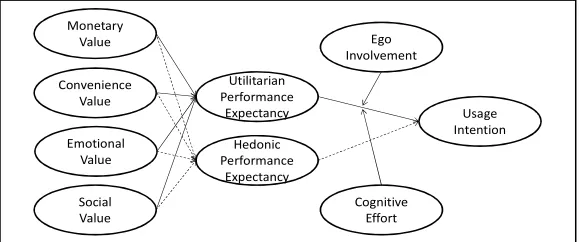
A. Augmented Reality and Motion Capture (ARMC) Model In this study, the Value-Attitude-Behavior hierarchy consumer decision model and the Prospect Theory was implemented to develop the ARMC Model [44]. Value-Attitude-Behavior outlines the type of values that could influence human behavior, whereas human behavior and scenario-based decision-making underline the Prospect Theory [44]. The ARMC model was developed to validate the research hypotheses regarding why online shoppers use virtual dressing rooms. The relationship and definition of the six constructs in the ARMC Model are shown in Figure 2 and Table II, respectively.
Fig. 1. ARMC Model Monetary
Value
Convenience Value
Emotional Value
Social Value
Utilitarian Performance
Expectancy
Hedonic Performance
Expectancy
Ego Involvement
Cognitive Effort
TABLEII
ARMCMODEL CONSTRUCT’S DEFINITION
Construct Definition
Monetary Value
The value of package and service as seen by the customers/potential customers
Convenience Value Time and effort convenience/value Emotional Value The product/service that stimulates
feelings
Social Value The sense of acceptance in society from the social connective value
Utilitarian Performance Expectancy
The feeling of trust that a technological solution could assist the users in performing their task effectively Hedonic
Performance Expectancy
The belief that user effectiveness when performing a task is attributed to an enjoyable experience from using technological solutions
An empirical study of the ARMC Model revealed a negative relationship between Usage Intention and Social Value, Emotional Value, Monetary Value, and Convenience Value. Furthermore, a positive relationship was discovered between Usage Intention and Utilitarian Performance Expectancy.
B. Online Virtual Fitting Room Model
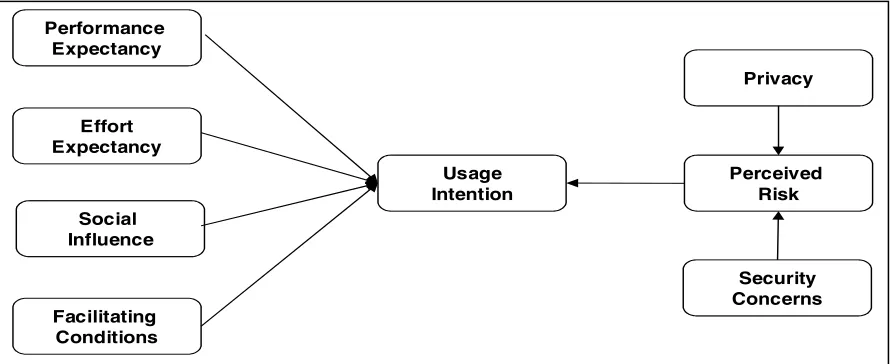
The UTAUT (Unified Theory of Acceptance and Use of Technology) model and the perceived risks of an e-commerce transaction model were used to develop the Online Virtual Fitting Room model [45], [46]. The constructs, which were introduced to understand the model’s relationship with usage intention, are Perceived Risk, Security Concerns, Facilitating Condition, Performance Expectancy, Effort Expectancy, Social Influence, and Privacy Concerns. An illustration of the Online Virtual Fitting Room Model and its definition are explained in Figure 2 and Table III, respectively.
Fig. 2. Online VFR Model
TABLEIII
THE DEFINITION OF ONLINE VFRMODEL CONSTRUCTS
Construct Definition
Performance Expectancy The expectation that online VFR usage would translate to enhanced business performance and improvement in service quality while saving cost, time, and effort
Effort Expectancy A construct that indicates the online VFR’s ease of use
Social Influence The opinions and recommendations of third parties, which will influence whether or not the user will adopt the VFR and purchase from the online retailer
Facilitating Condition A construct that indicates whether or not the user received support, resources, or knowledge when using the online VFR
Perceived Risk The risks and uncertainty that the online VFR usage poses such as possible monetary or data loss
Privacy Concern The user’s concern or fear of how the VFR application will handle and use their data Security Concern The user’s concern about security when conducting transactions online.
The empirical study shows that six constructs— Perceived Risk. Performance Expectancy, Effort Expectancy, Social Influence, Privacy Concerns, and Security Concerns— influence user intention when using the online VFR. The foremost construct with the most influence on user intention is the perceived risk construct, which comprises privacy, information safety, and security [45].
C. Augmenting Purchase Intent Model
Schwartz developed an Augmenting Purchase Intent Model to understand the impact of Image Interactivity Technology (IIT) implementation on user attitude and Purchase Intent [47]. The constructs of this model are clearly explained in Figure 3 and Table IV.
Performance Expectancy
Effort Expectancy
Social Influence
Facilitating Conditions
Usage Intention
Privacy
Perceived Risk
Fig. 3. Augmenting Purchase Intent Model
TABLEIV
THE DEFINITION OF AUGMENTING PURCHASE INTENT MODEL CONSTRUCTS
Construct Definition
Image Interactivity Technology (IIT)
The use of augmented reality in an online retail environment
Telepresence A feeling of being elsewhere created by the use of augmented reality technology. Attitude The feeling towards a particular product
or service Product
Knowledge
Understanding that particular product or service
The empirical result of this model study shows that customer purchase intention influenced by the use of IIT is strongly correlated to customer attitude. However, the correlation between product knowledge and purchase
intention was found to be irrelevant even when using the same stimulant (augmented reality).
D. Virtual Product Experience Model
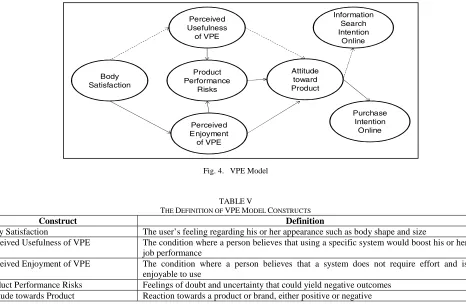
The Technology Acceptance Model (TAM) and Perceived Risk Theory were the main references for developing the Virtual Product Experience (VPE) in a previous work [48]. The developers of this model aimed to understand the relationship between body satisfaction and attitude and its correlation with other online purchase intentions or otherwise. Body Satisfaction and Attitude towards Product, Perceived Enjoyment of VPE, Perceived Usefulness of VPE, and Product Performance Risks are some of the VPE constructs. The VPE model and its constructs are explained in Figure 4 and Table V.
Fig. 4. VPE Model
TABLEV
THE DEFINITION OF VPEMODEL CONSTRUCTS
Construct Definition
Body Satisfaction The user’s feeling regarding his or her appearance such as body shape and size
Perceived Usefulness of VPE The condition where a person believes that using a specific system would boost his or her job performance
Perceived Enjoyment of VPE The condition where a person believes that a system does not require effort and is enjoyable to use
Product Performance Risks Feelings of doubt and uncertainty that could yield negative outcomes Attitude towards Product Reaction towards a product or brand, either positive or negative
Image Interactivity Technology
Telepresence
Attitude
Product Knowledge
Purchase Intent
Tech aversion past ownership
visual processor
Body Satisfaction
Perceived Usefulness
of VPE
Product Performance
Risks
Perceived Enjoyment of VPE
Attitude toward Product
Information Search Intention
Online
From the experimental results, it is found that body satisfaction plays a significant role in influencing the purchase intention of online customers. Apart from that, the VPE empirical result also signifies that user enjoyment also has a positive impact on purchase intention. To maximize the impact of a virtual product, the researcher suggests the use of interactive and hedonic features to reduce the weight age of body satisfaction [48].
E. Online Shopping Acceptance Model
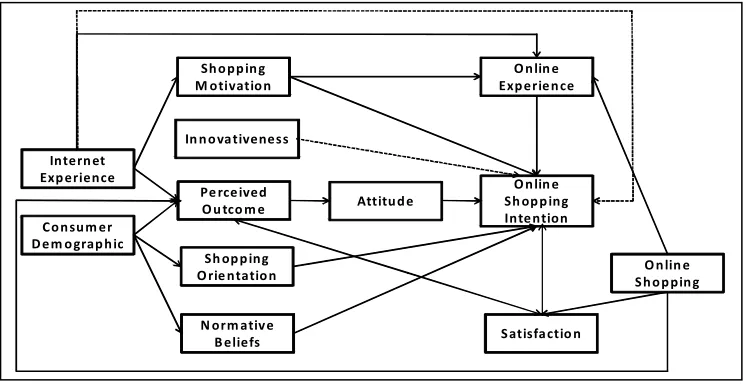
An Online Shopping Acceptance Model (OSAM) was developed based on various possible theoretical models, but finally, only the Technology Acceptance Model (TAM) and traditional retail and marketing theories were taken into consideration [49]. The OSAM model intends to understand the level of acceptance of customers when shopping online. All OSAM constructs are explained in Figure 5 and Table VI.
Fig. 5 OSAM Model VPE Model
TABLEVI
THE DEFINITION OF OSAMMODEL CONSTRUCTS
Construct Definition
Perceived Outcome
Possible outcome perceptions taking the form of negative or positive behavior Shopping
Orientation
One element of the lifestyle of the consumer affected by gender and individual belief
Online Experience User experience as a result of using a system, which has a strong relationship with interface design and the system overall
Shopping Motivation
This motivation is driven from the user’s perception of a system’s usefulness. Satisfaction The feelings that the user felt from
previously shopping online Consumer
Demographic
The background of consumers that will affect their online shopping intention such as Internet experience, age, and education.
The construct relationship within the OSAM model is reported based on previously done research, which shows that all constructs have a significant correlation with the usage intention of users. From this study, it is also found that the stimulation made through all constructs is an effective way to attract purchase transaction.
F. Results Discussion
As mentioned earlier, current VFR solutions face issues of profound emotion from the user’s perspective, as well as usability issues. Therefore, this section discusses these issues in more depth with a focus on existing models. Based on the
literature on VFR-related models, it can be observed that usability was only touched on superficially, while profound user emotions were not addressed at all. Only one study on the OSAM model, which listed the satisfaction construct, discussed the aspect of usability [49].
Nevertheless, the study did not correctly use satisfaction from a usability point of view. ISO 9241-11:1998 defines satisfaction as having a positive attitude towards a product and having freedom from discomfort [23], i.e. the pleasure that a user gets from using a system or product is called satisfaction. Therefore, when usability is considered, the bare minimum aspects that should be discussed are satisfaction, effectiveness, and efficiency. Also, for developing a model in future works, accessibility, learnability, operability, recognizability, user error protection, appropriateness, and user interface aesthetics, which are six other aspects of usability, should also be considered as factors in the usability construct. The ARMC model provided the best attempt at including an emotional element out of all the five models discussed, with the introduction of the ‘Emotional Value’ construct.
However, this construct only focused on the current state of user emotion either after or while using a product, which is not even close to the true objective of profound emotion. The actual definition of profound emotion arises from a much more comprehensive state, which is a combination of emotional, social, behavioral, sensing, intellectual/cognitive, and spiritual experiences [37]. A profound feeling is defined as the harmony between various aspects of the mental state: sentiment, emotion, and knowledge [37]. Therefore, taken Intern et
Exp erience
C o n su m er D e m o grap h ic
Sh o pp in g M otivatio n
In n o va tivenes s
Pe rce ived O u tco m e
Sh op p ing O rie ntatio n
N orm ativ e B eliefs
Attitu d e
O n lin e Exp erie n ce
O n lin e Sh op p ing Inte ntion
O n lin e S h o p pin g
simply, a profound emotion is the feeling a user has when perceiving, seeing or using a product for the first time.
The VFR-related model would greatly benefit from applying usability and profound emotion, as each has its own strength to add to the advantages of the model. The solution provider and the users would benefit from applying usability, which is an increase in value and monetary gains [50]. Various works have also pointed towards a system gaining strong continuous usage and purchase intention as a result of good perceived usability, as it is one of the main factors influencing user satisfaction [51], [54]. Once a buyer is emotionally engaged, the probability of the user purchasing a product would be higher, which is the aim of profound emotion [55]. Moreover, studies have also found that customers make decisions based on emotions, especially when shopping online [4], [56], [62]. Therefore, future developments of the VFR model would strongly benefit from including profound emotion and usability as part of the model constructs.
G. A Proposed Virtual Fitting Room Model
Based on the previous findings and discussions, it is important to integrate the elements of usability and profound emotion in future VFR models. The proposed model is based on the Online Virtual Fitting Room Model, which was
introduced by Huang and Qin [45]. This model was selected as the reference model for this study based on the following rationalizations:
The reference model is used in the same context of the application, which is the virtual fitting room. It is suitable for online use and introduces new technology to encourage usage intention. This should be a critical consideration as online clothing customers are not very familiar with the VFR solution. The Unified Theory of Acceptance and Use of Technology (UTAUT)—an improvement from the Technology Acceptance Model (TAM)—was used to develop the reference model. Besides that, the UTAUT also includes seven other theories, which are the Theory of Reasoned Action (TRA), the Socio-Cognitive Theory (SCT), the Model of PC Utilization (MPCU), Theory of Planned Behavior (C-TAM-TPB) Model, Combined TAM and the Innovation Diffusion (ID) theory, Theory of Planned Behavior (TPB), and the Motivational Model. The empirical result of the reference model found that six out of the seven constructs positively influenced the usage intention among users. It also shows that the constructs of the reference model are valid and must be retained in the newly introduced VFR model.
Fig. 6. The proposed VFR model
Fig. 7 Usability and Emotion constructs of the proposed VFR model
Referring to Figure 7, the usability construct comes with three determinants, which are effectiveness, efficiency, and
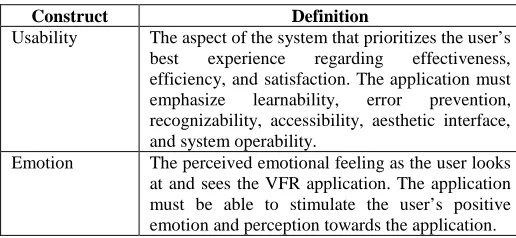
satisfaction, while the emotional construct relates to positive emotion as well as positive perception. The definitions of both constructs are explained in Table VII.
TABLEVII
PROPOSED USABILITY AND EMOTION CONSTRUCT DEFINITION
Construct Definition
Usability The aspect of the system that prioritizes the user’s best experience regarding effectiveness, efficiency, and satisfaction. The application must emphasize learnability, error prevention, recognizability, accessibility, aesthetic interface, and system operability.
Emotion The perceived emotional feeling as the user looks at and sees the VFR application. The application must be able to stimulate the user’s positive emotion and perception towards the application. Performance
Expectancy
Effort Expectancy
Social Influence
Facilitating Conditions
Usage Intention
Privacy
Perceived Risk
Security Concerns Usability
Emotion
Proposed new construct
These two constructs are expected to positively influence the usage intention of the VFR application, which then stimulates the user’s feeling that the application is usable, useful, and delightful apart from the existing factors contributed by the other constructs.
IV.CONCLUSION
Fitting issues in the online clothing industry have negatively affected both business owners and customers in monetary or non-monetary ways. Even though there is a technological solution that addresses this issue, namely the Virtual Fitting Room, it will not be able to prevent misfit cases if the online customers are reluctant to use the application. Therefore, the issues and limitations of existing VFR applications must be solved comprehensively, and improvements to the model’s usability and profound emotional constructs undertaken. For future work, the proposed VFR model must be tested and verified to ensure that it is attractive enough to influence usage intention and most importantly is usable and emotionally satisfying for users.
REFERENCES
[1] eMarketer, “Worldwide Retail Ecommerce Sales Will Reach $ 1 . 915 Trillion This Year”
[2] Brooks, A. L. & Brooks, E. P, “Towards an inclusive virtual dressing room for wheelchair-bound customers,” 2014 International Conference on Collaboration Technologies and Systems, CTS 2014, 582–589, doi:10.1109/CTS.2014.6867629, 2014.
[3] Jonströmer, H., Rentzhog, M. & Anér, E., “E-commerce – New Opportunities, New Barriers,” Kommerskollegium, The National Board of Trade, Retrieved from http://www.kommers.se/In- English/Publications/2012/E-commerce--New-Opportunities-New-Barriers/,2012.
[4] Cilley, J., “Apparel & Footwear Retail Survey Report: Solving The Fit Problem,” 2016.
[5] Syazwan, N., Noraidah, S., & Tengku Siti Meriam, T.W., “Fitting Issues in Malaysia Online Clothing Industry,” PG Symposium, 2016. [6] Hoon Nah, F. F. & Davis, S., “HCI research issues in e-commerce,”
Journal of Electronic Commerce Research, 3(3), 98–113. Retrieved from http://www.csulb.edu/journals/jecr/issues/20023/paper1.pdf, 2002.
[7] Ioannis, P. & Kostas, K.., “Augmented Reality Platforms for Virtual Fitting Rooms,” The International Journal of Multimedia & Its Applications (IJMA), 4(4), 35–46. doi:10.1109/ICALT.2010.54, 2012. [8] Liu, X. H., Sze, K. Y., Jiang, C. F. & Wang, C., “Online cloth virtual fitting room based on a local cluster.” Proceedings - 2009 International Conference on New Trends in Information and Service Science, NISS 2009, (1), 139–144. doi:10.1109/NISS.2009.30, 2009. [9] Swatman, P. M. C. & Chin, C. Y. P., “The Virtual Shopping
Experience: Virtual Presence as a Motivator for Online Shopping.” SSRN Electronic Journal, (March 2004). doi:10.2139/ssrn.630061, 2004.
[10] Fits Me., “Fits Me,” Retrieved from http://fits.me/, 2017.
[11] Youfitinit, “Youfitinit.” Retrieved from http://www.youfitinit.com/ 2017.
[12] Zugara., “The Webcam Social Shopper (WSS),” Retrieved from http://zugara.com/, 2017.
[13] Randall, G., “Fashion ecommerce : are virtual fitting rooms the silver bullet ?,” Econsultancy, https://econsultancy.com/blog/66058-fashion-ecommerce-are-virtual-fitting-rooms-the-silver-bullet/, 2015. [14] Syazwan, N., Noraidah, S., & Tengku Siti Meriam, T.W., “Virtual
Fitting Room: The Needs For Usability and Profound Emotional Elements,” ICEEI 2017.
[15] Sakhardande, P., Thanawala, R., “UX Maturity Model: From Usable to Delightful,” User Experience Magazine, 14(3), 2014
[16] T.Ramaprabha & M.Mohamed, S., “The efficiency enhancement in non immersive virtual reality system by haptic devices,” International Journal Of Advanced Research in Computer Science and Software Engineering, 2(3), 2012.
[17] Okeil, A., “Hybrid design environments: Immersive and non-immersive architectural design,” Electronic Journal of Information Technology in Construction, 15(March), 202–216, 2010.
[18] Shahrbanian, S. & Ma, X., “Use of virtual reality (immersive vs. non immersive) for pain management in children and adults: A systematic review of evidence from randomized controlled trials,” European Journal of Experimental Biology, 2(5), 1408–1422, Retrieved from
http://www.pelagiaresearchlibrary.com/european-journal-of-experimental-biology/vol2-iss5/EJEB-2012-2-5-1408-1422.pdf, 2012. [19] Gultepe, U. & Gudukbay, U., “Real-time virtual fitting with body
measurement and motion smoothing,” Computers and Graphics (Pergamon), 43(1), 31–43. doi:10.1016/j.cag.2014.06.001, 2014. [20] Martin, C. G. & Oruklu, E., “Human Friendly Interface Design for
Virtual Fitting Room Applications on Android Based Mobile Devices,” Journal of Signal and Information Processing, 3(4), 481– 490. doi:10.4236/jsip.2012.34061, 2012.
[21] Prajkta, P., Vaishali, S., Sonali, K. & Priyanka, D., “Towards A Next Generation Universally Accessible Online Shopping-For- Apparel,” IJARIIE, (4), 724–727. doi:IJARIIE-ISSN(O)-2395-4396, 2015. [22] Tengku Siti Meriam, T. W., Hairulliza, M. J., Noraidah, S. @ A.,
Hazura, M., Siti Fadzilah, M. N. & Normala, R., “Interaction Design Model in Virtual Museum Environment,” Asia-Pacific Journal of Information Technology and Multimedia, 5(1), 71–81, 2016. [23] ISO, “ISO 9241-11:1998(en),” Retrieved from
https://www.iso.org/obp/ui/#iso:std:iso:9241:-11:ed-1:v1:en, 1998. [24] Tet Kun, C. & Sahari, N., “Utilitarian or Experiential? An Analysis of
Usability Questionnaires,” International Journal of Computer Theory and Engineering, 7(2), 167–171. doi:10.7763/IJCTE.2015.V7.950, 2015.
[25] Yu-Hui Chen, Abebe Rorissa & Carol Anne Germain, “Usability Definitions in a Dynamically Changing Information Environment,” Information Studies Faculty Scholarship, Volume 15, Number 4, October 2015 pp. 601-621, 2015
[26] Nigel Bevan, James Carter & Susan Harker, “ISO 9241-11 Revised: What Have We Learnt About Usability Since 1998?,” Human-Computer Interaction: Design and Evaluation. HCI 2015. Lecture Notes in Computer Science, vol 9169. pp. 143-151, Springer Cham, 2015.
[27] ISO, “ISO / IEC 25010 : 2011 Systems and software engineering -- Systems and software Quality Requirements and Evaluation (SQuaRE) -- System and software quality models,” 2011.
[28] Rajanen, M. & Iivari, N., “Usability cost-benefit analysis: how usability became a curse word?,” Human-Computer Interaction– INTERACT 2007, hlm.511–524. doi:10.1007/978-3-540-74800-7_47, 2007.
[29] Hertzum, M., “Usability Testing : Too Early ? Too Much Talking ? Too Many Problems ?,” Journal of Usability Studies (JUS), 11(3), 83– 88, 2016.
[30] Research Collective, “The Basics of ROI in Human-Centered Design,” Research Collective, Accessed from: https://research-collective.com/blog/human-cenetered-design-roi/, 2017.
[31] Ross Johnson, “The Roi Of Usability,” 3.7 Designs, Accessed from: https://3.7designs.co/blog/2016/09/the-roi-of-usability/, 2016. [32] Giuseppe Fedele, Mario Fedriga, Silvano Zanuso, Simon Mastrangelo
& Francesco Di Nocera, "Can User Experience affect buying intention? A case study on the evaluation of exercise equipment," Human Factors & Ergonomics Society, 2017.
[33] Vivek Sharma, Neelam Rup Prakash & Parveen Kalra, "User Sensory Oriented Product Form Design Using Kansei Engineering and Its Methodology for Laptop Design", International Journal of Scientific Research in Science, Engineering and Technology(IJSRSET), Print ISSN : 2395-1990, Online ISSN : 2394-4099, Volume 2, Issue 1, pp.161-164, January-Febuary-2016.
[34] Dahlgaard, J. J., Schütte, S., Ayas, E. & Mi Dahlgaard‐Park, S., “Kansei /affective engineering design,” The TQM Journal, 20(4), 299–311. doi:10.1108/17542730810881294, 2008.
Services," International Journal of Technology (2016) 1: 97-104, ISSN 2086-9614, 2016.
[36] Thedy Yogasara & Joshua Valentino, “Realizing the Indonesian National Car: The Design of The 4×2 Wheel Drive Passenger Car Exterior Using the Kansei Engineering Type 1,” International Journal of Technology (2017) 2: 338-351, ISSN 2086-9614, 2017.
[37] Anitawati, “Design & Emotion : The Kansei Engineering,” 1–14. doi:ISSN 2231-7473, 2010.
[38] Mitsuo Nagamachi & Anitawati Mohd Lokman, “Kansei Innovation: Practical Design Applications for Product and Service Development,” Taylor& Francis Group: CRC Press, Volume 32, ISBN: 13:978-1-4987-0683-4, 2015.
[39] Ishardita Pambudi Tama,Wifqi Azlia & Dewi Hardiningtyas, “Development of customer oriented product design using Kansei engineering and Kano model: Case study of ceramic souvenir,” Industrial Engineering and Service Science 2015, IESS 2015, Procedia Manufacturing 4 ( 2015 ) 328 – 335, 2015.
[40] Mu-Chen Chen, Chia-Lin Hsu, Kuo-Chien Chang & Man-Chi Chou, “Applying Kansei engineering to design logistics services – A case of home delivery service,” International Journal of Industrial Ergonomics, Volume 48, July 2015, Pages 46-59, 2015.
[41] Ana Hadiana, Popon Dauni & Anitawati Mohd Lokman, "Kansei Engineering Implementation in Designing User Interface for Web Based Academic Information System," International Journal of Basic and Applied Science, Vol. 04, No. 03, January 2016, pp. 42-50, 2016. [42] Sugoro Bhakti Sutono, “Selection of Representative Kansei
Adjectives using Cluster Analysis: A Case Study on Car Design,” International Journal of Advanced Engineering, Management and Science (IJAEMS), Vol-2, Issue-11, Nov- 2016, ISSN : 2454-1311, 2016.
[43] Taiwo, A. A. & Downe, A. G., “The Theory of User Acceptance and Use of Technology ( UTAUT ): A Meta-Analytic Review of Empirical Findings,” Journal of Theoretical and Applied Information Technology, 49(1), 2013.
[44] Kang, J.-Y. M., “Augmented reality and motion capture apparel e-shopping values and usage intention,” International Journal of Clothing Science and Technology, 26(6), 486–499. doi:10.1108/IJCST-05-2013-0055, 2014.
[45] Huang, N. & Qin, G., “A study of online virtual fitting room adoption based on UTAUT,” 2011 International Conference on E-Business and E-Government, ICEE2011 - Proceedings, 1002–1005. doi:10.1109/ICEBEG.2011.5881681, 2011.
[46] Venkatesh, V., Morris, M. G., Davis, G. B. & Davis, F. D., “User Acceptance of Information Technology: Toward a Unified View,”
MIS Quarterly, 27(3), 425–478.
doi:10.1017/CBO9781107415324.004, 2003.
[47] Schwartz, A. M., “Augmenting Purchase Intent: An Empirical Study on the Effects of Utilizing Augmented Reality in Online Shopping,” Electronic Theses and Dissertations UC Riverside. University of California Riverside, 2011.
[48] Yu, U., “Relationship of body satisfaction to virtual product experience and perceived risk of product performance in online and multi-channel apparel shopping, Graduate Theses and Dissertations, Iowa State University, 2009.
[49] Zhou, L., Dai, L. & Zhang, D., “Online Shopping Acceptance Model: Critical Survey of Consumer Factors in Online Shopping” Journal of Electronic Commerce Research, 8(1), 41–62. doi:10.1086/209376, 2007.
[50] Ventakesh, V., Ramesh, V. & P. Massey, A., “Understanding Usability in Mobile Commerce,” Communications of The ACM, 46(12), 53–56, 2003.
[51] Min Chiu, C., Hsiang Hsu, M., Yuan Sun, S., Ching Lin, T. & Chen Sun, P., “Usability , quality , value and e-learning continuance decisions,” Computers & Education, 45(December), 399–416. doi:10.1016/j.compedu.2004.06.001, 2005.
[52] Jakob Nielsen, “Is Poor Usability Killing E-Commerce ?,” Nielsen Norman Group,. https://www.nngroup.com/articles/did-poor-usability-kill-e-commerce/, 2001.
[53] Onradt, U., Luckel, L. & Ellwart, T., “The Role of Usability in Business-to-Business E-Commerce Systems : Predictors and Its Impact on User ’ s Strain and Commercial Transactions,” Advances in Human-Computer Interaction, 2012(948693), 1–11. doi:10.1155/2012/948693, 2012.
[54] Panda, S. K., Swain, S. K. & Mall, R., “An Investigation into Usability Aspects of E-Commerce Websites Using Users ’ Preferences,” Advances in Computer Science: an International Journal (ACSIJ), 4(1),65–73,2015
[55] Anitawati, M. L., Nor Laila, M. N. & Nagamachi, M., “Kansei Engineering: a Study on Perception of Online Clothing Websites,” 10th QMOD Conference. Quality Management and Organiqatinal Development., pg8, 2007.
[56] Overmars, S. & Poels, K., “A touching experience: Designing for touch sensations in online retail environments,” International Journal of Design, 9(3), 17–31, 2015.
[57] Wallace, S., “The State of Retail,” Online Shopping Survey, 2015. [58] Cheng Yee, C. & Rashad, Y., “How Customer Perception Shape
buying Online Decision,” Global Journal of Management and Business Research: E Marketing, 14(2), 1–8, 2014.
[59] Jeff Tanner & Raymond, M. A., Marketing Principles, 2012. [60] Syeda Quratulain, K., “Consumer Perception and Buying Decisions
(The Pasta Study),” International Journal of Advancements in Research & Technology, 1(6), 1–10, 2012.
[61] Yi Jin Lim, Osman, A., Nizam, S., Rahim, A. & Abdullah, S., “Factors Influencing Online Shopping Behavior : The Mediating Role of Purchase Intention” Vol. 35, 401–410. Elsevier B.V. doi:10.1016/S2212-5671(16)00050-2, 2016.