ISSN 2185-3762
Design and Management of a Self-Access Language Learning Space integrated into a taught course
Sahar Alzahrani, University of Southampton, UK
Vicky Wright, University of Southampton, UK
Corresponding author: [email protected]
Publication date: June, 2016.
To cite this article
Alzahrani, S., & Wright, V. (2016). Design and management of a self-access language learning space integrated into a taught course. Studies in Self-Access Learning Journal, 7(2), 136-151.
To link to this article
http://sisaljournal.org/archives/jun16/alzahrani_wright
This article may be used for research, teaching and private study purposes. Please contact the authors for permission to re-print elsewhere.
136
Design and Management of a Self-Access Language Learning Space
Integrated into a Taught Course
Sahar Alzahrani, University of Southampton, UK
Vicky Wright, University of Southampton, UK
Abstract
This paper reports on the design and management of an online self-access language learning (SALL) space that was used with a group of Saudi medical students to complement
classroom-based learning. The aim was to increase the opportunities for communication and language practice and, more specifically, to help develop the learners’ language learning autonomy (Little, 1999). In a pre-study, a questionnaire and a focus group were used to collect information about the students’ needs and interests in language learning. The design of this space was informed by the students’ feedback on their language learning needs and styles as recommended by Breen (1986) and Marsh (2012). Desire2Learn, a widely used virtual learning environment, was used to provide learners with an online self-access center because of the many features it has which would help learners to take control of their learning. The learning resources and online tools included instant messaging (IM), a news stream, access to a facilitator and other learning support, moderated discussions, videos, images, activities and quizzes, as well as links to external materials and to free self-access language learning resources. A description will be provided of how the materials, the tools, and the facilities were integrated within this space along with the justification for each of the elements. A look ahead to how this study could be extended for use with all learners enrolled in the medical scheme of the university will be discussed at the end of the paper.
Keywords: self-access learning, online language learning space, needs analysis, language learner autonomy, SALL management, virtual learning environment
Background
The increasing interest in learner autonomy and learner-centred approaches to
137
be perhaps about the effectiveness of the, but about the need for the physical SACs as compared to virtual online learning spaces.
SALL has gone dramatically beyond the confines of SACs as a result of the
proliferation of advanced technologies and the prevalence of the internet (Gardner & Miller, 2014; Lamb & Reinders, 2005) and social networking. Teaching can now be computer-assisted or computer-mediated, and numerous opportunities for intercultural communication and authentic use of language are nowadays available for learners in synchronous and asynchronous modes (Gardner & Miller, 2014). Nevertheless, technology might not be used effectively when incorporated in SALL. Only a handful of the 45 SACs investigated in Reinders & Lázaro’s (2007) study used technology to its best effect.
In fact, despite the large amount of literature on SALL, few researchers have addressed the management of SALL (Gardner & Miller, 2014). The literature of SALL highlights the resources used in SALL and its educational importance, but there is a dearth of studies that deal with SALL management and the training provided to the managers (Gardner & Miller, 2014). In the few studies addressing SALL management, the role of SALL
management staff and the time dedicated to this role were underestimated (Gardner & Miller, 2014).
This paper is part of a PhD project which looked at the effectiveness of an
intervention to promote learners’ autonomy in language learning. It is proposed in this paper that SALL management can be carried out not only in a physical SAC, but also in a virtual space integrated into a taught course (see The aim of the design of the SALL space section), as indicated by Gardner & Miller (2011; 2014). This paper describes how different elements of SALL opportunities were selected, combined, and managed in order to support learners and to help foster their language learner autonomy. It presents the manager’s perspective on details of the design and management of the SALL space in the context of this study. The researcher in this study played the three roles of the course developer, teacher, and manager.
Design and Implementation Stage of an Online Language Learning Space
The aim of the design of the SALL space
138
and this has tended to make ‘self-access language learning’ synonymous with ‘autonomous language learning’. Wenden (1991) described autonomous learners as those who have developed learning tactics, an awareness of learning, and positive attitudes to use these abilities on their own in an appropriate, assertive, and flexible manner. Just as with the common rationale for the establishment of any SALL environment, the aim in this study is to support learners’ autonomous language learning. It also aims to create more opportunities for communication and language practice, as recommended by Little (1999), to help learners improve their language proficiency and accordingly their language learning autonomy.
The success of SALL management can be influenced by the style of management adopted by the institution (Gardner & Miller, 2014). Fortunately, the aim of this study was in line with the mission of Umm AlQura University, where this research was carried out. The university invests significant amounts of money in the provision of facilities that can help to incorporate technology in teaching across different disciplines. Moreover, the university has plans to prepare learners with the skills to take control of their learning in order to raise a new generation of lifelong learners.
This study was undertaken with a group of Saudi medical students (N=24) in order to enhance their language learning opportunities. SALL resources and activities were selected and designed in detail to complement classroom-based learning. Learners who took part in this study came from a previous background of minimal access to technology for learning purposes. Part of the aim of this paper is to show how the SALL manager worked to
encourage learners to collaborate, to reflect on learning, to practice the use of language, and to have interaction with the learning material, with the teacher, and with peers to reach the ultimate goal, which is the enhancement of their autonomy in language learning.
139
learning, language use, and development of helpful learning skills. The design of the SALL space is task-based, where learners are given tasks ranging from two to six tasks per optional module (i.e. lesson). These modules were to be worked on voluntarily and collaboratively when the teacher was in the classroom once a week. In addition, they were given the
opportunity to access the SALL space anytime, anywhere outside the classroom to learn and practice the language within the online learning community.
Consideration of learners’ needs
In order to foster learners’ autonomous learning, learners need to be provided with the appropriate SALL opportunities and support (Gardner & Miller 1999; Hurd, 1998; Reinders, 2010). This level of support cannot be achieved without considering the needs and interests of the learners (Lee, 2014; Levy & Stockwell, 2006; Morrison, 2014) because learners are aware of these needs and can help to produce the learning content (Legenhausen, 2013). It is a tenet that learners have the right to decide about the time, the place, the way, and the process of learning they prefer to do outside the classroom (Morrison, 2014).
Despite the suggestion by some scholars such as Gardner (2011), that self-access learners should be the managers of their own learning, SALL managers still have a management responsibility (Gardner & Miller, 2014). Managers need to understand the context, collect the views of learners, teachers, stakeholders, and support personnel in order to get a full understanding of what is there, what is needed, and what is the best way of doing it (Morrison, 2014).
140
Selection and integration of the tools, facilities, and materials
The manager of the SAC in this study worked with the hardware, software, VLE, and pedagogical elements in order to ensure that they provided SALL opportunities which would help the learners to develop their ability to take control of their language learning. For this reason, every learner was assigned a computer connected to the Internet so that they could access the SALL space during class time. Learners were also provided with tools that were intended to be easy to use to help them explore information and access the resources.
There are many options for online spaces which can store online resources which learners can then explore and use for their language learning. The decision in this study was to use Desire2Learn, a widely used VLE, to provide learners with access to the intended online self-access learning options. This decision was made mainly because this was the institutional VLE and it was well supported by the university.
This was not the only reason for the adoption of Desire2Learn, as the researcher was looking for a user-friendly VLE with features including an interesting interface and easy navigation. Besides these two features, Desire2Learn has many other features which help learners to take control of their learning and help the teacher and the learners to experiment with the online resources such as an instant messaging (IM), a news stream, a dropbox area, discussion forums, and a quiz tool to design different types of quizzes and tasks.
The IM tool (i.e. pager) embedded in Desire2Learn gives a list of the instant messages received in the inbox of any user of the online space and it can be used synchronously for instant messages or asynchronously to leave a message for someone who is offline at some point. It was used as one of the communication channels for the members of the online learning community to share questions, answers, quick ideas, quick updates, or any emerging issues. Learners used it to communicate with the teacher after university working hours to enquire about any difficulty they were facing when they used the VLE or about what some of the tasks were asking them to do. This tool helped the learners to get the support they need for autonomous learning during SALL.
141
any emerging update to be shared with learners, or any further resources uploaded to the VLE.
The dropbox area was used by the learners to submit any document they would like to share with the members of their online learning community, including the teacher and their peers, and to upload the projects they constructed in their small groups. This tool allows learners to view the score they obtained for each of the tasks and the feedback if there was any. This feature of the dropbox tool allows learners to check their scores for the evaluation of their performance and to monitor their progress in learning.
The quiz tool was used by the SALL manager to construct small tasks in different forms such as short answer, long answer, multiple-choice, matching, and picking more than one answer. The number of attempts allowed before the task is submitted is under the control of the SALL manager and can be adapted at any point. This can help both the teacher and the learners to track the progress in the learners’ performance by looking at all of the attempts submitted before the final submission. Though learners’ use of the VLE is voluntary, the SALL manager was able through the quiz tool to assign the grade points for the different tasks to help learner evaluate their performance and they were automatically getting their scores when they submitted their tasks.
142
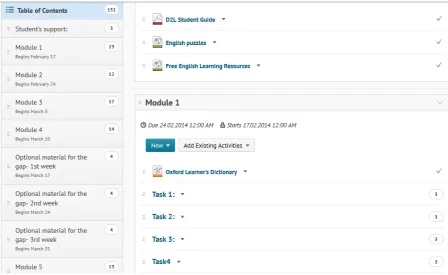
Figure 1. The Main Content Section and Navigation Pane on the VLE
SALL can be successful when teachers promote it either by enhancing learners’ beliefs about SALL or by designing the SALL environment in an effective and engaging way (Dofs & Hobbs, 2011; Gardner & Miller, 2014). Therefore, lots of choice was built into the design of the online space whether in the tasks to be performed, into the material to use to finish some of the tasks, or into the time and place in which it would be done. The provision of these choices built on the needs and interests reported by the learners in the pre-study questionnaire and focus group. Additionally, the tasks used in the content of the SALL space were designed to be engaging and to stimulate the learners’ critical thinking and higher order thinking skills (e.g. problem-solving, project-based, role-play, communicative tasks). Diverse types of learning materials were uploaded to the VLE and embedded in the design of the task-based content of the online space (e.g. links to dictionaries, links to language learning
websites, videos, pictures, Microsoft Word documents, PDFs) to facilitate learners’
experimentation with language. At the top of each of the tasks, the learning outcome expected to be achieved after doing the tasks was stated to enhance learners’ awareness about their learning which would give them the control over their learning.
143
learner autonomy (Little, 1999). To be able to achieve that, communicative tasks ranging from two to six tasks per module were included in the design of the online space. An indirect approach to teaching speaking was used to encourage learners to find a solution through interaction (Hedge, 2000). Problems were given in different types of tasks such as free blended discussions (i.e. learners discuss the discussion topic posted on the VLE while they physically exist in the face-to-face classroom), role-play tasks, and problem solving tasks. The direct approach to teaching speaking skills was also used in the SALL design when topics were posted on the discussion board for learners to talk about either synchronously or asynchronously as self-access tasks while they are at home.
Learners’ reflection on their learning was emphasized in the design of the SALL space in order to provide opportunities which contribute to their development as autonomous learners as recommended by Lamb and Reinders (2005) and Schwienhorst (2008). A guided reflective writing form was uploaded to the VLE after all of the tasks in each module with six questions asking about the tasks and strategies the learners liked the most and those they liked the least along with the plan they might have at the end of the session. Learners were encouraged to do the reflective writing in order to get them to think critically and reflect on their learning before they left the classroom, but some were doing it at home instead and were submitting it to the dropbox.
The materials that the SALL manager selected for the tasks on this SALL space were authentic and relevant to the learners’ needs and to their subject matter. Gardner and Miller (2014) encourage SALL managers to provide appropriate authentic material mapped to the learners’ needs which would help learners to personalize their learning (Dam, 1995) and to increase their confidence (Jones, 2001). Using authentic learning materials as the input for tasks makes learners play the role of the consumers of this material (Littlejohn, 1997). They use this authentic material to discuss and think about the way to do the tasks. Learners can select from the selection of materials given to them to work on. The organisation of the material in SALL plays an important role in the learners’ response and use of these materials since good organisation will encourage learners’ effective use and avoid their withdrawal (Gardner & Miller, 2014).
144
Desire2Learn and it was exploited for the SALL opportunities offered to learners in this study to increase the use of language and the interaction among learners within their learning community (Halvorsen 2009, McLoughlin & Lee, 2007; Mynard, 2011; Warshauer & Liaw, 2011). It presents a list of the topics given for discussions with statistics available on the posted threads and replies on each of the topics.
Management of the Online Language Learning Space
Gardner and Miller (2014) point out that the abundance of technology and networked resources together with the integration of SALL into taught courses has made the role of the SALL manager in terms of providing ever better SALL opportunities more complex than ever before. Furthermore, the current blurring of the borders between physical SACs, virtual SALL spaces, and integrated SALL has contributed to making the role of the SALL manager increasingly challenging (Gardner & Miller, 2014).
To increase the likelihood of success in SALL, SALL managers need to coordinate the work with the course developers and the teachers (Gardner & Miller, 2014). It would have been problematic for the SALL manager in this study to liaise with the course
developers and teacher if the course was developed and taught by someone else. Being the course developer, teacher, and manager helped to avoid the need to liaise with the other managing partners but increased the work that the SALL manager needed to do.
Different forms of support were given to learners in the design and management of the SALL. The design of the free discussion tasks (i.e. the ones designed to be performed in a blended mode) takes into consideration the provision of supportive elements to the learners including description of the discussion context at the beginning, introducing some input in the instructions of the task, and some pictures to help them to get a feeling of the discussion topic. Quick links to Oxford Online Dictionary were added to every page to facilitate their experimentation and to provide the support they need for the development of their
autonomous learning when something makes them pause while learning. Choice was
carefully built into the design of the online space both in terms of the activities on offer or the resources themselves.
145
was through teacher’s written feedback on their performances and activities in the SALL space. The focus of the feedback was not on language accuracy but on their linguistic and metalinguistic awareness as well as on motivation maintenance. The tasks students submit to dropbox are checked by the teacher afterwards. In the dropbox area of Desire2Learn, there was a designated area for the teacher to provide written feedback on each submitted task. The teacher was continuously checking the submissions and was giving prompt feedback to help the learners maintain their motivation while working online. Learners were checking the feedback given on each of the tasks and were discussing it together even while they were working online in the classroom.
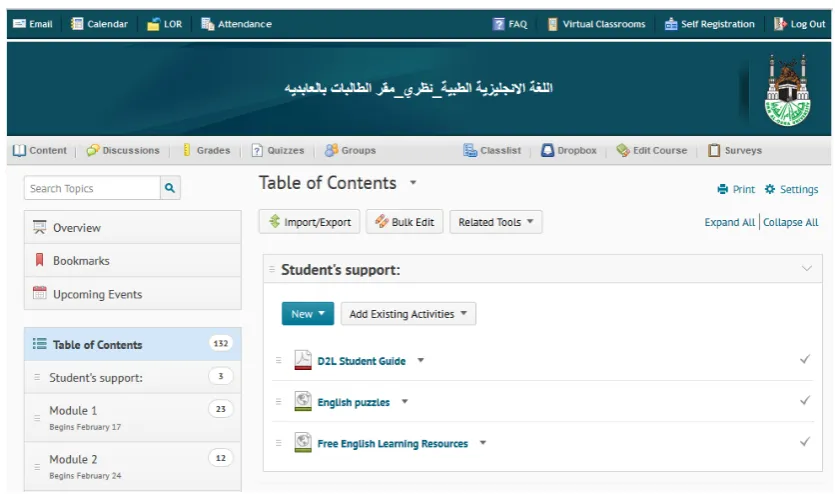
Support is also exemplified in the HELP resource which was added to the SALL main content section. This additional block allows access to any element that offers support to learners such as the VLE manual for learners as users, English puzzles, and many other free self-access English learning resources (Figure 2). This support helped to elevate learners’ motivation when they find what they needed to know about the use of the VLE as they were heard talking inside the classroom about how the manual helped them to deal with
Desire2Learn and they were sharing tips on how to use it. Learners who consulted the additional self-access language learning resources were more engaged with the learning experience and that was seen in their performance of all of the tasks, including optional ones, their continuous synchronous and asynchronous interaction with the teacher and peers, and their attempts to encourage their peers to check out different elements of the SALL space.
146
It is not easy to give learners sufficient background information on, for example, netiquette (Gardner & Miller, 2014) and what they can do in SALL. However, SALL
managers need to make sure that learners clearly understand the concept of SALL and how to perform within its borders (Murphy & Southgate, 2011). Thus, as a manager, face-to-face negotiation sessions were held with the learners in order to have them report on any potential issues related to their learning using the SALL space. The learning outcomes of the tasks were communicated to the learners to enhance their metacognitive knowledge about their learning which would influence their motivation (Lamb, 2010; Lamb & Reinders, 2005). Because it is important that SALL managers explain to the learners that they will be given the appropriate support while using the SALL space (Gardner & Miller, 2014), the opportunities of decision making and choice offered to the learners in this study were also indicated to them. SALL managers, according to Morrison (2014) and Schwienhorst (2008), need to understand that their role is to manage the learning opportunities they are providing to
learners rather than managing the learning. Hence, learners were repeatedly reminded that the work in this SALL space is voluntary and that they will be helped but not taught.
SALL managers play an important role as experts providing knowledge when they are consulted by the learners (Morrison, 2008), guides to provide the support that learners need to perform in a different learning context (Hurd, 2008; Young, Hafner, & Fisher, 2007), and language advisors (Mozzon-McPherson. 2000). Therefore, the teacher, who is the manager of this SALL, ensured she would be present online to check the updates on the VLE regularly, maintain learners’ engagement, support them whenever needed, and present herself as an example of a committed learner.
Looking Ahead
The current English courses offered to medical students in their foundation year are conventional, face-to-face, general English in the first semester and medical English in the second semester. Several teachers have now taken the initiative to integrate the use of technology in their teaching. According to the policy of the institution, the core content of these courses should be delivered in face-to-face meetings and technology use can be
integrated in the teaching. The core content cannot be achieved one hundred percent through self-access. Therefore, keeping the face-to-face meetings and the core content of the courses is important.
147
one whole (Gardner & Miller, 2014). By then, teachers will be able to use teaching
approaches appropriate to SALL and learners will develop a sense of SALL and its necessary skills (Gardner & Miller, 2014).
There are plans to open the SALL space to every learner enrolled in the medical scheme of this university. The expansion of these SALL opportunities can form a mini-MOOC directed at medical students to help them improve their medical English and to provide greater opportunities to practice the language in their field along with general English. This extension would add an additional burden to the SALL manager role (Gardner & Miller, 2014). Therefore, we should plan to have one or more paid moderator to ensure that the SALL management is done efficiently. This is because the aim is not only to increase the numbers of the enrolees, as is the case of many of the current MOOCs (Alzahrani, 2015), but also to provide a good quality of learning and effective management of the SALL space.
Conclusions
The SALL space that was created and the efforts made in this study to maintain the space and to manage it were all motivated by the fact that SALL is important to “the learners, the teachers, and the host institutions” (Gardner & Miller, 2014, p. 3). Given the affordances of technology and the learners’ need to access a variety of authentic learning resources relevant to their field of study and future career, the provision of SALL opportunities and the good management of the SALL space would help to satisfy these needs and help them to develop essential learning skills to become autonomous learners.
Notes on the Contributors
Sahar Alzahrani is a PhD candidate at the University of Southampton. She is a lecturer at Umm AlQura University, Saudi Arabia, teaching English for Specific Purposes (mainly Medical English) since 2006. Her research interests are learning technologies, learner autonomy, innovations in teaching, blended learning, E-learning, and development of instructional materials.
148
distance learning. She supervises research students in the area of learner strategies, learner and teacher autonomy and blended learning.
Acknowledgement
We would like to thank Umm Al-Qura University, Makkah, Saudi Arabia for giving us the opportunity to carry out this study on SALL with medical students and for providing the place, technology, and the facilities needed for the study to take place.
References
Alzahrani, S. M. (2015). Lessons learned from collaboration in online discussion fora: towards a successful digital learning community, paper presented at the EUROCALL Conference, the University of Padova, Italy.
Breen, M. P. (1986). Learner contributions to task design. In C. N. Candlin & D. F. Murphy. (Eds.), Language learning tasks (pp. 23-46). Englewood Cliffs, NJ: Prentice-Hall.
Dam, L. (1995). Learner autonomy 3: From theory to classroom practice. Dublin, Ireland: Authentic.
Dofs, K., & Hobbs, M. (2011). Guidelines for maximising use of independent learning centres: Support for ESOL learners. Retrieved from
http://akoaotearoa.ac.nz/download/ng/file/group-7/guidelines-for-maximising-student-use-of-independent-learning-centres.pdf.
Gardner, D. (2011). Looking in and looking out: Managing a self-access centre. In D. Gardner (Ed.), Fostering autonomy in language learning (pp. 186-198). Gaziantep, Turkey: Zirve University. Retrieved from http://ilac2010.zirve.edu.tr.
Gardner D., & Miller, L. (1997). A study of tertiary level self-access facilities in Hong Kong. Hong Kong: City University of Hong Kong.
Gardner, D. & Miller, L. (1999). Establishing self-access. Cambridge, UK: Cambridge University Press.
Gardner, D. & Miller, L. (2011) Managing self-access language learning: Principles and practice, System, 39(1), 78-89. doi:10.1016/j.system.2011.01.010
Gardner, D., & Miller, L. (2014). Managing self-access language learning. Hong Kong: City University of Hong Kong Press.
149
Hedge, T. (2000). Teaching and learning in the language classroom. Oxford, UK: Oxford University Press.
Hurd, S. (1998). “Too carefully led or too carelessly left alone”? Language Learning Journal, 17(1), 70-74. doi:10.1080/09571739885200121
Hurd, S. (2008). Second language learning at a distance: Metacognition, affect, learning strategies and learner support in relation to the development of autonomy. Volume 1: Introduction to the published work. PhD thesis, The Open University. Retrieved from http://oro.open.ac.uk/21773/
Jones, B. (2001). Developing learning strategies. London, UK: CILT.
Lamb, T. (2010). Assessment of autonomy or assessment for autonomy? Evaluating learner autonomy for formative purposes. In A. Paran, & L. Sercu. Testing the untestable in language education (pp. 77-97). Bristol, UK: Multilingual Matters.
Lamb, T., & Reinders, H. (2005). Learner independence in language teaching: A concept of change. In D. Cunningham & A. Hatoss. An international perspective on language policies, practices and proficiencies. Belgrave, Australia: FIPLV.
Little, D. (1999). Developing learner autonomy in the foreign language classroom: A social-interactive view of learning and three fundamental pedagogical principles. Revista Canaria de Estudios Ingleses, 38, 77-88.
Littlejohn, A. (1997). Self-access work and curriculum ideologies. In P. Benson & P. Voller (Eds.) Autonomy and independence in language learning (pp. 181-191). London, UK: Longman.
Lee, I. (2014). Managing self-access language learning at Hong Kong Baptist University. In D. Gardner & L. Miller. Managing self-access language learning (pp. 101-110). Hong Kong: City University of Hong Kong Press.
Legenhausen, L. (2013, September). Learner autonomy as a response to the challenges of educational inclusion. Paper presented at the IATEFL LASIG International Conference, Hannover, Germany.
Levy, M., & Stockwell, G. (2006). CALL dimensions: Options and issues in computer-assisted language learning. New York, NY: Routledge.
Marsh, D. (2012). Blended learning: Creating learning opportunities for language learners. Cambridge, UK: Cambridge University Press.
McLoughlin, C., & Lee, M. J. W. (2007). Social software and participatory learning:
150
Morrison, B. (2008). The role of the self-access centre in the tertiary language learning process. System, 36(2), 123-140. doi:10.1016/j.system.2007.10.004
Morrison, B. (2014). Managing self-access language learning at Hong Kong Polytechnic University. In D. Gardner & L. Miller. Managing self-access language learning (pp. 91-100). Hong Kong: City University of Hong Kong Press.
Mozzon-McPherson, M. (2000). An analysis of the skills of advising and their implications in on the emerging role of language learning advisors. Links and Letters, 7, 118-126.
Murphy, L., & Southgate, M. (2011). The nature of the ‘blend’: interaction of teaching modes, tools and resources. In M. Nicolson, L. Murphy, & M. Southgate (Eds.), Language teaching in blended contexts (pp. 13-28). Edinburgh, UK: Dunedin Academic Press.
Murphy, L., & Hurd, S. (2011). Fostering learner autonomy and motivation in blended teaching. In M. Nicolson, L. Murphy, & M. Southgate (Eds.), Language teaching in blended contexts. (pp. 43-56). Edinburgh, UK: Dunedin Academic Press.
Mynard, J. (2011). Learning environments that facilitate reflection on learning. JALT CALL Journal, 7(3), 293-306. Retrieved from
http://journal.jaltcall.org/articles/7_3_Mynard.pdf
Mynard, J. (2012). Does “self-access” still have life in it?: A response to Reinders (2012). ELTWorldOnline, 4. Retrieved from https://blog.nus.edu.sg/eltwo/files/2015/10/0411-Does-Self-Access-Still-Have-Life-in-It-v570id.pdf
Reinders, H. (2010). Towards a classroom pedagogy for learner autonomy: A framework of independent language learning skills. Australian Journal of Teacher Education, 35(5), 40-55. doi:10.14221/ajte.2010v35n5.4
Reinders, H. (2012). The end of self-access?: From walled garden to public park.
ELTWorldOnline, 4. Retrieved from http://blog.nus.edu.sg/eltwo/files/2013/12/The-End-of-Self-Access-From-Walled-Garden-to-Public-Park_editforpdf-12771ui.pdf
Reinders, H., & Lázaro, N. (2007). Innovations in language support: The provision of technology in self-access. Computer Assisted Language Learning, 20(2), 117-130. doi:10.1080/09588220701331428
Schwienhorst, K. (2008). Learner autonomy and CALL environments. London, UK: Routledge.
Vygotsky, L. S. (1978). Mind in society. Cambridge, MT: Harvard University Press.
151
Wenden, A. (1991). Learning strategies for learner autonomy: Planning and implementing learner training for language learners. Hemel Hemstead, UK: Prentice Hall.