Abdulla, J., Rose, S.P., Mackenzie, A.M., Mirza, W. and Pirgozliev, V. Exogenous tannase improves feeding value of diet containing field beans (Vicia faba) when fed to broilers. 2016. British Poultry Science, 57(2), pp.246-250.
Exogenous tannase improves
feeding value of a diet containing
field beans (Vicia faba) when fed to
broilers
by Abdulla, J., Rose, S.P., Mackenzie, A.M., Mirza, W.
and Pirgozliev, V.
Copyright, Publisher and Additional Information: This is the author accepted manuscript. The final published version (version of record) is available online via Taylor & Francis
Please refer to any applicable terms of use of the publisher.
1
Exogenous tannase improves feeding value of diet containing field beans (Vicia faba) 1
when fed to broilers 2
3
J. Abdulla, S.P. Rose, A.M. Mackenzie, W. Mirza, V. Pirgozliev* 4
The National Institute of Poultry Husbandry, Harper Adams University, Shropshire, TF10 5
8NB, UK 6
7
Correspondence to: [email protected] 8
9
Abstract 1. A total of 72 male Ross 308 broilers were used in a study to investigate the effect 10
of dietary tannase on apparent metabolisable energy (AME), coefficients of dry matter 11
(DMR) and nitrogen (NR) retention and fat digestibility (FD) of a diet containing 300g/kg 12
field beans (Vicia faba). Growth performance variables and gastrointestinal tract 13
development were also measured. 14
2. Two treatments were used in this study: control (C) and C + 3400 tannase units (TU) per 15
kg feed. Diets were formulated to be nutritionally adequate with the exception that the AME 16
was lower than recommended (12.65 MJ/kg vs 12.97 MJ/kg, respectively). 17
3. Inclusion of tannase increased AME by 0.4 MJ/kg DM (P<0.05). Tannase supplementation 18
improved dietary DMR (P<0.05), NR (<0.001) and FD (P<0.05) by 2.8, 3.2 and 6.5%, 19
respectively. 20
4. Birds fed tannase had 4.4% reduction in feed intake and 2.6% improvement in gain to feed 21
ratio (P<0.05). Compared to control diet, birds fed tannase had reduced relative to body 22
weight (%BW) proventriculus and gizzard and pancreas weights, 3.29 vs 3.09% and 0.47 vs
23
0.44%, respectively. 24
2
Global demand for dietary protein has recently led to an unstable increase in the supply and 26
price of soybean. In addition, the use of soybeans has led to consumer resistance because 27
much of it comes from genetically modified crops unsuitable for use in organic farming 28
(Vicenti et al., 2009). These circumstances have stimulated research on alternative protein 29
sources, especially high-protein legumes, free of genetic modifications that can satisfy the 30
protein requirements (Ravindran et al., 2010; Laudadio et al., 2011). The content of 31
antinutrients in field beans (Vicia faba), primarily polysaccharides and tannins, are the main 32
reason reduced nutrient digestibility and growth performance of broilers fed field bean based 33
diets (Longstaff and McNab, 1991). Although the beneficial effect of feeding fibre degrading 34
enzymes to legume containing diets is known (Castanon and Marquardt, 1989; Cowieson et 35
al., 2004) there is lack of information on the effect of tannin degrading enzymes on feeding 36
value of field beans for broilers. 37
The main objective of this experiment, therefore, was to determine the effect of 38
supplementary tannase, an enzyme that hydrolyses tannins, on dietary metabolisable energy, 39
nutrient utilisation and gastrointestinal tract development. The overall feed intake, weight 40
gain and feed conversion efficiency of the birds were also measured. 41
42
MATERIALS AND METHODS 43
Materials and methods 44
Field bean sample 45
A UK grown field bean sample of cultivar Sultan from 2013 harvest year was used in a 46
broiler feeding experiment. This field bean cultivar was selected for the experiment because 47
of its relatively high content of hydrolysable tannins and low metabolisable energy (Abdulla 48
3
mm screen and then mixed in a horizontal mixer with the other feed ingredients. Freshly 50
milled sample in duplicate was used for analyses and in the feeding study to avoid spoilage. 51
The gross energy (GE) of the bean samples was determined using a bomb calorimeter (Parr 52
Instrument Company, Moline, IL). Nitrogen was determined by the combustion method 53
(AOAC, 2000) using a LECO (FP-528 N, LECO Corp., St. Joseph, MI). The crude protein 54
(CP) values were obtained as N x 6.25. Oil (as ether extract) in the bean sample was extracted 55
with diethyl ether by the ether extraction method (AOAC, 2000) using a Soxtec system (Foss 56
UK Ltd.). The contents of non-starch polysaccharides (NSP), hydrolysable tannins (HT) and 57
trypsin inhibitors (TI) in the experimental field bean sample were determined by the methods 58
of Englyst et al. (1994), Makkar et al. (1993) and Smith et al. (1980), respectively. 59
Diet preparation 60
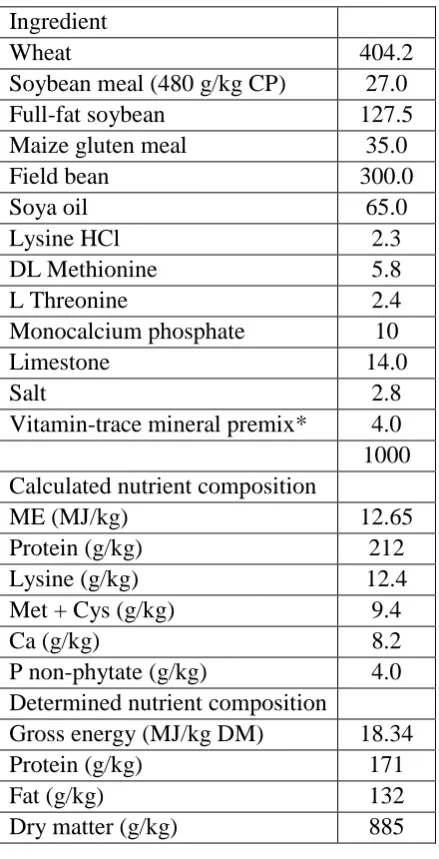
A control diet (C) containing 300 g/kg field bean sample was prepared (Table 1). The diet 61
was then split into two batches and one of them was supplemented with 3400 units/kg (TU) 62
of propriety tannase (Kerry Ingredients and Flavours, Osberstown, Naas, Co. Kildare, 63
Ireland) resulting in diet CT. The enzyme had also 6220 units/kg of pectinase and less than 64
200 units/kg of phytase activity. The enzyme preparation was based on tannase produced by 65
Aspergillus niger. The enzyme was in a liquid form and 17ml/kg was sprayed on the top of 66
diet CT. The dry matter content of diet C was adjusted by spraying of 17ml water per kg of 67
diet. After spraying the diets were thoroughly mixed in a horizontal mixer. 68
Birds, husbandry and sample collection 69
All procedures were approved by The Animal Experimental Committee of Harper Adams 70
4
Male Ross 308 broiler chickens were obtained from a commercial hatchery at one-day old 72
and were placed in a single floor pen and fed on a proprietary broiler starter feed until 6 d of 73
age. On the first day of the experimental period (at 7 d of age), the chicks were individually 74
weighed and assigned to one of the experimental pens. Two birds were placed in each pen 75
(0.4m X 0.4m solid floor area) within a controlled environment room. Each diet was fed at 76
random to 16 pens from 7 to 21d age. Room temperature and lighting program followed 77
commercial recommendations (Aviagen Ltd., Edinburgh, UK). Access to the mash form feed 78
and the water was ad libitum. 79
During the last four days of the experiment, from 17 to 21 d age, the solid floor of each pen 80
was replaced with a wire mesh. All excreta were collected daily and refrigerated. On the last 81
collection the samples from each pen were pooled, the total amount was immediately dried at 82
60◦C and then milled. Representative samples of dry and milled excreta were taken for 83
analyses. Feed intakes were also measured for the same period. 84
On the last day of the study, at 21d age, the two birds in each pen were weighed and killed by 85
cervical dislocation. The empty weights of gastrointestinal tract (GIT) segments, including 86
proventriculus and gizzard (PG), pancreas and small intestine, of each bird were determined, 87
according to the procedures described by Amerah and Ravindran (2008). The weights of the 88
segments were presented as relative to BW (% BW). 89
Metabolisable energy and nutrient utilisation determination 90
Excreta were oven-dried in forced draft oven at 60°C to constant weight, weighed, and milled 91
to pass through a 0.75 mm mesh. The gross energy, nitrogen and oil in feed and excreta were 92
determined as for the field bean sample. The dietary N-corrected apparent metabolisable 93
energy (AMEn) was calculated as described by Hill and Anderson (1958). The coefficients of 94
5
determined as the difference between the respective nutrient intake and nutrient excreted 96
divided by the intake. 97
STATISTICAL ANALYSES 98
Statistical analyses were performed using the Genstat statistical software package (Genstat 99
15th release 3.22 for Windows; IACR, Rothamstead, Hertfordshire, UK). The metabolisable 100
energy content of the experimental diets, broiler growth performance, and nutrient utilisation 101
were compared statistically by ANOVA. In all instances, differences were reported as 102
significant at P < 0.05. 103
RESULTS AND DISCUSSION 104
The determined chemical composition of the Sultan cultivar field bean sample contained 105
856g/kg dry matter, 18.27 MJ/kg GE, 245 g/kg CP, 12 g/kg oil, 190 g/kg total NSP (135g 106
non-soluble and 55 g soluble), 12.3 mg/g HT and 2.3 mg/g TI, respectively (results are 107
presented on dry matter basis). All birds were healthy throughout the study period and there 108
was no mortality. There was no effect of treatment on final body weight and weight gain of 109
the birds (Table 2). Birds fed diet TC had reduced feed intake (FI) but improved feed 110
conversion efficiency (FCE) (P<0.05) compared to the control fed birds. 111
Exogenous tannase supplementation improved dietary AMEn by 0.4 MJ/kg compared to the 112
control (P<0.05) (Table 3). Similarly, tannase supplementation resulted in improved DMR, 113
NR and FD (P<0.05). 114
Birds fed tannase had reduced the relative proventriculus and gizzard weight, and also 115
reduced the relative pancreas weights compared to birds fed the control diet (P<0.05) (Table 116
4). There was no effect (P>0.05) of dietary treatment on the relative weight of the small 117
6
The study evaluated the efficacy of supplementary tannase enzyme on growth performance, 119
energy and nutrient utilisation and GIT development when field bean diet was fed to broilers. 120
The data demonstrate that young broilers are sensitive to dietary supplementation with 121
exogenous tannase. There are no previous published studies of dietary tannase 122
supplementation in broiler feeds. However, there are published reports on the negative impact 123
of high dietary tannin on the studied variables (Jansman, 1993; Brufau et al., 1998; O'Neill et 124
al., 2012). 125
The diets were relatively high in HT content from the Sultan field bean cultivar inclusion 126
(approximately 3.5 g/kg diet). The growth of the birds did not differ between diets and was in 127
the expected range for broilers reared in similar environment and fed mash diets (Karadas et 128
al., 2014; Pirgozliev et al., 2015a, 2015b). In agreement with improved AMEn and nutrient 129
utilisation, birds fed tannase supplemented diet had an improved FCE. This is in line with 130
Kubena et al. (1983) who reported reduced feed efficiency when high tannin diets were fed to 131
poultry. 132
Tannins are able to form complexes with proteins, so they can also bind to enzymes, which 133
have implications for their biological activity. It has been reported that high-tannin inclusion 134
reduces the activities of all digestive enzymes in various in vitro and in vivo assays (Griffiths, 135
1979; Griffiths & Moseley, 1980; Singh, 1984). This supports the increased nutrient 136
utilisation coefficients in the recent report suggesting that exogenous tannase was able to 137
hydrolise at least part of the dietary tannins and alleviate their negative impact observed in 138
other studies. This is in line with the observed improved AME, N and amino acid digestibility 139
of broilers when fed diets low in tannin compared to high tannin diets (Nyachoti et al., 1996; 140
7
Kubena et al. (1983) and Ahmed et al. (1991) also found an increased pancreas in broilers fed 142
high-tannin diets. Similar to trypsin inhibitors, tannins are also able to form complexes with 143
proteins and bind to enzymes, thus tannins may stimulate pancreatic secretion in a manner 144
analogous to that of proteinase inhibitors from legume seeds (Griffiths, 1980), suggesting an 145
explanation on the reduced pancreas size in birds fed tannase in this study. 146
Kubena et al. (1983) found that the weights of PG of birds fed high tannin feed (15 g tannic 147
acid per kg diet) was lower compared to the control fed birds. This is the opposite of our 148
findings that reducing dietary tannin (via supplementing diets with tannase) reduced the 149
relative PG weights of birds. In the present study the diets contained about 3.5 g/kg 150
hydrolysable tannins (measured as tannic acid), although Kubena et al. (1983) had 15 g tannic 151
acid per kg diet. 152
In conclusion supplementation of field bean-based diets with tannase enzyme improved feed 153
efficiency, dietary metabolisable energy and nutrient utilisation. Although the beneficial 154
effects associated with tannase treatment were in line with pancreatic size reduction, it is 155
possible that the pectinase activity in the tannase preparation may have also influenced the 156
responses of the birds. The mechanisms require further elucidation. 157
DISCLOSURE STATEMENT 158
No potential conflict of interest was reported by the authors. 159
ACKNOWLEDGEMENTS 160
Mr Jalil Abdulla is grateful for the financial support from the Kurdistan Regional 161
Government - Iraq. Special thanks to Mr Paddy Barrett (Askew & Barrett (Pulses) Ltd) who 162
donated some of the field bean samples. 163
8 165
Table 1. Diet formulation (g/kg ‘as-fed’) of the diets 166
167
Ingredient
Wheat 404.2
Soybean meal (480 g/kg CP) 27.0
Full-fat soybean 127.5
Maize gluten meal 35.0
Field bean 300.0
Soya oil 65.0
Lysine HCl 2.3
DL Methionine 5.8
L Threonine 2.4
Monocalcium phosphate 10
Limestone 14.0
Salt 2.8
Vitamin-trace mineral premix* 4.0 1000 Calculated nutrient composition
ME (MJ/kg) 12.65
Protein (g/kg) 212
Lysine (g/kg) 12.4
Met + Cys (g/kg) 9.4
Ca (g/kg) 8.2
P non-phytate (g/kg) 4.0 Determined nutrient composition
Gross energy (MJ/kg DM) 18.34
Protein (g/kg) 171
Fat (g/kg) 132
Dry matter (g/kg) 885
168 169
* Vitamin and trace-mineral premix provided per kg diet: μg: retinol 2160, cholecalciferol 170
75; mg: alpha-tocopherol 25, menadione 1.5, riboflavin 5, pantotenic acid 8, cyanocobalamin 171
0.01, pyridoxine 1.5, thiamine 1.5, folic acid 0.5, niacin 30, biotin 0.06, I 0.8, Cu 10, Fe 80, 172
Se 0.3, Mn 80, Zn 80. Diets were not supplemented with coccidiostat 173
9
Table 2. The effect of experimental diets on growth performance of broilers 184
185
FI (g DM/b/d) WG (g/b/d) FCE (g:g)
Control 59.0 53.5 0.906
Tannase 56.4 52.4 0.930
SEM (df=31) 0.74 0.50 0.0070
P 0.025 0.165 0.031
186
Each mean represents values from 16 replicate pens of 2 chicks each; Bird performance was 187
determined from 7 to 21 d age; There is statistically significant difference between treatments 188
when P ≤ 0.05. 189
190
Table 3. The effect of experimental diets on apparent metabolisable energy (AME), dry 191
matter (DMR), and nitrogen (NR) retention, and fat digestibility (FD) 192
193
AMEn (MJ/kg DM)
DMR NR FD
Control 13.20 0.641 0.634 0.744
Tannase 13.60 0.659 0.654 0.792
SEM (df=31) 0.079 0.0039 0.0033 0.0107
P 0.003 0.006 <0.001 0.007
194
Each mean represents values from 16 replicate pens of 2 chicks each; Dietary AME, DMR, 195
NR and FD were determined between 17 and 21 d age; There is statistically significant 196
difference between treatments when P ≤ 0.05. 197
198
Table 4. The effect of experimental diets on broilers gastrointestinal tract development (data
199
presented as relative to BW (%BW))
200 201
Total GIT (% BW) P&G (% BW) SI (% BW) Pancreas (% BW)
Control 9.39 3.29 5.64 0.47
Tannase 9.26 3.09 5.73 0.44
SEM (df=31) 0.102 0.048 0.104 0.008
P 0.363 0.012 0.565 0.042
202
Each mean represents values from 16 replicate pens; Gastrointestinal tract development were 203
determined at 21 d old using the bigger birds in each pen; There is statistically significant 204
difference between treatments when P ≤ 0.05. GIT – gastrointestinal tract; P&G – 205
10 REFERENCES 207
208
Abdulla, J., Pirgozliev, V., Rose, S.P. and Mackenzie, A.M. (2015) Feeding quality of field 209
beans for broiler chickens, WPSA meeting Chester 13-15 April. British Poultry Abstracts- in 210
press 211
212
Ahmed, A. E., Smithard, R., and Ellis, M. (1991) Activities of enzymes of the pancreas, and 213
the lumen and mucosa of the small intestine in growing broiler cockerels fed on tannin-214
containing diets. British Journal of Nutrition, 65: 189-197. 215
216
Amerah, A.M. and Ravindran, V. (2008) Influence of method of whole-wheat feeding on the 217
performance, digestive tract development and carcass traits of broiler chickens. Animal Feed 218
Science and Technology, 147: 326-339. 219
220
Association of Official Analytical Chemists. 2000. Official Methods of Analysis. 17th ed. 221
AOAC, Gaithersburg, MD. 222
223
Brufau, J., Boros, D. and Marquardt, R.R. (1998) Influence of growing season, tannin content 224
and autoclave treatment on the nutritive value of near-isogenic lines of faba beans (Vicia faba 225
L.) when fed to leghorn chicks. British poultry science, 39: 97-105. 226
11
Castanon, J.L., and R.R. Marquardt, (1989) Effect of enzyme addition, autoclaved treatment 228
and fermenting on the nutritive value of field beans (V. faba L.). Animal Feed Science and 229
Technology, 26: 71–79. 230
231
Cowieson, A.J., Acamovic, T. and Bedford, M.R. (2003) Supplementation of diets containing 232
pea meal with exogenous enzymes: effects on weight gain, feed conversion, nutrient 233
digestibility and gross morphology of the gastrointestinal tract of growing broiler chicks. 234
British poultry science, 44: 427-437. 235
236
Englyst, H.N., Quigley, M.E. and Hudson, G. J. (1994) Determination of dietary fibre as non-237
starch polysaccharides with gas–liquid chromatographic, high-performance liquid 238
chromatographic or spectrophotometric measurement of constituent sugars. Analyst, 119: 239
1497-1509. 240
241
Griffiths, D.W. (1979) The inhibition of digestive enzymes by extracts of field bean (Vicia 242
faba). Journal of the Science of Food and Agriculture, 30: 458-462. 243
244
Griffiths, D. W. (1980). The inhibition of digestive enzymes by polyphenolic compounds, In: 245
Friedman, M. (ED) Nutritional and Toxicological Significance of Enzyme Inhibitors in Food, 246
pp. 509-516 (New York, Plenum Press). 247
12
Griffiths. D.W. and Moseley, G. (1980) The effect of diets containing field beans of high or 249
low polyphenolic content on the activity of digestive enzymes in the intestines of rats. 250
Journal of the Science of Food and Agriculture, 31: 255-259. 251
252
Hill, F. W. and Anderson, D. L. (1958) Comparison of metabolisable energy and productive 253
energy determinations with growing chicks. Journal of Nutrition, 64: 587-603. 254
255
Jansman, A.J.M. (1993) Tannins in feedstuffs for simple stomached animals. Nutrition 256
Research Reviews, 6: 209-236. 257
258
Karadas, F. Pirgozliev, V. Rose, S.P. Dimitrov, D. Oduguwa, O. and Bravo, D. (2014) 259
Dietary essential oils improve the hepatic anti-oxidative status of broiler chickens. British 260
Poultry Science, 55: 329-334. 261
262
Kubena, L. F., Phillips, T. D., Creger, C. R., Witzel, D. A. and Heidelbaugh, N. D. (1983)
263
Toxicity of ochratoxin A and tannic acid to growing chicks. Poultry science, 62: 1786-1792.
264
265
Laudadio, V., Ceci, E. and Tufarelli, V. ( 2011) Productive traits and meat fatty acid profile 266
of broiler chickens fed diets containing micronized fava beans (Vicia faba L. var. minor) as 267
the main protein source. The Journal of Applied Poultry Research, 20: 12-20. 268
13
Longstaff, M. and McNab, J.M. (1991) The inhibitory effects of hull polysaccharides and 270
tannins of field beans (Vicia faba L.) on the digestion of amino acids, starch and lipid and on 271
digestive enzyme activities in young chicks. British Journal of Nutrition, 65: 199-216. 272
273
Makkar, H.P., Blümmel, M., Borowy, N.K. and Becker, K. (1993) Gravimetric determination 274
of tannins and their correlations with chemical and protein precipitation methods. Journal of 275
the Science of Food and Agriculture, 61: 161-165. 276
277
Nyachoti, C. M., Atkinson, J. L. and Leeson, S. (1996) Response of broiler chicks fed a high-278
tannin sorghum diet. The Journal of Applied Poultry Research, 5: 239-245. 279
280
O’Neill, H.M., Rademacher, M., Mueller-Harvey, I., Stringano, E., Kightley, S. and 281
Wiseman, J. (2012) Standardised ileal digestibility of crude protein and amino acids of UK-282
grown peas and faba beans by broilers. Animal Feed Science and Technology, 175: 158-167. 283
284
Pirgozliev, V., Karadas, F., Rose, S.P., Beccaccia, A. Mirza, M.W. and Amerah, A.M. 285
(2015a) Dietary xylanase increases hepatic vitamin E concentration of chickens fed wheat 286
based diet. Journal of Animals and Feed Sciences, 24: 80-84. 287
288
Pirgozliev, V., Whiting, I., Wilson, J., Rose, S.P., Mirza, M.W., Ivanova S. and Kanev, D. 289
(2015b) Nutrient availability of wheat distillers dried grains with solubles (DDGS) for 290
14 292
Ravindran, G., Nalle, C. L., Molan, A. and Ravindran, V. (2010) Nutritional and biochemical 293
assessment of field peas (Pisum sativum L.) as a protein source in poultry diets. The Journal 294
of Poultry Science, 47: 48-52. 295
296
Singh, U. (1984). The inhibition of digestive enzymes by polyphenols of chickpea (Cicer 297
urierinum L.) and pigeonpea (Cajanus rajan (L.) Millsp.). Nutrition Reports Inrernational29. 298
74S753. 299
300
Smith, C., Van Megen, W., Twaalfhoven, L. and Hitchcock, C. (1980) The determination of 301
trypsin inhibitor levels in foodstuffs. Journal of the Science of Food and Agriculture, 31: 302
341-350. 303
304
Vicenti, A., Toteda, F., Turi, L.D., Cocca, C., Perrucci, M., Melodia, L. and Ragni, M. (2009) 305
Use of sweet lupin (Lupinus albus L. var. Multitalia) in feeding for Podolian young bulls and 306