The Performance Study of Complete and
Incomplete State Feedback of a Missile Auto
Pilot System
Sanjukta Dey and Chiranjit Sain
Siliguri Institute of Technology, Sukna, Siliguri, India Email: {sanjuktadey2012, sain.aec}@gmail.com
Abstract—A procedure for the choice of proper closed loop pole locations for pole placement technique has been proposed. To get fast and stable acceleration in pitch plane with good tracking quality, a pole placement method has been used to a linear missile autopilot. In this paper Missile auto pilot with incomplete state feedback as well as complete state feedback has been presented. The performances of the system like time response and frequency response characteristics have been studied here. Thus the choice of a missile auto pilot configuration can be done from this article. A comparative study has also been carried out between the incomplete and complete state feedback missile auto pilot system in order to meet the performance specifications for a class of guided missiles. The performance indices of the system have been executed in the MATLAB/SIMULINK environment to get the different characteristics.
Index Terms—autopilot, pitch plane, state feedback, MATLAB, simulation
I. INTRODUCTION
Autopilot is an automatic mechanism for keeping a space craft in desired flight path. A missile autopilot is a closed loop system and it is a minor loop inside the main guidance loop. If the missile carries accelerometer and rate gyros to provide additional feedback into the missile servos to modify the missile motion then missile control system is usually called an autopilot. When the autopilots control the motion in the pitch and the yaw plane, they are called lateral pilots. Missile autopilot design techniques have been dominated by classical control methods over the past several decades and a number of autopilots with two loops and three loop control configuration have been designed with their own merits and limitations. A systematic design methodology for the linear design of a lateral two loop autopilot for a class of guided missile which controls the lateral acceleration of the missile body using measurement from an accelerometer for output feedback and from a rate gyro to provide additional damping has been presented in [1]. A pole placement method for designing a linear missile autopilot for tail controlled missile has been presented in [2], which can provide fast and stable acceleration in
Manuscript received April 30, 2014; revised July 23, 2014.
pitch plane with good tracking quality. An incomplete state feedback controller has been designed and a numerical example illustrates the effectiveness of the developed methodology. In [3] the stability and the variation in several parameters are presented. The missile autopilot was designed using linear parameter varying control technique in [4]. [5] Describes a procedure for optimizing the performance of an industrially designed inventory control system. Here the genetic algorithm has been used for optimizing the system performance. The Ɵ-D non linear control method is used to design a full-envelop, hybrid bank to turn/skid to turn autopilot for an air breathing air to air missile is presented in [6].
The main objective of the present work is to compare the behavior of complete and incomplete autopilot as presented in [2] to meet the performance specifications for a class of guided missiles. It is to be emphasized that for the gain scheduling to work, it is essential for the controller gains designed for each equilibrium point to guarantee the stability for actual flight conditions near the equilibrium point. Thus this is important to design controllers that have stability robustness which is the ability to provide the stability in spite of modeling errors due to high frequency unmodeled dynamics and plant parameter variations. The present work is a humble attempt to extend the work done in [2] by performing a parametric stability robustness analysis of the autopilot with state feedback evaluating its performance in realistic situation where several independent model parameters may be subjected to perturbations with in specified bounds.
II. TWO LOOP MISSILE AUTOPILOT CONFIGURATION IN PITCH PLANE
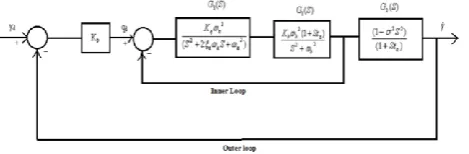
The autopilot uses one accelerometer and one rate gyro [1]. The flight path rate demand autopilot is shown in Fig. 1. The transfer function which forms the basis for this two loop autopilot configuration are G3(S), G1(S) and
G2(S). Thus, the autopilot configuration in Fig. 1 is a
modified form and is of flight path rate demand type instead of the conventional configuration with a lateral acceleration demand.
transfer function and G3(s) represents the second order
actuator. Kp is the control gain,
d is the input to theautopilot and
is the output of the autopilot.Figure 1. Block diagram of two loop missile autopilot in pitch plane Autopilot system design parameters: The autopilot system design parameters for the missile have been given in this Table I.
TABLEI. VALUES OF THE PARAMETERS
Parameters Case 1 Case2
ta 2.85 sec 0.36 sec
ωb 5.6 rad/sec 11.77 rad/sec
σ2 0.00142 sec2 0.00029 sec2
mη -12.84 sec-2 -53.0 sec-2
ωa 180 rad/sec 180 rad/sec
ξa 0.6 0.6
Kb -0.1437 sec-1 -9.91 sec-1
U 3000 m/s 470 m/s
All results have been obtained by MATLAB simulation using the parameter values and the transfer functions are
) 36 . 31 (
) 506432 . 4 8433 . 12 ( ) 1 ( )
( 2 2 2
2
1
S S S
St K
S G
b a b b
32400 216
55728
) 2
( )
( 2 2
2
2
3
S S S
S K S
G
a a a
a q
A. State Feedback Autopilot Design 1) Autopilot in incomplete state feedback
Since the state variable ἠ (fin rate) is assumed to be not available, an incomplete state feedback controller has been designed in Fig. 2 which uses a linear combination of the output and the two available state variables only to meet the desired autopilot specification in terms of gain margin and phase margin and a unity steady state gain. Therefore, three control gains have been used to move the closed loop poles to any desired locations.
Poles assignment: Denoting the chosen closed-loop pole locations as
S 1,2 = – a ± jb (dominant poles),
S 3,4= –c ± jd (faster poles),
The desired characteristic equation is
S4+d3S3+d2S2+d1S+d0=0
[from the equation 1+G(S)H(S)=0] (1) where,
(2) )
85 . 2 1 (
) 00142 . 0 1 ( ) 1 (
) 1
( ) (
2 2
2 2
S S St
S S
G
a
216 ) 2 2 (
3 a c
d
4 2
2 2 2
2(a b c d 4ac)1.536010
d (3)
5 2
2 2
2
1 (2a c2b c2ac 2ad )4.716610
d (4)
6 2
2 2 2
0 (a b )(c d )5.578610
d (5)
where,
18
6
a a
a
90 6
5
a a
c
8759 . 18 ) ln(
6
p a a
M
b
10
d
The control gain matrix KT = [k1 k2 k3 k4] may be
obtain from Ackermann’s formula once the desired closed loop poles are specified. The elements of the control gain matrix in terms of aerodynamic parameters and the actuator parameters are given as
0 a
1
(d - t -2 ) -
-k
(1 ) 0.0084
a a b a b
s q a a b
a b d d
t
(6)
) (
) 2 (
2 3
2
a q s
a a
K K d k
(7)
258 . 0 ) 2
(
2 2
2 1
3
a b a b q s
b a a
t K
K K
d k
(8)
0 2
4 2
(d - -2 -
-(1 0.8501
a b a a a b a b a b
s q b a b a b
t d d t
k
t
(9)
Shifting of the closed-loop poles can be effected without implementing any feedback from the state by choosing
a a
d3 2 in
) (
) 2 (
2 3
2
a q s
a a
K K d k
Such that the control gain k2=0 for all operating
conditions.
Now the configuration of the incomplete state feedback controller:
s 1 2 3
1 s 3 3 s 1 3 4 s 1 2 3
2 2 2 2
s b q a b
4 3 2 2 2 2
1
2 2 2 2
4
2 2 2 2 2 2
3 1
2 2 2 2
3 4
K G G G
1 k K G k K G G k K G G G
K K K (1- )
2 (
) (2
) (
)
d
a a a b s b q a
s b q a b a a b
s b q a b a a b s q a b
s b q a b s b q a b
S
S S S k K K K
k K K K S
k K K K t k K K
k K K K k K K K
(10)
Once the state feedback control gains are known for a given set of aerodynamic data and actuator dynamics, the GM and PM of the designed autopilot can be evaluated by opening the autopilot loop in pitch plane using the resulting open loop transfer function
) )(S S (S ) c S c S (c G(S) 2 b 2 2 a a a 2 0 1 2 2
(11)
where,
0
c a b s q s q b s q b
(12)
3 s q b b
1 k K K K
c a ta (13)
)
( 1 2 4 2 2 2
2 k KsKqa k KsKqKba b
c (14)
0 0.05 0.1 0.15 0.2 0.25 0.3
-0.8 -0.6 -0.4 -0.2 0 0.2 0.4 0.6 0.8 1 1.2 Step Response Time (sec) A m p lit u d e
Figure 3. Time response of the autopilot in incomplete state feedback
-100 -50 0 50 100 150 200 M a g n it u d e ( d B )
10-1 100 101 102 103 104
0 90 180 270 360 450 P h a s e ( d e g ) Bode Diagram
Gm = 11.9 dB (at 86.5 rad/sec) , Pm = 42.2 deg (at 18.5 rad/sec)
Frequency (rad/sec)
Figure 4. Bode plot of the autopilot in incomplete state feedback
TABLE II. GAIN MARGIN AND PHASE MARGIN OF THE AUTOPILOT IN
INCOMPLETE STATE FEEDBACK
Gain Margin Phase Margin Gain Crossover Frequency Phase Crossover Frequency 11.9 dB 42.2 deg 86.5 rad/sec 18.5 rad/sec
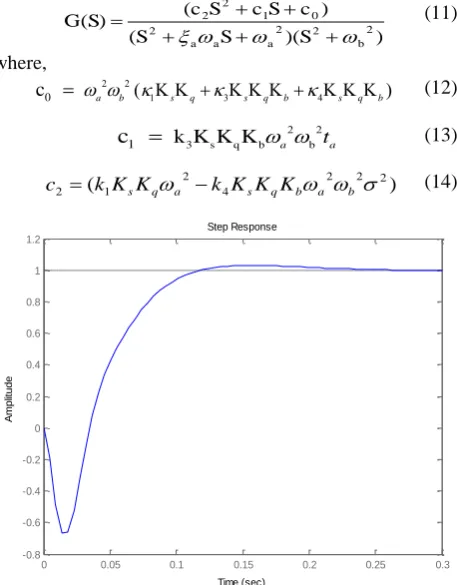
Performance study:To evaluate the performance of the incomplete state feedback controller, the time domain analysis in Fig. 3 and the bode plot in Fig. 4 with the nominal values have been done and in Table II Gain margin and Phase margin has been shown.
The time response of the autopilot system with the nominal values of the parameters:
Discussion: In case of incomplete state feedback controller the time response is obtained in Fig. 3. Due to non minimum phase zero, an initial negative flight path rate is obtained in missile time response. Here the
Peak response=1.18 at 0.13 sec Settling time=0.215 sec Rise time=0.08 sec
The frequency domain analysis of the autopilot system with the nominal values of the parameters:
For analysis the stability of the incomplete state feedback controller, bode plot has been done.
So we can conclude that the system is stable. 2) Autopilot in complete state feedback
The performance of the incomplete state feedback controller has been studied. Now the feedback contribution of the fin rate () has been added with associated gain k2 to investigate the change in autopilot
performance. The control gains are k1, k2, k3and k4. The
block diagram has been represented in Fig.5. Complete state feedback configuration:
Figure 5. Block diagram of an autopilot in complete state feedback Transfer function:The closed-loop transfer function of the autopilot with state feedback is
) ( ) 2 ( ) ( ) 2 ( ) 1 ( ) 1 ( 2 2 4 2 2 3 2 2 1 2 2 2 2 3 2 2 2 2 2 2 2 4 2 1 2 2 2 2 2 3 4 2 2 2 2 3 2 1 4 3 1 3 3 2 3 1 3 2 1 b a q b s b a q b s b a q s b a a b a q b s b a q s b a a b a q b s a q s b a a q s a a b a q b s s s s s d K K K k K K K k K K k t K K K k K K k S K K K k K K k S K K k S S S K KsK G G G K k G G K k G K Sk G K k G G G K (15)
Poles assignment: The closed-loop poles using the relations developed in [2], are:
S3,4 = – c ± jd (faster poles),
The desired characteristic equation is
0 0 1 2 2 3 3
4
d S d S d S d S where,
250
3
d (16)
4 2
2 2 2
2 (a b c d 4ac)1.536010
d (17)
5 2
2 2 2
1(2a c2b c2ac 2ad )4.716610
d (18)
6 2
2 2 2
0 (a b )(c d )5.578610
d (19)
where,
18
6
a a
a
90 6
5
a a
c
8759 . 18 ) ln(
6
p a a
M
b
180
d
Here, the control law is U=-Kx. The state feedback gain yields the closed loop poles, (- a+jb, -a-jb, -c+jd, -c-jd) can be obtained.
The control gain matrix
4 3 2
1 k k k
k
KT , may be
obtain once the desired closed loop poles are specified [2]. The element of the control gain matrix in terms of aerodynamic parameters, actuator parameters and the coefficients of the desired characteristic equations are given as [2],
) 1 (
) 2
-) 2 -t -(d
2 2 2 a
2 0 1
b t K K
d t d
d b k
a a q s
b a a a b a b
a a a
=-0.0082 (20)
6 2
3
2 5.5610 10
) (
) 2
(
a q s
a a
K K d k
(21)
0200 . 0 2
) 2 ( ) 2 (
2
2 3
1
3
a b a b q s
b a a a
a
t K
K K
d d
k
(22)
2 2 2 2
0 1 2
4 2 2 2 2
( ) ( 2 ) ( 2 )
(1 )
0.8863
a b a a a b a a b s q b a b a b
d t d d
k
K K K t
(23)
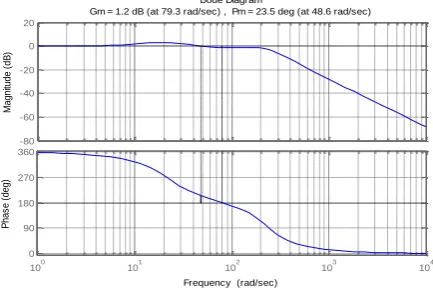
Performance study:To evaluate the performance of the complete state feedback controller, we have done the time domain analysis in Fig. 6 and frequency domain analysis in Fig. 7. The complete analysis of gain margin and phase margin has been represented in Table III.
The time response of the autopilot with the nominal values of the parameters:
Discussion: In case of complete state feedback controller we can achieve this time response. Due to non minimum phase zero the plot has been dripped in the negative y axis.
From the response we can get these characteristics Peak response=1.2 at 0.15 sec
Settling time=0.24 sec
Rise time=0.09 sec
The frequency domain analysis of the autopilot with the nominal values of the parameters:
For stability analysis bode plot has been done here. So we can say that the system is stable.
0 0.05 0.1 0.15 0.2 0.25 0.3 0.35
-0.8 -0.6 -0.4 -0.2 0 0.2 0.4 0.6 0.8 1 1.2
Step Response
Time (sec)
A
m
pl
itu
de
Figure 6. Time response of theautopilot in complete state feedback
-80 -60 -40 -20 0 20
M
a
g
n
itu
d
e
(
d
B
)
100 101 102 103 104
0 90 180 270 360
P
h
a
s
e
(
d
e
g
)
Bode Diagram
Gm = 1.2 dB (at 79.3 rad/sec) , Pm = 23.5 deg (at 48.6 rad/sec)
Frequency (rad/sec)
Figure 7. Bode plot of theautopilot in complete state feedback
TABLE III. GAIN MARGIN AND PHASE MARGIN OF THE AUTOPILOT IN
COMPLETE STATE FEEDBACK
Gain Margin
Phase Margin
Gain Crossover Frequency
Phase Crossover Frequency 1.2 dB 23.5 deg 79.3 rad/sec 48.6 rad/sec
B. Comparison between Two State Feedback Controllers
After the study of the performances we have gathered some results of the time response as well as frequency response. The design objective was to achieve the desired stability margins (GM>=6dB and PM>=40 degree). Here gain margins and phase margins of incomplete state feedback controller and complete state feedback controller are GM=11.9dB, PM=42.2degree and GM=1.2dB, PM=23.5 degree respectively.
So in case of frequency response we can say that the gain margin and phase margin of incomplete state feedback controller satisfies the desired condition.
response=1.2 at 0.15 sec, settling time=0.24 sec, rise time=0.09 sec.
It is observed that the significant response characteristics match with incomplete state feedback. As it produces a response with slightly improved settling time and rise time, selection of incomplete state feedback controller is better.
III. CONCLUSION
The performance of incomplete state feedback controller as well as the complete state feedback controller has been studied for a typical operating point. It is observed that the value of control gain k2was found
to be negligible compared to the value of the gains k1, k3,
k4.
Thus, the choice of an incomplete state feedback configuration and not employing a sensor of measuring the fin rate is justified.
It is observed that the significant response characteristics clearly match and the control with incomplete state feedback produces a response with slightly improved settling time and rise time. Thus a simplified structure of autopilot has an acceptable performance.
The incomplete state feedback controller without fin rate feedback eliminates the need for an observer system to provide estimation for the unavailable . A cost effective design with a slower actuator might be achieved for a specified operating point using a modified state feedback controller without implementation of fin position feedback. It is interesting to note that a closed loop actuator with feedback gain k2 produces a reduced
speed of response in the closed loop.
a
Damping ratio of actuator.
A quantity whose inverse determines the Location
d
Missile flight path rate demanded, rad/sec.
a
Natural frequency of oscillation of actuator, rad/sec.
b
Weathercock frequency, rad/sec.
d
Missile flight path demanded, rad.w
m Moment derivative due to pitch incidence α,
m–1sec–1.
m Moment derivative due to elevator deflection, sec–2.
Z Force derivative due to elevator, m sec–2
w
Z Force derivative due to incidence α, sec–1
REFERANCES
[1] G. Das, K. Dutta, T. K. Ghoshal, and S. K. Goswami, “Structured design methodology of missile autopilot,” Journal of the
Institution of Engineers (India)-AS, vol. 76, pp. 49-59, Mar. 1996.
[2] R. K. Meheta, K. Dutta, and S. K. Goswami, “On incomplete state feedback design of missile autopilot in pitch plane,” Journal of the
Institution of Engineers (India)-AS, vol. 87, pp. 17-23, May 2006.
[3] R. K. Meheta, K. Dutta, and S. K. Goswami “An observer-based lateral autopilot for tail-controlled missiles,” Journal of the
Institution of Engineers (India)-EL, vol. 88, pp. 15-23, Sep. 2007.
[4] F. Wu, A. Packard, and G, Balas, “Systematic gain scheduling control design: A missile autopilot example,” Asian Journal, vol. 4, pp. 341-347, Sep. 2002.
[5] S. M. Disney, M. M Naim, and D. R. Towill, “Genetic algorithm optimization of a class of inventory control systems,” Int. J. Production Economics, vol. 68, pp. 259-278, 2000.
[6] M, Xin and S. N. Balakrishnan, “Nonlinear missile autopilot design with Ɵ-D technique,” University of Missouri-Rolla, Rolla, MO 65409, pp. 1-38.
The article does not take into account the effects of various nonlinearities and delays introduced by sampling and computation. However, the control gains obtained by using the proposed design cycle may be employed as initial guess values for design of autopilot in the presence of nonlinearities.
APPENDIX NOTATIONS
Parameters Name of the parameters Kb Airframe aerodynamic gain, sec-1 Mp Peak overshoot.
Kp Lateral autopilot control gain outer loop. q Missile body rate in pitch, rad/sec. qd Missile body rate demanded in pitch, rad/sec. Kq Fin servo gain, sec-1.
ta Incidence lags of airframe, sec. Ks Forward path gain is state feedback design
Elevator deflection, rad.
Elevator deflection rate, rad/sec.
Missile flight path rate, rad/sec.
Mrs. Sanjukta Dey received B.Tech in Electrical Engineering from Siliguri Institute of Technology, Siliguri, India in 2009 and also received M.Tech in the specialization of Control & Instrumentation from Netaji Subhas Engineering College, Kolkata, India in 2011. Presently she is working as Assistant Professor at Siliguri Institute of Technology, Siliguri since2011. Her present research of interests includes Control Systems Engineering, Non-Linear Dynamics, Fuzzy logic etc.