
VOLUME NO. 8 (2018), ISSUE NO. 07 (JULY)
ISSN
2231-5756
A Monthly Double-Blind Peer Reviewed (Refereed/Juried) Open Access International e-Journal - Included in the International Serial Directories Indexed & Listed at:
Ulrich's Periodicals Directory ©, ProQuest, U.S.A., EBSCO Publishing, U.S.A., Cabell’s Directories of Publishing Opportunities, U.S.A., Google Scholar, Indian Citation Index (ICI), J-Gage, India [link of the same is duly available at Inflibnet of University Grants Commission (U.G.C.)],
Index Copernicus Publishers Panel, Poland with IC Value of 5.09 (2012) & number of libraries all around the world.
VOLUME NO. 8 (2018), ISSUE NO. 07 (JULY)
ISSN
2231-5756
CONTENTS
Sr.
No.
TITLE & NAME OF THE AUTHOR (S)
Page
No.
1. OFFICE TECHNOLOGY AND MANAGEMENT (OTM) AND ENTREPRENEURIAL
SKILLS POSSESSED BY BUSINESS EDUCATION STUDENTS IN COLLEGES OF
EDUCATION FOR MANAGEMENT OF SMALL SCALE BUSINESSES IN
ADAMAWA STATE
Dr. TITUS AMODU UMORU & YAKUBU BALA (MABEN)
1
2. INDIAN BANKING AN URGE ON A RETAIL DRIVE: THE CHALLENGES AND THE
OPPORTUNITIES OF INDIAN BANKING SYSTEM - A DESCRIPTIVE STUDY
K. VINAYA LAXMI, P. VIJAY KUMAR & M.S. NARAYANA
7
3. A RISK-RETURN ANALYSIS ON OPTIMUM PORTFOLIO OF VARIOUS ASSET
CLASSES
T. DEVA PRASAD & C. CHAITANYA
10
4. A STUDY OF PRINTING INDUSTRY EMPLOYEES INCOME AND EXPERIENCE
A. CHELLADURAI & S. R. SEENIVASAN
17
5. A STUDY ON THE IMPACT OF DEMONETISATION AMONG PUBLIC
JUMAILA.K
22
6. IMPACT OF CORPORATE SOCIAL RESPONSIBILITY ON HIGHER EDUCATION IN
INDIA
DIPAK KARMAKAR
24
VOLUME NO. 8 (2018), ISSUE NO. 07 (JULY)
ISSN
2231-5756
CHIEF PATRON
Prof. (Dr.) K. K. AGGARWAL
Chairman, Malaviya National Institute of Technology, Jaipur
(An institute of National Importance & fully funded by Ministry of Human Resource Development, Government of India)
Chancellor, K. R. Mangalam University, Gurgaon
Chancellor, Lingaya’s University, Faridabad
Founder Vice-Chancellor (1998-2008), Guru Gobind Singh Indraprastha University, Delhi
Ex. Pro Vice-Chancellor, Guru Jambheshwar University, Hisar
FOUNDER PATRON
Late Sh. RAM BHAJAN AGGARWAL
Former State Minister for Home & Tourism, Government of Haryana
Former Vice-President, Dadri Education Society, Charkhi Dadri
Former President, Chinar Syntex Ltd. (Textile Mills), Bhiwani
CO-ORDINATOR
Dr. BHAVET
Former Faculty, Shree Ram Institute of Engineering & Technology, Urjani
ADVISOR
Prof. S. L. MAHANDRU
Principal (Retd.), Maharaja Agrasen College, Jagadhri
EDITOR
Dr. PARVEEN KUMAR
Professor, Department of Computer Science, NIMS University, Jaipur
CO-EDITOR
Dr. A. SASI KUMAR
Professor, Vels Institute of Science, Technology & Advanced Studies (Deemed to be University), Pallavaram
EDITORIAL ADVISORY BOARD
Dr. S. P. TIWARI
Head, Department of Economics & Rural Development, Dr. Ram Manohar Lohia Avadh University, Faizabad
Dr. CHRISTIAN EHIOBUCHE
Professor of Global Business/Management, Larry L Luing School of Business, Berkeley College, USA
Dr. SIKANDER KUMAR
Chairman, Department of Economics, Himachal Pradesh University, Shimla, Himachal Pradesh
Dr. JOSÉ G. VARGAS-HERNÁNDEZ
Research Professor, University Center for Economic & Managerial Sciences, University of Guadalajara,
Guadala-jara, Mexico
Dr. M. N. SHARMA
Chairman, M.B.A., Haryana College of Technology & Management, Kaithal
Dr. TEGUH WIDODO
Dean, Faculty of Applied Science, Telkom University, Bandung Technoplex, Jl. Telekomunikasi, Indonesia
Dr. M. S. SENAM RAJU
Professor, School of Management Studies, I.G.N.O.U., New Delhi
Dr. A SAJEEVAN RAO
Professor & Director, Accurate Institute of Advanced Management, Greater Noida
Dr. D. S. CHAUBEY
Professor & Dean (Research & Studies), Uttaranchal University, Dehradun
Dr. CLIFFORD OBIYO OFURUM
VOLUME NO. 8 (2018), ISSUE NO. 07 (JULY)
ISSN
2231-5756
Dr. KAUP MOHAMED
Dean & Managing Director, London American City College/ICBEST, United Arab Emirates
Dr. VIRENDRA KUMAR SHRIVASTAVA
Director, Asia Pacific Institute of Information Technology, Panipat
SUNIL KUMAR KARWASRA
Principal, Aakash College of Education, ChanderKalan, Tohana, Fatehabad
Dr. MIKE AMUHAYA IRAVO
Principal, Jomo Kenyatta University of Agriculture & Tech., Westlands Campus, Nairobi-Kenya
Dr. SYED TABASSUM SULTANA
Principal, Matrusri Institute of Post Graduate Studies, Hyderabad
Dr. BOYINA RUPINI
Director, School of ITS, Indira Gandhi National Open University, New Delhi
Dr. NEPOMUCENO TIU
Chief Librarian & Professor, Lyceum of the Philippines University, Laguna, Philippines
Dr. SANJIV MITTAL
Professor & Dean, University School of Management Studies, GGS Indraprastha University, Delhi
Dr. RAJENDER GUPTA
Convener, Board of Studies in Economics, University of Jammu, Jammu
Dr. SHIB SHANKAR ROY
Professor, Department of Marketing, University of Rajshahi, Rajshahi, Bangladesh
Dr. ANIL K. SAINI
Professor, Guru Gobind Singh Indraprastha University, Delhi
Dr. SRINIVAS MADISHETTI
Professor, School of Business, Mzumbe University, Tanzania
Dr. NAWAB ALI KHAN
Professor & Dean, Faculty of Commerce, Aligarh Muslim University, Aligarh, U.P.
MUDENDA COLLINS
Head, Operations & Supply Chain, School of Business, The Copperbelt University, Zambia
Dr. EGWAKHE A. JOHNSON
Professor & Director, Babcock Centre for Executive Development, Babcock University, Nigeria
Dr. A. SURYANARAYANA
Professor, Department of Business Management, Osmania University, Hyderabad
P. SARVAHARANA
Asst. Registrar, Indian Institute of Technology (IIT), Madras
Dr. MURAT DARÇIN
Associate Dean, Gendarmerie and Coast Guard Academy, Ankara, Turkey
Dr. ABHAY BANSAL
Head, Department of Information Technology, Amity School of Engg. & Tech., Amity University, Noida
Dr. YOUNOS VAKIL ALROAIA
Head of International Center, DOS in Management, Semnan Branch, Islamic Azad University, Semnan, Iran
WILLIAM NKOMO
Asst. Head of the Department, Faculty of Computing, Botho University, Francistown, Botswana
Dr. JAYASHREE SHANTARAM PATIL (DAKE)
Faculty in Economics, KPB Hinduja College of Commerce, Mumbai
SHASHI KHURANA
Associate Professor, S. M. S. Khalsa Lubana Girls College, Barara, Ambala
Dr. SEOW TA WEEA
Associate Professor, Universiti Tun Hussein Onn Malaysia, Parit Raja, Malaysia
Dr. OKAN VELI ŞAFAKLI
Professor & Dean, European University of Lefke, Lefke, Cyprus
Dr. MOHENDER KUMAR GUPTA
VOLUME NO. 8 (2018), ISSUE NO. 07 (JULY)
ISSN
2231-5756
Dr. BORIS MILOVIC
Associate Professor, Faculty of Sport, Union Nikola Tesla University, Belgrade, Serbia
Dr. LALIT KUMAR
Faculty, Haryana Institute of Public Administration, Gurugram
Dr. MOHAMMAD TALHA
Associate Professor, Department of Accounting & MIS, College of Industrial Management, King Fahd University
of Petroleum & Minerals, Dhahran, Saudi Arabia
Dr. V. SELVAM
Associate Professor, SSL, VIT University, Vellore
Dr. IQBAL THONSE HAWALDAR
Associate Professor, College of Business Administration, Kingdom University, Bahrain
Dr. PARDEEP AHLAWAT
Associate Professor, Institute of Management Studies & Research, Maharshi Dayanand University, Rohtak
Dr. ALEXANDER MOSESOV
Associate Professor, Kazakh-British Technical University (KBTU), Almaty, Kazakhstan
Dr. ASHOK KUMAR CHAUHAN
Reader, Department of Economics, Kurukshetra University, Kurukshetra
Dr. BHAVET
Former Faculty, Shree Ram Institute of Engineering & Technology, Urjani
YU-BING WANG
Faculty, department of Marketing, Feng Chia University, Taichung, Taiwan
SURJEET SINGH
Faculty, Department of Computer Science, G. M. N. (P.G.) College, Ambala Cantt.
Dr. MELAKE TEWOLDE TECLEGHIORGIS
Faculty, College of Business & Economics, Department of Economics, Asmara, Eritrea
Dr. RAJESH MODI
Faculty, Yanbu Industrial College, Kingdom of Saudi Arabia
Dr. SAMBHAVNA
Faculty, I.I.T.M., Delhi
Dr. THAMPOE MANAGALESWARAN
Faculty, Vavuniya Campus, University of Jaffna, Sri Lanka
Dr. SHIVAKUMAR DEENE
Faculty, Dept. of Commerce, School of Business Studies, Central University of Karnataka, Gulbarga
SURAJ GAUDEL
BBA Program Coordinator, LA GRANDEE International College, Simalchaur - 8, Pokhara, Nepal
FORMER TECHNICAL ADVISOR
AMITA
FINANCIAL ADVISORS
DICKEN GOYAL
Advocate & Tax Adviser, Panchkula
NEENA
Investment Consultant, Chambaghat, Solan, Himachal Pradesh
LEGAL ADVISORS
JITENDER S. CHAHAL
Advocate, Punjab & Haryana High Court, Chandigarh U.T.
CHANDER BHUSHAN SHARMA
Advocate & Consultant, District Courts, Yamunanagar at Jagadhri
SUPERINTENDENT
VOLUME NO. 8 (2018), ISSUE NO. 07 (JULY)
ISSN
2231-5756
CALL FOR MANUSCRIPTS
We invite unpublished novel, original, empirical and high quality research work pertaining to the recent developments & practices in the areas of Com-puter Science & Applications; Commerce; Business; Finance; Marketing; Human Resource Management; General Management; Banking; Economics; Tourism Administration & Management; Education; Law; Library & Information Science; Defence & Strategic Studies; Electronic Science; Corporate Gov-ernance; Industrial Relations; and emerging paradigms in allied subjects like Accounting; Accounting Information Systems; Accounting Theory & Practice; Auditing; Behavioral Accounting; Behavioral Economics; Corporate Finance; Cost Accounting; Econometrics; Economic Development; Economic History; Financial Institutions & Markets; Financial Services; Fiscal Policy; Government & Non Profit Accounting; Industrial Organization; International Economics & Trade; International Finance; Macro Economics; Micro Economics; Rural Economics; Co-operation; Demography: Development Planning; Development Studies; Applied Economics; Development Economics; Business Economics; Monetary Policy; Public Policy Economics; Real Estate; Regional Economics; Political Science; Continuing Education; Labour Welfare; Philosophy; Psychology; Sociology; Tax Accounting; Advertising & Promotion Management; Management Information Systems (MIS); Business Law; Public Responsibility & Ethics; Communication; Direct Marketing; E-Commerce; Global Business; Health Care Administration; Labour Relations & Human Resource Management; Marketing Research; Marketing Theory & Applications; Non-Profit Or-ganizations; Office Administration/Management; Operations Research/Statistics; Organizational Behavior & Theory; Organizational Development; Pro-duction/Operations; International Relations; Human Rights & Duties; Public Administration; Population Studies; Purchasing/Materials Management; Re-tailing; Sales/Selling; Services; Small Business Entrepreneurship; Strategic Management Policy; Technology/Innovation; Tourism & Hospitality; Transpor-tation Distribution; Algorithms; Artificial Intelligence; Compilers & Translation; Computer Aided Design (CAD); Computer Aided Manufacturing; Computer Graphics; Computer Organization & Architecture; Database Structures & Systems; Discrete Structures; Internet; Management Information Systems; Mod-eling & Simulation; Neural Systems/Neural Networks; Numerical Analysis/Scientific Computing; Object Oriented Programming; Operating Systems; Pro-gramming Languages; Robotics; Symbolic & Formal Logic; Web Design and emerging paradigms in allied subjects.
Anybody can submit the soft copy of unpublished novel; original; empirical and high quality research work/manuscript anytime in M.S. Word format after preparing the same as per our GUIDELINES FOR SUBMISSION; at our email address i.e. [email protected] or online by clicking the link online
submission as given on our website (FOR ONLINE SUBMISSION, CLICK HERE).
GUIDELINES FOR SUBMISSION OF MANUSCRIPT
1. COVERING LETTER FOR SUBMISSION:
DATED: _____________
THE EDITOR
IJRCM
Subject: SUBMISSION OF MANUSCRIPT IN THE AREA OF______________________________________________________________.
(e.g. Finance/Mkt./HRM/General Mgt./Engineering/Economics/Computer/IT/ Education/Psychology/Law/Math/other, please specify)
DEAR SIR/MADAM
Please find my submission of manuscript titled ‘___________________________________________’ for likely publication in one of your journals.
I hereby affirm that the contents of this manuscript are original. Furthermore, it has neither been published anywhere in any language fully or partly, nor it is under review for publication elsewhere.
I affirm that all the co-authors of this manuscript have seen the submitted version of the manuscript and have agreed to inclusion of their names as co-authors.
Also, if my/our manuscript is accepted, I agree to comply with the formalities as given on the website of the journal. The Journal has discretion to publish our contribution in any of its journals.
NAME OF CORRESPONDING AUTHOR :
Designation/Post* :
Institution/College/University with full address & Pin Code :
Residential address with Pin Code :
Mobile Number (s) with country ISD code :
Is WhatsApp or Viber active on your above noted Mobile Number (Yes/No) :
Landline Number (s) with country ISD code :
E-mail Address :
Alternate E-mail Address :
Nationality :
* i.e. Alumnus (Male Alumni), Alumna (Female Alumni), Student, Research Scholar (M. Phil), Research Scholar (Ph. D.), JRF, Research Assistant, Assistant Lecturer, Lecturer, Senior Lecturer, Junior Assistant Professor, Assistant Professor, Senior Assistant Professor, Co-ordinator, Reader, Associate Profes-sor, ProfesProfes-sor, Head, Vice-Principal, Dy. Director, Principal, Director, Dean, President, Vice Chancellor, Industry Designation etc. The qualification of
VOLUME NO. 8 (2018), ISSUE NO. 07 (JULY)
ISSN
2231-5756
NOTES:
a) The whole manuscript has to be in ONE MS WORD FILE only, which will start from the covering letter, inside the manuscript. pdf.
version is liable to be rejected without any consideration.
b) The sender is required to mention the following in the SUBJECT COLUMN of the mail:
New Manuscript for Review in the area of (e.g. Finance/Marketing/HRM/General Mgt./Engineering/Economics/Computer/IT/ Education/Psychology/Law/Math/other, please specify)
c) There is no need to give any text in the body of the mail, except the cases where the author wishes to give any specific message
w.r.t. to the manuscript.
d) The total size of the file containing the manuscript is expected to be below 1000 KB.
e) Only the Abstract will not be considered for review and the author is required to submit the complete manuscript in the first
instance.
f) The journal gives acknowledgement w.r.t. the receipt of every email within twenty-four hours and in case of non-receipt of
acknowledgment from the journal, w.r.t. the submission of the manuscript, within two days of its submission, the corresponding author is required to demand for the same by sending a separate mail to the journal.
g) The author (s) name or details should not appear anywhere on the body of the manuscript, except on the covering letter and the
cover page of the manuscript, in the manner as mentioned in the guidelines.
2. MANUSCRIPT TITLE: The title of the paper should be typed in bold letters, centered and fully capitalised.
3. AUTHOR NAME (S) & AFFILIATIONS: Author (s) name, designation, affiliation (s), address, mobile/landline number (s), and
email/al-ternate email address should be given underneath the title.
4. ACKNOWLEDGMENTS: Acknowledgements can be given to reviewers, guides, funding institutions, etc., if any.
5. ABSTRACT: Abstract should be in fully Italic printing, ranging between 150 to 300 words. The abstract must be informative and
eluci-dating the background, aims, methods, results & conclusion in a SINGLE PARA. Abbreviations must be mentioned in full.
6. KEYWORDS: Abstract must be followed by a list of keywords, subject to the maximum of five. These should be arranged in alphabetic
order separated by commas and full stop at the end. All words of the keywords, including the first one should be in small letters, except special words e.g. name of the Countries, abbreviations etc.
7. JEL CODE: Provide the appropriate Journal of Economic Literature Classification System code (s). JEL codes are available at
www.aea-web.org/econlit/jelCodes.php. However, mentioning of JEL Code is not mandatory.
8. MANUSCRIPT: Manuscript must be in BRITISH ENGLISH prepared on a standard A4 size PORTRAIT SETTING PAPER. It should be free
from any errors i.e. grammatical, spelling or punctuation. It must be thoroughly edited at your end.
9. HEADINGS: All the headings must be bold-faced, aligned left and fully capitalised. Leave a blank line before each heading.
10. SUB-HEADINGS: All the sub-headings must be bold-faced, aligned left and fully capitalised.
11. MAIN TEXT:
THE MAIN TEXT SHOULD FOLLOW THE FOLLOWING SEQUENCE:
INTRODUCTION REVIEW OF LITERATURE
NEED/IMPORTANCE OF THE STUDY STATEMENT OF THE PROBLEM OBJECTIVES
HYPOTHESIS (ES)
RESEARCH METHODOLOGY RESULTS & DISCUSSION FINDINGS
RECOMMENDATIONS/SUGGESTIONS CONCLUSIONS
LIMITATIONS
SCOPE FOR FURTHER RESEARCH REFERENCES
APPENDIX/ANNEXURE
VOLUME NO. 8 (2018), ISSUE NO. 07 (JULY)
ISSN
2231-5756
12. FIGURES & TABLES: These should be simple, crystal CLEAR, centered, separately numbered & self-explained, and the titles must be
above the table/figure. Sources of data should be mentioned below the table/figure. It should be ensured that the tables/figures are
referred to from the main text.
13. EQUATIONS/FORMULAE: These should be consecutively numbered in parenthesis, left aligned with equation/formulae number placed
at the right. The equation editor provided with standard versions of Microsoft Word may be utilised. If any other equation editor is utilised, author must confirm that these equations may be viewed and edited in versions of Microsoft Office that does not have the editor.
14. ACRONYMS: These should not be used in the abstract. The use of acronyms is elsewhere is acceptable. Acronyms should be defined
on its first use in each section e.g. Reserve Bank of India (RBI). Acronyms should be redefined on first use in subsequent sections.
15. REFERENCES: The list of all references should be alphabetically arranged. The author (s) should mention only the actually utilised
references in the preparation of manuscript and they may follow Harvard Style of Referencing. Also check to ensure that everything
that you are including in the reference section is duly cited in the paper. The author (s) are supposed to follow the references as per the following:
All works cited in the text (including sources for tables and figures) should be listed alphabetically.
Use (ed.) for one editor, and (ed.s) for multiple editors.
When listing two or more works by one author, use --- (20xx), such as after Kohl (1997), use --- (2001), etc., in chronologically ascending order.
Indicate (opening and closing) page numbers for articles in journals and for chapters in books.
The title of books and journals should be in italic printing. Double quotation marks are used for titles of journal articles, book chapters, dissertations, reports, working papers, unpublished material, etc.
For titles in a language other than English, provide an English translation in parenthesis.
Headers, footers, endnotes and footnotes should not be used in the document. However, you can mention short notes to elucidate
some specific point, which may be placed in number orders before the references.
PLEASE USE THE FOLLOWING FOR STYLE AND PUNCTUATION IN REFERENCES: BOOKS
Bowersox, Donald J., Closs, David J., (1996), "Logistical Management." Tata McGraw, Hill, New Delhi.
Hunker, H.L. and A.J. Wright (1963), "Factors of Industrial Location in Ohio" Ohio State University, Nigeria. CONTRIBUTIONS TO BOOKS
Sharma T., Kwatra, G. (2008) Effectiveness of Social Advertising: A Study of Selected Campaigns, Corporate Social Responsibility, Edited by David Crowther & Nicholas Capaldi, Ashgate Research Companion to Corporate Social Responsibility, Chapter 15, pp 287-303. JOURNAL AND OTHER ARTICLES
Schemenner, R.W., Huber, J.C. and Cook, R.L. (1987), "Geographic Differences and the Location of New Manufacturing Facilities," Jour-nal of Urban Economics, Vol. 21, No. 1, pp. 83-104.
CONFERENCE PAPERS
Garg, Sambhav (2011): "Business Ethics" Paper presented at the Annual International Conference for the All India Management Asso-ciation, New Delhi, India, 19–23
UNPUBLISHED DISSERTATIONS
Kumar S. (2011): "Customer Value: A Comparative Study of Rural and Urban Customers," Thesis, Kurukshetra University, Kurukshetra.
ONLINE RESOURCES
Always indicate the date that the source was accessed, as online resources are frequently updated or removed. WEBSITES
VOLUME NO. 8 (2018), ISSUE NO. 07 (JULY)
ISSN
2231-5756
OFFICE TECHNOLOGY AND MANAGEMENT (OTM) AND ENTREPRENEURIAL SKILLS POSSESSED BY
BUSINESS EDUCATION STUDENTS IN COLLEGES OF EDUCATION FOR MANAGEMENT OF SMALL SCALE
BUSINESSES IN ADAMAWA STATE
Dr. TITUS AMODU UMORU
PROFESSOR & HEAD
DEPARTMENT OF BUSINESS AND ENTREPRENEURSHIP EDUCATION
KWARA STATE UNIVERSITY
MALETE
YAKUBU BALA (MABEN)
LECTURER
DEPARTMENT OF BUSINESS MANAGEMENT
ADAMAWA STATE POLYTECHNIC
YOLA
ABSTRACT
The study was conducted to assessd Office Technology and Management (OTM) and Entrepreneurial skills possessed by business education students in Colleges of Education for the managment of small scale business in Adamawa State. Descriptive survey design was adopted for the study. The entire 189 final year students of business education from the two collges of education formed the population and sample of the study. A 4-point likert rating scale with a structured constructs containing 31 items was used to elicit responses from the respondents. Cronbach Alpha relaibility method was used to determine the internal consistency of the instrument which yielded reliability co-efficient of 0.87. The data collected were anlaysed using mean and standard deviation to answer the reserarch questions while t-test was used to test the null hypothesis of no signifant difference at 0.05 level of significance. The findings of the study revealed, among others, that office technology and management and entreprenuership skills are moderately possessed and that all the skills are highly required by both male and female students for effective management of small scale businesses. The study concluded that these skills if possessed will make business education graduagtes better prepared to take up jobs in organizatins and perform satisfactorily or be self-employed by establishing small and medium businesses. Therefore, recoommendatins were made, among others, that the study of Office technology and management should be encouraged by all stakeholders, as it is geared towards skill acquisition, knowledge development and entrepreneurship.
KEYWORDS
office technology and management, entrepreneurship skills, management, small scale business.
JEL CODE
O14
INTRODUCTION
usiness education is an educational programme that prepares students for entry and advancement in jobs within business and to handle their business affairs as well as to function intelligently as consumers and citizens in a business economy. Osuala (2007) defined business education as that aspect of vocational education, which emphasizes job competency, career preparation and work adjustments. It involves acquisition of special skills in business subject areas would enable the individuals operate in the environment such individuals find themselves. Therefore, business education is the aspect of the total educational programme that provides the knowledge, skills understanding and attitudes needed to perform in the business world as a producer and/or consumer of goods and services that business offers also business education leads to acquisition of relevant skills in different business subject areas.
Business education at college of education level equips the students with skills in Office Technology and Management (OTM) and entrepreneurship, which will enable the students, manage small scale enterprise on graduation. The objectives of business education at NCE level among others is to equip graduates with the right skills that will enable them to engage in a life of work in the office as well as for the management of small scale businesses.
Two fundamental issues come to the fore when a skill is to be acquired, according to Okoro and Ursula (2012), the first is the conditions which promote acquisition and the second is the change that will occur when the skill is acquired. Therefore, skill is the acquired attitudes and behaviours after an exposure to theories and practices in the field of study. Skill is the ability to do something with a degree of proficiency resulting from certain behaviour pattern in respect to smoothness, speed and accuracy. Skill acquisition process in a developing country like Nigeria should be in three stages: theoretical, practical and exposure to challenges (Peace, 2009). Also, it is well known that class activities are theoretical in nature and most times, are general principles which apply to more than one situation. Practical class work on the other hand, may be by trial and error method. It involves doing something that is more physically applied to more specific situation.
Management in the view of Obi (2011) is the process by which those in authority plan, organize and control a business in an effort to make it successful. Manage-ment is the process of directing, administering or running a business. It is essentially directing human efforts and energies and coordinating the whole as a team and giving vital leadership. Therefore, Management consist of five functions as: planning, organizing, leading, coordinating and controlling. These functions make management an essential instrument in business or enterprise administration. Management is an instrument of an enterprise that is used to achieve positive end-results.
Small scale business is a business that is independently owned and managed in its dominant field of operations by private individuals to meet up their desired income and employment needs. A small scale business enterprise is one which possesses the following characteristics: usually the managers are also the owners, capital is supplied and the ownership is held by an individual or small group; the area of operation is mainly local; and the relative size of the firm within industry must be small when compared with biggest units in its field. All the massive attention and support given to small scale business relate to the widely acclaimed fact that small scale businesses are job and wealth creators.
In Nigeria, the central Bank according to Chendo (2013) defined small scale enterprises on the basis of total asset and number of employee. Nevertheless, the National Council for Industry (2002) cited in Egbetokun (2008) and Osotimehin and Olajide (2012) defined micro business as a business whose total cost, including working capital but excluding cost of land, is not more than N1million and a labour size of not more than 10 workers. While small scale business is a business whose total cost, including working capital but excluding cost of land is over N1million but not more than N40million and a labour size of between 11 and 35 workers. Based on the above, it seems that in Nigeria there is no consensus on the definition of small scale businesses, but they are defined along three dimensions; in terms of either employment or investment, or a combination of any two, or all. It also worth deducing that any business with capital base worth N1million or has a number of employees up to 11 is regarded as small scale businesses (Olowu & Aliyu, 2015).
VOLUME NO. 8 (2018), ISSUE NO. 07 (JULY)
ISSN
2231-5756
Office Technology and Management programme therefore, is an educational programme meant for the acquisition of knowledge, skills office ethics and compe-tencies needed to prepare the individuals to enter gainful employment in specific business and office occupation. These skills include Message handling system skills, Document management system skills, and record management skills.Okorie (2000) defined entrepreneurship skills simply as business skills which an individ-ual acquires to enable him function effectively in the turbulent business environment as an entrepreneur. These skills include human relations skills, time Man-agement Skills, Independence, creativity and innovativeness skills, persistence and perseverance skills, Technical Skills, business manMan-agement skills, personal en-trepreneurial skills, innovative skills, and Self-Motivation skills. Nwabuona (2010) described the OTM programme as focusing on combination of office information technical skills with adequate and relevant business knowledge in solving organizational problems. He noted that the target is to produce hybrid administrative professionals to respond to the demands of a dynamic and intensely computerized work place. To Komolafe and Ajani (2010), Office Technology and Management is a work oriented educational programme that aims at skill acquisition which are useful and employable in the labour market. Komolafe and Ajani explained that the programme is designed to development participant’s skills, abilities, understanding, attitudes, work habits and appreciation of encompassing knowledge and information needed by individuals in order to enter and progress in employment on a useful and productive base. It is a component of business education and indeed vocational and technical education. According to Nwaosa, Egbule and Olannye (2013) the following skills are required by office technology and management students, Telecommunication Skills: telecommunication facilities, message handling system skills:Entrepreneurship refers to the key competence to an individual's ability to turn ideas, gifted potentials into positive action (Sanni, 2014). According to the views of Ogbonna, Ani and Ezeh (2015), entrepreneurship is an attempt to create value through recognition of business opportunities, the management or risk taking appropriate to business opportunities and through the communicative and management skills to mobilize human, financial and material resources necessary to bring such a project to function.
The above definitions are in line with the view of Oborah (2009) who stated that the concept of entrepreneurship is associated with a number of activities which include the following: The ability to create and built something from nothing, The ability of having a vision matched with focus and determination of building an enterprise, The skills for seeing an opportunity where others fail to do so, The ability to aggregate, marshal and control resources judiciously, The ability to build a working team to complement your own talents and efforts, The ability to engage in activities despite all odds and possibly turn them into your own favours and the willingness to undertake personal and financial risks.
Business education graduates in Adamawa State are yet to maximize these opportunities in creating jobs for themselves and others instead, they roam the streets in search of jobs, which are either few in supply or even non-existent. The higher educational programmes in Nigeria had fallen short of expectations, and as a result, many of the graduates of these institutions lack basic skills required by the labour market. The short fall in required basic skills has also resulted in mass unemployment among the graduates. The pace in technological changes in the field of business and education has affected the labour market. The educational programmes at all levels should be made relevant to provide the graduates with the needed entrepreneurial skill needs that should give adequate attention to entrepreneurial development in the country. To be able to teach entrepreneurship education, the teachers themselves, especially in Business Education pro-gramme of colleges of education should be well verse in entrepreneurial skills and entrepreneurial orientation necessary to develop amongst Business Education students.
STATEMENT OF THE PROBLEM
With the soaring unemployment rate in Nigeria, self-employment and establishment of small scale businesses are presently high on the country’s national agenda, with the hope that they will provide alternate channels of employment. Yearly, thousands of college graduates join the labour market in search of employment. According to Nwangwu (2007), the challenge is thus one of not tackling the already sizeable unemployed youths but also absorbing the new entrants into the labour market. Underlying this situation is the fact that the training which students of business education receive in the college has not been fully successful in equipping them with desirable skills required for job creation and self-employment upon graduation. The failure of colleges of education to inculcate in students skills required for self-reliance has led to wastages in human and natural resources that abound in Nigeria. This is because the youths and graduates of colleges of education are not equipped with skills with which to exploit the natural resources that abound in Nigeria. This has rendered the pursuit of self-reliance among our business education graduates. The poor state of youth development in Nigeria has remained a source of worry to government and concerned citizens. The looming crises in national development has been considered as the major cause of rural poverty, youth restiveness, armed robbery, prostitution and trafficking, import dependence and low level of industrial development. At both the national and community levels, the scarcity of skilled youths and unemployment are areas of greatest concern to the common man. The situation now is that most business education graduates in Nigeria make little or no attempt to establish small scale businesses of their own despite the abundant business opportunities available in the country. Instead, they continue to besiege ministries and government offices in search of jobs that are either extremely few in supply or even non-existent. The problem of the study therefore, is “what are the office technology and manage-ment and entrepreneurial skills possessed by business education students in Colleges of Education for managemanage-ment of small scale businesses in Adamawa State?”
RESEARCH QUESTIONS
The research work provides answers to the following specific research questions:-
1. To what extent are the office technology and management skills possessed by business education students in colleges of education for the management of small scale businesses in Adamawa State?
2. What is the extent to which entrepreneurial skills are possessed by business education students in colleges of education for the management of small scale businesses in Adamawa State?
RESEARCH HYPOTHESES
In line with each of the research question, the following null hypotheses were formulated and tested at the significant level of 0.05.
1. Ho1: There is no significant difference in the mean responses of male and female business education students in Colleges of Education on the office technology
and management skills possessed for the management of small scale businesses in Adamawa State.
2. Ho2: There is no significant difference in the mean responses of male and female business education students in Colleges of Education on the
entrepreneur-ship education skills possessed for the management of small scale businesses in Adamawa State.
METHODOLOGY
VOLUME NO. 8 (2018), ISSUE NO. 07 (JULY)
ISSN
2231-5756
face validated by three experts two from the Department of Business and Entrepreneurship Education Kwara State University Malete, and One in the Department of Vocational Education, Modibbo Adama University of Technology, Yola. The comments and corrections were incorporated and used for the final development of the instrument. The internal consistency of the instrument was determined using Cronbach Alpha method, which yielded a coefficient of 0.87 showing that the instrument was reliable for the study. All the 189 copies of the questionnaire were administered by the researchers with the help of two researcher assistants, who helped to collect on the spot the completed questionnaire to ensure a high percentage return rate of the questionnaire. The data collected were collated and analysed using mean to answer the research questions while t-test was used test the null hypotheses at 0.05 level of significance. If the calculated t-value was greater than the table value for the given degree of freedom (df) the null hypothesis was regarded as significant otherwise not significant.RESULTS
Research Question One: To what extent are the office technology and management skills possessed by business education students in colleges of education for
the management of small scale businesses in Adamawa State.
Mean and standard deviation of responses on Office technology and management skills possessed by business education students
TABLE 1 S/N ITEMS
X SD Remark
1 Ability to maintain customers list for automated mass mailing 2.35 1.12 Slightly possessed 2 Ability to keep information about guests and vendors of the business electronically 2.85 0.96 Moderately possessed 3 Ability to manage time and being economical in sending and receiving message electronically 2.84 0.99 Moderately possessed 4 Ability to surf the internet to find suppliers and customers 2.20 1.18 Slightly possessed 5 Ability to track, search and locate client online using the web 2.06 1.09 Slightly possessed 6 Ability to type, recall and retrieve document using computer 2.85 0.96 Moderately possessed 7 Ability to store and rename document electronically 2.77 0.97 Moderately possessed 8 Ability to manually file and retrieve document 2.69 0.99 Moderately possessed 9 Ability to use different packages like Ms word, Ms office, Ms excel, Ms access etc 2.28 1.12 Slightly possessed 10 Ability to use communication package like e-mail 2.32 1.13 Slightly possessed 11 Ability to make and receive telephone calls politely 2.74 0.94 Moderately possessed 12 Ability to identify the mode of communication to be used in a given business situation 2.38 1.09 Slightly possessed 13 Ability to ensure effective flow of communication through established channels within the
business electronically 2.69 1.03 Moderately possessed
14 Ability to accept responsibility for mistakes 2.38 1.14 Slightly possessed 15 Ability to stay for extra hours if there are urgent job to be done 2.31 1.14 Slightly possessed 16 Good public relations with customers 2.92 0.89 Moderately possessed 17 Ability to appreciate customers for their patronage 3.06 0.96 Moderately possessed
Weighted Mean 2.57 1.04 Moderately possessed
Source: Field Survey, 2017
Table 1 revealed that the respondents slightly possessed the skills of ability to maintain customers list for automated mass mailing (mean = 2.35), ability to surf the internet to find suppliers and customers (mean = 2.20), ability to track, search and locate client online using the web (mean = 2.06) while the skills of ability to keep information about guests and vendors of the business electronically (mean = 2.85), ability to manage time and being economical in sending and receiving message electronically (mean = 2.84) and ability to type, recall and retrieve document using computer (mean = 2.85) are moderately possessed for the manage-ment of small scale businesses. It was also revealed that the skill of ability to store and rename documanage-ment electronically is moderately possessed (mean = 2.77), ability to manually file and retrieve document (mean = 2.69). Table one also showed that the following skills are moderately possessed: ability to make and receive telephone calls politely (mean = 2.74), ability to ensure effective flow of communication through established channels within the business electronically (mean = 2.69), good public relations with customers (mean = 2.92) and ability to appreciate customers for their patronage (mean = 3.06). The following skills are slightly possessed by business education students in colleges of education for the management of small scale businesses: ability to use different packages like Ms word, Ms office, Ms excel, Ms access etc (mean = 2.28), ability to use communication package like e-mail (mean = 2.32), ability to identify the mode of communication to be used in a given business situation (mean = 2.38), ability to accept responsibility for mistakes (mean = 2.38) and ability to stay for extra hours if there are urgent job to be done (mean = 2.31). All the 17 items have their standard deviation ranged from 0.94 to 1.14 which are below the fixed value of 1.96. This means that the responses of the respondents were not too wide spread; the responses are slightly clustered to the mean.
On the overall, the data analysed in Table 1 revealed that office technology and management skills are moderately possessed by business education students in colleges of education for the management of small scale businesses (mean = 2.57, SD = 1.04).
Research Question Two: What is the extent to which entrepreneurial skills are possessed by business education students in colleges of education for the
manage-ment of small scale businesses in Adamawa State?
To answer research question two the responses obtained from despondence was analysed using mean and standard deviation as shown below.
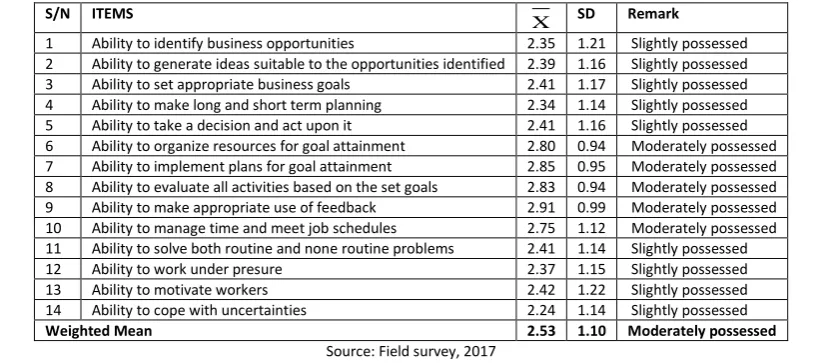
TABLE 2: MEAN AND STANDARD DEVIATION OF RESPONSES ON ENTREPRENEURIAL SKILLS POSSESSED BY BUSINESS EDUCATION STUDENTS S/N ITEMS
X SD Remark
1 Ability to identify business opportunities 2.35 1.21 Slightly possessed 2 Ability to generate ideas suitable to the opportunities identified 2.39 1.16 Slightly possessed 3 Ability to set appropriate business goals 2.41 1.17 Slightly possessed 4 Ability to make long and short term planning 2.34 1.14 Slightly possessed 5 Ability to take a decision and act upon it 2.41 1.16 Slightly possessed 6 Ability to organize resources for goal attainment 2.80 0.94 Moderately possessed 7 Ability to implement plans for goal attainment 2.85 0.95 Moderately possessed 8 Ability to evaluate all activities based on the set goals 2.83 0.94 Moderately possessed 9 Ability to make appropriate use of feedback 2.91 0.99 Moderately possessed 10 Ability to manage time and meet job schedules 2.75 1.12 Moderately possessed 11 Ability to solve both routine and none routine problems 2.41 1.14 Slightly possessed 12 Ability to work under presure 2.37 1.15 Slightly possessed 13 Ability to motivate workers 2.42 1.22 Slightly possessed 14 Ability to cope with uncertainties 2.24 1.14 Slightly possessed
Weighted Mean 2.53 1.10 Moderately possessed
VOLUME NO. 8 (2018), ISSUE NO. 07 (JULY)
ISSN
2231-5756
Table 2 revealed that the following skills are slightly possessed by business education students in colleges of education for the management of small scale busi-nesses: ability to identify business opportunities (mean = 2.35), ability to generate ideas suitable to the opportunities identified (mean = 2.39), ability to set appropriate business goals (mean = 2.41), ability to make long and short term planning (mean = 2.34), Ability to take a decision and act upon it (mean = 2.41), ability to solve both routine and none routine problems (mean = 2.41), ability to work under presure (mean = 2.37), ability to motivate workers (mean = 2.42) and ability to cope with uncertainties (mean = 2.24). The Table also revealed that the moderatley possessed skills for the management of small scale businesses are: ability to organize resources for goal attainment (mean = 2.80), ability to implement plans for goal attainment (mean = 2.85), ability to evaluate all activities based on the set goals (mean = 2.83), ability to make appropriate use of feedback (mean = 2.91) and ability to manage time and meet job schedules (mean = 2.75). The Table showed that all the 14 items have their standard deviation ranged from 0.94 to 1.22 which are below the fixed value of 1.96. This means that the responses of the respondents were not too wide spread, the responses are slightly clustered to the mean.On the overall, the data analysed in Table 2 revealed that entrepreneurial skills are moderately possessed by business education students in colleges of education for the management of small scale businesses (mean = 2.53, SD = 1.10).
TEST OF HYPOTHESES
The null hypotheses of the study were tested using independent t-test to find the significant difference between the mean responses of lecturers and students. The null hypotheses were tested at 0.05 level of significance. The summary of the test of hypotheses are presented in Tables 7 to 10 as follows:
H01: There is no significant difference in the mean responses of male and female business students in colleges of education on the office technology and
manage-ment skills possessed for the managemanage-ment of small scale businesses The test of this null hypothesis can be seen as summarise in table 7 below
TABLE 3: SUMMARY OF T-TEST OF THE DIFFERENCE BETWEEN THE MEAN RATINGS OF MALE AND FEMALE STUDENTS ON THE OFFICE TECHNOLOGY AND MANAGEMENT SKILLS POSSESSED FOR THE MANAGEMENT OF SMALL SCALE BUSINESSES
Group N Mean SD t-cal Df p-value Decision
Male 74 2.81 1.00
2.68 187 0.008 S Female 115 2.41 0.98
Source: Field survey, 2017 P<0.05
The data in Table 3 revealed that there are 74 and 115 male and female business education students respectively. Male students had higher mean (X = 2.81;
SD = 1.00) than female students (X = 2.41; SD = 0.98). The Table revealed that there was significant difference between the mean responses of male and female students regarding office technology and management skills possessed for the management of small scale businesses (t187 = 2.68, P=0.008). Therefore, the
hypoth-esis that stated that there is no significant difference in the mean responses of male and female business students in colleges of education on the office technology and management skills possessed for the management of small scale businesses was rejected. This indicated that male and female business education students differ statistically significantly in their responses regarding office technology and management skills possessed for the management of small scale businesses. The implication is that male students (mean = 2.81) possessed office technology skills more than their female counterparts (mean = 2.41).
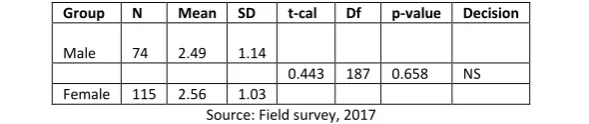
H02: There is no significant difference in the mean responses of male and female business students in colleges of education on the entrepreneurial skills possessed
for the management of small scale businesses.
The test of this null hypothesis can be seen as summarise in table 8 below
TABLE 4: SUMMARY OF T-TEST OF THE DIFFERENCE BETWEEN THE MEAN RATINGS OF MALE AND FEMALE STUDENTS ON THE ENTREPRENEURIAL SKILLS POSSESSED FOR THE MANAGEMENT OF SMALL SCALE BUSINESSES
Group N Mean SD t-cal Df p-value Decision
Male 74 2.49 1.14
0.443 187 0.658 NS Female 115 2.56 1.03
Source: Field survey, 2017 P>0.05
The data in Table 4 revealed that there are 74 and 115 male and female business education students respectively. Male students had higher mean (X = 2.49;
SD = 1.14) than female students (X = 2.56; SD = 1.03). The Table revealed that there was no significant difference between the mean responses of male and female students regarding the entrepreneurial skills possessed for the management of small scale businesses (t187 = 0.443, P=0.658). Therefore, the hypothesis
that stated that there is no significant difference in the mean responses of male and female business students in colleges of education on the entrepreneurial skills possessed for the management of small scale businesses was not rejected. This indicated that male and female business education students did not differ statisti-cally significantly in their responses regarding the entrepreneurial skills possessed for the management of small scale businesses. Though, slight difference can be observed with female students having higher mean (mean = 2.49) than their male counterparts (mean = 2.56), but the mean difference was not statistically significant.
DISCUSSION OF FINDINGS
With reference to research question one which stated that to what extent are the office technology and management skills possessed by business education students in colleges of education for the management of small scale businesses and null hypothesis (Ho1) There is no significant difference in the mean responses
of male and female business students in colleges of education on the office technology and management skills possessed for the management of small scale businesses, findings revealed that there was significant difference between the mean responses of male and female students regarding office technology and management skills possessed for the management of small scale businesses. The study discovered that business education students of colleges of education moderately possessed skills to keep information about guests and vendors of the business electronically, manage time and being economical in sending and receiving message electronically, type, recall and retrieve document using computer, store and rename document electronically, manually file and retrieve document, make and receive telephone calls politely, ensure effective flow of communication through established channels within the business electronically, appreciate customers for their patronage and a good public relations with customers for managing small scale businesses in Adamawa State.
VOLUME NO. 8 (2018), ISSUE NO. 07 (JULY)
ISSN
2231-5756
progress in employment on a useful and productive basis. This view was supported by Komolafe and Ajani (2010) Office Technology and Management is a work oriented educational programme that aims at skills acquisition which are useful and employable in the labour market.For research question two which stated that what is the extent to which entrepreneurial skills are possessed by business education students in colleges of educa-tion for the management of small scale businesses, and null hypothesis (Ho2) there is no significant difference in the mean responses of male and female business
students in colleges of education on the entrepreneurial skills possessed for the management of small scale businesses., findings revealed that there was no significant difference between the mean responses of male and female students regarding the entrepreneurial skills possessed for the management of small scale businesses. The study discovered that business education students of colleges of education slightly possess skills to identify business opportunities, generate ideas suitable to the opportunities identified, set appropriate business goals, make long and short term planning, take a decision and act upon it, solve both routine and none routine, work under presure, motivate workers and cope with uncertainties.
On the other hand, it was revealed that business education students of colleges of education moderately possessed skills to organize resources for goal attainment, implement plans for goal attainment, evaluate all activities based on the set goals, make appropriate use of feedback and Ability to manage time and meet job schedules. It was therefore, indicated that business education students of colleges of education moderately possess entrepreneurial skills for the management of small scale businesses in Adamawa State. This finding is also in line with Schnurr and Newing (2007) who justify the need for promoting entrepreneurship culture on the ground that youth in all societies need to have exhibit sterling qualities such as resourcefulness, initiative, drive, imagination, enthusiasm, zest, ambition energy, boldness, audacity and courage which are all valuable traits for self-reliant.
CONCLUSION
On the bases of the findings of this study, it was concluded that Office Technology and Management and entrepreneurship skills are highly required by Business Education Students as they have tremendous influence on management of small scale businesses. The implication is that when these skills are properly possessed and utilized, they will make business education graduagtes better prepared to take up jobs in organizatins and perform satisfactorily or be self-employed by establishing small and medium businesses.
RECOMMENDATIONS
Based on the findings of the study and discussions outlined herein, the following recommendations are made.
(1) The study of Office technology and management should be encouraged by all stakeholders, as it is geared towards skill acquisition, knowledge development and entrepreneurship.
(2) Business education programme in colleges of education should be mandated to establish Entrepreneurship study centre. The centre should be equipped with all the modern facilities which could enrich the students with practical skills needed for successful small scale business management.
(3) Lecturers should avoid gender discrimination in instructional delivery most especially in courses that are psychomotor base such as Office Technology and Management as it was indicated that both male and female have not significantly differ in skills possessed.
REFERENCES
1. Ademiluyi, F. L. (2007). Business Competencies Needed for Effective Entrepreneurship as Perceived by Fresh Graduates. Business Education Journal, 6(1), 18-28.
2. Akande, O. (2011). Accounting Skill as a Performance Factor for Small Businesses in Nigeria. Journal of Emerging Trends in Economics and Management
Sciences, 2(5), 372-378.
3. Bude, I. (2007). Determining Sample Size, from http://edis.ifas.ufl.edu/. Retrieved on April 02, 2017.
4. Buzzle, C. (2011). In Lawrencia, E. N. & Ojochide, A. A. (2016). Entrepreneurial Opportunities in Office Technology and Management Programme: A Panacea for Youth Unemployment. Association of Business Educators of Nigeria Conference Proceedings, 3(1), 306-315.
5. Chendo, N. A. (2013). Managers Perception of Environmental Sustainability in Small and Medium Scale Enterprises (SMES): Implication for Competitive Mar-keting Advantages for Sachet Water Manufacturers in Anambra State, Nigeria. European Journal of Business and Management, 5(7), 186-190.
6. Erhurun, H. E. O. (2007). Skills Acquisition: A Toll for Youth Empowerment for Economic Growth & Development. Journal of Business and Management
Studies, 1(2), 116-125.
7. Esene, R. A. (2013). Perception of OTM Education and non-OTM Education toward Quality Assurance in OTM Programmes in Polytechnics in Delta State and Edo State. Nigeria Journal for Business Educators, 1(2), 23 – 39.
8. Ezeani, N. S. (2012). The Teacher and Skills Acquisition in Business Education: From the Perspective of Accounting Skills. Arabian Journal of Business and
Management Review, 2(4), 85-93.
9. Fasehun, O. O. (2013). Technical Manpower and Entrepreneurship in a Developing Economy. Technology Education Journal, 9(1), 34-39. 10. Hisrich, F. (2011). Entrepreneurship, Starting, Developing and Managing a New Enterprise. London: McGraw Hill Coy Inc.
11. Ibrahim, A. A., & Hassan, A. A. (2014). The Challenges of Entrepreneurship Education in Nigerian Tertiary Institutions. Nigerian Journal of Technology Teacher
Education (NIJOTTE), 4(1), 76-85.
12. Komolafe, I. A., & Ajani, J. (2010). Office Technology and Management Curriculum, Issues, Strategies and Rationale. Journal of Secretarial Forum, 5(1), 64 – 65.
13. Martyn. S. (2008). Qualitative research design. Retrieved March, 26th 2017 from: http://www.experiment-resources.com/qualitative-research-design.html
14. National Council of Industry. (2012). Assessing 21st Century Skills: Committee on the Assessment of 21st Century Skills. Board on Testing and Assessment,
Division of Behavioural and Social Sciences and Education. Washington, DC: The National Academies Press.
15. Nwabuona, E. (2010). Office Technology and Management: some Issues and Solutions. Oko: The Scribe Federal Polytechnic.
16. Nwangwu, I. O. (2007). Entrepreneurship in Education- Concept and Constraint. African Journal of Educational and Developmental Studies 4(1), 196-207 17. Nwaosa, I. P., Egbule, C. N., & Olannye, V. E. (2013). The Impact of New Technologies on Secretarial Practice in Automated Business Office. Association of
Business Educators of Nigeria, 2(3), 106-111.
18. Oduma, C. A. (2010), A survey of employers’ perception of the professional business Competencies needed by business education graduates for gainful employment in Organization. Journal of Business and Vocational Education, 1(1), 25 –37.
19. Okeke, E. N. (2010). School-Industry link in Entrepreneurship Education. Unizik Orient Journal of Education, 5(1), 17-24. 20. Okorie, J. U. (2000) Developing Nigeria’s Workforce. Menty Envious Publishers, Calabar.
21. Okoro, I. F. & Ursula, O. I. (2012). The Teacher and Skills Acquisition at Basic Education from the Perspective of Cake Making in Home Economics. International
Journal of the Common Wealth Research and Capacity Education Initiative (IJCWRCEI), 3(3), 184-196.
22. Olowu, M. D. Y. & Aliyu, I. (2015). Impact of Managerial Skills on Small Scale Business Performance and Growth in Nigeria. European Journal of Business and
management, 5(1), 109-114.
23. Osotimehin, K. O., Jegede, C. A., Akinlabi, B. H., & Olajide, O. T. (2012). An Evaluation of the Challenges and Prospects of Micro and Small Scale Enterprises Development. Nigeria. American International Journal of Contemporary Research, 2(4), 154-166.
24. Osuala, E. C. (2007). Principles and Practice of Business Education. Obasi. Pacific Correspondence College and Press Ltd.
VOLUME NO. 8 (2018), ISSUE NO. 07 (JULY)
ISSN
2231-5756
26. Sanni, M. G. (2014).” Entrepreneurship Education for Actualizing the Goal of Self-reliant Nation”. Nigerian Journal of Technology Teacher Education (NIJOTTE),4(1), 200-207.
27. Schnurr, J. & Newing. P. (1997). A Conceptual and Analytical Framework for Youth Enterprise and Livelihood Skills Development: Defining an IDRC Niche, Canada:.IDRC.
28. Sighn, B. & Sharma, T. (2011). In Lawrencia, E. N. & Ojochide, A. A. (2016). Entrepreneurial Opportunities in Office Technology and Management Programme: A Panacea for Youth Unemployment. Association of Business Educators of Nigeria Conference Proceedings, 3(1), 306-315.
29. Umunadi, K. E. (2010). Acquisition of Skills and Competences by Technical Education Teachers as Instrument for National Growth in Nigeria. Journal of
VOLUME NO. 8 (2018), ISSUE NO. 07 (JULY)
ISSN
2231-5756
INDIAN BANKING AN URGE ON A RETAIL DRIVE: THE CHALLENGES AND THE OPPORTUNITIES OF INDIAN
BANKING SYSTEM - A DESCRIPTIVE STUDY
K. VINAYA LAXMI
RESEARCH SCHOLAR, JNTUK, KAKINADA; &
ASST. PROFESSOR
LAQSHYA INSTITUTE OF TECHNOLOGY & SCIENCE
KHAMMAM
P. VIJAY KUMAR
DIRECTOR (PROGRAMMING)
BOS IN DEPARTMENT OF COMMERCE
JAWAHARLAL NEHRU TECHNOLOGICAL UNIVERSITY
KAKINADA
M.S. NARAYANA
HEAD
DEPARTMENT OF MBA
NARSARAOPET ENGINEERING COLLEGE
NARSARAOPET
ABSTRACT
Banking sector in India has been evolved with a feeble and unorganized financial perspective in the ancient times but turned out with great strengths withstanding with challenges, hurdles and ultimately stood as brave and audacious, confronting the current day transformation on demand. The focus of the banking has been concentrated with high priority on par with core to the retail banking based on the customer centric perspective and to sustain the customer with banks in tough competition. The concept of digitalization has led to the great changes in the operational efficiencies and infrastructure facilities of the banking even in the remote areas of the country. But still the gaps are being identified in the serviceability of the banks though the banks are modified with structure and equipment developed. The presentation of this paper is to make an effort to learn about the various drawbacks of the banking services in the Indian industry to upgrade with the present causalities and expectations of customers.
KEYWORDS
retail services in banks, customer satisfaction, awareness of banking services, digital services, data mining, money laundering.
JEL CODES
G2, G21.
INTRODUCTION
anking in India is not a new topic and has initiated long back in 18th century. Among the first bank the banks were Bank of Hindustan, which established in
1770 and liquidated in 1829-32; and General Bank of India, established in 1786 but failed in 1791. The largest bank, and the oldest still in existence, is the State Bank of India.
The imperial bank of India now renowned as SBI has its origination in the 1921, by merging of Bank of Madras which established in July 1843, Bank of Calcutta originated in June 1806, which was renamed as the Bank of Bengal in 1809 and the Bank of Bombay established in 1840. State Bank of India is the first independent bank in India, which nationalized in 1955.
The Reserve Bank of India was established in 1935, under the Reserve Bank of India Act, 1934.
In 1960, the State Bank of India has emerged with eight state-associated banks under the State Bank of India (Subsidiary Banks) Act, 1959. These are now merged into the SBI in April 2017.
The Indian banking sector is broadly classified into scheduled banks and non-scheduled banks. The scheduled banks are those which are defined under the second Schedule of the Reserve Bank of India Act, 1934. The scheduled banks are further classified into: Nationalised banks; State Bank of India and its associates now merged into SBI, Indian private sector banks, Regional Rural Banks (RRBs), foreign banks. The term commercial banks refers to both scheduled and non-scheduled commercial banks which are regulated under the Banking Regulation Act, 1949.
Indian government nationalized 14 major private banks in 1969. Six, other private banks were nationalized in 1980. These nationalized banks are now the majority lenders in the Indian organized financial economy.
Among the three sectors of the economy in India, the service sector, that too banking sector in the economy leads the growth. According to Jordan banking is not only the life blood of financial system in India but it is even in the global world. Banks have undergone a drastic transformation in the recent past. Retail banking has evaluated as a major catalyst in the development of banking industry with more transparent and standardized system of transactions to enrich the customer satisfaction.
The liberalization, privatization and globalization of the economy has lead an emergence of restructuring and reengineering in process to face the competence with foreign banks and private banks at a stretch. The retail banking is the mass market banking where individual customers are target groups rather than com-mercial banks are deal with wholesale banking by providing services to other institutions such as business organizations, mortgage brokers, real estate, underwrit-ers, market makunderwrit-ers, etc.
Services are also being customized and added with value at every mode of transaction with internet usage and electronic system development. Penetration of services is not only confined to urban areas but even spread, habituated in rural and remote areas with equal enforcement being witnessed.
The dependence of customers over retail lending has created attractive, lucrative banking segments that are offering growth opportunities for existing and new emergent banks. The integration of retail services with global standards is making banking industry inevitable to become dynamic and vibrant in present situation with resource mobilization.
Though being discouraged of its customization in retail segment by the banking, the retail sector has proved the adaptability and perseverance for resource mobilization.

![TABLE 4: EMPLOYEE’S INCOME AND YEAR OF EXPERIENCE [Expected frequency (E)]](https://thumb-us.123doks.com/thumbv2/123dok_us/10046805.1991171/28.595.50.498.46.410/table-employee-s-income-year-experience-expected-frequency.webp)
