V
OLUMEN
O.
8
(2018),
I
SSUEN
O.
08
(A
UGUST)
ISSN
2231-5756
A Monthly Double-Blind Peer Reviewed (Refereed/Juried) Open Access International e-Journal - Included in the International Serial Directories
Indexed & Listed at:
Ulrich's Periodicals Directory ©, ProQuest, U.S.A., EBSCO Publishing, U.S.A., Cabell’s Directories of Publishing Opportunities, U.S.A., Google Scholar, Indian Citation Index (ICI), J-Gage, India [link of the same is duly available at Inflibnet of University Grants Commission (U.G.C.)],
Index Copernicus Publishers Panel, Poland with IC Value of 5.09 (2012) & number of libraries all around the world.
V
OLUMEN
O.
8
(2018),
I
SSUEN
O.
08
(A
UGUST)
ISSN
2231-5756
INTERNATIONAL JOURNAL OF RESEARCH IN COMMERCE, IT & MANAGEMENT
CONTENTS
Sr.
No.
TITLE & NAME OF THE AUTHOR (S)
Page
No.
1
.
EFFECTS OF SOCRATIC AND CONVENTIONAL LECTURE TEACHING METHODS
ON ACADEMIC PERFORMANCE OF SECONDARY SCHOOL STUDENTS IN
FINANCIAL ACCOUNTING IN ADAMAWA STATE, NIGERIA
Dr. TITUS AMODU UMORU & BABANGIDA HARUNA
1
2
.
HUMAN RESOURCE MANAGEMENT PRACTICES & WORK LIFE BALANCE:
WOMEN INFORMATION TECHNOLOGY PROFESSIONALS
SARITA VAIDYA, Dr. PRASHANT GUPTA & Dr. JYOTI SHARMA
6
3
.
EVALUATION OF EMPLOYEES’ PERFORMANCE USING DATA ENVELOPMENT
ANALYSIS AS A TOOL: A PILOT STUDY OF HR EXECUTIVES OF THDCIL
ASHUTOSH KUMAR ANAND & Dr. V.P.GANGWAR
11
4
.
DIGITAL INDIA – A CRITICAL REVIEW
Dr. NARINDER TANWAR
16
5
.
A STUDY ON CUSTOMERS ATTITUDE TOWARDS SOCIAL MEDIA
NETWORKING
S. CHITRA & M. BHUVANESWARI
20
6
.
ASSESSMENT OF EMOTIONAL INTELLIGENCE AND ITS IMPACT ON
LEADERSHIP STYLE OF LEATHER ENTREPRENEURS AND EXECUTIVES
A. NIYAZ AHMED
28
V
OLUMEN
O.
8
(2018),
I
SSUEN
O.
08
(A
UGUST)
ISSN
2231-5756
INTERNATIONAL JOURNAL OF RESEARCH IN COMMERCE, IT & MANAGEMENT
CHIEF PATRON
Prof. (Dr.) K. K. AGGARWAL
Chairman, Malaviya National Institute of Technology, Jaipur
(An institute of National Importance & fully funded by Ministry of Human Resource Development, Government of India)
Chancellor, K. R. Mangalam University, Gurgaon
Chancellor, Lingaya’s University, Faridabad
Founder Vice-Chancellor (1998-2008), Guru Gobind Singh Indraprastha University, Delhi
Ex. Pro Vice-Chancellor, Guru Jambheshwar University, Hisar
FOUNDER PATRON
Late Sh. RAM BHAJAN AGGARWAL
Former State Minister for Home & Tourism, Government of Haryana
Former Vice-President, Dadri Education Society, Charkhi Dadri
Former President, Chinar Syntex Ltd. (Textile Mills), Bhiwani
CO-ORDINATOR
Dr. BHAVET
Former Faculty, Shree Ram Institute of Engineering & Technology, Urjani
ADVISOR
Prof. S. L. MAHANDRU
Principal (Retd.), Maharaja Agrasen College, Jagadhri
EDITOR
Dr. PARVEEN KUMAR
Professor, Department of Computer Science, NIMS University, Jaipur
CO-EDITOR
Dr. A. SASI KUMAR
Professor, Vels Institute of Science, Technology & Advanced Studies (Deemed to be University), Pallavaram
EDITORIAL ADVISORY BOARD
Dr. S. P. TIWARI
Head, Department of Economics & Rural Development, Dr. Ram Manohar Lohia Avadh University, Faizabad
Dr. CHRISTIAN EHIOBUCHE
Professor of Global Business/Management, Larry L Luing School of Business, Berkeley College, USA
Dr. SIKANDER KUMAR
Chairman, Department of Economics, Himachal Pradesh University, Shimla, Himachal Pradesh
Dr. JOSÉ G. VARGAS-HERNÁNDEZ
Research Professor, University Center for Economic & Managerial Sciences, University of Guadalajara,
Guadala-jara, Mexico
Dr. M. N. SHARMA
Chairman, M.B.A., Haryana College of Technology & Management, Kaithal
Dr. TEGUH WIDODO
Dean, Faculty of Applied Science, Telkom University, Bandung Technoplex, Jl. Telekomunikasi, Indonesia
Dr. M. S. SENAM RAJU
Professor, School of Management Studies, I.G.N.O.U., New Delhi
Dr. A SAJEEVAN RAO
Professor & Director, Accurate Institute of Advanced Management, Greater Noida
Dr. D. S. CHAUBEY
Professor & Dean (Research & Studies), Uttaranchal University, Dehradun
Dr. CLIFFORD OBIYO OFURUM
V
OLUMEN
O.
8
(2018),
I
SSUEN
O.
08
(A
UGUST)
ISSN
2231-5756
INTERNATIONAL JOURNAL OF RESEARCH IN COMMERCE, IT & MANAGEMENT
Dr. KAUP MOHAMED
Dean & Managing Director, London American City College/ICBEST, United Arab Emirates
Dr. VIRENDRA KUMAR SHRIVASTAVA
Director, Asia Pacific Institute of Information Technology, Panipat
SUNIL KUMAR KARWASRA
Principal, Aakash College of Education, ChanderKalan, Tohana, Fatehabad
Dr. MIKE AMUHAYA IRAVO
Principal, Jomo Kenyatta University of Agriculture & Tech., Westlands Campus, Nairobi-Kenya
Dr. SYED TABASSUM SULTANA
Principal, Matrusri Institute of Post Graduate Studies, Hyderabad
Dr. BOYINA RUPINI
Director, School of ITS, Indira Gandhi National Open University, New Delhi
Dr. NEPOMUCENO TIU
Chief Librarian & Professor, Lyceum of the Philippines University, Laguna, Philippines
Dr. SANJIV MITTAL
Professor & Dean, University School of Management Studies, GGS Indraprastha University, Delhi
Dr. RAJENDER GUPTA
Convener, Board of Studies in Economics, University of Jammu, Jammu
Dr. SHIB SHANKAR ROY
Professor, Department of Marketing, University of Rajshahi, Rajshahi, Bangladesh
Dr. ANIL K. SAINI
Professor, Guru Gobind Singh Indraprastha University, Delhi
Dr. SRINIVAS MADISHETTI
Professor, School of Business, Mzumbe University, Tanzania
Dr. NAWAB ALI KHAN
Professor & Dean, Faculty of Commerce, Aligarh Muslim University, Aligarh, U.P.
MUDENDA COLLINS
Head, Operations & Supply Chain, School of Business, The Copperbelt University, Zambia
Dr. EGWAKHE A. JOHNSON
Professor & Director, Babcock Centre for Executive Development, Babcock University, Nigeria
Dr. A. SURYANARAYANA
Professor, Department of Business Management, Osmania University, Hyderabad
P. SARVAHARANA
Asst. Registrar, Indian Institute of Technology (IIT), Madras
Dr. MURAT DARÇIN
Associate Dean, Gendarmerie and Coast Guard Academy, Ankara, Turkey
Dr. ABHAY BANSAL
Head, Department of Information Technology, Amity School of Engg. & Tech., Amity University, Noida
Dr. YOUNOS VAKIL ALROAIA
Head of International Center, DOS in Management, Semnan Branch, Islamic Azad University, Semnan, Iran
WILLIAM NKOMO
Asst. Head of the Department, Faculty of Computing, Botho University, Francistown, Botswana
Dr. JAYASHREE SHANTARAM PATIL (DAKE)
Faculty in Economics, KPB Hinduja College of Commerce, Mumbai
SHASHI KHURANA
Associate Professor, S. M. S. Khalsa Lubana Girls College, Barara, Ambala
Dr. SEOW TA WEEA
Associate Professor, Universiti Tun Hussein Onn Malaysia, Parit Raja, Malaysia
Dr. OKAN VELI ŞAFAKLI
Professor & Dean, European University of Lefke, Lefke, Cyprus
Dr. MOHENDER KUMAR GUPTA
V
OLUMEN
O.
8
(2018),
I
SSUEN
O.
08
(A
UGUST)
ISSN
2231-5756
INTERNATIONAL JOURNAL OF RESEARCH IN COMMERCE, IT & MANAGEMENT
Dr. BORIS MILOVIC
Associate Professor, Faculty of Sport, Union Nikola Tesla University, Belgrade, Serbia
Dr. LALIT KUMAR
Faculty, Haryana Institute of Public Administration, Gurugram
Dr. MOHAMMAD TALHA
Associate Professor, Department of Accounting & MIS, College of Industrial Management, King Fahd University
of Petroleum & Minerals, Dhahran, Saudi Arabia
Dr. V. SELVAM
Associate Professor, SSL, VIT University, Vellore
Dr. IQBAL THONSE HAWALDAR
Associate Professor, College of Business Administration, Kingdom University, Bahrain
Dr. PARDEEP AHLAWAT
Associate Professor, Institute of Management Studies & Research, Maharshi Dayanand University, Rohtak
Dr. ALEXANDER MOSESOV
Associate Professor, Kazakh-British Technical University (KBTU), Almaty, Kazakhstan
Dr. ASHOK KUMAR CHAUHAN
Reader, Department of Economics, Kurukshetra University, Kurukshetra
Dr. BHAVET
Former Faculty, Shree Ram Institute of Engineering & Technology, Urjani
YU-BING WANG
Faculty, department of Marketing, Feng Chia University, Taichung, Taiwan
SURJEET SINGH
Faculty, Department of Computer Science, G. M. N. (P.G.) College, Ambala Cantt.
Dr. MELAKE TEWOLDE TECLEGHIORGIS
Faculty, College of Business & Economics, Department of Economics, Asmara, Eritrea
Dr. RAJESH MODI
Faculty, Yanbu Industrial College, Kingdom of Saudi Arabia
Dr. SAMBHAVNA
Faculty, I.I.T.M., Delhi
Dr. THAMPOE MANAGALESWARAN
Faculty, Vavuniya Campus, University of Jaffna, Sri Lanka
Dr. SHIVAKUMAR DEENE
Faculty, Dept. of Commerce, School of Business Studies, Central University of Karnataka, Gulbarga
SURAJ GAUDEL
BBA Program Coordinator, LA GRANDEE International College, Simalchaur - 8, Pokhara, Nepal
FORMER TECHNICAL ADVISOR
AMITA
FINANCIAL ADVISORS
DICKEN GOYAL
Advocate & Tax Adviser, Panchkula
NEENA
Investment Consultant, Chambaghat, Solan, Himachal Pradesh
LEGAL ADVISORS
JITENDER S. CHAHAL
Advocate, Punjab & Haryana High Court, Chandigarh U.T.
CHANDER BHUSHAN SHARMA
Advocate & Consultant, District Courts, Yamunanagar at Jagadhri
SUPERINTENDENT
V
OLUMEN
O.
8
(2018),
I
SSUEN
O.
08
(A
UGUST)
ISSN
2231-5756
INTERNATIONAL JOURNAL OF RESEARCH IN COMMERCE, IT & MANAGEMENT
CALL FOR MANUSCRIPTS
We invite unpublished novel, original, empirical and high quality research work pertaining to the recent developments & practices in the areas of Com-puter Science & Applications; Commerce; Business; Finance; Marketing; Human Resource Management; General Management; Banking; Economics; Tourism Administration & Management; Education; Law; Library & Information Science; Defence & Strategic Studies; Electronic Science; Corporate Gov-ernance; Industrial Relations; and emerging paradigms in allied subjects like Accounting; Accounting Information Systems; Accounting Theory & Practice; Auditing; Behavioral Accounting; Behavioral Economics; Corporate Finance; Cost Accounting; Econometrics; Economic Development; Economic History; Financial Institutions & Markets; Financial Services; Fiscal Policy; Government & Non Profit Accounting; Industrial Organization; International Economics & Trade; International Finance; Macro Economics; Micro Economics; Rural Economics; Co-operation; Demography: Development Planning; Development Studies; Applied Economics; Development Economics; Business Economics; Monetary Policy; Public Policy Economics; Real Estate; Regional Economics; Political Science; Continuing Education; Labour Welfare; Philosophy; Psychology; Sociology; Tax Accounting; Advertising & Promotion Management; Management Information Systems (MIS); Business Law; Public Responsibility & Ethics; Communication; Direct Marketing; E-Commerce; Global Business; Health Care Administration; Labour Relations & Human Resource Management; Marketing Research; Marketing Theory & Applications; Non-Profit Or-ganizations; Office Administration/Management; Operations Research/Statistics; Organizational Behavior & Theory; Organizational Development; Pro-duction/Operations; International Relations; Human Rights & Duties; Public Administration; Population Studies; Purchasing/Materials Management; Re-tailing; Sales/Selling; Services; Small Business Entrepreneurship; Strategic Management Policy; Technology/Innovation; Tourism & Hospitality; Transpor-tation Distribution; Algorithms; Artificial Intelligence; Compilers & Translation; Computer Aided Design (CAD); Computer Aided Manufacturing; Computer Graphics; Computer Organization & Architecture; Database Structures & Systems; Discrete Structures; Internet; Management Information Systems; Mod-eling & Simulation; Neural Systems/Neural Networks; Numerical Analysis/Scientific Computing; Object Oriented Programming; Operating Systems; Pro-gramming Languages; Robotics; Symbolic & Formal Logic; Web Design and emerging paradigms in allied subjects.
Anybody can submit the soft copy of unpublished novel; original; empirical and high quality research work/manuscriptanytime in M.S. Word format
after preparing the same as per our GUIDELINES FOR SUBMISSION; at our email address i.e. [email protected] or online by clicking the link online
submission as given on our website (FOR ONLINE SUBMISSION, CLICK HERE).
GUIDELINES FOR SUBMISSION OF MANUSCRIPT
1. COVERING LETTER FOR SUBMISSION:
DATED: _____________
THE EDITOR
IJRCM
Subject: SUBMISSION OF MANUSCRIPT IN THE AREA OF______________________________________________________________.
(e.g. Finance/Mkt./HRM/General Mgt./Engineering/Economics/Computer/IT/ Education/Psychology/Law/Math/other, please specify)
DEAR SIR/MADAM
Please find my submission of manuscript titled ‘___________________________________________’ for likely publication in one of your journals.
I hereby affirm that the contents of this manuscript are original. Furthermore, it has neither been published anywhere in any language fully or partly, nor it is under review for publication elsewhere.
I affirm that all the co-authors of this manuscript have seen the submitted version of the manuscript and have agreed to inclusion of their names as co-authors.
Also, if my/our manuscript is accepted, I agree to comply with the formalities as given on the website of the journal. The Journal has discretion to publish our contribution in any of its journals.
NAME OF CORRESPONDING AUTHOR :
Designation/Post* :
Institution/College/University with full address & Pin Code :
Residential address with Pin Code :
Mobile Number (s) with country ISD code :
Is WhatsApp or Viber active on your above noted Mobile Number (Yes/No) :
Landline Number (s) with country ISD code :
E-mail Address :
Alternate E-mail Address :
Nationality :
V
OLUMEN
O.
8
(2018),
I
SSUEN
O.
08
(A
UGUST)
ISSN
2231-5756
INTERNATIONAL JOURNAL OF RESEARCH IN COMMERCE, IT & MANAGEMENT
NOTES:
a) The whole manuscript has to be in ONE MS WORD FILE only, which will start from the covering letter, inside the manuscript. pdf.
version is liable to be rejected without any consideration.
b) The sender is required to mention the following in the SUBJECT COLUMNof the mail:
New Manuscript for Review in the area of (e.g. Finance/Marketing/HRM/General Mgt./Engineering/Economics/Computer/IT/
Education/Psychology/Law/Math/other, please specify)
c) There is no need to give any text in the body of the mail, except the cases where the author wishes to give any specific message w.r.t. to the manuscript.
d) The total size of the file containing the manuscript is expected to be below 1000 KB.
e) Only the Abstract will not be considered for review and the author is required to submit the complete manuscript in the first instance.
f) The journal gives acknowledgement w.r.t. the receipt of every email within twenty-four hours and in case of non-receipt of acknowledgment from the journal, w.r.t. the submission of the manuscript, within two days of its submission, the corresponding author is required to demand for the same by sending a separate mail to the journal.
g) The author (s) name or details should not appear anywhere on the body of the manuscript, except on the covering letter and the cover page of the manuscript, in the manner as mentioned in the guidelines.
2. MANUSCRIPT TITLE: The title of the paper should be typed in bold letters, centeredand fully capitalised.
3. AUTHOR NAME (S) & AFFILIATIONS: Author (s) name, designation, affiliation (s), address, mobile/landline number (s), and
email/al-ternate email address should be given underneath the title.
4. ACKNOWLEDGMENTS: Acknowledgements can be given to reviewers, guides, funding institutions, etc., if any.
5. ABSTRACT: Abstract should be in fully Italic printing, ranging between 150 to 300 words. The abstract must be informative and
eluci-dating the background, aims, methods, results & conclusion in a SINGLE PARA. Abbreviations must be mentioned in full.
6. KEYWORDS: Abstract must be followed by a list of keywords, subject to the maximum of five. These should be arranged in alphabetic
order separated by commas and full stop at the end. All words of the keywords, including the first one should be in small letters, except special words e.g. name of the Countries, abbreviations etc.
7. JEL CODE: Provide the appropriate Journal of Economic Literature Classification System code (s). JEL codes are available at
www.aea-web.org/econlit/jelCodes.php. However, mentioning of JEL Code is not mandatory.
8. MANUSCRIPT: Manuscript must be in BRITISH ENGLISH prepared on a standard A4 size PORTRAIT SETTING PAPER. It should be free
from any errors i.e. grammatical, spelling or punctuation. It must be thoroughly edited at your end.
9. HEADINGS: All the headings must be bold-faced, aligned left and fully capitalised. Leave a blank line before each heading.
10. SUB-HEADINGS: All the sub-headings must be bold-faced, aligned left and fully capitalised.
11. MAIN TEXT:
THE MAIN TEXT SHOULD FOLLOW THE FOLLOWING SEQUENCE:
INTRODUCTION REVIEW OF LITERATURE
NEED/IMPORTANCE OF THE STUDY STATEMENT OF THE PROBLEM OBJECTIVES
HYPOTHESIS (ES)
RESEARCH METHODOLOGY RESULTS & DISCUSSION
FINDINGS
RECOMMENDATIONS/SUGGESTIONS
CONCLUSIONS LIMITATIONS
SCOPE FOR FURTHER RESEARCH
REFERENCES
APPENDIX/ANNEXURE
V
OLUMEN
O.
8
(2018),
I
SSUEN
O.
08
(A
UGUST)
ISSN
2231-5756
INTERNATIONAL JOURNAL OF RESEARCH IN COMMERCE, IT & MANAGEMENT
12. FIGURES & TABLES: These should be simple, crystal CLEAR, centered, separately numbered & self-explained, and the titles must be
above the table/figure. Sources of data should be mentioned below the table/figure. It should be ensured that the tables/figures are
referred to from the main text.
13. EQUATIONS/FORMULAE: These should be consecutively numbered in parenthesis, left aligned with equation/formulae number placed
at the right. The equation editor provided with standard versions of Microsoft Word may be utilised. If any other equation editor is utilised, author must confirm that these equations may be viewed and edited in versions of Microsoft Office that does not have the editor.
14. ACRONYMS: These should not be used in the abstract. The use of acronyms is elsewhere is acceptable. Acronyms should be defined
on its first use in each section e.g. Reserve Bank of India (RBI). Acronyms should be redefined on first use in subsequent sections.
15. REFERENCES: The list of all references should be alphabetically arranged. The author (s) should mention only the actually utilised
references in the preparation of manuscript and they may follow Harvard Style of Referencing. Also check to ensure that everything
that you are including in the reference section is duly cited in the paper. The author (s) are supposed to follow the references as per
the following:
•
All works cited in the text (including sources for tables and figures) should be listed alphabetically.•
Use (ed.) for one editor, and (ed.s) for multiple editors.•
When listing two or more works by one author, use --- (20xx), such as after Kohl (1997), use --- (2001), etc., in chronologically ascending order.•
Indicate (opening and closing) page numbers for articles in journals and for chapters in books.•
The title of books and journals should be in italic printing. Double quotation marks are used for titles of journal articles, book chapters, dissertations, reports, working papers, unpublished material, etc.•
For titles in a language other than English, provide an English translation in parenthesis.•
Headers, footers, endnotes and footnotes should not be used in the document. However, you can mention short notes to elucidatesome specific point, which may be placed in number orders before the references.
PLEASE USE THE FOLLOWING FOR STYLE AND PUNCTUATION IN REFERENCES:
BOOKS
•
Bowersox, Donald J., Closs, David J., (1996), "Logistical Management." Tata McGraw, Hill, New Delhi.•
Hunker, H.L. and A.J. Wright (1963), "Factors of Industrial Location in Ohio" Ohio State University, Nigeria. CONTRIBUTIONS TO BOOKS•
Sharma T., Kwatra, G. (2008) Effectiveness of Social Advertising: A Study of Selected Campaigns, Corporate Social Responsibility, Edited by David Crowther & Nicholas Capaldi, Ashgate Research Companion to Corporate Social Responsibility, Chapter 15, pp 287-303.JOURNAL AND OTHER ARTICLES
•
Schemenner, R.W., Huber, J.C. and Cook, R.L. (1987), "Geographic Differences and the Location of New Manufacturing Facilities," Jour-nal of Urban Economics, Vol. 21, No. 1, pp. 83-104.CONFERENCE PAPERS
•
Garg, Sambhav (2011): "Business Ethics" Paper presented at the Annual International Conference for the All India Management Asso-ciation, New Delhi, India, 19–23UNPUBLISHED DISSERTATIONS
•
Kumar S. (2011): "Customer Value: A Comparative Study of Rural and Urban Customers," Thesis, Kurukshetra University, Kurukshetra. ONLINE RESOURCES•
Always indicate the date that the source was accessed, as online resources are frequently updated or removed. WEBSITESV
OLUMEN
O.
8
(2018),
I
SSUEN
O.
08
(A
UGUST)
ISSN
2231-5756
INTERNATIONAL JOURNAL OF RESEARCH IN COMMERCE, IT & MANAGEMENT
HUMAN RESOURCE MANAGEMENT PRACTICES & WORK LIFE BALANCE: WOMEN INFORMATION
TECHNOLOGY PROFESSIONALS
SARITA VAIDYA
Ph. D. RESEARCH SCHOLAR
INTERNATIONAL INSTITUTE OF PROFESSIONAL STUDIES
DEVI AHILYA UNIVERSITY
INDORE
Dr. PRASHANT GUPTA
PROFESSOR
JAIPURIA INSTITUTE OF MANAGEMENT STUDIES
JAIPUR
Dr. JYOTI SHARMA
ASSOCIATE PROFESSOR
INTERNATIONAL INSTITUTE OF PROFESSIONAL STUDIES
DEVI AHILYA UNIVERSITY
INDORE
ABSTRACT
Work life balance is achieving a balance between work and family demands. Large number of women is entering in information technology industry and Women more likely suffer from role over load as she was found to undertake majority of house hold duties with work responsibility as a result confronted with work life imbalance. Human resource management professionals have to take some initiatives in the form of human resource management practices to deal with work life imbalance. This study is an attempt to find out relationship between human resource management practices & work life balance among women information technology professionals. A well-structured questionnaire was developed. A sample of 130 women information technology professionals were drawn from Pune, one of the information technology hub of Maharashtra. Result reveals that there exist a significant relationship between human resource management practices & work life balance among women information technology professional. Human resource management practices taken in the study to attain work life balance are self rostering, telecommuting, unpaid maternity leave, paid maternity leave, a carers room or bringing children to work in emergencies and carers leave. Study suggested that information technology organization should implement these above mentioned human resource management practices in their organization to better manage work life imbalance among women information technology professional.
KEYWORDS
human resource management practices, information technology industry, work life balance, women information technology professional, work life balance initi-atives.
JEL CODES
M1, M12.
1. INTRODUCTION
n developing country like India, drastic changes have been observed from last few decades. Shift of family structure from joint to nuclear family, changes in work culture from fixed hour working to long working hours and Entry of women in workforce from the time when men as the bread earner of family and women as the homemaker or caretaker of family. To the time now when the men earns and women earns too. But Women are still taking care of family, so the question is how she manages the dual role of working outside as a professional & managing family responsibility as a homemaker. Hence the concept of work life balance arises. Work life balance is defined as a satisfactory level of involvement or ‘fit’ between the multiple roles in a person’s life (Clarke, Koch and Hill, 2004). Women struggle to balance their multiple roles as compared to their male counterpart (Kamenou, 2008). Women more likely suffer from role over load as she was found to undertake majority of house hold duties and moreover women scarifies more at the time of childcare responsibility (Bridge, 2009). To deal with above mentioned situation human resource management professionals were taken some initiatives to balance the work & non work life of women professionals & these initiatives were known as human resource management practices. HRM practices are those favorable practices which are created by employers for their employees to manage their work and non-work demands. HRM practices relate to specific practices, formal policies, and philosophies that are designed to attract, develop, motivate, and retain employees who ensure the effective functioning and survival of the organization (Cheng Ling Tan & Aizzat Mohd Nasurdin, 2011). Earlier women’s were associated with the professions like teaching, nursing, and banking and now after globalization & urbanization with improved education the society has witnessed a surge in the participation of women in the Information Technology Industry. The Indian Information Technology Industry has marked their identity in the last few years and emerged as one of the fastest growing sector not in terms of economic growth but also in terms of employment generation. Work culture of IT industry is highly demanding as the IT projects were basically outsourced from US, Europe, Australia etc., and employees need to work according to their working hours. With the growing number of women in IT industry, highly demanding IT work culture and multitasking women who played dual role in work & family front has emphasized practitioners & researchers interest in the topic Human resource management practices & work life balance among women IT professionals of India.
2 REVIEW OF LITERATURE
2.1 WORK LIFE BALANCE & WOMEN
Work life balance is a state of equilibrium in which an individual can balance work & non work demands. The term work life balance was first coined in 1986 although its usage in everyday language was sporadic for a number of years.
V
OLUMEN
O.
8
(2018),
I
SSUEN
O.
08
(A
UGUST)
ISSN
2231-5756
INTERNATIONAL JOURNAL OF RESEARCH IN COMMERCE, IT & MANAGEMENT
role”. In recent scenario the term is known as Work-life balance, in its broadest sense, is defined as a ‘fit’ between the multiple roles in a person’s life (Hudson, 2005).
Women experiencing more work family conflict then due to role-over load, interference from work to family and interference from family to work (Higgins et al. 1994). Women confronted with more work interference in family than men as women spent more time on fulfilling family responsibility as compared to men, in spite of spending around same number of hours in paid work as men. Both men & women reported the same level of family interference in work (Gutek et al. 1991) but contrary to Gutak study Rajadhyaksha and Velgach (2009) in their study found that women experienced more family interference with work as compared to men. However both men & women experience same level of work interference with family.
The concept of work life balance attention in management studies by the entry of women in work force and captured more attention due to growing number of women with dependent children entering in to the workforce (Hamilton et al., 2006). Study revealed that women having dependent children confronting more work life imbalance than those who do not have dependent children as women having children need to spent time with them for their upbringing (Sanjiv Gupta, 2009). Women being married and having children directly affect the balance of work and personal life (Nathalie & Philippe, 2006). As the age of women increases and they get married & have children, their responsibilities increases at home that affect their work life balance. Parallely as their length of service increase their responsibilities at work place will also increase. Hence it is quite natural that as the working women grow in their age, their responsibility will also increase that may affect their work-life balance (Kumari K. Thriveni& Devi V. Rama, 2012).
2.2 HRM PRACTICES & WORK LIFE BALANCE AMONG WORKING WOMEN
Indian women professionals striking with the work life imbalance, so many factors like role conflict, lack of recognition, organizational politics, gender discrimina-tion, elderly and children care issues, quality of health, problems in time management and lack of proper social support influencing the issue (Vijaya Mani, 2013).“Work–life” is an umbrella term incorporating wide range of HRM practices envisioned to support employees to balance their work and non-work respon-sibilities (Callan, 2007; Glass & Finley, 2002). Supportive HRM practice is becoming a challenge for the employers to provide. They commonly refer to practices that enable employees to balance the demands of paid work and personal life which can be in the form of workplace flexibility or work time flexibility (Subrama-niam, 2010). HRM practices were basically covering two factors i.e. work based factor & family based factor to manage work life balance. HRM practices under family based factor are provision of childcare/eldercare help women to get relieve from some family responsibilities; and HRM practices under work based factor are flexible work schedules, work from home to assist women to better manage their family commitments by giving them greater control over their work arrange-ments. (Niharika & Supriya, 2010; Heywood & Jirjahn, 2009).Working women confronted with less work life conflict if organization provides HRM practices having leave policies like maternity leave, carer’s leave. These leave policies provide an opportunity to give full attention to family as per requirement while remain attached to the organization (Rogier & Padgett, 2004) and, as a result will be able to concentrate more on work, which in turn increase performance.
Organizations basically develop HRM practices for female employees' to their family responsibilities with work responsibilities. Although both men and women can suffer from work–family conflict (Grönlund, 2007; Kossek & Ozeki, 1998; van Veldhoven & Beijer, 2012), and organization often provide HRM practices for both men & women, but it is found that women employees are frequent user of HRM practices (Vandello, Hettinger, Bosson, & Siddiqi, 2013; Wise & Bond, 2003).Studies reported that organization having HRM practice to support work life balance will help to decrease absenteeism and turnover (Rogier & Padgett, 2004), and increase productivity and innovation (Taneja, Pryor, & Oyler, 2012) and as a result employee will have more loyalty & attainment towards organization (Butts, Casper, & Yang, 2013; Wang, Lawler, & Shi, 2011).
2.3 WORK LIFE BALANCE AMONG IT WOMEN PROFESSIONALS
Sushree Sangita Das et al (2016) in their study analyses the ground reality of women information technology professionals in Mumbai and they found that duration of working hours are not uniform and it may vary as per the task. They need to work for around 12 hours per day. Managing house hold activities & dependent care is a big challenge for them. This affects the normal family life, lead to both physical and mental exhaustion resulting in stress. Study also reported that in order to play dual role rationally, women information technology professionals in Mumbai are already seen, in compromising either at family or at the professional life. Bharathi S. Vijayakumar (2015) in their study of work life balance of women employees in IT industry with special reference to Pune focuses on certain key professional challenges and personal challenges and enhancers to work life balance. Study recommends that travel time from home to workplace to be lessened, Supportive people at office &family, job rotation, crèche facility within the company premises, and work from home at least 2-3 days a week will help better manage work life balance.
Vanitha & Meenakumari (2011) in their study stated that women played multifaceted roles at family, society and at work places with extraordinary pressures. Due to absence of co-ordination and support from work & family part work family conflict arises and it also mutually influences each other. The impact of these influences impetus with work and family problems and sometimes leads to undesirable consequences.
Reimara and Vasanthi (2011) in their study have attempted to understand how work and family related factors influence the work-family balance of Indian women information technology professionals. The study revealed that of women information technology professionals can attain work life balance by setting priorities in their work and personal lives and by having support systems from supervisor, co-supervisor and from family members. The study also concluded that working women can achieve work life balance only when organization design & implement supportive HR policies and practices. As a result women professionals would be more committed towards organization & perform better at work place, and this in turn participate in the growth of economy and positively impact society as whole.
Valk and Srinivasan (2011) in their study of the work and family related factors in women information technology professionals in India shows six major dimensions namely family influence on life choices, attempts to negotiate multi-role responsibilities, self and professional identity, work life challenges and the combating strategies, organizational policies and practices and social reinforcement.
Kelkar (2003) in his study observed that human resource management practices to balance work life imbalance are available in information technology companies of jargaon but only on paper not on real sense. Employee has to work around 14-16 hours a day a work place & if required then need to work on home as well.
3. NEED OF THE STUDY
The topic of work life balance got more attention by the entry of women in work force & changes in work culture. Previously male was bread earner of family & female was caretaker of family so they both perform their roles & responsibility independently and no clash happened but after entry of women in work force role interference has been observed like interference of work in to family and needs to work 24*7 and specially in IT industry project were outsourced from USA, Europe etc and employees need to work according to their work time and both the factors enhance work life imbalance among women IT professionals. So HRM professionals have to take initiative to deal with the work life imbalance. This study is an attempt to identify factors affecting work life balance & to know the relationship between HRM practice & work life balance among women IT professional.
4. STATEMENT OF THE PROBLEM
Women’s are playing multifaceted role of handling paid work responsibility with homemaker and caretaker of family. This results in role-over load or role conflicts among working women. IT industry demands 24*7, 365 days working, as the projects in IT industry were outsourced from western country and IT professionals required to give support as & when required. So this study is an attempt to identifying factors affecting work life balance of working women in IT industry and to find out human resource management practices that help women IT professionals in managing their multifaceted role henceforth in attaining work life balance.
5. OBJECTIVES OF THE STUDY
The Objectives of this Study are:
1. To identify factors of work life balance among women IT professionals of Pune.
V
OLUMEN
O.
8
(2018),
I
SSUEN
O.
08
(A
UGUST)
ISSN
2231-5756
INTERNATIONAL JOURNAL OF RESEARCH IN COMMERCE, IT & MANAGEMENT
6. HYPOTHESIS
H0: There is no significant relationship between human resource management practices and work life balance among women IT professionals of Pune.
H1: There is significant relationship between human resource management practices and work life balance among women IT professionals of Pune.
7. RESEARCH METHODOLOGY
7.1 DESCRIPTION OF SAMPLE
The study was conducted for women IT professionals of Pune. Sample of 130 women IT professionals was drawn through convenient sampling.
7.2 DESCRIPTION OF THE TOOL USED
A structured questionnaire developed for the purpose of study. Questionnaire is divided into three parts namely: demographic profile contains age, marital status, children status, educational qualification, monthly income, and experience, work life balance scale contains 22 items grouped into four factors, and six women centric human resource management practices.
In work life balance & human resource management scale 7 point liker scale was used and coded as 1 = Strongly Disagree, 2 = Disagree, 3 = Slightly Disagree, 4 = Neutral, 5 = Slightly Agree, 6 = Agree, & 7 = Strongly Agree.
Cronbach’s alpha statistics was applied to check the reliability of the questionnaire, thenafter factor analysis for work life balance was done. To achieve the objective & test the hypotheses of study Pearson correlation was applied.
8. RESULT & DISCUSSION
Statistical testing & analysis was done by using SPSS (originally Statistical Package for the Social Sciences) version 22 for Windows.
8.1 PROFILE OF THE RESPONDENTS
150 questionnaire was distributed among women IT professional of Pune out of which 130 completely filled was receive & used for further analysis. Out of 130 68 was married & 62 unmarried and 40 is having children & remaining 90 is not having children.
8.2 RELIABILITY& VALIDITY
A questionnaire consist two different scales: human resource management practices and work life balance. Cronbach‘s alpha statistics is measured for both the scales individually. As shown in the table 1 given below the Chronbach’s alpha value of work life balance is .889 & human resource management practices are .850. The Chronbach’s alpha value more than 0.72 is considered as good and acceptable in literature. Inter-term correlation between the variables is good, hence questionnaire has sound validity.
TABLE 1: RELIABILITY STATISTICS OF WORK LIFE BALANCE AND HUMAN RESOURCE MANAGEMENT PRACTICES SCALE
Scale
Reliability Statistics
Cronbach's Alpha Cronbach's Alpha Based on Standardized Items N of Items
Work-Life Balance .889 .890 22
HRM Practices .850 .855 6
8.3 FACTOR ANALYSIS
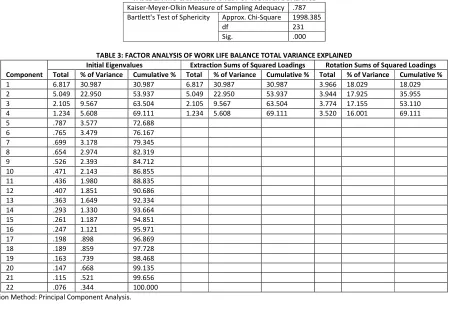
All the variables of work life balance scale have good inter-item correlation. To check data adequacy KMO Barlett’s test of sampling adequacy was applied. The KMO value for work life balance scale shown in table 2 is .787, which is acceptable value and good, as value of KMO above 0.5 is acceptable and higher the value more adequacies associated with data. Hence data is adequate & factor analysis could be applied. To identify the factor principal component analysis was done and as a result four factors have been extracted with eigen value more than 1. All the factors accounts for cumulative variance of 69.111% shown in table 3. Four factor were named as work family interference, family work interference, work family enhancer, & family work enhancer
TABLE 2: KMO & BARTLETT’s TEST OF WORK LIFE BALANCE
Kaiser-Meyer-Olkin Measure of Sampling Adequacy .787 Bartlett's Test of Sphericity Approx. Chi-Square 1998.385
df 231
Sig. .000
TABLE 3: FACTOR ANALYSIS OF WORK LIFE BALANCE TOTAL VARIANCE EXPLAINED Component
Initial Eigenvalues Extraction Sums of Squared Loadings Rotation Sums of Squared Loadings Total % of Variance Cumulative % Total % of Variance Cumulative % Total % of Variance Cumulative %
1 6.817 30.987 30.987 6.817 30.987 30.987 3.966 18.029 18.029
2 5.049 22.950 53.937 5.049 22.950 53.937 3.944 17.925 35.955
3 2.105 9.567 63.504 2.105 9.567 63.504 3.774 17.155 53.110
4 1.234 5.608 69.111 1.234 5.608 69.111 3.520 16.001 69.111
5 .787 3.577 72.688
6 .765 3.479 76.167
7 .699 3.178 79.345
8 .654 2.974 82.319
9 .526 2.393 84.712
10 .471 2.143 86.855
11 .436 1.980 88.835
12 .407 1.851 90.686
13 .363 1.649 92.334
14 .293 1.330 93.664
15 .261 1.187 94.851
16 .247 1.121 95.971
17 .198 .898 96.869
18 .189 .859 97.728
19 .163 .739 98.468
20 .147 .668 99.135
21 .115 .521 99.656
22 .076 .344 100.000
V
OLUMEN
O.
8
(2018),
I
SSUEN
O.
08
(A
UGUST)
ISSN
2231-5756
INTERNATIONAL JOURNAL OF RESEARCH IN COMMERCE, IT & MANAGEMENT
8.4HYPOTHESIS INTERPRETATION
H0: There is no significant relationship between human resource management practices and work life balance among women IT professionals of India.
H1: There is significant relationship between human resource management practices and work life balance among women IT professionals of India.
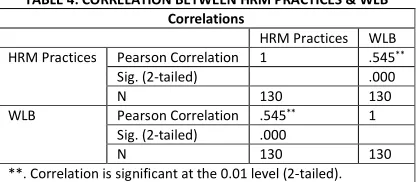
TABLE 4: CORRELATION BETWEEN HRM PRACTICES & WLB Correlations
HRM Practices WLB
HRM Practices Pearson Correlation 1 .545**
Sig. (2-tailed) .000
N 130 130
WLB Pearson Correlation .545** 1
Sig. (2-tailed) .000
N 130 130
**. Correlation is significant at the 0.01 level (2-tailed).
To test the relationship between human resource management practices and work-life balance among women IT professionals’ of India bivariate correlation was applied. As shown in table 4 the value of r =.522 and p =.000. As the value of p is less than .05, hence null hypotheses is not accepted and alternate is accepted. Similarly value of correlation is also found positive, thus analysis indicates that there is significant positive relationship between human resource management practices and work-life balance among women IT professionals’ of India. Positive relationship shows that implementation HRM practices self rostering, telecom-muting, unpaid maternity leave, paid maternity leave, a carers room or bringing children to work in emergencies and carers leave will increase, so will be the work life balance among women IT professionals of India.
9. FINDINGS
Results reveals that human resource management practices plays significant role in attaining work life balance of women IT professionals. Positive correlation was found between human resource management practices and work life balance. This relationship indicates that implication of selected human resource practices increases work life balance among women IT professionals. Long working hours, shift system and other working conditions in Information technology sector make it more prone to disturb work and family equilibrium. In such environment human resource practices act as a support system for women employees who play dual role of house maker as well as professional. Situation become more difficult with working mothers and hence child care, maternity leave and other related policies provision contributes in balancing work and family both among working women.
Moreover, study also explored four factors of work life balance and indicates whether work will hinder or contribute in work life balance depends upon the policies followed by organization.
10. RECOMMENDATION & SUGGESTION
It is recommended that IT organization should take the issue of work life balance in priority and should take some initiative for their women employees to achieve work life balance. HRM practices like self rostering, telecommuting, paid & unpaid maternity leave and child care arrangement required to implement within IT organization to facilitate women IT professionals. It is recommended that travel time between home & work place need to be lessened; more supportive people at work place, family; and flexibility work rules along with good pay scale will help in achieving work life balance.
Effective implementation of HRM practices is required attain work life balance. Many IT organizations have HRM practices to attain work life balance but employees are not aware about availability of practices so it is suggested that employer should make aware employees about HRM practice so that they can take benefit of them. This will help them to manage work life imbalance and as a result employee performance will improve. Employee performance will help in increasing organization performance and decrease in employee absenteeism & turnover ratio.
11. CONCLUSION
Working women’s are playing multifaceted role, same is with women IT professionals and IT industry follows the long working hours work culture. As a result the issue of work life imbalance came in front of women IT professionals. Literature reveals that they can cope up with work life imbalance only when organization provides them effective human resource management practices. Through extensive review of literature and experts opinion six major human resource manage-ment practices were identify which helps to attain work life balance among women IT professionals of India and these practices are practices self-rostering, telecommuting, unpaid maternity leave, paid maternity leave, a carers room or bringing children to work in emergencies and carers leave. The study attempted to measures the relationship between human resource management practices and work life balance among women IT professionals of India and findings reveals that’s there is a positive significant relationship between human resource management practices and work life balance among women IT professionals of India. Hence, study concludes that IT organization should implement these above mention human resource management practices within their organization. Implemen-tation of these practices will help IT women professionals to better manage their work & non work life. As result, their performance will increase and employee absenteeism & turnover will decrease and ultimately, organization performance will improve.
12. LIMITATIONS
Limitations of the study are:
The study is limited to women IT professionals only.
The findings of the study cannot be generalized as the data is only from a section of women IT employees from Pune. The study used the long instrument size which influences the attrition of respondents while filling questionnaire.
13. SCOPE FOR FURTHER STUDY
The study includes only women IT professionals in future study can be done by covering women & men both.
Current study includes six HRM practice to attain work life balance of women IT professionals. Further same study can be done by including more HRM practices like job sharing, health assessment program etc. to facilitate women IT professionals.
Further comparative study can be done among married & unmarried women IT professionals. In future the study can be done between women IT professionals having child & not having child.
IT organization can refer this study to get insight of HRM practices that help women IT professionals in maintaining their work life balance.
REFERENCES
1. Bharathi, S. Vijayakumar. (2015), “Work Life Balance of Women Employees in the Information Technology Industry”, Asian Journal of Management Research 2229-3795. 5, pp 323-343.
V
OLUMEN
O.
8
(2018),
I
SSUEN
O.
08
(A
UGUST)
ISSN
2231-5756
INTERNATIONAL JOURNAL OF RESEARCH IN COMMERCE, IT & MANAGEMENT
3. Callan, S. (2007), “Implications of family-friendly policies for organizational culture: Findings from two case studies”, Work, Employment & Society, 21, pp 673–691.
4. Clarke, M., Koch, L., and Hill E. (2004), “Differentiating balance and fit. The work–family interface”
5. Glass, J. L., & Finley, A. (2002), “Coverage and effectiveness of family-responsive workplace policies”, Human Resource Management Review, 12, pp 313– 337.
6. Grönlund, A. (2007), “More control, less conflict? Job demand–control, gender, and work–family conflict” Gender, Work and Organization, 14, pp 476–497. 7. Heywood, J. S., & Jirjahn, U. (2009), “Family-friendly practices and worker representation in Germany”, Industrial relations: A Journal of Economy and Society,
48, pp 121–145.
8. Kelkar Govind (2003), “Women in the digital Era: Gender and Culture, (Keynote address)”, International conference on women in the digital era; organized by STPI and Annamalai University, Annamalainagar, TN, Dec 10-13, 2003.
9. Kossek, E. E., &Ozeki, C. (1998), “Work–family conflict, policies, and the job-life satisfaction relationship: A review and directions for organizational behavior– human resources research”’ Journal of Applied Psychology, 83, pp 139–149.
10. Kumari K Thriveni, Devi V Rama (2012), “Impact of Demographic Variables on Work-Life Balance of Women Employees (with special reference to Bangalore City)”,International Journal of Advances in Management and Economics, Vol.1, Issue 6, pp 226-229.
11. Niharika Doble and M. V. Supriya (2010), “Gender differences in perception of work life balance”, Management (4), Volume 5, No.4- winter, pp 331-342 12. Rajadhyaksha, U. &Velgach, S. (2009), “Gender, gender role ideology and work-family conflict in India” Academy of Management, Chicago, IL, USA. Retrieved
October 7, 2010.
13. Reimara Valk and Vasanthi Srinivasan (2011), “Work-family balance of Indian women software professionals: A qualitative study”, IIMB Management Review, Vol. 23, pp. 39-50.
14. Rogier, S. A., & Padgett, M. Y. (2004), “The impact of utilising a flexible work schedule on the perceived career advancement potential of women”, Human Resource Development Quarterly, 15,pp 89–106.
15. Sanjiv Gupta, Liana C Sayer, Philip N Cohen (2009), “Earnings and the Stratification of Unpaid Time Among US Women”, Social Indicators Research, Dordrecht, Vol. 93, pp 153-158.
16. Sushree Sangita Das, Shashi A. Mishra (2016), “A Study on Work Life Balance of Women Working in IT Sectors of Mumbai City”, International Journal of Humanities and Social Science Invention, Volume 5, Issue 9, pp 43-47.
17. Taneja, S., Pryor, M. G., &Oyler, J. (2012), “Empowerment and gender equality: The retention and promotion of women in the workforce”, Journal of Business Diversity, 12, pp 43–53.
18. Van Veldhoven, M. J. P. M., & Beijer, S. E. (2012), “Workload, work-to-family conflict, and health: Gender differences and the influence of private life context”, Journal of Social Issues, 68, pp 665–683.
19. Vandello, J. A., Hettinger, V. E., Bosson, J. K., & Siddiqi, J. (2013), “When equal isn't really equal: The masculine dilemma of seeking work flexibility”, Journal of Social Issues, 69, pp 303–321.
20. Vanitha,A., & Meenakumari,S., (2011), “Family Vs Work Conflict among Working women in India with Special Reference to IT, Education and Banking Sector”, International Journal of Research in commerce, IT and Management, ISSN 2231-5756, Volume No. 1, Issue No. 6 (November).pp. 113-119.
21. Vijya Mani (2013), “Work Life Balance and Women Professionals” Global Journal of Management and Business Research Interdisciplinary, Volume 13 Issue 5 Version 1.0, pp. 34-41.
22. Wang, P., Lawler, J. J., & Shi, K. (2011), “Implementing family-friendly employment practices in banking industry: Evidences from some African and Asian countries” Journal of Occupational & Organizational Psychology, 84, pp 493–517.