ISSN 1392-2785 ENGINEERING ECONOMICS. 2006. No 3 (48)
THEECONOMICCONDITIONSOFENTERPRISEFUNCTIONING
Pension Reform Progress and Problems
Egl
ė
Leš
č
inskien
ė
, Algimantas Sakalas
Kauno technologijos universitetas K. Donelaičio g. 73, LT-44029, Kaunas
A wish of every person is social guarantees ensured applying various levels of citizens and state participation. Two diametrically different variants exist: the state and the private social insurance the combination of which creates several systems used in practice. The choice of a particular system is determined by the approach to per-sonal and state responsibility priorities as well as eco-nomical criteria. From the very beginning of the inde-pendence Lithuanian State met with the solution of this problem. Sate pension funds (due to the economic de-crease and high unemployment rate) were unable to per-form their per-former obligations and had to be urgently re-formed.
The reorganization of the pension system has been running since the regain of Independence. The state obli-gation fulfillment to the pensioners was guaranteed by combining Sodra, state budget and financial possibilities of the credit system. All type pensions were indexed pay-ing particular attention to inflation rate. The analysis of the applied pension formation and payment systems of the world (Barr N., 1998; Behrendt Ch., …; Dubinas, 1992; Green, 2002; Makinen T., 1999; Palacios R., …), par-ticularly European countries (Great Britain, Germany) and especially post communist countries (Check republic, Poland, Latvia, Russia, Kazakhstan, Azerbaijan) was fulfilled. The principles of the pension reform fulfillment were formulated that were highly influenced by the old habit to shoulder all the responsibility about one’s own destiny to the state and do not take any responsibility on oneself. These principles were also affected by compli-cated financial situation that did not allow the guarantee of a reasonable pension rate and a higher level of pen-sioner living standards. Nobody doubts that people who created the well-being of the country should be honoured for that, however now the financial possibilities of the country are rather limited.
This article shows the progress of the pension reform that started in 1995 paying the greatest attention to the transition from the obligatory insurance to the individu-ally accumulated insurance. The necessity to match the pension system to the abrupt changes of economy, labour market, political life and social life due to the integration into the European Union has been stressed. This can be achieved by improving the laws and administration pro-cedures related with the pension system at the same time removing shortcomings that occur due to the imperfection of the new system and the lack of experience. With the requirements to fulfill the pension reform more quickly: “to rationally combine the principles of current pension financing and accumulation” (A.Paulauskas), “involving
non-governmental organizations into the delivering of the social services” (E.Gentvilas), but strived to give the real economical background to these proposals, i.e. to match the wishes and possibilities.
Keywords: pension reform, unemployment, demographi-cal situation, obligatory and accumulating social insurance, risk.
Introduction
Different systems of pension funds accumulation and payment exist that have the following differences:
• Various sources of pension funds establishing: a) pension funds are made of two parts –payments made by a person who works and by his employer or the institution; b) pension funds are made of only one type of payment: either a person or his institution pays insurance contributions;
• Pension funds are formed and the payment made by: a) a state organization; b) a private enterprise; c) a state or private enterprise;
• People receive pensions not at the same age and pension sizes are different.
The selection of the form depends on the view of the country towards the responsibility of a person and the state, demographic and economic situation, as well as traditions.
After the transit of Lithuania into the system of the market economy the social system of the pension forming and the payment when all the responsibility for its effec-tiveness depends on the state was changed and the grad-ual transition to more effective market system, where greater freedom and the responsibility was given to the individual and the private sector, was started. Without wider discussions of theoretical questions of the effec-tiveness of two different systems, a special investigation should be done. It can be mentioned that the state refused its own priorities in this field first of all because of the complicated economic situation, changed distribution and collection of monetary means, and extremely difficult economic situation.
The object of the research: the reform of pension system of the state social insurance.
The main goals of the pension reform are:
• To balance the financial flows of the pension sys-tem of the social insurance so that the syssys-tem could operate without financial deficit, i.e. could support itself;
could get a greater part of their former salary and other income than they received until now. This can be achieved with the introduction of the volun-tary pension accumulation;
• The stock capital of the accumulated pension funds should stimulate the development of the state capital market and the financial infrastruc-ture, open the investment space and radically ac-celerate the economic development of the country. The pension reform started in Lithuania in 1995. The principles of the social insurance were introduced. The right to the pension was more closely related with the period of the state social pension insurance, and the pen-sion sizes with the installments of the person paid to the social insurance budget. The age when a person can retire from job began to increase gradually. Some privileges were abrogated. The relief pensions were started to be paid from the state budget means.
The second stage of the reform began in 2003 and people who, wanted to be insured, could participate in the system of the insurance pension accumulation, i.e. to transfer some part of the payment into pension accumula-tion funds. During this stage of the reform the benevolent demographical situation was used and some part of social insurance installments was accumulated in personal ac-counts of participants and could be used “if the worst comes to the worst”. There was also the attempt to pass the accumulation funds to the private sector and increase the effectiveness of their utilization.
The third stage is related with the increase of the part
of the accumulated pension fund and more effective usage. The aims of the article are to analyse the causes that preconditioned the pension reform, evaluate the political aspects of the reform, highlight the risk factors of the re-form and forecast the means for its further improvement.
Scientific novelty of the problem
Talking into account the distinctions of Lithuanian situation, there has been chosen the way of evolutionary, but not radical, reform where some facilitating (e.g., the prolongation of a pension age) means have been used. The main factor in this process is a rather high stability of the previous system of social insurance and not full reli-ance on new market systems that have led to the bank-rupcy of some financial institutions (banks) and the scan-dals associated with ineffective management of Sodra (social insurance) property. This conditioned the choice of an irrational model that has been characteristic to most former socialist countries.
Reasons that influenced the pension reform The necessity to reform the pension system in Lithuania was determined by many social and economic reasons but the most important are:
The unemployment and employment rate. The re-sults of the economic fall are industrial production and agricultural decrease of the structure of individual in-come: employee’s payroll relatively decreased and the number of unemployed people increased.
Table 1 The employment rate in Lithuania and the EU in the year 2004
Lithuania EU – 25
Total Men Women Total Men Women
Employment level (15-64
years old), percent 59.6 62.2 57.3 62.9 71.0 54.7 Unemployment level, percent 13.8 14.6 12.9 8.9 8.1 9.9
Source: Data of statistical department and the forecast of the Eurostat inhabitants [5 and 8]
Declining demographical situation. Very obvious “ag-ing” tendency of the society of developed countries can be more clearly traced in Lithuania, i.e., the birthrate de-creases, the number of older people increases and the number of working-age people decreases.
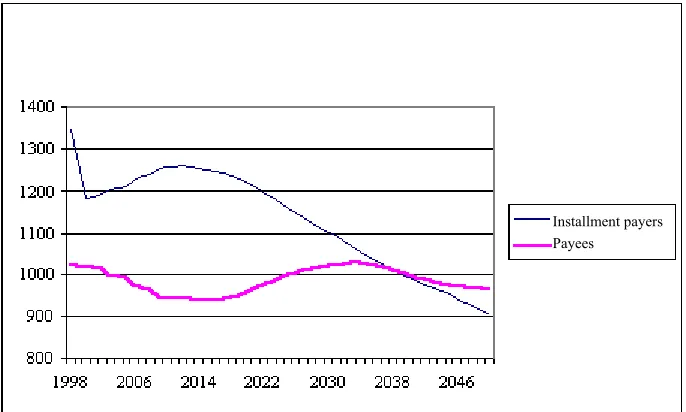
The ratio of pensioners and working-age people (the index of the dependent) up to 2009 should positively change due to the lengthening of the pension age. In 1998 this ratio was 33.7%, in 2009 it will be 24.9%. But later on till the end of the anticipated period it will increase and in 2050 it will be 47.3%. It means that in 2050 two or a bit more people from 15 till 65 years will have to sup-port one pensioner. If the pension age is as it has been defined by the present law, i.e. 60 years for women and 62.5 years for men, then beginning from 2039 the number of all the pensioners would exceed the number of the in-stalment payees. The decline of demographic situation is also determined by increased emigration rates.
Tax evasion. Commonplace tax evasion also minimizes the number of socially insured people. If in 1976 three
workers had to support one pensioner now they have to sup-port two pensioners. This number constantly increases. Since 1991 the number of the insured people has decreased from 1764.3 thousand down to 1352.2 thousand (1996), i.e. more than by 400 thousand (Dzikevičius A., 2000). Some of them are unemployed. But there is only a bit more than 186 thousand of unemployed people who are registered in the jobcentre (Social …, 2004). The rest part works for the “shadow” economics, i.e. they do not pay not only a part of the social insurance but none of the payment at all, or are not insured according to the law.
se-curity. The lobbyist relationships of acquaintances or relatives are noticed in these countries when the laws are
applied for the narrow egotist clannish needs while trying to break the laws or change them.
Installment payers Payees
Figure. The change of the number of installment payers and pensioners(thousands) (the pension age as it has been defined by the law)
The junction of the XX and XXI ages shows the pecu-liar Romanesque type state structure in Lithuania when the ideas to privatize all and fully, to liquidate or reduce the role of the state sector found their way in such state pro-tected fields as health and social security. The provisions of the extreme liberalism, seemed, to begin dominating in all state development processes. But in the real life politi-cal changes were so painful and drastic that radipoliti-cal reforms were unacceptable. There were two reasons:
• The first one, insufficient and premature reform preparation. The practice of the privatization re-form that was often changed and had many abuse and strain facts evidently showed this. The charac-ter of the Romanesque type state was conspicuous;
• The second reason, was the loss of the responsibil-ity for one’s own future and the state’s signifi-cance attribution to the lower and middle class of the workers. Though political parties in Lithuania developed in accordance with the principles of the Western parties and the ideological platforms, tested in “the free world” the market fundamental-ism ideology and the mentality of the overwhelm-ing majority, became the main hindrance in further process of the radical reconstruction.
These contradictions had also influenced the progress of the pension reform, especially, in its preparatory stage.
The inability to demonstrate the inefficiency of Bis-marck type social security determined the fact that some lobbyist structures tried to change the cooperative model into marginal type structures. They tried to change the state social security into the private insurance. Most po-litical parties of Lithuania confirmed the ideology of such market fundamentalism and trying to avoid greater social cataclysms, they were afraid to demonstrate the actual social security structures. On the other hand, they did not start fundamental reforms, improving the functioning of social security that were proposed by specialists of the
social security for rather a long time, i.e. to more quickly increase the pension age, to limit the size of the working pensioners, to liquidate special state pensions etc. If po-litical parties had agreed on these essential questions of social security there would have been no such drastic deficit of social security fund budget (in 2000 the budget deficit was 212 mln. Litas, and in 2003 there was the sur-plus of 185.5 mln. Litas (LSD, 2000, 2003)), and the problems of socially maintained people would have been solved more favourably.
Pension reform scheme in Lithuania
The new system of Lithuanian social security was ar-ranged by payment principle related with the labour mar-ket, for example:
• The pension rate depends on the former salary and the record of service;
• The sickness allowance is related with the salary;
• The negative income-tax is used to calculate al-lowance. It is obvious that total personal income, comprised from the salary and allowance, would be always greater for those who get greater salary;
• The social insurance fund is financed by install-ments from payroll;
• The child-care allowance is greater for those women who are insured if compared with those who are not (e.g. students).
The institution of social insurance fund that was separated from the state budget in 1990 supports the fact that the social security is built on the labour market. This is a typical feature of the corporative model.
to increase the stimuli to participate in the labour market. It was partly conditioned by the endeavour to move from the egalitarianism that prevailed during the Soviet regime to
the merit-based market social security system.
The main features of the reform of the pension sys-tem in Lithuania are shown in Table 2.
Table 2 Features of the pension system reform in Lithuania
Stages of pension reform Main features of the period The first stage is the
re-formed pension system of social security’s current fi-nancing
The system is financed by employers and the insured installments that are accumulated in a separate state social security fund of the state budget (VSDF). The social security system is administered by the State Board of the Social Security Fund (hereinafter “Sodra”). The pension formula of the social insurance has two pension forms: the main and additional one. The main part of the social security pension is equal to all the people with the record of service. The additional part of social security pension is related with the former salary and the record of service. The main part of the seniority pension with the record of service of (30 years) is equal to, so called, “base pension” of the state social security (hereinafter “base pension”) that is defined by the government. People who do not have the mandatory record of service get a part of the pension that equals to the corresponding part of the base pension.
The second stage is the pen-sions of the mandatory ac-cumulative pension insur-ance
The employed people who are secured by social insurance rate for the whole pension in 2005 have the right to transfer 3.5 percent of the mandatory installments to the 1st stage 2nd level pension system
with determined contributions (every year this contribution part will be increased by one percent up to 5.5 percent in 2007). For the participants of this pension system the extra part of the national in-surance pension will be less, accordingly. The pensions of 2nd level have determined contributions,
thus, their rate will depend on the contribution amount, the payment period, investment return of the pension fund property and the fund management deductions.
The third stage is the pen-sions of voluntary accumula-tion
The participant of pension accumulation and people who signed long-term insurance policies with life insurance institutions can return some part of the paid income-tax. This part of income-tax is returned from payments when they together with other expenses are exempt from taxation (e.g., taken for studies, a house or apartment purchase etc.) make not more than 25 per cent of the person’s income. The same privilege is given to profit tax for the employer when he pays contributions for his employees. The taxation of the payments or returned means from the 3rd stage pension fund or the
life insurance enterprise varies and depends on the accumulation period. When a participant of the pension fund or a person who signed along-term life insurance policy will get the payment (at the age of his retirement), the part of his payment that is equal to the payment sum is imposed by 15 per cent reduced tariff. The same 15 per cent reduced tariff is used when the participant, who accumu-lated means for his pension for not less than 10 years, gives up the pension fund and does not choose another fund or quits the life insurance policy. In other cases, i.e. when the participant of the 3rd stage
pension fund leaves the pension fund or quits the life insurance, or the contact is disrupted before 10 years have passed then 33 per cent taxation tariff from the sum of the money to be returned is used.
The main protection during the retirement age, dis-ability or widowhood in Lithuania is secured with the help of the national insurance pension system. The aver-age, base part of the pension in 2004 was 44 per cent of the average pension. The additional part of the pension is calculated by giving 0.5 per cent of the salary (the in-sured income-tax of the insurant) for every year of work experience. The average pension during 10 years that passed from the beginning of the first stage of the pension reform increased from 151 Litas in 1995 to 454.54 Litas in December of 2005 (VSDFVSD, 2005). During this pe-riod the total price index was 138%, thus, the purchasing power increased significantly.
Paid national insurance pensions are usually indexed
by increasing two parameters that are reflected in the pension formula: either the base pension which influ-ences the size of a part of the pension or on the average of the insured income of the insured which influences an additional part of social insurance pensions.
As the present generation of the pensioners lived in the period of overall employment (until 1990) actually all the inhabitants who are pensioners now have a sufficient record of service and the right to the national insurance pension. The old-age or disability pension in 2005 re-ceived 91 per cent of old people (VSDFVSD, 2005).
It should be mentioned that the first positive changes of the reform are felt. The greatest positive influence was the improvement of economic results (see Table 3).
Table 3 Comparison of the increase of GNP and the debts of the government sector and the predicted deficit
2000 2001 2002 2003 2004 2005 2006 2007 2008 Increase of GNP, percent 3.9 6.4 6.8 9.7 6.7 7.0 6.0 5.3 6.8 Debt of the government
sector, percent from GNP 23.8 22.9 22.4 21.4 19.6 19.8 19.5 19.2 18.6 Deficit of the government
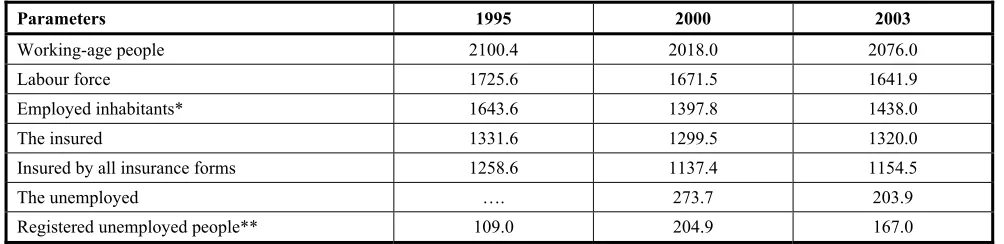
From this point of view our country still has the uni-versal social insurance system of the old people. But the situation may change in the future when more people who did not work for some time in their lives or were not insured by the social pension insurance will become pensioners. In 2005 out of 2 million 76 thousand of working age people only 1 million 320 thousand people were socially insured, and the situation has not im-proved since 1995. Meanwhile the number of insurants insured by all forms of social insurance, who make the
most payments to the budget of the State national insur-ance fund decreased by 100 thousand if compared with the year 1995 (Table 4). The increase of the employ-ment and the improveemploy-ment of the administration of the social insurance system (that all employed people should participate in the social insurance pension sys-tem) is still one of the most important tasks. These measures would promote better financing of the system of these pensions and more people would get social se-curity pension in the future.
Table 4 Employed and insured inhabitants in the period of 1995-2003
Parameters 1995 2000 2003
Working-age people 2100.4 2018.0 2076.0
Labour force 1725.6 1671.5 1641.9
Employed inhabitants* 1643.6 1397.8 1438.0
The insured 1331.6 1299.5 1320.0
Insured by all insurance forms 1258.6 1137.4 1154.5
The unemployed …. 273.7 203.9
Registered unemployed people** 109.0 204.9 167.0
*Source: Data of Statistics department and “Sodra” (average annual data, thousand).
** Note: Not-updated index of employed inhabitants in 1995, and updated index of Statistics department after the population census
in 2000 and 2003.
Private pensions of the 1st stage 2nd level and the 3rd
stage. In 2004 in the 2nd level system participated more than 50 percent of the insured by national social insurance.
The 3rd stage of private pensions is still being introduced. In 2004 only about 3200 people signed the pension accumula-tion policies in the 3rd stage pension funds. The accumulative life insurance can be partially attributed to the private income insurance in the declension of years. In 2004 such long-term life insurance policies were signed by approximately 300 thousand inhabitants (LRDBKD, …). But to select some part of the accumulative insurance policies as the pension accumu-lation has no rational ground because any legal act obliges a person to keep to one’s agreement till he or she reaches the retirement age.
It should be mentioned that a small part of the social de-ductions into accumulation funds does not contribute to the system growth. Almost in all post-communist countries two kinds of contributions those paid by the employer and those paid by the insured are used. They are 22.5 and 2.5 percent in Lithuania, 16.26 and 16.26 in Poland, which is more radical, in Check republic, Slovakia, Hungary, Latvia and Albania, where personal installments of the insured persons are greater.
The risks of pension reform
The successful progress of the 2nd stage of the pension re-form does not mean that the rere-form perre-formed has no short-comings and faces no disturbances and risks. They appear in all the spheres: legal, economical, organizational etc.
1. One of the most serious violations is the legal base.
Though there is a task to insure the security of accu-mulation funds, too huge limitations minimize the ef-fective utilization of accumulated means. More effec-tive activity of pension funds is limited by the
prohibi-tion to invest into countries that belong to the Organi-zation of Economic Cooperation and Development (OECD). The processes were also stopped for a long time by the prohibition to invest into the funds that plough into derivative paper securities (now these vio-lations are fixed). There are also various advertising limitations. The managers of pension funds have to coordinate every word with the control institutions. The confidence on the accumulation funds is reduced by attributing to one fund after the person signs the policy. Now this violation has already been changed and people may decide and break the signed accumu-lation policies and return to the traditional accumula-tion in “Sodra” system. The attempts to solve the situations when the employers’ press the staff to sign the policies and their signing has negative influence to the whole activity of the system, and leaves people in confusion, increases the system’s expenditure and dis-turbs confidence. Enjoying good results of the reform starting point and risking to close our eyes before real violations that may soon stop the reform progress. The development of the stocks market is the crucial factor during the transition period to the private pen-sion insurance system. The activity of the private ac-cumulation pension funds is based on the investment of the insured means while trying to store the value of the installments and to get some profit. Thus the li-quidity, capitalization and safety of the stock market are the obligatory attributes of the pension reform. 2. Economic risk. Too small a part of Sodra contribution
sig-nificant. But those who agree that this reform should be developed and expanded have some doubts and contradictory opinions as to what methods should be chosen for this reform. Many people watched the ad-vertisements about double or even triple bigger pen-sions, but at the same time they saw how their parents and grandparents get very small pensions during this transitional period of the pension reform. But nobody has ever explained that in order to get a bigger second pension contribution should be also greater. Unfortu-nately salaries remained as small as they were before. This risk is due to the unexpected changes of the prof-itability rates of the financial property.
Recently the suggestion of the European Reconstruc-tion and Development bank was heard (it was being discussed in Lithuania some time ago) that the reform should be improved by the mandatory private accumu-lation. But those who suggested this method violate the main aims of this reform that are social first of all. The voluntary accumulation stimulates social motiva-tion, encourages taking individual social solutions, thus, it is important from the point of view of case-work. After the installment of the accumulation burden the motivation of a person would increase to charge oneself with the old-age pension, and this is one of the corner-stone of the reform. Most of the people would still prefer to leave the whole responsibility to the state. The requirement of mandatory accumulation should be protected by some kind of guarantees. But the most important thing is that our own motiva-tion as free individuals are responsible for future would be again destroyed. Suffice it to say that one more trump should be received: by giving guarantees and taking responsibilities it would also have free hands to define the conditions. On the other hand, as the sponsor of the people security at an old age the state could further show its own caretaking for people and become still much “better”.
Although the supporters of the mandatory accumula-tion are right when they say that the more active par-ticipation (and much more the obligatory one) would really have some impact on the economics, and the beautiful macroeconomic vision would not only im-prove the statistical values but would also benefit the people. But primarily the reform is necessary for the financial security of the people but not the economics. Thus the impact on the individual man is the most im-portant thing and not the values that can be increased, expanded and showed with proud.
Those who own economic arguments would also re-main satisfied because such solution would not only give the impulse to the country’s economics through the motivation of employees but would become the ef-fective means to minimize a part of the shadow eco-nomics in the state. Those who are afraid that the sys-tem may not attract new participants to the syssys-tem would have to better understand that a greater tariff of installments would stimulate people to individually accumulate as they would see clear benefit of such a solution.
3. Institutional risk. This is the risk that may occur due to the possible bankrupt and /or inability of the
main-tenance institutions to fulfill the delegated functions. The pension fund cannot bankrupt and participants cannot lose their payments. The government of Lithuanian republic has to take the responsibility for the activity of the pension funds (LRPSRI, 200 ) as the pension accumulation in the pension funds is obligatory, thus institutions should be established that will have to guarantee the stable activity of the new pension system. If accumulated contributions of the working people of Lithuania can support only several pension funds the government has to decide on the following:
•How to create the most effective pension fund with the smallest expenditures of the employees? For ex-ample, to arrange the license auctions of the function fund activity at the beginning of the reform as it was done in Argentina or let the pension funds to estab-lish without any restrictions that will bankrupt later increasing the management expenditures;
•What kind of institutional structure of the pension fund market should be formed at the beginning stage because it will influence the long-term parameters of the activity of pension system.
4. Individual risk. This risk may occur due to the un-specified individual working activity related with high level of unemployment. This shows that any individ-ual is uncertain about his life. Nobody knows when he or she may become unemployed not because of his own fault but because the enterprise may bankrupt or his personal qualification may be insufficient. This is determined not only by the unstable economic situa-tion in Lithuania but the economic crises and setbacks of neighbour states and migration to the countries of the EU. The health is also an important factor.
5. Demographical risk. Migration and the reduction of people of working age (see Table 5) exacerbate the fi-nancial state of the pension funds because the number of people paying contributions decreases. It has to be stated that the financial situation was aggravated by the pension payment to the working pensioners in spite of the fact that this decision from the point of view of morality is really legitimate and just. Besides it in-creased the confidence in the pension system.
Table 5 The forecast of the ratio of the people of employable age and
pensioners for the period of 1997-2005
People of
em-ployable age, % Pensioners, %
Ratio of the working people and pensioners
1997 57.2 20.1 2.8
2000 58.0 19.5 3.0
2005 61.2 18.1 3.4
2010 62.2 17.9 3.5
2015 61.0 18.6 3.3
2020 59.6 19.6 3.0
2025 58.0 21.1 2.7
One of the most severe problems of economics that should be solved immediately is the prolongation of the re-tirement age. One stage of the pension age increase was made that coincided with the high unemployment rate and small unemployment allowances. But according to the range of the pension age in Lithuania even today it is shorter than in some developed European countries. If the retirement age for men and women in Lithuania is 62.5 and 60 years, ac-cordingly, only in Italy (60 and 55 years), France (60 and 60 years) and in Turkey (55 and 50 years) it is shorter. In all the rest countries it is longer than in Lithuania. In Denmark, Spain, Cyprus, Norway, Finland, and Sweden it is equal to men and women – 65 years, but in Australia, Belgium, Switzerland, the Great Britain, Greece it is 65 and 60 years, accordingly.
Thus the increase of the pension age is though unpopu-lar, but indispensable perspective of the pension reform.
The investigation of the content and progress of the pen-sion system reform allows us to make the following conclu-sions.
Conclusions
1. The necessity of the pension reform in Lithuania was determined by many factors. These are economical depression of the state and high unemployment level and low payment related with it, the quick aging of inhabitants and low level of the pensions received. During the transition period the purchasing power of the average monthly payment greatly minimized but the spending power of pensions and allowances de-creased still more as their ratio with the average sal-ary reduced. This is an extra burden to the poorest inhabitants of the society that was crated by eco-nomically active people who retired from the system of social solidarity. The situation was also exacer-bated by the defective income-tax payment system and work in the “black market”.
2. During the first years of social security reform the at-tempt was made to secure the former rights to the so-cial security or even to expand it. The new system was created with the view that the transient period will pass quickly and will not be very painful. This was one of the reasons why the extensive social secu-rity system was chosen from the point of view of the pensioners’ range (the pension payment to the work-ing pensioners), but not the pension size. The pen-sions were paid at the expense of the indebtedness. 3. During the social transformations in Lithuania the
es-tablishment of the cooperative model of social secu-rity was initiated but this model was chosen not be-cause of the striving to repeat the principle of Bis-marck or due to the influence of the market partners (trade unions and employers’ organizations) but mostly because of the striving to increase the stimuli to participate in the labour market. It was partly con-ditioned by the endeavour to move from the egali-tarianism that prevailed during the Soviet regime to the merit-based market social security system. As a final result not the model of radical changes was cho-sen but only merely adapted existing model in which only very small part of the installments can be paid to the accumulation funds.
4. The present pension reform should be improved be-cause it does not guarantee the significant pension increase. It does not make people more active while solving the pension security issues individually. The improvement of the present day reform is rather unpopular because of the lengthening of the pension age and the stricter control of the income-tax collec-tion. But the greatest improvement might be achieved only by the improvement of economic situation, the increase of the labour payment and the reduction of the influence of the shade economics.
5. During the present pension reform the essential im-provement of the living standards of the pensioners can be achieved only if the employees will accumu-late the extra means either themselves or through the accumulated life insurance. The new possibilities also have their way of expression in the expansion of the pension insurance package.
Refrences
1. Dzikevičius,A. Lietuvos pensijų sistemos tobulinimas. Vilnius, 2000. 2. Socialinės apsaugos ir darbo ministerijos pagrindiniai statistiniai
duomenys. 2004-12-01. www.socmin.lt
3. Lietuvos Respublikos pensijų sistemos reformos įstatymas, Valstybės žinios, 2002, Nr.123-5511.
4. Makinen,T. Structural pressures, social policy and pov-erty//International Social Security Review, 1999, No 4, p.7. 5. Lietuvos statistikos departamentas: http://www.std.lt
6. Valstybinio socialinio draudimo fondo valdybos statistiniai duomenys: http://www.sodra.lt
7. Lietuvos Respublikos draudimo priežiūros komisijos duomenys:
http://www.socmin.lt
8. Eurostato gyventojų prognozės: http://www.finmin.lt
9. Dubinas,V.Senatvės pensijų sistema užsienyje // Lietuvos ūkis, 1992, Nr.1-2, p34-35.
10. Barr,N. The Economics of the Welfare State. 3 ed., 1998.
11. Behrendt,Ch. Private pensions – a viable alternative? http://www.uni-konstanz.de/FuF/Verwiss/Alber/Behrendt/research.htm
12. Expenditure on pensions in Europe. www.europa.eu.int/comm/eurostat 13. Green Paper on Stakeholder Pensions.
http://www.yabloko.ru/Pub/2002/2002_03
14. Dalyvavimas pensijų reformoje: piliečiai, rinkos, viešosios instituci-jos- konferencijos ataskaita. III dalis: Pensijų reforma: pensijų fondų
sistemos Lietuvoje kūrimo problemos, Katkus,V., Martinaitytė,E. Vilnius, 2002.
15. Solving the annuitisation problem in the Polish pension reform / Otto,W., Wisniewski,M.. www.actuaries.org/members/en/events/ seminars/Brighton/programmee.cfm
16. Individual choice and the transition to a funded pension system / Palacios,R., Whitehouse,E. www.axiaecon.com/switching.pdf 17. ВеликаяБританиясосвоейпенсионнойсистемой
http://www.yabloko.ru/ Publ/2002/ 2002_03/020306_fk_laz_pensbrit.html 18. ПенсионнаяреформавКазахстане
http://www.kazecon.kz/rus/reform 19. ПенсионнаяреформавЛатвии
http://www.lm.gov.lv/krieviski/reformas/soc_ap_ref /pensijas.html. 20. ПенсионнаяреформавРоссии
www.polit.ru/documents/476669.html 21. Пенсионнаяреформа: опытЛатвии
http://www.rg.ru/prilog/es/103001/3.shtm. 22. ПенсионнаясистемаАзербайджана
www.deutchebotshaft-moskau.ru/ru/bibliotek/inter-nationes/reister-rente 24. ПенсионнаясистемавЛатвии
http://www.lm.gov.lv/krieviski/reformas/soc_ap_ref/ pensijas.html 25. ПенсионнаясистемавЧехии
http://www.sharel.ru/czech/social.html 26. Пенсионныефонды: опытдвухстран.
http://epigraph.sinor.ru/315/spravoc.php?i=sp_05
27. ПенсионнаясистемавСШАhttp://www.psca.org/data/45th.html
Eglė Leščinskienė, Algimantas Sakalas
Pensijų reformos eiga ir problemos
Santrauka
Šiame straipsnyje nagrinėjama 1995 metais pradėtos pensijų re-formos eiga, akcentuojant perėjimą nuo privalomojo prie savanoriškojo kaupiamojo draudimo. Pabrėžiamas būtinumas priderinti pensijų siste-mą prie staigiųūkio, darbo rinkos, politinio gyvenimo, socialinio gyve-nimo pokyčių dėl integracijos į Europos Sąjungą: tobulinant pensijų
sistemą reglamentuojančius įstatymus ir administracines procedūras, šalinant spragas, kurios neišvengiamos dėl naujos sistemos trūkumų, nepakankamo patyrimo.
Eama skirtingų pensinių fondų kaupimo ir išmokėjimo sistemų, kurių pasirinkimą lemia šalies požiūris į žmogaus ir valstybės atsako-mybę, demografinė, ekonominė situacija, tradicijos.
Atsižvelgiant į Lietuvos situacijos ypatumus, pasirinktas evoliu-cinis, o ne radikalus reformos procesas, kuriame svarbus vaidmuo skiriamas amortizuojančių procesų (pensinio amžiaus ilginimas) ir individualios atsakomybės laipsniškam įvedimui. Amortizuojantis sistemos pertvarkos radikalumo veiksnys, mūsų nuomone, yra pa-kankamai aukštas buvusios „Sodros“ sistemos stabilumas ir nepasiti-kėjimas naujomis rinkos sistemomis, sąlygotas daugelio finansinių
institucijų bankrotų, skandalų, kilusių dėl nepakankamai efektyvaus „Sodros“ turto valdymo.
Pirmame etape įgyvendinta nemaža operatyvinių, „Sodros“ biu-džeto deficitą mažinančių priemonių (pensinis amžiaus prailginimas ir pan.).
Antrasis reformos etapas pradėtas 2003 metais, suteikus drau-džiamiesiems galimybę dalyvauti socialinio draudimo pensijų kaupimo sistemoje – perkelti dalįįmokųį kaupiamuosius pensijų fondus. Šiuo reformos etapu buvo siekiama pasinaudoti laikinai palankia demografi-ne situacija ir dalį socialinio draudimo įmokų sukaupti asmeninėse dalyvių sąskaitose, taip jas atidedant blogesniems laikams. Kartu siekta perduoti kaupiamuosius fondus privačiam sektoriui ir taip padidinti jų
panaudojimo efektyvumą.
Trečias etapas siejamas su kaupiamosios pensijų fondo dalies di-dinimu ir efektyvesniu jos panaudojimu.
Šiame straipsnyje išnagrinėtos pensijų reformą lėmusios priežas-tys, įvertinti politiniai Lietuvos socialinės reformos aspektai, nustatyti reformos rizikos veiksniai ir tolesnės tobulinimo priemonės.
Pensijų sistemos reformos būtinumą Lietuvoje lėmė nemaža socia-linių ir ekonominių priežasčių, tarp kurių svarbiausios yra šios: nedar-bas ir užimtumo lygis, blogėjanti demografinė situacija, mokesčių ven-gimas, politiniai socialinės politikos aspektai.
Šie ypatumai turėjo įtakos ir pensijų reformos eigai, ypač jos pa-ruošiamajame etape. Lietuvos politinės partijos, vengdamos didesnių
socialinių kataklizmų, nesiryžo demontuoti veikiančių socialinės ap-saugos struktūrų. Buvo sparčiau ilginamas pensinis amžius, nežymi dalis įmokų nukreipta į kaupiamuosius privačius fondus.
Sėkminga pensijų reformos antrojo etapo eiga nereiškia, kad re-forma vyksta sklandžiai ir nesusiduriama su trukdžiais ir rizika. Jų yra visose srityse: juridinėje, ekonominėje, organizacinėje ir pan.
1. Viena rimčiausių kliūčių – įstatyminė bazė. Tobulintinas kaupiamųjų fondų dydžio didinimas, juose sukauptų lėšų efek-tyvesnisanaudojimas, vertybinių popierių rinkos vystymas – tai pagrindinės įstatyminės bazės tobulinimo kryptys.
2. Ekonominė rizika apima nedarbo mažinimą, kovą su šešėline ekonomika, mokesčių didinimą.
3. Institucinė rizika. Tai rizika, kylanti dėl privačiojo pensijų
fondo galimo bankroto ir (arba) vyriausybinių priežiūros insti-tucijų.
4. Asmeninė rizika. Atsiranda dėl asmeninės darbo veiklos ne-apibrėžtumo, susijusio su aukštu nedarbo lygiu.
5. Demografinė rizika. Migracija, darbingo amžiaus žmonių su-mažėjimas sunkina Pensijų fondų finansinę būklę, nes mažėja
įmokas mokančių darbuotojų.
Atliktas pensijų sistemos reformos turinio ir eigos tyrimas leidžia padaryti šias išvadas.
1. Pensijų reformos būtinumą Lietuvoje lėmė daugelis veiksnių. Tai ekonominis šalies nuosmukis ir su tuo susijęs aukštas nedarbo ir žemas darbo užmokesčio lygis, spartūs gyventojų senėjimo pro-cesai, galų gale žemas gaunamų pensijų lygis. Pereinamuoju lai-kotarpiu vidutinio mėnesinio darbo užmokesčio perkamoji galia smarkiai sumažėjo, tačiau pensijų ir pašalpų perkamoji galia su-mažėjo dar labiau, kadangi jų santykis su vidutiniu uždarbiu nu-smuko. Tai papildoma našta silpniausiems visuomenės sluoks-niams, kurią uždėjo ekonomiškai aktyvūs žmonės, pasitraukę iš socialinio solidarumo sistemos. Situaciją blogino ir netobula mokesčių mokėjimo sistema, darbas juodojoje rinkoje.
2. Pirmaisiais socialinės apsaugos reformos metais buvo pasiryžta išsaugoti buvusias teises į socialinę apsaugą arba netgi jas iš-plėsti. Nauja sistema buvo kuriama tikintis, kad pereinamasis laikotarpis vyks greitai ir bus mažiau skaudus. Tai buvo viena iš priežasčių, kodėl buvo orientuotasi į gana ekstensyvią socia-linės apsaugos sistemą išmokų gavėjų aprėpimo požiūriu (pen-sijų išmokėjimas dirbantiems pensininkams), tačiau ne išmokų
dydžiu. Išmokamos pensijos buvo įsiskolinimų sąskaita. 3. Socialinių transformacijų metu Lietuvoje buvo mėgintas kurti
korporatyvinis socialinės apsaugos modelis, tačiau toks mode-lis pasirinktas ne dėl siekimo pakartoti Bismarko principą ar dėl darbo rinkos partnerių (profesinių sąjungų ir darbdavių or-ganizacijų) įtakos, tačiau dėl siekimo padidinti stimulus daly-vauti darbo rinkoje. Iš dalies tai sąlygojo ir siekimas pasitrauk-ti nuo lygiavos, slėgusios sovietiniais metais ir pereiti prie rin-kos bei nuopelnais grįstos socialinės apsaugos sistemos. Tačiau galų gale pasirinktas ne radikalus pertvarkos modelis, o tik ne-žymiai patobulintas esamas modelis, kuriame vos menka dalis
įmokų gali būti skiriama mokėjimams į kaupiamuosius fondus. 4. Dabartiniu metu veikianti pensijų reforma yra tobulintina, nes
ji negarantuoja esminio pensijų didėjimo, neaktyvina pačių
dirbančiųjų spręsti aprūpinimo senatvėje klausimus.
Tobulinant šiandieninę reformą, būtina imtis tokių nepopulia-rių priemonių kaip pensinio amžiaus ilginimas diegimas, taip pat mokesčių surinkimo sistemos tobulinimas. Tačiau didžiau-siąįtaką gyvenimo sąlygoms gerinti tikėtina tik iš esmės pasi-keitus ūkio ekonominei situacijai, padidėjus darbo užmokesčiui ir sumažėjus šešėlinės ekonomikos poveikiui.
5. Esant šiandieninei pensijų reformai, esminis senatvės gyveni-mo lygio pagerėjimas gali būti užtikrintas tik tada, kai darbuo-tojai sukaups patys ar per kaupiamąjį gyvybės draudimą papil-domų išteklių. Naujų galimybių teikia ir pensinio draudimo paketo plėtimas.
Raktažodžiai: pensijų reforma, nedarbas, demografinė situacija, privalomas ir kaupimasis socialinis draudimas, rizika.
The article has been reviewed.