ISSN 1392-2785 ENGINEERING ECONOMICS. 2006. No 1 (46) WORK HUMANISM
Application of the Principles of Total Quality Management in the
Knowledge Formation
Jadvyga Ramanauskien
ė
, Julius Ramanauskas
Lietuvos žemės ūkio universitetas
Universiteto g. 10, Akademija, LT-53361, Kauno r.
The economy of developed countries is very much dependent on the production of knowledge, distribution and application. According to foreign researchers and practitioners, future is the age of knowledge, knowledge organizations, new economy that forces organizations to create new methods of work, competences, processes, management methods and the principles of strategic man-agement. The scope of knowledge sectors (education, communications) increases very rapidly. Knowledge is obtained through thinking, experience, observation, in-formation channels and other sources.
Modern managerial science has introduced a lot of new terms, theories and the ways of problem solution. These developments have been stimulated by changing business conditions. Thus, the main objective of organi-zations is to increase both international and international competition. It should be noted that it is not only the peo-ple who are the agents of change, but their knowledge and abilities play a crucial role in this competitive world. New management methods are very useful in forecasting the organization’s future, however, human resources are of the utmost importance in this process. Both human and financial capital open wide possibilities for further growth and development. The intensification of these agents under the conditions of growing globalization and competition is the main obligation for every organization and its managerial staff.
Seeking to survive in contemporary stiff competition, the organization is to concentrate its efforts on the devel-opment of human intellect and managerial practice. Only highly qualified employees with considerable experience are expected to feel and be able to overcome difficulties and support their organization in the struggle for ad-vance. This situation has called for special research in order to ensure the quality of studies, the latter begun the main facet in knowledge development and dissemination. European and other countries have already introduced advanced methods of total quality management.
The aim of this research is to determine the main fac-tors influencing the quality of studies. The research was conducted in the period of 2002-2004. The students of Bachelor and Master studies of Lithuania Agricultural University took part in the investigation. So called mind attack method was used for data collection. The method of cause and consequence as well as Paret law were used for the generalization of the results.
The investigation has helped to determine the level of the knowledge delivered to the students. Seeking better results in this field, total quality management should be
introduced. The introduction of the system of quality management according to ISO 9001 is the obligation mo-tivated by both clients’ requirements and the necessity to increase the University’s service quality through the im-provement of studies process management.
Keywords: knowledge, information, competence, quality, management.
Introduction
Human intellect becomes the main capital in future or-ganizations. People are not only resources or one of the main resources in organizations. It is the factor influencing the creation of competitive advantage. Moreover, people themselves do not make organizations competitive and more advanced in the market. It is the ideas that are em-bedded in people’s minds as well as the ability to use and manage them that lead to advantages. Therefore it is not enough to manage people, the main task is to manage peo-ple’s knowledge, abilities and intellect. Organization man-agement theories use the term “human capital” meaning organization employee’s intellect. Working in changing surroundings under the conditions of changing environ-ment, increasing competition and globalized markets, or-ganizations turn to the aspects of quality and quantity. This process increases the importance of management, compe-tence and knowledge. Thus, it is not only knowledge quan-tity that matters, but its quality, effective use and constant inspection as well as adaptation to the changing environ-ment assisting in seeking foreseen objectives (Ra-manauskiene, 2005).
Some USA and European universities apply the prin-ciples of Total Quality Management in teaching and ad-ministration processes. According to these considera-tions, the application of quality standards and approaches is one of the main requirements for higher schools, seek-ing to satisfy their clients’ wishes and realize the objec-tive foreseen. The application of quality methods in ad-ministration is som how easier and not so much threaten-ing to the academic personnel, the latter often suspectthreaten-ing its freedom limitations. When the success in the field of administration improvements has been achieved, it is eas-ier to attain the approval to improve quality in teaching processes (Adomaitiene, 2002).
organizations. According to most scientists and practi-tioners, future is the age of knowledge, knowledge or-ganizations, new economy stimulating new work ods based on knowledge, competence, managerial meth-ods and the strategies of organization management (Bieliunas, 2000; Evans, 2003; Hoyle, 2001; Jucevicius, 1998; Vanagas, 2004; West, 2000).
Lithuania as well as other EU countries face a very important and complex task to create an effective system of higher education quality adopting the most advanced experience of other European countries and developing their own system (Zekeviciene, 2005).
The main problem is how to manage, develop and convey knowledge as well as to create new programs, i.e. what study programs, new methods and aids should be used in order to achieve a proper level of the knowledge conveyed and competition advantage on the way to long-term success.
Research aim is to determine the main factors influ-encing studies quality and suggest the means to improve it. The main tasks in achieving this aim are as follows: 1) to analyze the importance of teacher’s knowledge
and competence in developing studies quality; 2) to investigate the level of university teachers’
knowledge and competence approached from the view of business management programs (stu-dents’ approach);
3) to determine the main factors influencing the quality of conveyed knowledge;
4) to evaluate the means improving the level of knowledge quality.
Research object – the process of business manage-ment studies
Research methods. Theoretical analysis is based on the study of scientific literature; practical analysis employs empirical data obtained from the research in 2002-2004. The problem dealt with in the article is based on general and special methods of investigation: systems analysis, logical analysis, expert evaluation methods that have helped to determine the factors influencing studies quality; the method of phenomena causative relationship and Paret law in grouping factors have been used.
Interrelationship of teachers’ competence and studies quality
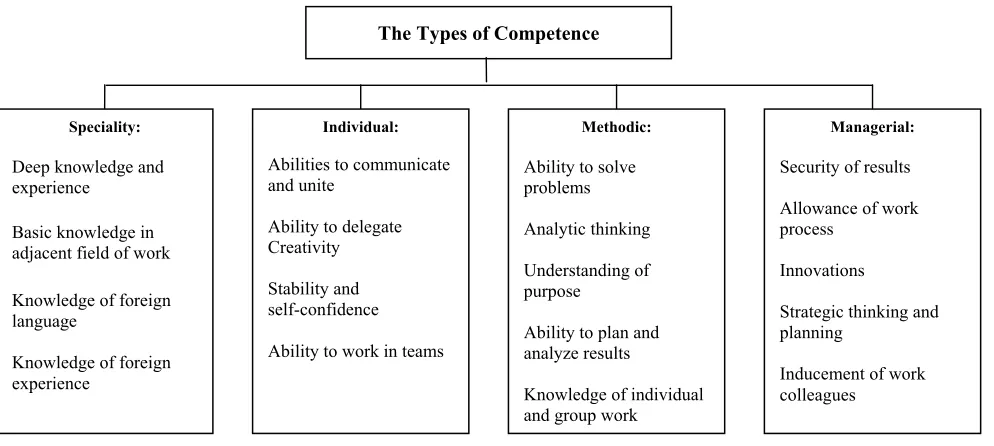
The experience of foreign researcher’s shows that only the wishes and activities of the members of the whole organization can lead to the expected results. It is very important to direct the activity of the whole organi-zation to these activities. Employees should be treated as a decisive factor of organization developments. This fea-ture manifests the distinct significance of the staff. More-over, employees’ obligations are very high and their role is very important. Employees’ competence becomes more and more important. V.I. Škatula (Skatula, 1998) singles out the following types of competences (Figure 1):
• speciality – ability to conceive and solve speciality problems;
• personal – personal development, ability to com-municate with people and groups of people; • methodical – participation in social processes; • managerial – management of the field.
Figure 1. Presents the constituents of general competence Thus, it could be concluded that rapid
environ-mental changes increasing competition and globalized market, close European integration processes require full commitment on the part of employees and activity itself. Competitive advantage is created by the following factors: loyalty, competence (knowledge and ability to use it) and work processes. Knowledge as any other
process should be managed. Knowledge management means intelligent knowledge accumulation seeking to optimize its use for the organization (Kėdaitienė, 2000). There exist several stages of knowledge man-agement: identification, acquiring, dissemination, distri-bution, expansion, application, preservation, assessment (Figure 2).
The Types of Competence
Speciality:
Deep knowledge and experience
Basic knowledge in adjacent field of work
Knowledge of foreign language
Knowledge of foreign experience
Individual:
Abilities to communicate and unite
Ability to delegate Creativity
Stability and self-confidence
Ability to work in teams
Methodic:
Ability to solve problems
Analytic thinking
Understanding of purpose
Ability to plan and analyze results
Knowledge of individual and group work
Managerial:
Security of results
Allowance of work process
Innovations
Strategic thinking and planning
Figure 2. Stages of knowledge process management
The research has been firstly related to knowledge dis-semination and application phases. Knowledge dissemina-tion is expressed by various terms in scientific economic lit-erature: “professional education and development” (Fried-man, 1998), “investment into human capital“ (Quinn, 1996; Nahapiet, 1998; Schultz, 1998, Starkevičiūtė, 1999). In this research we use these concepts in conveying knowledge to the subjects. The first group of investments comprises direct expenses assigned for the development of teachers’ profes-sional abilities and qualification. Thus, university manage-ment representatives (heads of departmanage-ments) are to ensure constant staff development. University should have the plan of constant staff development. Personal development is not only the matter of the staff, it is also the commitment of management. Staff development plan is an integrated docu-ment. The main thing is teaching, assessment is the secon-dary matter. The guru of quality management E. Deming paid much attention to training. He held that it was very im-portant to implement training programs and to create the at-mosphere of universal development. Training expenses should be considered as necessary investments. Qualifica-tion development is to engage all hierarchical levels. Start-ing with the top level management trainStart-ing is no the only thing, the staff should be motivated and motivation also needs expenses. The realization of quality conception is to be started from the top level. There should not be the situa-tion when you come to the chief with your own opinion and leave the office with the chief’s opinion.
The second group of investments includes the invest-ments which should create general university culture, at-tractive working conditions and payment system. There should not exist sphere barriers. Vertical barriers create communication issues between the management staff and staff. Horizontal direction raises the problems between structural units and their staff. Coherent ties appear when the quality system ensures the rationality of all plans and actions. The third group includes the investments that change the nature of the work itself. These investments are assigned for the development of work and objectives. A number of factors are singled out in economics, manage-ment and practice. These factors are successfully carried out by business sector, universities, governments and
non-governmental organizations (Anskaitis, 2000)
This research embraces only those factors, which help to improve employee’s work. People are not simple screws in both manufacturing and service processes. Much depends on them, and they should feel this. They are community members, and they could be identified with the organization itself. Person should be allowed to show himself/herself as a personality. Only then it is possible to speak about work quality. There should not be baseless tasks. Situations im-prove when employees get real tasks reflecting not only managers’ wishes but the possibilities of a real system.
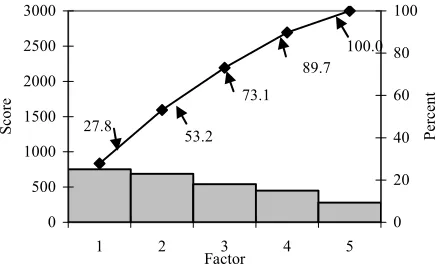
What conclusions could be drawn from these considera-tions? Seeking the answer to this question, the students’ atti-tudes towards knowledge quality acquired from business management programs has been investigated side by side with the study of the knowledge conformity to the require-ments of the present developrequire-ments. Fifty students of the Bachelor and Master studies of Lithuania Agricultural Uni-versity, took part in the investigation in 2002-2004. So called mind attack method has been used. According to this method, each student has been asked to write down five causes predetermining the quality of their studies. The in-formation obtained has been grouped according to similari-ties into five groups. Paret diagram has been used to present the influence of the causes in a decreasing order (Figure 3).
89.7 73.1
53.2
100.0
27.8
0 500 1000 1500 2000 2500 3000
1 2 3 4 5
Factor
Sc
or
e
0 20 40 60 80 100
Pe
rcent
Figure 3. Factors, influencing the quality level of studies: 1 - novelty of knowledge and information; 2 - study program-mers; 3 - competence of lecturers; 4 - financial lack for
imple-mentation of training devices; 5 - activity of students
Feedback
Objects of knowledge
Identification of knowledge
Obtaining knowledge
Development of knowledge
Preservation of knowledge
Application of knowledge
Dissemination of knowledge Assessment of
Figure 3 presents the factors determining the level of the knowledge conveyed to students. The factors have been presented in a decreasing order: 1) knowledge and infor-mation novelty – 27.8 %; 2) studies programs 25.4 %; 3) teachers competence – 20%; 4) shortage of finance for the implementation of new teaching aids – 16.6; 5) students’ activity – 10.3%. Thus, it could be concluded that earlier acquired knowledge needs constant innovation.
The quality of studies is very much dependent on the unification of quality regulations and norms as well as the introduction of European standards. The standards of In-ternational. Standardization Organization (ISO) are of the utmost importance. ISO standards are the basis of all ac-tivities.
There are educational institutions in Europe that have already created quality systems or they are in the devel-opment phase, however, only few of them have the cer-tificate of ISO series standardization in the field of man-agement systems. The biggest number of certificated educational institutions is in Great Britain, Germany, Holland and France. The standards of ISO 9000 series are mostly applied in technical universities because it is eas-ier for them than for humanitarian institutions to adapt to special requirements. Besides, the former are much closer related to business practice and can use their experience in creating quality systems (Adomaitienė, 2002; Ru-zevičius, 2004; Slatkevičienė, 2005).
Quality improvement and its support are not the only causes why universities seek to get the certificate of ISO 9000 series. The most important motive is interior need, e.g. studies programs, examination and assessment qual-ity. Furthermore, universities strive for better image be-cause ISO 9000 certificate can be some kind of an indica-tor for clients proving that the institution is very much interested in teaching quality (Hang, 1996).
The quality management system of ISO 9000 intro-duces strict documentation and management control, raises employees’ responsibility, motivates management staff to keep to the requirements. The universities that have introduced the quality management system assert that ISO 9000 certificate is neither obligatory nor suffi-cient condition to ensure the quality of educating and administrating, however, the certificate serves as a basis for constant improvement and indicates that the im-provement has already been achieved.
Implementation of the system of Total quality management
Quality is achieved through the introduction of qual-ity management system. This system has been created in order to improve the results of organization activity tak-ing into account the needs of all those who are interested in the issue, Quality management systems (QMS) and their introduction are rather complex issues, they call for bigger solutions on the part of the managerial staff and other employees. The experience of most universities shows that the introduction of Total Quality Management (TQM) is quite possible in higher schools, especially if the model has been created by the institution itself (Canic, 2000; Dew, 2000; Ho, 1996; Michael, 1997; Montano, 1999). The system is to be prepared according
to ISO 9001:2000 standard. Quality management system functions and is reliable when:
• The system is easily understood, implemented, controlled, renovated and producing results. • Products/ services satisfy clients’ needs and
ex-pectations.
• The system has been created taking into account the needs of society and environment.
• There is a possibility to stop the occurrence of problems.
Quality management system is usually applied for the whole activity concerning the quality of product/ service. The system should include all the stages of product life service: from the primary market need analysis to the to-tal satisfaction of need (Ramanauskiene, 2004). Typical stages of the realization of quality management system keeping in line with ISO 9000 series of standards are as follows:
Stage 1. Preparation work for the creation of quality management system:
• Decision to create quality management system (the order of the head of the organization);
• The preparation of the main program:
9 The study of ISO standards.
9 Formation of managerial and work groups for the introduction of ISO standards.
9 The analysis of the present elements of quality
system.
9 The formation of the program for quality sys-tem creation.
9 Preparation of quality policy.
9 Distribution of capacities and authorizations according to the functions of quality system.
Stage 2. The preparation and implementation of the documents of the quality management system:
9 Documentation structure and composition.
9 Working out the schedule for document prepa-ration.
9 Document preparation and implementation. Stage 3. The preparation of the quality management system for certification:
9 The assessment of the quality management
sys-tem (interior organizational audit with the help of consultants).
9 Correcting activities and their realization.
9 The choice of a certification institution,
docu-ments preparation.
9 Presentation of the order for a certification in-stitution.
9 Creation of certification conditions.
the very first steps as the effectiveness and the end result depend on them.
The implementation of the system according to ISO 9001 standard is motivated not only by clients’ require-ments, but by the need to guarantee high quality of teach-ing services accordteach-ing to the obligatory demands to im-prove educational process.
Not a single stage can be omitted in the realization of the model. If there is some need for the highest compe-tence, consultants could be hired. The motives for this might be as follows; 1) the practical application and in-terpretation of standards and their requirements; 2) need to save the time of organization employees; 3) a smoother process of implementation and less mistakes.
Introducing TQM universities should follow the
fol-lowing attitudes:
• Not to make any concessions that could decrease the quality of teaching services.
• To acknowledge mistakes and try to correct them. • Teaching services should be supplied according to
the most recent programs and with less expense. • To fix decent and unconditional relationships with
clients and suppliers.
• Not to make any decisions or to take actions that could worsen quality or consumers’ need satisfaction. Striving to achieve that the team of TQM implemen-tation were able to manage the process, its members should be trained according to TQM conceptions, meth-odologies and modern theories.
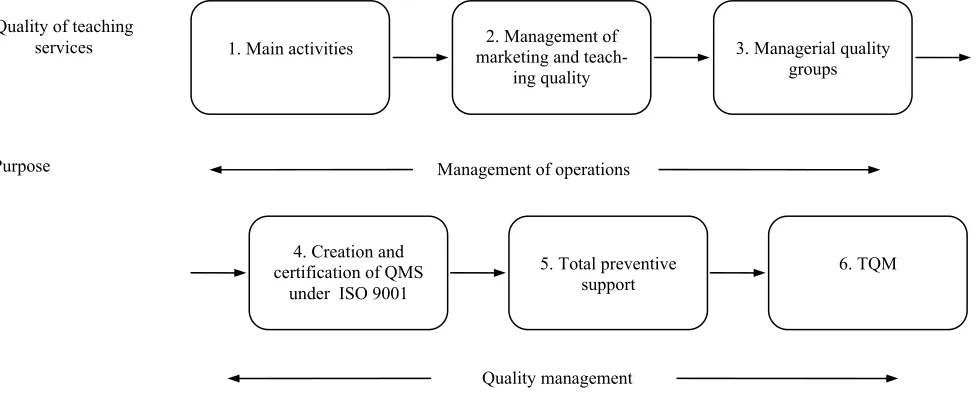
Figure 4. Model of total quality management implementation
Source: Composed under Ho S.K., Wearn K. (1996). A. Higher Education TQM Excellence Model: HETQMEX//Quality Assurance in Education. Vol. 4, No 2.
The applications algorithm of TQM in educational organizations is similar to that in business practice. TQM introduction is carried out through the following phases:
1)The main forms of activity are identified (organiza-tion, systemizing management, standardiza(organiza-tion, self-analysis), and they are obligatory to every em-ployee in order to ensure total quality environment. 2)Management of marketing and teaching quality
management. As marketing function is directly dependent on a client and activity effectiveness, its success is the main objective. TQM principles should be applied in every marketing aspect, e.g., students’ body formation needs exact and rapid in-formation.
3)Quality management teams, small groups are to independently manage quality in their working places. Educational development aspect is very important in such groups. It is important to teach group leaders and members to be ready to fulfill all tasks. Discipline programs could be created and improved by such groups, as well as knowledge
assessment methods, etc. The successful activities of these groups depend on the following condi-tions: informed and educated employees; authori-ties willing to share information; “group spirit” in the team; clear tasks in the hierarchical division; stimulating system.
4)The creation of the quality management system according to the standards of ISO series and certi-fication. This model should be realized in accor-dance with the previously mentioned sequence of ISO 9000 standards implementation.
5)Total support is expected. There should be created the system of all organizational equipment plan-ning, management control, ensuring the highest ef-fectiveness. Laboratory equipment, computer tech-nologies producing direct influence on teaching / learning process should be controlled in order to achieve the quality level of the services supplied. It could be concluded that the implementation of quality management system in higher schools is benefi-cial in these respects: better understanding of university Purpose
Quality of teaching
services 1. Main activities marketing and teach-2. Management of ing quality
3. Managerial quality groups
Management of operations
4. Creation and certification of QMS
under ISO 9001
5. Total preventive
support 6. TQM
vision, mission and objectives could be achieved; the in-volvement of all employees into the process of quality improvement increases university responsibility for teaching services; team work ensures students’, teachers’ and administration’s cooperation, better understanding of students’ needs, creates friendly atmosphere; constant improvement of teaching programs and process is under way; employees’ capabilities are used to the full, and business organizations start relying on educational insti-tutions, their product and service quality; competitive ad-vantage increases.
Conclusions
1)Teachers’ knowledge level and competence di-rectly determine studies quality. General teachers’ competence consists of the ability to perceive and solve specialty problems, ability to cooperate and participate in social processes as well as to manage activities.
2)Under the conditions of the present market reality, not only knowledge quantity is important, but also its effective use and adaptation in changing envi-ronment. Qualitative knowledge management, i.e. intelligent knowledge accumulation is to help to strive for studies quality.
3)Knowledge management stages are: identification, obtaining, development, dissemination, applica-tion, preservaapplica-tion, knowledge object distinguish-ing and assessment. The stages of knowledge use and development are the main phases in the stud-ies process. The leaders of the university structural units should ensure personnel’s qualifications de-velopment according to a constant staff develop-ment plan.
4)The main factors influencing studies quality level are presented in the following decreasing order: 1) novelty of knowledge and information – 27.8%; 2) study programs – 25.4 %; 3) teachers’ competence – 20%; 4) shortage of finance for new teaching aids – 16.6%; 5) students’ activity – 10.3%. 5)Optimal use of investment into knowledge
devel-opment can help to achieve positive results in in-creasing teachers’ competence, loyalty to studies, increase of quality level and higher qualifications. 6)The introduction of TQM can assist in better
knowledge quality. TQM standards according to ISO 9001 motivate clients' needs and higher level of university service in teaching process and its management.
References
1. Adomaitienė, R. Visuotinės kokybės vadybos diegimo ypatumai Vakarų šalių universitetuose / R. Adomaitienė, J. Ruževičius // Or-ganizacijų vadyba: sisteminiai tyrimai, 2002, No 22, p. 7−21. 2. Anskaitis, A. Kuo vertingos investicijos į žmones? / A. Anskaitis, V.
Bareišis // Ekonomika ir vadyba, 2000, No 2 (3), p. 7−11.
3. Barczyk, C. C. Visuotinės kokybės vadyba. Vilnius: Technika, 1998. 68 p.
4. Bieliūnas, M. Žinių vadybos praktinis taikymas: pokyčiai, kuriuos lemia ekonomikos tendencijos// Informacijos mokslai, 2000, No 14, p. 46−56.
5. Canic, M. J. Service Quality and Higher Education Do Mix / M. J.
Canic, P. M. McKarthy // Quality progress, 2000 September. 6. Dew, J. R. Roll Quality Roll. Strategic Quality Planning ar the
Uni-versity of Alabama // Quality progress, 2000, p. 49−54.
7. Ewans, J. R. Total Quality: Management, Organization and Strategy / J. R. Ewans, J. W. Dean. Mason: Thomphson, 2003. 375 p.
8. Friedman, M. Kapitalizmas ir laisvė. Vilnius: Mintis, 1998. 191 p. 9. Haug, P. Introduction of Total Quality Management (TQM) into the
Process of Teaching Management: a Diskussion of Initial Applica-tions / P. Haug, K. S. Keleman // Journal of Management Education, 1996, Vol. 20, No 3, p. 319−340.
10. Ho, S. K. Higher Education TQM Excellence Mdel: HETQMEX / S. K. Ho, K. A. Wearn // Quality Assurance in Education, 1996, Vol. 4, p, 35−42.
11. Hoyle, D. ISO 9000 Quality systems handbank, Buterworth Heine-mann, 2001.
12. Jucevičius, R. Strateginis organizacijų vystymas. 2 leidimas. Pa-saulio lietuvių kultūros, mokslo ir švietimo centras. Kaunas, 1998. 456 p.
13. Kėdaitienė, A. Marketingo žinios ir informacija: tarpusavio sąveika, valdymo proceso ypatumai bei organizavimo būdai. Marketingo te-orijos ir metodai: mokslinės konferencijos medžiaga. Kaunas: Dakra, 2000. 137 p.
14. Michael, R. K. Comprehensive Model for Implementing Total Qual-ity Management in Higher Education / R. K. Michael, V. E. Sower, J. A. Motwani // Bechmarketing for Quality Management & Techno-ligy, 1997, Vol. 4, No 2, p. 104−120.
15. Montano, C. B. Total Quality Management in Higher Education / C. B. Montano, G. H. Utte’r // Quality Progress, 1999 August, p. 52−59.
16. Nahapiet, J. Social capital, intelectual capital and the organizational advantage / J. Nahapiet, S.Ghoshal // Academy of Management Re-view, 23/2, 1998, p. 242−266.
17. Quinn, J. B. Leveraging intellect / J. B. Quinn, P. Anderson, S. Finkelstein // Academy of Management Executive, 1996, p. 7−27. 18. Ramanauskienė, J. Verslo vadybos studijų kokybę sąlygojantys
veik-sniai / Vagos: Mokslo darbai / LŽŪU. Akademija, 2004, No 65 (18), p. 80−85.
19. Ramanauskienė, J. The role of marketing information and consulting for developing rural tourism in Lithuania // Acta agraria et silvestria. Series agraria, sekcja ekonomiczna 44 (2). Vol. XLIV/2. Wydawnictwo oddziału Polskiej Akademii Nauk. Kraków, 2005, p. 335−344. 20. Ruževičius, J. Motivation and efficiency of quiality management
sys-tems implementation: a study of Lithuanian organizations / J. Ruževičius, R. Adomaitienė, J. Sirvydaitė // Total guality manage-ment and business excellence, London, 15 (2), 2004, p. 173−189. 21. Schultz, T. W. Investavimas į žmones: Gyventojų kokybės
eko-nomika. Vilnius: Eugrimas, 1998. 192 p.
22. Slatkevičienė, G. Quality policy impact on competition of organiza-tions / G. Slatkevičienė, R. Adomaitienė, J. Ruževičius, A. Marč in-skas // Quality management for organizational and regional develop-ment: Proceedings of 8th QMOD international conference. Palermo, 2005, p. 797−808.
23. Starkevičiūtė, M. Ekonomika. Pranešimas apie žmogaus socialinę
raidą Lietuvoje. Jungtinių Tautų atstovybė Lietuvoje. 1999. p. 37−46.
24. Tessun, F. Managing the Knowledge // The Power of Knowledge – From Research Findungs to Research Intelligence, 51-th. ESOMAR Marketing Research Congress. Berlin, 1998.
25. Vanagas, P. Visuotinės kokybės vadyba. Kaunas: Technologija, 2004. 427 p.
26. West J. Quality management principles: Foundation of ISO 9000:2000 family / J. West, Ch. A. Cianframi, J. J. Tsiakals // Quality Progres, February, 2000.
27. Žekevičienė, A. Lietuvos aukštojo mokslo integracijos į bendrą Eu-ropos aukštojo mokslo erdvę problemos visuotinės kokybės vadybos aspektu. Konferencijos „Kokybės vadybos vaidmuo Lietuvos ūkio globalizacijos procesuose” medžiaga. Kaunas: Technologija, 2005, p. 174−182.
28. Шкатулла, В. И. Настольная книга менеджмента по кадрам.
Jadvyga Ramanauskienė, Julius Ramanauskas
Visuotinės kokybės vadybos principų taikymas žinių formavimo procese
Santrauka
Organizacijoms dirbant nuolat kintančioje aplinkoje, didėjant konkurencijai ir globalėjant rinkoms, vis dažniau pereinama nuo kie-kybės prie kokybės. Šis procesas sparčiai didina valdymo, kompeten-cijos ir žinių svarbą, todėl svarbu ne tik turimų žinių kiekis, bet jų
kokybė, efektyvus panaudojimas bei nuolatinis peržiūrėjimas ir adap-tacija kintančioje aplinkoje, padėsiantys organizacijoms siekti numa-tytų tikslų.
Dabartiniame vadybos moksle sparčiai daugėja naujų terminų, teorijų, naujų problemų sprendimo būdų. Tai tarsi reakcija į sparčiai kintančias verslo aplinkos sąlygas. Be abejo, nauji valdymo metodai reikalingi, norint prognozuoti organizacijų ateitį. Anot daugelio Va-karų šalių mokslininkų ir praktikų, ateitis – žinių amžius, žinių orga-nizacijos – tai nauja ekonomika, verčianti organizaciją turimų žinių
pagrindu kurti naujus darbo metodus, kompetencijas ir procesus, val-dymo metodus bei organizacijų valdymo strategijas.
Lietuvai, kaip ir kitoms ES šalims, iškilo labai svarbus ir sudė -tingas uždavinys – sukurti efektyvią aukštojo mokslo kokybės užtik-rinimo sistemą, perimant pažangiausią Europos šalių patirtį ir kartu plėtojant savąją. Tad pagrindinis šio tyrimo klausimas, į kurį ieškoma atsakymo: kaip mokymo įstaiga turi valdyti, tobulinti ir perteikti ži-nias, kurti naujas programas, t.y. kokias studijų programas, naujus metodus ir priemones turėtų taikyti, kad būtų pasiektas atitinkantis šiuos laikus žinių kokybės lygis bei konkurencinis pranašumas ir jos veikla būtų sėkminga ir ilgalaikė. Tyrimo tikslas – nustatyti pagrindi-nius studijų kokybės lygį lemiančius veiksnius ir pasiūlyti jį
gerinan-čias priemones.
Teoriškai analizuojama problema pagrįsta mokslinės literatūros studija; praktinėje analizėje naudoti empiriniai duomenys, gauti ap-klausus 2002-2004 m. pagrindinių studijų ir magistrantūros studentus. Iškeltai problemai tirti ir teoriniams bei praktiniams rezultatams gauti naudoti bendramoksliniai ir specialūs tyrimo metodai: sisteminė ana-lizė, loginė analizė, ekspertinio vertinimo metodas tiriant bei nusta-tant veiksnius, lemiančius studijų kokybę; reiškinių priežastinio ryšio metodas ir Pareto dėsnis grupuojantveiksnius ir tiriant jųįtaką tyri-mo objektui.
Remiantis užsienio šalių patirtimi, pažymėtina, kad be visos or-ganizacijos narių noro ir kompetentingos veiklos negalima pasiekti norimo rezultato. Reikia sugebėti reikiamai nukreipti organizacijos veiklą, įtraukiant ir visus jos darbuotojus. Darbuotojai turi būti trak-tuojami kaip lemiamas organizacijos veiklos plėtojimo veiksnys. Jau vien tai pabrėžia jos darbuotojų išskirtinumą. Be to, šiais laikais dar-buotojams keliami ypač aukšti reikalavimai, ir jų vaidmuo ypač dide-lis. Tad vis svarbesnė organizacijai tampa darbuotojų kompetencija. V. Škatulla išskiria šias kompetencijos rūšis: specialybės – sugebė ji-mas suvokti ir išspręsti dalykines ir specialybės problemas; asmeninė
– asmens išsivystymas, bendravimas su žmonėmis ir kolektyvu; me-todinė – dalyvavimas socialiniuose procesuose; valdymo – savo dar-bo srities valdymas. Kiekvienos šių rūšių kompetencijos indėlis į
bendrąją tikslo siekimo sėkmę didina organizacijos konkurencinį pra-našumą.
Tad konkurencinį pranašumą sukuria toks trijų stiprybių derinys: lojalumas, kompetencija (žinios ir sugebėjimas jomis naudotis) bei darbo procesas. Žinias, kaip ir bet kurį kitą procesą, reikia valdyti. Paprastai skiriami šie žinių valdymo etapai: identifikavimas; įgijimas, plėtojimas, paskirstymas ir naudojimas, išsaugojimas, žinių objektų
išskyrimas ir vertinimas. Atliekant tyrimą pirmiausia buvo domėtasi žinių plėtojimo ir naudojimo etapais. Moksliniuose ekonomikos vei-kaluose žinių plėtojimą (investicijos į darbuotojų mokymąsi) įvairūs autoriai (Schultz, Starkevičiūtė, Nahapiet, Ghoshal, Quinn, Anderson, Finkelstein, Friedman ir kt.) vadina įvairiais terminais – „profesinis švietimas ir lavinimas”, „investicijos į žmogiškąjį kapitalą” ir pan.
Šiame tyrime, taikant šias sąvokas žinių perteikimo subjektams (t.y. dėstytojams), pirmajai investicijų grupei priskiriamos tiesioginės iš-laidos dėstytojų profesiniams sugebėjimams gerinti, jų kvalifikacijai kelti. Antrajai investicijų grupei reikėtų priskirti tas investicijas, ku-riomis būtų sukuriama bendroji universitetinė kultūra, patrauklios darbo sąlygos ir atlyginimo už darbą sistema. Trečiajai grupei galima priskirti investicijas, keičiančias paties darbo prigimtį ir skiriamas darbo procesui ir jam keliamiems tikslams tobulinti. Ekonomikos ir vadybos moksluose bei praktikoje išskirta grupė veiksmų, kuriuos vienodai sėkmingai vykdo verslo sektorius, universitetai, vyriausybi-nės ir nevyriausybinės organizacijos. Šis tyrimas apima tik tuos veiksnius, kuriais tobulinami studijų procesai.
Tyrimo procese nustatyti veiksniai, lemiantys studentams tei-kiamų žinių kokybės lygį. Šių veiksnių rangavimas pagal lyginamąjį
svorį mažėjančia tvarka atrodo taip: 1) žinių ir informacijos naujumas – 27,8 proc. 2) studijų programos – 25,4 proc.; 3) dėstytojų kompe-tencija – 20 proc.; 4) lėšų trūkumas naujoms mokymo priemonėms diegti – 16,6 proc; 5) studentų aktyvumas – 10,3 proc. Taigi galime teigti, kad nepamirštant tos naudos, kurią teikia praeities žinios, bū ti-na sekti ti-naujoves kaip svarbiausius studijų pažangos komponentus.
Didelęįtaką studijų kokybės orientacijai turi taisyklių ir kokybės
normų unifikacija, vienodų europinių standartųįvedimas. Be to,
ypa-tingą reikšmę kokybės pranašumui įsigyti turi Tarptautinės
standarti-zacijos organistandarti-zacijos (ISO) serijos standartai. Organizacijoms,
nau-dojančioms šią orientaciją, ISO standartai tapo pagrindiniu jų
veik-los elementu.
Europoje yra mokymo institucijų, kuriose jau sukurtos kokybės sistemos arba atliekami jų rengimo darbai, tačiau dar nedaugelis jų
turi ISO serijos standarto kokybės vadybos sistemos atitikties sertifi-katą. Daugiausia sertifikuotų mokymo institucijų yra Didžiojoje Bri-tanijoje, Vokietijoje, Olandijoje ir Prancūzijoje. ISO 9000 serijos standartus dažniausiai taiko techninio profilio universitetai, nes jie lengviau prisitaiko prie reikalavimų nei humanitarinių mokslų insti-tucijos. Be to, pirmieji turi daugiau ryšių su verslo praktika ir pasi-naudoja jos patirtimi kuriant kokybės sistemas. Kokybės gerinimas ir palaikymas nėra vienintelė priežastis, kodėl universitetai siekia gauti ISO 9000 serijos sertifikatą. Daugumos mokymo institucijų kokybės sistemų diegimo svarbiausiu motyvu buvo vidaus poreikiai, pavyz-džiui, mokymo programų, studentų egzaminavimo ir įvertinimo ko-kybės užtikrinimas ir kt. Be to, universitetai siekia geresnio įvaizdžio, kadangi ISO 9000 sertifikatas gali būti rodiklis, kad institucija dera-mai rūpinasi mokymo kokybe.
Įdiegta ISO 9000 kokybės vadybos sistema sugriežtina doku-mentacijos ir vadybos kontrolę, išryškina darbuotojų konkrečią atsa-komybę, suteikia vadovams tikrumą, kad laikomasi nustatytų standar-tų ir procedūrų. Universitetai, įdiegę kokybės vadybos sistemą, tvirti-na, kad ISO 9000 sertifikato gavimas nėra nei būtina, nei pakankama sąlyga užtikrinti mokymo ar administravimo kokybei, tačiau sertifi-katas gali suteikti pagrindą, kuriuo būtų siekiama nuolatinio gerinimo bei patvirtina, kad tai jau pasiekta. Be to, įdiegti kokybės vadybos sistemą motyvuoja ne tik klientų (organizacijų, kur dirbs būsimieji specialistai) reikalavimai, bet ir universiteto poreikiai garantuoti aukštą studijų paslaugų kokybę, gerinti studijų proceso valdymą.
Kokybės vadybos sistemos taikymo mokymo organizacijoje al-goritmas yra panašus į naudojamą verslo praktikoje.
Apibendrinant galima teigti, kad, aukštojoje mokykloje į gyven-dinus kokybės vadybos sistemą, efektas pasiekiamas šiais pagrindi-niais aspektais: išsamesnis universiteto vizijos, misijos ir tikslų suvo-kimas; visų darbuotojųįtraukimas į kokybės gerinimo procesą sustip-rina universiteto atsakingumą už teikiamas mokymo paslaugas; ko-mandinis darbas užtikrina studentų, dėstytojų ir administracijos ben-dradarbiavimą, palengvina įsiklausymą į studentų poreikius, sukuria draugišką atmosferą; vyksta nuolatinis mokymo programų ir mokymo proceso tobulinimas; geriau panaudojami darbuotojų sugebėjimai ir išauga verslo vadovų pasitikėjimas mokymo institucijos teikiamu produktu ir paslaugų kokybe; didėja konkurencinis pranašumas.
Raktažodžiai: žinos, informacija, kompetencija, kokybė, vadyba..
The article has been reviewed.