Increasing Business Transparency by Corporate Social Reporting: Development
and Problems in Lithuania
Lina Dagiliene
1, Sviesa Leitoniene
1, Adriana Grencikova
21
Kaunas University of Technology
Laisves av. 55, LT-44309, Kaunas, Lithuania
E-mail. [email protected], [email protected]
2
Alexander Dubcek University of Trecin Studentska st. 3, 91150 Trecin, Slovakia E-mail. [email protected]
http://dx.doi.org/10.5755/j01.ee.25.1.2356
The paper analyzes a transparency of business activities in relation to social reporting issues. Investors, customers, employees and other stakeholders are less trustful in recent decades. While rethinking what is needed to build trust in business environment, one of the most important subjects to discuss is increasing of business transparency because companies that are in conflict with their stakeholders cannot survive for a long run. Thus, corporate social reporting serves as a true opportunity to improve trust and competitiveness.
Companies report on social issues under many different communication forms such as corporate social responsibility report, sustainability report, report to society, social report, communication on progress, social information disclosure on their websites or even annual reports. European countries, including Lithuania, haven’t formed a single system of corporate social reporting as social disclosure is voluntary. Thus, not only a relatively small number of companies make these statements, but at the same time they are different in content and structure, and therefore not always comparable. Stakeholders, assessing companies in the context of social responsibility and making socio-economic decisions, have no opportunity to use understandable and comparable information on human resources, products, environment control and public services. Thus the research question is directed to the identification of problems of corporate social reporting development both at the institutional and organizational levels.
The objective of this paper is to analyze problems of social reporting and disclosure in Lithuania in order to increase the transparency of business activities. The research methods applied in this article are analysis of legal acts, logical and comparative analysis OFM scientific literature, dynamic and social reporting content analysis, problem analysis. As the article refers to corporate social reporting development in Lithuania, there is the theoretical background of researches mainly made in Lithuania carried out. This paper also presents the problems of social reporting in Lithuania from institutional and organizational views, the results from empirical researches of companies‘ disclosed social information. The findings of the article show that still more declaratory socially responsible business ideas dominate in Lithuania, while the actual manifestation of social reporting is in the initial level. At the same time the most important thing should be the process of implementation of socially responsible business, as social reporting is rather a process for better business transparency than just a document. The process of corporate social reporting may be improved by strengthening legal framework and improving legal conditions for voluntary reporting. But at the same time the regulatory mechanism is not enough because trust is always related to main values driving the companies and their managers.
Keywords: business transparency, corporate social reporting, social responsibility, stakeholders, social accounting.
Introduction
The main goal of social accounting and reporting is to create a social transparency system for responsible decision-making and company„s communication with stakeholders. Social reporting issue is the logical part of social accounting approach which determines that companies should provide also non-financial information in order to satisfy the goals of stakeholders concerned. It is even possible to say that the product of social accounting process is social reporting. It should be mentioned that not only the fact of disclosed information about company„s environmental and social activity is important, but also the assessment of such activity by the stakeholders, i.e. if they consider the company is social responsible. The European
issues (Laine, 2010; Adams & Kuasirikun, 2000; Camara
et al., 2009; O‟Dwyer et al., 2005). Laine (2010) even argues that over time sustainability seems to have transformed from a possibly revolutionary concept into an evolutionary one.
This paper analyzes the problems of social reporting in Lithuania due to its development from institutional and organizational view. Empirical researches of social responsibility and social accounting in Lithuanian companies are sporadic and fragmented. The major part of researches is of educative and incentive nature and has been initiated and implemented by national institutions. In 2007, the study of the legal framework in Lithuania regarding the factors that promote and impede corporate social responsibility (CSR) was carried out. In 2010, the investigation “Social responsibility self-assessment guide for business” was carried out. In these studies the focus is on socially responsible business idea, while lacking emphasizing social reporting importance as consequences of CSR. Lithuania has a relatively recent development of socially responsible business and social reporting, e.g. it became a member of the Global Compact only since 2005. Thus the research problem is raised by the question: what are the problems of corporate social reporting development in Lithuania in the context of increasing business transparency?
The objective of this paper is to analyze problems of social reporting and disclosure in Lithuania in order to increase the transparency of business activities. The
research methods are analysis of legal acts, logical and comparative analysis of scientific literature, dynamic and social reporting content analysis, problem analysis.
Corporate Social Accounting and Reporting
Theoretical Research in Lithuania
The rapid economic development of the environmental problems encountered, and later emerged during the economic crisis, social problems, prompting leaders to take into account economic development, environmental and social problems together and to implement economic development model that would ensure sustainable development. As a result of pressure from stakeholders to implement, the concept of sustainable development promotes company's management decisions related to their social responsibilities. To inform the public about the policies in this area, companies provide environmental protection, sustainability reports, or publish social information on their websites. In order to prepare reports on the organization's interaction with the environment, employees, community, customers and other stakeholders the specific social information must be available. Traditional financial and management accounting systems provide only a small part of required information. It is developed in a separate accounting areas - social accounting.
Social accounting and reporting are the performance monitoring and evaluation system required to ensure compliance with company business environment, economy and society. Social accounting, unlike financial accounting, reveals company's contribution to society. It is related to ethical business behavior, which contributes to human and planetary well-being.
The recent development of CSR is a growing role of social accounting, which includes social and environmental information collection, analysis and presentation to the stakeholders. The main source of information for CSR is social reporting. Social responsibility report is a document of the company, which provides information about company's planned and ongoing social and environmental performance, taking into account the results already achieved and thus company informing stakeholders about responsible business practices. However, social information may be disclosed in annual reports, environmental reports, social responsibility (progress) reports, sustainability reports and websites. Although corporate social responsibility reports vary, but in general they are prepared in accordance with the principles of the Global Compact, which includes human rights, improvement of relations with employees, the environment and fighting corruption. Thus different social reports disclose social information of companies‟ activities
In recent decades in the world, as well as in Lithuania, there is a lively debate and research in socially responsible business ideas in the context, but the accounting system responds slowly to changes. In Lithuania, like other EU countries, investigations are still concentrated on the promotion of CSR ideas (Ruzevicius & Serafinas, 2007; Bernatonyte & Simanaviciene, 2008; Juscius & Snieska, 2008; Ruzevicius, 2008; Dagiliene, 2009; Amstromskiene & Adamoniene, 2009; Juscius, 2009; Bernatonyte et al.,
2009; Ruzevicius, 2009; Dagiliene & Bruneckiene, 2010; Bagdoniene & Paulaviciene, 2010; Simanskiene & Pauzoliene, 2010; Simanaviciene et al., 2011; Dagiliene & Gokiene, 2011; Leitoniene & Sapkauskiene, 2012, Valackiene & Miceviciene, 2011). Most of these economic investigations is designed for research and development tendencies of CSR initiatives in Lithuania (Ruzevicius & Serafinas, 2007; Amstromskiene & Adamoniene, 2009; Bernatonyte et al., 2009, Juscius, 2009; Ruzevicius, 2009), i.e. the institutional approach is dominated. This research direction could also be attributed to SWOT analysis of CSR policy in Lithuania made by Simanaviciene et al.,
2011. Other investigations are designed for integration of social responsibility and organizations management systems (Bernatonyte & Simanaviciene, 2008; Juscius & Snieska, 2008; Bagdoniene & Paulaviciene, 2010; Simanskiene & Pauzoliene, 2010), i.e. the organizational approach dominates. In this regard, previously mentioned researches of CSR initiated by national institutions and implemented in 2007 and 2010 are also important.
The Lithuanian accounting researchers work focuses on the presentation of social accounting information (Vaskeliene & Selepen, 2008; Legenzova, 2008; Dagiliene, 2009; Dagiliene & Bruneckiene, 2010; Dagiliene & Gokiene, 2011; Leitoniene & Sapkauskiene, 2012). Political, social and cultural changes create the need to gather and analyze information about social and environmental factors, and determine the changes in traditional accounting systems. The first studies in this field analyzed only the additional information, it‟s quality, quantity and presentation in financial statements (Vaskeliene & Selepen, 2008; Legenzova, 2008; Dagiliene, 2009).
in annual reports. Dagiliene and Bruneckiene (2010) analyzed the role of voluntary disclosure aspect of CSR. Dagiliene and Gokiene (2011) carried out the valuation of social responsibility reports of Lithuanian companies. In 2012 Leitoniene and Sapkauskiene investigated social disclosures in corporate social reporting. These studies distinguished that the basic social accounting problem in Lithuania is the limitations of corporate social accounting regulation. This refers to the traditional accounting principles and accounting standards, legal acts and voluntary social reporting, management systems standards. Lithuania, which became the EU member and contributing to the Lisbon strategy, formulated the goal – to create a competitive and dynamic knowledge-based economy based on sustainable economic development, harmonious relations between business, government and civil society representatives on the implementation of CSR - has been approved by the development of vision and its implementation in priority areas. However, the legal presumption of CSR initiatives was created in Lithuania„s accession to the EU period. In 2003–09–11 Lithuanian Government approved the National Strategy for Sustainable Development. Under this strategy and other CSR initiatives in promoting the legal acts, Lithuanian companies on their willingness to assume additional responsibilities to improve business practices, introduce modern human resource management technologies, implement natural resource-efficient technologies, manufacturing processes used for human health-friendly materials, creating strategic business plans for possible negative effects of natural and social environment, harmonizing labor relations and actively participate in social dialogue. However, it should be noted that social accounting research is characterized by an eclectic approach. There is a lack of highlighting the element of social accounting systems and its disclosed information as CSR consequences. Methodological aspects of the social reporting are not sufficiently explored also.
Reseach Methodology for Corporate Social
Reporting
The empirical study is to investigate corporate social reporting in Lithuania, using a dynamic and social reporting content analysis and problem analysis.
The article presents a dynamic analysis of the years 2008-2011 according to the number of social reports and socially responsible business number.
In response to found out abuses in companies reports of recent years, many countries have taken initiatives to review the accounting principles, in order to increase business transparency. Usually social reporting contains various issues that raise interest of stakeholders: human rights and human resources, product design and development, environmental protection, bribery and community. The Global Reporting Initiative (GRI) is one of the most popular non-governmental initiatives in the social and sustainable performance reporting and standardization and this methodology refers to reporting economic, social and environmental information based on corporate performance. In this article, social reporting content analysis was carried out by the three major Global
Compact principles on human and labor rights, environmental protection, amti-corruption. In this study, content analysis was a measure of social reports, submitted by the number of sentences about corporate social responsibility, i.e. on human and labor rights, environmental protection and anti-corruption measures.
There were investigated social responsibility reports of companies belonging to the Lithuanian National Responsible Business Network of the period 2006–2010. During the analyzed period 52 social responsibility reports were presented. Problems that hinder the development of corporate social reporting have been grouped into two types: 1) institutional, 2) organizational. As the policy of CSR of the organization is formulated by legal framework of the country and the needs of stakeholders, it is noted that one part of the problems is related to mandatory regulations, laws, methodological guidelines and etc. These problems are called institutional problems. The other group of the problems is related to the implementation of responsible business principles and its promotion in companies. These problems are called organizational ones.
Corporate Social Reporting In Lithuania:
Current Situation and Problems
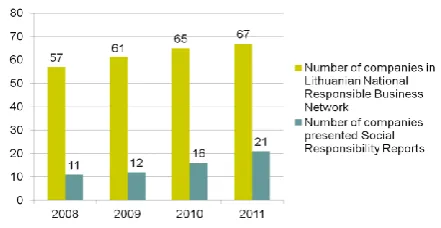
The biggest voluntary initiative of CSR worldwide is Global Compact. Since 2005, there is the National Responsible Business Network operating as a part of the Global Compact initiative in Lithuania. Companies that joined the Global Compact, declare that they apply 10 principles of social responsibility, disclosing in annual social reports for stakeholders. Dissemination and promotion of CSR initiative in the network is expanding every year. According to the annual activity reports of the National Responsible Business Network this network comprises 57 companies and organizations in Lithuania in 2008, 61 – in 2009, 65 – in 2011, 67 – in 2012. The fastest connection has already become apparent in 2011, at the beginning of January to April when 10 new companies joined to the Network. Companies are removed from the National Network in the cases of interruption of business collaboration and the absence of obligatory social reports within a certain period. However, this is rather a formal statement. Although the National Network in Lithuania is expanding, it should be noted that members often delay in reporting or do not report as a whole: only 11 organizations (out of 57 members) presented social responsibility reports in 2008, 12 organizations – in 2009, 16 – in 2010 and 21 – in 2011.
First of all, in Lithuania, like in many developing countries, the promotion of business disclosure about its social activities started in state institutions and professional organizations in the initiative. Laws and regulations are adopted that encourage companies to submit compulsory financial information in the financial statements and annual reports. Law on Financial Statements of Entities (Article
25, paragraph 2) and Law on Consolidated Accounts of Entities (Article 9, paragraph 2) establish a mandatory rule only on financial disclosure, and companies that must prepare an annual report from the financial and non-financial performance analysis should present “the environmental and employee matters related information”.
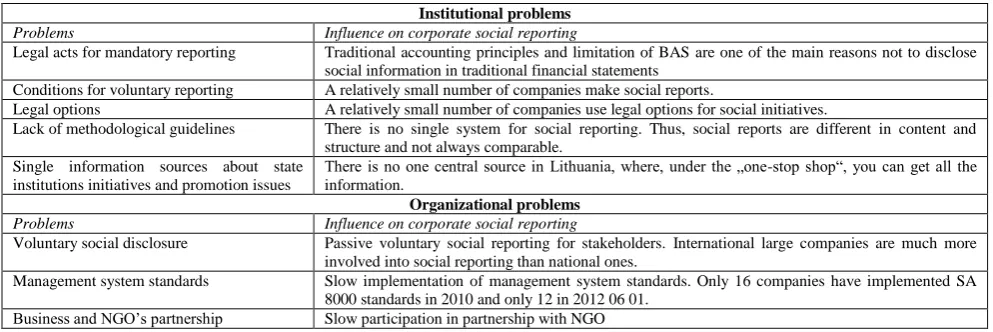
Table 1
Institutional and organizational problems of corporate social reporting in Lithuania (created by the authors)
Institutional problems
Problems Influence on corporate social reporting
Legal acts for mandatory reporting Traditional accounting principles and limitation of BAS are one of the main reasons not to disclose social information in traditional financial statements
Conditions for voluntary reporting A relatively small number of companies make social reports.
Legal options A relatively small number of companies use legal options for social initiatives.
Lack of methodological guidelines There is no single system for social reporting. Thus, social reports are different in content and structure and not always comparable.
Single information sources about state institutions initiatives and promotion issues
There is no one central source in Lithuania, where, under the „one-stop shop“, you can get all the information.
Organizational problems
Problems Influence on corporate social reporting
Voluntary social disclosure Passive voluntary social reporting for stakeholders. International large companies are much more involved into social reporting than national ones.
Management system standards Slow implementation of management system standards. Only 16 companies have implemented SA 8000 standards in 2010 and only 12 in 2012 06 01.
Business and NGO‟s partnership Slow participation in partnership with NGO
These laws provide that generally accepted accounting principles should be applied to the financial statements. Traditional accounting principles and limitations of Business accounting standards (BAS) are one of the main reasons for determining corporate decision not to disclose social information in traditional financial statements. The prevailing accounting theory developed over a long period of time, while social disclosure is a new area of accounting. For this reason, some existing generally accepted accounting principles and standards restrict the disclosure of social opportunities. The main objective of financial statements is to reflect a true and fair view of the state of the company and must include policies on social responsibility policy as well. However, such accounting principles as the implementation and viability of information comparability complicate the social information inclusion in mandatory reporting. Thus, the social demand for information requires major changes in traditional accounting models, but now there are mandatory reporting principles limitations due to the fact that social information is provided only for voluntary reports.
Also, companies listed on the NASDAQ OMX Vilnius Stock Exchange must comply with the the Code of Corporate Governance, which encourages companies to disclose information adequately for the market. This document recommends that listed companies comply with certain standards of transparency and ensure the quality of management, to improve disclosure to shareholders, in order to increase confidence of investors and other stakeholder groups. The Code does not recommend specifically how and how much the company should provide information about social and environmental business risks. Although provisions of the Code of Corporate Governance for listed companies on the NASDAQ OMX Vilnius are much more specific than the legal requirements mentioned above, but these requirements are summarized in the form and may be
treated differently. Thus, corporate social information is different in scope and quality. For this reason, in 2012 guidelines for CSR have been developed, aim of which is to help Stock Exchange listed companies to apply social and environmental requirements of business and to increase the transparency of social reporting.
Thus, Lithuanian laws determine what information should be disclosed at the minimum level. It depends on company‟s voluntary information disclosure (Dagiliene, 2010). However, aspects of social reporting are not defined by law. Compulsory corporate social reporting is specified in more than one European country. The European Commission has approved the EU Accounts Modernisation Directive Guide, which provides that a certain amount of the companies must provide not only financial information but also information about the employees and the environment. It is likely that many countries will follow these recommendations. In Lithuania there are also attempts to make the social reporting compulsory by accepting the Law of Corporate Social Initiatives. This law is intended to only one area within the meaning of CSR, corporate social responsibility to employees and their family members.
annual reports (e.g. AB Achema group, AB ORLEN Lithuania "concern" MG Baltic ").
Figure 1. Dynamics of social reporting in 2008–2011 (created by
the authors)
In the report of CSR at the national level progress in Lithuania in 2008–2010 (prepared by the UNDP project "Gateway: Social and environmental innovation”), information provided in websites of 100 largest Lithuanian companies has been analyzed. The results of investigation show that a large share of companies disclose information about their socially responsible activities. Some companies have a separate section of the CSR and the environment. In addition, Leitoniene and Sapkauskiene (2012) investigated that in the period of 2006–2010, only three companies, one of which AB TEO LT has provided the annual social responsibility report; one company provided four reports since 2007, four have submitted three social reports, while the remaining provided two or one.
The part of social responsibility reports is prepared and publicized because some companies participate in the National Responsible Business Network. Social responsibility reports of such companies (i.e. Communications on Progress) are prepared by the Global Compact principles. There is a space available in electronic reporting tool for the Lithuanian language. For example, Swedbank AB, UAB Medical bank, Ukio Bankas prepare their reports by the Global Compact 10 principles. But as shown in the study of Leitoniene and Sapkauskiene (2012), social responsibility reports differ in the extent of social information and quality (Figure 2). The main reason for differences in social information is the scope and content of the individual sectors varied business specifics, stock listings, foreign investment and environmental pollution.
International guidelines for voluntary reporting partially solve this problem. GRI initiative is designed to CSR reporting requirements of the application of a particular company, depending on the area. The main objective of GRI is to develop voluntary reporting rules that are applied on a global scale and to ensure the quality of the information, consistency and practical use. Sustainability reporting guidelines consist of principles and indicators that are used to measure economic, environmental and corporate social progress. However, GRI principles are criticized because they focus on the presentation of information about the environment, so there is no equilibrium between the three components of sustainable development. In addition, the United Nations Environment Program and Public Environmental Reporting Initiative interest in voluntary environmental reporting concepts. GRI methodology is not very popular
in Lithuania. Only the mature companies in the field social responsibility (e.g. AB TEO LT, AB SEB Bank) use it.
( )Analyzed number of companies in a given sector
Figure 2. Results of social information disclosure in
Communications on progress in 2006–2010 (created by the authors)
The state of legislation has provided a number of measures that could encourage companies to integrate CSR concept or specific measures in their activities. In addition, some measures are new, some of them have not even been started to apply (e.g. Implementation program of green procurement, companies‟ annual reports of environmental and personnel issues, etc.). This shows that companies lack information about how they can use their legal options.
At present in Lithuania there is no one central source, where, under the “one-stop shop”, you can get all the information about state institutions initiatives of socially responsible business development and promotion issues. Lithuania emerged in recent years, the organizations that are supervised by corporate social reporting are: Lithuanian National Responsible Business Network as the part the Global Compact, and association “Investors‟ Forum” initiative of “Clear Wave”.
system was 1099 in 2010 (and 1246 in 2012–06–01); the number of companies registered certificated environmental protection management system was 638 in 2010 (and 727 in 2012–06–01). 157 companies have implemented certificated Employee Safety and Health Service Management Systems in 2009 and even 369 in 2010 (and 437 in 2012–06–01). The number of companies that implemented other certificated management systems is 89 in 2009 and 151 in 2012–06–01. And only 16 companies have implemented SA 8000 standard in 2010 and only 12 in 2012–06–01. On the one hand, social responsibility management systems are still not widespread in Lithuania. On the other hand, the question about better transparency and benefits of the use of social standards should be raised.
Conclusions
Analyzing the problems of corporate social reporting in Lithuanian companies, these main conclusions were made:
Lithuanian companies faced institutional and organizational problems that hamper the development of corporate social reporting in Lithuania and at the same time decrease the level of business transparency.
Institutional problems are related to current inadequate legal framework for social accounting and reporting; they could be solved with the support of state institutions and professional organizations. These problems could be attributed to traditional legal acts and standards for accounting, limitations of regulation for mandatory and
voluntary reporting, lack of application of legal options for social initiatives, promotion of business and NGO„s partnership, creation and coordination of single source for social information, lack of methodological guidelines.
Organizational problems are related to the implementation of responsible business practice and its promotion in business company. These problems (the voluntary preparation and publication of social reporting to the stakeholder groups, implementation of actual management system standards and disclosure this information, participation in business and NGO„s partnership) are largely dependent on the company„s manager and the potential of human resources as the manager is responsible for the company.
As the key insight it should be noted that still more declaratory socially responsible business ideas dominate in Lithuania, while the actual manifestation of social accounting and reporting is in the initial level. At the same time the most important thing should be the process of implementation of socially responsible business, as social reporting is rather a process for better business transparency than just a document. The process of corporate social reporting may be improved by strengthening legal framework and improving legal conditions for voluntary reporting. But at the same time, regulatory mechanism is not enough because trust is always related to values driving the companies and their managers.
References
Adams, C. A., & Kuasirikun, N. (2000). A comparative analysis of corporate reporting on ethical issues by UK and German chemical and pharmaceutical companies. European Accounting Review, 9(1), 53–79. http://dx.doi.org/ 10.1080/096381800407941
Analysis of the Republic of Lithuania the legal framework for the promoting and hindering factors of corporate social responsibility (2007). Available from internet: http://www.socmin.lt/index.php?1998324661.
Astromskiene, A., & Adamoniene, R. (2009). Tendencies of enterprise social responsibility initiatives in Lithuania.
Economics and Management - 2009, 217–221.
Bagdoniene, D., & Paulaviciene, E. (2010). The integration of social responsibility and organizations management system.
Economics and Management - 2010, 366–373.
Bebbington, J., Gray, R., & Larrinaga, C. (2000). Environmental and social accounting in Europe. European Accounting Review, 9(1), 3–6. http://dx.doi.org/10.1080/713764847
Bernatonyte, D., & Simanaviciene, Z. (2008). Cases study of corporate social responsibility in Lithuania business society.
Business and Management, 501–505.
Bernatonyte, D., Vilke, R., & Keizeriene, E. (2009). Economic crisis impact directions concerning corporate social responsibility in Lithuanian SME. Economics and Management–2009, 229–234.
Bonacchi, M. (2009). Corporate Social Responsibility: Readings and Cases in a Global Context. European Accounting Review, 18(3), 641–644. http://dx.doi.org/10.1080/09638180903162247
Camara, M., Chamorro, E., & Moreno, A. (2009). Stakeholder Reporting: The Spanish Tobacco Monopoly (1887–1986).
European Accounting Review, 18(4), 697–717. http://dx.doi.org/10.1080/09638180902863753
Capron, M., & Gray, R. (2010). Experimenting with assessing corporate social responsibility in France: an explanatory note on an initiative by social economy firms. European Accounting Review, 9(1), 99–109. http://dx.doi.org/ 10.1080/096381800407969
Code of Corporate Governance for the Companies Listed on NASDAQ OMX Vilnius (2006). Source: http://www.nasdaqomxbaltic.com/files/vilnius/teisesaktai/The%20Corporate%20Governance%20Code%20for%20th e%20Companies%20Listed%20on%20NASDAQ%20OMX%20Vilnius.pdf.
Dagiliene, L. (2010). The research of corporate social responsibility disclosures in annual reports. Inzinerine Ekonomika-Engineering Economics, 21(2), 197–204.
Dagiliene, L., & Bruneckiene, J. (2010). The role of voluntary disclosure information in the context of social responsibility. Economics and Management -2010, 451–456.
Dagiliene, L., & Gokiene, R. (2011). Valuation of corporate social responsibility reports. Economics and management
-2011, 21–27.
Franci, J., Nanda, D., & Olsson, O. (2008). Voluntary disclosure, earnings quality and cost of capital. Journal of Accounting Research. http://dx.doi.org/10.1111/j.1475-679X.2008.00267.x
Global Reporting Initiative – GRI. Source: https://www.globalreporting.org/Pages/default.aspx.
Gray, R., Javad., M., Power, D. M., & Sinclair. C. D. (2003). Social and environmental disclosure and corporate charastersitics: a research note and extension. Journal of Business Finance & Accounting, 28(3/4), 327–356. http://dx.doi.org/10.1111/1468-5957.00376
Guidelines for Corporate Social Responsibility Stock Exchange listed companies: methodological tool to improve the responsibility of the ISA in 2012. Source: http://www.undp.lt/index.php?page=leidiniai&hl.
Holder-Webb, L., Cohen, J. R., Nath, L., & Wood, D. (2009). The supply of corporate social responsibility disclosures among U.S. firms. Journal of Business Ethics, 84, 497–527. http://dx.doi.org/10.1007/s10551-008-9721-4
Inchausti, B. G. (1997). The Influence of company characteristics and accounting regulation information disclosed by Spanish firms. European Accounting Review, 6, 48–68. http://dx.doi.org/10.1080/096381897336863
Johansen, T. R. (2010). Employees, Non-financial Reports and Institutional Arrangements: A Study of Accounts in the Workplace. European Accounting Review, 19(1), 97–130. http://dx.doi.org/10.1080/09638180902989392
Juscius, V., (2009). Corporate social responsibility and corporate identity during contemporary economic crisis.
Economics and Management - 2009, 264–269.
Juscius, V., & Snieska, V. (2008). Influence of corporate social responsibility on competitive abilities of corporations.
Inzinerine Ekonomika-Engineering Economics(3), 34–44.
Laine, M. (2010). Towards Sustaining the Status Quo: Business Talk of Sustainability in Finnish Corporate Disclosures 1987-2005. European Accounting Review, 19(2), 247–274. http://dx.doi.org/10.1080/09638180903136258
Leitoniene, S., & Sapkauskiene, A. (2012). Analysis of social information as measure of ethical behaviour of Lithuanian firms. Economics and Management-2012, 17(3), 836–843.
Legenzova, R. (2008). Valuation of Lithuanian companies‟ ownership structure relationship with the financial information presentation. Economics and Management -2008, 48–54.
Lithuanian standards board. Source: http://www.lsd.lt/typo_new/index.php?id=enLithuanian standards board. Source: http://www.lsd.lt/typo_new/index.php?id=enNational Network of Responsible Business in Lithuania. Source: http://globalcompact.lt/lt/
O‟Dwyer, B., Unerman, J., & Hession, E. (2005). User needs in sustainability reporting: Perspectives of stakeholders in Ireland. European Accounting Review, 14(4), 759–787. http://dx.doi.org/10.1080/09638180500104766
Owen, D. L., Swift, T. A., Humphrey, C., & Bowerman, M. (2000). The new social audits: accountability, managerial capture or the agenda of social champions. European Accounting Review, 9(1), 81–98. http://dx.doi.org/10.1080/ 096381800407950
Republic of Lithuania Law on Financial Statements of Entities. Available from internet: http://www3.lrs.lt/psl/inter3/ dokpaieska.showdoc.
Republic of Lithuania Law on Consolidate Accounts of Entities. Source: http://www3.lrs.lt/psl/inter3/dokpaieska.showdoc. Ruzevicius, J., & Serafinas, D. (2007). The development of socially responsible business in Lithuania. Inzinerine
Ekonomika-Engineering Economics, 1, 36–43.
Ruzevicius, J. (2009). Development of sustainable and socially responsible business in Lithuanian the international context. Economics, 86, 68–75.
Simanaviciene, Z., Kovaliov, R., Subonyte, J. (2011). Corporate social responsibility SWOT analysis policy in Lithuania.
Economics and Management -2011, 605–613.
Simanskiene, L., & Pauzuoliene, J. (2010). Corporate social responsibility significant to Lithuanian organizations.
Management theory and studies for rural business and infrastructure development, 20.
Ubius, U., & Allas, R. (2012). The Impact of Corporate Social Responsibility on the Innovation Climate. Inzinerine Ekonomika-Engineering Economics, 23(3), 310–318.
Tornqvist, U. (1999). An empirical study of accountability: delegation of responsibility and external disclosure in some Swedish companies. European Accounting Review, 8(1), 139–156. http://dx.doi.org/10.1080/096381899336186 Valackiene, A., & Miceviciene, D. (2011). Methodological Framework Analysing a Social phenomenon: Stakeholder
Vaskeliene, L., & Selepen, J. (2008). Information about intellectual capital disclosure in Lithuanian joint stock companies.
Economics and Management–2008, 88–96.
Lina Dagilienė, Šviesa Leitonienė, Adriana Grenčikova
Verslo įmonių veiklos skaidrumo didėjimas dėl socialinės atskaitomybės: plėtra ir problemos Lietuvoje
Santrauka
Pastaraisiais dešimtmečiais vis mažėja investuotojų, vartotojų, darbuotojų ir kitų suinteresuotų grupių pasitikėjimas verslu. Siekiant sustiprinti šį pasitikėjimą verslo aplinkoje, aktualiu klausimu tampa įmonių veiklos skaidrumo didinimas. Iš dalies šią problemą galėtų išspręsti įmonių socialinė atskaitomybė, kuri turi didelę reikšmę įmonei, siekiančiai didinti savo veiklos skaidrumą, pasitikėjimą, taip pat norą išlikti konkurencinėje kovoje. Taigi šiame straipsnyje yra analizuojama verslo veiklos skaidrumo problema socialinės atskaitomybės požiūriu.
Socialinės apskaitos ir atskaitomybės pagrindinis tikslas yra sukurti socialinę skaidrumo sistemą tiek priimant atsakingus sprendimus, tiek ir įmonei bendraujant su suinteresuotomis grupėmis. Socialinės atskaitomybės ir jos pateikimo klausimai yra socialinės apskaitos proceso rezultatas, kuriame teigiama, kad bendrovės turėtų pateikti ir nefinansinę informaciją apie savo veiklą, kad būtų patenkinti suinteresuotųjų grupių poreikiai. Reikėtų paminėti ir tai, kad svarbus ne tik faktas atskleidžiant informaciją apie įmonės aplinkos apsaugos ir socialinę veiklą. Tačiau svarbus ir to fakto patikimumas, taip pat ir suinteresuotų grupių vertinimas. Europos šalys, įskaitant ir Lietuvą, nesukūrė bendros įmonių socialinės atskaitomybės sistemos, nes socialinės informacijos atskleidimas yra savanoriškas. Todėl tik nedaugelis įmonių teikia tokias ataskaitas, o ir pateiktos ataskaitos skiriasi savo turiniu ir struktūra, todėl yra sunkiai palyginamos. Dažniausiai įmonės pateikia socialinę informaciją įvairiomis formomis. Tai gali būti ne tik įmonių socialinės ataskaitos. Tai gali būti: tvarumo ataskaita, ataskaitos visuomenei, pažangos ataskaita, socialinės informacijos atskleidimas interneto svetainėse arba net metinėse finansinėse ataskaitose. Problema ta, kad suinteresuotosios grupės, vertindamos įmones socialinės atsakomybės požiūriu ir priimdamos socialinius ir ekonominius sprendimus, neturi galimybės pasinaudoti vienoda, suprantama ir palyginama informacija apie žmogiškuosius išteklius, produktus, aplinkos apsaugą ir viešąsias paslaugas. Visa tai sąlygoja aktualumą mokslinių tyrimų, kurie būtų nukreipti į įmonių socialinės atskaitomybės plėtros problemų identifikavimą tiek organizaciniu, tiek instituciniu lygiu. Galima būtų išskirti šias pagrindines užsienio mokslininkų socialinės apskaitos ir atskaitomybės tyrimo kryptis: socialinės informacijos vertinimo problemos (Capron, Gray, 2000; Bonacchi, 2009; Owen ir kt., 2000; Bebbington, Gray ir Larrinaga, 2000; Johansen, 2010; Gray ir kt., 2003; Holder-Webb ir kt., 2009, Übius ir Allas, 2012); savanoriško ataskaitų pateikimo klausimai (Tornquist, 1999; Franci, Nanda ir Olsson, 2008; Inchausti, 1997); bendrovės socialinės atskaitomybės klausimai (Laine, 2010; Adams, Kuasirikun, 2000; Camara, Chamorro ir Moreno, 2009; O‟Dwyer, Unerman ir Hession, 2005). Empirinių tyrimų, susijusių su socialine apskaita ir atskaitomybe Lietuvos įmonėse yra mažai ir jie fragmentiški. Didžioji dalis mokslinių tyrimų yra daugiau šviečiamojo ir skatinamojo pobūdžio ir buvo inicijuoti ir įgyvendinti nacionalinių institucijų. Pavyzdžiui, 2007 metais buvo atlikta Lietuvos Respublikos teisinės sistemos studija, kuri ištyrė veiksnius, kurie skatina ar trukdo įmonių socialinės atsakomybės (ĮSA) plėtrą; 2010 metais pateiktas „Socialinės atsakomybės įsivertinimo vadovas įmonėms“. Pagrindinis dėmesys šiuose tyrimuose sutelktas į socialiai atsakingo verslo idėją, tačiau nebuvo iškelta socialinės atskaitomybės, kaip įmonių socialinės atsakomybės (ĮSA), svarba. Be to, Lietuvoje dar yra palyginti nedidelė, socialiai atsakingo verslo ir socialinės atskaitomybės plėtra, nes Pasaulinio susitarimo nariu ji tapo tik nuo 2005 metų. Taigi šiame straipsnyje problema yra formuluojama klausimu: kokios yra įmonių socialinės atskaitomybės plėtros Lietuvoje problemos didinant/gerinant verslo skaidrumą ? Šio darbo tikslas yra išanalizuoti socialinės atskaitomybės ir jos atskleidimo problemas Lietuvoje, siekiant padidinti verslo veiklos skaidrumą. Tyrimo metodai: teisės aktų analizė, loginė ir lyginamoji mokslinės literatūros analizė, socialinių ataskaitų turinio analizė.
Teorinis analizuojamo klausimo pagrindimas remiasi įmonių socialinės atskaitomybės plėtros Lietuvoje tyrimu, kuris didžiąja dalimi apima Lietuvoje atliktų šios srities tyrimų analizę. Lietuvoje, kaip ir kitose ES šalyse, tyrimai vis dar daugiausia sutelkti į ĮSA idėjų skatinimą. Didžioji dalis šių mokslinių tyrimų yra skirti ĮSA iniciatyvų Lietuvoje tendencijoms analizuoti (Rudzevičius, Serafinas, 2007; Amstromskiene, Adamonienė, 2009; Bernatonytė, Vilkė ir Kaizerienė, 2009; Juščius, 2009; Ruževičius, 2009), t. y. dominuoja institucinis požiūris. Kita tyrimų dalis yra skirta socialinės atsakomybės ir organizacijų valdymo sistemų integracijos klausimui (Bernatonytė, Simanavičienė, 2008; Juščius, Snieška, 2008; Bagdonienė, Paulavičienė, 2010; Šimanskienė, Pauzoliene, 2010), t. y. vyrauja organizacinis požiūris. O Lietuvos apskaitos mokslininkų darbuose pagrindinis dėmesys skiriamas socialinės informacijos atskleidimo problemoms (Vaskeliene, Selepen, 2008; Legenzova, 2008; Dagilienė, 2009; Dagilienė, Bruneckienė, 2010; Dagilienė, Gokienė, 2011; Leitoniene, Sapkauskienė, 2012). Ir tik nuo 2010 metų tyrimuose pradėta tirti socialinės apskaitos ir atskaitomybės problema. Čia būtų galima išskirti šių Lietuvos mokslininkų tyrimus: Dagilienė (2010), Dagilienė ir Bruneckienė (2010), Dagilienė ir Gokienė (2011), Leitonienė ir Sapkauskienė (1212). Dagilienė (2010) tyrė informacijos apie įmonių socialinę atsakomybę atskleidimą metinėse finansinėse ataskaitose. Dagilienė ir Bruneckienė (2010) analizavo ĮSA savanoriško atskleidimo svarbą. Dagilienė ir Gokiene (2011) atliko Lietuvos įmonių socialinių ataskaitų vertinimą. Leitonienė ir Sapkauskienė (2012) tyrė socialinės informacijos atskleidimo kokybę įmonių socialinės atskaitomybės mastu. Šie tyrimai parodė, kad pagrindinė socialinės apskaitos problema Lietuvoje yra įmonių socialinės apskaitos reguliavimo ribojimai, kurie yra susiję su tradiciniais apskaitos principais ir apskaitos standartais, teisės aktais ir socialinės atskaitomybės savanoriškumo principu, vadybos sistemų standartais. Vis dėlto reikia paminėti, kad socialinės apskaitos tyrimai Lietuvoje yra gana eklektiški. Stokojama socialinės apskaitos ir jos informacijos kaip ĮSA sistemos dalies ištyrimo. Be to, socialinės atskaitomybės metodologiniai aspektai nėra pakankamai išnagrinėti.
Šio empirinio tyrimo tikslas yra ištirti socialinės atskaitomybės situaciją Lietuvoje, taikant socialinių ataskaitų dinaminę ir turinio analizes bei probleminę analizę. Straipsnyje yra pateikiama 2008-2011 metų dinaminė analizė, paremtapateiktais socialinių ataskaitų duomenimis ir socialiai atsakingų įmonių skaičiumi. Taip pat atliktas socialinės atskaitomybės problemų Lietuvoje empirinis tyrimas tiek instituciniu, tiek organizaciniu požiūriais. Lietuvos teisės aktų, apskaitos principų ir standartų, socialiai atsakingų įmonių organizacijų ir jų ataskaitų turinio tyrimo rezultatai patvirtina, kad Lietuvos įmonės susiduria ir su institucinėmis ir su organizacinėmis problemomis, kurios trukdo Lietuvoje įmonių socialinės atskaitomybės plėtrą ir tokiu būdu sumažina verslo skaidrumo lygį. Institucinės problemos yra susijusios su dabartiniu, nepakankamu socialinės apskaitos ir atskaitomybės teisiniu pagrindimu, kuris gali būti patobulintas padedant valstybės institucijoms ir profesinėms organizacijoms. Šioms problemoms gali būti priskiriami tradicinių teisės aktų ir apskaitos standartų ribojimai socialinės atskaitomybės požiūriu, privalomų ir savanoriškų ataskaitų reguliavimo ribojimai, socialinių iniciatyvų teisinio palaikymo trūkumas, nepakankamas verslo ir NVO partnerystės skatinimas, bendro socialinės informacijos šaltinio kūrimo ir koordinavimo poreikis, metodologinių gairių stoka.
Organizacinės problemos yra susijusios su socialiai atsakingo verslo praktikos skatinimu ir įgyvendinimu įmonėse. Šios problemos (socialinės ataskaitų parengimo ir paskelbimo suinteresuotosioms grupėms savanoriškumas, vadybos sistemos standartų įgyvendinimas ir šios informacijos atskleidimas, dalyvavimas verslo ir NVO partnerystėje) didžiąja dalimi priklauso nuo įmonės vadovo ir žmogiškųjų išteklių potencialo.
Apibendrinant būtina paminėti, kad Lietuvoje vis dar dominuoja labiau deklaratyvi, socialiai atsakingo verslo idėja, o socialinės apskaitos ir atskaitomybės pateikimas yra tik pradiniame etape. Šiuo metu daug svarbesnis klausimas turėtų būti socialiai atsakingo verslo įgyvendinimo procesas, pabrėžiant, kad socialinė atskaitomybė yra verslo skaidrumo atskleidimo procesas, o ne dokumentas. Įmonių socialinės atskaitomybės procesas pagerės, kai bus sustiprintas teisinis pagrindas ir tobulinamos savanoriškos atskaitomybės teisinės sąlygos. Tačiau tuo pačiu metu reguliavimo mechanizmo nepakanka, nes pasitikėjimas paprastai yra susijęs su pagrindinėmis įmonių ir jų vadovų vertybėmis.
Raktažodžiai: verslo skaidrumas, įmonių socialinės atskaitomybės ataskaitos, įmonių socialinė atsakomybė, suinteresuotosios grupės, socialinė apskaita.
The article has been reviewed.