R E S E A R C H A R T I C L E
Open Access
Self-objectification and eating disorder
pathology in an ethnically diverse sample
of adult women: cross-sectional and
short-term longitudinal associations
Lisa Smith Kilpela
1*, Rachel Calogero
2, Salomé A. Wilfred
3, Christina L. Verzijl
4, Willie J. Hale
5and
Carolyn Black Becker
3Abstract
Background:Extensive support exists for objectification theory’s original aim of explaining patterns of women’s mental health risk through a sociocultural lens. One pathway in objectification theory proposes a mediational role of body shame in the relationship between self-objectification and eating disorder (ED) pathology. Robust past cross-sectional research supports this proposed pathway, but largely in non-Hispanic Caucasian, college-aged samples; this pathway has yet to be empirically demonstrated longitudinally. Given previously documented concerns regarding direct measurement of body shame, we tested two measures of body shame as mediators in both cross-sectional and longitudinal models in a diverse sample of adult women.
Method:Utilizing snowball sampling via email, we recruited age and racially/ethnically diverse women predominantly within the United States. Participants completed online surveys assessing self-objectification (operationalized as body surveillance), body shame, and ED pathology at baseline, 3-months and 6-months. Results:Racial/ethnic minority (n= 139) and non-Hispanic Caucasian (n= 181) adult women completed the measures. Cross-sectional moderated mediation models indicated that racial/ethnic status did not moderate relationships, and that body shame significantly mediated the relation between body surveillance and ED pathology at each time point. The longitudinal model, analyzed using cross-lagged panel analyses, was nonsignificant, as body surveillance failed to predict future body shame when controlling for past body shame. Conclusions:Racial/ethnic status did not moderate relations at any time point. Cross-sectional findings replicated past research; the longitudinal model did not support a core mediation pathway linking self-objectification to ED pathology through body shame. Because self-objectification putatively develops earlier in life, future research also should examine these relations in younger diverse samples over a longer time period.
Keywords:Self-objectification, Body shame, Racial and ethnic minority, Longitudinal mediation, Eating disorder pathology
© The Author(s). 2019Open AccessThis article is distributed under the terms of the Creative Commons Attribution 4.0 International License (http://creativecommons.org/licenses/by/4.0/), which permits unrestricted use, distribution, and reproduction in any medium, provided you give appropriate credit to the original author(s) and the source, provide a link to the Creative Commons license, and indicate if changes were made. The Creative Commons Public Domain Dedication waiver (http://creativecommons.org/publicdomain/zero/1.0/) applies to the data made available in this article, unless otherwise stated. * Correspondence:[email protected]
1Department of Psychiatry, University of Texas Health Science Center San Antonio, San Antonio, TX 78229, USA
Plain English summary
Objectification theory proposes that sexual objectifica-tion of women in Western societies has a negative im-pact on their mental health. One model within this theory proposes that eating disorder (ED) pathology de-velops from body shame, which results from self-objectification (the internalization of these sexualizing experiences by others toward herself). Most research on this model, however, has been conducted with primarily college-aged, non-Hispanic Caucasian women. The current study set out to investigate this model in a more diverse sample of adult women over the course of 6 months. First, we found that neither ethnic grouping nor ethnic identify impacted this model. We also found that, when examined at each point in time, body shame medi-ated the relationship between self-objectification and ED pathology. Over time, however, this model did not hold up because self-objectification did not predict future body shame after taking into account past body shame. More research is needed to better understand how these experiences relate to one another, how they influence ED behaviors over time, and how these experiences may or may not differ in diverse samples.
Background
Sexual objectification of women is ubiquitous in industri-alized, westernized societies. Objectification theory [1] postulates that recurrent encounters of sexual objectifica-tion in Western societies condiobjectifica-tion girls and women to in-corporate the sexually-objectifying gaze of others into their own self-view. This internalization is referred to as self-objectification, and is posited to be the first psycho-logical consequence of sexual objectification for women. When women self-objectify, they tend to prioritize bodily appearance over the body’s capabilities and functionality; they also engage in chronic self-surveillance, a process that has been conceptualized as the behavioral manifestation of self-objectification [2, 3]. Objectification theory pro-poses that self-objectification creates more opportunities for poor subjective experiences (e.g., body shame, appear-ance anxiety), which may, in turn, increase women’s vul-nerability to a number of mental health risks, including eating disorders (EDs).
To date, most research has tested the mental health pre-dictions of objectification theory by focusing on ED path-ology [4,5]. Indeed, self-objectification has been found to be associated with increased body shame [6,7] and appear-ance anxiety [8], as well as disordered eating [9–11]. While some research has shown direct effects of self-objectification on measures of disordered eating (e.g., [6]), the bulk of the research has demonstrated a robust indirect effect of self-objectification on disordered eating through body shame (e.g., [5,10,12–15]). This particular mediation pathway (i.e., indirect effect of self-objectification on
disordered eating through body shame) reflects a core me-diational model within objectification theory. One major limitation of existing research is that the vast majority of studies have relied on cross-sectional investigations with predominantly Caucasian samples [11]. One problem with relying on cross-sectional research to demonstrate medi-ation is the inability to infer causmedi-ation due to the lack of temporal sequence [16]. Additionally, cross-sectional models may inaccurately detect indirect effects that are not present in longitudinal models [16]. Thus, longitudinal confirmation of mediation models is important when es-tablishing casual and temporal mediation.
Only two studies to our knowledge have conducted lon-gitudinal investigations of this core mediation model within objectification theory, even though the model pro-poses longitudinal relationships. Both studies investigated the model under conditions that could be viewed as alter-ing self-objectification. First, Rolnik and colleagues [17] evaluated the core mediation model during a period of sorority recruitment, which was conceptualized as an ob-jectifying experience. The model was supported cross-sectionally, but not longitudinally. Specifically, self-objectification (operationalized as self-surveillance) at Time 1 failed to predict body shame at Time 2, and Time 2 body shame failed to predict Time 3 ED pathology.
The second study [18] was conceptualized as a replica-tion test of the first study under condireplica-tions that were viewed as being opposite to Rolnik et al. [17]. Becker and colleagues [18] tested this core mediation model during a dissonance-based body image program (see [19] for re-view). Results from Becker et al. [18] were very similar to Rolnik and colleagues [17]. At baseline, the model was supported cross-sectionally; longitudinally, the model was not supported as self-objectification failed to predict fu-ture body shame. It should be noted that the timing of the assessments, which lasted a little over a month in Rolnik et al. [17] and 8 weeks in Becker et al. [18], may have been too close to observe the hypothesized relationships. Fur-thermore, both studies investigated the mediation model in a narrow sample (i.e., predominantly White, non-Hispanic collegiate sorority members).
As noted by Phinney [22], the construct of ethnic iden-tity is included in one’s self-concept and is derived from the valuing of and attachment to cultural group member-ship. Ethnic identity– above and beyond the categorical assignment to a racial/ethnic group – may influence sociocultural risk for ED pathology in diverse ethnic groups. To further complicate this, our world is becoming increasingly multi-racial/ethnic; thus, understanding the level of ethnic identity with cultural groups is important to evaluate in the etiology of ED pathology vis a vis socio-cultural risk factors. Therefore, additional research is needed to investigate the role of self-objectification and body shame in the prediction of ED pathology over time and among ethnically diverse samples.
The current study
The present study examined a core mediation model of objectification theory linking self-objectification (mea-sured as self-surveillance) to disordered eating through body shame both cross-sectionally at three time points (baseline, 3-month, and 6-month assessments) and longi-tudinally (baseline through 6-month assessment). This study was designed to address limitations in the existing literature in four distinct ways. First, in accordance with recent research on this core mediation model of objectifi-cation theory (e.g., [21]), we examined these models in a large, diverse sample of women, where just under half of the sample reported an ethnic/racial identity other than non-Hispanic Caucasian. Second, we recruited a sample that was over three times as large as previous longitudinal studies. Third, we tested the model longitudinally over a longer period of time than in previous research.
Fourth, we assessed body shame with two different mea-sures, using both the Shame subscale of the Objectified Body Consciousness Scale (OBCS; [2]) and the Phenom-enological Body Shame Scale (PBSS: [14]). The Shame subscale of the OBCS focuses on beliefs about perceived personal failures to meet internalized cultural beauty ideals around weight and shape, and directly asks about feeling ashamed, reflecting a cognitive appraisal of what women think about their appearance. This subscale is reli-able and widely used as a measure of body shame in the objectification literature [3], but has two limitations.
More specifically, the Shame subscale is sometimes used in conjunction with the Surveillance subscale of the OBCS to form a composite measure of self-objectification [23], and both the Surveillance and Shame subscales include items that refer to worry and concern about one’s appear-ance; not surprisingly, these subscales are usually highly correlated [24]. Indeed, McKinley and Hyde [2], developers of the OBCS, proposed that self-surveillance and body shame were meant to operate hand-in-hand, as part of women’s objectified body consciousness. Thus, it is plaus-ible that the levels of these two variables comprise
objectified body consciousness collectively, but not separ-ately. This possibility suggests that self-objectification at one time point would not necessarily predict body shame at a later time point, because the components of objecti-fied body consciousness do not work separately over time to exert their effects, which is why researchers have found cross-sectional mediation but not longitudinal mediation. Importantly, both Rolnik et al. [17] and Becker et al. [18] used the Shame subscale of the OBCS.
In addition, according to emotion researchers, direct measurements of shame are problematic because people feel ashamed of feeling shame. One solution to this is to measure shame indirectly. For instance, the PBSS focuses on the motivational and behavioral components of experi-encing body shame (e.g., a desire to hide, escape, or dis-appear; [25]). Although the PBSS has been used less often, it is broader in scope and also reliable [14]. By assessing a qualitatively different manifestation of body shame that shares less method variance with the Surveillance subscale than the Shame subscale, we sought to circumvent some of the concerns highlighted above with the OBCS Shame Subscale and to determine if the core mediation model would be supported longitudinally when body shame is measured differently than in previous research.
We hypothesized that race/ethnicity would moderate this core objectification theory mediation model both cross-sectionally and longitudinally. We also expected to support the core mediational model cross-sectionally at all three time points with both measures of body shame. Consistent with Becker et al. [18] and Rolnik et al. [17], we predicted that the indirect effect of self-objectification through OBCS Shame subscale would not be significant in the longitudinal model. We did, however, hypothesize a significant indirect effect for self-objectification through the PBSS longitudinally.
Methods
Participants
(0.3%). Because participants could select“other”and type in a response, when participants self-selected“other”for race and typed in“Hispanic”or a country of origin currently cat-egorized by the NIH as Hispanic (e.g., “Mexican”), we counted this response as of Hispanic ethnicity.
Twelve percent (12.5%) of participants were born side of the United States and 5.0% currently resided out-side of the U.S. Over half reported having at least a bachelor’s degree (51.4%) and 3.8% completed at least high school. Approximately one-third of participants were cur-rently married (34.1%); 49.4% were never married.
Procedure
Institutional Review Board (IRB) approval was granted for this study and participants were recruited via email, social media, personal and professional networks, and by word of mouth. Recruitment emails described the study as exploring body image and wellness in a diverse popu-lation of adult women, ages 18 years and older. All emails/posts requested that women forward the study invitation to their own social and professional networks. After providing informed consent, participants com-pleted self-report questionnaires online. Participants were asked to complete the questionnaires at baseline (Time 1), 3-month (Time 2), and 6-month (Time 3) follow-up. Upon completion of the questionnaires at each time point, participants could provide their email address to enter a lottery for a $200 Amazon gift card. Although nearly 1100 women completed the baseline survey, we observed substantial attrition by 6-month follow-up (i.e., approximately 30% retention). Due to our use of longitudinal analyses and concerns with imputing approximately 60% of the data, we selected a subsample from the larger study (N= 320) who completed all three time points for the present study.1
Measures
Demographic information
Participants reported their age, height, weight, race and ethnicity, country of birth, current country of residence, highest level of education, and marital status. Although self-report is not optimal for assessing height and weight, we were unable to collect these data objectively due to the online nature of the study.
Multigroup ethnic identity measure (MEIM)
In addition to self-reported race/ethnicity, participants completed the MEIM [22] as a measure of ethnic iden-tity. Participants rate the extent to which they agree or disagree with 12 statements, ranging from 1 (strongly disagree) to 5 (strongly agree). Higher scores indicate a stronger ethnic identity. Good reliability has been dem-onstrated by numerous previous studies (averageα= .86; [26]), as well as by the present study (α= .87).
Self-objectification
We used the Surveillance subscale of the Objectified Body Consciousness Scale (OBCS; [2]) to operationalize self-objectification, which is consistent with past litera-ture (e.g., [15, 17, 18, 27]), and assesses more of the
“doing” component of self-objectification [28]. Partici-pants rated 8 items (e.g., “I often compare how I look with how other people look”) from 1 (strongly disagree) to 7 (strongly agree), with a “not applicable” option for items that do not apply. Not applicable (NA) items are considered missing values; an individual’s subscale score was considered missing if 25% or more of responses were NA or missing. We handled reverse-scored items such that higher scores indicated greater self-objectification. Construct validity has been demonstrated for this scale [3]. In the present sample, internal consistency was good (α= .86).
Body shame
We utilized two separate measures of body shame in the present study. First, we assessed the cognitive compo-nents of personal body shame with the widely used Shame subscale of the OBCS, which serves as a more direct measure of body shame. Participants rated 8 items (e.g., “I would be ashamed for people to know what I really weigh”) from 1 (strongly disagree) to 7 (strongly agree), with a “not applicable” option for items that do not apply. The OBCS Shame subscale is structured and scored identical to that of the Surveillance subscale (i.e., reverse-coded items scored such that higher scores indi-cate greater shame; 25% or more of items NA or missing qualifies as missing overall score). In the present sample, internal consistency was good for the OBCS Shame sub-scale (α= .88). Second, we assessed the motivational and behavioral components of experiencing shame when participants imagine looking at themselves in a mirror, such as the desire to hide, escape, or disappear, with the Phenomenological Body Shame Scale (PBSS; [14]), which serves as an indirect measure of body shame. Partici-pants rated 18 items (e.g., desire to hide, escape, dis-appear) from 1 (never) to 4 (always). Scores are averaged; higher scores indicate higher body shame. In the present sample, internal consistency was good for the PBSS (α= .96).
1
Eating disorder symptoms
We assessed ED symptoms with the Eating Disorder Examination Questionnaire (EDE-Q; [29]), the self-report version of the Eating Disorder Examination [30], which measures eating behaviors and attitudes over the past 28 days. We utilized the EDE-Q global score in this study to assess overall ED symptoms. Research indicates good internal consistency (α= .92;α= .96 in the present sample) and test-retest reliability (r= .90; [31]).
Analytic strategy
Ethnic grouping
We grouped participants based on self-reported racial/ ethnic status. As noted above, 56.6% of participants re-ported their race/ethnicity as non-Hispanic Caucasian. Of the 43.4% of participants who endorsed any other race/ethnicity, nearly half of these participants (48.2%) endorsed“multiple races/ethnicities.”Given 1) the small numbers of participants in any other single racial/ethnic category (which precluded simply analyzing differences between groups), and 2) the relatively high percentage of participants self-reporting “multiple ethnicities,” we col-lapsed the total sample into two groupings: non-Hispanic Caucasian and Multi-ethnic. Of note, although the NIH distinguishes between race (e.g., White, Black, Asian) and ethnicity (i.e., exclusively Hispanic/Latinx or Non-Hispanic/Latinx), we operationally defined “ ethni-city” to be consistent with the construct of ethnic iden-tity used within the multicultural arena more broadly (e.g., [22, 32]). Thus, from here on in this paper we use
the term“ethnicity” in this broader sense, which encom-passes both of the NIH categories of race and ethnicity under“ethnicity.”
In order to explore if these two groups differed in terms of self-reported ethnic identity (i.e., the strength of ethnic identity), we conducted a one-way analysis of variance (ANOVA) using the MEIM. The two groups were significantly different on MEIM (F(1, 318) = 46.26, p< .001), with the Multi-ethnic group reporting signifi-cantly greater ethnic identity (M= 3.50, SD= 0.80) than the non-Hispanic Caucasian group (M= 2.96,SD= 0.61), indicating stronger identification with ethnic grouping and culture in the Multi-ethnic group than the non-Hispanic Caucasian group.
Model testing
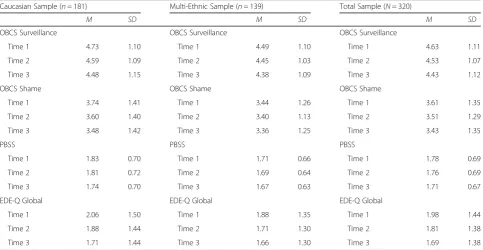
All analyses were conducted in MPlus (Version 8; [33]). Means and standard deviations for measures at each time point are presented in Table 1. We first evaluated cross-sectional models at each of the three time points (baseline, 3-month follow-up, and 6-month follow-up) using both body shame measures as parallel mediators in order to provide the most stringent test of the indirect effects of each body shame measure. In each of these three cross-sectional models, we included body surveil-lance as the independent variable and ED symptoms as the dependent variable. We also tested multiple group models at each time point using ethnic group (i.e., non-Hispanic Caucasian or Multi-ethnic) as a potential mod-erator. Longitudinal mediation using data from all three
Table 1Descriptive statistics for sub-groups and total sample at each time point
Caucasian Sample (n= 181) Multi-Ethnic Sample (n= 139) Total Sample (N= 320)
M SD M SD M SD
OBCS Surveillance OBCS Surveillance OBCS Surveillance
Time 1 4.73 1.10 Time 1 4.49 1.10 Time 1 4.63 1.11
Time 2 4.59 1.09 Time 2 4.45 1.03 Time 2 4.53 1.07
Time 3 4.48 1.15 Time 3 4.38 1.09 Time 3 4.43 1.12
OBCS Shame OBCS Shame OBCS Shame
Time 1 3.74 1.41 Time 1 3.44 1.26 Time 1 3.61 1.35
Time 2 3.60 1.40 Time 2 3.40 1.13 Time 2 3.51 1.29
Time 3 3.48 1.42 Time 3 3.36 1.25 Time 3 3.43 1.35
PBSS PBSS PBSS
Time 1 1.83 0.70 Time 1 1.71 0.66 Time 1 1.78 0.69
Time 2 1.81 0.72 Time 2 1.69 0.64 Time 2 1.76 0.69
Time 3 1.74 0.70 Time 3 1.67 0.63 Time 3 1.71 0.67
EDE-Q Global EDE-Q Global EDE-Q Global
Time 1 2.06 1.50 Time 1 1.88 1.35 Time 1 1.98 1.44
Time 2 1.88 1.44 Time 2 1.71 1.30 Time 2 1.81 1.38
Time 3 1.71 1.44 Time 3 1.66 1.30 Time 3 1.69 1.38
time points was tested using the cross-lagged panel model displayed in Fig. 1, which included both body shame measures as simultaneous mediators. In the fig-ure, the indirect effect of body surveillance on ED symp-toms through body shame as measured by the PBSS is the product of the paths labeled “a1” and “b1.” Likewise, the indirect effect of body surveillance on ED symptoms via body shame as measured by the OBCS Shame sub-scale is the product of the paths labeled“a2”and“b2.”
Results
Cross-sectional models
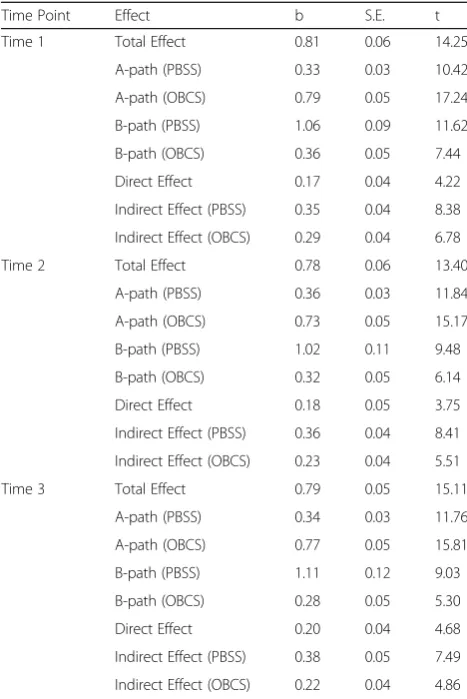
Ethnic group was not a significant moderator in any of the cross-sectional models. Allowing all the paths to vary across the two ethnic groups did not result in a signifi-cant improvement in model fit at baseline (χ2difference (11) = 4.74, p = .94), 3 months (χ2 difference (11) = 6.88, p= .81), or 6 months (χ2difference (11) = 4.74, p= .94), indicating that the groups were not significantly different on any of the paths in the model at any timepoint. Add-itionally, due to the aforementioned importance of con-sidering ethnic identity, we also ran each cross-sectional model with ethnic identity (MEIM score) as a moderator on an exploratory basis; MEIM was not a significant moderator in any of the cross-sectional models (all p’s greater than .57). Therefore, we report the results for the full sample for each cross-sectional model (Table2) and include confidence intervals for the indirect effects and the percent of the total effect that was mediated below.
At baseline, the indirect effect between body surveil-lance and ED symptoms was significant for both the
PBSS (95% CI [.27, .43], 43.21% of the total effect medi-ated) and the OBCS body shame subscale (95% CI [.20, .37], 35.56% mediated). This model predicted 73.70% of the variability in ED symptoms, 28.30% of the variability in the PBSS, and 42.20% of the variability in the OBCS body shame subscale. Similarly, at 3-month follow-up (Time 2) the indirect effect was significant for both the PBSS (95% CI [.28, .45], 46.65% mediated) and the OBCS body shame subscale (95% CI [.15, .32], 29.82% medi-ated). This model predicted 68.00% of the variability in ED symptoms, 30.40% of the variability in the PBSS, and 36.40% of the variability in the OBCS body shame sub-scale. Lastly, the indirect effect was significant for both the PBSS (95% CI [.28, .48], 47.85% mediated) and the OBCS body shame subscale (95% CI [.13, .31], 27.27% mediated) at 6-month follow-up. This model predicted 73.50% of the variability in ED symptoms, 33.10% of the variability in the PBSS, and 41.10% of the variability in the OBCS body shame subscale. In summary, objectifica-tion theory was supported at all three time points using cross-sectional data.
Longitudinal model
Similar to the cross-sectional models, ethnic group was nonsignificant as a moderator in the longitudinal model. Therefore, we present results for the full sample. As shown in Fig. 2, all autoregressive time effects were sig-nificant. Specifically, body surveillance at Time 1 pre-dicted body surveillance at Time 2, and the Time 2 body surveillance value predicted the Time 3 value (all p’s < .001). Body shame as measured by the PBSS at Time 1 predicted the Time 2 value, and Time 2 PBSS predicted
the Time 3 value (all p’s < .001). Body shame as mea-sured by the OBCS at Time 1 predicted the Time 2 value, as did the Time 2 value on Time 3 (allp’s < .001). Similarly, ED symptoms at Time 1 predicted the Time 2 value, and Time 2 ED symptoms predicted the Time 3 value (allp’s < .001).
Results from the longitudinal cross-lagged mediation model are shown in Fig. 2. The longitudinal mediation model included two hypothesized a paths (a1: Time 1 body surveillance to Time 2 PBSS; a2: Time 1 body sur-veillance to Time 2 OBCS body shame), neither of which was significant. Thus, the antecedent position of body surveillance in this model was not supported. Of the two hypothesizedb paths in this model (b1: Time 2 PBSS to Time 3 ED symptoms; b2: Time 2 OBCS body shame to Time 3 ED symptoms), only the b1path was significant indicating that Time 2 PBSS significantly predicted ED symptoms at Time 3. Finally, the hypothesized indirect effects between body surveillance and ED symptoms for both mediators in the model were nonsignificant.
Discussion
The present study sought to extend the limited longitu-dinal research on a core mediation model linking self-objectification to eating disorder (ED) pathology through body shame by testing the model under the following conditions: 1) evaluating the core mediational pathways in a diverse, multi-ethnic sample of adult women across the lifespan, 2) using a larger sample than in previous re-search, 3) examining two measures of body shame that tap into different aspects of body shame in the context of objectification theory, and 4) testing the theory over a 6-month time period. Regarding ethnicity findings, re-sults suggest that the relations between the variables de-tailed in the core mediation model operated similarly in Multi-ethnic, predominantly American participants as compared to non-Hispanic Caucasian participants. This finding is somewhat inconsistent with recent research by Schaefer and colleagues [21], who found that body shame did not mediate the relationship between self-objectification and eating disorder pathology in African American women. However, the inconsistency may be an artifact of differing methodology. Schaefer et al. [21] examined three distinct racial/ethnic groups, non-Hispanic Caucasian, African American, and non-Hispanic, whereas this study grouped different non-Caucasian races/ethnicities together. We did so primarily because many participants did not identify with a single race/eth-nicity and therefore did not have adequate power to examine individual differences between specific ethnic and racial groups. Thus, the present study may have masked differences between single ethnic groups.
Consistent with both our hypotheses and past research (e.g., [21]), results from the cross-sectional mediation models at each time point (i.e., baseline, 3 months, and 6 months) indicated that both measures of body shame me-diated the relation between self-surveillance and eating dis-order (ED) pathology, thus providing robust support for this core mediation model within the broader objectifica-tion theory. Of note, much of the past research examining these relationships has been conducted in predominantly non-Hispanic Caucasian samples, and frequently utilized college-aged women as participants. In the current study, however, our sample was comprised of nearly 50% multi-racial/ethnic women with ages spanning much of the life-span (i.e., 18–70). Therefore, our results with a more di-verse sample of women further support prior cross-sectional relations between self-surveillance, body shame, and ED pathology.
With regards to our longitudinal hypotheses, results were mixed. Consistent with past research (e.g., [17,18]) and our hypothesis, body shame operationalized via OBCS Shame did not mediate the relation between self-surveillance at baseline and ED symptoms over time, when controlling for prior levels of both body shame
Table 2Results from cross sectional mediation models at each assessment
Time Point Effect b S.E. t
Time 1 Total Effect 0.81 0.06 14.25
A-path (PBSS) 0.33 0.03 10.42
A-path (OBCS) 0.79 0.05 17.24
B-path (PBSS) 1.06 0.09 11.62
B-path (OBCS) 0.36 0.05 7.44
Direct Effect 0.17 0.04 4.22
Indirect Effect (PBSS) 0.35 0.04 8.38
Indirect Effect (OBCS) 0.29 0.04 6.78
Time 2 Total Effect 0.78 0.06 13.40
A-path (PBSS) 0.36 0.03 11.84
A-path (OBCS) 0.73 0.05 15.17
B-path (PBSS) 1.02 0.11 9.48
B-path (OBCS) 0.32 0.05 6.14
Direct Effect 0.18 0.05 3.75
Indirect Effect (PBSS) 0.36 0.04 8.41
Indirect Effect (OBCS) 0.23 0.04 5.51
Time 3 Total Effect 0.79 0.05 15.11
A-path (PBSS) 0.34 0.03 11.76
A-path (OBCS) 0.77 0.05 15.81
B-path (PBSS) 1.11 0.12 9.03
B-path (OBCS) 0.28 0.05 5.30
Direct Effect 0.20 0.04 4.68
Indirect Effect (PBSS) 0.38 0.05 7.49
Indirect Effect (OBCS) 0.22 0.04 4.86
Note.All t-values listed in the table are significant at thep< .001 level; PBSS = Phenomenological Body Shame Scale; OBCS = Objectified Body
and ED symptoms. Specifically, a cross-lagged panel ana-lysis indicated that self-surveillance at baseline did not significantly predict body shame using the OBCS Shame subscale at 3 months when controlling for baseline body shame. OBCS Shame at 3 months also did not predict ED pathology at 6 months.
Contrary to our hypotheses, the longitudinal model also was not supported when using the PBSS. Specific-ally, baseline self-surveillance again did not significantly predict body shame at 3 months. Of note, although self-surveillance did not predict later PBSS, the PBSS was a better predictor of ED pathology at 6 months than the OBCS Shame subscale (Fig.2). Therefore, the PBSS may tap into an aspect of the body shame construct that is more predictive of ED behaviors over time. The PBSS also may have better construct validity for measuring body shame as described in objectification theory than does the OBCS Shame subscale [14].
One interpretation of the longitudinal findings is that objectification theory is simply incorrect with regards to the proposed relationship between self-objectification, body shame and ED pathology. We argue, however, that this is a problematic conclusion to draw at this time for several reasons. First, it is premature to abandon this pathway of objectification theory given the very limited body of longitudinal objectification research. Second, ob-jectification theory posits numerous pathways linking sexual and self-objectification to other intermediary vari-ables in the prediction of disordered eating. We did not test the full objectification theory model in the present study, and therefore we cannot draw any conclusions about the veracity of objectification theory to predict ED
pathology based on extant findings. Finally, a number of factors could account for the fact that we did not find longitudinal support for the indirect effect of self-surveillance on ED pathology through body shame, and these factors should be addressed in future research.
For instance, it may be that the transaction of self-surveillance and body shame occurs at a substantially fas-ter rate, and also may co-occur, which is consistent with our cross-sectional findings. As such, other methodology (e.g., ecological momentary assessment, or EMA) may be better at detecting longitudinal relationships. For example, Fitzsimmons-Craft and colleagues [34] found that state-level body surveillance was a proximal trigger of body dis-satisfaction among college women, when assessed mul-tiple times per day over a two-week period.
Moreover, in adult women, the effects of and reactions to chronic self-objectification (i.e., subsequent body shame) may be firmly established prior to assessment in the study. Given that women and girls experience sexual objectification beginning in youth in Western cultures, discernable and causal longitudinal effects of self-surveillance on body shame may be conflated by the time one reaches adulthood. Thus, we may be trying to longitu-dinally document a process that occurred years earlier and is not ongoing. Typically, with longitudinal studies, the outcome of interest has not yet occurred at baseline. In this case, a true predictive longitudinal investigation of the development of ED pathology would need to assess self-objectification and body shame prior to the occurrence of ED pathology, and self-objectification prior to the occur-rence of body shame. In the sample of community women examined in the present study, ED pathology co-occurred Fig. 2Results from longitudinal cross-lagged mediation model. Within time point covariances omitted for clarity, all were significant atp≤.005
level. Grey paths were not significant. **p< .01, ***p< .001; PBSS = Phenomenological Body Shame Scale; OBCS = Objectified Body
with self-objectification and body shame, as observed with the cross-sectional findings. As such, we recommend that researchers consider a much more comprehensive risk factor study, which assesses self-objectification in a youn-ger sample without any evidence of ED pathology, and then follows participants over an even longer time period to observe if self-objectification predicts the development of ED pathology via body shame. As long as participants are assessed repeatedly, such a study could test both the longitudinal association of self-objectification and ED pathology and whether or not shame mediates that relationship.
In addition, although the OBCS Surveillance subscale is a commonly used operationalization of self-objectification, this measurement scale has been criticized on conceptual and methodological grounds as a valid indicator of self-objectification [3, 35]. In particular, the content of the scale is narrowly focused on worry and surveillance around clothing and general appearance, and does not ad-equately discriminate itself from body shame and other body image scales. Self-objectification involves a doubled perspective on the self whereby women come to view themselves from the outside as well as the inside, disrupt-ing the self-body connection—none of which is captured in extant measures of self-objectification [3]. Critically, these narrowed operationalizations contribute to incon-sistent and inaccurate interpretations of the evidence for the role of self-objectification across the various domains in which it has been tested. While cross-sectional findings shore up support for the role of self-objectification in models of ED pathology when the OBCS Surveillance sub-scale is used, the null longitudinal findings observed here and elsewhere behoove researchers to consider and select the assessment of self-objectification carefully in future studies.
Lastly, our results indicate that past body shame is a very robust predictor of future body shame, which is con-sistent with past literature [17,18]. Thus, it is possible that although early life experiences of self-objectification may have played a role in the initial development of body shame, perpetual body shame is more influential in main-taining levels of body shame than is continued self-surveillance. The above proposed risk factor study could provide evidence as to whether or not this is the case.
There are numerous limitations to the current study. First, due to extremely high attrition after the baseline as-sessment (upwards of 60% attrition), the present study uti-lized completer analyses. Therefore, self-selecting out of the study may have been systematically affiliated with levels of body shame, self-surveillance, or ED behaviors. Feedback from some participants who opted out of com-pleting follow-up assessments, however, stated that the time to complete the survey was not feasible for them. Additionally, we only used survey/self-report data that
were completed online and not in a controlled environ-ment. Also due to low numbers of participants in specific ethnic and racial groups, we were unable to examine spe-cific cultural/ethnic differences across various groups. Within the multi-ethnic group, however, nearly 50% of participants self-described as multi-racial or “other,” therefore narrowing racial or ethnic identity of these par-ticipants into one category would not have been accurate, either. Future research would benefit from a more thor-ough investigation of relations between these constructs in various ethnic and racial groups.
Conclusions
Overall, results from the current study using a more di-verse sample provide further support for the cross-sectional relations of self-surveillance, body shame, and ED symptoms. These models held up at each time point, thus these relations operated similarly at each time point in the current study. Longitudinal results, however, did not support the core meditational model described by objectification theory; yet, findings are consistent with two other longitudinal evaluations of these relations. Limitations hinder broad generalization of the current findings; however, future research should examine rela-tions of these variables over time in order to thoroughly examine the causal and/or cyclical relations in the core mediation model of disordered eating described within objectification theory.
Abbreviations
ANOVA:Analysis of Variance; ED: Eating Disorder; EDE-Q: Eating Disorder Examination - Questionnaire; IRB: Institutional Review Board; MEIM: Multi-Ethnic Identity Measure; NIH: National Institutes of Health; OBCS: Objectified Body Consciousness Scale; PBSS: Phenomenological Body Shame Scale
Acknowledgements
Not applicable.
Authors’contributions
LSK cleaned, analyzed, and interpreted data, and was a major contributor to writing the manuscript. SW and CV collected the data, managed the study, and contributed to preparation of the manuscript. RC was a major contributor in writing the manuscript and in interpreting outcomes. CBB conceptualized and conducted the study, and contributed to writing of the manuscript. WH conducted statistical analyses. All authors approved the final manuscript.
Funding
The writing of this manuscript was supported by the National Institute on Aging grant P30 AG044271.
Availability of data and materials
The datasets used and/or analyzed during the current study are available from the corresponding author on reasonable request.
Ethics approval and consent to participate
This study and its associated consent form were approved by the Trinity University Institutional Review Board prior to beginning the study.
Consent for publication
Competing interests
The authors declare that they have no competing interests.
Author details
1Department of Psychiatry, University of Texas Health Science Center San Antonio, San Antonio, TX 78229, USA.2Department of Psychology, Western University, 1151 Richmond St, London ON N6A 3K7, Canada.3Department of Psychology, Trinity University, San Antonio, USA.4Department of Psychology, University of South Florida, Tampa, USA.5Department of Psychology, University of Texas San Antonio, 1 UTSA Circle, San Antonio, TX 78249, USA.
Received: 6 August 2019 Accepted: 8 November 2019
References
1. Fredrickson BL, Roberts TA. Objectification theory: Toward understanding
women's lived experiences and mental health risks. Psychol Women Q.
1997;21(2):173–206.https://doi.org/10.1111/j.1471-6402.1997.tb00108.x.
2. McKinley NM, Hyde JS. The objectified body consciousness scale
development and validation. Psychol Women Q. 1996;20(2):181–215.https://
doi.org/10.1111/j.1471-6402.1996.tb00467.x.
3. Calogero R. Operationalizing self-objectification: assessment and related
methodological issues. In: Calogero RM, Tantleff-Dunn S, Thompson JK, editors. Self-objectification in women: causes, consequences, and counteractions.
Washington, DC: American Psychological Association; 2011. p. 23–49.
4. Tiggemann M. Objectification theory: Of relevance for eating disorder
researchers and clinicians? Clin Psychol. 2013;17(2):35–45.https://doi.org/10.
1111/cp.12010.
5. Tiggemann M, Williams E. The role of self-objectification in disordered
eating, depressed mood, and sexual functioning among women: A comprehensive test of objectification theory. Psychol Women Q. 2012;36(1): 66–75.https://doi.org/10.1177/0361684311420250.
6. Noll SM, Fredrickson BL. A mediational model linking self-objectification,
body shame, and disordered eating. Psychol Women Q. 1998;22(4):623–36.
https://doi.org/10.1111/j.1471-6402.1998.tb00181.x.
7. Quinn DM, Kallen RW, Cathey C. Body on my mind: The lingering effect of
state self-objectification. Sex Roles. 2006;55(11–12):869–74.https://doi.org/
10.1007/s11199-006-9140-x.
8. Calogero RM. A test of objectification theory: The effect of the male gaze
on appearance concerns in college women. Psychol Women Q. 2004;28(1): 16–21.https://doi.org/10.1111/j.1471-6402.2004.00118.x.
9. Augustus-Horvath CL, Tylka TL. A test and extension of objectification
theory as it predicts disordered eating: does women's age matter? J Couns
Psychol. 2009;56(2):253.https://doi.org/10.1037/a0014637.
10. Calogero RM, Davis WN, Thompson JK. The role of self-objectification in the
experience of women with eating disorders. Sex Roles. 2005;52(1–2):43–50.
https://doi.org/10.1007/s11199-005-1192-9.
11. Schaefer LM, Thompson JK. Self-objectification and disordered eating: a
meta-analysis. Int J Eat Disord. 2018;51:483–502.https://doi.org/10.1002/eat.22854.
12. Calogero RM. Objectification processes and disordered eating in British
women and men. J Health Psychol. 2009;14(3):394–402.https://doi.org/10.
1177/1359105309102192.
13. Dakanalis A, Carrà G, Calogero R, Fida R, Clerici M, Zanetti MA, et al. The
developmental effects of media-ideal internalization and self-objectification
processes on adolescents’negative body-feelings, dietary restraint, and
binge eating. Eur Child Adolesc Psychiatry. 2015;24(8):997–1010.https://doi.
org/10.1007/s00787-014-0649-1.
14. Fredrickson BL, Roberts T-A, Noll SM, Quinn DM, Twenge JM. That swimsuit
becomes you: sex differences in self-objectification, restrained eating, and
math performance. J Pers Soc Psychol 1998;75(1):269–284.https://doi.org/
10.1037/0022-3514.75.1.269.
15. Tylka TL, Hill MS. Objectification theory as it relates to disordered eating
among college women. Sex Roles. 2004;51(11–12):719–30.https://doi.org/
10.1007/s11199-004-0721-2.
16. O’Laughlin KD, Martim MJ, Ferrer E. (2018) Cross-sectional analysis of
longitudinal mediation processes. Multivar Behav Res. 2018;53(3):375–402.
https://doi.org/10.1080/00273171.2018.1454822.
17. Rolnik AM, Engeln-Maddox R, Miller SA. Here’s looking at you:
Self-objectification, body image disturbance, and sorority rush. Sex Roles. 2010; 63(1–2):6–17.https://doi.org/10.1007/s11199-010-9745-y.
18. Becker CB, Hill K, Greif R, Han H, Stewart T. Reducing self-objectification: are
dissonance-based methods a possible approach? J Eat Disord. 2013;1(10):1–
11.https://doi.org/10.1186/2050-2974-1-10.
19. Becker CB, Stice E. From efficacy to effectiveness to broad implementation:
Evolution of the Body Project. J Consult Clin Psychol. 2017;85(8):767–82.
https://doi.org/10.1037/ccp0000204.
20. Fitzsimmons EE, Bardone-Cone AM. Downward spirals of body surveillance and
weight/shape concern among African American and Caucasian college women.
Body Image. 2011;8(3):216–23.https://doi.org/10.1016/j.bodyim.2011.04.003.
21. Schaefer LM, Burke NL, Calogero RM, Menzel JE, Krawczyk R, Thompson JK.
Self-objectification, body shame, and disordered eating: Testing a core mediational model of objectification theory among White, Black, and
Hispanic women. Body Image. 2018;24:5–12.https://doi.org/10.1016/j.
bodyim.2017.10.005.
22. Phinney JS. The multigroup ethnic identity measure: A new scale for use
with diverse groups. J Adolesc Res. 1992;7(2):156–76.https://doi.org/10.
1177/074355489272003.
23. Fairchild K, Rudman LA. Everyday stranger harassment and women’s
objectification. Soc Justice Res. 2008;21(3):338–57.https://doi.org/10.1007/
s11211-008-0073-0.
24. Moradi B, Varnes JR. Structure of the Objectified Body Consciousness Scale:
Reevaluated 20 Years later. Sex Roles. 2017;77(5–6):325–37.https://doi.org/
10.1007/s11199-016-0731-x.
25. Lewis M. Shame: the exposed self. New York: Free Press; 1995.
26. Ponterotto JG, Gretchen D, Utsey SO, Stracuzzi T, Saya R Jr. The multigroup
ethnic identity measure (MEIM): Psychometric review and further validity
testing. Educ Psychol Meas. 2003;63(3):502–15.https://doi.org/10.1177/
0013164403063003010.
27. Martins Y, Tiggemann M, Kirkbride A. Those speedos become them: The
role of self-objectification in gay and heterosexual men's body image.
Personal Soc Psychol Bull. 2007;33(5):634–47.https://doi.org/10.1177/
0146167206297403.
28. Calogero RM, Tylka TL, Donnelly LC, McGetrick A, Leger AM. Trappings of
femininity: A test of the“beauty as currency”hypothesis in shaping college
women’s gender activism. Body Image. 2017;21:66–70.https://doi.org/10.
1016/j.bodyim.2017.02.008.
29. Fairburn CG, Beglin SJ. Assessment of eating disorders: interview or
self-report questionnaire? Int J Eat Disord. 1994;16(4):363–70.
30. Cooper Z, Fairburn C. The eating disorder examination: A semi-structured
interview for the assessment of the specific psychopathology of eating
disorders. Int J Eat Disord. 1987;6(1):1–8.https://doi.org/10.1002/1098-108X
(198701)6:1<1::AID-EAT2260060102>3.0.CO;2–9.
31. Stice E, Shaw H, Burton E, Wade E. Dissonance and healthy weight eating
disorder prevention programs: a randomized efficacy trial. J Consult Clin
Psychol. 2006;74(2):263–75.https://doi.org/10.1037/0022-006X.74.2.263.
32. Roberts RE, Phinney JS, Masse LC, Chen YR, Roberts CR, Romero A. The
structure of ethnic identity of young adolescents from diverse ethnocultural
groups. J Early Adolesc. 1999;19(3):301–22.https://doi.org/10.1177/
0272431699019003001.
33. Muthén LK, Muthén BO. Mplus User’s Guide. 8th ed. Muthén & Muthén: Los
Angeles; 2017.
34. Fitzsimmons-Craft EE, Bardone-Cone AM, Wonderlich SA, Crosby RD, Engel
SG, Bulik CM. The relationships among social comparisons, body surveillance, and body dissatisfaction in the natural environment. Behav
Ther. 2015;46(2):257–71.https://doi.org/10.1016/j.beth.2014.09.006.
35. Roberts TA, Calogero RM, Gervais S. Objectification theory: Continuing
contributions to feminist psychology. In Travis C, White J, editors. APA Handbook of the Psychology of Women (Vol. 1: History, theory, and
battleground). Am Psychol Assoc; 2018. p. 249–272.
Publisher’s Note