The Thirty-Third AAAI Conference on Artificial Intelligence (AAAI-19)
Optimizing in the Dark: Learning an
Optimal Solution through a Simple Request Interface
Qiao Xiang,
1,2∗Haitao Yu,
1James Aspnes,
2Franck Le,
3Linghe Kong,
4Y. Richard Yang
1,2 1Tongji University,2Yale University,3IBM T.J. Watson Research Center,4Shanghai Jiao Tong University[email protected], [email protected], [email protected], [email protected], [email protected], [email protected]
Abstract
Network resource reservation systems are being developed and deployed, driven by the demand and substantial bene-fits of providing performance predictability for modern dis-tributed applications. However, existing systems suffer limi-tations: They either are inefficient in finding the optimal re-source reservation, or cause private information (e.g., from the network infrastructure) to be exposed (e.g., to the user). In this paper, we design BoxOpt, a novel system that leverages efficient oracle construction techniques in optimization and learning theory to automatically, and swiftly learn the opti-mal resource reservations without exchanging any private in-formation between the network and the user. We implement a prototype of BoxOpt and demonstrate its efficiency and ef-ficacy via extensive experiments using real network topology and trace. Results show that (1) BoxOpt has a 100% correct-ness ratio, and (2) for 95% of requests, BoxOpt learns the optimal resource reservation within 13 seconds.
1
Introduction
When facing a genie that only tells you whether it can grant a wish or not, how can you find the best wish it can grant?
Although the question may sound like one from fairy tales, people deal with such question in many real world sce-narios. For example, modern distributed applications (e.g., (Zaharia et al. 2012; White 2012)) construct complex data flows between end hosts,e.g., in data center networks. The key to supporting these applications is the ability to provide guaranteed network resources (i.e., bandwidth) for perfor-mance predictability (Mogul and Popa 2012). As such, many network resource reservation systems are developed and de-ployed (Campanella et al. 2006; Guok and Robertson 2006; Johnston, Guok, and Chaniotakis 2011; Riddle 2005; Zheng et al. 2005; Sobieski, Lehman, and Jabbari 2004). However, because of the underlying networks’ concern of revealing sensitive information, existing reservation systems do not provide applications with an interface to access informa-tion of the underlying network infrastructure (e.g., topology, links’ available bandwidth). Instead, networks only offer a
simple reservation interface for applications to submit
re-quests for reserving a specific amount of bandwidths for a
∗
The corresponding authors are Q.Xiang and Y. R. Yang. Copyright c⃝2019, Association for the Advancement of Artificial Intelligence (www.aaai.org). All rights reserved.
set of flows:request(flow set,bw values)), and returns ei-ther success or failure. A major concern of this design is its inefficiency for the applications/users to find the optimal amount of network resources to reserve. To further illustrate the issues, consider the example in Figure 1, where a user (e.g., application) wants to determine and reserve the max-imum achievable bandwidth for two flows from S1toD1,
andS2toD2, respectively. Using existing solutions that
of-fer only asimple reservation interface, finding the constraint that both flows can collectively get only 100 Mbps of band-width is already an instance of the NP-hard membership-query based constraint acquisition problem (Bessiere et al. 2017), letting alone finding the optimal reservation for both flows (e.g., 50 Mbps for each flow).
S1 D1
S2 D2
l1 l
2 l3 l4 l5
l7
l8 l9 l10l11
l12
l6
Each link: 100 Mbps
sw2
sw1
sw5
sw6
sw7
sw8
sw3
sw4
Figure 1: An example network topology: the routes of two flows share bottleneck links,i.e.,l3 andl4, hence they can
only collectively get a 100 Mbps bandwidth.
To address this problem, researchers have proposed sev-eral solutions, but all of them suffer limitations, and vio-late privacy requirements. For example, to determine opti-mal bandwidth reservations, recent proposals depart from the simple reservation interface, and require either networks to reveal sensitive information to users (Soul´e et al. 2014; Subramanian, D’Antoni, and Akella ; Heorhiadi, Reiter, and Sekar 2016; Lee et al. ), or vice versa (Gao et al. 2016; Gao et al. 2017; Xiang et al. 2018). These solutions are therefore limited to settings where the level of trust between the applications and the underlying network is high. These solutions cannot be deployed in general settings as malicious parties may use the exposed network information to identify vulnerable links and launch attacks (e.g., DDoS).
network resource reservation using only the simple
reserva-tion interface?This task is non-trivial due to the extremely
limited feedback (i.e., success/failure) provided by simple reservation interface.
Our solution to this problem is BoxOpt, a novel learn-ing system that automatically, and efficiently learns the op-timal resource reservations for the user through the sim-ple reservation interface, without exchanging any private information between the network and the user (e.g., band-width feasible region of the network and the resource or-chestration policy of the user). Specifically, BoxOpt allows users to include their resource reservation objectives as con-cave utility functions of the requested resources (e.g., band-widths) in the reservation requests. Upon receiving a reser-vation request, BoxOpt models the simple reserreser-vation in-terface of network resource reservation systems as a mem-bership oracle over a polytope. It then expands oracle con-struction techniques (Lovasz, Grotschel, and Schrijver 1993; Lee, Sidford, and Vempala 2017) from optimization and learning theory to construct a separation oracle through in-voking the membership oracle in near O(n) iterations (n
being the number of flows), which when called upon will accurately infer a search space in which the optimal reser-vation vector lies. With such a separation oracle, BoxOpt then constructs an optimization oracle based on ellipsoid method, which can learn the optimal reservation vector throughO(n2)calls on the separation oracle.1 In this way, BoxOpt not only can learn the optimal resource reservation efficiently, but also is privacy-preserving in that no private information is exchanged between the user and the network.
Themain contributionsof this paper are as follows: •We study the important problem of learning the optimal network resource reservation through the simple reservation interface of network resource reservation systems. In partic-ular, we design BoxOpt, a novel, fast, automatic, privacy-preserving learning system. To the best of our knowledge, BoxOpt is the first working system that solves this problem, and can be extended to other optimization problems.
•We model the simple reservation interface as a member-ship oracle over a polytope, and expand oracle construction techniques from optimization and learning theory to develop an efficient optimization oracle in BoxOpt, which learns the optimal resource reservation in nearO(n3)of calls on the
membership oracle.
•We implement a prototype of BoxOpt and demonstrate both its efficiency and efficacy through extensive experi-ments using real topologies and traces. Results show that (1) BoxOpt has a 100% correctness ratio, and (2) for 95% cases, it can learn the optimal reservation within 13 seconds.
The remaining of this paper is organized as follows. We present an overview of BoxOpt in Section 2. We give de-tails on how BoxOpt efficiently learns the optimal network
1
We choose the ellipsoid method because it is a classic cutting plane method. However, the design of BoxOpt is modular and other cutting plane methods,e.g., analytic center method (Atkinson and Vaidya 1995) and random walk (Bertsimas and Vempala ), can also be used to construct an optimization oracle from a separation ora-cle.
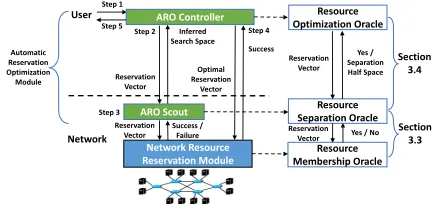
Step 5
Success / Failure Reservation
Vector
Network Resource Reservation Module User ARO Controller
Network
Reservation Vector
Inferred Search Space Step 1
Step 2
ARO Scout
Step 3
Optimal Reservation
Vector Success Step 4
Automatic Reservation Optimization Module
Resource Optimization Oracle
Resource Separation Oracle
Resource Membership Oracle
Reservation Vector
Yes / Separation Half Space
Reservation
Vector Yes / No Section3.3
Section 3.4
Figure 2: The architecture and workflow of BoxOpt.
resource reservation only using the simple reservation inter-face in Section 3. We present the evaluation results of Box-Opt in Section 4. We discuss related work in Section 5 and conclude the paper in Section 6.
2
Overview of BoxOpt
In this section, we first present the architecture and the work-flow of BoxOpt. We then give a formal, mathematical for-mulation of the key technical challenge in BoxOpt: how to find the optimal network resource reservation through the simple reservation interface.
2.1
Architecture
BoxOpt is composed of two components: an automatic reservation optimization (ARO) module for the user, and a network resource reservation (NRR) module for the network (Figure 2). The two components interact with each other through the simple reservation interface commonly used in traditional network resource reservation systems.
Automatic reservation optimization module: The ARO module is a private component belonging to the user, and is composed of two sub-components: an ARO controller, and an ARO scout.
The ARO controller is the main interface for the user to submit the resource reservation requests. A request consists of a set of n flows,F = {f1, f2, . . . , fn}, to reserve the resources for, and a concave utility functionutil(x)to max-imize, with x = [x1, x2, . . . , xn] and each xi represent-ing the available bandwidth that can be reserved for flow
fi ∈ F. Example utility functions include total throughput and priority-based total throughput. Given a user resource reservation request, the objective of the ARO controller is to infer the optimal resource reservation to maximizeutil(x). The ARO controller achieves it with the assistance of the ARO scout: Specifically, the ARO controller iteratively se-lects a vectorˇxof bandwidth values forF (called
reserva-tion vector) and sends it to the ARO scout. For each
reserva-tion vector, the ARO scout returns a search space where the optimal reservation vector lies in. With the inferred search spaces returned by the ARO scout, the ARO controller grad-ually converges to the optimal reservation vector that maxi-mizesutil(x).
vector lies in, and returns the inferred search space back to the ARO controller. To infer the search space where the the optimal reservation vector lies in, the ARO scout sends a se-quence of reservation vectors to the NRR through the simple reservation interface. As further described in Section 3 and Section 4, for each reservation vector submitted from the ARO controller, the ARO scout might submit tens or hun-dreds of reservation vectors to the NNR to get an accurately-inferred search space, potentially, leading to a high over-head. As such, to reduce the total latency to find the optimal reservation vector, the ARO scout is placed with the network instead of the user. This design decision reduces the user-network communication latency by 20x as demonstrated in the evaluation section. More importantly, this design does not expose the private information of the user (i.e.,util(x)) to the network, as the ARO controller does not send such information to the scout.
Network Resource Reservation Module: The NRR mod-ule is a private component belonging to the network. Its pri-mary role is to verify whether the reservation vectors sub-mitted by the ARO scout can be satisfied. Upon receiv-ing a reservation vector from the ARO scout, the NRR ex-tracts the relevant constraints from the network. The con-straints include both physical network concon-straints (e.g., if two flows share a same link, their allocated bandwidths can-not exceed the link’s available bandwidth), and network policies (e.g., rate limiting, etc.) The constraints are cap-tured as an abstraction of linear inequalities (Gao et al. 2016; Xiang et al. 2018). For example, to capture the physical net-work constraints, the NNR first retrieves the routes (i.e., se-quence of traversed links) for each flow. Then, for each link
lin the network, the NNR generates the following linear in-equality to ensure that the allocated bandwidths to the flows do not exceed the link’s available bandwidth:
∑
xi≤wl,∀fithat useslin this route,
wherewl is the available bandwidth on linkl. Consider-ing the example in Figure 1, the NRR module generates the following linear inequalities:
x1≤100 ∀lu∈ {l1, l2, l5, l6},
x2≤100 ∀lu∈ {l7, l8, l11, l12},
x1+x2≤100 ∀lu∈ {l3, l4},
x1, x2, x3≥0.
(1)
Then, the NRR generates additional linear inequalities to represent the network’s internal traffic engineering policies, such as load-balancing and bandwidth limiting. For exam-ple, suppose the network wants to limit the total bandwidth of flowsf1andf2to be no more than 80 Mbps even if there
is no common link in their routes. Then a linear inequality
x1+x2+x3≤80is generated to represent this policy.
Ge-ometrically, the abstraction of linear inequalities represents
thebandwidth feasible regionof the network for providing
bandwidths to a set of flows.
Finally, for each generated linear inequality, the NRR checks if it is satisfied by the bandwidth values specified in the reservation vector. If any inequality is violated, it returns a FAILURE signal. Otherwise, it returns SUCCESS.
2.2
Workflow
Having presented the basic components of BoxOpt, we now briefly present its workflow to automatically compute and reserve the optimal network resources for a set of flows as follows (Figure 2):
•Step 1: The user submits a resource reservation request for a set of flowsFto the ARO controller. The request also includes a concave utility functionutil(x)of the bandwidths ofF.
•Step 2: In an outer loop, the ARO controller iteratively selects reservation vectors to send to the ARO scout. The se-lection of the reservation vectors is described in Section 3.4, Algorithm 3. In return, for each reservation vector, the ARO scout determines and replies with an inferred search space.
• Step 3: In an inner loop, upon receiving a reservation vector from the controller, the ARO scout interacts with the NRR, according to Algorithm 1 from Section 3.3, to infer the next search space and send it back to the ARO controller.
The nested iteration of Step 2 and 3 stops when the ARO controller converges to the optimal reservation vector maxi-mizingutil(x).
•Step 4: The ARO controller sends the optimal reserva-tion vector to the NRR module to reserve the optimal re-sources for the user.
•Step 5: The ARO controller confirms with the user that the optimal network resource reservation has been success-ful.
2.3
Key Challenge
Through the introduction of its architecture and workflow, we show that BoxOpt isprivacy-preservingby design: nei-ther the user nor the network exposes the private information (i.e., internal optimization objective of the user and the band-width capacity region of the network) to the other party. As such, the remaining key challenge for BoxOpt lies in Step 2 and 3: how can the ARO module interact with the NRR module through the simple reservation interface to compute
the optimal network resource reservation?. To address this
challenge, we first give a formal, mathematical formulation. Specifically, we first model the NRR module as a
re-source membership oracle. Without loss of generality, we
useAx ≤ bto denote the set of linear inequalities gener-ated by the NRR module, and useK:{x|Ax≤b,x≥0} to represent the bandwidth feasible region for a set of flows
F. In this way, we give the definition of resource member-ship oracle:
Definition 1. [Reservation Membership Oracle (ReMEM)]
Given a reservation vector xˇ, return YES if xˇ ∈ K, and
return NO otherwise.
ReM EM(ˇx)accurately captures the interaction between
the ARO scout and the NRR module. Next, we formally de-fine the problem of network resource reservation optimiza-tion via simple reservaoptimiza-tion interface.
Problem 1(Optimization via Membership Oracle). Find the optimal solution to the following optimization problem
subject to,
Ax≤b, (3)
x≥0, (4)
without the knowledge ofAandb, but only using ReMEM
defined in Definition 1.
Maximizingutil(x)subject toK: {x|Ax≤b,x≥0} is a classic convex optimization problem. There has been a rich body of literature on how to efficiently solve such prob-lems (Boyd and Vandenberghe 2004). However, most of the existing algorithms require the knowledge of the feasible re-gion (in our caseAx ≤b). One may think of a strawman to learnKthrough the ReMEM oracle, and apply the stan-dard optimization techniques to find the optimalx. However, finding the feasible region through a membership oracle is NP-hard (Bessiere et al. 2017), making this strawman im-practical. In contrast, as we will present next, BoxOpt resorts to efficient oracle transformation techniques in optimiza-tion and learning theory (Lee, Sidford, and Vempala 2017; Lovasz, Grotschel, and Schrijver 1993) to solve this prob-lem (i.e., efficiently learn the optimal resource reservation via membership oracle).
3
Optimizing Network Resource Reservation
via Simple Reservation Interface
Having formally defined the key challenge for BoxOpt as a problem of optimization via membership oracle, this sec-tion discusses how we solve this problem. For presentasec-tion clarity, this section starts by reviewing some concepts in op-timization theory. Then, it presents the basic idea of our so-lution, followed by its details.
3.1
Notations
Unless explicitly noted, we usev to denote a scalar andv to denote a vector ofndimensions, wherenis the number of flows the user wants to reserve bandwidth for (see Sec-tion 2.1). We use∥v∥2 =
√∑ v2
i to denote the Euclidean norm ofv, and use∥v∥∞ = max|vi|to denote the max-imum norm ofv. We use B2+(m, η) = {x|∥x−m∥2 ≤ η,x ≥ 0} to denote the set of all positive vectors whose Euclidean distance tomis at mostη, and useB∞+(m, η) =
{x|∥x−m∥∞≤η,x≥0}to denote the set of all positive vectors whose maximum norm distance tomis at mostη.
3.2
Basic Idea
Our approach to solve Problem 1 utilizes the equivalence and polar relationships between different oracles in opti-mization theory (Lovasz, Grotschel, and Schrijver 1993). In particular, we focus on the relationships between ReMEM with the following two oracles:
Definition 2. [Resource Separation Oracle (ReSEP)] Given
a reservation vectorxˇ, return YES ifxˇ∈K, and otherwise
return a half space{y|pT(y−xˇ)≤δ}that containsKbut
notˇx.
Definition 3. [Resource Optimization Oracle (ReOPT)]
Given a reservation request for a set of flowsFand the
util-ity functionutil(x), findx∗∈Kthat maximizesutil(x).
Algorithm 1:Resource Separation OracleReSEP(xˇ)
1 Selectϵ∈(0, r], ρ∈(0,1);
2 κ←Rr;
3 ifReMEM returns YES forˇxthen 4 returnxˇ∈K;
5 else ifˇx∈/B2(0, R)then
6 returnthe half space{y|ˇxT(y−ˇx)≤0};
7 else
8 r1 ←rR−
1 3ϵ
1 3;
9 ˜g←Subgradient(0, r1,4ϵ,3κ); 10 returnthe half space
{y|˜gT(y−ˇx)≤(40n+ 1)ρ−1R23κϵ13};
Given that there exist efficient algorithms (e.g., ellipsoid method) that can construct an optimization oracle through invoking a separation oracle with a polynomial number of iterations, if we can construct a separation oracle through a polynomial number of calls to a membership oracle, we will be able to solve Problem 1.
One may think classic half space learning techniques can achieve such a construction of separation oracle via mem-bership oracle. However, the problems are different. In half space learning, the goal is to compute a hyperplane to sepa-rate a set of given samples (in our case, the reservation vec-tors) from two predefined classes. In contrast, the goal of ReMEM to ReSEP construction is to compute a hyperplane separating K and a reservation vector not belonging toK
by strategically choosing a minimal number of reservation vectors to send to ReMEM.
Specifically, we develop our solution to Problem 1 in two phases. First, we leverage recent progress on geometric al-gorithms (Lee, Sidford, and Vempala 2017) to develop an efficient algorithm that constructs ReSEP through invoking ReMEM for a polynomial number of times. Specifically, our algorithm expands the weak membership/separation oracle construction in (Lee, Sidford, and Vempala 2017) to strong membership/separation oracle construction. Second, we de-velop an ellipsoid-method-based algorithm that constructs ReOPT through local feasibility checks and invoking Re-SEP for a polynomial number of times. Mapping these two phases to Step 2 and 3 in the workflow of BoxOpt, we see that the ARO scout is essentially the separation oracle SEP, and the ARO controller is the optimization oracle Re-OPT (Figure 2). Next, we give the details of each phase.
3.3
From Resource Membership Oracle to
Resource Separation Oracle
To construct ReSEP from ReMEM, we first define two aux-iliary functions on vectord∈Kgiven a reservation vector ˇ
x:
αˇx(d)← max
d+αˇx∈Kα, (5)
hxˇ(d)← −αxˇ(d)∥ˇx∥2 (6)
We see that given a vectord∈K,d+αˇx(d)is the last
Algorithm 2: Computing the subgradient of hˇx(d)
Subgradient(d, r1, τ, L)
1 r2←
√τ r
1
√
nL;
2 Randomly selectyfromB∞(d, r1)following a uniform
distribution;
3 Randomly selectzfromB∞(y, r2)following a uniform
distribution;
4 fori←1, . . . , ndo
5 Define line segmentB∞(y, r2)∩z+sei, wheres∈R
andeiis a vector whose elements are all zeros except
theith one;
6 Denote the endpoints of this line segment assiandti,
respectively;
7 Evaluatehˇx(ti)andhˇx(si)using binary search and
ReMEM;
8 ˜gi= hˇx(ti)−hxˇ(si)
2r2 ;
9 return˜g;
is the Euclidean distance fromdto this point. Without loss of generality, we assume thatB2+(0, r)⊂K⊂B2+(0, R)for some positive numbersr, Rand such an assumption can be trivially satisfied in practice. Extending the proof technique in (Lee, Sidford, and Vempala 2017) for ann-dimensional ball to only a partial ball on the first orthant, we get
Lemma 1. Given ˇx,hˇx(d) is convex on K, and is RR−θ+θ
Lipschitz inB2+(0, θ)for0< θ < r.
With these auxiliary functions and a theorem that for any Lipschitz function, it is linear on a small ball (Bubeck and Eldan 2016), we can construct ReSEP by computing the sub-gradient ofhˇx(d)atd=0, which can be computed by
bi-nary search and invoking ReMEM. The constructed separa-tion oracle is presented in Algorithm 1, and the computasepara-tion of the subgradient ofhxˇ(d)is presented in Algorithm 2.
A key insight in Algorithm 1 is that it expands the ap-plicability of similar construction process from weak mem-bership/separation oracles to strong memmem-bership/separation oracles (i.e., ReMEM and ReSEP). In particular, we have
Lemma 2. There is a random variableφwith expectation
E(φ)≤2n√τ Lr
1 such that∀q∈K,
hˇx(q)≥hˇx(d) +˜gT(q−d)−φ∥q−d∥∞−4nr1L.
With this lemma, we show the correctness of Algorithm 1 in the following theorem.
Theorem 1. Ifˇx∈/K, Algorithm 1 yields a half space
con-tainingKbut notˇxwith probability1−ρ.
Proof. Whenˇx ∈/ B2+(0, R), it is easy to see that the
re-turned half space{y|ˇx(y)−ˇx≤0}(Line 6 of Algorithm 1) containsK but not x. Whenˇ ˇx ∈/ K butˇx ∈ B2+(0, R), from Lemma 1, we know thathˇx(d)has a Lipschitz
con-stant of3κonB2+(0,r2). By selectingϵ∈(0, r]and setting
r1 =rR−
1
3ϵ13 (Line 1 and 8 of Algorithm 1, respectively), we can getB+
∞(0,2r1)⊂B2+(0,
r
2). As such, we can apply
Lemma 2 and get that∀q∈K
hˇx(q)≥hxˇ(0) +˜gT·q−φ∥q∥∞−12nr1κ. (7)
Next, because ˇx ∈ B2+(0, R), we have −1
κˇx ∈ K and
hˇx(−1κˇx) =hˇx(0)−∥ ˇ x∥2
κ . Then we use Lemma 2 to get
hxˇ(−
1
κˇx)≥hˇx(0) +˜g
T· −1
κxˇ−
φ
κ∥ˇx∥∞−12nr1κ, (8)
As such, we then get
˜
gT ·xˇ≥ ∥ˇx∥2−φ∥ˇx∥∞−12nr1κ2. (9)
Next, becauseϵ ∈ (0, r],xˇ ∈/ K andB+2(0, r) ⊂ K, we have(1−ϵ
r)K⊂K. By definition ofhxˇ(d), we have
hˇx(0)≥ −(1−
ϵ
r)∥ˇx∥2≥ −∥ˇx∥2+ϵκ. (10)
Adding Equations (9) and (10) and then subtracting2ϵκon the right hand side, we get
hˇx(0) +˜gT ·ˇx≥ −φ∥ˇx∥∞−12nr1κ2−ϵκ. (11)
Next, we add Equation (11) to Equation (7) and get that ∀q∈K,
hˇx(q) ≥ ˜gT(q−xˇ)−φ∥q∥∞−φ∥ˇx∥∞
−12nr1κ−12nr1κ2−ϵκ
≥ ˜gT(q−ˇx)−2φR−24nr
1κ2−ϵκ.
(12)
∀q ∈ K, we havehˇx(q) ≤ 0, and then we can haveφ˜ ≥
˜
g(q−xˇ), whereφ˜is a random scalar independent ofqthat satisfies
E( ˜φ)≤4
√
12ϵκ r1
nR+ 24nr1κ2−ϵκ. (13)
Puttingr1=rR−
1 3ϵ
1
3 into Equation (13), we get
E( ˜φ)≤40nϵ13R 2
3κ+ϵκ. (14)
Further leveragingϵ≤r≤R, we get
E( ˜φ)≤(40n+ 1)ϵ13R 2
3κ. (15)
Then we can finish the proof using Equation (15) and Markov inequality.
In addition, observing Algorithm 1 and Algorithm 2, we see that the bottleneck to construct ReSEP is to computehˇx
using binary search and ReMEM (Line 4-8 in Algorithm 2). As such, we give the following theorem on the complexity of Algorithm 1.
Theorem 2. Algorithm 1 constructs the reservation
sepa-ration oracle (ReSEP) through anO(nlogR)calls on the
reservation membership oracle (ReMEM).
3.4
From Resource Separation Oracle to
Resource Optimization Oracle
Having constructed ReSEP from ReMEM, we next develop an ellipsoid-method algorithm to construct ReOPT from Re-SEP, which is summarized in Algorithm 3.
This algorithm adopts a binary search strategy to find the largestutil(x)that is feasible onK. In each main iteration (Line 3-24), it constructs a feasible problem
util(x)≥unext,
and uses ellipsoid method to test if this problem is feasible. One difference from the classic ellipsoid method is: when evaluating if the centerpof an ellipsoidEiis a feasible so-lution, we first evaluate ifpis feasible forutil(x)≥unext, and only invoke ReSEP if util(p) ≥ unext. This is be-causeutil(x)is kept at the ARO controller, where ReOPT runs, but not shared to ARO scout, where ReSEP resides. This would not affect the correctness of the ellipsoid method for verifying the feasibility of Equation (16) because a half space containingutil(x)≥unextwill also contain the fea-sible region defined in Equation (16). In the meantime, the privacy of user is also preserved.
Algorithm 3: Reservation Optimization Oracle
ReOP T(util(x)).
1 Compute the maximum and minimum ofutil(x)subject to
xi∈[0, R]wherei= 1, . . . , nand denote the value as
umaxandumin;
2 ul←umin,ur←umax;
3 whileul< urdo
4 unext←(ul+ur)/2;
5 Build an ellipsoidE0boundingB2+(0, R);
6 Vl←V ol(B2+(0, r)),i←0;
7 f easible←f alse; 8 whileV ol(Ei)≥Vldo 9 p←center ofEi; 10 ifutil(p)< unextthen
11 f easible←f alse;
12 H← {y|(∇util(p))T(y−p)>= 0};
13 else ifReSEP(p)returns a half spaceHthen 14 f easible←f alse;
15 else
16 f easible←true;
17 x∗←p;
18 break;
19 Ei+1←the minimum-volume ellipsoid containing
Ei∩H;
20 i←i+ 1;
21 iff easible==f alsethen
22 ur←unext;
23 else
24 ul←unext;
25 returnx∗;
We present the following theorem on the optimality and efficiency of Algorithm 3.
Theorem 3. Algorithm 3 finds x∗ that maximizesutil(x)
subject toKthrough anO(n2)calls on the reservation
sep-aration oracle (ReMEM).
Proof. The complexity result in this theorem follows the
classic ellipsoid method. For the optimality claim, we ob-serve that even ifutil(x)is concave,Kis still a polytope. As such,x∗will be a vertex of this polytope. In this way, the op-timality of Algorithm 3 can be proved in the same way as the ellipsoid method optimally solves linear programming.
Putting Theorems 2 and 3 together, we get the following theorem on the optimality and efficiency of BoxOpt.
Theorem 4. BoxOpt findsx∗ that maximizes util(x)
sub-ject to Kthrough anO(n3logR)calls on the reservation
membership oracle (ReMEM).
4
Performance Evaluation
We implement a prototype of BoxOpt and evaluate its per-formance on an operational federation network supporting large-scale distributed science collaborations, and using real traffic traces from recent science experiments. We first de-scribe our setup, followed by the detailed results.
4.1
Methodology
We evaluate the performance of BoxOpt on the topol-ogy from LHC Open Network Environment (LHCONE), a global science network consisting of 62 institutes (Martelli and Stancu 2015). We randomly select a topology for each institute from the Topology Zoo (Knight et al. 2011), and then assemble the connections and topologies from previ-ous steps into a unified large network. We replay the actual trace from the CMS experiment (cms-dashb ), a main source of traffic in LHCONE. We focus on a 48-hour trace starting from December 14, 2017, consisting of 716 resource reser-vation requests. The number of flows in each request varies between 1 and 7. Because the CMS experiment is one of the largest ongoing distributed scientific experiments with complex, distributed analytics across tens of geographically distributed locations, we believe the trace is representative of complex data flow of modern distributed applications.
4.2
Results
In our experiments, we setRandrin Algorithm 1 to be the maximum and minimum of link bandwidth in the network topology. We run extensive experiments by choosing differ-ent values ofϵandρand different utility functions. In what follows, we present the results of one setting: maximizing total throughput whenρ = 0.001 andϵ = 15r. Results of other settings are highly similar as this setting, hence are omitted due to page limit.
Correctness of BoxOpt: For each reservation request, we compare the optimal resource reservation computed by Box-Opt with the optimal solution to the problem util(x) sub-ject toKcomputed by a state-of-the-art optimization solver (e.g., CPLEX (CPLEX 2018)). We find that in all 716 re-quests, BoxOpt outputs the same optimal solution as the solver does,i.e., BoxOpt has a 100% correctness ratio.
). Then the communication latency to find the optimal re-source reservation for a given request is the sum of all RTTs incurred by corresponding ReSEP invocations.
Figure 3a plots the CDF of communication latency of all requests in the experiment. We observe that for 95% of the requests, BoxOpt is able to learn the optimal resource reser-vation within 13 seconds. This demonstrates the efficiency of BoxOpt to swiftly learn the optimal resource reserva-tion via the simple reservareserva-tion interface. Figure 3b plots the statistics of the communication latency for different sizes of reservation requests. The nonlinear increase of the latency is consistent with conclusion in Theorem 3. However, com-pared with the lasting time of network resource reservation (e.g., hours and days) and the amount of data being trans-mitted (e.g., TBs), BoxOpt is highly efficient.
0 1 2 3 4 Latency (ms) 104
0 0.2 0.4 0.6 0.8 1
(a)CDF of the communication la-tency of BoxOpt.
1 2 3 4 5 6 7 Number of flows 0
1 2 3
Latency (ms)
104
(b)Communication latency of Box-Opt with different sizes of request.
Figure 3: Efficiency of BoxOpt: total communication la-tency to compute the optimal resource reservation.
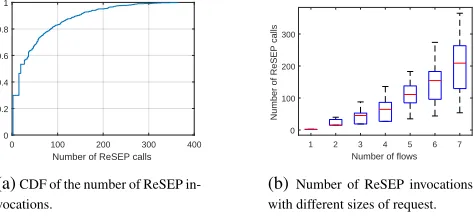
Efficiency of ReOPT: We next study the efficiency of the ReOPT oracle to learn the optimal resource reservation. To this end, we count the number of ReSEP invocations (i.e., the bottleneck operation of the ReOPT oracle) for each re-quest. Figure 4a gives the CDF of the number of ReSEP invocations. We observe that for 95% requests, the ReOPT learns the optimal reservation within 200 ReSEP calls. Fig-ure 4b further breaks down the statistics based on the size of requests. We observe that the nonlinear increase of ReSEP invocations is consistent with Theorem 3 and Figure 3b.
0 100 200 300 400 Number of ReSEP calls 0
0.2 0.4 0.6 0.8 1
(a)CDF of the number of ReSEP in-vocations.
1 2 3 4 5 6 7 Number of flows 0
100 200 300
Number of ReSEP calls
(b)Number of ReSEP invocations with different sizes of request.
Figure 4: Efficiency of ReOPT: number of ReSEP invoca-tions to learn the optimal resource reservation.
Efficiency of ReSEP: In the end, we study the efficiency of the ReSEP oracle to infer the search space for ReOPT. To this end, we count the number of ReMEM invocations (i.e., the bottleneck operation of the ReSEP oracle) for each
re-0 2 4 6 8 10 Number of total ReMEM calls 104
0 0.2 0.4 0.6 0.8 1
(a)CDF of the number of ReMEM invocations.
1 2 3 4 5 6 7 Number of flows 0
2 4 6 8
Number of total ReMEM calls
104
(b)Number of ReMEM invocations with different sizes of request.
Figure 5: Efficiency of ReSEP: number of ReMEM invoca-tions to learn the optimal resource reservation.
quest. Figure 5a gives the CDF of the number of ReMEM invocations. We observe that for 95% requests, the total ReMEM invocations required is within 30000. This large number demonstrates the necessity and benefits of putting ReSEP (i.e., the ARO scout) with the network. Integrating this observation from Figure 4a and Figure 3a, we can con-clude that this design improves the efficiency of BoxOpt (i.e., the communication latency) by 20 times. Figure 5b fur-ther breaks down the statistics based on the size of requests. We observe that the almost linear increase of ReMEM invo-cations is consistent with Theorem 2.
5
Related Work
Many network resource reservation systems have been de-veloped and deployed (Campanella et al. 2006; Guok and Robertson 2006; Johnston, Guok, and Chaniotakis 2011; Riddle 2005; Zheng et al. 2005; Sobieski, Lehman, and Jab-bari 2004). However, existing systems either are inefficient, or cause private information to be exposed. In contrast, Box-Opt adopts a novel approach to efficiently learn the optimal resource reservation through the limited feedback from the simple interface provided by reservation systems.
One area closely related to our problem is constraint
learning (De Raedt, Passerini, and Teso 2018; Bessiere et al.
2017; Ruggieri 2012; Bessiere et al. 2004; Ruggieri 2013). We refer readers to (De Raedt, Passerini, and Teso 2018) for a comprehensive survey. Instead of learning all linear inequalities that compose the bandwidth feasible region, in BoxOpt, we show that the optimal solution to an optimiza-tion problem can be learnt efficiently and accurately with-out knowing any constraints. One future direction is to in-tegrate constraint learning into BoxOpt to further accelerate the learning of the optimal resource reservation.
6
Conclusion
We design BoxOpt, a novel, automatic learning system to efficiently learn the optimal resource reservations through the simple reservation interface of network resource reser-vation systems, without exposing the private information of network or user. We demonstrate its efficiency and efficacy through extensive evaluation using real network topology and trace.
Acknowledgment
The authors thank Christian Bessiere, Haizhou Du, Kai Gao, Chin Guok, Max Del Giudice, Chris Harshaw, Amin Karbasi, Yin Tat Lee, Geng Li, Yang Liu, John MacAuley, Harvey Newman, Lam M. Nguyen, Salvatore Ruggieri, Mudhakar Srivatsa, Xin Wang, Jingxuan Zhang and Rui Zhang for their help during the prepa-ration of this paper. The authors also thank the anonymous review-ers for their valuable comments. This research is supported in part by NSFC grants 61702373, 61672385, 61701347, and 61672349; China Postdoctoral Science Foundation 2017-M611618; NSF awards CCF-1637385, CCF-1650596, OAC-1440745; Google Re-search Award; and the U.S. Army ReRe-search Laboratory and the U.K. Ministry of Defence under Agreement Number W911NF-16-3-0001.
References
Atkinson, D. S., and Vaidya, P. M. 1995. A cutting plane algorithm for convex programming that uses analytic centers. Mathematical Programming69(1-3):1–43.
Bertsimas, D., and Vempala, S. Solving convex programs by ran-dom walks. InProceedings of the 34th ACM STOC.
Bessiere, C.; Hebrard, E.; Hnich, B.; and Walsh, T. 2004. Disjoint, partition and intersection constraints for set and multiset variables. In International Conference on Principles and Practice of Con-straint Programming, 138–152. Springer.
Bessiere, C.; Koriche, F.; Lazaar, N.; and O’Sullivan, B. 2017. Constraint acquisition.Artificial Intelligence244:315 – 342. Boyd, S., and Vandenberghe, L. 2004.Convex optimization. Cam-bridge university press.
Bubeck, S., and Eldan, R. 2016. Multi-scale exploration of con-vex functions and bandit concon-vex optimization. InConference on Learning Theory, 583–589.
Campanella, M.; Krzywania, R.; Reijs, V.; Wilson, D.; Sevasti, A.; Stamos, K.; and Tziouvaras, C. 2006. Bandwidth on demand services for european research and education networks. InIEEE Bandwidth on Demand 06, 65–72. IEEE.
CMS Task Monitoring. http://dashb-cms-job.cern.ch/. 2018. Ilog cplex.
De Raedt, L.; Passerini, A.; and Teso, S. 2018. Learning constraints from examples. InProceedings in Thirty-Second AAAI Conference on Artificial Intelligence, AAAI, New Orleans, USA, 02–07. Gao, K.; Gu, C.; Xiang, Q.; Wang, X.; Yang, Y. R.; and Bi, J. 2016. ORSAP: abstracting routing state on demand. In24th IEEE Inter-national Conference on Network Protocols, ICNP 2016, Singapore, November 8-11, 2016, 1–2.
Gao, K.; Xiang, Q.; Wang, X.; Yang, Y. R.; and Bi, J. 2017. Nova: Towards on-demand equivalent network view abstraction for net-work optimization. InIWQoS’17, 1–10.
Global Ping Statistics - WonderNetwork, 2018. https:// wondernetwork.com/pings/.
Guok, C., and Robertson, D. 2006. Esnet on-demand secure cir-cuits and advance reservation system (oscars).Internet2 Joint92. Heorhiadi, V.; Reiter, M. K.; and Sekar, V. 2016. Simplifying software-defined network optimization using sol. InNSDI, 223– 237.
Johnston, W.; Guok, C.; and Chaniotakis, E. 2011. Motivation, de-sign, deployment and evolution of a guaranteed bandwidth network service. InProceedings of the TERENA Networking Conference. Knight, S.; Nguyen, H. X.; Falkner, N.; Bowden, R.; and Roughan, M. 2011. The internet topology zoo. 29(9):1765–1775.
Lee, J.; Turner, Y.; Lee, M.; Popa, L.; Banerjee, S.; Kang, J.-M.; and Sharma, P. Application-driven bandwidth guarantees in data-centers. InSIGCOMM’14.
Lee, Y. T.; Sidford, A.; and Vempala, S. S. 2017. Efficient convex optimization with membership oracles. arXiv preprint arXiv:1706.07357.
Lovasz, L.; Grotschel, M.; and Schrijver, A. 1993. Geometric algorithms and combinatorial optimization - 2nd corrected edition. Springer.
Martelli, E., and Stancu, S. 2015. Lhcopn and lhcone: status and future evolution. InJournal of Physics: Conference Series, volume 664, 052025. IOP Publishing.
Mogul, J. C., and Popa, L. 2012. What we talk about when we talk about cloud network performance. SIGCOMM CCR 1242(5):44– 48.
Riddle, B. 2005. Bruw: A bandwidth reservation system to sup-port end-user work. InTERENA Networking Conference, Poznan, Poland.
Ruggieri, S. 2012. Deciding membership in a class of polyhedra. InECAI, 702–707.
Ruggieri, S. 2013. Learning from polyhedral sets. In23rd Int. Joint Conference on Artificial Intelligence (IJCAI 2013), 1069– 1075. AAAI Press.
Sobieski, J.; Lehman, T.; and Jabbari, B. 2004. Dragon: Dynamic resource allocation via gmpls optical networks. InMCNC Optical Control Planes Workshop, Chicago, Illinois.
Soul´e, R.; Basu, S.; Marandi, P. J.; Pedone, F.; Kleinberg, R.; Sirer, E. G.; and Foster, N. 2014. Merlin: A language for provisioning network resources. InCoNEXT’14, 213–226. ACM.
Subramanian, K.; D’Antoni, L.; and Akella, A. Genesis: Synthe-sizing forwarding tables in multi-tenant networks.ACM POPL’17. White, T. 2012. Hadoop: The definitive guide. O’Reilly Media, Inc.
Xiang, Q.; Zhang, J. J.; Wang, X. T.; Liu, Y. J.; Guok, C.; Le, F.; MacAuley, J.; Newman, H.; and Yang, Y. R. 2018. Fine-grained, multi-domain network resource abstraction as a fundamental prim-itive to enable high-performance, collaborative data sciences. In
Proceedings of the ACM SIGCOMM 2018 Conference on Posters and Demos, 27–29. ACM.
Zaharia, M.; Chowdhury, M.; Das, T.; Dave, A.; Ma, J.; McCauley, M.; Franklin, M. J.; Shenker, S.; and Stoica, I. 2012. Resilient dis-tributed datasets: A fault-tolerant abstraction for in-memory cluster computing. InNSDI’12, 2–2. USENIX Association.