R E S E A R C H
Open Access
On some Mann’s type iterative algorithms
Nawab Hussain
1*, Giuseppe Marino
1,2, Luigi Muglia
2and Badriah AS Alamri
1*Correspondence:
1Department of Mathematics, King
Abdulaziz University, P.O. Box 80203, Jeddah, 21589, Saudi Arabia Full list of author information is available at the end of the article
Abstract
First we present some interesting variants of Mann’s method. In the last section, we show that many existing results in the literature are concrete realizations of our general scheme under varying assumptions on the coefficients.
MSC: 47H09; 58E35; 47H10; 65J25
Keywords: hierarchical fixed point problems; variational inequalities; nonexpansive mappings; two-step algorithms
1 Some results on very small variation of Mann’s method
LetHbe a real Hilbert space, (αn)n∈N⊂(,α]⊂(, ) and (βn)n∈N, (μn)n∈N⊂(, ]. In the sequel, we will use the following notation:
• We say thatζn=o(ηn)if ηζnn→asn→ ∞.
• We say thatζn=O(ηn)if there existK,N> such thatN≤ |ζηnn| ≤K.
Iterative schemes to approximate fixed points of nonlinear mappings have a long history and they still are an active research area of the nonlinear operator theory.
Here we are interested in the Mann iterative method introduced by Mann [] in . The method generates a sequence (xn)n∈Nvia the recursive formula
xn+=αnxn+ ( –αn)Txn, (.)
where the coefficients sequence (αn)n∈Nis in the real interval [, ],Tis a self-mapping of a closed and convex subset ofCof a real Hilbert spaceH, and the valuex∈Cis chosen arbitrarily.
Mann’s method has been studied in the literature chiefly for nonexpansive mappingsT
(i.e.,Tx–Ty ≤ x–yfor allx,y∈C). Due to Reich [] it is known that ifTis nonexpan-sive andnαn( –αn) = +∞, then the sequence (xn)n∈Ngenerated by Mann’s algorithm (.) converges weakly to a fixed point ofT. Thanks to the celebrated counterexample of Genel and Linderstrauss [], we know that Mann’s algorithm fails, in general, to converge strongly also in the setting of a Hilbert space.
In order to ensure strong convergence, in the past years, the method has been modified in several directions: by Ishikawa [] using a double convex-combination, by Halpern [] using an anchor, by Moudafi [] using a contraction mapping, by Nakajo and Takahashi [] using projections. These are just a few (but extremely relevant) of such modifications. In this section we propose a variation of Mann’s method (Theorem . and Theorem .) which differs from all those present in the literature, and it is closest to the original method (.). Moreover, we give several corollaries that are concrete and meaningful applications.
In the next section we see that the proof of all these results can be obtained by a very general two-step iterative algorithm. In the last section we give the proof of our main theorem and compare the rate of convergence of our method with that of Halpern on a specific case.
To our knowledge, Theorem . below provides a method that is almost the Mann method but ensures strong convergence.
Theorem . Letαn,μn∈(, ]such that • limn→∞αn= ,
n∈Nαnμn=∞;
• |μn––μn|=o(μn),and|αn––αn|=o(αnμn).
Then the sequence(xn)n∈Ngenerated by
xn+=αnxn+ ( –αn)Txn–αnμnxn
strongly converges to a point x∗∈Fix(T)with minimum normx∗=minx∈Fix(T)x.
Takingμn= we obtain the following.
Corollary . Letαn∈(, ]such that
lim n→∞αn= ,
n∈N
αn=∞, |αn––αn|=o(αn).
Then the sequence(xn)n∈Ngenerated by
xn+= ( –αn)Txn
strongly converges to a point x∗∈Fix(T)with minimum normx∗=minx∈Fix(T)x.
We can seex∗as the point inFix(T) nearest to ∈H. If we search for the point inFix(T) nearest to an arbitraryu∈H, then we have the following theorem.
Theorem . Under the same assumptions on the coefficientsαn,μnof Theorem.,the
sequence(xn)n∈Ngenerated by
xn+=αnxn+ ( –αn)Txn+αnμn(u–xn)
strongly converges to a point x∗u∈Fix(T)nearest to u,x∗u–u=minx∈Fix(T)x–u.
Taking againμn= , we obtain the following.
Corollary .(Halpern’s method) Under the same assumptions on the coefficientsαnof
Corollary.,the sequence(xn)n∈Ngenerated by
xn+=αnu+ ( –αn)Txn
IfAis aδ-inverse strongly monotone operator withA–()=∅, then (I–δA) is
nonex-pansive [, p.] with fixed pointsFix(I–δA) =A–(). By Theorem . withT= (I–δA),
we have the following.
Corollary . Under the same assumptions on the coefficientsαn,μnof Theorem.,the
sequence(xn)n∈Ngenerated by
xn+=αnxn+ ( –αn)(I–δA)xn+αnμn(u–xn)
strongly converges to a point x∗A,u∈A–()nearest to u,x∗
A,u–u=minx∈A–()x–u.
The first interesting example of a monotoneδ-inverse strongly monotone operator with
A–()=∅is the gradient of a convex function. Precisely, letφ:H→Rbe a convex and
Fréchet differentiable function. Let us suppose that∇φ(x) is anL-Lipschitzian mapping. We are interested in approximate solutions of the variational inequality (in the sequel (VIP))
∇φx∗,y–x∗≥, ∀y∈H, (.)
since it is the optimality condition for the minimum problem
min x∈Hφ(x).
In our hypotheses,∇φ(x) is a L-inverse strongly monotone operator. Then the mapping (I–L∇φ) is nonexpansive, and it results that the following can be obtained by Corol-lary ..
Corollary . LetFix((I–L∇φ))=∅and u∈H.Let us suppose that
• limn→∞αn= ,
n∈Nαnμn=∞;
• |μn––μn|=o(μn),and|αn––αn|=o(αnμn).
Then the sequence generated by the iteration
xn+=αnxn+ ( –αn)
I–
L∇φ xn+αnμn(u–xn), n≥ (.)
strongly converges to x∗∈Fix((I–
L∇φ))that is the unique solution of the variational
in-equality
x∗–u,y–x∗≥, ∀y∈Fix(S), (.)
i.e.,x∗is the solution of(.)nearest to u.
A further interesting result concerns a Tikhonov regularized-constrained least squares defined as follows:
min x∈C
Ax–b
+
εx
that aims the (ill-posed) constrained least squares problem
min x∈C
Ax–b
, (.)
whereC=n∈NFix(Tn),Ais a linear and bounded operator onH,b∈Hand (Tn)n∈Nare
nonexpansive satisfying the following:
(h) Tn:H→Hare nonexpansive mappings, uniformly asymptotically regular on bounded subsetsB⊂H,i.e.,
lim
n→∞supx∈BTn+x–Tnx= ;
(h) it is possible to define anonexpansivemappingT:H→HwithTx:=limn→∞Tnx such that ifF:=n∈NFix(Tn)=∅, thenFix(T) =F.
Reich and Xu in [] proved, among others, that the unique solution of (.) strongly converges, whenε→, to the solution of (.) that has minimum norm. The optimality condition to solve (.) is to solve the following variational inequality:
A∗Ax–A∗b+εx,y–x≥, ∀y∈
n∈N
Fix(Tn), (.)
whereA∗is the adjoint ofA.
In light of Reich and Xu’s results, it would be interesting to approximate a solution of (.) (for smallε).
LetB:=A∗A–A∗b. Note that sinceBis firmly nonexpansive, i.e., -inverse strongly monotone soI–Bis firmly nonexpansive [], hence nonexpansive. We are able to prove the following results.
Theorem . Assume that
• limn→∞αn= ,
n∈Nαnμn=∞;
• |βn–βn–|=o(αnβnμn),|μn–μn–|=o(αnβnμn)and|αn–αn–|=o(αnβnμn); • |β
n –
βn–|=O(αnμn).
Let us supposelimn→∞αβnnμn=τ∈(, +∞).
(These hypotheses are satisfied,for instance,byαn=μn= √n,βn=√n,n≥.)
Then(xn)n∈Ndefined by(.),i.e.,
⎧ ⎨ ⎩
yn=βn(I–A∗A)xn+ ( –βn)xn+βnA∗b,
xn+=αn( –μn)xn+ ( –αn)Tnyn, n≥
(.)
strongly converges tox˜∈n∈NFix(Tn)that is the unique solution of the variational in-equality
τDx˜+ (I–S)x˜,y–x˜
≥, ∀y∈
n∈N
Fix(Tn), (.)
i.e.,
τx˜+A
∗Ax˜–A∗b,y–x˜≥, ∀y∈
Note that we do not assume any hypotheses on the commutativity of the mappings in spite of the main theorem in [] (see also [, ]).
2 A general iterative method
In this section we study the convergence of the followinggeneral two-step iterative algo-rithmin a Hilbert spaceH:
⎧ ⎨ ⎩
yn=βnSxn+ ( –βn)xn,
xn+=αn(I–μnD)xn+ ( –αn)Wnyn, n≥,
(.)
where
• D:H→His aσ-strongly monotone andL-Lipschitzian operator onH,i.e.,D
satisfies
Dx–Dy,x–y ≥σx–y and Dx–Dy ≤Lx–y.
• S:H→His a nonexpansive mapping. • (Wn)n∈Nis defined onHand such that
(h) Wn:H→Hare nonexpansive mappings, uniformly asymptotically regular on bounded subsetsB⊂H,i.e.,
lim
n→∞supx∈BWn+x–Wnx= ,
(h) it is possible to define anonexpansivemappingW:H→H, with
Wx:=limn→∞Wnxsuch that ifF:=
n∈NFix(Wn)=∅thenFix(W) =F. • The coefficients(αn)n∈N⊂(,α]⊂(, ),(βn)n∈N⊂(, )and(μn)n∈N⊂(,μ), where
μ<Lσ.
Remark . If (Tn)n∈N does not satisfy (h) and (h), then it is always possible to
con-struct a family of nonexpansive mappings (Wn)n∈Nsatisfying (h) and (h) and such that
n∈NFix(Tn) =
n∈NFix(Wn) (see [, ]).
All the previous results easily follow from our main theorem below.
Theorem . Let H be a Hilbert space.Let D,S, (Wn)n∈Nbe defined as above.Then: ()Letτ=limn→∞αnβnμn= .Assume that
(H) limn→∞αn= ,
n∈Nαnμn=∞;
(H) supx∈BWnz–Wn–z=o(αnμn),whereB⊂His bounded; (H) |μn––μn|=o(μn)and|αn––αn|=o(αnμn).
(These hypotheses are satisfied,for instance,byαn=μn=√nandβn=n,n≥.)
Then the sequence generated by iteration(.)strongly converges to x∗∈F that is the unique solution of the variational inequality
Dx∗,y–x∗≥, ∀y∈F. (.)
(H) limn→∞αn= ,
n∈Nαnμn=∞;
(H) supx∈BWnz–Wn–z=o(αnμnβn),whereB⊂His bounded;
(H) |βn–βn–|=o(αnβnμn),|μn–μn–|=o(αnβnμn)and|αn–αn–|=o(αnβnμn); (H) |βn–β
n–|=O(αnμn).
(These hypotheses are satisfied,for instance,byαn=μn= √n,βn=√n,n≥and(Wn)and (λn)are as in Stm.)
Then xn→ ˜x,as n→ ∞,wherex˜∈F is the unique solution of the variational inequality
τDx˜+ (I–S)x˜,y–x˜
≥, ∀y∈F. (.)
()Ifτ=limn→∞αnβμnn=∞andFix(S)
F=∅.Let us suppose that
(H) limn→∞αn= ,n∈Nαnμn=∞;
(H) supx∈BWnz–Wn–z=o(αnμn),whereB⊂His bounded. (H) |μn––μn|=o(μn),and|αn––αn|=o(αnμn).
Ifβn→β= ,as n→ ∞,and|βn––βn|=o(αnμn),then the sequence generated by
itera-tion(.)strongly converges to x∗∈F∩Fix(S)that is the unique solution of the variational inequality
Dx∗,y–x∗≥, ∀y∈F∩Fix(S). (.)
Proof We give the proof in the next (and last) section.
Proof of Theorem . It follows by Theorem .() choosingD=I, μ= ,Wn=T and
S=I.
Proof of Theorem. If we takeDx=x–u,S=I,μ= andWn=T, the proofs follow by
Theorem .().
Proof of Corollary. Easily follows by Corollary . whenA=∇φandδ=L.
Remark . It is interesting to note that the convergence in Corollary . can be obtained from Theorem .() whenS=Wn= (I–δA).
The last application of our main theorem concerns the problem to minimize a quadratic function over a closed and convex subsetCofH
min x∈C
Ax,x–h(x), (.)
wherehis a potential function for a contraction mappingf,i.e.,h=fonH(for references, one can read [, ]).
LetAbe a strongly positive bounded linear operator onH,i.e., there existsγ¯> such thatAx,x ≥ ¯γxfor allx∈H.
We know the fact, due to Suzuki [], thatWnx:=λnT()x+ ( –λn)T( √
)xis a nonex-pansive mapping such thatFix(Wn) =Fix(T())∩Fix(T(√)) =F. Moreover,
Wn+x–Wnx ≤ |λn+–λn|T()x–T( √
)x.
Further, ifxlies in a bounded setB⊂X, the uniform asymptotic regularity onBfollows. IfSx:=λT()x+ ( –λ)T(√)x, thenFix(S) =Fand, for allx∈H,
lim
n→∞Wnx=Vx.
In light of [, , ], we consider
min x∈F
Ax,x–h(x). (.)
We are able to prove the following new convergence result.
Theorem . Let us suppose that
• limn→∞αn= ,
n∈Nαnμn=∞; • |λn+–λn|=o(αnμn);
• |μn––μn|=o(μn),and|αn––αn|=o(αnμn).
Ifβn→β= ,as n→ ∞,and|βn––βn|=o(αnμn),then the sequence generated by
itera-tion(.),i.e.,
⎧ ⎨ ⎩
xn+=αn(I–μnA)xn+αnμnf(xn) + ( –αn)Wnyn, n≥,
yn=βn(λT() + ( –λ)T( √
))xn+ ( –βn)xn
(.)
strongly converges to x∗∈F that is the unique solution of the variational inequality
(A–γf)x∗,y–x∗≥, ∀y∈F, (.)
which is the optimality condition to solve
min x∈F
Ax,x–h(x).
Proof of Theorem. Easily follows by Theorem . statement whenS=λT() + ( –
λ)T(√),Wn=λnT() + ( –λn)T( √
) andD=A–f (see []).
3 Proof of Theorem 2.2
Lemma . Let (xn)n∈N be defined by iteration (.) and (αn)n∈N, (βn)n∈N ⊂[, ] and
(μn)n∈N⊂(,μ).Assume that
(H) βn=O(αnμn)
holds.Then(xn)n∈Nand(yn)n∈Nare bounded.
Proof PuttingBn:= (I–μnD), we then have
i.e., (I–μnD) is a ( –μnρ)-contraction (see []). Letz∈F. Then, for sufficiently large
Nand forγ > , we have
xn+–z ≤αnBnxn–Bnz+αnBnz–z+ ( –αn)Wnyn–z ≤αn( –μnρ)xn–z+αnμnDz+ ( –αn)βnSxn–z
+ ( –αn)( –βn)xn–z
≤αn( –μnρ)xn–z+αnμnDz+ ( –αn)βnSz–z+ ( –αn)xn–z ≤( –μnαnρ)xn–z+αnμnDz+βnSz–z
≤( –μnαnρ)xn–z+αnμn
Dz+γSz–z
(by convexity of the norm)
≤max
xn–z,
Dz+γSz–z ρ
.
So, by an inductive process, one can see that
xn–z ≤max
xi–z,
Dz+γSz–z
ρ :i= , . . . ,N
.
As a rule (yn)n∈Nis bounded too.
We recall the following lemma.
Lemma . In the hypotheses of Theorem.(),we have that the sequence generated by z∈H and the iteration
zn+=αn(I–μnD)zn+ ( –αn)Wnzn
strongly converge to x∗∈F that is the unique solution of the variational inequality
Dx∗,y–x∗≥, ∀y∈F. (.)
Proof The proof is given in [, Theorem .].
Proof of Theorem.
Proof of . Let us note that sinceτ = , then (H) holds so (xn)n∈N is bounded by
Lemma .. Let us consider the iteration generated by
⎧ ⎨ ⎩
z=x,
zn+=αn(I–μnD)zn+ ( –αn)Wnzn, n≥.
(.)
By Lemma ., (zn)n∈Nstrongly converges to the unique solution of VIP (.). Then if we
compute
≤αn( –μnρ)xn–zn+ ( –αn)βnSxn–zn+ ( –αn)xn–zn ≤( –αnμnρ)xn–zn+ ( –αn)βnSxn–zn
≤( –αnμnρ)xn–zn+βnO().
Callingsn:=xn–zn,an:=αnμnρ, we have that
sn+≤( –an)sn+βnO().
Sincenαnμn=∞andτ= , we can apply Xu’s Lemma . in [] to obtain the required result.
Proof of . It is not difficult to observe that, by Byrne [], (I–S) is a-inverse strongly monotone operator, so (τD+ (I–S)) is aσ
τ-strongly monotone operator. Then (VIP) (.) has a unique solution by the celebrated results of Browder and Petryshyn [] and Deim-ling Theorem . in [].
We next prove that (xn)n∈Nis asymptotically regular with respect to (βn)n∈N,i.e.,
lim n→∞
xn+–xn
βn
= .
In order to prove the previous limit, we first compute
xn+–xn ≤αnBnxn–Bn–xn–+Bn–xn––Wn–yn–|αn–αn–|
+ ( –αn)Wnyn–Wn–yn–
≤αnBnxn–Bnxn–+αnBnxn––Bn–xn–
+Bn–xn––Wn–yn–|αn–αn–|
+ ( –αn)Wnyn–Wnyn–+ ( –αn)Wnyn––Wn–yn–
≤αn( –μnρ)xn–xn–+αn|μn–μn–|Dxn–
+Bn–xn––Wn–yn–|αn–αn–|
+ ( –αn)yn–yn–+Wnyn––Wn–yn–. (.)
By definition ofynone obtains that
yn–yn–=βnSxn–Sxn–+Sxn––xn–|βn–βn–|+ ( –βn)xn–xn–
≤βnxn–xn–+Sxn––xn–|βn–βn–|
+ ( –βn)xn–xn–
=xn–xn–+Sxn––xn–|βn–βn–|. (.)
So, substituting (.) in (.), we obtain
xn+–xn ≤αn( –μnρ)xn–xn–
+αn|μn–μn–|+|αn–αn–|+|βn–βn–|
+ ( –αn)xn–xn–+Wnyn––Wn–yn–
= ( –μnαnρ)xn–xn–+Wnyn––Wn–yn–
+αn|μn–μn–|+|αn–αn–|+|βn–βn–|
O(). (.)
Let us observe that by (H)
lim n→∞
αn|μn–μn–|+|αn–αn–|+|βn–βn–| αnμn
=
and (H) guarantees that
lim n→∞
Wnyn––Wn–yn– αnμn
= .
Puttingsn:=xn–xn–,an:=μnαnρandbn=Wnyn––Wn–yn–+ (αn|μn–μn–|+|αn–
αn–|+|βn–βn–|)O(), we can write (.) as
sn+≤( –an)sn+bn.
Thus (H), (H) and (H) are enough to apply Xu’s Lemma . in [] to assure that (xn)n∈N is asymptotically regular. Moreover, dividing byβnin (.), one observes that
xn+–xn
βn
≤( –μnαnρ)
xn–xn– βn
+Wnyn––Wn–yn–
βn
+αn|μn–μn–|+|αn–αn–|+|βn–βn–|
βn
M
≤( –μnαnρ)
xn–xn– βn
+xn––xn
βn–
βn–
+Wnyn––Wn–yn–
βn
+M
|
αn–αn–| βn
+αn|μn–μn–|
βn
+|βn–βn–|
βn
by (H) ≤( –μnαnρ)
xn–xn– βn–
+O(αnμn)xn––xn
+Wnyn––Wn–yn–
βn
+M
|αn–αn–| βn
+αn|μn–μn–|
βn
+|βn–βn–|
βn
.
Since (H), (H) and (H) hold, by using again Xu’s Lemma . in [], we have
lim n→∞
xn+–xn
βn
= .
then by the Opial property of a Hilbert space
lim inf
k→∞ xnk–p<lim infk→∞ xnk–Wp ≤lim inf
k→∞
xnk–xnk++xnk+–Wnkynk
+Wnkynk–Wnkp+Wnkp–Wp
≤lim inf k→∞
xnk–xnk++αnkBnkxnk–Wnkynk
+ynk–p+Wnkp–Wp
≤lim inf
k→∞ ynk–p ≤lim inf
k→∞
βnkSxnk–p+xnk–p
.
Sinceβn→ asn→ ∞, then
lim inf
k→∞ xnk–p<lim inf
k→∞ xnk–Wp ≤lim inf
k→∞ xnk–p,
which is absurd. Thenp∈F. On the other hand,
xn+–xn=αn(Bnxn–xn) + ( –αn)(Wnyn–xn)
= –αnμnDxn+ ( –αn)(Wnyn–yn) + ( –αn)(yn–xn)
= –αnμnDxn+ ( –αn)(Wnyn–yn) + ( –αn)βn(Sxn–xn),
so that we define
vn:=
xn–xn+
( –αn)βn
= (I–S)xn+
βn
(I–Wn)yn+
αnμn ( –αn)βn
Dxn. (.)
As a rulevn:=(–xn–αxnn)+βn is also a null sequence asn→ ∞.
Now we prove thatωw(xn) =ωs(xn),i.e., every weak limit is a strong limit too. We only need to prove thatωw(xn)⊂ωs(xn).
Let us fixz∈ωw(xn), thenz∈F, and by (.) it results
vn,xn–z=
(I–S)xn,xn–z
+
βn
(I–Wn)yn,xn–z
+ αnμn ( –αn)βn
Dxn,xn–z
=(I–S)xn– (I–S)z,xn–z
+(I–S)z,xn–z
+
βn
(I–Wn)yn,xn–yn
+
βn
(I–Wn)yn,yn–z
+ αnμn ( –αn)βn
Dxn–Dz,xn–z+
αnμn ( –αn)βn
Dz,xn–z.
Since the operator (I–Wn) is monotone for alln∈N, we obtain that
vn,xn–z ≥
(I–S)z,xn–z
+
βn
(I–Wn)yn,xn–yn
+
βn
(I–Wn)yn– (I–Wn)z,yn–z
+ αnμn ( –αn)βn
Dz,xn–z+
αnμnσ ( –αn)βn
xn–z
≥(I–S)z,xn–z
+(I–Wn)yn,xn–Sxn
+ αnμnσ ( –αn)βn
xn–z+
αnμn ( –αn)βn
Dz,xn–z,
and so we can write
xn–z≤
( –αn)βn
αnμnσ
vn,xn–z–
(I–S)z,xn–z
–(I–Wn)yn,xn–Sxn
–
σDz,xn–z.
Let us note that
yn–Wnyn ≤ yn–xn+xn–xn++xn+–Wnyn ≤βnSxn–xn+xn–xn++αnBnxn–Wnyn ≤βn+xn–xn++αn
O().
So, by the hypotheses,yn–Wnyn → asn→ ∞. So if (xnk)k is such thatxnk →zas
k→ ∞, it follows that
xnk–z
≤( –αnk)βnk
αnkμnkσ
vnk,xnk–z–
(I–S)z,xnk–z
–(I–Wnk)ynk,xnk–Sxnk
–
σDz,xnk–z.
Sincevn→ and (I–Wn)yn→ asn→ ∞, then every weak cluster point of (xn)n∈N(that lies inF) is also a strong cluster point.
We prove thatωw=ωs(xn) is a singleton. By the boundedness of (xn)n∈N, let (xnk)k∈Nbe a subsequence of (xn)n∈Nconverging (weakly and strongly) tox. For allz∈F, again by (.)
Dxnk,xnk–z=
( –αnk)βnk
αnkμnk
vnk,xnk–z–
( –αnk)βnk
αnkμnk
(I–S)xnk,xnk–z
–( –αnk)
αnkμnk
(I–Wnk)ynk,xnk–z
(by monotonicity) ≤( –αnk)βnk
αnkμnk
vnk,xnk–z–
( –αnk)βnk
αnkμnk
(I–S)z,xnk–z
–( –αnk)βnk
αnkμnk
(I–Wnk)ynk,xnk–ynk
≤( –αnk)βnk
αnkμnk
vnk,xnk–z–
( –αnk)βnk
αnkμnk
(I–S)z,xnk–z
–( –αnk)βnk
αnkμnk
(I–Wnk)ynk,xnk–Sxnk
.
Passing to limit ask→ ∞, we obtain
that is, (.) holds. Thus, since (.) cannot have more than one solution, it follows that
ωw(xn) =ωs(xn) ={˜x}and this, of course, ensures thatxn→ ˜xasn→ ∞. Now we investigate the case
τ:= lim n→∞
βn
αnμn = +∞.
Proof of . Letz∈F∩Fix(S). Then
xn+–z ≤αnBnxn–Bnz+αnBnz–z+ ( –αn)Wnyn–z ≤αn( –μnρ)xn–z+αnμnDz+ ( –αn)βnSxn–z
+ ( –αn)( –βn)xn–z
≤αn( –μnρ)xn–z+αnμnDz+ ( –αn)xn–z ≤( –μnαnρ)xn–z+αnμnDz.
So, by an inductive process, one can see that
xn–z ≤r.
By (.) inProof of , we have
xn+–xn ≤( –μnαnρ)xn–xn–+Wnyn––Wn–yn–
+αn|μn–μn–|+|αn–αn–|+|βn–βn–|
O(). (.)
Let us observe that by (H) we have
lim n→∞
αn|μn–μn–|+|αn–αn–|+|βn–βn–| αnμn
= ,
and (H) guarantees that
lim n→∞
Wnyn––Wn–yn– αnμn
= .
Then, callingsn=xn–xn–,an=μnαnρandbn=Wnyn––Wn–yn–+ (αn|μn–μn–|+
|αn–αn–|+|βn–βn–|)O(), we can write (.) as
sn+≤( –an)sn+bn,
and (H), (H) and (H) are enough to apply Xu’s Lemma . in [] and to assure that (xn)n∈Nis asymptotically regular.
For everyv∈Fix(S)∩F, it results that
+ ( –βn)xn–v–βn( –βn)Sxn–xn
≤αnBnxn–v+xn–v–βn( –βn)Sxn–xn. (.)
So, by the boundedness we get
βn( –βn)Sxn–xn≤αnBnxn–v+xn–v–xn+–v
≤αn+xn–xn+
O(). (.)
ThenSxn–xn → asn→ ∞and, by the demiclosedness principle, the weak cluster points of (xn)n∈Nare fixed points ofS,i.e.,ωw(xn)⊂Fix(S). Let us show that there are more
ωw(xn)⊂F. If not, letp∈ωw(xn) andp∈/F. By the Opial property of a Hilbert space, we
have
lim inf
k→∞ xnk–p<lim inf
k→∞ xnk–Wp ≤lim inf
k→∞
xnk–xnk++xnk+–Wnkynk
+Wnkynk–Wnkp+Wnkp–Wp
≤lim inf k→∞
xnk–xnk++αnkBnkxnk–Wnkynk
+ynk–p+Wnkp–Wp
≤lim inf
k→∞ ynk–p ≤lim inf
k→∞
βnkSxnk–p+ ( –βnk)xnk–p
=lim inf
k→∞ xnk–p,
which is absurd, sop∈F. To conclude, ifzis the unique solution of VIP (.), then
xn+–z=αn
Bn(xn) –Bnz
+αn(Bnz–z) + ( –αn)(Wnyn–z) ≤αn(Bnxn–Bnz) + ( –αn)(Wnyn–z)
+ αnμn–Dz,xn+–z
≤αn( –μnρ)xn–z+ ( –αn)yn–z
+ αnμn–Dz,xn+–z
= ( –αnμnρ)xn–z+ αnμn–Dz,xn+–z.
Since every weak cluster point of (xn)n∈Nlies inF∩Fix(S), then for an opportune
subse-quence (xnk)p
lim sup
n→∞ –Dz,xn+–z=klim→∞–Dz,xnk–z=–Dz,p–z ≤.
Thus, callingsn:=xn–z,an=αnμnρandbn= αnμn–Dz,xn+–z, we can write
sn+≤( –an)sn+bn,
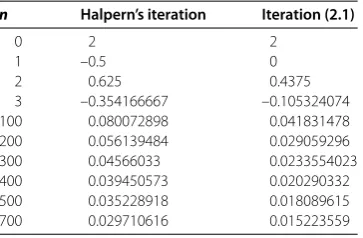
Table 1 Comparison of convergence rate of Halpern’s iteration and iteration (2.1)
n Halpern’s iteration Iteration (2.1)
0 2 2
1 –0.5 0
2 0.625 0.4375
3 –0.354166667 –0.105324074
100 0.080072898 0.041831478
200 0.056139484 0.029059296
300 0.04566033 0.0233554023
400 0.039450573 0.020290332
500 0.035228918 0.018089615
700 0.029710616 0.015223559
To us, applications of Theorem . are a well-known problem, and also we know that there exist several iterative approaches to approximate the solutions. Nevertheless, our iterative scheme summarizes a lot of them assuming very simple hypotheses on the nu-merical sequences, and it can be applied to a wide class of mappings thanks to hypotheses (h) and (h). However the reader could ask for a comparison of scheme (.) and the well-known iterative approach cited here. We do not known the rate of convergence of our method, but it is enough to see the numerical examples in [, ] to conclude that it is not possible to compare two iterative schemes. However, for the sake of complete-ness, we include a very simple case which shows that our scheme is faster than Halpern’s scheme.
Example . LetH=R,u= ,Wnx:= –x(henceF={}),Dx:=x– ,Sx:=x– . Let
αn=n,μn= andz= . Then Halpern’s iterative method
zn+=αnu+ ( –αn)Wnzn
becomes
zn+=
n–
– n zn.
Ifβn=n, from our scheme (.) we obtain
xn+=
n–
–
n xn–
n .
Thus our iterative scheme is slightly faster as shown in Table (see also []).
Competing interests
The authors declare that they have no competing interests.
Authors’ contributions
All authors contributed equally and significantly in writing this article. All authors read and approved the final manuscript.
Author details
1Department of Mathematics, King Abdulaziz University, P.O. Box 80203, Jeddah, 21589, Saudi Arabia.2Dipartimento di
Acknowledgements
The authors are grateful to the anonymous referees for their useful comments and suggestions. This project was funded by the Deanship of Scientific Research (DSR), King Abdulaziz University under grant No. (29-130-35-HiCi). The authors, therefore, acknowledge technical and financial support of KAU.
Received: 23 July 2014 Accepted: 16 January 2015
References
1. Mann, WR: Mean value methods in iteration. Proc. Am. Math. Soc.4, 506-510 (1953)
2. Reich, S: Weak convergence theorems for nonexpansive mappings in Banach spaces. J. Math. Anal. Appl.67(2), 274-276 (1979)
3. Genel, A, Lindenstrauss, J: An example concerning fixed points. Isr. J. Math.22(1), 81-86 (1975)
4. Ishikawa, S: Fixed points and iteration of a nonexpansive mapping in a Banach space. Proc. Am. Math. Soc.59, 65-71 (1976)
5. Halpern, B: Fixed points of nonexpanding maps. Bull. Am. Math. Soc.73, 957-961 (1967)
6. Moudafi, A: Viscosity approximation methods for fixed-points problems. J. Math. Anal. Appl.241, 46-55 (2000) 7. Nakajo, K, Takahashi, W: Strong convergence theorems for nonexpansive mappings and nonexpansive semigroups.
J. Math. Anal. Appl.279(2), 372-379 (2003)
8. Takahashi, W, Toyoda, M: Weak convergence theorems for nonexpansive mappings and monotone mappings. J. Optim. Theory Appl.118(2), 417-428 (2003)
9. Reich, S, Xu, H-K: An iterative approach to a constrained least squares problem. Abstr. Appl. Anal.2003, 503-512 (2003)
10. Byrne, C: A unified treatment of some iterative algorithms in signal processing and image reconstruction. Inverse Problems20, 103-120 (2004)
11. Hussain, N, Marino, G, Abdu, AAN: On Mann’s method with viscosity for nonexpansive and nonspreading mappings in Hilbert spaces. Abstr. Appl. Anal.2014, Article ID 152530 (2014)
12. Hussain, N, Takahashi, W: Weak and strong convergence theorems for semigroups of mappings without continuity in Hilbert spaces. J. Nonlinear Convex Anal.14(4), 769-783 (2013)
13. Marino, G, Muglia, L: On the auxiliary mappings generated by a family of mappings and solutions of variational inequalities problems. Optim. Lett. (2013). 10.1007/s11590-013-0705-7
14. Marino, G, Muglia, L, Yao, Y: The uniform asymptotical regularity of families of mappings and solutions of variational inequality problems. J. Nonlinear Convex Anal.15(3), 477-492 (2014)
15. Colao, V, Marino, G, Xu, H-K: An iterative method for finding common solutions of equilibrium and fixed point problems. J. Math. Anal. Appl.344(1), 340-352 (2008)
16. Marino, G, Xu, HK: A general iterative method for nonexpansive mappings in Hilbert spaces. J. Math. Anal. Appl.
318(1), 43-52 (2006)
17. Suzuki, T: The set of common fixed points of a one-parameter continuous semigroup of mappings is F(T(1))∩F(T(√2)). Proc. Am. Math. Soc.134(3), 673-681 (2005)
18. Cianciaruso, F, Marino, G, Muglia, L: Iterative methods for equilibrium and fixed point problems for nonexpansive semigroups in Hilbert spaces. J. Optim. Theory Appl.146(2), 491-509 (2010)
19. Xu, HK: Iterative algorithms for nonlinear operators. J. Lond. Math. Soc.2, 1-17 (2002)
20. Xu, HK, Kim, TH: Convergence of hybrid steepest-descent methods for variational inequalities. J. Optim. Theory Appl.
119(1), 185-201 (2003)
21. Browder, FE, Petryshyn, VW: Construction of fixed points of nonlinear mappings in Hilbert space. J. Math. Anal. Appl.
20(2), 197-228 (1967)
22. Demling, K: Nonlinear Functional Analysis. Dover, New York (2010); first Springer, Berlin (1985)
23. Cianciaruso, F, Marino, G, Muglia, L, Yao, Y: On a two-step algorithm for hierarchical fixed point problems and variational inequalities. J. Inequal. Appl.2009, Article ID 208692 (2009). doi:10.1155/2009/208692