Inferring Particles
Anjan Chakravartty: Scientific Ontology: Integrating Naturalized Metaphysics and Voluntarist Epistemology. Oxford: Oxford University Press, 2017, 296pp, US$74.00 HB.
Peter J. Lewis
1. Scientific Ontology
In his excellent book, Chakravartty builds a strong case for a particular conception of the
relationship of science to metaphysics. Metaphysics, he contends, is inescapable: even the most diehard empiricist must make use of metaphysical presuppositions. Conversely, science is essential to metaphysics: an ontology that is divorced from empirical scrutiny is just too epistemically risky. So empirical inquiry and metaphysical inference must work together to inform our picture of the ontology of the natural world.
The main novel feature in his account of scientific ontology is his construction of a metaphysical distance measure. Some ontological claims are close to the science that informs those claims, and some are further away. The distance is a measure of the epistemic risk one takes in asserting the claim: the further from the empirical base, the greater the risk. But conversely, claims far from the empirical base can serve explanatory and unificatory purposes regarding claims closer in. Since different philosophers have different (reasonable) attitudes towards epistemic risk, Chakravartty endorses a pluralism about scientific ontology. If you are risk-averse, you might reasonably endorse only a narrow range of ontological claims lying very close to the empirical base, but if you are more risk-tolerant, you might reasonably endorse a wider variety of ontological claims, including claims that are further from the base.
Chakravartty illustrates his arguments concerning scientific ontology by considering two case studies: the existence of dispositional properties, and the existence of particles. Here I consider the latter. What can we infer from the Standard Model of particle physics concerning the ontological status of the structures and entities it describes? I argue that, while this case study initially appears to support Chakravartty’s arguments, on closer inspection it suggests a different approach to scientific ontology.
2. Science and Structure
A striking feature of contemporary particle physics is the major role played by group-theoretic structures. A dizzying array of subatomic particles has been discovered, but fortunately order can be imposed on them by noting that they can be organized as the nodes in a particular mathematical group structure, the SU(3) symmetry group.
The prominence of symmetry groups in understanding the nature of subatomic particles has suggested to some that the relevant ontology here is the structure rather than the particles. That is, what exists is the group-theoretic structure, and the particles either have a derivative existence as nodes in this more fundamental structure, or shouldn’t be thought of as existing at all. This is a particular instance of ontological structural realism—the position that what there is, fundamentally, is structure rather than things.
Ontological structural realism can be motivated in a number of ways apart from the use of symmetry groups. At a very general level, it is often argued that we can only know the relational properties of objects, not their intrinsic properties (Russell 1927/1992). Furthermore, newer theories often build on the mathematical structure of earlier theories, while rejecting their entities (Worrall 1989). It is a short step from these epistemological claims to the contention that all we should really admit the existence of are the relations, not the relata (Ladyman 1998). In the context of subatomic particles, philosophers have noted that quantum mechanics allows two particles to have all their properties in common, including
spatiotemporal properties, so that by Leibniz’s law we should not say they are distinct entities (French 1989). Again, the moral is taken to be that the ontology consists of a certain structure, not an arrangement of individuals.
Chakravartty (143) notes that there are two kinds of ontological structural realism, eliminative and non-eliminative. According to the eliminative structural realist, the ontology in the subatomic domain consists only of the SU(3) structure; terms like “electron” simply provide a convenient way of talking about aspects of this structure. According to the non-eliminative structural realist, subatomic ontology consists of both the SU(3) structure and the particles, where the particles depend on the structure. That is, while the particles exist, they are nothing more than nodes in the structure.
Chakravartty argues that both eliminativist and non-eliminativist versions require contentious metaphysical presuppositions. In the eliminativist case, the presupposition arises because of the need for causal efficacy: something in the ontology must be the locus of causation. Presumably this something must be concrete. But eliminativists only countenance structural relations, not entities standing in these relations. Hence they have to assume the existence of “concrete relations-in-themselves” as the locus of causation (151).
The non-eliminativist does not need to assume this: since they admit particles into their ontology, the particles can act as the locus of causation. But non-eliminativists face a difficulty regarding the kind identity of the particles concerned. What makes this particle a proton rather than a neutron? We would normally point to an intrinsic property: the proton has a positive charge. But the non-eliminativist structural realist takes the identity of a particle to be
exhausted by its relations to other nodes in the SU(3) structure. Hence the non-eliminativist is forced to posit the existence of entities whose kinds are constituted exclusively by extrinsic properties (155).
extra-empirical virtues such as overall simplicity. Whether the additional explanation and unification are worth the extra epistemic risk is a matter of personal judgment. If not, then the relevant version of structural realism is untenable (158).
Chakravartty takes the case study of particle physics to illustrate his concept of metaphysical distance. At some point in the spectrum of metaphysical inference, an inquirer will judge that the extra explanation you gain is not worth the extra epistemic risk (163). Different inquirers will dig in their heels at different points. Hence several distinct positions concerning the fine-grained nature of subatomic particles may be reasonable, including eliminativist and non-eliminativist versions of structural realism, as well as the denial of both. 3. The Standard Model
Let us now return to the Standard Model of subatomic particles to see how well it coheres with Chakravartty’s account. There are several features of the development of the Standard Model that I think are salient here, so I will briefly run through a little history (taken from Dodd 1984).
The mathematical foundation of the Standard Model is Noether’s theorem (Noether 1918/1971). Noether’s theorem shows that there is a deep connection between symmetries and conserved quantities. Conserved quantities are often invoked in particle physics to explain the dynamical features of the particles. For examples, kaons are only produced in pairs, and have much longer lifetimes than physicists initially expected. Both features were explained by positing that kaons carry non-zero values of a new quantity, dubbed “strangeness”, and postulating that it is conserved by interactions involving the strong nuclear force, but not by interactions involving the weak nuclear force. Then the production of kaons in pairs is explained by the fact that production is via the strong nuclear force from particles with strangeness 0: one of the pair is strangeness +1 and the other is strangeness –1, conserving strangeness. The explanation of the long lifetimes of the particles is that a particle with non-zero strangeness cannot decay into particles with zero strangeness via the strong force, so must decay via the (slower) weak force.
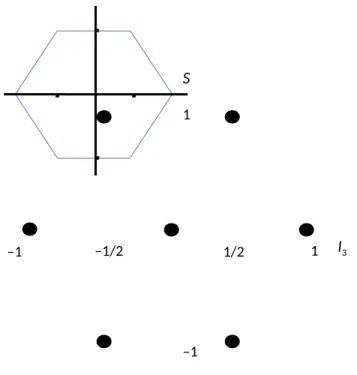
Given Noether’s theorem, this conservation law is equivalent to a symmetry. Indeed, the kaons and pions can be represented as nodes in a rotational symmetry structure in a suitable parametrized space (fig. 1). [INSERT DIAGRAM HERE] By the early 1960s it was realized that the many hundreds of subatomic particles so far produced could all be represented as nodes in a suitable representation of the SU(3) symmetry group. This structure has empirical significance: the nodes that did not correspond to known particles directed experimentalists where to look to find them. The discovery of the Ω−¿¿
in 1963, completing the spin-3/2 baryon decuplet, was regarded as decisive confirmation of the SU(3) structure.
But it was also notable that some parts of the SU(3) structure remained empty. In 1964, Gell-Mann and Zweig proposed an explanation: the mesons and baryons are all made out of three kinds or “flavors” of quark—up, down, and strange—with two quarks making up a meson, and three quarks making up a baryon. The occupied parts of the SU(3) structure can all be so represented; the unoccupied parts cannot. Hence the quark hypothesis provides a ready explanation of the observed kinds of particle.
elements only for such a scheme, devoid of physical reality.” That is, the quarks can be thought of simply as shorthand for more mathematical structure.
However, Dodd (1984, 58) also notes that “indirect evidence for the physical reality of the quarks is now very convincing.” That evidence came from the deep inelastic scattering experiments at the Stanford Linear Accelerator beginning in the late 1960s. These experiments probed the internal structure of nucleons (protons and neutrons) by scattering high-energy electrons and neutrinos off them. Significantly, the electron scattering experiments and the neutrino scattering experiments were consistent with the same three-quark structure for the nucleon, even though the electrons interact with the nucleon via the electromagnetic force and the neutrinos interact with the nucleon via the weak nuclear force.
How well does this history cohere with Chakravartty’s account of scientific ontology? Some elements of the history fit quite well with his claims. In particular, Chakravartty (157) notes that our standard ontological intuitions require a location in a structure to be occupied by a concrete particle: “Until and unless that location is occupied by an entity, there is nothing here that is recognizable as an aspect of the physical world. Unpopulated structures are at best abstract—they lack causal or physical oomph.” This coheres with the physicists’ demand for demonstrable causal oomph—via the deep inelastic scattering experiments—before they were willing to accept quarks as genuine parts of the world as opposed to mere mathematical structure.
In turn, this supports Chakravartty’s claims that the metaphysical presuppositions of both eliminative and non-eliminative structural realism are contentious. In 1965, physicists didn’t doubt the reality of the quark structure, but they did doubt the reality of quarks as concrete, causal entities in the world. This suggests that mathematical structures in themselves are not typically regarded as sufficient for causal power. An entity that is straightforwardly reducible to mathematical structure is presumably no help in this regard either, or else the reality of the structure would be sufficient for the reality of quarks as individuals. What is needed are entities that can act as the bearers of intrinsic properties like charge, properties that in turn can generate causal oomph.
So initially, it looks like the history of the Standard Model is congenial to Chakravartty’s position. But some features of the history are still somewhat mysterious. Why did physicists feel it necessary to probe the structure of the nucleon using both electrons and neutrinos? Neutrinos are very hard to detect; if it is just causal oomph we are after, surely interactions between quarks and electrons would suffice.
Dodd (1984, 110) suggests that the importance of reproducing the experiments with neutrinos was to “establish that the electromagnetic and weak interactions ‘see’ the same partons” (where a parton is a proper part of a nucleon). That is, physicists needed to rule out the possibility that the electromagnetic force reveals a three-entity structure inside the nucleon, but the weak force reveals a two-entity structure (say).
interaction will reveal the same three-entity structure. If that had not turned out to be the case, then the structure of the nucleon could not be represented using the quark model, whether interpreted as three particles with intrinsic properties or as a relational structure.
In other words, I am not convinced that physicists see an important distinction between relational structure and intrinsic properties; they are two ways of describing the same thing. One thing that is notable about the history of the Standard Model is the way physicists move back and forth easily between describing particles in terms of a relational structure and describing them using intrinsic properties. Pions and kaons can be described as nodes in a symmetry structure in a space parameterized by strangeness and the third component of isospin (a function of strangeness, charge and baryon number) but equally well they can be described as discrete particles with intrinsic properties of strangeness, charge, and baryon number.
Indeed, Noether’s theorem tells us that every symmetry corresponds to a conserved quantity, so a symmetric system of relations is guaranteed to be equivalent to ascribing the conserved quantity, conceived as an intrinsic property, to the nodes, conceived as particles. That is, I don’t think physicists would find the existence of entities whose kinds are constituted exclusively by extrinsic properties at all problematic. Chakravartty sees this as a contentious presupposition required by non-eliminative structural realism, but in the practice of physics it seems to go almost without saying.
Furthermore, since the intrinsic property guaranteed by Noether’s theorem is a
conserved quantity, it is intimately connected with dynamical behavior. Noether’s theorem connects relational structure to causal powers: the relation between the two neutral kaons (K0
and K0) is equivalent to the conserved property of strangeness, which underwrites the causal powers of individual kaons to decay only via the weak interaction. Hence I don’t think physicists would find the supposition that concrete relations have causal powers at all problematic. Some parts of the SU(3) structure are concrete—those that are instantiated in the physical world— and the relations making up those parts have causal oomph. Again, Chakravartty sees this is a contentious presupposition of eliminative structural realism, but it seems to be a commonplace aspect of subatomic physics.
4. Broader Implications
A closer look at the history of the Standard Model suggests that the metaphysical presuppositions of both eliminative and non-eliminative structural realism are not as contentious as Chakravartty makes out, but rather that they are part and parcel of modern physics. Does that mean that physicists are (perhaps tacit) structural realists? No, I don’t think so. Structural realism—of the ontic variety considered here—involves more than the
acceptance of relations as part of the furniture of the world. It also involves the denial of individuals, at least as fundamental.
that there is no interesting distinction to be made between an ontology of relations and an ontology of particles: they are just two ways of conceiving of the same physical reality.
Of course, ontology isn’t just a matter of what physicists think. Chakravartty’s (68) distinction between explicit and implicit subject matters of scientific investigation is useful here. Physicists explicitly consider the nature of the subatomic constituents of matter, and do so in a way that is even-handed between relations and individuals. But they do not explicitly consider the nature of relations and individuals. This is part of the implicit subject matter of scientific investigation, and is typically studied by philosophers rather than physicists. It is entirely possible for philosophers to conclude that some form of ontic structural realism is the best account of the subatomic realm, despite the ambivalence of physicists.
Nevertheless, I think the physicists might be onto something here. Consider again the structure shown in fig. 1. If the particles at the nodes are all genuine ontological kinds in the world, with intrinsic properties as shown in the diagram, then the relational structure is instantiated in the world: that’s all it takes. Conversely, if the relational structure of kinds is instantiated in the world, then the particles at the nodes are all genuine ontological kinds in the world: that’s all it takes. A concrete structure and a set of concrete individuals are just two ways of conceiving of the same physical content concerning subatomic ontology.
What I am advocating here is deflationism regarding the debate between structural realism and traditional particle realism: understood in the right way, there is no choice to be made between them. The ontology of the subatomic world can be conceived as a structure of relations, or it can be conceived as a set of particles with intrinsic properties, and neither conception is more fundamental. There might be an interesting epistemic thesis in the vicinity: all we can know about strangeness, for example, can be expressed relationally, and we have no epistemic access to what strangeness might be “in itself”. But the ontological issue dissolves: we don’t have to choose one view as the uniquely correct description of reality.
This deflationism can be seen as an instance of the broader metaphysical deflationism defended by Thomasson (2015). According to this approach, questions about ontology are resolved by conceptual work to figure out what it would take for a given entity to exist, and empirical work to determine whether those conditions are met. The SU(3) structure of
subatomic physics was a hard-won empirical discovery, but given that structure, the existence of kaons and pions as particles with intrinsic properties is easy: all it takes is the structure. More generally, our empirical knowledge of the world can be expressed using different conceptual schemes, none of which is uniquely “true” or “correct” or “fundamental”. Rather, following Carnap (1950), different conceptual schemes have different pragmatic virtues, and might be useful for different purposes.
alternative conceptual scheme might be better for certain purposes, but “better” here carries no connotation of corresponding to worldly structure (contra Sider 2011).
Chakravartty (15) mentions in passing the “irenic thought” that everything he says can be read in a deflationary way if you are so inclined. What I am suggesting here is that a deflationary view of scientific ontology is more distant from his own views than he
acknowledges. But of course to spell out and defend such a contention would take a lot more time and space. Chakravartty has given us a beautifully clear picture of one way of
understanding the relationship of science and metaphysics, and it will serve, I am sure, as the foundation for a fruitful ongoing debate.
References
Carnap, Rudolf (1950), “Empiricism, semantics, and ontology,” Revue Internationale de Philosophie 4: 20–40.
Dodd, J. E. (1984), The Ideas of Particle Physics. Cambridge University Press.
French, Steven (1989), “Identity and individuality in classical and quantum physics,”
Australasian Journal of Philosophy 67: 432–446.
Ladyman, James (1998), “What is structural realism,” Studies in History and Philosophy of Science 29: 409–424.
Noether, Emmy (1918/1971), “Invariant variation problems,” Transport Theory and Statistical Physics 1: 183–207 (1971); English translation of “Invariante Variationsprobleme,”
Nachr. d. König. Gesellsch. d. Wiss. zu Göttingen, Math-phys. Klasse, 235–257 (1918). Russell, Bertrand (1927/1992), The Analysis of Matter. Routledge (1992); first published
London: Kegan Paul (1927).
Sider, Theodore (2011). Writing the Book of the World. Oxford University Press. Thomasson, Amie (2015), Ontology Made Easy. Oxford University Press.
–1 1/2 –1/2
–1 1
1
S
I3