The Thirty-Third AAAI Conference on Artificial Intelligence (AAAI-19)
Mining Entity Synonyms with Efficient Neural Set Generation
Jiaming Shen
♮, Ruiliang Lyu
†, Xiang Ren
‡, Michelle Vanni
, Brian Sadler
, Jiawei Han
♮♮Department of Computer Science, University of Illinois Urbana-Champaign, IL, USA
†Department of Electronic Engineering, Shanghai Jiao Tong University, China U.S. Army Research Laboratory, MD, USA
‡Department of Computer Science, University of Southern California, CA, USA ♮
{js2, hanj}@illinois.edu †[email protected] ‡[email protected]
{michelle.t.vanni.civ, brian.m.sadler6.civ}@mail.mil
Abstract
Mining entity synonym sets (i.e., sets of terms referring to the same entity) is an important task for many entity-leveraging applications. Previous work either rank terms based on their similarity to a given query term, or treats the problem as a two-phase task (i.e., detecting synonymy pairs, followed by organizing these pairs into synonym sets). However, these
approaches fail to model theholisticsemantics of a set and
suffer from the error propagation issue. Here we propose a new
framework, namedSynSetMine, that efficiently generates
entity synonym sets from a given vocabulary, using example sets from external knowledge bases as distant supervision.
SynSetMineconsists of two novel modules: (1) a set-instance classifier that jointly learns how to represent a permutation invariant synonym set and whether to include a new instance (i.e., a term) into the set, and (2) a set generation algorithm that enumerates the vocabulary only once and applies the learned set-instance classifier to detect all entity synonym sets in it. Experiments on three real datasets from different domains
demonstrate both effectiveness and efficiency ofSynSetMine
for mining entity synonym sets.
Introduction
Anentity synonym setis a set of terms (i.e., words or phrases) that refer to the same real-world entity. For instance,{“USA”, “United States”, “U.S.”}is an entity synonym set as all terms in it refer to the same country. Entity synonym set discov-ery can benefit a wide range of applications such as web search (Cheng, Lauw, and Paparizos 2012), question answer-ing (Zhou et al. 2013), and taxonomy construction (Anh, Kim, and Ng 2015). Take the query “Emirates Airline U.S. to UAE” as an example, understanding “U.S.” refers to “United States” and “UAE” stands for “United Arab Emirates” is crucial for an intelligent system to satisfy the user information need.
One line of work for entity synonym sets discovery takes a ranking plus pruningapproach. Given a query term referring to one entity, it first ranks all candidate terms based on their probabilities of referring to the same entity and then prunes the rank list into an output set. By treating each term in a vocabulary as a query, this approach can finally output all the entity synonym sets in the vocabulary. A variety of fea-tures are extracted, including corpus-level statistics (Turney
Copyright c⃝2019, Association for the Advancement of Artificial
Intelligence (www.aaai.org). All rights reserved.
2001), textual patterns (Nakashole, Weikum, and Suchanek 2012), or query contexts (Chakrabarti et al. 2012), from dif-ferent data sources (e.g., query log (Chaudhuri, Ganti, and Xin 2009), web table (He et al. 2016), and raw text corpus (Qu, Ren, and Han 2017)) to calculate the above probabilities. However, this approach treats each candidate term separately and computes its probability of referring to the query entity independently. As a result, it ignores relations among candi-date terms which could have helped to improve the quality of discovered synonym sets. Furthermore, as shown in (Ren and Cheng 2015), the number of true synonyms varies a lot across different entities and thus converting a rank list into a set itself is a non-trivial problem and can be error-prone.
Another line of work divides the synonym set discovery problem into two sequential subtasks: (1)synonymy detection (i.e., finding term pairs of synonymy relation), and (2) syn-onymy organization(i.e., aggregating synonymous term pairs into synonym sets). Methods developed for synonymy detec-tion leverage textual patterns (Wang and Hirst 2012) and dis-tributional word representations (Shwartz and Dagan 2016) to train a classifier that predicts whether two terms hold the onymy relation. Then, those predicted term pairs form a syn-onymy graph on which different graph clustering algorithms are applied (Hope and Keller 2013; Oliveira and Gomes 2014; Ustalov, Panchenko, and Biemann 2017). This approach is able to capture relations among candidate terms and returns all entity synonym sets in the vocabulary. However, these two-phase methods only use training data in their first phase and cannot leverage training signals in the second phase. Fur-thermore, the detected synonymous term pairs are usually fixed during synonymy organization and there is no feedback from the second phase to the first, which causes the error accumulation problem.
0
{Emirates Air} the US
{Emirates Airline} Emirates Air 1
Emirates Airline
{United Arab Emirates, UAE} 0 1
1 0
Label
{United Arab Emirates, UAE} the Emirates UAE
{United States, USA.} USA {United States, U.S.}
Instance Set
4 Emirates Air announces a new daily service to Orlando, USA.
3 Emirates Airline is an airline based in the United Arab Emirates. The United States had an ambassador resident in the UAE since 1974 2
The U.S. is a country covering a vast swath of North America. 1
Document Text ID
Text corpus D
Q180432 {Emirates Airline, Emirates Air}
{United Arab Emirates, UAE, the Emirates} Q878
{United States, U.S., USA Q30
Entity Synonym Set Entity ID
Knowledge Base K Entity linking
Distant Supervision
Distant Supervision Acquisition Learning Set-Instance Classifier
Pr(t2S)
S
t f
set
instance
set-instance classifier
Used for training
Set Generation Algorithm
United Kingdom army British armed force
ww2 world war 2 world war ii
wwii darth sidious
emperor palpatine
palpatine
… … …
Vocabulary V
palpatine
emperor palpatine
darth sidious
United Kingdom army British armed force
wwii world war ii world war 2 ww2
Set Generation Algorithm
Discovered entity synonym sets
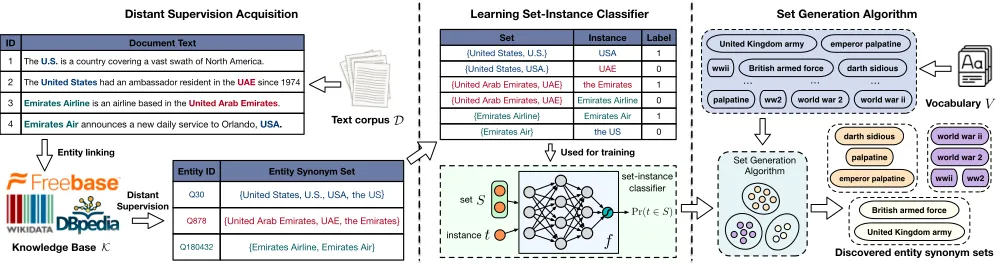
Figure 1:SynSetMineFramework Overview.
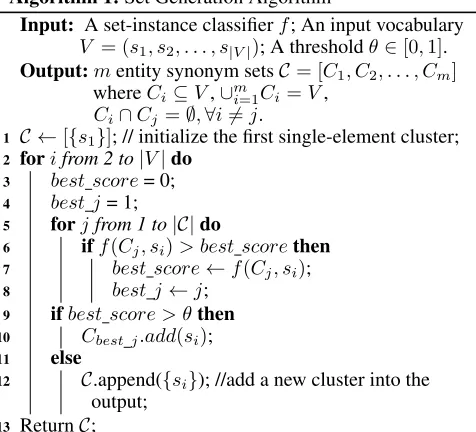
To effectively leverage distant supervision signals, SynSetMineconsists of two novel modules. First, we train a set-instance classifier which jointly learns how to repre-sent an entity synonym set and whether to include a new instance (i.e., a term) into the set. This set-instance classifier can model a set holistically, instead of decomposing it into separated pairs. As a result, it effectively captures relations among candidate terms and directly leverages supervision signals from the set structure. Second, we design an efficient set generation algorithm that applies the learned set-instance classifier to discover new entity synonym sets. Given a vocab-ulary, this algorithm processes each term in it one at a time and maintains a pool of all detected sets. For each term in the vocabulary, the algorithm applies the set-instance classifier to determine whether and which previous detected set this term should reside in. If no matching set can be found, a new set is formed, consisting of this single term, and added into the pool of detected sets. As it only enumerates the vocabulary once to generate all synonym sets, this algorithm is efficient.
Contributions.This study makes three contributions: (1) a novel framework,SynSetMine, is proposed that leverages distant supervision for entity synonym set mining; (2) a set-instance classifier is designed to model entity synonym sets holistically and is integrated into a set generation algorithm to discover new synonym sets efficiently; and (3) extensive experiments conducted on three real-world datasets from different domains show the effectiveness of the method.
Problem Formulation
We first elaborate on some important concepts and then for-mulate the problem.
Entity Synonym Set.An entity synonym set is a set of terms (i.e., words or phrases) that refer to the same real-world entity.
Knowledge Base.A knowledge base consists of many facts about a set of entities. In this work, we focus on one partic-ular type of facts: entity synonym. For some entities, their synonyms are manually curated and stored in a knowledge base. The knowledge base provides such training signals to help discover more entity synonym sets.
Problem Definition.Given a text corpusD, a vocabularyV
(i.e., a list of terms) derived fromD, and a knowledge base
K, the task ofmining entity synonym setaims to discover all
entity synonym sets consisting of terms inV, based on the information extracted fromDandK.
The
SynSetMine
Framework
Our proposed SynSetMine framework consists of three main steps (Figure 1): (1) an entity linker is used to map in-corpus text (i.e., entity mentions) to entities in the given knowledge base, which provides some training entity syn-onym sets as distant supervision; (2) a classifier is constructed to determine whether a term should be included into the syn-onym set, based on the above distant supervision; and (3) the learned classifier is integrated into a set generation algorithm which outputs all term clusters in the vocabulary as detected entity synonym sets.
Distant Supervision Acquisition
A knowledge base contains a collection of curated entities with their known synonyms. These entities can provide dis-tant supervision signals to help discover more entity synonym sets that are not in the knowledge base from raw text cor-pus. To automatically acquire the distant supervision, we first apply an existing entity linker such as DBpedia Spot-light (Mendes et al. 2011) which directly maps in-corpus text (i.e., entity mentions) to entities in the knowledge base. However, most entity linkers are not perfect and heavily rely on the string-level features which could introduce additional noise, as shown in (Shen et al. 2018b) and the example below. Therefore, we follow the same procedure in (Qu, Ren, and Han 2017) to reduce the linking errors. Specifically, for each entity mention and its linked entity, if the mention surface string is not in that entity’s synonym set (in the knowledge base), we remove the link between them. Finally, we group all entity mentions that linked to the same entity as a training entity synonym set, and collect all synonym sets from the linked corpus as distant supervision.
group the remaining two entity mentions into an entity syn-onym set{“USA”, “America”}.
Learning Set-Instance Classifier
After obtaining distant supervision, we train a set-instance classifier, denoted asf(S, t), to determine whether a syn-onym setSshould include an instancet(i.e., a term).
Set-Instance Classifier Architecture. One key require-ment of the set-instance classifierf(S, t)is that its output should be invariant to the ordering of elements in setS. An intuitive way to achieve suchpermutation invariance prop-erty is to decompose the set-instance prediction into multiple instance-instance pair predictions, as shown in Figure 2. Each pair prediction decides whether two instances are synonyms, and all pair prediction results are finally aggregated into the set-instance prediction result. However, this method com-pletely ignores the relations between elements in setS.
In this work, we are inspired by (Zaheer et al. 2017) and design a neural network architecture that directly learns to represent the permutation invariant set. The architecture of our set-instance classifier is shown in Figure 3. The bottom part of Figure 3 shows a set scorerq(·)which takes a set
Z as input, and returns a quality scoreq(Z)that measures how complete and coherent this setZis. Given a synonym setSand an instance termt, our set-instance classifierf(·)
first applies the set scorer to obtain the quality score of input setS (i.e.,q(S)). Then, we add the instancetinto the set and apply the set scorer again to obtain the quality score of
S∪ {t}. Finally, we calculate the difference between these two quality scores, and transform this score difference into the probability using a sigmoid unit as follows:
Pr(t∈S) =f(S, t) =φ(q(S∪ {t})−q(S)), (1)
whereφ(x) =1+1e−x is the sigmoid function.
Given a collection ofmset-instance pairs{(Si, ti)|mi=1}
with their corresponding labels {yi|mi=1}, we learn the
set-instance classifier using the log-loss as follows:
L(f) =
m ∑
i=1
−yilog(f(Si, ti))−(1−yi) log(1−f(Si, ti)),
(2) whereyiequals to 1 ifti ∈Siand equals to 0 otherwise.
Note that if the set scorerq(·)is invariant to the ordering of elements in its input set, our set-instance classifier built on it will naturally satisfy the permutation invariance property. Following we first describe the set scorer architecture (the bottom part of Figure 3) and then discuss how to generate set-instance pairs from distant supervision.
Set Scorer Architecture. Given a set of terms Z = {z1, . . . , zn}, the set scorer first passes each term zi into
an embedding layer and obtains its embeddingxi. Then, an “embedding transformer”φ(·)is applied to transform the raw embedding to a new term representationφ(xi). After that, we sum all transformed term representations and obtain the “raw” set representationv(Z) =∑n
i=1φ(xi). Finally, we feed this
set representation into the “post-transformer” which outputs the final set quality score. Since the summation operation is
Input set S Pair Prediction
sn
…
t
A same
Input instance
Set-instance Classifier f
f(S, t)
s1
…
Pair Prediction
… …
s term s Figure legends
A aggregation
Figure 2: Aggregating instance-instance pair prediction re-sults into set-instance prediction result.
Input set S Set Scorer
sn
…
t [
-Set Scorer same
Input instance
Set-instance Classifier f
Embedding Layer
…
xn x1
z1 (x1)
(xn)
A set Z q(Z)
zn Quality of set Z
q(S)
q(S[ {t})
Set Scorer q
s term s
[ set union - minus
sigmoid unit
f(S, t)
Embedding
Transformer Sum TransformerPost
s1 Figure legends
v(Z)
Figure 3: Architecture of our set-instance classifier.
commutative, the “raw” set representationv(Z)is invariant to the ordering of elements inZand so is the set-scorerq.
In this work, we initialize the embedding layer using term embeddings pre-trained on the given corpus. We instantiate the “embedding transformer” using a fully connected neural network with two hidden layers. For the “post transformer”, we construct it using another fully connected neural network with three hidden layers. We demonstrate the necessity of these two transformers and study how the size of hidden layers may influence model performance in later experiments.
Generation of Training Set-Instance Pairs. To train the set-instance classifierf(S, t), we need to first generate a col-lection of training set-instance pairs from training synonym sets. For each entity synonym setES, we randomly holdout one instancetpos
∈ESand construct a positive set-instance sample(Spos, tpos)whereSpos =ES
\ {tpos
}. Then, for each positive sample(Spos, tpos), we generateKnegative
samples by selectingKnegative instancestnegi |K
i=1and pair
each of them withSpos. To generate each negative instance
tnegi , we can either randomly choose a term from the vocab-ularyV (denoted ascomplete-randomstrategy); select a term that shares same token with some string inSpos
(de-noted asshare-tokenstrategy), or combine these two methods (denoted asmixturestrategy). We study how this negative sample sizeKand the sampling strategy influence the model performance in later experiments.
Set Generation Algorithm
Algorithm 1:Set Generation Algorithm
Input: A set-instance classifierf; An input vocabulary
V = (s1, s2, . . . , s|V|); A thresholdθ∈[0,1].
Output:mentity synonym setsC= [C1, C2, . . . , Cm]
whereCi⊆V,∪mi=1Ci=V,
Ci∩Cj =∅,∀i̸=j.
1 C ←[{s1}]; // initialize the first single-element cluster; 2 forifrom 2 to|V|do
3 best score= 0;
4 best j= 1;
5 forjfrom 1 to|C|do
6 iff(Cj, si)> best scorethen
7 best score←f(Cj, si);
8 best j←j;
9 ifbest score > θthen
10 Cbest j.add(si);
11 else
12 C.append({si}); //add a new cluster into the
output;
13 ReturnC;
a pool of all detected setsC. For each termsi∈V, it applies
the set-instance classifierf to calculate the probability of adding this term into each detected set inC, and finds the best setCjthat has the largest probability, If this probability value
passes the thresholdθ, we will addsiinto setCj. Otherwise,
we create a new set{si}with this single term and add it into
the set poolC. The entire algorithm stops after one pass of the vocabulary and returns all detected sets inC. Note that we do not need to specify the number of entity synonym sets in the vocabulary and our set generation algorithm will determine this value on its own. In this work, we simply set the probability thresholdθto be 0.5 and study its influence on clustering performance below.
Complexity Analysis. To compare with the clustering al-gorithm that requires the input cluster number, we suppose our algorithm will eventually returnKclusters. Then, our al-gorithm applies the set-instance classifier at mostO(|V| ·K)
times, where|V|denotes the vocabulary size. Most computa-tion efforts of set-instance classifier are the matrix multiplica-tion in two transformers, which can be accelerated by GPU. As a comparison, the time complexity ofk-means algorithm isO(|V|·K·I)whereIdenotes the number of iterations, and for most supervised clustering methods (such asSV Mcluster
(Finley and Joachims 2005)) and two-phase methods (such as WATSET (Ustalov, Panchenko, and Biemann 2017)), their time complexity isO(|V|2)as they need to explicitly
calcu-late all pairwise similarities. Finally, we emphasize that we can further parallelize lines 5-8 in Algorithm 1 by grouping all set-instance pairs{(Cj, si)|j = 1,· · ·,|C|}into a batch
and applying the set-instance classifier only once. In practice, this strategy can significantly reduce the running time.
Experiments
In this section, we first describe our experimental setup, and then report the experimental results. Finally, we analyze each
Table 1: Datasets Statistics.
Dataset Wiki NYT PubMed
#Documents 100,000 118,664 1,554,433
#Sentences 6,839,331 3,002,123 15,051,203
#Terms intrain 8,731 2,600 72,627
#Synonym sets intrain 4,359 1,273 28,600
#Terms intest 891 389 1,743
#Synonym sets intest 256 117 250
component ofSynSetMinein more details and show several concrete case studies. Our model implementation is available at: https://github.com/mickeystroller/SynSetMine-pytorch.
Experimental Setup
Datasets. We evaluateSynSetMineon three public bench-mark datasets used in (Qu, Ren, and Han 2017):
1. Wiki contains 100K articles in the Wikipedia. We use Freebase1as the knowledge base.
2. NYTincludes about 119K news articles from 2013 New York Times. We use Freebase as the knowledge base.
3. PubMed contains around 1.5M paper abstracts from PubMed2. We select UMLS3as the knowledge base.
For Wiki and NYT datasets, DBpedia Spotlight4is used as the entity linker, and for PubMed, we apply PubTator5 as
the entity linker. After the linking step, we randomly sample a portion of linked entities as test entities and treat the re-maining as training entities. Note that there is no overlapping between training vocabulary and testing vocabulary, which makes the evaluation more realistic but also more challeng-ing. The statistics of these datasets are listed in Table 1. All datasets are available at: http://bit.ly/SynSetMine-dataset.
Compared Methods. We select the following algorithms to compare with our method.
1. Kmeans: An unsupervised clustering algorithm which takes term embedding as features and returns detected synonym sets as clusters. This algorithm requires a prede-fined cluster numberKand we set its value to the oracle number of clusters for each dataset.
2. Louvain (Blondel et al. 2008)6: An unsupervised
com-munity detection algorithm which takes a graph as input and returns discovered graph communities. To apply this algorithm, we first construct a term graph where each node represents a term. Then, we calculate the cosine similarity between each pair of term embeddings, and if the similar-ity is larger than a thresholdα, we will add an edge into the graph. We tune this thresholdαon training set.
1https://developers.google.com/freebase/
2
https://www.ncbi.nlm.nih.gov/pubmed 3
https://www.nlm.nih.gov/research/umls/
4https://github.com/dbpedia-spotlight/dbpedia-spotlight
5
https://www.ncbi.nlm.nih.gov/CBBresearch/Lu/Demo/PubTator/ 6
Table 2: Quantitative results of entity synonym set mining. All metrics are in percentage scale. We run all methods except L2C five times and report the averaged score with standard deviation. Due to the bad scalability of L2C, we have not obtain its results on PubMed dataset within 120h, and indicate this using “–” mark.
Method Wiki NYT PubMed
ARI (±std) FMI (±std) NMI (±std) ARI (±std) FMI (±std) NMI (±std) ARI (±std) FMI (±std) NMI (±std)
Kmeans 34.35 (±1.06) 35.47 (±0.96) 86.98 (±0.27) 28.87 (±1.98) 30.85 (±1.76) 83.71 (±0.57) 48.68 (±1.93) 49.86 (±1.79) 88.08 (±0.45)
Louvain 42.25 (±0.00) 46.48 (±0.00) 92.58 (±0.00) 21.83 (±0.00) 30.58 (±0.00) 90.13 (±0.00) 46.58 (±0.00) 52.76 (±0.00) 90.46 (±0.00)
SetExpan+Louvain 44.78 (±0.28) 44.95 (±0.28) 92.12 (±0.02) 43.92 (±0.90) 44.31 (±0.93) 90.34 (±0.11) 58.91 (±0.08) 61.87(±0.07) 92.23 (±0.15)
COP-Kmeans 38.80 (±0.51) 39.96 (±0.49) 90.31 (±0.15) 33.80 (±1.94) 34.57 (±2.06) 87.92 (±0.30) 49.12 (±0.85) 51.92 (±0.83) 89.91 (±0.15)
SVM+Louvain 6.03 (±0.73) 7.75 (±0.81) 25.43 (±0.13) 3.64 (±0.42) 5.10 (±0.39) 21.02 (±0.27) 7.76 (±0.96) 8.79 (±1.03) 31.08 (±0.34)
L2C 12.87 (±0.22) 19.90 (±0.24) 73.47 (±0.29) 12.71 (±0.89) 16.66 (±0.68) 70.23 (±1.20) – – –
SynSetMine 56.43 (±1.31) 57.10 (±1.17) 93.04 (±0.23) 44.91 (±2.16) 46.37 (±1.92) 90.62 (±1.53) 74.33 (±0.66) 74.45 (±0.64) 94.90 (±0.97)
3. SetExpan (Shen et al. 2017)7+Louvain: A two-phase un-supervised approach that first uses SetExpan (i.e., a weakly-supervised set expansion algorithm) to find each term’sk
nearest neighbors in embedding space, and then construct ak-NN graph on which the above Louvain algorithm is applied. We tune the variablekon training set.
4. COP-Kmeans (Wagstaff et al. 2001)8: A
semi-supervised variation of the Kmeans algorithm that can incorporate pairwise constraints (e.g., two elements must or cannot be clustered together) and output clusters that satisfy all constraints. We convert training synonym sets into these pairwise constraints and set the oracle number of clustersKfor each dataset.
5. SVM9+Louvain: A two-phase supervised approach which
first uses a SVM for synonym pair prediction and then groups all predicted pairs into a graph where the Louvain algorithm is applied. The SVM is learned on training set.
6. L2C (Hsu, Lv, and Kira 2018)10: A supervised clustering
method that learns a pairwise similarity prediction neural network and a constrained clustering network on training synonym sets, then applies the learned networks on test vocabulary to detect new entity synonym sets.
7. SynSetMine: Our proposed approach which trains a set-instance classifier and integrates it seamlessly into an effi-cient set generation algorithm.
Parameter Settings and Initial Term Embedding. For a fair comparison, we use the same 50-dimension term em-bedding, trained on each corpus, across all compared meth-ods. We tune hyper-parameters in all (semi-)supervised al-gorithms using 5-fold cross validation on training set. For SynSetMine, we use a neural network with two hidden lay-ers (of sizes 50, 250) as embedding transformer, and another neural network with three hidden layers (of sizes 250, 500, 250) as post transformer (c.f. Figure 3). We optimize our model using Adam with initial learning rate 0.001 and apply dropout technique with dropout rate 0.5. For the set genera-tion algorithm, we set the probability thresholdθbe 0.5. We will discuss the influence of these hyper-parameters later.
7
https://github.com/mickeystroller/SetExpan
8https://github.com/Behrouz-Babaki/COP-Kmeans
9
http://scikit-learn.org/stable/modules/svm.html 10
https://github.com/GT-RIPL/L2C
Evaluation Metrics. As all compared methods output entity synonym sets in the form of clusters, we evaluate them using three standard clustering evaluation metrics.
• ARImeasures the similarity of two cluster assignments. Given the ground truth cluster assignmentC∗and model predicted cluster assignmentC, we useT P(T N) to denote the number of element pairs that are in the same (different) cluster(s) in bothC∗andC, respectively. We denote the to-tal number of element pairs inC∗asN, and then calculate ARI as follows:
ARI= RI−E(RI)
max(RI)−E(RI), RI=
(T P +T N)
N ,
whereE(RI)is the expected RI of random assignments.
• FMIis another similarity measure of two cluster assign-ments. Besides the aboveT P, we useF P (F N) to denote the number of element pairs that belong to the same clus-ters inC∗(C) but in different clusters inC(C∗), respectively. Then, we calculate FMI as follows:
FMI= √ T P
(T P +F P)(T P +F N).
• NMIcalculates the normalized mutual information be-tween two cluster assignments. This metric is widely used in literature and its calculation details can be found in (Nguyen, Epps, and Bailey 2009).
Experimental Results
set size
4 6 8 10 12 14 16
Accuracy
0.75 0.8 0.85 0.9 0.95 1
1.05 encoding set holistically for prediction averaging pair predictions
(a)
set size 4 6 8 10 12 14 16
F1 score
0.7 0.75 0.8 0.85 0.9 0.95 1
encoding set holistically for prediction averaging pair predictions
(b)
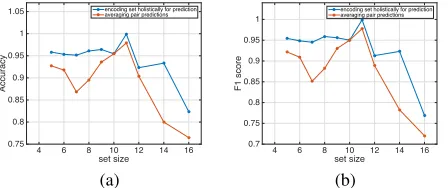
Figure 4: Evaluation of set-instance classifiers on PubMed dataset using (a) Accuracy and (b) F1 score.
reason is that during the training stage, L2C needs to calcu-late each example’s class distribution, and this computation effort is proportional to the training cluster number which is in the scale of thousands11. Another major deficiency of
both SVM+Louvain and L2C is that their learned model is based on pairwise similarity and does not have a holistic view of set. On the other hand,SynSetMineencodes synonym sets directly and therefore is able to capture set-level features beyond pairwise similarity.
Set-instance Pair Prediction Performance. To further an-alyze the importance of encoding set structure, we compare our method with the approach that averages instance-instance pair prediction results, as shown in Figure 2. Specifically, given a trained set-instance classifierf(S, t), we first con-struct an instance-instance classifierg(t1, t2)to determine
whether two instances should be put into the same set. We letg(t1, t2)to be the mean off({t1}, t2)andf({t2}, t1).
Then, for each set-instance pair(S, t), we apply the clas-sifier g to obtain all instance pair prediction results (i.e.,
g(t′, t),
∀t′
∈S) and average them into the final prediction. For evaluation, we convert the testing synonym sets in PubMed dataset into a collection of 3486 set-instance pairs, among which 1743 pairs are positive. Results are shown in Figure 4. We can see clearly that the set-encoding based ap-proach performs much better than the “averaging pair predic-tion” approach in terms of both accuracy and F1 score. This demonstrates the importance of capturing entity relations among the set and modeling the set structure holistically.
Efficiency Analysis. We implement our model based on the PyTorch library, same as the L2C baseline. We train two neural models (SynSetMineand L2C) on one Quadro P4000 GPU and run all the other methods on CPU. Results are shown in Table 3. Compared with the other supervised neural model L2C, our method can predict significantly faster. In addition, our set generation algorithm avoids explicitly computing all pairwise term similarities and thus is more efficient during the prediction stage.
11
For comparison, L2C originally runs on MNIST and CIFAR-10 datasets where examples with the same class label is viewed as a cluster and the cluster number is of scale 10-100.
Table 3: Efficiency analysis. Model and data loading time are excluded. GPU time are marked with⋆. We use “–” to indicate that either there is no training time for unsupervised methods, or the model is too slow to train and thus we don’t get one trained model for prediction.
Method Training Prediction
Wiki NYT PubMed Wiki NYT PubMed
Kmeans – – – 1.82s 0.88s 2.95s
Louvain – – – 3.94s 20.59s 74.6s
SetExpan+Louvain – – – 323s 120s 4143s
COP-KMeans – – – 249s 37.94s 713s
SVM+Louvain 4.9m 37s 1.3h 29.21s 5.80s 101.32s
L2C 16.8h⋆ 30.7m⋆ >120h⋆ 20.9m⋆ 56.6s⋆ –
SynSetMine 48m⋆ 6.5m⋆ 7.5h⋆ 0.852s⋆ 0.348s⋆ 1.84s⋆
Model Analysis and Cases Studies
Following we conduct more experiments to analyze each component of ourSynSetMineframework in more details and show some concrete case studies.
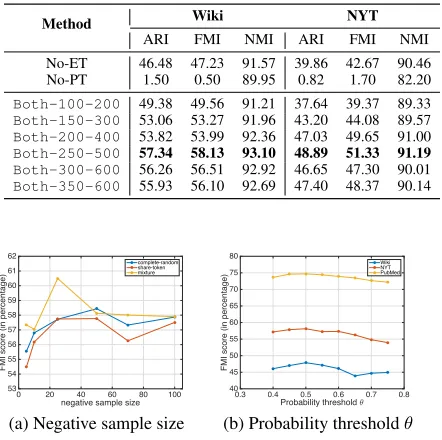
Effect of training set-instance pair generation strategy and negative sample size. In order to train the set-instance classifier, we need to first convert the training entity synonym sets (obtained from distant supervision) to a collection of set-instance pairs. We study how such conversion strategy and different negative sample sizes will affect the model per-formance on Wiki dataset. Results are shown in Figure 5a. First, we find that thecomplete-randomstrategy actually performs better than theshare-tokenstrategy. One pos-sible explanation is that thecomplete-randomstrategy can generate morediversenegative samples and thus provide more supervision signals. Second, we observe that by com-bining the above two strategies and generating more mixed negative samples, our model can be further improved, which again may contribute to thediversityof negative samples.
Effects of different set-scorer architectures. To demon-strate the necessity of our model components, we first com-pare the current set-scorer architecture (c.f. Figure 3) with its two ablations. Specifically, we leave either the Embedding Transformer (ET) or the Post Transformer (PT) out, and test the performance of remaining models. As shown in Table 4, both ET and PT are essential to our model, and removing either of them will significantly damage our model’s perfor-mance. Furthermore, the Post Transformer, which operates on the set representation, is particularly important to our model. To further explore the effect of above two transformers, we train our model with different hidden layer sizes. Specifically, we useBoth-X-Yto denote a set-scorer composed of an Embedding Transformer (of hidden sizes {50, X}) and a Post Transformer (of hidden sizes{X, Y, X}). Results are shown in Table 4. We discover that the performance first keeps increasing when the hidden layer size grows and then drops slightly. Also, the best model sizes are consistent for both Wiki and NYT datasets.
gener-Table 4: Analysis of set scorer architecture. “No-ET” means no Embedding Transformer (ET) module, “No-PT” means no Post Transformer (PT) module, andBoth-X-Ystands for using both ET (of hidden sizes{50, X}) and PT (of hidden sizes{X, Y, X}).
Method Wiki NYT
ARI FMI NMI ARI FMI NMI
No-ET 46.48 47.23 91.57 39.86 42.67 90.46
No-PT 1.50 0.50 89.95 0.82 1.70 82.20
Both-100-200 49.38 49.56 91.21 37.64 39.37 89.33
Both-150-300 53.06 53.27 91.96 43.20 44.08 89.57
Both-200-400 53.82 53.99 92.36 47.03 49.65 91.00
Both-250-500 57.34 58.13 93.10 48.89 51.33 91.19
Both-300-600 56.26 56.51 92.92 46.65 47.30 90.01
Both-350-600 55.93 56.10 92.69 47.40 48.37 90.14
negative sample size
0 20 40 60 80 100
FMI score (in percentage)
53 54 55 56 57 58 59 60 61 62
complete-random share-token mixture
(a) Negative sample size
Probability threshold θ 0.3 0.4 0.5 0.6 0.7 0.8
FMI score (in percentage)
40 45 50 55 60 65 70 75 80
Wiki NYT PubMed
(b) Probability thresholdθ
Figure 5: Hyper-parameters analysis.
ation algorithm will be and more sets will be generated. In all the above experiments, we set the thresholdθto be 0.5. In this experiment, we intend to empirically study how this hyper-parameter will influence the clustering performance and how SynSetMineis sensitive to the choice ofθ. Therefore, we run our set generation algorithm with fixed set-instance clas-sifier and varied thresholds. The results are shown in Figure 5b. First, we notice that the performance of our clustering algorithm is insensitive toθand a value within 0.4 and 0.6 is generally good forθ. Second, we find that settingθto be 0.5 is robust and works well across all three datasets.
Case Studies. Table 5 presents some example outputs of SynSetMine. We can see that our method is able to detect different types of entity synonym sets across different do-mains. Then, in Table 6, we show a concrete case comparing our set-instance classifier with the approach that aggregates the instance-instance pair predictions. Clearly, the set encod-ing based method can detect more accurate entity synonyms.
Related Work
Entity Synonym Discovery. Most of previous efforts on en-tity synonym discovery focus on discovering enen-tity synonyms from (semi-)structured data such as web table schemas (Ca-farella et al. 2008) and query logs (Chaudhuri, Ganti, and Xin 2009; Ren and Cheng 2015). In this work, we aim to mine en-tity synonym sets directly from raw text corpus, which has a border application scope. Given a corpus, one can leverage co-occurrence statistics (Baroni and Bisi 2004), textual pattern (Nakashole, Weikum, and Suchanek 2012; Yahya et al. 2014;
Table 5: Example outputs on three datasets.
Dataset Distant Supervision Discovered Synonym Sets
Wiki {“londres”, “london”} {“gas”, “gasoline”, “petrol”} {“mushroom”, “toadstool”} {“roman fort”, “castra”}
NYT {“myanmar”, “burma”}
{“royal dutch shell plc”, “royal dutch shell”, “shell”}
{“honda motor”, “honda”} {“chief executive officier”, “ceo”}
PubMed {“alzheimers disease”, {“dna microarrays”, “dna chip”,
“Alzheimer’s dementia”} “gene expression array”, “dna array”}
Table 6: Comparison of set-instance classifier with the ap-proach that aggregates instance-instance pair predictions.
Method Set-instance Classifier Aggregate Pair Predictions
Synonym set {“u.k.”, “britain”} {“u.k.”, “britain”}
Ranked terms
“uk” “uk”
“united kingdom” “indie” “great britain” “united kingdom”
“elizabeth ii” “america”
Shen et al. 2018a), distributional similarity (Pantel et al. 2009; Wang et al. 2015), or their combinations (Qu, Ren, and Han 2017) to extract synonyms. These methods, however, only find synonymousterm pairsora rank listof query entity’s synonym, instead of entity synonym sets. Some work attempt to further cut-off the rank list into a set output (Ren and Cheng 2015) or to build a synonym graph and then apply graph clustering techniques to derive synonym sets (Oliveira and Gomes 2014; Ustalov, Panchenko, and Biemann 2017). However, these two-phase approaches suffer from the noise accumulation problem, and cannot directly model the entity set structure. Comparing to them, our approach can model entity synonym sets holistically and capture important rela-tions among terms in the set. Finally, there exist some studies, such as finding lexical synonyms from dictionary (Ustalov et al. 2017) or attribute synonyms from query logs (He et al. 2016), but this work focuses on mining entity synonyms from raw text corpora.
Set Representation Learning. Our work is also related to set representation learning, which aims to construct permuta-tion invariant representapermuta-tions of sets. PointNet (Qi et al. 2017) models points in a space as sets and uses multi-layer percep-trons and max pooling function to learn their representation. DeepSets (Zaheer et al. 2017) establishes the general form of permutation invariant functions and proposes to learn these functions using a deep neural network consisting of multi-layer perceptrons and aggregation functions. AutoEncSets (Hartford et al. 2018) further extends DeepSets by modeling the interactions across sets. In this work, in addition to just representing given sets, we go beyond one step and aim to predictsets (i.e., entity synonym sets) from the vocabulary.
Conclusions
new entity synonym sets. Extensive experiments on three real-world datasets demonstrate both effectiveness and efficiency of our framework. In the future, we plan to further integrate set-instance classifier into the set generation algorithm and learn both of them in an end-to-end fashion.
Acknowledgements
This research is sponsored in part by U.S. Army Research Lab. under Cooperative Agreement No. W911NF-09-2-0053 (NSCTA), DARPA under Agreement No. W911NF-C-0099, National Science Foundation IIS 16-18481, IIS 17-04532, and IIS-17-41317, DTRA HDTRA11810026, and grant 1U54GM114838 awarded by NIGMS through funds provided by the trans-NIH Big Data to Knowledge (BD2K) initiative (www.bd2k.nih.gov). Xiang Ren’s research has been supported in part by National Science Foundation SMA 18-29268. We thank Meng Qu for providing synonym discov-ery datasets and anonymous reviewers for valuable feedback.
References
Anh, T. L.; Kim, J.-j.; and Ng, S. K. 2015. Incorporating trusti-ness and collective synonym/contrastive evidence into taxonomy
construction. InEMNLP.
Baroni, M., and Bisi, S. 2004. Using cooccurrence statistics and
the web to discover synonyms in a technical language. InLREC.
Blondel, V. D.; Guillaume, J.-L.; Lambiotte, R.; and Lefebvre, E. 2008. Fast unfolding of communities in large networks.
Cafarella, M. J.; Halevy, A. Y.; Wang, D. Z.; Wu, E.; and Zhang, Y.
2008. Webtables: exploring the power of tables on the web.PVLDB
1:538–549.
Chakrabarti, K.; Chaudhuri, S.; Cheng, T.; and Xin, D. 2012. A
framework for robust discovery of entity synonyms. InKDD.
Chaudhuri, S.; Ganti, V.; and Xin, D. 2009. Exploiting web search
to generate synonyms for entities. InWWW.
Cheng, T.; Lauw, H. W.; and Paparizos, S. 2012. Entity synonyms
for structured web search.IEEE Transactions on Knowledge and
Data Engineering24:1862–1875.
Finley, T., and Joachims, T. 2005. Supervised clustering with
support vector machines. InICML.
Hartford, J. S.; Graham, D. R.; Leyton-Brown, K.; and Ravanbakhsh,
S. 2018. Deep models of interactions across sets. InICML.
He, Y.; Chakrabarti, K.; Cheng, T.; and Tylenda, T. 2016. Automatic discovery of attribute synonyms using query logs and table corpora.
InWWW.
Hope, D. R., and Keller, B. 2013. Maxmax: A graph-based soft
clustering algorithm applied to word sense induction. InCICLing.
Hsu, Y.-C.; Lv, Z.; and Kira, Z. 2018. Learning to cluster in order
to transfer across domains and tasks. InICLR.
Mendes, P. N.; Jakob, M.; Garc´ıa-Silva, A.; and Bizer, C. 2011. Dbpedia spotlight: shedding light on the web of documents. In I-SEMANTICS.
Nakashole, N.; Weikum, G.; and Suchanek, F. M. 2012. Patty: A
taxonomy of relational patterns with semantic types. In
EMNLP-CoNLL.
Nguyen, X. V.; Epps, J.; and Bailey, J. 2009. Information theoretic measures for clusterings comparison: is a correction for chance
necessary? InICML.
Oliveira, H. G., and Gomes, P. 2014. Eco and onto.pt: a flexible
ap-proach for creating a portuguese wordnet automatically.Language
Resources and Evaluation48:373–393.
Pantel, P.; Crestan, E.; Borkovsky, A.; Popescu, A.-M.; and Vyas, V. 2009. Web-scale distributional similarity and entity set expansion.
InEMNLP.
Qi, C. R.; Su, H.; Mo, K.; and Guibas, L. J. 2017. Pointnet: Deep learning on point sets for 3d classification and segmentation. In CVPR.
Qu, M.; Ren, X.; and Han, J. 2017. Automatic synonym discovery
with knowledge bases. InKDD.
Ren, X., and Cheng, T. 2015. Synonym discovery for structured
entities on heterogeneous graphs. InWWW.
Shen, J.; Wu, Z.; Lei, D.; Shang, J.; Ren, X.; and Han, J. 2017. Setexpan: Corpus-based set expansion via context feature selection
and rank ensemble. InECML/PKDD.
Shen, J.; Wu, Z.; Lei, D.; Zhang, C.; Ren, X.; Vanni, M. T.; Sadler, B. M.; and Han, J. 2018a. Hiexpan: Task-guided taxonomy
con-struction by hierarchical tree expansion. InKDD.
Shen, J.; Xiao, J.; He, X.; Shang, J.; Sinha, S.; and Han, J. 2018b. Entity set search of scientific literature: An unsupervised ranking
approach. InSIGIR.
Shwartz, V., and Dagan, I. 2016. Cogalexv shared task: Lexnet -integrated path-based and distributional method for the identification
of semantic relations. InCogALex@COLING.
Turney, P. D. 2001. Mining the web for synonyms: Pmi-ir versus
lsa on toefl. InECML.
Ustalov, D.; Chernoskutov, M.; Biemann, C.; and Panchenko, A. 2017. Fighting with the sparsity of synonymy dictionaries for
automatic synset induction. InAIST.
Ustalov, D.; Panchenko, A.; and Biemann, C. 2017. Watset:
Auto-matic induction of synsets from a graph of synonyms. InACL.
Wagstaff, K.; Cardie, C.; Rogers, S.; and Schr¨odl, S. 2001.
Con-strained k-means clustering with background knowledge. InICML.
Wang, T., and Hirst, G. 2012. Exploring patterns in dictionary
definitions for synonym extraction. Natural Language Engineering
18:313–342.
Wang, H.; Gao, B.; Bian, J.; Tian, F.; and Liu, T.-Y. 2015. Solving verbal comprehension questions in iq test by knowledge-powered
word embedding.CoRRabs/1505.07909.
Yahya, M.; Whang, S. E.; Gupta, R.; and Halevy, A. Y. 2014.
Renoun: Fact extraction for nominal attributes. InEMNLP.
Zaheer, M.; Kottur, S.; Ravanbakhsh, S.; P´oczos, B.; Salakhutdinov,
R.; and Smola, A. J. 2017. Deep sets. InNIPS.
Zhou, G.; Liu, Y.; Liu, F.; Zeng, D.; and Zhao, J. 2013. Improving question retrieval in community question answering using world