UDC: 621.311.21:005.511(497.11)
Hydro-Information Systems and Management of Hydropower Resources
in Serbia
D. Divac1*, N. Grujović2, N. Milivojević3, Z. Stojanović4, Z. Simić5
Institute for Development of Water Resources “Jaroslav Černi”, 80 Jaroslava Černog St. 11226 Beli Potok, Serbia; e-mail: 1 [email protected], 3 [email protected],
4 [email protected], 5[email protected]
2 Faculty of Mechanical Engineering, University of Kragujevac, 6 Sestre Janjić St., 34000 Kragujevac, Serbia; e-mail: [email protected]
*Corresponding author
Abstract
installed power of 540 MW), “Drina” Hydro-Information System (which relates to the whole river Drina basin with an area of 19570 km2, which is shared between the three neighboring states, so that 30.5% of its area belongs to Serbia, 31.5% to Montenegro, and 37% to Bosnia-and-Herzegovina; the system of 9 hydropower plants was built in the River Drina catchment and these plants have the total installed power of 1932 MW and average annual electricity generation of 6350 GWh; in this catchment it is possible to develop significant new hydropower capacities, which would allow for additional annual electricity generation higher than 7000 GWh), and “Vlasina” Hydro-Information System (which is related to the system of “Vlasinske HPPs” that has a relatively low power of 125.9 MW and the mean annual electricity generation of 295 GWH, but which represents a very important electricity generation plant within the system of EPS (Electric Power Industry of Serbia), because it is used for generation of peak-load electricity and as the cold or spinning reserve of the system). The presented hydro-information systems are actually the systems for the support to decision-making on all levels, i.e., local, regional, state and trans-boundary. These systems create possibilities for the optimum management in real time as well as harmonization of various interested parties (electric power industries, situated in different states, with different interests that operate under the circumstances of the evident lack of uniformity regarding natural inflows and consumption needs). In a long run the conditions are created for the further development on the catchment (new development projects, additional generation capacities etc.) in order to achieve the optimum exploitation of hydropower potential, as well as the multi-purpose use of water.
Keywords: Hydropower plants, management, hydro-informatics, modeling, optimization, acquisition, software
1. Introduction
1.1. General issues regarding planning and management on water resources
Planning of exploitation and management of water resources are basically motivated by an aspiration to achieve the best possible economic and social effects under the circumstances of limited resources and multi-purpose use of water, and, at the same time, to keep the negative impacts on the environment within the set limitations. The definition of benefits that arise from the exploitation of water resources is not unique, but this sort of quantification can only be accomplished by the means of a complex analysis. The possible goals are minimization of frequent floods and droughts, the optimum management of hydropower facilities, providing of good navigation conditions, water quality improvement etc.
Planning of exploitation of water resources obtains a completely new dimension if it is treated in the above-mentioned way. It becomes an active, a priori part of the planned measures for the preservation and protection of the environment and spatial design. Water industry regulations and limitations become a more and more crucial factors in decision-making in relation to locations and directions of development of certain industries, choice of technological processes, key city-planning solutions etc. This planning is to be considered as a permanent activity.
The choice of management activities is closely related to the accepted approach to water management on a global level (UN conventions, mostly in the form of guidelines), on a regional level, or on a level of international river basins (international conventions), as well as on the level of a state in relation to river basins (legal regulations). Water resources management that should be performed on the level of a basin within a particular state or within international river basins has to be harmonized with the main principles and standards accepted on the international level. The process of planning of the exploitation of water resources is treated as the vital part of spatial architecture. In relation to the above-mentioned, it is becoming more and more evident that the planning documentation of the highest rank related to water resources management must precede the preparation national spatial plans; the main reason for this is the fact that the requests of the water industry systems regarding the specific necessary space are conditioned by spatial availability of certain locations and are of a higher priority than the request of other users of the same space.
The first condition for successful implementation of projects is the existence of a national, regional or local institution and legal stipulation, which would allow for the implementation of the project related to planning and management of water resources in the best possible way. In practically all of the cases, the legal authorities and institutions have the decisive role. There are several reasons why the role of legal authorities and institutions is necessary. First of all, water is a resource that does not recognize the right of ownership, i.e. it is impossible for water to become a private property. All the issues related to water ultimately have to be discussed and solved on the level of the only possible proprietor and that is the state. Besides, extreme investments are needed in order to develop water resources. Most of the projects related to the exploitation of water resources exceed the financial capacities of privately-owned companies, and most often have a large number of users that benefit from the implementation of the project. Only the highest authorities of the state are able to define the correct and optimum modes of exploitation of water resources. The most common reasons for unsuccessful implementation of a project are the lack of support from the highest authorities and the deficiency of financial means. Taking the above-mentioned into account, it becomes understandable why the institutional aspect of planning and management of water resources obtains more attention every day.
field of expertise, but it is exactly the process of harmonization of all interested parties from the beginning of the planning process.
1.2. The role of hydropower plants within the integral electricity generation system
The development of economy and society is closely related to electricity generation and consumption. Everyday life and economical activities practically depend to a great extent on the amount and quality of the supplied electricity. This interdependence sets high requests of consumers of electricity directed towards its producers and distributors; these requests can briefly defined as practically uninterrupted availability and high quality (frequency, voltage etc.) of electricity.
An electricity generation and transmissionconsists of technical resources for generation, transmission and distribution of electricity on the one hand, and consumers of electricity on the other hand. The main issue of the working process of an electricity generation and transmission system is to provide supply of electricity to a large number of spatially dislocated consumers that are beyond the control of the system, by generating electricity in the available power plants, which have to operate within their technical standards and satisfy all conditions related to changes and change rates of the load.
Electricity generation can be achieved in different ways. The existing systems world-wide rely mostly on non-renewable energy sources, i.e., combustion of fossil fuels (coal, oil and natural gas) and the use of nuclear energy. The main problem of exploitation of fossil fuels, from the ecological point of view, is the emission into the atmosphere of large amounts of carbon-dioxide, which is generated in the process of the burning of carbon, which is the main energy source of fossil fuels. Nuclear power plants do not emit carbon-dioxide, but nuclear fuel is after its use extremely radioactive and must be stored for several decades (in the case of the most radioactive fuel even for several centuries) in secured concrete poolsor in underground bunkers. Under normal circumstances, nuclear energy is a very clean source of energy, but the potential emergency hazard progressively reduces the number of newly-built nuclear plants. Besides the already named generation facilities, which as a rule have large capacities, within the electricity generation and distribution systems there is also a large number of smaller distributed electricity generators, which rely on different sorts of renewable energy sources (excluding hydropower). These renewable energy sources (solar, wind-driven generators and the like) currently have very limited capacities, because the energy that they generate is still relatively expensive and at the same time, the generation process cannot be controlled. The increase of their participation in the total electricity generation is expected in the future, because the non-renewable energy sources are being reduced and their damaging impact has become more evident in the last few decades.
All the above-mentioned system produce base electricity since the nature of their generation does not allow for dynamic operation and flexibility. The additional electricity generation, which adds to the base electricity generation up to the level required by users, is precisely the generation of electricity from the hydropower potential (Razmond, 1997; Crampes and Moreaux, 2001).
channels, pipelines etc.), conversion of energy (turbines, generators), transformation and distribution of energy (switching facilities, transmission lines), and for storageof electricity and management of the whole system.
Although there are certain negative impacts of the exploitation of hydropower potential (dislocation of population, potential excess situations etc.), as well as the effects, which reduce the hydropower of certain objects with time (i.e., filling of the storage with sediment), hydropower still generally represents the most exploited renewable energy source.
The advantages of the exploitation of hydropower potential can be analyzed from several aspects. In comparison to other energy sources, hydropower plants in the first place do not generate gases which are produced by combustion of fossil fuels, for example carbon-dioxide, which has influence on the greenhouse effect, along with carbon-monoxide, various sulphur compounds and other substances that are harmful to a certain extent. In addition, there are harmful effects that arise from excavation and transport of coal. In comparison with nuclear power plants, hydropower plants do not produce dangerous waste and there are no risks like those associated with uranium mines or the hazard of leakage of radioactive fuels. As compared to electricity generation by wind-driven plants, which use wind energy in order to transform it into electricity, hydropower plants are more manageable. In cases of hydropower plants with large leading storages, it is possible to generate electricity with arbitrarydynamics, what cannot be achieved by wind-driven generators. This is one of the most significant features of hydropower potential that cannot be found in any other form of electricity generation.
The exploitation of hydropower potential is therefore based on the transformation of the potential energy of the stored water into electricity by the driving the turbines in electricity generating facilities. Although electricity generation by hydropower plants represents only 6% of the total electricity generation in the world, the option of efficient management and inexpensive “fuel” make this form of electricity generation irreplaceable when it comes to the management of large electricity generation and transmission systems. Hence, hydropower plants are never managed separately from the entire electricity generation and transmission system.
However, the complexity and diversity of approaches to the organization of electricity market, make defining of general rules and procedures related to management of hydropower plants and planning of hydropower potential exploitation impossible. Namely, different models of deregulationof an electricity generation and transmission system lead to different modes of operation of the system as whole.
small consumers have no opportunity to chose their supplier). The competition model on the low voltage levelrepresents the final degree of deregulation of the electricity market (once such a system is created, there is no more need for price regulation, but the implementation of such a model requires substantial communication and organizational resources). It is necessary to mention that in spite of all the advantages offered by deregulation of electricity market some issues remain open. The main issue is that of the stability and reliability of such systems, because in the open market each participant attempts to maximize his own profit, which has as a consequence that none of them is a priori interested in properly-timed development of new capacities.
On the other hand, the generation in hydropower plants is directly determined by rainfall, which is transformed into catchment runoff and electricity generation is often influenced by droughts, snowmelt periods and other similar extreme situations. In a long run, electricity generation can be influenced by climate changes. The exploitation of hydropower potential is determined by many restrictions, which are related to multi-purpose exploitation of water resources. At the same time, the main inputinto the system is dictated by natural hydrologic processes and is not manageable, while the weather forecast is reliable only to a certain extent.
However, in spite of all the mentioned problems and limitations, the main role of hydropower plants lies in their capacity to provide a flexible response to the needs of an electricity generation and transmission system, with a quality that cannot be expected from other systems. Their main role is to provide support to thermal- and nuclear-power plants (as the main generators of electric power), as well as to smaller, but difficult-to-manage systems, which rely on the renewable energy sources (solar-power plants, wind-power plants, plants that use the energy of the sea, geo-thermal springs, bio-gas etc.). In relation to this, the discrimination should be made between so-called run-off-river plants that in fact have the performances of base generation, and power plants with large storages, which provide electricity in the periods of extreme consumption.
Specific features related to the nature of hydropower and the methods of its exploitation (Labadie, 2004), as well as the role of hydropower plants within a broad electricity generation and transmission system (pronounced dynamics and the complexity of requests), determine and bring forward complex optimization procedures in relation to planning and management of the exploitation of hydropower potential. Namely, under the circumstances of very complex relations at the electricity market and taking into account the specific role of hydropower systems and their conjunction with other systems (thermal-power plants, nuclear-power plants, solar-power systems etc.), it can be concluded that there are no integral principles of management of hydropower facilities, which could be applicable in all cases. An additional problem that complicates the unification of solution to the problems of the management is the continuous transformation of the functioning of the electricity market, which is progressively moving away from the idea of centralized systems, which have unchangeable regulation principles. It is therefore necessary to treat the management of hydropower facilities as a dynamic system of rules and methods, which can separately be changed and adapted to the needs of the electricity market.
1.3. The application of information technologies to management of hydropower potential
which ultimately leads to the physical management of the plant. Taking that into account, the planning of generation of hydropower plants includes the definition of the schedule of the commitment of the available units, as the adequate response to the demands of the electricity generation and transmission system, with the goal of minimization of the operating costs, optimum exploitation of the hydropower potential, and adherence to the exploitation limitations of the system. During the operation of the system, the constructional limitations, such as the minimum and maximum discharge through the turbines, minimum and maximum power, shortest time of unit operation, duration of startup and shutdown etc., must be taken into account. Beside the constructional limitations, in the case of hydropower systems and often the multi-purpose usage of their storages, there are very complex limitations related to exploitation, which must not be breached under any circumstances. Most commonly, these limitations are in relation to flooding hazards, disturbance of navigation along the certain sections of the watercourse, destructive impact on the flora and fauna etc. A special class of limitations appears when certain hydropower potential is shared by two independent entities, for instance two companies or two states. Beside all previously mentioned facts, it also has to be taken into account that hydropower systems often consist of two, three, or more power plants, which operate in a cascade, or sometimes jointly with a reversible plant. In such cases, the problem becomes even greater because of the fact that the working operation of power plants in a cascade is characterized by a very pronounced interdependence, what leads to an additional range of operational imitations regarding their exploitation.
The improvement of information-communication technologies, especially in the field of software development (object-oriented architecture (Booch 1991, 1994), distributed and parallel programming (Fujimoto 2000; Coulouris et al., 1994; etc.), then in data processing (neural networks, expert systems, knowledge extraction from data(Barr and Figenbaum, 1982; etc.), treatment of random events under the circumstances of ambiguity (fuzzylogic by Duckstein and Tecle, 1993; etc.) allow for the transformation of the rigid traditional methods of planning and management of hydropower facilities (static, strictly hierarchical) into dynamic processes. It is of great importance to note that nowadays it is possible to develop models, which completely allow for the interaction of managerial and technical approaches to the management of a system.
Therefore, the complexity and the range of the problems related to the planning of the exploitation of hydropower plants in relation to the integral management of water resources, bring into focus the development of the software and the necessary information-communication infrastructure. Generally speaking, all complex problems related to planning and management of water resources have to rely, as most of human activities nowadays, on the intense application of information and communication technologies. Since water resources are nowadays treated as a public property, it has been necessary to create, by the integral management, with its numerous preconditions and limitations, the new conceptual framework for that purpose. As a solution to that problem appeared a new discipline, called hydro-informatics, which makes use of the latest achievements in the field of information technologies, in order to improve the exploitation of water resources and their environment.
model characteristics, such as terrain, land cover, land use etc. Such data is stored within the GIS systems (Geographical Information Systems) in suitable forms, which in most cases still have to be processed in order to obtain information that is needed for the application of mathematical models. On the other hand, temporal boundary conditionsare represented by large time series, measured on a certain number of measurement sites. These series are often incomplete and one has to rely on statistic tools in order to re-construct this data. The connection between information technologies and modeling methods, such as simulation and optimization, in relation to the problems in hydro-informatics, is evident (Velickov et al. 1998).
The main challenge in hydrology is the fact that a completely homogenous hydrologic system does not exist. In the systems of this size often there is not even an approximate uniformity regarding parameters, flux and state variables, which means that there is also no unique solution. Generally speaking, in a hydrologic system under real-life conditions it is not possible to repeat an experiment with the same initial statesand external influences, because the nature itself dictates the conditions of each particular experiment. Exactly for this reason, the contemporary hydrology mostly depends on the measurements within the real physical systems. But it is also necessary to know the nature of the location on which water flow occurs, so that the observation and measurement of hydrologic processes should be treated in context of each particular problem. Most of the phenomena which form the hydrologic cycle can be directly or indirectly measured. Since the interaction of certain processes related to water flowis very pronounced, it is often necessary dispose over a large number of measurements in order to understand these phenomena, i.e., in order to come to the right conclusions and create high quality models for forecasting, simulation and decision-making.
The development of information technologies, especially GIS, databases, monitoring and telecommunication systems, has made a huge amount of data available to experts in the field of hydrology and related scientific disciplines. The sudden increase in the amount of the available data has also lead to the problem of unification and manipulation of mass data, and the activities related to classification, data quality check and data processing have become time-consuming, what has also reduced the importance of data availability. As hydrologic information is regarded any information that directly describes the hydrologic cycle or that is in any way related to it, such as precipitation, evapotranspiration, infiltration, discharges, conditions in storages, land cover, land use, topography etc. It is common to classify hydrologic information into one of the following categories: geographical (spatial) information, information in the form of time series, and space-timeinformation. Geographical information is related to data, which is projected on the surface of the Earth and spatially distributed. Practically, geographical information is any information that can be presented on a map. Data in the form of time-series represents information that is distributed in time, such as variation of discharge on a certain river profile and the like. Finally, a large amount of data is spatially distributed, but it also possesses a significant temporal component, i.e., it is changing in time (radar recordings or field of air pressureetc.).
Generally speaking, it is not possible to develop one universal system, which would be able to solve all the optimization problems of the operational planning of the electricity generation in hydropower plants, because of a great non-linearity of the problem and a great number of degrees of freedom in decision-making. The greatest improvement has been achieved in the optimum management of the generation in the systems of thermal-power plants; there are many industrial solutions, which are used in their operation (Sheble and Fahd, 1994; Tseng, 1996; Svoboda et al., 1997; Fentenmark, 1997; Lai and Baldick, 1999). On the other hand, there are far less solutions published in relation to management of hydropower systems (Li et al., 1997; Guan et al., 1999; Arce et al., 2002). Firstly, the conditions for the exploitation of hydropower are far more complex, because the existing storages are most often used also for the purposes of water supply, irrigation, fulfilling the requests of the industry etc. At the same time, water is a sensitive resource, which is directly connected with flora and fauna and the environment. Besides, the operation of hydropower plants, unlike the operation of thermal-power plants, exhibits a pronounced dynamics during their daily exploitation and is often used as a compensation factor within an electricity generation and transmission system (Razmond 1997), what has previously been explained.
In order to meet all of the above-mentioned requests, it is necessary to implement an operational simulation model of water flow through complex objects in the system and the transformation of its energy into electricity in hydropower plants (IEEE Committee Report (1992)), whose application can provide for the optimum exploitation of the complex hydropower and water resources management system. The simulation model for hydropower calculations and the management of the exploitation of the system has a task to allow for an efficient process of making decisions related to management and the mode of exploitation, and the development of study analyses based on hydraulic and energy-related calculations. Such a model should in the first place allow to dispatchers to perform the analyses of the possible variants of exploitation on the daily basis, and, on the basis of them, to make decisions regarding the strategy of exploitation and operationally perform a large number of tasks. Firstly, it is necessary to allow for the preparation of the daily schedule of operation of the power plants for the current and the following days. In relation to this, it is necessary to allow for the check of the daily load diagram, obtained in the form of the hourly operation schedule for the current and the following days; the inspection should be performed from the point of view of compatibilitywith the previously set limitations and a correction of the daily plan should also be performed, on the basis of the check of the realization and the newly forecasted inflow,
which is used to establish the consequences to the set limitations that cannot be tolerated. It is also necessary to allow for the choice of the optimum number of units that should operate so that the hourly plans of each power plant and load (power) distribution between them should be realized; the goal is that each power plant should exploit its available hydropower potential with the maximumefficiency of all committed units.
generation and transmission system, analysis of the management under the circumstances of evacuation of the waves of extremely high waters, analysis of the generation in order to achieve the maximum profits, analyses that serve as a basis for the harmonization with the other interested parties regarding potential sharing, the impact of the operating regimes of hydropower plants on storages and riparian areasetc.
Beside the set short-term goals, the application of a mathematical model can have broader and longer-lasting effects. The application of the model can create conditions for the optimum management of the water resources in a catchment, as well as for the solution of the potential conflicts in relation to lack of compatibility between the interests in different states, local communities, certain companies, and other parties interested in the basin. The model can also provide to the interested parties in real-time the information on the state of the complex hydropower and water resources management system; it can also provide support to the decision-making process within the system management by means of establishing and promoting of the system for coordination and cooperation between different parties. The model should also increase the efficiency in the process of cooperative decision-making by means of software tools (simulation, optimization, forecasting and visualization) in the form of the practical means of support during negotiations etc.
From the above-mentioned, it is possible to conclude that there is a need for one system that would support the decision-making process; this system should contain information-communication components which would be closely connected to hydrologic investigations and focused on the presentation, manipulation, and distribution of the data that describe the fundamental hydrologic processes. Such systems, which are developed in accordance with the standards of informatics and the existing directives and guidelines related to management of water resources, are called Hydro-Information Systems (HIS).
The implementation and application of a HIS is actually the pre-condition for the creation of a digital or virtual hydrologic observatory. This term denotes an all-encompassing overview of information that describes the natural environment of a catchment area, hydrologic measurements, simulation models of different processes and phenomena, as well as conceptual frameworks for acquisition of new hydrologic insights. A virtual hydrologic observatory can be realized by the implementation of a HIS within the boundaries defined by a basin.
It can also be stated that the realization of a HIS represents a synergy between information-communication technologies and science and technologies related to management of water resources, with the goal to meet all the requests that the contemporary society imposes on them.
2. Hydropower potential in Serbia
2.1. The role and importance of hydropower plants within the electricity generation and transmission system of Serbia
possibility for overnight shutdown. Contrary to thermo-power plants, hydropower plants allow effortless and relatively rapid change of load, but they are significantly dependent on hydrologic conditions, i.e. the inflow.
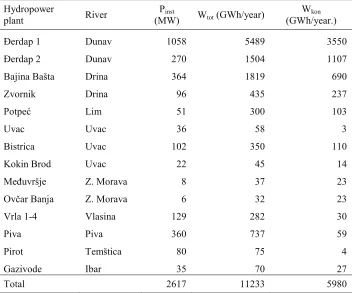
The possible generation capacity of the existing hydropower plants, under average hydrologic conditions, amount circa 11 TWh/year. The installed powers of the existing hydropower plants and their approximate generation capacities, under average hydrologic conditions, are shown in the following table.
Hydropower
plant River (MW) Pinst Wtot (GWh/year) (GWh/year.) Wkon
Đerdap 1 Dunav 1058 5489 3550
Đerdap 2 Dunav 270 1504 1107
Bajina Bašta Drina 364 1819 690
Zvornik Drina 96 435 237
Potpeć Lim 51 300 103
Uvac Uvac 36 58 3
Bistrica Uvac 102 350 110
Kokin Brod Uvac 22 45 14
Međuvršje Z. Morava 8 37 23
Ovčar Banja Z. Morava 6 32 23
Vrla 1-4 Vlasina 129 282 30
Piva Piva 360 737 59
Pirot Temštica 80 75 4
Gazivode Ibar 35 70 27
Total 2617 11233 5980
Table 1. Installed powers and mean zears production of existing hydropower plants in Serbia
The table also demonstrates the generation capacity “Piva” HPP that, according to the contract between the Power Industry Companies of Serbia and Montenegro, operates in the scope of the electricity generation and transmission system of Serbia and the electric power system of Serbia guarantees the corresponding supply of electricity to the electricity generation and transmission system of Montenegro.
It is necessary to emphasize that there are no data in this table regarding the electricity generation in the pumped-storage hydropower plant “Bajina Bašta”, because its generation is determined by a special optimization procedure and depends on the overall conditions in the electricity generation and transmission system of Serbia. The capacities of this plant are the following: power in generation (turbine) regime600 MW, power in pumping regime580 MW, energy equivalent of the storage 194 GWh, efficiency of the conversion cycle73%.
concept of minimization of total costs of electricity generation. According to this concept, the lowest partof the diagram should be filled in with the constant generation in hydropower plants, in order to minimize or eliminate water spilling in hydropower plants. On top of this category, the data on generation in thermal-power plants is filled in, with the power that corresponds is equal to their technical minimum. The following category is the generation in thermo-power plants with a variable power, i.e., the power higher than the technical minimum. In the upper part of the diagram the variablegeneration in hydropower plantsis filled in and on the top of the diagram the generation and power of the reversible power plant is filled in. The commitment of the units in thermal-power plants is performed sequentially according to specific fuel consumptions, i.e., specific fuel costs. This concept clearly demonstrates the role of hydropower plants (of the variable part of their generation), i.e., of the variable generation. Evidently, the minimum of the costs within the system assigns to the hydropower plants the role of covering the top part of the load duration diagram, i.e., of the daily load diagram, along with the monitoring of daily load changes, including the shutdown of units in certain plants, if needed.
In reality, the occasional unavailability of certain components of the generation and transmission parts of the system occurs, as well as the uncertainty regarding the amount of electricity consumption and the shape of the daily load diagramon the next day. In order to enable the system to supply electricity to its customers without disturbances, it is necessary for the system to dispose over a certain reserve of power, as well as of energy.In accordance with their features, hydropower plants primarily cover the operational reserves. Specifically, hydropower plants with storage for seasonal regulationalsotake part in the covering of a part of the so-called “cold” reserve. In order to fulfill these needs of the system a certain amount of powerand the corresponding storagecontenthave to bereserved.
Taking into account their features (the available power, rate of load change, a larger number of units with lower power, low minimum unit powers etc), hydropower plants play a significant role in the exploitation of an electricity generation and transmission system.
During regular operational conditions hydropower plants cover the consumption of energy and powerup to the previously planned values and depending on the inflowand the actual state of storages. The remaining installed capacities(in the first place, the power plants with storages for daily and weekly regulation) participate in providing the spinning reserve of the system (primarily the plants with short intakes, quick response etc.) and thus in the frequency-power regulation.
Hydropower plants with large storages (for seasonal or long-term water regulation), which are beyond the amount that is needed for the covering of the consumption regarding energy and power provide in the first place a part of the cold reserve of the system, and the rest of their capacity, if it has not already been engaged for the needs of the overhaul reserve(what should be avoided), is considered to be the spinning reserve. Here it should be mentioned that the cold reserve within a system is basically provided for by thermo-power plants; but it is possible to overcome a longer shutdown of units in a thermal-power plant by reserving a certain quantity of powerof hydropower plants and the accumulated quantities of water (i.e. it energy equivalent). Thermal-power plants provide energy for the cold reserve, but only during the periods when the energy is at their disposal and not when he corresponding demand exists; hydropower plants provide the space needed for the storage of this energy and capacity for its use. This approach allows for the single storageand the reserved capacityto ensure the multiple use of energy for the needs of the cold reserve of the system.
special conditions (isolated operation, state of war, etc.) that were until recently have been considered hypothetical, have occurred in Serbia during the last ten years, with all their consequences, what makes it equally relevant for technical discussion as any other form of operation. In the first place it is necessary to state that, in order to overcome the most severe of all emergency conditions (the complete breakdown of the electricity generation and transmission system), there is an obligation posed to all hydropower with storages to leave aside an unconditional reserve of 10% of the energy equivalent (of the storage), regardless of the conditions of the supply of electricity to the customers. The engagement of the remaining 10% of the storages occurs only if the stability of the system cannot be achieved by other regulatory elements, i.e. if the system breakdown has occurred and in order to restore the operation of the electricity generation and transmission system. The restoration process(synchronization, load) commences precisely by the engagement of the mentioned storage reserves. After the engagement of storage hydropower plants the remaining hydro- and thermal-power plants are engaged, with taking into account of their technical characteristics, which especially applies to thermo-power plants that have (practically) underwent the rejection of the full load and whose re-activation requires a certain period of time. During this period, the main load of electricity supply to customers and the restoration of the system has to be delivered by the hydropower plants, especially by those with storages and the ones located immediately downstream from them.
In case of other emergency conditions, caused by either the unavailability of generation sources or by changes (increase) in consumption, the promptness of their response to such changes is the basis of their participation in the alleviation. The main condition for such operation is the existence of the operational power reserve. Under this condition, hydropower plants are also engaged in the secondary regulation of frequencyand power.
“Đerdap (Iron Gate) 1” HPP has a relatively small storage with a dynamic use, but with its operating regime with two peaks, and the “Đerdap 2” HPP as its compensation basin, it manages to place the most of its electricity generation into the variable part of the load diagram.
It is a power plant with the powerhouse at the base of the dam, with short inlet condutsand the block connection(inlet-turbine-generator-outlet) that make possible its rapid load change.The power of each unitis 175 MW.
“Đerdap 2” HPP is actually a compensation basinof the “Đerdap 1” HPP and it places the most of its electricity generation into the constant partof the load diagram.For this reason it has no opportunity to take part in the regulation of the power of the system.The storage of the “Đerdap 2” HPP is also limited by the navigation conditions(Qmin=2000 m3/s) and the allowed oscillations of the water level equal to 60 cm at the confluence of the River Timok. The power of each unit is 27 MW.
“Zvornik” HPP, “Bajina Bašta” HPP and “Potpeć” HPP represent hydropower plants that can perform water regulationon a daily basis, i.e. on a weekly basis (“Bajina Bašta HPP). The smallest water regulationcapacity among these plants has the “Zvornik” HPP, because of the amount of sediment in its storage. The construction of hydropower facilities along the section between the “Zvornik” HPP and the “Bajina Bašta” HPP would solve the issue of the variable operationof the “Zvornik” HPP (cascaded power plants). This cascade of power plants could take part in the regulation of system power and provision of the spinning reserve, and make use of the seasonally regulated waters from the upstream accumulations (“Piva”, “Uvac”, “Kokin Brod”).
and the seasonal water regulation. Although the long water inlet conduiton the “Bistrica” HPP prevents rapid load changes, the existing capacities are sufficiently operational.
“Piva” HPP that according to the contract between Electric Power Industries of Serbia and Montenegro, operates for the needs of the electricity generation and transmission system of Serbia, has the storage with the volumeof 790 millions of m3 and the capacity for the seasonal water regulation, which, along with its short inlet conduits and power facilities built downstream from it (“Višegrad” HPP, “Bajina Bašta” HPP and “Zvornik” HPP), allows it to make use of its performances to full extent and in all forms (consumption, reserves, regulation etc.) and also the increase of generation capacity of the downstream objects.
“Vlasina” HPPs are, with their degree of installationrelative to the mean flow(Qi=18 m3/s) and the volume of 107 millions of m3, also the facilities with the wide field of application within the system. With the realized water pumping (PSP “Lisina”), these facilities can fulfill any task within the electricity generation and transmission system, including the cold reserve.
“Pirot” HPP is, with its active volume of 130 millions of m3 and the installed flow of 42 m3/s, also very suitable for the performing of any task within the electricity generation and transmission system. Its somewhat longer inlet tunnel decreases its load change rate, but this does not affect this function of the power plant (frequency-power regulation).
“Ovčar Banja” HPP and “Međuvršje” HPP, which are some of the oldest facilities in Serbia, are according to their features practically the actually distribution facilities. The value of the installed flow(40 m3/s) in relation to the available inflow(34 m3/s) as well as the amount of sediment in the storagepractically place the generation of these facilities in the constant part of the load diagram.
The electricity generation and transmission system of Serbia includes also the reversible hydropower plant “Bajina Bašta”. This facility is during its generating operating regime practicallya hydropower plant with all its advantages (highpower, possibility of a rapid startup in the system etc.). In the pumping operating regimethis facility possesses very rigid features. Efficiency of the pumping/generation cycleis 0.73, what defines this facility as a whole as a consumer. The inflow into the head storage is insignificant as compared to the pumped volumes of water. It can be stated that, compared to a classic hydropower plant, the reversible power plantdoes not make use of renewable resources (apart from accepting the waters that would otherwise be spilled). This means that there are no advantages of the so-called “free fuel”, but the plant is less dependent on hydrologic circumstances and much more on the state of the sub-system consisting of thermo-power plants. The size of the active volume of the storage
(150 millions of m3; 190 GWh) makes this facility very suitable and usable for the providing of the part of the cold reserve of the system.
The reversible power plant “Bajina Bašta” places its energy into the highest part of the system load diagram. Because of the efficiencyof the pumping/generation cyclethat is less than 1 (0.73), there is a tendency that this facility should operate as briefly as possible, but with its maximum power. The quantity and distribution of the pumped watersare defined by the state of the thermo-power plants, the problem of usage of the spillways and the placing of the technical minimaof their units. The amount of the daily pumping defines the differences between the fuel costsand the reduction costs, with and without pumping, which defines at the same time the daily component of generation.Principally, the pumping is performed as long as the costs of the system (fuel + reductions) with pumping are lower than the costs of the system without pumping.
circumstances of the system. The stored amount of energy (190 GWh) allows this facility to be engaged when it is necessary to replace an unit in the thermal-power plant with the power on the order of 300 MW during the period of circa one month, or when a quick start is needed for the replacement of big units (with the power of 600 MW) during the period of two weeks.
2.2. A view on the possible further directions of the development of the capacities for electricity generation in Serbia
The projected amount and structure of the consumption of electricity in the electricity generation and transmission system of Serbia could be satisfied by the use of the existing generation capacities, as well as by the construction of new capacities within the thermo-power plants and by the activation of the part of the remaining available hydropower potential.
Besides the existing thermal-power plants and in order to satisfy the forecasted electricity consumption in the forthcoming period, the construction of the new thermal-power blocks is planned that would predominantly rely on the domestic lignite (“Kolubara B” TPP and “TENT 3” TPP).
Beside the existing hydropower plants, the construction of the new hydropower plants is planned. The actual rate of the activation of the remaining hydropower potential is going to depend on the dynamics of the increase in consumption, availability of thermal-power potentials and the economic feasibility of particular hydropower facilities, with the obligatory participation of all users of the hydropower potential and the space it covers.
Based on the available data it is possible to understand that the unexploited hydropower potential in Serbia, which can be exploited by future facilities with the power higher than 10 MW, is around 7300 GWh (Drina 3000 GWh, Lim 400 GWh, Ibar 500 GWh, Zapadna Morava 375 GWh, Velika Morava 800 GWh, Beli Drim 550 GWh, Dunav 1000 GWh). The hydropower potential values of the other watercourses are much lesser and they amount, all together, to some 600 GWh. The unexploited hydropower potential (7300 GWh) consists of the common potential with the neighboring countries (in the first place with Republic Srpska i.e. Bosnia and Herzegovina) of some 4400 GWh, while some 2900 GWh are exclusively the hydropower potential of Serbia.
The most important objects for exploitation of the hydropower potential of watercourses are storages and without their construction it would not be possible to adequately utilize the potential to a significant amount. The construction of storages that can regulate the annual irregularities of discharges is a common interest of water resources management industry and the electricity generation and transmission system power within an integral water resources management system. The request for the maximally rational exploitation of watercourses, dam profilesand storagesis an imperative for the exploitationof watercourses, as well as for other high-priority users of waterand water resources management industry as a whole.
Out of the total storage volume(of some 1250 millions of m3) that can possible be achieved by the means of construction of hydropower storages, some 722 millions of m3, or 60%, have been used so far. For the further development of storages there are left at disposal some 500 millions of m3, with the energy equivalent of some 600 GWh, what could be achieved by construction of twelve storages. The fact that the total energy equivalentof the existing storages is concentrated in four storages indicates the deficiency of storage capacity and significant problems present in construction of such facilities.
frequency and regulating the power. Taking into account the character of hydrologic phenomena (small catchment area, variable inflow), the economic analysis of the size of the future facilities is going to lead towards the higher ratios of the installed and the natural discharge. On the other hand, this will allow for the more significant participation in the power regulation in the system. Short inlet conduits and the greater number of them should allow for the significant power change rate, what influences in a good manner the regulation characteristics of the system.
Small capacities for energy storage, continually growing needs for the seasonal regulation of dischargeand the covering of longer periods of emergency shutdowns of the units in thermo-power plants, dictate the growing need for construction larger storages and thermo-power plants. The increase in the economical parameters of hydropower plants, which leads to their more rapid exploitation, is going to be influenced by increasing environmental demands, what shall lead to an increase in the investment values of the alternative energy resources and indirectly lead to the greater exploitation of hydropower potentials.
For these reasons, it is necessary to identify profitable and feasible hydropower projects on the territory of Serbia; in relation to this, it is also necessary to determine the required conditions for the achievement of the feasibility of the analyzed investment projects, depending on their territorial distribution (the projects on the territory of Serbia, the projects on the boundary watercourses and even the possible projects on the territories of other states – Montenegro and Bosnia and Herzegovina). In relation to that, it is necessary to define the principles for the sharing of the potential between the states on catchment areas, to identify and quantify the influences of investment projects, relating to the generation in the existing capacities, as well as to the influence on sharing of the potential between the states; it is also necessary to quantify the effects of the joint operationof the existing power plants (including the effects of their rehabilitation).
3. Concept of the hydro-information system
Generally speaking, a Hydro-Information System (HIS) is a technical system intended for the support to water resources management on a catchment; it consists of a greater number of mutually connected hardware and software components, measurementobjectsand instruments and users of the system. More specifically, a Hydro-Information System is an organized set of data and software components that relies on a certain equipment and hardware and which is used by for that purpose specially trained technical staff.
The development and use of a hydro-information system allow for significant insight into the behavior of a hydro-system within a catchment area during its exploitation so far, on the scenarios with several variants of development possibilities in the future and on the exploitation in real-time, which all together creates an appropriate platform for decision-making.
The most important goals of the development and application of such a system are:
Aggregation of all relevant hydrologic, meteorological, hydrogeological, hydropower and other relevant data, as well as the creation of conditions that could allow their availability to a broad range of interested users,
Making of the best decisions related to the choice of the optimum solutions for water exploitation (hydropower and other forms of exploitation), protection against high waters and protection of waters, i.e., the integral basin regulation in accordance with the goals of all the users of the basin area,
Support to the process of coordination of interests in relation to the management of the catchment area by means of establishing and promoting of the system for coordination and cooperation.
Further education of qualified staff by means of the distribution of the development results and application of the decision-making support systems through scientific and professional publications and
The process of informing the users, increasing the understanding and participation of the general public in the process of water resources management and protection. Such a system for decision-making support is of great assistance to those who actually make decisions on all levels (local, regional, state and interstate). By means of HIS, on a short-term level, the optimum management of the existing capacities is allowed for (in spite of the fact the electric power industries are located in different countries and have different interests and under the conditions of the very pronounced lack of regularity regarding the natural inflows and consumption). On a long-term scale, conditions are being created for the further development of the system (new development projects, additional generation capacities etc.) in order to allow for multipurposeexploitation of a basin(for the electricity generation, which can be achieved by the exploitation of this attractive hydropower potential, as well as for other purposes)
The main functional features of such a HIS should be the following ones:
A HIS should be composed of information-communication components related to hydrologic researches and focused on collecting, processing and archiving of the relevant information on a catchment that describe the fundamental hydrologic processes, which have to be systematized and available to users, through different forms of browsing, presentation and use of the model,
A HIS should allow for the modeling of all relevant processes related to the flow of water in the basin (i.e., related to the inevitable natural processes such as the transformation of rainfall into runoff, water flow in watercourses, evaporation from storages etc., or the manageable processes, such as electric power production, water capturing and releasing etc.) in models that are physically-based,
A HIS, in interaction with meteorological information systems that contain meteorological forecasts, should allow for the forecasting of the runoff from the catchment areas, i.e., of the inflowinto the storages in the system and on such a basis create operational plans for management of hydropower plants, all in accordance with various requests of the dispatcher,
A HIS should contain methods and a platform for as simple as possible browsing and processing of relevant data, taking into account in every situation their geo-referencing, in order to collect in one place all the data on discharges, water levels, electricity generation, precipitation, temperatures, snow pack heightetc.; this data can be physically placed within diverse information systems and sometimes the data related to the same quantity has different resolutions or was measured by a different measurement method or is located in diverse ISs, therefore a HIS should be able to combine, unite and fill-in the data,
The functioning of a HIS should be based on solutions that are basically scalable, secure, simple to monitor, interoperable and independent from an operative system. Such an approach frees the user free from having to understand all the intricacies related to data collecting, processing and distributing and at the same time separates data manipulation logic from user applications,
A HIS should be developed on the principles of the open service-oriented architecture (SOA), which is based on the sets of loosely connected services that can communicate with each other and that can be called in a standard way by multiple clients within distributed systems.
Human resources, i.e., technical staff that makes use of a hydro-information system, are extremely important for its proper functioning and that is the reason why they have to be properly educated in the field of informatics and technology.
4. Structure of a hydro-information system
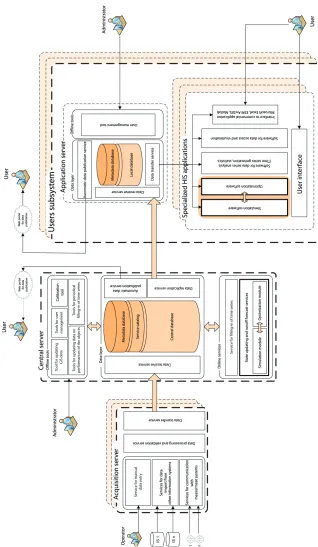
In order to realize the previously defined functional features, a hydro-information system has to consist of the following subsystems: the central server, the acquisition servers and the user sub-system, as shown in Figure 1.
The central server has a role in data coordination, distribution, synchronization and storage, as well as in the management of data access and HIS services.
The role of the acquisition servers within a hydro-information system is to collect and process data on measurements.
The user sub-system is composed of the user server and the specialized HIS applications. The user hydro-information server represents a functional unit, composed of a database, services, tools and applications that allow archiving, publishing and analyzing of the data related to a hydro-system. The specialized HIS programs are tools that implement technologies intended for decision-making support in relation to water regimes, the mode of basin exploitation and the hydropower potential.
4.1. Central HIS server
The data layer of the central server represents a complex functional segment that has a role to manage data archiving into the central database. It also has the role to coordinate users’ requests regarding the acquiring of available data. The data layer of the central server unifies central database, metadata database, catalog of services, data transfer service, replication service and automated data publishing service. This layer is presented in more detail in the paper Milivojević et al. (2009d).
The purpose of the central database is the archiving of all the relevant data on the system, which has been designed to collect the data in the best possible manner and offer them to a user; the data is recorded on different locations and systems, but the data exchange between users is standardized, which allows for an integral and unique approach to analysis, decision-making and research in the catchment area. The database contains a variety of information, such as system configuration data, performances of all objects (the existing and the possible future ones), relief data, hydrographic network, land cover, soil, data on hydro-meteorological stations and measurement sites, hydrologic and meteorological data. The database has a relational data model that allows the replication of a real system into the information one that can be used for the description of the processes and the state of a system in the most efficient manner. Within the central database the data has to be archived in accordance with the GIS model; this means that all the data on relief, soil, land cover and water facilities, as well as all the other data of importance for hydrologic and exploitation phenomena and processes, has to be geographically referenced. The structure of the data model is closest to the ArcHydro model (Maidment, 2002), which is one of the generally accepted models. Taking into account that complex models like the hydrologic model presented in the paper Simić et al. (2009) completely rely on the mass spatial data, which are obtained on the basis of the GIS data, like it is described in the paper Prodanović et al. (2009), it is necessary to include these data, too, into the structure of the central server database. The applied standard ArcHydro data model of the organization of the database allows the application of the standard GIS packages, such as ArcView or Autodesk Map.
The metadata database represents the storage of all information on the available data, its attributes (name, type, discretization etc.), method of archiving and access (database server, connection parameters etc.). This database allows for the distributed organization and extensibility of a HIS, taking into account the fact that by its updating it becomes possible to dynamically follow each change in the data structure and the functioning of a HIS. Metadata are of special importance in the process of the validation of measured data, which is performed on-line on an acquisition server and also, periodically, by the means of special tools on the central server of a HIS. Metadata that is necessary for the performance of validation is discussed in the paper Branisavljević et al. (2009) in the scope of the proposed validation algorithms.
The catalogue of services is related to data, on the central server and on the local servers, within the external information systems and automated measurement systems. The access is possible only within the domain of a HIS; information is intended for the services that are used for acquiring of the data by users, as well as for the synchronization of the contents of the central database and databases on the local hydro-information servers. The services catalogue is also used for the synchronization of the content of the central server and the local hydro-information servers in relation to active and available services.
the central database. In order for data to be archived, its definition has to exist in the metadata database on the central server.
Replication represents a set of technologies used for copying and distribution of data and objects from one database into another, along with their synchronization for the purpose of consistency preservation. The details on the replication mechanisms are presented in the paper on the software solution of a HIS, i.e., Milivojević et al. (2009).
The automated data publicationservice represents the necessary component for the creation of local and public portals, FTP servers etc., and in order to create the automated data publishing in a defined format to satisfy the users’ needs. The automated data publication service consists in the first place of a set of web-services for data access. This is the basis for the further development of the portal templates, conversion and data distribution in predefined formats via FTP servers etc.
On-line services represent software components that are automatically executed on the central server in order to define the necessary information for the operational use of a HIS. On-line services include following: the service for filling-in of time series and the service for computation of the up-to-date state of the basin and forecasting of the catchment runoff.
The service for filling-in of time series, by the means of certain methods, and depending on the data type, discretization and the nature of a phenomenon, automatically fills inor improves the “gaps” in the data. This process depends on the available measured data and the time span of the arbitrary time series. The identification of the existing “gaps”, as well as all the necessary information on them, before and after the processing by the service for filling-in of time series is located in the metadata database.
The service for computation of the up-to-date basin state is related to the part of the HIS services that are in charge of the creation of the conditions for operational use of the HIS model presented in the paper Simić et al. (2009). Input data for the service or computation of the up-to-date computational state of the system is the so-called “real-time data” from the measurement sites within the catchment. Using the optimization (and simulation) module, as well as the already mentioned input data, this service automatically calibrates the key parameters on the catchment and in that way updates the basin water state in the model. The computational stateobtained in this manner is stored in the database; later on it will be used as the initial data for the future calculations of catchment runoff. Input data for forecasting of catchment runoffis the data on the current basinstateupdated by the model, and meteorological forecasts from the other information systems. By using the simulation module on the basis of the above-mentioned input data, this service automatically creates the forecast of basin runoff and inflow into storages. In this manner it is possible to use the model in “real-time”, without the need for calculations over a certain longer period of time, what is extremely important in cases when the calculation is used as a support to management of hydropower objects, where the speed of execution of the simulation application is of great importance.
Off-line tools are intended for the administrators of the central HIS server, who manage the data structure and access, as well as the up-to-date contents of a database. This group of applications consists of the tool for updating GIS data, the tool for updating object performances data, the user management tool, calibration tool and the tool for periodical filling-in of time series.
The tool for updating object performances data contains the necessary functions for access, visualization and modification, i.e., the updating of all the data on the performances of the objects stored in the central database of a HIS. It is necessary for the tool to contain an intuitive user interface, but also the ability to import from and export into standard formats the data from the sources such as Excel, Access and the like.
The component of the hydro-information system intended for the activities related to user accounts and access rights is the user management tool. By the means of this tool, system administrators can create, modify and delete user accounts and user groups. It is also possible to create the sets of system access rules for particular user groups, as well as to check the resulting rulesfor single users and system components.
The calibration tool is based on the special-purpose use of the module for optimization (and simulation), in order to determine the values of the parameters of the model of transformation of rainfall into basin runoff, as well as of the model of water flow through natural watercourses and system objects.
The calibration of these parameters represents a markedly non-linear mathematical problem that requires a systematic approach. The process of the calibration of the models parameters should be periodically performed, within the defined periods of time (e.g. once a year). This is the reason why it is necessary for each hydro-information system to include the tool for calibration of model parameters.
The system for periodical validation and data filling-in assumes the constant interaction of the system with an expert, who makes decisions based on the graphic representation of time series and supplementary tools for detection of anomalies. Although some data validation steps have been performed during the acquisition, they are left as functions in the off-line system too, because of the possibility that certain useful information could be obtained later on. On the basis of the graphic representation and the use of a specific tool, it is possible to perform the advanced data validation. A very important factor in this data validation phase is the actual engineering experience, because the process is not unambiguous, i.e. it is dependent on the applied method, as well as on the available measured data.
4.2. Acquisition servers of a HIS
An acquisition server generally consists of a data acquisition layer, data processing logic and validation and data transfer service. The server acquiresthedata that can be received from the automated measurement systems, from other information systems, or that are entered by the means of special services for manual data entry. The acquired data is transferred to the automated process of processing and validation, which implements the algorithms presented in the Branisavljević et al. (2009) in order to secure the reliability of the data. The processed and controlled data is transferred by the acquisition server to the central server. The acquisition server can also acquirea limited set of data from the central server in order to synchronize the logics of validation and data processing.
In order to make it possible for an acquisition server to acquire the data from different sources, a separate data acquisition layer has been formed, which acquires the data from automated measurement systems, other databases and through the manual data entry by an operator. By the means of configuration files and metadata it is possible to add new sources to the system.
(is the data in the needed format, is it within the real ranges and the like). The data is further transferred to more detailed processing and validation.
A significant number of measurements on hydropower objects is automated and included into a corresponding information system. Such information systems contain databases and components that allow the database data access. Taking into account the fact that this is mass data, it is desirable to acquire it directly from such an information system. On the basis of metadata acquired from a data source, different components for data acquisition are created. Data from other information systems, depending on the information on their reliability, can or cannot pass processing and validation.
It occurs sometimes that automated measurements, which are a part of the SCADA system, are not included into an information system that would allow an external user to obtain them. Taking into account the fact that this is mass data, it is desirable that it can be acquired. However, because of the specific requirements related to the reliability of the SCADA systems, it is not recommendable to access the data directly. It is necessary in such cases to create special services for communication with measurement systems. These services perform local data collecting; they also send the data for further processing and validation.
All the collected data, prior to being transferred to the central server, undergo the processes of processing and validation. Depending on data reliability, it is possible to skip certain steps in this process. Some of the basic checks are the elimination of multiple measurements, verification of data type etc. Relating to the data on exploitation features of the objects, it is possible to perform the validation of the acquired data regarding the ranges of possible values,
fulfillment of certain interdependencies, current state of an object (e.g., overhaul and the like) etc.
4.3. User sub-systems of a HIS
It is possible to implement a large number of server/client functional components within a HIS, which are called the user sub-systems. A user sub-system, in a most general sense, consists of a application server and a certain number of specialized HIS programs, which access the user server as clients. A user server is designed to manage local data, as well as to find and acquire available data from the central server.
The structure of application server is very similar to the structure of the central HIS server. The data layer of a application server represents a complex functional structure, which has a role to manage data transfer into a local database. A local administrator coordinates users’ requests related to the acquisition of available data. The data layer of a user server includes local database, metadata database, data receive service, service for automated data publishing and data providing service. The database on a local server is designed on the basis of the central database, but it is also to a great extent specialized and adapted to the needs of individual users. The data in this database is obtained by copying and distribution of a set of data or objects from the database on the central server, along with the process of synchronization in order to preserve the data consistency. The metadata database is obtained by copying and distributing of data from the central server database, along with the process of synchronization in order to preserve the consistency. The data receive service allows the reception of the data from the central server and its further distribution to local servers, via local networks, occasional connections, wireless connections and the Internet.