Modeling of Musculoskeletal Systems Using Finite Element Method
B. Stojanovic1, M. Kojic1,2
1 Center for Scientific Research of Serbian Academy of Sciences and Arts and University of
Kragujevac
Jovana Cvijica bb, 34000 Kragujevac, Serbia e-mail: [email protected]
2 Harvard School of Public Health
Harvard University, Boston, USA e-mail: [email protected]
Abstract
Muscles are organs whose primary function is to produce force and motion. Skeletal muscles are attached to bones and can move them voluntarily. Although numerous mathematical models of muscles have been developed, most of them consider muscle behavior under specific conditions only.
Motivated by the fact that the existing muscle models are very limited under arbitrary conditions of activation and loading, we here first sumarize the extension of Hill’s model to include different fiber types and then implement the extended model to the analysis of musculoskeletal systems. The proposed models are verified by comparing the calculated results with experimental measurements and data from literature. In order to provide efficient modeling of muscles and musculoskeletal systems, a software for automatic muscle generation using medical images has been developed and incorporated into the general-purpose finite element program PAK.
The muscle models and the developed software can be used as a powerful tool in designing medical and sport equipment, planning trainings and analyzing exercises, to prevent work injuries and significantly reduce costs for individuals and society.
Key words: muscle modeling, finite element method, Hill's muscle model, musculoskeletal system
1. Introduction
fiber corresponding to stretch increment of the fiber, with a use of Hill’s constitutive model, was developed in Kojic et al. [1].
In previous versions of Hill’s model a muscle is considered as an assemblage of sarcomeras, where, taking all sarcomeras to be identical, is one of the simplifications. A number of authors have shown that a muscle is a heterogeneous material structure which induces non-uniform stress and strain distributions (Pappas et al. [2]), as well as different fatiguing of muscle regions (Witte et al. [3]). An individual muscle, as a body organ, represents a collection of different fiber types, with a large range in contractile properties among them.
An extension of Hill’s three-component model is introduced in Stojanovic et al. [4] and Stojanovic [5] (see also Kojic et al. [6]) which takes into account different fiber types. This model consists practically of a number of sarcomeras of different types coupled in parallel with the connective tissue. The proposed model is used to model musculoskeletal systems described by 1D and 3D elements. Accuracy of the model is demonstrated by comparing results predicted by model and experimental results.
2. Computational procedure
2.1. Model definition
Hill's model represents an active muscle composed of contractile element arranged in series with a nonlinear elastic element (Fung [7]). To account for the elasticity of the muscle at rest, elastic parallel element is added (Fig. 1a). The Hill equation is derived from the quick-release experiments referring to the ability of tetanized skeletal muscle to contract and can be written as
(
v b S a+)(
+)
=b S(
0+a)
(1)where S represents muscle tension, S0 is the maximum force that can be produced under isometric tetanic contraction, v is the velocity of the contraction, and a and bare constants. A graphical representation of the equation is given in Fig. 1b. The maximum tension in tetanized condition S0 is strongly dependent on the muscle stretch ratio and is given by Gordon's curve (Fig. 1c). The Hill equation can be rewritten in a dimensionless form as
(
)
(
0)
0 0
1 /
1 /
v v S
S c v v
− =
+ (2)
in which the maximum velocity 0 0
bS v
a
= , and the constant c S0
a
= .
The tension-stretch relationship for the nonlinear elastic element is given by
(
)
( )S= S∗+β eα λ λ−∗ −β (3)
in which S∗ represents the tension corresponding to a stretch λ∗, while α and β are the material constants.
Since the Hill three-component model is based on a single sarcomere, the model may not be adequate for composite muscle consisting of different fiber types. To overcome this deficiency of a single sarcomere model, a multi-fiber model can be defined as shown in Fig. 2 [4,5].
Fig. 2. Extended Hill’s model of muscle.
The model consists of a number of series of contractile and serial elements, representing a bundle of various types of sarcomeras (active part of a muscle), coupled in parallel to the linear elastic element which represents the connective tissue (passive part). In this schematic representation, CEi and SEEi are the contractile and serial elastic elements of the i-th type of
muscle fiber, while PEE is the parallel elastic element. All these fibers have the same direction in space at a considered muscle point, which we call the fiber direction.
2.2. Stress calculation
Applying now Hill’s equation (2) to each fiber type in the multi-fiber functional model of Fig. 2, we obtain stress in the contractile element as
0 0
0
1 /
1 /
i i
t t i t i t t i m m
m a i i i
m m
c
λ λ
σ σ α
λ λ
+Δ = +Δ + Δ Δ
− Δ Δ (4)
where i m λ
Δ is stretch increment of the contractile element. The stress 0
tσi is the maximum
stress corresponding to the stretch t i p
equation, it is taken that the compressive velocity is positive. Also, an activation function t t i a α
+Δ
is introduced in order to simulate submaximal activation of the fiber. The stretch increment
0 i m λ
Δ can be calculated as
0 0
i i
m t m
λ λ
Δ = Δ & (5)
where i0 m
λ& is the stretch rate corresponding to maximum isometric tetanized tension.
Furthermore, according to equation (3), the constitutive relation for the stress of serial elastic element of the i-th fiber type is
(
)
i is
t t i t i i i
s s e
α λ
σ σ β Δ β
+Δ = + − (6)
where αi and βi are the material constant of the fiber.
From the condition that the stresses in contractile and serial elements are equal, i.e.
t t i t t i
m s
σ σ
+Δ = +Δ , equations (4), (6), and kinematical data of the model in Fig. 2, the following non-linear equation is obtained
( ) (
2 3)
4 5 0i i s
i i i i i i i
s s s
f Δλ = a + Δa λ eα λΔ + Δ +a λ a = (7)
where
(
)
1(
)
2 3
0 0
0 0
4 5 0 1
0 0
1 , ,
,
i i i i
i t i i i t i i
s i s i
m m
t i t t i i i t i t t i i i
i i a i t i t t i i i a
a
i i
m m
a c k c
a a
c c
a k a a
σ β σ β λ λ σ α β σ α β σ α β λ λ +Δ +Δ +Δ ⎛ ⎞ = + ⎜ − ⎟ = + Δ Δ ⎝ ⎠ − − = = − − − Δ Δ (8)
This equation with one unknown, i s λ
Δ , can be solved by a standard Newton’s method. Therefore, for a given stretch in the muscle fiber direction, t t
p λ
+Δ (calculated from
displacements t+Δtu at a muscle material point), after solving equation (7) with respect to i s λ Δ , we can obtain the stress t t i
s σ
+Δ from equation (6), and therefore have the stress t t i m σ
+Δ at a
material point.
The stress in the parallel elastic element is calculated as follows
t+ΔtσE =CE t+Δte (9)
where CE is the elastic constitutive matrix of the surrounding connective tissue, and t+Δte is
the strain at the material point determined from displacements. Finally, the total stress in the fiber direction can be expressed as
(
)
1
1 N
t t t t E i t t i
s i
σ σ φ φ ϕ σ
+Δ +Δ +Δ
=
= − +
∑
(10)where φ is the fraction of the active part in the total muscle volume, while ϕi is the fraction of
1 1 N i i ϕ = =
∑
(11)Tangent constitutive matrix. The tangent constitutive matrix t+ΔtC (Kojic and Bathe, [9])
of the muscle as a continuum can be calculated using the constitutive relations in the fiber direction. The overall material properties of a muscle are considered orthotropic with the moduli in the fiber directions equal to the tangent moduli, while in the transverse directions the moduli are set equal to the elastic modulus EE.
Derivative of t t i t t i
s m
σ σ
+Δ = +Δ with respect to the sarcomere stretch
p
λ can be written as
(
)
i is
t t i i
i t i i
s s
s
p p
eα λ
σ α σ β λ λ λ +Δ Δ ∂ ∂Δ = +
∂ ∂ (12)
where si p λ λ ∂Δ
∂ is obtained from the derivative of equation (7) with respect to λp.
Following the above equation, the tangent modulus of the active part in the tangent matrix can be expressed as
1 1
1 1 1 1
t t i t t i
N N N
t t a i t t i i s t t i s
p
t t t t
i i i p
E E e σ σ ϕ ϕ λ ϕ λ +Δ +Δ +Δ +Δ +Δ +Δ +Δ = = = ∂ ∂ = = = ∂ ∂
∑
∑
∑
(13)Hence, the total tangent modulus can be written as
(
)
1 1 E t t 1a
E = −φ E +φ +ΔE (14)
The calculated stress and the constitutive matrix refer to the local co-ordinate system in which one axis is in the fiber direction.
3. Modeling of musculoskeletal systems
3.1. Introduction
Musculoskeletal system (MSS) is a system of organs which enables animals to move. The skeleton also carries and protects the internal organs. Human musculoskeletal system consists of the skeleton, made of bones connected by joints, and skeletal muscles attached to the skeleton by tendons.
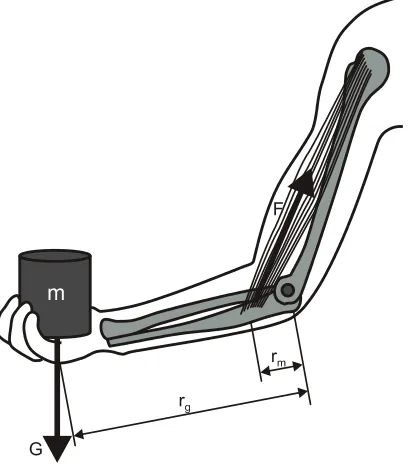
Beside other functions, muscles have task to move skeleton, and thus to move the whole body. Muscles are connected to bones by tendons and move them according to the lever principle. Connections between muscles and bones are usually very close to joints, so lever arm is much smaller than the bone length. Therefore, the force at the end of the bone is several times smaller than the force in the muscle moving the bone.
3.2. Modeling human arm
A typical example of musculoskeletal coupling in order to produce a motion is the human arm. One of the most important motors of human forearm is the biceps brachii muscle. The term
process of the scapula. The tendon of the long head passes into the joint capsule at the head of the humerus, and attaches on the scapula at the supraglenoid tubercle (Fig. 3a). Distally, the biceps attaches to the radial tuberosity, and because this bone can rotate, the biceps also supinates the forearm. The biceps also connects with the fascia of the medial side of the arm, at the bicipital aponeurosis (Fig. 3b).
a) b)
Fig. 3. Anatomy of human arm.
Figure 4 shows functioning of the human arm. Radius bone is connected to the joint on distal end of the humerus. Although proximal end of the biceps muscle is connected to scapula, in modeling of forearm motion we can consider it as attached to the humerus head. Distal end of the biceps muscle is attached to radius bone, at the distance rm from rotation axis. At the end of the radius and ulna we have the hand which can be subjected to constant or variable force.
The finite element model of a human arm is shown in Fig. 5, which is equivalent to the model in Fig. 4. The only difference between these two models is that the constant loading is in Fig. 4 is replaced in Fig 5 by an elastic spring with force proportional to the spring elongation.
Fig. 5. Finite element model of human arm.
In the finite element model, the bones are represented by one or more 8-node 3D elements. In the case where muscle insertion exists, the bone must be modeled using more then one finite element, so the extra nodes can be used to attach elements representing muscles.
On the other hand, muscles can be modeled as three-dimensional (using 8-node 3D elements), or, in order to simplify the model, as line one-dimensional elements (trusses). Regardless to the elements employed in the analysis, the material characteristics are defined by Hill's muscle model or its modification, such as extended multifiber Hill's model, model including fatigue (Tang et al. [10]), etc. If a muscle is modeled as a three-dimensional body, its connection to bones is realized using 1D linear elastic elements representing the tendons.
In this paper, models of cylindrical joints only allow a rotation around one axis. Such joints are modeled by connecting two 3D elements by two nodes as shown in Fig. 5. This way, the common nodes restrain translation of the forearm relative to the upper arm, but allow rotation around the axis which is defined by these two nodes.
Using the proposed model of the arm, the results shown in Fig. 6 are obtained.
Step Displac.
[m]
1 30 60 100
Fig. 6. Displacement field of the human arm modeled by finite element method.
Comparison between the elbow torque calculated using the proposed model and the experimental results from literature (Buchanan [11]) are shown in Fig. 7. The torque reaches the maximal value when the angles are around 90 degrees, and rapidly decreases for small and large values of the angle. This shape of the torque-angle curve is reasonable due to the fact that muscle, according to Gordon's curve (Fig. 1c), generates maximal force in its slack length, i.e. for angles between 90 and 110 degrees. In addition, the change of the lever arm has the influence to the shape of the torque-angle curve.
Elbow angle [O]
40 60 80 100 120
E
lbow
t
orq
ue
[%
o
f m
a
xi
m
um
]
0 20 40 60 80 100
Model
Buchanan, 1995
It can be seen from Fig. 7 that the model has a good prediction when compared to the experimental results for angles between 30 and 110 degrees. Large errors at the ends of the interval can be explained by the fact that only the biceps muscle is modeled, while influence of other forearm flexors is neglected. All these muscles have different ranges where the maximal force is generated, so one muscle can compensate a decreasing force due to the change of length and lever arm of other muscles.
4. Conclusions
Muscle is material body deformed under external and internal mechanical loads. Therefore, the basic mechanical principles of deformable body motion can be applied to model muscle mechanics. Regarding the complexity of muscle geometry and material properties, it is impossible to solve the problems of muscle motion analytically, so numerical methods, such as Finite element method, have to be used.
The basic relation for mathematical modeling of muscles in the approach presented here is Hill's equation, which represents the relation between muscle velocity and force during tetanic contraction. In order to overcome lack of Hill's three component model considering one sarcomere, extended multifiber Hill's model is summarized and incorporated into finite element software PAK [12]. This generalized model is applicable to 1D, 2D and 3D analysis with large deformations and displacements are assumed.
The described model can also be used for modeling mechanical behavior of musculoskeletal systems. Applicability of the model is demonstrated on a human arm example. Comparison between calculated and experimental results from literature shows good accuracy of the model.
The muscle models and the developed software can be used as a powerful tool in modeling mechanical response of muscle and musculoskeletal systems. Further research may lead toward improvement of the proposed models by including stochastic activation, various types of joints and contact between muscles and bones.
Acknowledgments
This study is partly supported by Ministry of Science and Environmental Protection of Serbia, projects TR6209 and OI144028, and City of Kragujevac.
References
[1] Kojic M, Mijailovic S, Zdravkovic N. Modelling of muscle behaviour by the finite element method using Hill's three-element model. Int. J. Numer. Meth. Eng. 1998; 43: 941-953.
[2] Pappas GP, Asakawa DS, Delp SL, Zajac FE, Drace JE. Nonuniform shortening in the biceps brachii during elbow flexion. J. Appl. Physiol. 2002; 92: 2381-2389.
[4] Stojanovic B, Kojic M, Rosic M, Tsui CP, Tang CY. An Extension of Hill’s Three-Component Model to Include Different Fiber Types in Finite Element Modeling of Muscle. Int. J. Numer. Meth. Eng. 2007; 71: 801-817.
[5] Stojanovic B (2007). Generalization of Hill's Phenomenological Model in Order to Investigate Muscle Fatigue. Ph.D. Thesis, CIMSI, University of Kragujevac Serbia. [6] M. Kojic, N. Filipovic, B. Stojanovic, N. Kojic, Computer Modeling in Bioengineering
– Theoretical Background, Examples and Software, J. Wiley and Sons, in press. [7] Fung YC, Biomechanics: Mechanical Properties of Living Tissues. Springer-Verlag
1993.
[8] Gordon AM, Huxley AF, Julian FJ. The variation in isometric tension with sarcomere length in vertebrate muscle fibers. J. Physiol. (London), 1966; 184: 170-192.
[9] Kojic M and Bathe KJ. Inelastic Analysis of Solids and Structures. Springer-Verlag, 2005.
[10] Tang CY, Stojanovic B, Tsui CP, Kojic M. Modeling of muscle fatigue using Hill's model. Biomedical Matererials and Engineering. 2005; 15(5): 341-348.
[11] Buchanan TS. Evidence that maximum muscle stress is not a constant: differences in specific tension in elbow flexors and extensors. Med. Eng. Phys 1995; 17(7): 529-536. [12] Kojic M, Slavkovic R, Zivkovic M, Grujovic N, PAK – Finite Element Program for
![Fig. 1. a) Hill's three-component model; b) Graphic representation of Hill equation; c) Gordon's curve (Gordon [8])](https://thumb-us.123doks.com/thumbv2/123dok_us/8369842.1674834/2.499.86.444.444.616/hill-component-model-graphic-representation-equation-gordon-gordon.webp)