ECCLESIOLOGY TODAY
ECCLESIOLOGY TODAY
© Copyright the authors 2014. All rights reserved. ISSN: 1460-4213
Published 2014 by the Ecclesiological Society c/o The Society of Antiquaries of London Burlington House
Piccadilly London WIV 0HS
The Ecclesiological Society is a registered charity. Charity No. 210501.
www.ecclsoc.org
Ecclesiology
Today
Issues 47 & 48 for December 2012 & July 2013
published April 2014
Journal of the
Ecclesiological Society
C
o n t e n t s
Chairman’s letter 2
The Hereford Screen
by Ingrid Brown 3
VIEWPOINT:The creation of liturgical space at Ely Cathedral in 2013: possibilities
A lecture given in Ely on 28 April 2013
by Jane Kennedy 45
VIEWPOINT: Problems affecting church monuments: a personal perspective
by Sally Badham 75
Ledgerstones and the Ledgerstone Survey of England and Wales
by Julian W S Litten 105
‘An age of destruction’?:
Anglican church closure past and present
by Linda Monckton 121
OBITUARY:
Terry Friedman (1940–2013) 133
Dear Fellow Member
You will immediately see that this is a bumper volume of Ecclesiology Today. It is in fact a joint edition, for December 2012 and July 2013. Though, alas, we are still behind with our production cycle.
There is a unifying set of themes to the articles in this volume – how do we properly value, keep, and use what we have inherited from the past?
The important article by Ingrid Brown on Scott’s Hereford screen sharply highlights some of the practical issues.When the legacy is something rather dominant, is suffering from corrosion, is seen as old-fashioned and ugly, symbolises something one would rather it did not, and gets thoroughly in the way, what does one do? It is not difficult to guess, though, perhaps unusually, this is one of those stories that does have a happy ending.
Jane Kennedy’s lecture on possible developments at Ely Cathedral deals not with inherited objects, but with inherited space and planning. Over the centuries the interior at Ely has been altered many times: how should this shape our view of its future?
Sally Badham’s article raises worrying issues about our legacy of church monuments.Whilst acknowledging the excellent work often done by the organisations and congregations responsible for churches, she points out many ways in which things can, and sometimes do, go wrong. Of most concern is the damage caused by bats in churches, a problem which has largely arisen in the last thirty years or so.
In his article, Julian Litten gives a brief history of ledgerstones, and explains the work of the Ledgerstone Survey. As the article explains, these monuments can be of considerable interest, both individually and for their broader social significance. Some of them are elegant, even beautiful. But we have no handlist, so cannot yet properly assess or value these items. And, how anyway should one look after objects which may form a substantial part of the stone floor surface?
Finally, Linda Monckton’s article deals with church closure. She demonstrates how the rate of closure has slowed down since the late 1960s, and how the pattern of re-use is changing. Each one of these buildings has been the subject of a sometimes complex series of choices about its future: it is fascinating to see the patterns that have arisen from these individual decisions, and to reflect on what the future might hold.
I hope you find these articles both enjoyable and thought-provoking.
Introduction
THE HEREFORD SCREEN was hailed in 1862 as ‘the finest piece of modern metal work in existence ... there is nothing ... which will bear even a moment’s comparison’.1The Illustrated
London News considered it ‘the most noble work of modern times
... the largest art-work in metal of which we have knowledge, ... [which] stands forth to the world as a monument of the surpassing skill of our land and our age’ (Fig. 1).2
But in less than fifty years, the 1897 edition of Architecture deemed it as ‘gorgeous ... but not so particularly artistic ... a great deal too gaudy and glittering for its place’,3 and by the early
twentieth century, the object was damned in Batsford & Fry’s
Cathedrals of England as ‘tortured art metalwork ... a melancholy
commentary on the transience of even the most eminent taste’.4
The screen, designed in 1861–2 by leading Gothic Revival architect Sir George Gilbert Scott and produced by renowned
Ingrid is a recent MA graduate in architectural history, with a particular interest in nineteenth-century churches and cathedral furnishings.
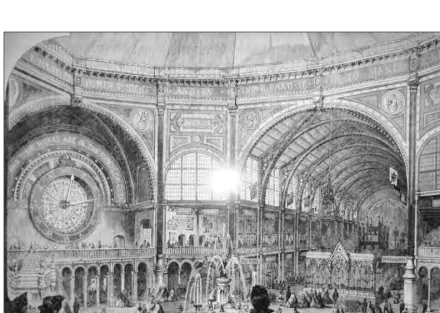
Fig. 1: Contemporary print of the Hereford screen at the 1862 Exhibition (Illustrated London News, 30 August 1962)
The Hereford Screen
Coventry metalworker Francis Alfred Skidmore, was made for Hereford cathedral, at the time ill-suited to new liturgical needs, and formed part of Scott’s larger undertaking to restore the cathedral to its former glory. Made from a variety of gleaming materials, including iron, brass and copper, the screen became central to Scott’s scheme, and answered the contemporary desire to reinstate a division between the choir and nave, in accordance with emerging ecclesiastical reform movements.
Displayed at the International Exhibition to great acclaim, it was famed before it even arrived at the cathedral. The combination of Scott and Skidmore in its design, both leading figures in the Gothic Revival, and the innovative techniques employed in its production, ensured its success, attracting considerable enthusiasm.
A decade later, Christopher Dresser’s 1871 Principles of
Victorian Decorative Design extolled Skidmore’s ‘correct and very
beautiful treatment of material, one of the finest examples of artistic metalwork with which we are acquainted’.5 Despite the
considerable acclaim, however, much less was said of the proposed purpose of the screen at Hereford.
As ironwork became unfashionable in the latter years of the century, concerns for the practicality of the ostentatious screen at the cathedral began to surface. Shortly before his death, Scott declared himself unhappy with the design.6 In the 1930s,
Hereford’s dean and chapter increasingly felt the obtrusiveness of the screen on the function of their cathedral, strongly desiring its removal. The matter soon aroused national interest, and became the subject of contentious debate. Noted defenders of Victorian art and architecture, John Betjeman and Nikolaus Pevsner, argued for the ‘sense of mystery and length’ which the screen effected in the cathedral,7 and as a Victorian ‘monument of the first order’,
should be retained for its historic and practical value.8 But the
dean firmly believed Scott and Skidmore’s creation spread ‘an atmosphere of gloom and decay’ within the cathedral.9 Finally,
amidst significant controversy, the screen was removed in 1967. By the late twentieth century, after failed attempts to preserve it and nearly three decades in storage, the screen was eventually acquired and restored to its former glory by the Victoria and Albert Museum (V&A) in London, where it stands today (Fig. 2). Displayed above the main entrance hall of the museum, the screen does little to give away the many eventful perambulations it has endured.
The original commission
By the time Sir George Gilbert Scott arrived to restore Hereford cathedral in 1858, the building had suffered over two centuries of damage and destruction. Many of its prized Norman features were obliterated, and its interior was entirely unsuited to contemporary needs.
The collapse of the great western tower on Easter Monday of 1786 had prompted a melangè of alterations particularly detrimental to Hereford’s choir, undertaken by the prominent eighteenth-century architect James Wyatt (1746–1813).10
But by 1813 visitors described the choir as ‘so deranged ... it was beyond description’,11
and there were structural problems: in 1841 Robert Willis (1800–75) described the cathedral as having ‘scarcely a vertical pier or wall in the whole building’, with the crossing piers expanding outwards under pressure from Wyatt’s alterations.12
In 1832, a determined drive to reform the choir was instigated on the arrival of dean John Merewether, who began a petition in 1835 to ‘open up the Saxon arch’ behind the early eighteenth-century altar-screen which had been installed by bishop Bisse in
the choir (Figs. 3 & 4).13 Merewether appointed early Gothic
Revival architect L. N. Cottingham to direct the works,14and he,
according to Pevsner, brought the ‘first considerable feeling for Gothic’ to the cathedral.15 But Cottingham’s insistence on
removing the ancient stone pulpitum to enable the repair of the weak crossing proved an unfortunate alteration, given that Hereford was the only cathedral whose pulpitum had retained its original place beneath the west arch of the crossing (Fig. 5).16
Merewether’s campaign finally came to an end in 1853, when Cottingham Junior absconded with his wages for the final stage of the restoration, before its completion.17 Thus, by the mid
nineteenth century, Hereford’s choir remained incomplete, and the cathedral was largely unfit for nineteenth-century purposes.
At the time, new ecclesiological movements, and the influential publication of The Ecclesiologist provided the driving force behind restorations throughout the country’s churches.18
The chancel, serving what was seen as the essential liturgical
Fig 3 (left): Choir, Hereford Cathedral, c. 1841, showing Bishop Bisse’ s Grecian panelled altar-piece and screen before its removal. (J. Myles, L. N. Cottingham, 1787-1847 – Architect of the Gothic Revival (London, 1996), p. 99, pl. 49)
function of a church, became a primary focus in the many campaigns, to be designed and furnished in the fourteenth-century gothic style.19 Screens were to be reinstated to comply
with new liturgical needs, to effect a partial separation between the choir and the nave, without cutting off the congregation from the proceedings. The demand to introduce screens created much work for the most successful architects and craftsmen of the day, and significant impetus to work in the gothic idiom.20
Sir George Gilbert Scott, pre-eminent among Gothic Revival architects, was at the forefront of the burgeoning church building and restoration campaigns.21Pevsner considered his churches to be
‘as archaeologically accurate as anything of the same date by Pugin’.22
In October 1854, the dean and chapter at Hereford called upon Scott to undertake a survey of the damaged building, and by November he had reported that both structural and aesthetic work needed to be carried out with urgency. Scott was appointed
Fig. 5 (left): Old stone pulpitum, Hereford Cathedral c.14th century. Removed by Cottingham in 1841. From a painting of 1830. (Aymer Vallance, Greater English Church Screens (London, 1947), p. 73, pl. 58)
chief architect of a renewed restoration campaign, and on 8 October 1858, signed a detailed specification for the works with his contractors Messrs. Ruddle and Thompson.23
Despite his primary concern to preserve the old masonry, Scott was aware of the dean’s desire to restore space and light to Hereford’s badly cramped choir.24 The architect provided an
extensive specification document, setting out his recommendations. In accordance with contemporary preferences, Scott planned to open out the choir (Fig. 6), and advised that decoration and furnishing be designed in the appropriate gothic idiom. He recommended the ironwork be undertaken by John Hardman of Birmingham, Potter of London, or Francis Skidmore of Coventry, all prominent Victorian metalworkers well-acquainted with medieval ecclesiastical design.25
It is clear from the exceptionally detailed manuscript that not even the smallest feature escaped Scott’s eye: the document is strewn with his own sketches, providing a fascinating insight into his deep-seated archaeological interests in restoration (Fig. 7), even though today he is often considered as overzealous in his alterations.26
Despite the comprehensive outline of the works, however, the specification is virtually silent on the issue of the screen, which is surprising considering it was later to be the central focus of the new choir. However, a vague outline of the chapter’s wishes for its design appear in the Cathedral Statement of Appeal, launched later during the restoration.27It appears that the dean and chapter
merely requested the reinstatement of a division in the choir
without ‘severing it from the remainder of the Church by a solid Screen of Stone’, but were undecided as to any particular style or materials. For the design, their instruction to Scott was no more specific than a request for an ‘open unobstructive Screen’ to replace the old ‘close structure of stone’.28The matter was left
‘open for consideration’. Scott’s expertise was invited to solve the somewhat paradoxical requirement for a new screen which would allow the congregation to be involved in the liturgical proceedings, but still provide a separation. The dean and chapter specified their approval of Scott’s contemporary work at Lichfield and the earlier Ely commission, as ‘an arrangement already carried out with great practical advantage’.29
At Lichfield, Scott, working in collaboration with Skidmore, provided the dean and chapter with an openwork choir screen of metallic construction (Figs. 8 & 9). This, their first metalwork Fig. 9: Lichfield Cathedral choir
screen, although more ornate than the architect intended, remains in its original position to this day.The open design proved highly successful in satisfying the need for a division which did not obstruct vision from either side, less achievable in stone or wood. Scott declared metal as ‘the only material which will unite the conflicting demands’ of the practical and aesthetic needs of the nineteenth-century choir screen.30
Scott and Skidmore
Francis Alfred Skidmore was born the son of a jeweller in Birmingham in 1817, later joining his father’s workshop following an apprenticeship in his youth (Fig. 10).31The family moved to
Coventry, where Skidmore developed great skill as a gold and silver smith, and became involved in ecclesiastical metalwork. His success resulted in the display of some of his finest pieces at the prestigious 1851 Exhibition at Crystal Palace (Fig. 11).
Fig. 10: Francis Alfred Skidmore, in old age. Portrait published in the Coventry Evening Telegraph, 8 February 2000.
Skidmore’s predilection for the medieval style gained him much favour among eminent Gothic Revival architects, including Arthur Blomfield with whom he worked at Chester cathedral,32
and Alfred Waterhouse, architect of the Natural History Museum in London. Skidmore’s skill in gold and silversmithing, and membership of the both the Oxford Architectural and the Ecclesiological Society ensured his pre-eminence in this niche market. George Edmund Street, prominent architect of the Revival who trained in Scott’s office, acclaimed Skidmore’s minutely-detailed bible cover as his ‘best work’.33
Scott first became acquainted with Skidmore through his work at various Coventry churches. Scott was enthused by recent advances which made iron a viable material for producing large-scale architectural objects economically.As a result of his successful partnership with Skidmore at Lichfield, Scott was doubtless inclined to recommend Skidmore to manufacture the new metalwork choir screen at Hereford.34
Project and design
By December 1860, restoration at Hereford was well underway, and attention finally turned to the redesigning of the east end.The chapter deliberated the arrangements of the choir, alongside ‘screens to be designed with a view to good workmanship’.35The
design of the screen was first formally discussed in detail at a meeting on 31 December 1861, when Scott’s ‘drawings for a Skreen at the West end of the Choir’ were approved.The architect advised its installation ‘in the strongest Terms’, to be manufactured by Skidmore’s Coventry firm.36
In his tender, Skidmore outlined the intention to ‘undertake to make a Skreen of Iron, brass, mosaics, Enamels’ according to an accompanying sketch to be ‘further developed by G. G. Scott Esq Architect’. Skidmore offered the screen to the dean and chapter for £1500, which was half its anticipated cost, upon condition that the screen was first ‘allowed to be exhibited ... during the forthcoming International Exhibition ... the said Contract to include the Delivery of the Skreen free of Charges at Hereford’.37
The dean and chapter quickly accepted Skidmore’s generous offer, and offered the use of cathedral workmen to assist with its installation once complete.38 However, Skidmore’s intention to
display the screen at the Exhibition implied an incredibly narrow production timeframe, given the event was due to begin in less than six months.
1861, the grand total of £3,893.10s. had been raised, with £1724. 10s received.39
The screen was in progress by January 1862. Skidmore and his workforce of over seventy men worked rapidly towards its completion.40Five months later the screen was virtually complete,
a phenomenal feat given the variety of materials and techniques employed in its production.41Although unfinished, the screen was
hastily transported from Skidmore’s Coventry workshop to the grand South Kensington venue of the Exhibition, and prepared for display by 1 May, the inaugural date of the event.
The International Exhibition
Skidmore’s masterpiece took pride of place in the Exhibition’s ‘South-Eastern Transept’, amongst a variety of metalwork from both local and foreign workshops (Figs. 12, 13, 14a & b).
Scott and Skidmore were hailed for their revolutionary use of metal in a church furnishing of such immense size, but it was Skidmore’s innovative techniques which attracted great admiration, and demonstrated his skills at the cutting edge of technology.
The Illustrated London News applauded the screen’s purpose, not as a choir furnishing, but as ‘an object of beauty ... in view of the ornament applied to it’. The sensitively detailed plates in J. B. Waring’s Masterpieces of Industrial Art and Sculpture at the
International Exhibition 1862 exemplify the scale and extent of
labour involved in producing the screen (Fig. 15).42The Art Journal
hailed the sculpture as ‘Truly artistic in conception and design’.43
However, some contemporary concerns for its proposed role at the cathedral were voiced. The description accompanying Waring’s plates stated:‘Very great praise is due both to the designer and artificers of this magnificent screen, although its use in a church where the Protestant service is performed seems more than questionable’.44
Installation and re-opening
The Exhibition came to a close in November 1862, and the installation of the screen at the cathedral was begun. In an appeal for funds, the dean emphasised that the ‘universal admiration which has been excited by this most beautiful specimen of metal-work’ would ‘justly give grounds for a belief that the dean and chapter would not be disappointed ... when the Screen is placed in its proper position’.45Scott had enumerated his scheme for the
Fig. 13: The Hereford screen at the 1862 International Exhibition, viewed from an upper mezzanine level. (Contemporary engraving)
entire Church available for public worship, an alteration of the greatest practical importance ...’ (Fig. 16).46
The cathedral re-opened to the public on 30 June 1863, recorded as the ‘day ... which witnessed one of the greatest of the many architectural triumphs of Mr Scott’s genius and skill’.47The
Guardian reflected on a time ‘when men sought to patch up the
ravages of time by shams and ignoble deceptions ... hiding the ancient glories of churches’, adding ‘Thank God, that time was past! The essence of our present restorations was to renew the old, not destroy it’.48 Skidmore’s creation formed the central focus,
‘dazzling with brilliance ... undoubtedly the most remarkable object in the cathedral’, as the choir formed a procession from the cloister to their seats, singing the 68th Psalm.
The grandeur of the occasion did much to conceal the dean and chapter’s earlier frustrations with the screen.The 1864 chapter minutes reveal that there had been difficulties installing it, with cathedral workmen kept ‘many weeks waiting’ while its situation was deliberated. Skidmore did not favour the chapter’s proposed arrangements, and insisted it be placed more directly beneath his monumental Corona to effect soft lighting upon his creation.49
Delays ensued while the metalworker demanded the screen be projected ‘further from the Stalls’, with workmen engaged in ‘erecting ... and subsequently removing, and re-erecting’ the screen.The changes necessitated the ‘returns of the Screen .. to be enlarged’, unhappily incurring the chapter additional expense.50
The chapter minutes of 15 August 1863, shortly after installation, records Skidmore’s request from the dean and chapter to ensure that ‘no Person be allowed to take any Photograph or Sketch of the Screen in the cathedral at any time during six months next ensuing without the consent in writing of Fig. 15: Hereford screen.
Skidmore’s Art Manufacturers Company’.51
This is doubtless indicative of concern for his professional interests, perhaps in protecting or patenting his design, or ensuring control over the marketing of his work.
Despite the friction described above, contemporary commentary appeared largely favourable once the screen was in
situ. Scott was commended for his ability to provide a ‘sufficient
division between the Nave and the Choir ... permitting the occupants of both the Tower and Nave to participate in the service ... a complete vindication of the advantage and beauty of metal-work for the purpose to which it is here applied’.52Indeed,
Skidmore’s insistence on the screen’s placement beneath the corona ensured the intended effect, described as ‘gem-like’ under its lighting and ‘suggestive of jewels on a crown’ (Figs. 17–22).53
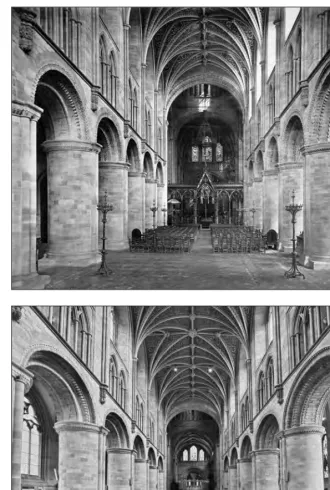
Fig. 18 (top): Hereford Cathedral nave, view looking east, probably between 1865 and 1885. The gas standards lining the nave are clearly seen, and the central gas corona can just be glimpsed. (Anon. Cornell University Library, A. D.White Photographs: 15/5/3090.01146)
Fig. 19 (bottom): The nave in 2013, showing approximately the same view as Figure 18 (though the perspective is different, the use of a wider-angle lens allowing the photographer to be closer to the altar to capture the view).Without the screen, the focal point is now the high altar, although the 1992 corona under the tower offers a resting point for the eye.
Despite the artistic appreciation of the screen, there remained a distinct lack of commentary on its function in the church. The
Ecclesiologist’s 1863 review of the restoration only referred to the
object as ‘Mr Skidmore’s magnificent brass screen, well known at the Exhibition of 1862’.54 In his report of the restored cathedral
in the Hereford Journal, the Revd W. Heather, Honorary Secretary of the Diocesan Church Building Society, emphasised his experience of its purely visual impact while standing at the heart of Scott’s choir,‘at once fascinated with the splendid Norman arch opened up by dean Merewether’, and ‘at once astonished at the effect produced by Mr Skidmore’s screen ... [surpassing] the most sanguine expectations that had been formed by it’.55
Design
As complete, the screen comprised an immense variety of metals and precious materials, produced from eight tons of iron, copper and brass, and lavished with more than 50,000 pieces of mosaic, enamels, and cut and polished stones. The piece was virtually covered with lavish adornment, colour and gilding, down to the most insignificant detail. Even the base was rendered from solid polished marble from Devonshire quarries.56
The basic composition of the design, with its tympanum, arcaded arches, and gabled centrepiece, reflects its architectural
Fig. 21 (left): The screen at Hereford, seen from the choir, probably between 1865 and 1885.The screen creates a separate space for the choir, whilst being transparent to the nave. (Anon. Cornell University Library, A. D.White Photographs:
15/5/3090.01120)
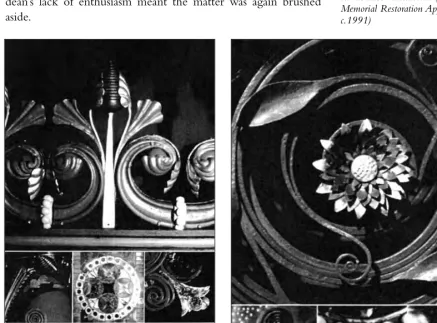
character, akin to the early French gothic style pre-1240. But the beauty and sensitivity of the detail indicate its likeness to far more delicate objects, such as finely engraved silver and gold, and jewellery (Figs. 23 & 24 and front cover). One can imagine the powerful visual effect of the screen under light, whether natural or artificial, with its profusion of patterns, reliefs, and reflective materials, making even the smallest elements shimmer and sparkle. The fine craftsmanship evident in every detail at Hereford indicates the hand of an experienced smith, and is a reminder of Skidmore’s early aptitude for detailed designs in precious metals,
Fig. 23 (top): The Hereford screen today, at the V&A.The screen is placed on a mezzanine balcony, approached from either side, as here.The use of polished brass and strong colours makes the work glitter.
Fig. 24a (bottom): The gates of the screen, at the V&A. It can be
Fig. 24f (above): Detail of the screen: the liturgical south end. Note the inlay work and use of semi-precious stones.
not surprising given his background in fine jewellery and church plate (Fig. 25). Skidmore’s methods distinguish him from his contemporaries, including the famous Birmingham metalworker, John Hardman, whose designs demonstrated much less in the way of filigree and ornamentation (Figs. 26 & 27).57
Skidmore would exploit these skills to their limit in his work for the Albert Memorial (1866–73) (Figs. 28 & 29). This royal monument displays many characteristic elements and techniques developed at Hereford, such as its scrolled foliate motifs, virtually identical to those of the screen (Fig. 30). Their increased sophistication indicates Skidmore’s unrelenting drive for perfection, allowing him to render extraordinary delicacy from materials of great strength.
Changing attitudes
Reverend Francis Havergal’s 1863 Guide to Hereford cathedral marvelled at the production of the screen, ‘conducted on the highest artistic principles’, emphasising the effectiveness of time upon its appearance, where ‘each succeeding year subdues the brilliancy of the metalwork and softens the colours’.58 However,
by the close of the century, metalwork began to fall from favour and the screen became victim to rapidly changing tastes.
The June 1897 edition of Architecture considered Hereford’s screen as ‘gorgeous, but not so particularly artistic ... a great deal too gaudy and glittering for its place’.59This appraisal was not
solely aimed at Skidmore’s work, but formed a broader critique of
Fig. 26 (top): Portion of Hereford screen. Illustration showing apex of one of the arcade arches.
(Christopher Dresser, Principles of Victorian Decorative Design (1872), p.150)
the craftsmanship of the period in which the screen was created, in which the author further criticised Boulton of Worcester’s sculptures upon the screen as ‘clumsily modelled’. The author considered Scott’s restored choir as ruinous to the ancient cathedral, and blamed the result on the ‘violent agitation’ of the prevailing theories, ‘exercising the minds of those interested in matters ecclesiastical on this very question of whether choirs ... should or should not be curtailed ... and also on the subject of opening out of choirs by the removal of obstructing screens ... [which] Scott let himself be influenced by’.
The zeal which held sway over ecclesiastical design in the middle of the century was now being questioned. Did such movements provide any benefit to the ancient fabric of cathedrals throughout the country? Indeed, the very factors that prompted the introduction of the screen at Hereford – the need to satisfy contemporary needs and evolving tastes – were those which were to influence the controversy surrounding its eventual removal.
The first decades of the twentieth century saw the continued evolution of liturgical needs. The Eucharist gained increased prominence as the central act of Anglican worship, and drove new
Fig. 28: Detail of canopy of the Albert Memorial, South Kensington, London. Sir G. G. Scott, F. A. Skidmore,
trends in church layout and furnishing.60 The partially-divided
nave and choir of the nineteenth century was now transformed into the desire for an entirely open arrangement, with no barrier between the congregation and clergy. Numerous churches began to reject the Ecclesiologist’s ‘gothic’ church for its inability to provide a more corporate style of worship.
In many cases, elaborate screens were deemed obstructive to the demand for a more centralised church interior, with the altar moved directly beneath the crossing in an entirely unobstructed setting; as a result, many screens throughout the country were removed.61
At Hereford, the condition of the choir became a considerable issue for the dean and chapter. The enormous, once glittering screen was now rapidly decaying, and formed an increasing bone of contention for both the cathedral and its regular worshippers.
The very technologies that captivated Skidmore probably drove the rapid deterioration of his creation, with his demand to ‘light the cathedral with gas’, which would, he said, ‘do as much as anything else to attract a congregation.’62But it is the sad reality
that Skidmore’s gas standards and corona, which so beautifully lit the cathedral, produced a continuous build up of moisture, an inevitable by-product of gas burning. The largely unventilated interior and the use of harsh nineteenth-century coal gas provided a damp atmosphere severely detrimental to the highly corrosive materials of the screen. The cutting-edge bimetallic construction and relief of its design probably further generated its own corrosion, attracting ‘electrolytic reactions’, and acting as a large Fig. 29: Detail of gates surrounding
battery due the damp conditions while it was in storage.63The
effects of combining such materials and technologies would not have been known at the time, given the lack of experience in these emerging techniques.
In a chapter meeting in March 1934, Canon Streeter spoke in favour of the screen’s removal,64and two months later, the advice
of the Central Council for the Care of Churches was sought for its official removal.65The matter was discussed by the Council at
a meeting in December, which considered whether the retention of the screen would be justified ‘as an example of the rich and costly work of its period’, or if its desired removal could be warranted as ‘incongruous with the ancient building’. The Council resolved that it ‘would not view with favour the removal of the screen’.66It was suggested the cathedral preserve the screen
as a vestige of its Victorian history, or alternatively, restore the choir to its original position, which was ‘pushed into a place for which it was never intended’. Only then would they consider removal. The impracticality of the recommendations and the dean’s lack of enthusiasm meant the matter was again brushed aside.
The Friends of Hereford cathedral felt passionately that the removal of the screen would benefit the cathedral interior. They likened the involvement of the Council to a committee of experts, drawing comparison to the Royal Academy. The Friends believed the Council’s reluctance to permit removal stemmed from their bias towards a ‘cultural view’, and ignorance of the realistic, practical concerns of those actually involved with the cathedral.67
A renewed attempt for removal was again met with refusal, with the Council wholly unwilling to permit removal of ‘some of the most distinguished work of the period just because people of today do not admire it’.68
Tensions escalated, and in 1939, Lisle Carr, bishop of Hereford expressed his long frustration with the screen for both liturgical and aesthetic reasons, describing it as ‘a real obstacle to worship’, and ‘entirely unworthy of the beautiful building’.69However, with
the outbreak of World War II nothing further was done for a time. In 1948, dean Burrows (1947–1961) sought the advice of the Royal Fine Art Commission. At a meeting held by the Commission on 3 January, the chapter’s reasons for removing the screen were discussed, with noted architect and architectural historian, John Summerson, among the Commission’s panel.70 It
was again resolved that the screen should be retained. The dean thanked the Commission but disagreed, disappointed at the resolutions, and decided to delay consideration ‘ until the views of the Friends ... had been obtained’.71
By the 1960s, an emerging distaste for England’s Victorian art and architecture began to surface, and reignited attempts to remove the screen at Hereford. Many commercial proposals to demolish prominent Victorian monuments and buildings provoked outrage, including that for Scott’s Midland Hotel at St Pancras and the Albert Memorial in South Kensington.
In churches, the combination of changing tastes with the desire for an open liturgy resulted in a proliferating ‘anti-screen fever’.72Their aesthetic and practical value was questioned once
again, with many declaring such screens only provided an obstructed view in the church.73Scott and Skidmore’s metalwork
screen at Salisbury was deemed a ‘halt to one’s vision’, and consequently removed and sold as scrap metal (Figs. 31 & 32).74
At Hereford, the screen had become frustrating to those involved with the functioning of the cathedral. But without permission to remove the screen, or any alternative to incorporate it elsewhere, no action could be taken. However, a proposed
scheme by the Herbert Art Gallery and Museum in Coventry to acquire the screen for an intended Museum of Industry provided renewed hope. Following the arrival of dean Price in 1961, a determined drive to eliminate the object was instigated. Dean Price expressed his delight at the proposal, emphasising that he did not want Hereford’s screen to suffer the same fate as Salisbury.
The Herbert Art Gallery endeavoured to launch their proposed Museum of Industry.Their curator, Cyril Scott, notified the Victorian and Albert Museum (V&A) of his intention of his intention to acquire the Hereford screen as an ‘outstanding example of the work of Francis Skidmore ... an artist very badly represented in our collections at present’.75The ambitious venture
was presented to the South Kensington museum in the hope of receiving financial backing towards their purchase of the screen, should it become a reality.
However, within weeks, the dean and chapter’s decision to remove the screen reached the national press, and provoked a heated public debate. Protests flooded the papers, divided between arguments for the artistic, historic value of the screen against those for its practical and aesthetic incongruity in an ancient church. Opinions ranged from noted authorities to laymen, and the involvement of Nikolaus Pevsner, John Betjeman and the Victorian Society, gave the controversy a higher profile.
Many feared the plans to preserve it would render it an object of ‘Victoriana’ in a museum collection. The Cathedrals Advisory Committee notified the dean of the ‘spat of protests’ they received, opposing its removal to the Coventry museum. The Council emphasised the screen represented ‘a very notable achievement of the craftsmanship of the past century ... the best work of that century from our greater churches’, and urged cleaning and repair ‘rather than relegation’.76
The matter soon became contentious. The Daily Telegraph published an article in which the dean and chapter were provocatively labelled ‘the Destroyers’, accused of mutilating the ancient monument. Peter Fleetwood-Hesketh, the architectural correspondent for the paper and author of the review, likened the dean’s actions to that of a ‘naughty baby ... breaking things’, arguing that the removal of the Victorian screen would go against ‘every reputable authority’ in the country.77
Archaeological Society emphasised that despite the prevailing dislike towards Victorian art, ‘it should not be forgotten that the Victorian period was part of the history of the country’.79
Many argued that ‘medieval builders did not intend the whole building to be comprehendible at a glance’, in that screens contributed a ‘useful architectural purpose ... giving the eye something to rest on at an intermediate point’.80Some demanded
the object be appreciated for its purpose within a cathedral, and that ‘to preserve a screen in a museum is not the right way of preserving it’.81
Nonetheless, the dean received considerable support from many locals and prominent authorities. Significantly, prominent architectural historian,Alec Clifton-Taylor, reassured the dean that he had long considered that ‘whatever may be the somewhat macabre merits of this screen ... it was no asset to Hereford’ while acknowledging the opposing views of his ‘old friend Nikolaus Pevsner on this subject’. Clifton-Taylor added that its installation at Coventry would enable far better appreciation by ‘High Victorian enthusiasts’.82
John Betjeman, founder of the Victorian Society, contested the arguments for the practical and aesthetic incongruity of the screen, arguing that, historically, screens enabled ‘clergy and choir [to] sing the daily offices undisturbed by visitors and pilgrims on their way to the shrines at the east end’. (But this was surely the function of medieval, not Victorian screens.) Betjeman insisted on Scott’s ingenuity in designing a screen to both obscure the ‘anticlimax’ of the newly exposed east end, and the ‘tunnel-like’ effect of the cathedral, while light enough to enable visibility of the choir and high altar.83
Canon Dawson of Salisbury described the screen as a work of ‘spiky, blatant vulgarity’, and blamed its installation upon the ‘debased fashion’ of the Victorian era.84 Dawson criticised the
decision-making process of the Central Advisory Committee, creating difficulties for chapters wishing to ‘substitute good modern work to inspire the congregations of this age .. who will deny ... setting itself up as an arbiter of taste for the cathedrals of this country’. Dawson praised the successful removal of Salisbury’s screen,‘where the record stands ... and actions speak much louder than words’.85 But not all churchmen were on the dean’s side.
Despite the tensions, removal of the screen was finally confirmed shortly after the New Year in 1967. Dismantling commenced on 6 February by Henshaw & Son, architectural metalworkers from Edinburgh, at a cost of £1888.10s. (Figs. 33 & 34). Work took place through the night to incur minimal disturbance. With the original drawings of the screen lost, the metalworkers used two large photographs of the object, taken at different angles, as a guide to dismantle the piece according to a logical sequence. This would facilitate possible future re-assembly of the screen.
However, by the 1970s, it was clear that Coventry’s intentions to preserve the screen in a Museum of Industry were not to materialise. The Gallery was unable to acquire a building ‘big enough for the screen’, despite help from the local council.87Fresh
controversy ensued. In 1979 the Birmingham Evening Mail reported that city councillors were ‘trying to decide what to do with the massively elaborate choir screen’ and were considering a range of options, including selling it to America.88
Finally, Coventry Council sought the advice of the V&A, pleading that that the screen should be housed in ‘more appropriate premises before it begins to suffer unduly’.89In 1982,
strategies to rescue the screen were discussed between the
Council and the museum.At last, on 20 May 1983, the screen was officially transferred to the possession of the V&A in a formal gift declaration, whereby ‘Such gift to ensure [sic] for the benefit of the Nation and to be under the care and subject to the order of the Secretary of State for Education and Science’.90
The crates containing the screen at Coventry were prepared for their transportation to London, where the object first stood over a century previously. It was deposited in the museum’s storage warehouse in Battersea, and it was to remain out of the public eye for nearly two more decades.
V&A restoration
The major re-organisation of the V&A’s National Ironwork Galleries in the 1990s provided fresh hope for the screen, lying in pieces on the floor of the storage warehouse. Marion Campbell, then Curator of the Ironwork Galleries, instigated a project of large-scale restoration.The goal of the campaign was to restore the ‘flamboyant object which the screen was when designed and installed’.91The V&A aimed to have the screen ready for display by
2001, to coincide with the centenary of Queen Victoria’s death, and their own exhibition, ‘The Victorians’.92
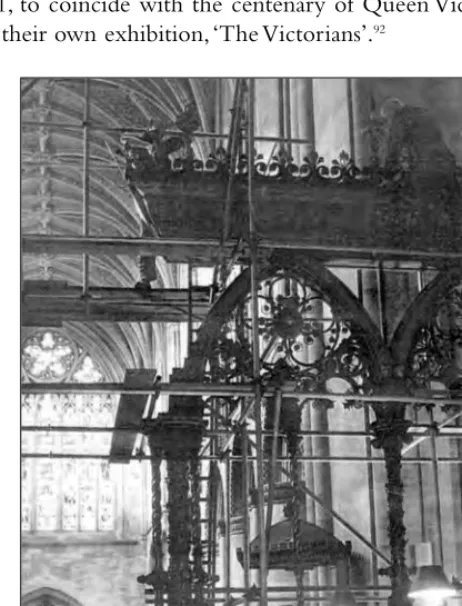
Following a successful application for funds from the Heritage Lottery Fund, and a major drive for remaining funds, restoration commenced by 1999. It was undertaken by conservators Plowden & Smith, and involved painstaking, tedious labour in restoring the over 14,000 pieces of the screen, variously spread amongst the packing crates (Fig 35). Many parts were in poor condition, corroded and with loss of paintwork.
Gradually, the assembly of the component parts began to take shape (Figs. 36 & 37), the reconstruction making use of an innovative life-size stencilling of the object onto the wall where it would be displayed (Fig. 38). The screen was finally unveiled in a glittering ceremony on Ascension Day, Thursday 24 May 2001.
Building Conservation praised the screen’s situation, which ‘jars
fantastically well with the other more sombre exhibits within the Ironwork Galleries’.93
Discussion and conclusion
It is hoped this article will go some way in bringing to attention the fascinating working relationship between Scott and Skidmore. The screen provides a rich insight into the collaboration between two celebrated Gothic Revival designers, who together produced some of the finest, most innovative metalwork of their era.
However, despite the concentration of modern scholarship on the Gothic revival period within which Skidmore had such prominence, he remains a little-known figure today. His life and career bear greater consideration, particularly given his involvement with some of the most prolific Victorian designers. Upon his death in 1896 his remarkable output was to be found in 22 cathedrals, 300 parish churches, 20 public buildings, and numerous private mansions, and much can still be seen today.94
Ironically, were it not for the Hereford screen’s perambulations, Skidmore’s fine craftsmanship may not have been brought to light, for the V&A’s restoration highlighted Skidmore’s unique workmanship, and the many innovative techniques he
Fig. 36: The V&A’s Diana Heath, Lead Conservator, with the screen laid out for assembly.
used, with each motif comprising a multitude of component parts to form a whole (Figs. 39 & 40). This final stage in the screen’s troubled history has enabled a wider appreciation of the Victorian metalworker’s phenomenal energy and the technical genius that produced the object.
Skidmore’s work was driven both by cutting edge technological developments of a newly-industrialised England, and by the contentious theological debates which provided the need for his work. These helped shape the High Victorian era within which he and Scott worked, and the project at Hereford was inevitably caught up with these preoccupations.
These are further exposed by Scott and Skidmore’s collaboration at Durham which led to a little-known and informative controversy that prevented the installation of a screen very similar to the one at Hereford, and reveals other contemporary attitudes to such ostentatious objects in church interiors. At Durham, Scott’s and Skidmore’s original proposal incited vehement protest by its archdeacon, Edward Prest, in 1874 as ‘a design which does not harmonise with the severe grandeur of the cathedral’, and ‘Because the screen .. will be so large and so highly decorated as to necessarily attract the eye to itself and will mar the impression made by the solidity and simplicity of the Architecture of the nave and the greater part of the Choir’.95
A screen of marble and alabaster was erected instead (Fig. 41). The same could be said of Hereford’s screen. Indeed, Scott later realised that the object was unsuited to its purpose at Hereford, and he lamented that it was ‘too loud and self-asserting for an English church’.96 Skidmore’s masterpiece may have done
little to elicit solemn devotion amongst Hereford’s worshippers, Fig. 38: Life-size stencil of Hereford
perhaps driven to distraction by the mesmerising detail of the gleaming object.
Ultimately, perhaps, the V&A has restored the purpose for which the screen was originally conceived, as an object intended for large-scale display. It is a happy, if somewhat uncanny, coincidence that the Hereford Screen, a true ‘South Kensington object’, finds its final resting place in an institution whose own existence was conceived from that same event which also catapulted Skidmore into the limelight, in 1851 (Fig. 41).97
Fig. 39 (top): Component parts of Hereford screen. Conservators’ sketches for re-assembly. Plowden & Smith, April 2000. (V&A Metalwork Department, Plowden & Smith Record Sheets Vol. 3, ref: PS/VA/002)
Fig. 41 (top): Durham cathedral, looking east into the choir, probably between 1865 and 1895, showing Scott & Skidmore’s screen, which remains in place today. (Anon. Cornell University Library, A. D.White Photographs: 15/5/3090.01048)
Today, modern architectural historians have praised the retention of the Scott and Skidmore screen at Lichfield, ‘where the cathedral authorities had the sense to restore Scott’s work rather than throw it out’ upon the whims of fashions and liturgy. But the fascinating history of Hereford’s screen bears testament to its unique position amongst its counterparts.98
The screen may be seen at the Victoria and Albert museum,
London, near the front entrance.Admission to the V&A is free. It is
open 10.00 to 17.45 daily, and 10.00 to 22.00 on Fridays
(selected galleries remain open after 18.00). Closed 24, 25 and 26
December.
Acknowledgements
We are grateful to the following for permission to reproduce
illustrations (via general licence where stated). Other photographs are
by the author. Michael D. Beckwith, under Creative Commons
Licence: Fig. 19 (from http://en.wikipedia.org/wiki/File:
Hereford_ Cathedral_ HDR.jpg); Cornell University Library,
A. D.White Photographs, under general licence: Figs. 18, 20, 21,
22, 31, 41 (from http://library24.library.cornell.edu:8280/
luna/ servlet/ CORNELL~ 3~1); Groenling: Fig. 9 (from
www. flickr.com/ photos/ana_ sudani/5016682843/sizes/o/);
Hereford Cathedral Archives: Fig. 7, 16; Lichfield Cathedral:
Fig. 8;Victoria and Albert Museum, London, under general licence:
Fig. 11, 25 (from http://collections.vam.ac.uk/); Victoria and
Albert Museum, London, Metalwork Department: Figs. 1, 2, 13,
14, 32, 33, 34, 35, 36, 37, 38, 39, 40.
Notes
1 Berrow’s Worcester Journal (1862), 7 (V&A Metalwork Department, uncatalogued). 2 ‘The Hereford Screen in the International Exhibition’, Illustrated London News
(30 August 1862), 246.
3 Architecture (June 1897), 269 (V&A Metalwork Department, uncatalogued). 4 H. Batsford & C. Fry, The Cathedrals of England (London, 5th ed., 1942), 50. 5 Christopher Dresser, Principles of Victorian Decorative Design (London, 1873),
unabridged republication (New York, 1995, 151).
6 Sir G. G. Scott, Personal and Professional Recollections by the Late Sir George Gilbert
Scott, R.A. (ed. G.G. Scott F.S.A.), London, 1879, 291.
7 John Betjeman, ‘Sense of mystery in cathedral: Hereford’s screen’, Hereford Times (4 March 1966).
8 N. Pevsner & P. Metcalfe, The Cathedrals of England: Midland, Eastern & Northern
England (London, 1985), 176.
9 The Friends of Hereford Cathedral Annual Report (April 1965); Dean Price,‘Hereford screen’, The Times (26 August 1965).
11 Malcolm (1813), cited in Aylmer & Tiller, Hereford Cathedral, 265.
12 Rev. R. Willis, ‘Report of a survey of the dilapidated portions of Hereford Cathedral, in the year 1841’ in J. Murray, Handbook, 7.
13 Dean Merewether (1834) cited in Aylmer & Tiller, Hereford Cathedral, 267. 14 Whitehead, ‘Architectural history’, 269.
15 N. Pevsner & P. Metcalfe, Cathedrals,156.
16 A.Vallance, Greater English Church Screens, being Great Roods, Screenwork & Rood-lofts
in Cathedral, Monastic & Collegiate Churches in England & Wales (London, 1947), 70.
17 Whitehead, ‘Architectural history’, 274.
18 G. Stamp, ‘George Gilbert Scott and the Cambridge Camden Society’, in ‘A Church as it Should Be’: The Cambridge Camden Society and its Influence (eds. C.Webster & J. Elliot), Shaun Tyas, 2000, 174; J. M. Neale, A Few Words to Church
Builders (Cambridge, 1841), 3.
19 J. M. Neale, Church Builders, 3.
20 P. Anson, Fashions in Church Furnishings 1840–1940 (London, 1965), 17. 21 D. Cole, ‘The buildings’, in Sir Gilbert Scott (1811–1878), Architect of the Gothic
Revival (V&A Exhibition Catalogue, Section II), London, 1978.
22 N. Pevsner, Architectural Writers of the Nineteenth Century (London, 1972), 168. St Mary’s Episcopal Cathedral, Edinburgh (1873–9), is a good example of Scott’s new church builds.
23 Sir G. G. Scott & J. Thompson. ‘Specification of works required in sundry restorations to the fabric of Hereford Cathedral’, in Hereford Cathedral Restoration,
Contract and Specification of Works (Hereford, 8 October 1858).
24 Sir G. G. Scott, Recollections, 291.
25 Hereford Cathedral, Dean and Chapter Acts 1843–1860 (9 Nov 1857), 405. 26 S. E. Dykes Bower, ‘The Restoration of the cathedrals’, in Sir Gilbert Scott
(1811–1878) (V&A).
27 Hereford Cathedral, ‘Appeal from the Dean and Chapter of Hereford for aid towards completion of the restoration of their Cathedral; discussion of provision and design of chancel screen with a letter from their architect George Gilbert Scott, 7 November 1862’, in J. Murray, Handbook, unnumbered.
28 Hereford Cathedral, ‘Appeal’, in J. Murray, Handbook, 6.
29 Hereford Cathedral ‘Appeal’, in J. Murray, Handbook, unnumbered.
30 Sir G. G. Scott (1857), cited in D.Wallington,‘Scott and Skidmore – The Lichfield legacy’, Friends of Lichfield Cathedral Seventy Fifth Annual Report (2012), 54. 31 ‘Tribute to city metal master’, Coventry Evening Telegraph (8 February 2000). 32 Skidmore designed the canopy tomb for Bishop Pearson at Chester.
33 G. E. Street, ‘Mr Street on the International Exhibition’ (25 July 1862), The
Ecclesiologist, N.S.,Vol. CXII (London, 1862), 206.
34 Hereford Cathedral Dean and Chapter Acts 1859–1871 (31 December 1861), 62. 35 Hereford Cathedral Dean and Chapter Acts 1859–1871 (25 June 1860),
unnumbered.
36 Hereford Cathedral Dean and Chapter Acts 1859–1871 (31 December 1861), 62. 37 Hereford Cathedral Dean and Chapter Acts 1859–1871 (31 December 1861), 62. 38 Hereford Cathedral Dean and Chapter Acts 1859–1871 (31 December 1861), 62. 39 Hereford Cathedral Dean and Chapter Acts 1859–1871 (31 December 1861), 62. 40 Hereford Cathedral Statement, ‘Works Commenced & In Progress’, Appeal from
the Dean and Chapter of Hereford for aid towards completion of the restoration of their Cathedral; discussion of provision and design of chancel screen with a letter from their architect George Gilbert Scott, 7 November 1862 in J. Murray, Handbook,
unnumbered.
41 Hereford Cathedral, ‘Appeal’, in J. Murray, Handbook, 6.
42 J. B. Waring, Masterpieces of Industrial Art & Sculpture at the International Exhibition
1862 (1863), plates 112–13.
43 Art Journal (London, 1862), 158.
44 J. B.Waring, Masterpieces, printed at reverse of plates 112–13. 45 Hereford Cathedral, ‘Appeal’, in J. Murray, Handbook, 7.
47 ‘Restoration and Reopening of Hereford Cathedral, Guardian (1 July 1863), 667. 48 ‘Restoration and Reopening of Hereford Cathedral, Guardian (1 July 1863), 667. 49 Hereford Cathedral Dean and Chapter Acts 1859–1871 (23 January 1864), 166–67. 50 Hereford Cathedral Dean and Chapter Acts 1859–1871 (23 January 1864), 166–67. 51 Hereford Cathedral Dean and Chapter Acts 1859–1871 (15 August 1863), 149. 52 ‘Guide to the Restored Portions of the Cathedral Church of Hereford.
Containing Correct Details of the Metallic Rood Screen, Corona, Stained Windows, Carvings, Pavements, Architecture, Memorials, and All Portions of the New Work. Forming a Sequel to the “Handbook for Hereford”‘, in J. Murray,
Handbook, 11.
53 ‘Guide to the Restored Portions of the Cathedral Church of Hereford’, in J. Murray, Handbook, 15.
54 ‘The International Exhibition’, The Ecclesiologist, N.S., Vol. CXIII ( London, February 1863), 215.
55 Rev.W. Heather, Hereford Cathedral: its History and Restoration (3rd edn. 1869), 24. 56 F.T. Havergal, Hand Guide to Hereford Cathedral. (Hereford, 1882), 18.
57 Dresser, Principles, 146–48.
58 Havergal, Hand Guide, unnumbered. 59 Architecture (June 1897), 269.
60 N.Yates, Liturgical Space – Christian Worship and Church Buildings in Western Europe
1500–2000 (Hampshire, 2008), 141.
61 N.Yates, Liturgical Space, 370.
62 Skidmore, cited in Wallington, Lichfield Cathedral Seventy Fifth Annual Report, 47. 63 Dr R. Baxter, personal communication (16 July 2012).
64 Hereford Cathedral Dean and Chapter Acts 1915–1949 (24 March 1934), 313. 65 Hereford Cathedral Dean and Chapter Acts 1915–1949 (24 March 1934), 314. 66 Council for the Care of Churches, letter to Dean Waterfield (11 December 1934). 67 L. Lee, letter to Dean Waterfield (27 December 1935).
68 Council for the Care of Churches, letter to Dean Waterfield (May 1936, incl. report of first refusal to remove screen).
69 Bishop L. Carr, formal address before Society for the Friends of Hereford Cathedral Meeting, 1939.
70 G. Samuel (Royal Fine Arts Commission), letter to Dean Burrows (22 January 1949).
71 Hereford Cathedral Dean and Chapter Acts 1948–1969 (25 January 1949), 19. 72 Whitehead, ‘Architectural history’, 285.
73 ‘Salisbury Cathedral Screen’, Country Life (13 October 1960), 812.
74 R. Mount, ‘Screens or vistas in Cathedrals? An old controversy revived’, Country
Life (29 September 1960), 672–73. Some pieces of the Salisbury screen were made
into a variety of objects, and the gates are presently held in the V&A’s Ironwork Galleries.
75 Cyril Scott (Curator, Herbert Art Gallery & Museum), letter to Hugh Wakefield (V&A, 3 August 1965).
76 Cathedrals Advisory Committee, letter to Dean Price (13 August 1965) (Hereford Cathedral Archives).
77 Peter Hesketh, ‘Hereford’s Pride and the Destroyers’, Daily Telegraph (16 August 1965).
78 ‘Cathedral Screen Move: Storm of Protest is Growing’, Hereford Times (20 August 1965).
79 ‘Screen: Few Object, Says Dean’, Hereford Times (27 August 1965).
80 ‘Chapter Urged to Keep Screen in Hereford Cathedral’, The Times (25 February 1966).
81 ‘Chapter Urged to Keep Screen in Hereford Cathedral’, The Times (25 February 1966).
82 Alec Clifton-Taylor, letter to Dean Price (26 August 1965) (Hereford Cathedral Archives).
85 Canon R.S. Dawson, letter (unspecified), (23 April 1967) (Hereford Cathedral Archives).
86 Dean Seiriol Evans of Gloucester, ‘Hereford Screen’, Hereford Times (3 March 1966).
87 City of Coventry Council, letter to Victorian Society (6 July 1979) (Hereford Cathedral Archives).
88 ‘Victoriana May Be Sold to the US’, Birmingham Evening Mail (1 October 1979). 89 City of Coventry Council, letter to V&A (10 April 1981).
90 ‘Form of Declaration of Gift’, Herbert Art Museum and Gallery Coventry to V&A (20 May 1983) (V&A Metalwork Department).
91 R. Harris, ‘The restoration of the Hereford screen – proposals for treatment and budget costings’ (V&A unpublished internal report, September 1996), 5. 92 ‘Time Running Out for Historic Screen’, Hereford Times (17 December 1997). 93 A. Birch, ‘Heaven’s Gate’, Building Design (Building Conservation Vol. 13,
27 July 2001).
94 ‘Death of Mr. F. A. Skidmore of Coventry’, Coventry Herald (13 November 1896). 95 Archdeacon E. Prest & Canon H.B.Tristram (Durham Cathedral), letter of protest,
Durham Cathedral Chapter Minutes (20 July 1874).
96 Sir G. G. Scott, Recollections, 290.
97 H. Hobhouse, The Hereford Cathedral Chancel Screen (Royal College of Art exhibition catalogue, 1998), 1.
98 G. Stamp, cited in Wallington, Friends of Lichfield Cathedral Seventy Fifth Annual
To Abbot Suger, as to his master St Augustine, this process [of building the church] is not so much the physical labour as it is the gradual edification of those who take part in the building, the illumination of their souls by the vision of the divine harmony that is then reflected in the work of art.1
CHALLENGED TO GIVE a lecture on the creation of liturgical space at Ely Cathedral in 2013 – today – I set as my starting point how two questions, from different people, helped shape my thoughts. Recently when speaking in one of Purcell’s offices about the value and variety of architectural work we do with churches and cathedrals, a young colleague asked me ‘what is liturgy?’And when talking to the cathedral guides at Ely about the many aspects of my role as cathedral architect, I was asked ‘What has an architect to do with liturgy?’
My answer to the first question can be short: liturgy I understand to be the words of the service, its music and the movement of the clergy and the laity. It encompasses the daily offices, Sunday Eucharist, the feasts of Christmas, Easter, Corpus Christi and so forth, installations and great events.
The answer to the second needs more consideration.
The way I approach the care and development of any building or site is dependent on my understanding of its history and significance. It is further informed by my understanding of the way my clients use or propose to use their building. This is why an architect needs to understand the development of liturgy.
In this lecture I will try to explain how Ely Cathedral (Figs 1–3) has been used liturgically from the Saxon building until today. I will set out some ideas for how the chapter might develop what is here, and what changes might be needed to provide a setting for a richer liturgy.
* * *
Ely cathedral: the history of the building and its liturgy
How does the history of this building – Ely Cathedral – relate to the liturgy our predecessors used? To put it another way, why is this building here? and why is it of such a form and size? and what happened inside and, indeed, outside it?
Jane Kennedy, Architect, is a partner in Purcell, a leading firm of architects. As Surveyor to the Fabric for Ely Cathedral since 1994, she has overseen a period of major restoration within the Cathedral and its precincts. Elsewhere, her work has encompassed Selby Abbey, Kew Palace, several Oxbridge colleges and Stowe, one of England’s finest country houses.
VIEWPOINT
: The creation of liturgical space at Ely
Cathedral in 2013: possibilities
A lecture given in Ely on 28 April 2013
Well, in truth we know remarkably little about what has happened here liturgically. We have records of great events, we understand much of the building history, we know some of the psalms, chants and prayers and we get glimpses of what might have been happening from records in other places. Given this lack, perhaps if we can understand the development of liturgy before the year 970 when Dunstan rededicated the church, how that affected the design of churches, and how medieval liturgy developed generally, we can then look at this particular building to see if it gives us hints about how all of that was worked out here
A plan for the ideal city of God: St Gall and Strabo
The St Gall plan (Figs 4 & 5) of an idealised Benedictine Monastery was drawn at Reichenau in the early ninth century and kept at the monastery of St Gall. It shows the monastery as Ideal City of God. The church has many altars to allow all the monks to say the mass each day. In the early Benedictine rule the office was said hourly or continuously.The layout would preclude its use as a pilgrim church. The western towers and apse are intriguing.
The production of this plan in Reichenau is of significance. Because it was here, in 842, that Walafrid Strabo wrote an important history of liturgical use known as the Libellus. Strabo is noted for introducing the Gloria Patrie, that is the ‘Glory be to the Father . . .’ which we use at the end of the psalms. His book was not entirely regimental and allowed diversity; for example at baptism he said that the infant could be immersed three times to mark either the three days Christ spent in hell, or for the Trinity, but in the latter case one immersion could also signify the Trinity! It suggests that the European church was diverse in its practices and that Strabo was trying to record and respect a variety of traditions.
Liturgy in the Saxon Church at Ely
More specific rules for liturgy in the Saxon churches were set out by King Edgar of England in the 970s in the Regularis Concordia, which must have had a great bearing on the design and use of the Saxon monastery at Ely. There should have been for example, an Oratorium, for prayer in a gallery over the west door. The body
Fig. 4 (top): The early ninth-century St Gall plan
of the church was called Ecclesia and was separate from the Choir. Liturgies are set out, and singing was to be used in the building, and specifically, for example, choirs were to sing from bridges or galleries in transepts at Tenebrae in Holy week.
What might this tell us about the Saxon church? There may well have been western towers and an internal western gallery and there should have been arrangements for choirs at high level.The monastery may, indeed, have been laid out as St Gall.
Our next source is the Liber Eliensis, written by a monk of Ely in the twelfth century, in its excellent modern translation by Janet Fairweather.2
The routine liturgy is not described, presumably because it was universal, but we can read about what was special. Great significance was given to the feast of the Purification of St Mary (Candlemas). We read that Cnut came every year if the weather allowed and that the same feast day was chosen for the rededication of the church by Dunstan in 970. On that occasion there was a great Procession of the ‘Archbishop, many bishops and pastors’ who went first to the domestic buildings, then to the Abbey Church, the titular Altar of St Peter and in the south part the chapel of St Mary.There were then seven days of feasting!
The contemporary ‘Benedictional of St Aetholwold’, the greatest Anglo-Saxon manuscript, which was produced in Winchester, illustrates blessings for use on a variety of occasions including one for the candles for the feast of the Purification.
Liturgy in the Norman building at Ely
All of this is tantalising because we have only hints and some fragile archaeological evidence for the Saxon church and monastery at Ely. We do of course understand very well the Norman rebuilding. Its plan and proportions were based on the Roman basilicas (Figs 6 & 7), as were no doubt, the Benedictine churches at Norwich and Peterborough. From Norwich there survives a ‘Customary’ or description of the services from the second half of thirteenth century. Norwich’s early liturgy was based on that at the Abbey of Fécamp in Normandy. Of Norwich it has been said that ‘If the building of a cathedral such as Norwich was “intended to impress the English with the power of the Norman conquerors and the divine favour reflected in the majesty of the churches”, then that intention was realised daily and visibly in liturgical ritual’.3The same must have been true
for Ely.
space between each monk in a procession.There are directions for antiphons to be sung on particular saints’ days, instructions on how to sing them, including the requirement for two monks to go to the altar and sing verses alternately from there. At Easter three monks were to dress as women and to go to retrieve the sacrament from the sepulchre and enter the choir after the third responsary. At the procession before Mass on the feast of the Raising of the Cross (15 September) a priest was to carry the cross in procession through the precinct, with relics suspended from its arms, and thence to the high altar where all the monks were to go up, genuflect and kiss the cross.
It is likely that the liturgy and customs at Ely were similar. Processions remained important and as at the Saxon rededication at Ely, they moved through the precinct as well as the church.
But there is still a great deal that we do not know. Ely was built with bridges across the ends of the transepts as at Winchester (Figs 8 & 9). These could have been used for the split choirs singing Tenebrae in Holy Week. But why were they removed in the early twelfth century (Fig. 10)? What else happened in the wide and commodious galleries or triforia at Ely? Were there
altars here to allow the monks to say mass each day without impeding pilgrims on the floor of the church? How were the western transepts and turrets to be used, and was a western gallery built or intended here? Is it significant that these parts of the building were being constructed as the bridges in the transepts were removed?
It is not unlikely that the west front was used liturgically, on Palm Sunday for singing and music, if not on other occasions (Figs 11–13). More of the galleries were originally open to the west and the complexity of these transepts is tantalising.
Fig. 7: Plan of the Roman basilica of San Paolo fuori le Mura (outline plan) with the plan of the Norman Ely Cathedral superimposed
Fig. 11: The Galilee porch at the west front of the Cathedral
The Gothic cathedral at Ely and its liturgy
Architecture of the High Gothic period is understood to begin with Abbot Suger’s rebuilding of the Abbey church at St Denis in the 1140s .We do have accounts of what he was trying to do and at both the consecration of the building, and the subsequent translation of the relics, there were elaborate processions and celebrations, this liturgy being the ultimate goal of Suger. No doubt there were similar festivities at Ely when the cathedral was enlarged and developed by Bishop Northwold in the thirteenth century. His arrangements made much of the shrines of Etheldreda and her relatives and the new plan was at least in part to accommodate pilgrims (Fig. 14a).