Issue 40
July 2008
Journal of the Ecclesiological Society
Ecclesiology
Today
Issue 40 published July 2008
ISSN: 1460–4213
The Ecclesiological Society 2008
All rights reserved
Society website: www.ecclsoc.org
Charity No: 210501
Journal of the
Ecclesiological Society
Articles
Editorial: ‘Further thoughts’: about this edition
by Richard Halsey 3
Further thoughts on ‘Sir Ninian Comper:
an Introduction and Gazetteer’ by Anthony Symondson 6 Temple Moore revisited by Geoff Brandwood 12 Reflections on ‘The Herefordshire School of
Romanesque Sculpture’ by Malcolm Thurlby 20 Brompton Oratory revisited by Roderick O’Donnell 30 Church studies in transition by Paul Cattermole 36 Reflections on revising Pevsner’s Essex by James Bettley 42 On Victorian church building in London:
a second bite at the cherry by Andrew Saint 48 Reconstructing a lost cathedral: York Minster
in the eleventh and twelfth centuries
by Stuart Harrison and Christopher Norton 53
Our parish churches: some reflections
on the passage of time by Chris Pickford 60 Reordering the reorderings by Peter Howell 67 Revisiting the position of the altar in contemporary
liturgical practice by Paul Velluet 72 The church of St Hilda, Crofton Park by Gavin Stamp 77 Appreciating Victorian and Arts and Crafts stained glass:
a battle half won by Matthew Saunders 83 Keeping our parish churches: further thoughts
by Trevor Cooper 92
Realising the inspiration by Richard Halsey 99
Regular Features
Chairman’s Letter 2
Book Reviews 103
Church Crawler 121
C
o n t e n t s
This issue
The guest editor of this issue is Richard Halsey. As you will see from the opposite page, he has chosen ‘Further thoughts’ as his theme, and I do not think I will be alone in thinking that this has led to a fascinating set of contents – a mix of personal viewpoints, updates on research and reflections of how things have moved on. We are grateful to Richard for such an interesting issue.
Annual conference
With this edition you should receive details of our Annual Conference, on Saturday 4 October, on the subject of Welsh Churches.We try and run conferences that deal with topics which have not been properly explored before, and this event certainly follows that tradition, as Welsh churches and chapels are far less well known than they should be. This is always a friendly and lively event, and I look forward to meeting many of you there.
For those of you who like to look ahead, the 2009 conference will probably be on the subject of ‘Church Towers’. Do drop me a line if you might be interested in giving a talk on some aspect of this subject.
The Spring 2009 issue and a call for case studies
The Spring 2009 edition will be devoted to one subject – PEWS.Your Council felt
that church and chapel seating is a subject which raises strong emotions, and that it would be helpful if the Society could produce a dedicated issue to aid – in an even-handed and dispassionate way – the debate about how pews and similar furnishings should be treated in future. This edition will be jointly edited by Sarah Brown and myself, and will contain much new material, some of it being specially commissioned.
As well as sections on the history of pews, their typology, and matters related to their future treatment, there will also be a number of case studies. Sarah and I would therefore welcome suggestions for recent examples involving the alteration of pews and other seating, particularly where there were tricky issues involved.We would also like to hear of any general historical or typological research regarding church seating in local churches (though it is unlikely that research relating to a single church or chapel would be of interest, and the focus is on local churches, not greater ones). Sarah’s contact details are on the final page of this volume.
Richard Halsey retired from English Heritage in 2007 after nearly thirty years centred on the conservation of ecclesiastical buildings. He is a trustee of the Friends of Friendless Churches, chairman of the Cambridgeshire Historic Churches Trust and a member of the Ely DAC, but still hoping to retrieve his academic interest in twelfth-century architecture.
WHEN I WAS invited to be the guest editor for this edition of Ecclesiology Today, it was suggested that I chose a theme and worked from there. Looking through recent editions, I realised how diverse the subject matter was: that, to my mind at least, was one of the journal’s strengths (a view the recent questionnaire shows is shared by many other members). I began then to think about how a number of shorter pieces might be marshalled together.
The greatest dilemma of academic study – at least in the arts – is to know when (and how) to conclude. Peter Lasko, my professor at the University of East Anglia, used to say ‘publish and be damned’, as indeed he was by some of his colleagues after the publication of his Pelican History of Art volume, Ars Sacra. Human artistic endeavour comes about for a huge variety of reasons that can be frustratingly difficult to discover and evaluate. The further back one goes in time, the greater the loss of hard evidence: inevitably, familiarity with the character of the society also diminishes.That is when an intelligent or ‘educated’ guess has to be made and where contemporary opinions can then diverge. The public ‘disputation’ was at the heart of the mediaeval university higher degree, where candidates had to stand and defend their findings and theories to their peers (and until quite recently, anyone had the right to attend an Oxford doctorate viva). I suppose that the twenty-first century equivalent is the website and especially, internet blogs and chat rooms, but the very nature of that medium discourages mature reflection.
Many learned journals have a waiting list for well presented articles and a healthy number of publishers are prepared to promote single subject books, which then receive reviews: this Society, through Ecclesiology Today and its occasional publishing ventures is a shining example! However, there are very few places for an author to come back on those reviews, to make a small but important amendment or addition to their original piece or even to air further or second thoughts.
Prompted by these notions, I therefore invited a large number of authors in the ecclesiological world if they would like the opportunity to revisit recent work. I asked for short pieces that expanded the evidence or argument already presented, responded to reviews or reflected on the way their work had been received or progressed since publication. I was looking for ‘concise, succinctly argued, even passionate’ pieces and so set a short deadline, which was too tight for about half the potential authors I approached.
‘Further thoughts’: about this edition
ECCLESIOLOGYTODAY40 · JULY2008
The fifteen contributions here cover a greater range of ‘further thoughts’ than I had imagined and so I have attempted to group them according to their approach as much as their subject matter. Some of the opinions expressed are indeed ‘passionate’ and approach the French concept of l’espirit d’escalier, the riposte that only occurs to you after the meeting has ended. I sincerely hope that all are not just of interest to members, but that some of you will feel moved to write a response (equally short) to be considered for publication in the next edition (in about six months time), though I am not suggesting that we return to the vituperative character assassinations that were the hallmark of the letters page of our predecessor Society’s journal in its first twenty or so years!
Updating the story
The first four contributors look at the reception of their books (and essay) and also rectify or complete the story.And each author explains the circumstances in which their work came to be published, as that had some influence on their writing. Anthony Symondson experienced unsubstantiated, anonymous criticism through a website, demonstrating that medium’s worst aspects. Geoff Brandwood tells us how he came to his subject and brings us up to date with new information. Malcolm Thurlby has long followed the advice of Peter Lasko (also his professor at UEA) and far from being damned, his publications have often elicited academic debate. Finally, Roderick O’Donnell puts matters right by delineating the history of the High Altar omitted from the Oratory Centenary volume.
Issues raised
However, their findings could well rewrite the history of Gothic architecture in England.
Changing churches
This third group is essentially concerned with changing churches to suit their core purpose, the seemly worship of God. Chris Pickford’sindustry is prodigious, as anyone with even a passing knowledge of his books on Bedfordshire churches can confirm. He reflects on how change was achieved in history and makes a plea for today’s conservationists to take their cue from the past.
Peter Howell is a veteran of many campaigns to retain the best endeavours of the last two centuries. In his account and reflection on recent practice in the Catholic Church he detects a wish to return to past practice, too late of course for some ensembles. Finally, on a really positive note, Paul Velluet rejoices in an exemplary altar setting he has found in an Austrian church, illustrating just the principles he gave us in a previous article.
The long view
Two authors revisit subjects that they have championed for many years. Gavin Stamp’s interest in suburban London churches has been reawakened by a recent house move: his account of St Hilda’s shows just how interesting these understudied buildings can be. Stirring-up interest is a major part of Matthew Saunders’job and he has his campaigning hat firmly in place to rally support for nineteenth-century stained glass. I felt sufficiently moved to choose one of his illustrations for the cover!
Issues facing historic places of worship
The final pair of essays both look back on the major projects the writers pursued to raise awareness of the issues facing the congregations of historic places of worship. The writers assess what their work has achieved. One essay is from Trevor Cooper, the Chairman of Council of the Society, and the other from myself (Richard Halsey).
I am most grateful to all the contributors for their prompt and fascinating responses to my request for their further thoughts. Unless otherwise stated, the photographs are theirs also. Of course, the views expressed remain those of the particular authors and should not be taken to represent the views of the Society (or indeed, myself!).
AT THE beginning of December last year, thirteen months after publication by the Ecclesiological Society and Spire Books of Sir Ninian Comper: an Introduction and Gazetteer, written by myself and Stephen Bucknall, a review of the book appeared on the Amazon internet website. It said:
For any admirer of Comper’s work, this book is I’m afraid a waste of time. Sparceley (sic) illustrated in black and white, one gets absolutely no idea of the speldour (sic) of Comper’s design and his wonderful use of colour. I didn’t even bother to read this dull over priced little volume. It is to be hoped that some day a book will be published on Comper that does justice to the subject.
It was submitted by ‘David Steele “iggy 992” (England)’, and he awarded the book one star out of five.
In August another review appeared in Mass of Ages, the journal of the Latin Mass Society, by Moyra Doorly.Writing in a ferment of indignation, she described St Mary’s,Wellingborough, as merely displaying ‘all the features associated with the Gothic Revival’ and, while grudgingly conceding the beauty of Comper’s work and his repudiation of Modernism, embarked on a diatribe against his later liturgical planning and accused him (and me) of playing down the doctrine of the sacrifice of the Mass and misunderstanding the evidence of North African basilican church planning. She misrepresented my meaning by half-quoting sentences and disavowed (through misreading the text and confusing planning with doctrine) that in the Roman Catholic Church the Mass is the central act of worship.What these reviews shared in common was that they were written from a basis of disappointment and bias which clearly affected them on a deep level. Miss Doorly has invented her own theory of celestial space in church planning, is engaged on a lone campaign directed against modern church architecture, and denies that Comper offers a solution to the malaise. I am sorry that Mr Steele wasted his money.
Apart from these, Sir Ninian Comper was widely and well reviewed in Britain, Canada and the United States. It went into four impressions in a year, remains in print, and met with a surprisingly warm reception: reviews continue to be published. I write ‘surprisingly’, because, recognising its limitations, I was apprehensive about publishing it. In the light of these misgivings, it might be instructive to set out the genesis and development of the book in order to explain them.
Anthony Symondson is a Jesuit priest and architectural historian, and the authorised biographer of Sir Ninian Comper. He has lectured and published widely on the subject. In 1988 he organized the exhibition, Sir Ninian
Comper: the Last Gothic Revivalist
at the Heinz Gallery, Royal Institute of British Architects.
Further thoughts on
Sir Ninian Comper:
an Introduction and Gazetteer
For many years the late Stephen Bucknall, one of Comper’s nephews, enthusiastically made a gazetteer of his great-uncle’s work. He intended this primarily (he told me) for the use of his family, and on that basis I co-operated by sharing my index. The gazetteer was significantly based on the entries in Comper’s own ledgers which Mr Bucknall had acquired from his brother, John, and the provisional card index to Comper’s drawings held by the British Architectural Library. A first edition was privately printed and widely circulated with an appeal for further information from other enthusiasts. Subsequent editions appeared until the Ecclesiological Society was approached with a proposal for publication. Later, Mr Bucknall thought that of all Comper’s publications, Of the Atmosphere of a Church, would be best suited to form a prologue. I was asked to write an introduction with the aim of setting that paper in context.Then, John Bucknall, Stephen Bucknall’s nephew, thought that it should be illustrated. I was asked to provide twenty or so illustrations and write brief notes on them, set in a chronological sequence. The outcome was approved and it would have resulted in a slim pamphlet.
Trevor Cooper saw these negotiations through to completion but while doing so, realised that it was relatively inexpensive to print further illustrations and from that moment the publication assumed a more ambitious scope. The inadequacy of the earlier proposals immediately became apparent, not least in the brevity of my notes, but also in the limited number of plates. I realised that a more comprehensive work was needed, one that would help to open the subject, identify Comper’s lasting legacy as a major twentieth-century church architect and introduce his work to a new audience. Comper has never lacked admirers, but the age in which he worked has become inaccessible to all but an older generation and the condition of what remains and its original integrity has, in many cases, deteriorated or been disordered.
More illustrations were tracked down, many in the National Monuments Record: others I had accumulated over a long period of time from wide sources, some I had commissioned, the rest came from different institutions. From the very beginning, it was recognized that the Ecclesiological Society was not in a position to commission colour plates, nor could it afford the copyright fees or expense of using existing colour photography. I knew that many would be disappointed by the lack of colour, given Comper’s genius as a colourist, but the problem was insoluble. It turned out to be a blessing in disguise.
Colour photography is now more accurate than it was in Comper’s lifetime, as the Comper Flickr website shows. The attention to detail on Flickr is often breathtaking, especially in painted glass, but sometimes distortion is continued by choosing unsuitable angles at the expense of scale and they injure his work in a new way. In the majority of cases, Comper’s achievement has suffered the depredations of time, liturgical re-arrangement, replacement by inferior textiles, crude embroidery and paint restoration (as well as by eruptive flower arrangements) that seriously disfigure its integrity. For instance, many of the exhibits in the Comper exhibition mounted at the Heinz Gallery in 1988 have disintegrated, been stolen or disappeared.
To do justice to the best examples with new photography would need levels of tact and suggestion to which the majority of clergymen would be resistant. Yet the outstanding colour photograph of St Mary’s, Wellingborough on the cover of the book, taken by Martin Charles, represented not only photographic skill of the highest order but a level of co-operation from Fr Robert Farmer, the vicar, that was as rare as it was welcome. He allowed all traces of change during the last forty years to be removed before the picture was taken. This enabled St Mary’s to be seen as it was left on Comper’s death in 1960. One reviewer said that the cover made picking up the book irresistible. It secured a place in Hatchard’s window, but Heywood Hill declined to stock it because it was not hardbound, and it briefly entered Waterstone’s list of best-selling architectural books.
The use of contemporary monochrome photographs, many taken under Comper’s direction, enabled his work to be seen as he originally intended. The approach of most of those photographers also complemented the architectural and liturgical understanding and ideals of earlier generations, for whom Comper’s work represented the culmination of perfection. The liturgical changes of recent times means that such a sympathetic level of empathy and knowledge is almost lost. The fortunate result is a chronology of many of Comper’s key (and lesser-known) works as he himself would have understood them. Many reviewers have commented on this strength, while others expressed disappointment that more colour illustrations were not included. The solution to the problem is to combine original monochrome and new colour illustrations in a future volume.
The amplification of the introduction into an extended essay on Comper’s thought, work and development was written to provide an overview. However, it also led to the solution of some problems with the gazetteer. I had seen, commented on and corrected several versions and considered that, in the light of the new introduction, it needed expansion and occasional
parenthetical notes on Comper’s most significant works, especially in the setting of his planning theories. Comper’s drawings have not been fully catalogued, but his papers have. Angela Mace, former archivist to the Royal Institute of British Architects, wrote a catalogue of his correspondence to which researchers are permanently indebted. I therefore included fuller details from her catalogue in the final revision of the gazetteer, thus making it a more detailed, thorough and comprehensive document.The core, structure and plan remain Stephen Bucknall’s and it would not have been accomplished if he had not tirelessly assembled it, corresponded copiously and visited the sites in search of the work. Since publication, corrections and the discovery of unrecorded works (published on the Ecclesiological Society’s website) have been minor.
at Oxford and Downside Abbey. His correspondence of 1928 with Cram was confined to the subject of church planning, inspired by his designs for the Seabury Memorial Cathedral in Aberdeen; they shared the same churchmanship but never met, still less enjoyed confidences. The suggestion that these distinguished architects went to Caldey for a nefarious purpose evaporates into fantasy.
In his book on Martin Travers, written in association with Rodney Warrener, and his more recent work on Anglican papalism, Michael Yelton accused Comper of avarice.This notion was derived from the Revd Francis Stephens, one of Travers’s last pupils and for many years chief designer for the Faithcraft Works. I have no evidence that it is true. Comper was an expensive architect because his standards of workmanship were high and he never relaxed them. However, he made little money from the practice, lived and travelled modestly, worked for most of his later years on an overdraft and, at the end of his life, had to sell land to continue. He sometimes worked for nothing for poor parishes (notably St John’s, Larcom Street,Walworth, London), presented a window to St Mary’s, Wellingborough, and other painted glass to St Philip’s, Cosham, and the House of Prayer, Burnham. Fees were left for collection to Arthur and, later, John Bucknall; both had to deal with the shortages and expense of post-war conditions.
Another source of misinformation to be found on parish and other websites, and even in books, records John Betjeman writing of Comper in 1948: ‘His ecclesiastical tastes are rococo as well as his architectural ones; he is perfectly satisfied so long as gold leaf is heaped on everywhere’. This originated on the website of St Michael’s, Inverness, and has been gleefully copied by people who should know better. In fact these words were written by Comper himself (as I note on p.184 of the book) and referred to the taste of the Revd W. R. Corbould, Rector of Carshalton, to whom they aptly applied. I first drew attention to them in an article published in The Thirties Society Journal (1991), ‘John Betjeman and the Cult of J. N. Comper’.With the exception of St Mark’s, Regents Park, I have so far failed to get this misquotation removed from the websites. As one of my aims was to rescue Comper from the absurd myths that have surrounded him, this remains an obstinate survival. Otherwise, my principal factual error was incorrectly recording the dates of Jean, Cardinal Verdier, Archbishop of Paris (he was in office in 1929–40, not 1921–31 (p.111)) and I misspelt Fr Corbould’s surname (pp.180, 184).
What I hope the book achieved is a complementary balance of what Comper thought, designed, wrote and realized, founded on documentary sources: illustrated by plates largely taken under his guidance: amplified by his mature architectural conclusions: embodied in a gazetteer that fills gaps in the text and will take the
JUST OVER ten years ago – in 1997 – my book on Temple Moore was published.1 I had become interested in Moore in the
late 1980s, having completed a thesis on church building and restoration in Leicestershire and come to the conclusion that I knew all too little about churches of the late Victorian and Edwardian periods. The heroic age of the early Victorian Gothic Revival and its achievements seemed reasonably clear and its story often told, but a quarter of a century ago the later years were altogether less well-charted. Jenny Freeman’s study of Caröe, Ted Hubbard’s of Douglas (edited by Peter Howell), Gavin Stamp’s of Scott junior, Anthony Symondson’s of Comper, and Michael Hall’s penetrating examinations of Victorian church building all lay in the future.
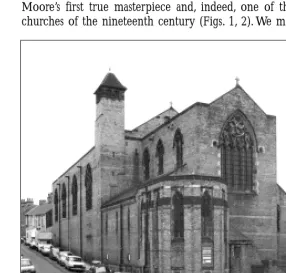
I made it my business to seek out a wide range of churches after about 1870 and the one architect who particularly impressed me – and about whom I knew next to nothing – was Temple Moore. Then in 1990, out of the blue, I got a letter from Dionys Moore (now deceased), who had heard of my interest in her grandfather’s work from the priest at St Peter’s in Barnsley, Moore’s first true masterpiece and, indeed, one of the greatest churches of the nineteenth century (Figs. 1, 2). We met and she
Geoff Brandwood has written extensively on church architecture, especially of the Victorian and Edwardian periods, and was Chair of the Victorian Society from 2001 until 2007.
Fig. 1: St Peter’s, Barnsley. First design 1885, east end 1891–3, Lady Chapel 1900–01, nave 1911. Like many of Moore’s churches this one was built for Anglo-Catholic worship. Moore, himself, was a devout Anglo-Catholic.
Temple Moore revisited
kindly told me much of Moore and his family and made available sketchbooks, accounts, press cuttings and other papers which greatly helped me to pull together an account of the architect and his work.
Moore was born in 1856 in Ireland, grew up in Glasgow and in 1872 was sent to the East Riding village of Londesborough as a pupil of the rector, the Rev. Richard Wilton.This move changed both the course of Moore’s life and the face of English church building.Architecture had not been in the family and, so far as we know, there were no plans for the young man to enter the profession. However, his artistic talent and interest in old buildings came to the notice of the great G.G. Scott junior (who was restoring Nunburnholme church nearby), so Moore became articled to Scott from 1875 to 1878. These were the years when Scott was building his three greatest churches – St Agnes, Kennington, All Hallows, Southwark, and St Mark’s Leamington Spa.Tragically the first two have been lost thanks to the combined efforts of the Luftwaffe and the diocese of London, but they were key buildings in the development of late Victorian church
architecture. They took forward the ideas of Englishness and refinement pioneered by Bodley in the 1860s along with the reawakened interest in the latest medieval styles. They must have made a big impact on the young Moore, as he embraced what he had seen in Scott’s office and developed it brilliantly throughout his career.
At the end of Moore’s pupillage Scott’s mental health was failing and he was often incapable of effective work. Moore shouldered much of the burden and loyally looked after Scott’s interests and those of his long-suffering family. This may be the reason why Moore’s independent career was slow to take off; it could also be that he was a slow-developer, rather like J.D. Sedding, another star of the late Gothic Revival who also did not produce anything of significance until his thirties. For Moore, the great debut building was St Peter’s, Barnsley, designed in 1885 but not begun until 1891. Thereafter his practice blossomed, including following in the footsteps of Pearson and Street for that great patron of Yorkshire church-building, Sir Tatton Sykes. By 1900 commissions crowded in and continued until the Great War brought architecture and so much else to a full stop. Afterwards came a few dozen minor works but before anything significant could be built, Moore died in 1920. His son-in-law, Leslie Moore, a partner from 1918, retained the older man’s name in the title of the practice – ‘Temple Moore & Moore’.2
ECCLESIOLOGYTODAY40 · JULY2008
A decade on from the book, this article presents the opportunity to ask myself questions like: what did I miss, and, more importantly, have I assessed his work properly? When writing a book such as mine, the responsibility is actually a big one. For writers on Shakespeare or Dickens or the causes of World War One, the market is big, with scope for many books at different levels and with different interpretations – and, therefore, many publishers willing to take them up. Not so in architectural history once we stray from such giants as Pugin or Lutyens, or the ever-appealing Arts and Crafts movement! Those writing books on Victorian architects are likely to be the only people to do so for a generation or more and any re-examination is going to be in the form of articles or as a part of more general works.
What did I miss? Sadly, in terms of family and business correspondence there was virtually nothing to go on and our knowledge of Moore’s private and office life is quite limited (in any case, as a very private man he would probably have wished it that way). However, information about the jobs he designed is excellent, thanks to the material Miss Moore was able to place at my disposal, the usual reports in the trade press, and the survival of caches of drawings at many churches or records offices.3 For a
long time I lived in the happy knowledge that I had missed no substantial scheme.
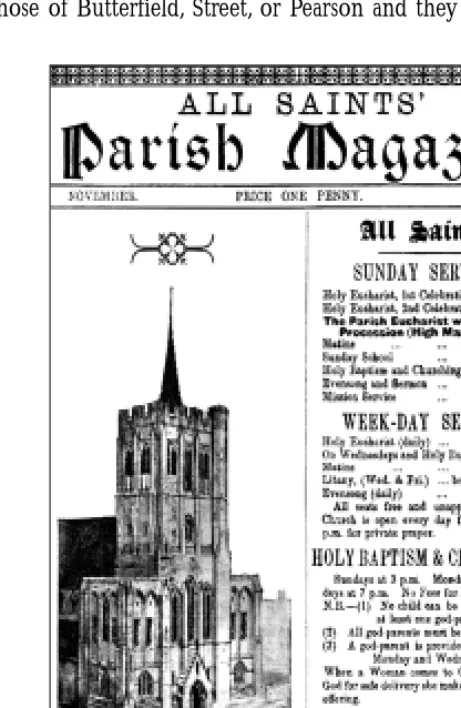
That is until late last year, when I visited Street’s 1874–8 All Saints, Middlesbrough, where grandiose plans were developed for the west end. In March 1910 Moore came up with a design for a tower with flanking organ galleries (Fig. 4). In October the same year he produced an alternative, cheaper scheme for a tower with a steep saddleback roof. A perspective of the first design found its way on to the cover of the parish magazine in 1912, no doubt in the hope of encouraging people’s generosity: it was republished in a book about the church in 2003.4 However, the later design
(Fig. 5), among the parish papers in Teesside Archives,5 was
hitherto unknown and is the only case of Moore designing a saddleback tower. All this came to nothing: sufficient funds were not raised, the Great War intervened, and such money as was available was diverted in 1926–7 to fixtures and fittings by Bodley & Hare (i.e. C. G. Hare).6
Other works I failed to identify are 1885 designs for an organ-case at Kemsley, Kent, and an altar and frontal for Bramley, Leeds, of around 1909.7Another couple of minor factual amendments
are detailed in the end notes.8
wish that some of my own illustrations had been better: but there are over 200 of them and they do give a comprehensive view of Moore’s work. My heartiest thanks go to Shaun Tyas of Paul Watkins Publishing for having the courage to accept the publishing proposal and seeing it to completion. He has been willing to produce architectural history books which otherwise might not see the light of day; long may he succeed.
And what of Moore’s reputation? In the book I included a short chapter setting out what others thought of him. Goodhart-Rendel, Pevsner, Betjeman and Stephen Dykes Bower, for example, all held him in very high regard. I also quoted Gavin Stamp’s view that Moore was ‘the most subtle and satisfying of the great Victorian church architects’; in a letter to me after the book was published he put it even more directly: ‘I still think Temple Moore was the best of the lot.’9That is exactly how I feel too, but
for many people his name still does not roll off the tongue like those of Butterfield, Street, or Pearson and they would be
hard-Fig. 4: Moore’s March 1910 design for the west end of All Saints,
Middlesbrough. As at Barnsley, this was a staunch Anglo-Catholic parish [Teesside Archives].
pressed to name many of his churches. Why? Crucially, much of his best work is not easily accessible and a great deal of it is in the north of England, beyond easy range of London-based architectural historians. Moore’s one great London church is
marooned in the suburbs of Tooting (All Saints’, Tooting Graveney, Fig. 6), while St Peter’s, mentioned above, sits in a grim bit of Barnsley. Earlier Victorian architects were building in or nearer the centres of towns and cities, while Moore’s generation was mostly supplying buildings further out. By his time, the spectacle of All Saints, Margaret Street, or the fireworks of St James the Less, Pimlico, both of which make such an instant impact, had
Fig. 6: All Saints,Tooting Graveney (1904–6), Moore’s only major church in London.The altarpiece is a Renaissance import from Bologna, brought in by the vicar along with other trophies from his travels: Moore disapproved heartily of them being placed in the Gothic setting and resigned.
passed out of fashion. His great churches have intense beauty which derives, as one contemporary critic said of a Moore design, from ‘good proportion and sweetness of line’.
To see Moore at his very finest, apart from churches mentioned already, you could profitably experience (and this aims to give a reasonable geographical spread), St Mark’s, Mansfield (1896–7), St Columba’s, Middlesbrough (1900–02), St Wilfrid’s, Harrogate (1904–8 onwards), St Anne’s, Royton, (1908–9), All Saints, Uplands, Stroud (1908–10), St Mary’s Canwell, Staffs. (1910–12), St James’, Clacton-on-Sea (1912–13), St Columba’s, Scarborough (design 1914, built 1922–6), and All Saints, Basingstoke (1915–17).They all reveal a great master at work.
Special offer to Ecclesiology Today readers. Copies of Geoff Brandwood’s Temple Moore: An Architect of the Late Gothic Revival are still available direct from the publisher, price £35 (UK) or £37 (overseas) (normal price £49.50). Send a cheque (made out to ‘Shaun Tyas’) or Visa or Mastercard details (no security code needed) to Shaun Tyas, 1 High Street, Donington, Spalding PE11 4TA. Or telephone 01775 821542.
Notes
1 Geoffrey Brandwood, Temple Moore: An Architect of the Late Gothic Revival (Shaun Tyas, 1997).
2 A rather odd idea but not without precedent. After Edmund Sharp retired from architecture in 1851 to concentrate on other business ventures, E. G. Paley traded as ‘Sharpe & Paley’, while after the death of J. D. Sedding in 1891, Henry Wilson still included his master’s name in the title of the practice.
3 After Leslie Moore’s death in 1957 and the refusal of the RIBA to take the office’s drawings, his widow Mary offered them to the churches involved. Many took them in and I was able to inspect rolls of drawings on many a vestry table. A large number have subsequently been placed in record offices.
4 Barry Jewitt, All Saints, Middlesbrough: A History of the Church and its Parish (2003). The whereabouts of the original perspective are unknown but the parish magazine is with the parish archives. The design for the west elevation of the tower and flanking wings scheme on tracing paper is held at Teesside Archives, PR/M(AS)6/1.
5 PR/M(AS)6/4.
6 A hanging rood, war memorial chapel, and an alabaster tabernacle for the high altar:Teesside Archives PR/M(AS)6/5–9.
7 RIBA Drawing Collection at the Victoria &Albert Museum: respectively PA106/17 and PA1107/5.
8 The other minor amendments mentioned in the text are as follows.We now know exactly when Giles Scott was apprenticed to Moore – 18 January 1899 (my book, p. 4, said ‘about 1898’): this information comes from Gavin Stamp (personal communication, 6 August 1997) who was shown Moore’s indenture by Betty Hoare. On p. 38 I said ‘“Pick” Brotton was a minor architect and produced plans for Moore of Rievaulx church’. In fact it was his father (also named Robert Pickering Brotton) who did so: e-mail from Mrs M. Anne Rees, great-granddaughter of Moore’s builder William Brotton, 7 February 2008.
IN 1999 I gave a lecture on The Herefordshire School of Romanesque Sculpture to the Friends of Hereford Cathedral, an event to launch my new book of the same title published by the local Logaston Press. That evening we sold about one hundred copies of the book, not bad for starters, I thought. The book continued to sell well, even though one important work of the School, the Orleton font, had been omitted because of my less-than-perfect computer skills. The omission was corrected in the second printing, which also included fragments from Edvin Loach which had come to my attention too late for inclusion in the first edition. The book is now in its fifth printing and a sixth is planned later this year.
I start with these figures because the book sales alone vindicate my decision not to publish with an established academic press. However, that was not my only reason. In my Introduction I stated that the book
aims at that delicate balance between appeal to the scholar and to the general public. It must be confessed that this is a somewhat daunting task. On the one hand, the art historian approaches the text with prior knowledge of the specialized literature and will seek insights into the
minutiae of the subject and new perspectives on the historical setting of
the work. On the other hand, there is the reader with no prior knowledge of the topic, a person, like me thirty years ago, who is captivated by the aesthetic experience of the south doorway of Kilpeck church.1
This approach complied with the philosophy of Andy Johnson, founder and owner of Logaston Press, to publish books of good academic quality which would also be accessible to the general reader. If I had to make the choice again it would be exactly the same. Admittedly, my decision was taken at a time in my career when I had nothing to lose by publishing with a ‘popular’ rather than an ‘academic’ press, as I was a tenured Full Professor. I wonder if a tenure-review committee or research assessors today would rank the book as highly as one published by a university press? However the book is categorized, it is worth noting that it has garnered many more citations than any one of more than 90 articles I have published in academic journals. It reached an even bigger audience when used as the basis of a two-page spread in the Daily Telegraph (27 March 2004).2Although a
welcome ‘advertisement’ leading to more book sales, it also achieved my object of bringing the Herefordshire School of Sculpture to the attention of more people.
Malcom Thurlby is Professor of Medieval Art and Architecture at York University,Toronto, Canada.
Reflections on
The Herefordshire School of
Romanesque Sculpture
Reviews of the book have been generally complimentary and Jeremy Knight was even kind enough to refer to it as ‘definitive’; I am not sure that I want to go that far but I was nonetheless very flattered.3 Ron Baxter noted that the photographs ‘alone are
worth the price of admission’ (£12.95).4There can be little doubt
that the ‘bargain price’, as Roger Stalley called it,5 appealed to a
large number of people who would not normally think of buying a more expensive art history book. One website refers to the book as ‘First-rate, packed with information (and photographs), yet still digestible’.6Tessa Garton found ‘the book contains much that is
useful and thought provoking, and has much to offer both to the scholar and to the general public’.7At the same time she detected
some limitations, notably ‘A more extensive discussion of the influence of patrons on style or iconography would have been useful’, a point with which Stalley was in basic agreement although he felt that this may have been outside the scope of the book, (a view I share). Garton also thought that interpretation of the sculpture based on the Bestiary ‘would have benefited from a more comprehensive discussion of the social context and audience for which the work was produced’.8 On the latter, Stalley stated
that ‘the author really needed to confront the (albeit intractable) question of the audience and its social composition’.9Intractable,
indeed; is it possible to determine whether or not the sculpture was aimed primarily at a rustic or an elite audience?
On the other hand, Ron Baxter (author of Bestiaries and their Users in the Middle Ages)10was not happy with the direct association
of some of the Kilpeck sculpture with the Bestiary. With specific reference to corbel 32 on the south side of the apse, he said:
Thurlby’s bold interpretation of the upside-down beast head at A6 as an ibex (which carries a good deal of iconographic weight in Bestiaries) is surely refuted by the observation that it has antlers rather than horns and is likelier, as the author of ‘A Short Tour...’ suggests, to represent a dead stag after the hunt. The author is reluctant to accept that Bestiaries provided the key to much medieval sculpture.They provided exemplars for sermons, which might well have been used to explicate such sculptures as these, but they were not the only source, and in any case their theological arguments are often so convoluted as to be almost incomprehensible. My own position is closer to that of the late Michael Camille, who argued that the corbels surrounding a church in a ring of imagery that was often worldly and sometimes grotesque and obscene could represent the reality of the world itself that surrounded and besieged the Church and the Man of God.11
sermons. On the specific reference to the ibex or stag, one does not preclude the other. In the interpretation of medieval art we do well to recall the words of Richard Krautheimer in the postscript to the reprint of his seminal article ‘An Introduction to an “Iconography of Medieval Architecture”’, in which he emphasized the importance of what he called ‘“double-think”, or better, “multi-think”’, or the likelihood of multiple connotations.12With that in mind, I associated the stag on corbel
65 at Kilpeck with both the Bestiary and the hunt.13For the latter
I made passing mention to corbels on the south wall of the nave of Elkstone (Gloucestershire). Specifically, corbel 12 (counting from the east) is carved with a knight on horseback; there is a hound on corbel 13, while a stag is on corbel 14 (Figs. 1–3).
The ibex interpretation was accepted by Jeremy Knight and the Sheela Na Gig Project.14More generally, Bestiary connections
are accepted by John Hunt and a website on Kilpeck.15Hunt has
also suggested that:
The apostles, and tonsured figures representing the Fathers of the Church, are displayed as column figures, an arrangement found widely in early twelfth-century Europe. Both St Paul and St Benedict have been variously suggested for two of the figures, but the only one that can be certainly identified is St Peter, shown with his keys. It may be that this theme was particularly intended to reflect Hugh de Kilpeck’s patronage of Gloucester Abbey and the establishment in Kilpeck of a Benedictine cell.16
Hunt further extended the study of Kilpeck church in the context of the caput or ‘chief place’ of the honor.17 Calvin B.
Kendall read the Kilpeck tympanum as a sign of Christ as the True Vine, with reference to John xv. 1–10, as previously suggested by Keyser and reported as a possible interpretation by me.18 For
Baxter and Pevsner, the Kilpeck tympanum is a Tree of Life.19
Baxter also challenged my association of aspects of Kilpeck with Ferrara Cathedral, as the date of 1135 in the inscription over the west portal of Ferrara Cathedral is ‘uncomfortably late’. However, this date is more likely to refer to the completion of the church and so construction would have commenced well before that.20Thus it would seem that the analogue can stand, although it
does raise questions about the exact nature of such links. A visitor from Herefordshire on pilgrimage to Rome might have visited Ferrara Cathedral and been impressed with the very latest work there; one has to ask if such a visitor might have had access to the workshop too.
The most comprehensive analysis of the Herefordshire School since the publication of my book is John Hunt’s essay entitled ‘Sculpture, Dates and Patrons: Dating the Herefordshire School of
Fig. 1. Elkstone (Gloucestershire), south nave corbel 12.
Fig. 2. Elkstone (Gloucestershire), south nave corbel 13.
Sculpture’.21 Most importantly he argued convincingly that
‘Shobdon cannot be placed before late 1135…more probably the late 1130s’. His evidence is based on a careful reading of the Wigmore Chronicle in which the main account opens with the words, ‘In the time of King Stephen’, and proceeds to introduce Hugh I de Mortimer, Oliver de Merlimond and the latter’s plans for Shobdon church.22In spite of Hunt’s reservations about dating
Kilpeck church by the 1134 gift to St Peter’s Abbey, Gloucester, I still believe it has much to recommend it.23Hunt also questioned
the dating of Bishop Roger’s work at Old Sarum Cathedral in relation to Kilpeck, but it now seems clear that the eastern arm of Sarum was finished by the mid 1120s.24Therefore, Kilpeck should
be dated earlier than Shobdon as suggested by James King.25
The Introduction to Herefordshire in The Corpus of Romanesque Sculpture in Britain and Ireland (CRSBI)26provides very
useful historical and geological information that pertains to the Herefordshire School, and the website presents detailed discussions of a number of Herefordshire School sites, especially Castle Frome27and Kilpeck.28 On the St George and the Dragon
tympanum at Brinsop, George Zarnecki reports my discussion of various Roman sources but is lukewarm to the idea of any connection with a cult image of Mithras.29He does not elaborate
and I remain convinced by the validity of the formal relationships. At Rowlstone, Zarnecki thought that the iconographic identification of the left-hand inverted figure to the right of the south capital of the chancel arch as St Peter ‘seems unlikely because no crucifixion is shown: because the figure carries a cross-sceptre and a book rather than keys: and because it would not explain the inverted angel alongside’.30 He observed that this
inversion could not be a mistake in the placing of the sculpture, because it forms part of the same stone as the capital and suggested instead that this was a mistake in carving. These observations notwithstanding, the inversion of the figures surely allude to St Peter’s crucifixion, the saint to whom the church is dedicated.
On the Fownhope tympanum, my discussion of the iconographic interpretation of the figures as the Virgin and Child, or God the Father and God the Son from a Trinity, completed by a bird in the voussoir above, was mentioned by Zarnecki and Baxter but without further discussion; they label the sculpture ‘Virgin and Child’.31 In addition to my presentation of Eardisley
and the account of the sculpture in the CRSBI,32 it should be
noted that during the restoration of Eardisley church it was reported that a ‘number of corbels of the Norman period….have been found’.33 Have any of them have survived in the houses or
Fig. 5. Kilpeck (Herefordshire), south nave corbel 4.
ECCLESIOLOGYTODAY40 · JULY2008
Fig. 7. Kilpeck (Herefordshire), south nave corbel 13.
rock gardens in the village?
Peter Lord was quite correct to spot the omission of the Brecon Priory (now Cathedral) font from my discussion of the Herefordshire School.34 This is now amended with specific
parallels cited with the Stottesden (Shropshire) font, with reference to Byzantine silks.35 On the other hand, Lord’s
association of the fonts at St Woolos at Newport and St Thomas at Over Monnow is incorrect; the former dates from much later in the twelfth century while the latter is a nineteenth-century Romanesque revival.36The label stops on the south doorway at
Marcross (Glamorgan) have now been compared with Kilpeck corbels.37
Research on the Herefordshire School continues. A forth-coming article by John Hunt discusses a red sandstone relief carving at Upton Bishop.38This shows the upper torso and head
of a figure, set within an architectural niche with part of another niche. The relief has been published as both Roman and Romanesque, and Martin Henig has associated it with the Herefordshire School.39 Hunt discusses these parallels but
concludes that the relief dates from the early middle ages. I attributed the sculpture reset in the Bell Inn at Alveley (Shropshire) to the patronage of Hugh de Mortimer between 1138 and 1140. Hunt argued that the work was created for Guy Lestrange who held the manor of Alveley and suggests a date between 1155 and the early 1160s.40 As I am now inclined to
accept Hunt’s attribution and dating, this means that the Herefordshire School was active for longer than I had originally proposed.
In my preface to Romanesque Architecture and Sculpture in Wales I remarked that I had cited a number of Welsh analogues in The Herefordshire School of Romanesque Sculpture but that ‘[in] retrospect, I am inclined to think that I did not give the Welsh sources due emphasis’.41 Given that Kilpeck and the churches in Erging or
Welsh journal), as ‘definitive’. Notes
1 Malcolm Thurlby, The Herefordshire School of Romanesque Sculpture (Logaston, 1999), xii.
2 Christopher Somerville,‘England:Tall tales captured in stone’, Daily Telegraph (27 March 2004). http://www.christophersomerville.pwp.blueyonder.co.uk/ Herefordshire%20Sculpture.htm
3 Jeremy Knight, ‘Review’, Archaeologia Cambrensis, 147 (1999) [2001], 242–47. 4 Ron Baxter, ‘Review’, Journal of the British Archaeological Association (JBAA), 155
(2002), 307.
5 Roger Stalley, ‘Review’, Archaeological Journal, 156 (1999), 438–39. 6 Peter Evans, ‘Kilpeck Church’, http://www.hoary.org/snaps/engl/kilp.html 7 Tessa Garton, ‘Review’, Transactions of the Ancient Monuments Society (TAMS), 45
(2001), 150–51. 8 Garton ‘Review’, 150. 9 Stalley, ‘Review’, 438.
10 Ron Baxter, Bestiaries and their Users in the Middle Ages (Stroud, 1998).
11 Ron Baxter, ‘St Mary and St David, Kilpeck, Herefordshire’, Corpus of Romanesque Sculpture in Britain and Ireland (CRSBI) linked from Herefordshire Site Index (henceforth CRSBI, Hereford) at http://www.crsbi.ac.uk/crsbi/ frhesites.html
12 Richard Krautheimer, ‘An Introduction to an “Iconography of Medieval Architecture”’, Journal of the Warburg and Courtauld Institutes, 5 (1942), 1–33; reprinted in Studies in Early Christian, Medieval and Renaissance Art (New York 1969), 115–49, postscript 149–50.
13 Thurlby, Herefordshire School, 51–52, 63–64.
14 Archaeologia Cambrensis, 147 (1999) [2001], 244; ‘The Sheela Na Gig Project’, http://www.sheelanagig.org/index.html#http://www.sheelanagig.org/ SheelaKilpeck.htm
15 John Hunt, ‘Kilpeck Church: a window on medieval “mentalité”’, http:// www.history.org.uk/pdfs/Kilpeck%20Church%20final.doc ; Evans, ‘Kilpeck’. 16 Hunt, ‘Kilpeck Church, a window’.
17 Hunt, ‘Kilpeck Church: a window’.
18 Calvin B. Kendall, The Allegory of the Church: Romanesque Portals and Their Verse
Inscriptions (Toronto, Buffalo and London: University of Toronto Press, 1998),
104–05.Thurlby, Herefordshire School, 44.
19 Baxter, ‘Kilpeck’; Nikolaus Pevsner, The Buildings of England: Herefordshire (Penguin, 1963), 202.
20 Arthur Kingsley Porter, Lombard Architecture, 4 vols. (New Haven, 1915–17, reprinted New York, 1966), II, 407–08. Baxter, JBAA Review. Also Pevsner,
Herefordshire, 203.
21 John Hunt, ‘Sculpture, Dates and Patrons: Dating the Herefordshire School of Sculpture’, Antiquaries Journal, 84 (2004), 185–222.
22 Hunt, ‘Sculpture, Dates and Patrons’, 187. 23 Hunt, ‘Sculpture, Dates and Patrons’, 191–99.
24 Malcolm Thurlby, ‘Sarum Cathedral as rebuilt by Roger, Bishop of Salisbury, 1102–1139: the state of research and open questions’, Wiltshire Archaeological and
Natural History Magazine, 101 (2008), 130–140.
25 James F. King, ‘The Parish Church of Kilpeck Revisited’, in Medieval Art,
Architecture and Archaeology in Hereford: British Archaeological Association Conference Transactions, 14, ed. David Whitehead (Leeds 1995), 82–93.
26 Ron Baxter, ‘Preface to Herefordshire’, CRSBI, http://www.crsbi.ac.uk/ crsbi/frhepreface.html.
27 George Zarnecki, ‘St Michael and All Angels, Castle Frome, Herefordshire’, CRSBI, Hereford.
28 Baxter, ‘Kilpeck’.
29 George Zarnecki, ‘St George, Brinsop, Herefordshire’, CRSBI, Hereford. 30 George Zarnecki, ‘St Peter, Rowlstone, Herefordshire’, CRSBI, Hereford. 31 George Zarnecki and Ron Baxter, ‘St Mary, Fownhope, Herefordshire’, CRSBI,
Hereford.
32 George Zarnecki and Ron Baxter, St Mary Magdalene, Eardisley, Herefordshire, CRSBI, Hereford.
33 The Builder, 20 (1862), 608.
34 Peter Lord, The Visual Culture of Wales: Medieval Vision (Cardiff, 2003), 72 note 48. 35 Malcolm Thurlby, Romanesque Architecture and Sculpture in Wales (Logaston, 2006),
111–13.
36 Thurlby, Wales, 163–64, 168. 37 Thurlby, Wales, 176.
38 I am grateful to John Hunt for sharing this article with me in advance of publication in the Antiquaries Journal.
39 Martin Henig, Corpus Signorum Imperii Romani, Corpus of Sculpture of the Roman
World, Great Britain,Volume 1, Fascicule 7, Roman Sculpture from the Cotswold Region with Devon and Cornwall (Oxford, 1993), cat. 255, pl. 59.
Introduction
IN 1984 Brompton Oratory celebrated the centenary of its consecration with a triumphant internal redecoration and an exterior cleaning (completed in 1994).A commemorative volume of essays The London Oratory Centenary 1884–1984 followed in 1985.1 There have been embellishments since, notably the
re-ordering of the St Joseph chapel in 2005,2to include two standing
angels left over at the re-erection of the seventeenth-century Lady altar from Brescia, the first and foremost of the imported continental Baroque sculptures for which the church is famous.3
The competition and the church (1880–84) by the architect Herbert Gribble were the subject of a chapter in the 1983 Survey of London volume.4 However, the form and date of the high altar
were surprisingly unnoticed. References to the high altar were also omitted from the Centenary volume, as the editor concluded that existing guide books covered the history of the church from 1884.5This paper rectifies these omissions.
The ‘style of the Italian Renaissance’
In my Centenary essay, I posited a forty year Gothic hegemony from Pugin’s Oscott College Chapel opening (1838) to the Oratory competition, (1878) stating that Sedding’s Holy Redeemer, Clerkenwell, was ‘the first Anglican classical church for half a century in London’.6In his review, Peter Howell countered
this with Thomas Allom’s 1852 St Peter’s Notting Hill, an example in its stuccoed façade and galleried interior of classical survival rather than Renaissance revival (as were so many contemporary nonconformist chapels of this type). Without citing any, Howell also referred to ‘many Irish examples’.7In fact, the handful of Irish
classical churches in this period are also examples of a classical survival, often of churches begun before the Great Famine (such as Longford cathedral) or the completion of Dublin classical churches by Patrick Byrne. The major exception is Byrne’s Our Lady, Rathmines also of 18528. I also claimed that ‘The
Oratory...stands out extraordinarily early in its return to Renaissance classical themes’ and gave examples of English and continental classical churches which succeeded it.9 Howell
thought this ‘over states [the] case’, and gave a further four continental examples (although his inclusion of St Augustin, Paris, a Romanesque or style-latin design, cannot be included). Such few exceptions surely prove the length of the Pugin hegemony and the important part played by the Oratory competition brief ‘for a
Rory O’Donnell has been a member of the Oratory Art and Architecture Committee for over twenty five years. He has published more than one hundred titles – from reviews to books – largely on Catholic church architecture in Britain and Ireland.
Brompton Oratory revisited
church in the style of the “Italian Renaissance”, in the late Victorian re-assessment of the status of the Renaissance.
Aspects of Gribble’s design and decoration are in fact Mannerist, even if his second façade design of 1890–3 shows a Baroque kunstwollen. A contemporary quip that the new church was a ‘réchauffé of St Paul’s and the Lowther Arcade and Newgate’10
should be noted. The ‘Lowther Arcade’ refers to the domed and top-lit interior of the arcade (demolished 1902) in the West Strand improvements by Nash, so strongly reflected in the top-lit dome system of the Oratory.‘Newgate’ refers to Dance Junior’s Newgate Prison (also demolished 1902), particularly Gribble’s quote of the French-style channelled rustication. In fact Wren (and Paris) was as strong an influence as Rome and I have analysed the ‘Englishness’ of the church in detail elsewhere.11By contrast, the
Baroque aspects are seen in the first two post-consecration phases; the two-stage construction of the façade – the lower by Gribble (1890), the upper by the clerk of works Peter Shaw (1893 ) – then in the addition of the outer dome in 1895 by George Sherrin. It is especially true of the marble cladding of the sanctuary by Cosgreave (1888–9) and the 1927–32 internal decoration by Commendatore Formilli. The loose description of the church as ‘Roman Baroque’ by some recent authors more
properly refers to these later aspects, rather than Gribble’s work in the ‘Italian Renaissance‘ style.12
The high altar
The competition Instructions specified that the high altar from the previous church would be re-used.13Early photographic evidence
suggests that this altar, clearly enlarged, survives in the present church14 and this is confirmed by the first guide of 1884.15
Although the Survey of London identified reused furnishings from the earlier church (such as the altar rails and floor in the sanctuary), it made no comment on the design or date of the high altar. The evidence which emerges from the Oratory archives is one of dithering over the decoration and the reuse of existing
ECCLESIOLOGYTODAY40 · JULY2008
furniture, demonstrating both Oratorian conservatism and the low status of their architect, Gribble. On 7 February 1883, in a cost cutting mood, the Congregation of Deputies decided on ‘replacing the High Altar and sanctuary floor...each of these items to be subject to a vote of the General Congregation’.16 On 27
April 1883 the General Congregation duly voted for estimating the cost of ‘replacing in the New Church the old High Altar with the addition of two steps to the already existing three and [to] increase the width of the super altare’.17 On 20 June 1883 it
accepted ‘Mr Goad’s estimate for replacing and making alterations to the old High altar…£300’.18
Significantly, the architect is not mentioned and the only drawing to survive relating to the actual high altar is a tracing labelled ‘Design for laying out the sanctuary floor’, showing the altar in position with extensions either side hatched in (work which in fact took place). Although there is a further undated
drawing by Gribble showing foundations to support four piers, they are for his unexecuted baldachino (see below). By contrast, more detailed drawings survive showing his designs for the foundations of the Sacred Heart altar (though others were to follow its details) and that for the fixing of the Lady altar from Brescia.19 Then in April 1886, an Oratorian, Fr Kenelm Best,
offered to pay for the ‘renewal of the High Altar’ as well as the decoration of the sanctuary and a ‘new high altar’.20 Could this
have been a new structure? If so, no drawings survive for it. Despite the words ‘replace’ and ‘new’, it would seem that the re-used altar was yet further adapted and ornamented piecemeal, as suggested by Fr Best’s further gift of a new tabernacle in December 1887 21 and the acceptance on 2 July 1890 of his gift
of ‘additional gilt ornament’.22Two Gribble drawings of either
January or June 1888 for the decoration of the apse have a blank white overlay or outline indicating that the high altar was to be re-used. Underlining its interim status, the high altar was not consecrated with the church in April 1884, an omission rectified only in 1934.
It is therefore argued here that it is the altar from the earlier church which survives, that it was not this altar which was moved to Chiswick23 and that it is not work of the 1920s by B. Pozzi as
suggested by Denis Evinson.24 The existing altar is therefore
identified as ‘the grand altar’25 by the architect J. J. Scoles26, from
the previous church. Three other Scoles’ side altars from the previous church also survive, notably that of St Joseph for which drawings dated 1861 survive. Given the maintenance of tradition here through forty years of liturgical turmoil, the high altar at the Oratory is the oldest in daily use in Catholic London.
I wish to thank the Revd Fr Rupert McHardy, Cong. Orat, archivist, for access to the archive, in particular to the uncatalogued collection of architectural drawings
Notes
1 Michael Napier & Alistair Laing (eds.), The London Oratory Centenary 1884–1984, (Trefoil, London 1985).
2 By Russell Taylor, architect: Church Building, 93 (May/June 2000), 18–19. 3 The angels are by Santo Calegari and Tomas Ruez. Alistair Laing, ‘Baroque
sculpture’ in Napier & Laing, Centenary, 65–83.
4 F. H. W. Shepperd (gen. ed), Southern Kensington, Brompton, Survey of London, vol. XLI, (Athlone Press, London, 1983), 50–7, Frontispiece.
5 Letter from the late Fr Michael Napier to the author, c.1983.
6 Roderick O’Donnell, ‘The Architecture of the London Oratory Churches’ in Napier & Laing Centenary, 21–47.
7 Peter Howell, review in Newsletter of the Society of Architectural Historians of Great
Britain, 27 (Spring 1986), 11.
8 Roderick O’Donnell, ‘Roman Reflections on the Liffey, classical Catholic churches in Victorian Dublin’, Country Life, CLXXVI (July 1984), 52–53. 9 Roderick O’Donnell, London Oratory Churches, 22 and footnotes 6, 7.
Fig. 4: St Joseph’s Chapel as reordered by Russell Taylor in 2005; the J. J. Scoles altar of 1861 is embraced by a screen of Tuscan Doric columns surmounted by two seventeenth century angels.
10 Fr F. R. Kerr ‘The Oratory in London’, Oratory Parish Magazine, VII, no 3, (3 March 1927), 42.
11 ‘[Roman] Catholic church architecture in England; ‘Irish occupation’ or ‘the Italian mission’?’ in D. Crellin and Ian. Dungavell (eds.) ‘Architecture and Englishness
1880–1914’, Papers from the Annual Symposium of the Society of Architectural Historians of Great Britain, 2003 (2006), 59–71, (pp 68–9), ‘Roman’ was
interpolated into my title by the editors.Andrew Saint’s essay in the same volume, ‘The cult of Wren’, 37–58 makes other points about the Wren Revival. 12 For instance, James Stevens Curl, The English Heritage Book of Victorian Churches,
(Batsford/English Heritage 1995), 43–5; Piety proclaimed, (London, 2002), 47–9. 13 London Oratory Archive (LOA), New Church file, ‘Instructions to Architects
offering designs for the new Church of the Oratory’.
14 LOA. Photographs in an undated album show that the recessed outer pier and console bracket on both sides are additions and the plinth has been heightened with four steps (not the five mentioned in the 1883 estimates).
15 The ‘altar, which originally stood in the old church, but has received further additions and embellishments’. B.F. Laslett, The Description of the New Church of the
Oratory (London, n.d. c.1884), 11.
16 LOA, Congregation of Deputies 7 February 1883.
17 LOA, General Congregation Minutes 27 April 1883. In Oratory in London
chronology 1845–1947, a typed manuscript c. 1947 of notes by Fr Ralph Kerr (died
1932) it has ‘replace old High altar with additions. £300’ under February 1883. 18 LOA, General Congregation Minutes 21 June 1883. John and E Goad, Phoenix
Marble Works, Stonehouse, Plymouth signed contract drawings dated 20 January 1880 to supply the marble of the major and minor orders; the capitals were omitted from this contract.
19 All drawing references are to the uncatalogued collection of architectural drawings in the LOA.
20 A manuscript addition to the Oratory chronology 1845–1947 has ‘“new high altar” first used 19 September 1886’.
21 Oratory chronology 1845–1947, December 1887. 22 LOA, General Congregation Minutes, 2 July 1890.
23 LOA, Fr Philip Gordon and Fr Kerr,‘Various memoranda relating to the London Oratory history’, 391–2 describe the original altar as made of wood, and moved to the church at Chiswick. This must refer to a yet antecedent high altar to that retained in 1884.
24 Denis Evinson, London Catholic Churches, (Sheffield University Press, c. 1995), 166. 25 Scoles’s 1853–4 temporary church was improved in 1858, see The Builder (1858), 500–1, (where the ‘grand altar’ is referred to) and also Building News, (1858), 690, 696.
Wymondham Abbey – first thoughts
PHILOSOPHICAL approaches to archaeology have changed greatly over the past thirty years and revisionism has so far affected the study of castles more than it has churches. It is worth considering how modern archaeological theory has influenced the study of castles and is creeping quietly into the study of churches. Recent work on Wymondham Abbey is a good example.
It was in 1995 that I was asked to produce a booklet on Wymondham Abbey and its bells1and to help the vicar, the Revd
John Barnes, to update the church guide book.2The Abbey has a
very rich archive that includes many documents dating from the fifteenth century relating to the bells, five account books of mediaeval gilds, and a bede-roll of 1524. The story of the long-standing animosity between the town and the monks which resulted in the Abbey having a tower at each end and two peals of bells has entered into vivid local legend. Careful collation of documents from different sources showed that generally the parishioners acted logically in defending their rights in the parish church and that periods of intense hostility were isolated. For most of the time town and monastery realised they were interdependent.
Research on towers and bells produced documentary evidence for dating the splendid north aisle with its range of nine windows (Fig. 1), seven in the local sixteenth-century Perpendicular style and two that were perhaps 200 years older. Seven entries occur in the Bede Roll bidding prayers for the donors of windows before 1524; a number of wills provide dates when donors died and a spot date, 1511, in the accounts of the Fraternity of the Light of Our Lady, gives independent evidence for making and glazing one window, complete with the costs. The advice given to me years before by R. Allen Brown, my supervisor at King’s College London, seemed sound. Wills can tell you what people intended to do, building contracts are stronger evidence of intention, but it is only accounts that confirm that the job was done; then you can look at the archaeology and ask whether it all makes sense. Wymondham north aisle was surely the classic case.
In 2006 there was an opportunity to consider a new book on Wymondham Abbey and so far critics have treated it kindly.3
Specialists were invited to write on various aspects of the Abbey, producing nineteen chapters and eight picture essays. Academics exchanged their views in open, honest and sometimes forthright
Paul Cattermole was born in Norfolk and began to be interested in churches in about 1950. Having learned to ring at Beccles in 1955, church towers and bells became a life-long addiction. He retired from teaching in 2003 and is at present honorary archivist at Wymondham Abbey and Norwich School.
Church studies in transition
discussion. My own contribution on the bells was robustly criticised for accepting the received wisdom that the parish bells were set up in the north-west tower of the Romanesque church around 1415, whilst ignoring a single inconvenient reference to the south-west tower. Careful consideration of the archaeology showed I was wrong: the south-west tower (Fig.2) was clearly strengthened to take the parish bells, just as Archbishop Thomas Arundel had ordered in 1411. This in turn resolved the problem of the north aisle, whose west end could not have been built if the north-west tower was still in use – second thoughts that could be good ammunition for critics. However, the new Wymondham book was produced without its editor fully appreciating the seismic changes that had taken place in archaeological thinking. The modernists could have a field day.
The modern approach to archaeology
It was only when a professional archaeologist suggested that I should look at up-to-date publications that I realised how much
the academic landscape had changed over recent years.4
Revisionism appears to have hit castles earlier and more severely than it has churches. Castellologists of an earlier generation asserted that castles were built primarily for defence. Comfortable living accommodation and the opportunity to display status were secondary considerations. Archaeology was supported by documents, the two sources being seen as complementary.Writers such as R. Allen Brown, H. M. Colvin and A. J. Taylor set the standard in their History of the King’s Works in 1963, scholarly text that a layman could read.
Not so now: Colin Platt has pointed out the dangers and inconsistencies of the modern approach to castles in an important article written in 2007.5Castles are apparently to be studied more
‘holistically’, yet Professor Matthew Johnson argues that scholars should look at ‘a new sample based on strictly archaeological criteria’ and ignore uncomfortable documentary references. At Cooling Castle in Kent, for example, ‘the documents do not in fact record what is “true” and we cannot fit our archaeology around them’. The important thing for Johnson is ‘actual field
ECCLESIOLOGYTODAY40 · JULY2008
Fig. 2: The south side of Wymondham Abbey, 1865. Photograph.
![Fig. 2: St Peter’s, Barnsley. Interiorwatercolour by W. Nimmo for TempleMoore.The passage aisles, woodenvaulted ceiling, blind arches in theaisles, and the complex and variedarches are all characteristic of Moore’swork [Photo:Academy Architecture,43 (1913), 5].](https://thumb-us.123doks.com/thumbv2/123dok_us/8370885.1675164/14.595.58.498.298.646/barnsley-interiorwatercolour-templemoore-woodenvaulted-theaisles-variedarches-characteristic-architecture.webp)