Volume-6 Issue-1
International Journal of Intellectual Advancements
and Research in Engineering Computations
IoT based super market system
Anbukalaiselvi C1, .Gokul M2, Karthikraja D3, Muralidharan V4, Parimaladevi M5
1,2,3,4
Final year ECE students, 5Assistant Professor (Sr.Gr),
Velalar College of Engineering and Technology, Erode, Tamilnadu, India - 638012
Abstract - Internet of Things (IoT) makes a revolution in human lives by connecting objects together every day. An inexpensive Radio Frequency Identification (RFID) tag can be attached to each product which, when placed in a smart shopping cart, can be automatically read by a cart equipped with an RFID reader. As a result, the billing can be conducted from the shopping cart itself, preventing customers from waiting in a long queue at check- out. Another benefit of this kind of system is that inventory management becomes much easier, as all items can be automatically read by an RFID reader instead of manually scanned by a laborer. In this system, the cart finds the location of items and it shows the way to the customers. The payment is done by face recognization. The cart identifies the obstacles in the way and it finds the location of items. In this paper, to validate the feasibility of a system, we identify the design requirements, a prototype system to test functionality and secure communication protocol to make the system practical. This smart shopping system is proposed with security under consideration.
Index Terms - Internet of Things (IoT), RFID, smart cart, smart shopping.
I. INTRODUCTION
The Internet of Things (IoT) is the network of physical devices, vehicles, home appliances and other items embedded with electronics, software, sensors, actuators, connectivity which enables these objects to connect and exchange data. Experts estimate that the IOT will consists of about 30 billion objects by 2020. This has brought a new revolution in industrial, financial, and environmental systems, and triggered great challenges in data management, wireless communications, and real-time decision making. The advantages of IoT are automation and control, information, monitor, time, money, better quality of life.
There are different applications in the real world such as smart home, wearable, smart city, smart grids, industrial internet, connected car, etc. From the beginning the internet of things hardware has been the problem. The problem is with the modern architecture of the chips made specifically for the IOT devices, the prices will go up making them expensive. As a result, data being sent by sensors/devices might be
unencrypted during communication, meaning it can be intercepted and understood by third-particles. Also, these new IOT companies leave sensors/devices in a network together without isolating them from each other.
When responding to the issues, the two key points are: detecting problems as soon as they occur, and taking
Provisional measures to prevent the spread of damage while the system continues to operate. A super market is a self-service shop offering a wide variety of food and household products, organized into aisles. It is a larger and has a wider selection than earlier grocery stores, but is smaller and more limited in the range of merchandise than a hypermarket or big-box market.
The features of super market are a Retail business model & type of service supported, weighing scale, Pole display and cash draw box, inventory types, inward process & purchase, loyalty and promotions. A Super market is a large retailing business unit and it operates on self service basis.
We propose the use of ultrahigh frequency (UHF) RFID technology [1] in the smart shopping system, as UHF passive tags have a longer range, from 1 to 12 m. Previous research on the design of smart shopping systems mainly focused on using low/high frequency RFID [1], which have inadequate ranges, and leave customers to manually scan items with an RFID scanner. We consider security and privacy issues related to smart shopping systems as no previous research has tackled it. In such a system, wireless communications between the server, smart carts, and items are vulnerable to various attacks; an adversary is able to interfere with the communications if no proper security method is applied. Privacy issues also exist in such a system: the competitor of a store might get easy access to the circulation of commodities for financial strategy; and customer preferences can be inferred by easily collecting the product information in shoppers’ shopping carts. There has been much related work on security and privacy in other areas [1], but none exists in the context of a smart shopping system. There are a few
restrictions in choosing a practical security method for a smart shopping system. As an IoT application, the power consumption must be low. In regards to the client–server communication: if the smart cart needs to send a message to the server after reading an item in the cart, it needs a lightweight, asymmetric scheme for signing and encrypting, in order to protect confidentiality and integrity.
II. RELATED WORK
In recent years, the IoT applications are very popular. But, the shopping systems have not been well developed. There are some researches that will improve the customer’s performance. There are multiple attempts made in 2003. The idea of smart shelves and smart cart were discussed by Pei [1]. The basic design using RFID and a barcode reader for product identification, while using Zig-Bee for communication has been proposed by Shanmugapriyan [1]. Kumar et al. [1] represented the first physical implementation with RFID and Zig-Bee. Gupta et al. [1] gave a very unconventional design for a smart cart, and they are one of the first examples to address the anti-theft issue. Their design was similar to a mail receptacle: a chute, where items are inserted and scanned, then dropped into a closed chamber. Ali and Sonkusare [1] designed a smart cart system with navigation and they also include the smart shelves. In grocery marketing, most stores are using barcodes nowadays, but we believe that RFID over barcodes, because RFID can read long distance and it connects the property of IoT and connects all the objects together.
In the existing system, every time after shopping people have to wait in a long queue. It consumes more time. The customers have to roam around the mall or store to buy the products. It gives more stress and the customers feel tired. Due to large queue time is wasted, to overcome this they have developed a smart way of shopping. In this particular technology, RFID tag is used by replacing the barcode form the product. The trolley will consist of RFID reader, LCD screen and the Zig-bee module. When a person put any product in the trolley it will scan the product and price and the brand of the product. The addition of price of the entire product will be added to generate the bill. This bill is stored in the microcontroller memory, which then transfers to the main computer through Zig-bee module [1].
In the existing system, the main problem is the location of particular items cannot be identified correctly. Time consumption will be more. The billing system should be updated. The movement of the cart can be made automatic by making use of sensors. In this way there is no need to pull heavy cart. Cart with LCD screens can be built which displays discount offers and total counting of the products then and there automatically. Also the LCD can be provided with a layout of the shopping market through which the customer can get the exact information of the products present in different places. Thus increasing the user friendliness.The communication medium can be replaced by Li-Fi, which covers a large area for transmission of information, making it more efficient. [2]
III. PROPOSED SYSTEM
A product is chosen by using a smart phone, at that time transmitter generates a signal to the receiver and trolley will identify the product and automatically find a path then start to track a product and it is taken by the customer. RFID readers can monitor the product cost in the local internet protocol, perhaps also updating a central server. The payment is done by face recognization.
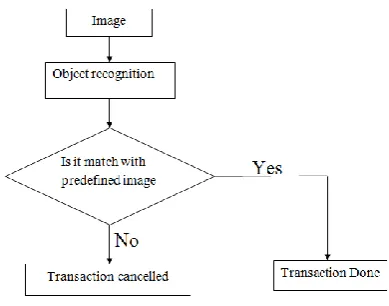
The billing of face recognization is done by image processing. Here digital image processing means to compare the inbuilt images, if it matches LCD or PC shows transaction is done, otherwise the transaction is cancelled.
The billing of products is done automatically by an RFID reader.The RFID reader scans the product and price of the product. RFID is used to maintain the database and billing system. In the proposed system, the RFID reader scans the product and it generates the bill and which is stored in microcontroller memory, and transfers to the main computer at the billing section. Here, the generated bill is shown in the system and the inbuilt image is compared and whether the image scanned is matched, the transaction is done, otherwise the transaction is cancelled.
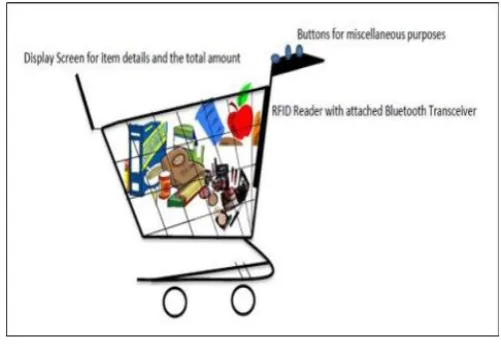
Fig.1 Products in the smart cart
BLOCK DIAGRAM:
COMPONENTS:
1. ARDUINO UNO ATMEGA 328:
Arduino is open source computer hardware and it is single-board microcontroller.12v power supply is given to both Arduino. Coordinates with the RFID reader, HC05 Bluetooth, IOT module, and LCD touch screen to perform computing functions.
2. RFID READER:
RFID –Radio Frequency Identification.
RFID technology allows several times to be quickly scanned and enables fast identification of a particular product, even when it is surrounded by several other items. RFID technology may be used in a variety of applications including passports, smart cards, airplane luggage, toll booth passes and home appliances. The RFID tag can be attached to each product which is placed in a smart shopping cart, can be read automatically by cart equipped with an RFID reader. As a result, the billing can be conducted from the cart itself. We use a UHF RFID reader, which allows a reading range up to 10 m. By tuning the transmission power of the reader, we can control its reading range.[1]
3. LIQUID CRYSTAL DISPLAY (LCD):
Display product information, possible navigation choices, billing information, and coupons, etc.
4. IOT MODULE:
An IOT module is a small electronic device embedded in objects, machines and things that connect to wireless networks and sends and receives data.
5. PERSONAL COMPUTER:
The PC is used for Digital Image Processing. The PC is connected to a communication port of Arduino. Here digital image processing means to compare the inbuilt images, if it matches LCD or PC shows transaction is done, otherwise the transaction is cancelled.
Fig. 3 Trolley path identification section
6. HC05 BLUETOOTH:
HC05 Bluetooth is an easy to use Bluetooth SPP (Serial Port Protocol) module, designed for transparent wireless serial connection setup.
Bluetooth is connected with smart cart. It transmits the data to the smart cart which entered into the mobile phone. The cart responds to the received data and moves to the corresponding product location.
FLOWCHART FOR TROLLEY MOVING:
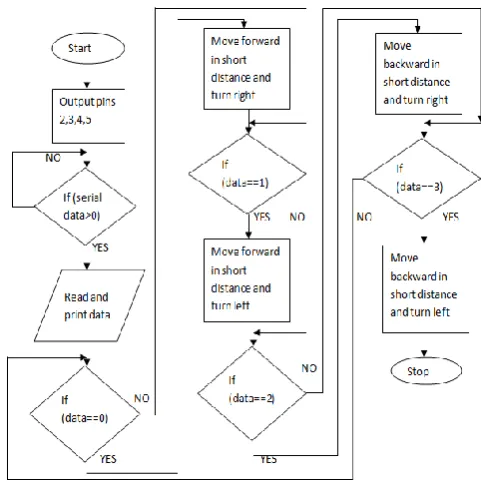
Fig. 4 Flow chart for Cart movement
In Trolley, there are two motors fixed and the Bluetooth is also connected with trolley. The trolley receives the data from smart phones. Bluetooth sends the data to the motor drive. The motor driver sends the signal to the motor 1 and 2 fixed in the wheels. The Arduino digital pins 2,3,4 and 5 are used. There are four cases,
Case 1: if data==0
The trolley moves forward in short distance and turns right.
Case 2: if data==1
The trolley moves forward in short distance and turns left.
Case 3: if data==2
The trolley moves backward in long distance and turns right.
The trolley moves backward in long distance and turns left.
PAYMENT SECTION:
Fig. 5 Flow chart for Payment
ALGORITHM:
K Nearest Neighbors - Classification
K nearest neighbors is a simple algorithm that stores all available cases and classifies new cases based on a similarity measure (e.g., distance functions). KNN has been used in statistical estimation and pattern recognition already in the beginning of 1970’s as a non-parametric technique. A case is classified by a majority vote of its neighbors, with the case being assigned to the class most commonly amongst its K nearest neighbors measured by a distance function. If K = 1, then the case is simply assigned to the class of its nearest neighbor.-
It should also be noted that all three distance measures are only valid for continuous variables. In the instance of categorical variables the Hamming distance must be used. It also brings up the issue of standardization of the numerical variables between 0 and 1 when there is a mixture of numerical and categorical variables in the dataset.
Choosing the optimal value of K is best done by first inspecting the data. In general, a large K value is more precise as it reduces the overall noise but there is no guarantee. Cross-validation is another way to retrospectively determine a good K value by using an independent dataset to validate the K value. Historically, the optimal K for most datasets has been between 3-10. That produces much better results than 1NN
Example:
Consider the following data concerning credit default. Age and Loan are two numerical variables (predictors) and Default is the target.
Fig. 6 Data concerning credit graph
We can now use the training set to classify an unknown case (Age=48 and Loan=$142,000) using Euclidean distance. If K=1 then the nearest neighbor is the last case in the training set with Default=Y.
D = Sqrt[(48-33)^2 + (142000-150000)^2] = 8000.01 >> Default=Y
Table.1 Euclidean Distance
With K=3, there are two Default=Y and one Default=N out of three closest neighbors. The prediction for the unknown case is again Default=Y.
STANDARDIZED DISTANCE:
One major drawback in calculating distance measures directly from the training set is in the case where variables have different measurement scales or there is a mixture of numerical and categorical variables. For example, if one variable is based on annual income in dollars, and the other is based on age in years, then income will have a much higher influence on the distance calculated. One solution is to standardize the training set as shown below.
Table.2 Standardized Distance
Using the standardized distance on the same training set, the unknown case returned a different neighbor, which is not a good sign of robustness.
IV. CONCLUSION
In this paper, we propose a secure smart shopping system using RFID technology. We detail the complete design of this system and build a prototype to test its functions. We believe that the stores will be covered by the automated cart moving system. Our future research will focus on improving the current system by reducing the higher efficiency. It is reliable and fair technology. It reduces the customers stress and this system shows the location of the particular items in a short period. The cart automatically moves when the name of the item is entered in the mobile phone application connected via Bluetooth. The aim of this paper is to reduce the customer stress, time and to avoid long queue at the billing section.
REFERENCES
1. Ruinian Li, Tianyi Song, Nicholas Capurso, Jiguo Yu, Jason Couture and Xiuzhen Cheng, Fellow “IOT Applications on Secure Smart Shopping System” in IEEE Internet of Things, vol.4, no.6, December 2017.
2. Z. Ali and R. Sonkusare, “RFID Smart Shopping and Billing” in IJARCCE , vol.2, no.12 in 2013.
3. Muhib A. Lambay “Automated Billing Cart” in International Journal of Computer Science Trends and Technology (IJCST) – vol 5 no.2, Mar – Apr 2017.
4. T. Shanmugapriyan, “Smart cart to recognize objects based on user intention,” Int. J. Adv. Res. Comput. Commun. Eng., vol. 2, no. 5, 2013, pp. 2049–2053.
5. R. Kumar, K. Gopalakrishna, and K. Ramesha, “Intelligent shopping cart,” Int. J. Eng. Sci. Innov. Technol., vol. 2, no. 4, pp. 499–507, 2013.
6. S. Gupta et al., “Arduino based smart cart,” Int. J. Adv. Res. Comput. Eng. Technol., vol. 2, no. 12, pp. 3083–3090, 2013.