Volume-7 Issue-2
International Journal of Intellectual Advancements
and Research in Engineering Computations
Smart parking system based on NFC
N.Nasurudeen Ahamed
1, S.Priyanga
2, T.Ramyapriya
2, K.Reeta
2, S.Sangavi
21
Assistant Professor, Dept of computer Science Engineering, Vivekanandha College of Engineering for
Women, Tamilnadu, India
2
U.G Scholar, Dept of computer Science Engineering, Vivekanandha College of engineering for women,
Tamilnadu, India
ABSTRACT
All people want to improve their quality of life and this can be achieved only by technology. Many problems are faced by daily vehicle users in payment based parking systems, both in open air p arking system where the parking is done along the streets and in closed parking system where parking is done in closed infrastructure added with entry and exit points. Delays (long queues) and accuracy in fares are the main problems faced by the users. Many solutions are proposed to solve this problem but all have their own drawbacks. In this paper a new solution is proposed based on Near Field Communication (NFC) which makes the payment system reliable and easy.
Keywords:
NFC, Closed parking, Open parking, Parking Payment.INTRODUCTION
Near Field Communication (NFC) is a wireless communication technology which operates at a frequency of 13.56MHz and transceives the data between two NFC enabled devices within few centimeters at the rate of 424Kbps. NFC is an advanced version of Radio Frequency Identification (RF-ID) and which combines the operation of both smartcard and reader.
Generally NFC applications are based on smart phones enabled with NFC technology. Nowadays many smart phones are enabled with NFC technology. Some applications of NFC are purchasing travel ticket and its payment, as electronic keys for vehicles and houses, as identification device combined with a smart phone. Since NFC is a short range communication technology, it can be assured that this technology is more secured when compared with other communication mechanisms such as radio frequency identification, infrared and Bluetooth.
Two different communication modes are there in NFC namely active and passive communication mode. An active mode device generates its own RF field whereas a passive mode device has to be powered by using the RF field of an active mode device and data transfer will be done by using load modulation.
EXISTING SYSTEM
Some of the existing system used RFID technology. Thus every car has to be provided RFID tags and RFID reader at parking space and other existing system uses GSM and INFRARED technology.
All this appliances becomes very much expensive, hence our paper overcomes this problem as it uses android application. Moreover our system depends on the QR code which is an alternative for the existing system which is based on RFID tags. QR code reduces the data space in database; it also reduces the cost of as compared to other existing system.
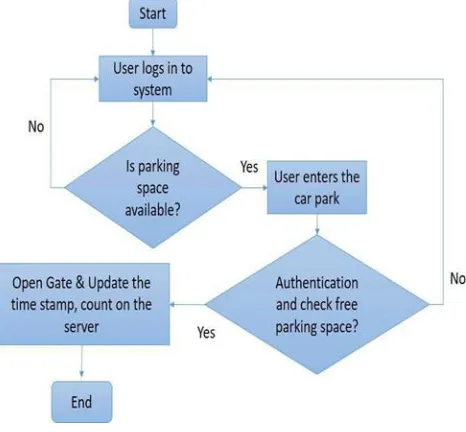
Fig 2.1 System operations for parking entry
PROPOSED SYSTEM
Approach to system operations for parking entry Firstly, the user is required to book a slot parking lot convenient to him by logging in or by creating an account on the ParkZapp website or the android application. He is then requested to provide his/her NFCID which is a unique ID associated with each NFC enabled device. After providing said information the user needs to book a slot as per the availability of slots. Once this is done, the user‟s NFCID will have been added to the database and its authentication would be complete.
When the user enters the parking lot he/she is required to flash his NFC enabled device at the NFC reader. At this point the system checks if the NFCID exists in the database, if it does the gat opens and the time stamp is noted and the user can proceed further to his convenient parking space and the count of the available parking lots will be updated accordingly. If the NFCID doesn‟t already
exist in the database, the user will not be allowed to enter the parking lot.
Approach to system operations for parking
exit
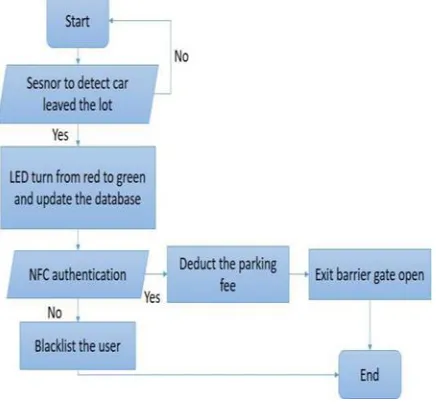
Once the Customer is done parking he/she will be prompted to proceed to the exit gate and the availability database will be updated accordingly. The user will have to flash his/her NFCID at the exit gate too. Upon this the NFCID will be again be checked in the database. If it already exists, the gate will open and the database entry of the NFCID will be deleted. This will ensure that the user books the slot again whenever needed. If the NFCID is not found in the database, the user will be blacklisted and suitable actions will be taken. [3] Timestamp will again be noted when the user flashes the NFCID again at the exit gate. The entry and the exit timestamp will be used to calculate the fare and the user will be prompted to pay the amount before the gates are opened.
Fig 3.2 system operations for parking exit
NFC is a method of wireless data transfer that detects and then enables technology in close proximity to communicate without the need for an internet connection. It's easy, fast and works automatically. NFC-enabled devices can act as electronic identity documents and key cards. NFC's short range and encryption support make it more suitable than less private RFID systems. However, in case of a QR code, the mobile device‟s camera can scan a code or QR can be displayed on phone and scanned by POS
In order to get a perspective and ideas we explored several research papers which helped us get valuable inputs on the current parking systems and their suggested solutions. The first research paper, namely „A Cloud-Based Smart- Parking System Based on Internet-of-Things Technologies‟ introduces a novel algorithm that increases the efficiency of the current cloud-based smart-parking system and develops a network architecture based on the Internet-of- Things technology.
It proposed a system that helps users automatically find a free parking space at the least cost based on new performance metrics to calculate the user parking cost by considering the distance and the total number of free places in each car park. The simulation results in the paper show that the algorithm helps improve the probability of
successful parking and minimizes the user waiting time.
Another research paper that we explored, namely „Smart Parking Applications Using RFID Technology‟ helped us realize the various advantages it could present over the current parking system. For instance, ins and check-outs were handled in a fast manner without having to stop the cars so that traffic jam problem would be avoided during these processes, drivers would not have to stop at the circulation points and parking tickets would be out of usage during check-ins and check-outs, ticket jamming problems for the ticket processing machines could be avoided, vehicle owners wouldn‟t have to make any payments at each check-out thus a faster traffic flow would be possible. Also, since there wouldn‟t be any waiting during check-ins and check-outs the formation of emission gas as a result of such waiting would be avoided. The research paper also included an atomized income tracking system, a car tracking system for charging and a central parking-car tracking system.
again on the way out to complete payment. Arduino microcontroller was used as the brain of the system and control the input/output of the system. Furthermore, vehicle searching function was included, which helps customers to locate their vehicle when forgotten.
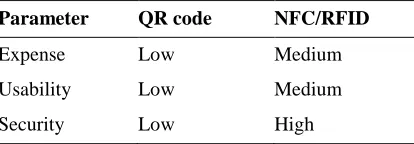
Table 3.1
Table highlights the main advantages and disadvantage of NFC which at the moment limits
the number of NFC-enabled mobile phones, while QR Code can be read with any camera-enabled mobile phone. Also, QR codes can be printed on an ordinary piece of paper using basic tools such as a printer and can be used accordingly. Whereas, NFC requires special devices to write on them. The comparison between QR code and NFC/RFID is shown as below.
IMPLEMENTATION
NFC is a method of wireless data transfer that detects and then enables technology in close proximity to communicate without the need for an internet connection. These parameters are better than zigbee,so we moved to NFC method its coverage is upto 4-10 cm and RFID is 0-3m.Transmission rate is 0.02-4mbps and RFID is 0.02-4mbps. The operational frequency is 13.56mhz and in RFID is 13.56mhz. Network topology are one to one in NFC as same as RFID method. Usability of NFC and RFID are easy and human centric.
When vehicle enters into the parking area user simply open the NFC in the mobile phone and select the reader mode, wait until the parking information get dumped inside the label. After then they may park and can leave. Whenever vehicle is parked in a parking area, the ultrasonic sensor detects the vehicle and the detection signal information is send to the small chip and then form the chip to the PC and the data is stored in the database this information is send to LCD display, it shows that the parking space is full or occupied.
By using the Dijkstra algorithm, there should be a guide for security of the vehicle and also to show the shortest path to find the vehicle and which increases in cost and complexity. To reduce the cost and decrease the complexity of operations NFC tag and the stickers are used for easy parking
and reverse searching of vehicles. For the purpose of security we are using DC motors to reduce the theft occurred in parking area.
LITERATURE SURVEY
NFC-enabled devices can act as electronic identity documents and key cards. NFC's short range and encryption support make it more suitable than less private RFID systems. However, in case of a QR code, the mobile device‟s camera can scan a code or QR can be displayed on phone and scanned by POS.In order to get a perspective and ideas we explored several research papers which helped us get valuable inputs on the current parking systems and their suggested solutions.
The first research paper, namely „A Cloud-Based Smart- Parking System Cloud-Based on Internet-of-Things Technologies‟ introduces a novel algorithm that increases the efficiency of the current cloud-based smart-parking system and develops a network architecture based on the Internet-of- Things technology.
It proposed a system that helps users automatically find a free parking space at the least cost based on new performance metrics to calculate the user parking cost by considering the distance and the total number of free places in each car park. The simulation results in the paper show that the algorithm helps improve the probability of successful parking and minimizes the user waiting Parameter QR code NFC/RFID
Expense Low Medium
Usability Low Medium
time.The next research paper, „iParker-A New Smart Car-Parking System Based on Dynamic Resource Allocation and Pricing‟ speaks about a new smart parking system that is based on intelligent resource allocation, reservation, and pricing.
The proposed system solves the current parking problems by offering guaranteed parking reservations with the lowest possible cost and searching time for drivers and the highest revenue and resource utilization for parking managers.
New fair pricing policies were also proposed that can be implemented in practice. The new system was based on mathematical modelling using mixed-integer linear programming (MILP) with the objective of minimizing the total monetary cost for the drivers and maximizing the utilization of parking resources.
Malicious and selfish nodes are the ones which construct the attacks. The attacks are usually caused in physical, data link, network, and application layer.
Routing protocols commonly exhibited to two types of attacks active and passive attacks. Nodes that perform attacks with the intention to damage other nodes by stimulating a network breakdown are called as activeNFC-enabled devices can act as electronic identity documents and key cards. NFC's short range and encryption support make it more suitable than less private RFID systems. However, in case of a QR code, the mobile device‟s camera can scan a code or QR can be displayed on phone and scanned by POS.
In order to get a perspective and ideas we explored several research papers which helped us get valuable inputs on the current parking systems and their suggested solutions. The first research paper, namely „A Cloud-Based Smart- Parking System Based on Internet-of-Things Technologies‟ introduces a novel algorithm that increases the efficiency of the current cloud-based smart-parking system and develops a network architecture based on the Internet-of- Things technology.
It proposed a system that helps users automatically find a free parking space at the least cost based on new performance metrics to calculate the user parking cost by considering the distance and the total number of free places in each car park.
The simulation results in the paper show that the algorithm helps improve the probability of successful parking and minimizes the user waiting time.The next research paper, „iParker-A New Smart Car-Parking System Based on Dynamic Resource Allocation and Pricing‟ speaks about a new smart parking system that is based on intelligent resource allocation, reservation, and pricing.
The proposed system solves the current parking problems by offering guaranteed parking reservations with the lowest possible cost and searching time for drivers and the highest revenue and resource utilization for parking managers. New fair pricing policies were also proposed that can be implemented in practice.
The new system was based on mathematical modelling using mixed-integer linear programming (MILP) with the objective of minimizing the total monetary cost for the drivers and maximizing the utilization of parking resources.
CONCLUSION
The results from the implemented system are now represented and analysed. Initially the scanning time for QR codes is represented. The illumination settings are categorized in to three categories. High with 60 lx, Medium 30lx and Low 10lx. The time taken for scanning in a highly illuminated environment is less when compared to low lit environment. In comparison with QR code scanning, NFC tags achieved a relatively lesser time.
The following figure shows the scanning time of NFC tags with different materials. The average time taken for a test which had 25 scans for each material. scans for each material is given in the Figure. It is clear that NFC is more stable than QR codes.
codes. It is inferred that NFC technology works on the basis of RFID technology which uses magnetic field induction as a medium to establish communication between electronic devices placed closely and operating at 13.56 MHz as it is unlicensed frequency and can transmit data at a maximum rate of 424kbps.
FUTURE SCOPE
In future, we describe an automatic system for car parks payment based on Near Field Communication technology. The developing system will allow users to use their own mobile phone both as an electronic ticket to enter and exit
the parking and as an electronic wallet to pay automatically for it. To fully implement this system, four applicative protocols will have to be developed: two protocols manage the entrance and the exit operations for close parks, while the other two manage the interaction of the user, enabling respectively the load of the money on the phone and the cash payment. The underlying structure of the system foresees the presence of the corresponding softwares performing the protocol operations and interacting directly with the NFC memory of the phone for the read/write tasks, and of a database collecting all the information concerning the presence and the payment of the users.
REFERENCES
[1]. Khanna, R. Anand. 2016. IoT based Smart Parking System. In: 2016 International Conference on Internet of Things and Applications (IOTA), Pune, India.
[2]. Z. Pala, N. Inac. 2007. Smart Parking Applications using RFID Technology. In: RFID Eurasia, 2007 1st Annual, Istanbul, Turkey.
[3]. L. Mainetti, L. Patrono, M. L. Stefanizzi, R. Vergallo. 2015. A smart Parking System based on IoT Protocols
and emerging enabling technologies. In: 2015 IEEE 2nd World Forum on Internet of Things (WF-IoT), Milan, Italy.
[4]. Kevin Curran, Amanda Millar, Conor Mc Garvey, “Near Field Communication”, International Journal of Electrical and Computer Engineering (IJECE), 2(3), 2012, 371-382.
[5]. Dr. Shyam Thangaraju, (2013) “Near Field Communication in Medical Devices”, White Paper, 2013. [6]. Florian Michahelles, Frederic Thiesse, Albrecht Schmidt, John R. Williams, "Pervasive RFID and Near Field
Communication Technology," IEEE Pervasive Computing, 6(3), 2007, 94-96, c3.
[7]. Jorma Ylinen, Mikko Kostela, Lari Iso-Anttila and Pekka Loula, “Near Field Communication Network Services”, Third International Conference on the Digital Society, Cancun, Mexico, February 1-7, 2009, 89-93.
[8]. V. Coskun, N, Ozdenizci & K. Ok. 2013. A Survey on Near Field Communication Technology, Wireless Pers Communication.
[9]. M. Vazquez-Briseno, F. I. Hirata, Juan de Dios Sanchez-Lopez, E. Jimenez-Garcia, C. Navarro-Cota and J. I. Nieto-Hipolito. 2012. Using RFID/NFC and QR-Code in Mobile Phones to Link the Physical and the Digital World, Interactive Multimedia, In Tech.
[10]. NFC Forum-SmartPoster RTD 1.0 Smart Poster Record Type Definition Technical Specification. NFC Forum, 2006. [3] Near Field Communication and the NFC Forum: The Keys to Truly Interoperable Communications. NFC Forum, 2007.
[11]. Near Field Communication in the real world: turning the NFC promise into profitable, everyday applications. Innovision Group, 2007.