www.theoryofcomputing.org
S
PECIAL ISSUE IN HONOR OFR
AJEEVM
OTWANIAn
O(k
3
log
n)
-Approximation Algorithm for
Vertex-Connectivity Survivable
Network Design
∗
Julia Chuzhoy
†Sanjeev Khanna
‡Received: August 13, 2010; published: August 17, 2012.
Abstract: In the Survivable Network Design Problem (SNDP), we are given an undirected graphG(V,E)with costs on edges, along with an integer connectivity requirementr(u,v)for each pairu,vof vertices. The goal is to find a minimum-cost subsetE∗of edges such that in the subgraph ofGinduced byE∗, each pairu,vof vertices isr(u,v)-connected. In the edge-connectivity version, a pairu,visr(u,v)-connected if there arer(u,v)edge-disjoint paths betweenuandv. Similarly, in thevertex-connectivity version, a pairu,visr(u,v)-connected if there arer(u,v)vertex-disjoint paths betweenuandv. The edge-connectivity version of SNDP is known to have a factor 2 approximation. However, no non-trivial approximation algorithm has been known so far for the vertex version of SNDP, except for special cases of the problem.
We present an extremely simple randomized algorithm that achieves anO(k3log|T|) -approximation for this problem, wherekdenotes the maximum connectivity requirement, and
∗A preliminary version of this paper appeared in the 50th Annual IEEE Symposium on Foundations of Computer Science
(FOCS), 2009.
†This research was supported in part by NSF CAREER award CCF-0844872 and Sloan Research Fellowship.
‡This research was supported in part by a Guggenheim Fellowship, an IBM Faculty Award, and by NSF Award CCF-0635084.
ACM Classification:F.2.2, G.1.6
AMS Classification:68Q25, 68W20, 68W25
T is the set of vertices that participate in one or more pairs with non-zero connectivity require-ments. We also give a simple proof of the recently discoveredO(k2log|T|)-approximation algorithm for the single-source version of vertex-connectivity SNDP. Our results establish a natural connection between vertex-connectivity and a well-understood generalization of edge-connectivity, namely,element-connectivity, in that an instance of vertex-connectivity SNDP can be reduced to a small number of instances of the element-connectivity SNDP.
1
Introduction
In the Survivable Network Design Problem (SNDP), we are given an undirected graphG(V,E)with costs on edges, and an integer connectivity requirementr(u,v)for each pairu,vof vertices. The goal is to find a minimum cost subsetE∗of edges such that each pair(u,v)of vertices is connected byr(u,v)paths in the subgraph induced byE∗. In the edge-connectivity version (EC-SNDP), these paths are required to be edge-disjoint, while in the vertex-connectivity version (VC-SNDP), they are required to be vertex-disjoint. It is not hard to show that EC-SNDP can be cast as a special case of VC-SNDP (see the full version of [8]). We denote bynthe number of vertices in the graph and bykthe maximum pairwise connectivity requirement,k=maxu,v∈V{r(u,v)}. We also define a subsetT ⊆V of vertices calledterminals: a vertex u∈T iffr(u,v)>0 for some vertexv∈V.
Even for k=1, both VC-SNDP and EC-SNDP are known to be APX-hard [2]; in fact the two problems are equivalent fork=1, and this special case is commonly referred to as the minimum Steiner Forest problem.
1.1 Vertex-Connectivity SNDP
While a celebrated result of Jain [15] gives a 2-approximation algorithm for EC-SNDP, no non-trivial approximation algorithms are known for VC-SNDP, except for restricted special cases. Agrawal et al. [1] showed a 2-approximation algorithm for the special case when the maximum connectivity requirement
k=1, that is, the minimum Steiner Forest problem. Fork=2, a factor 2-approximation algorithm was given by Fleischer [11]. Thek-vertex connected spanning subgraph problem, a special case of VC-SNDP where for allu,v∈V r(u,v) =k, has been studied extensively. Cheriyan et al. [6,7] gave anO(logk)-approximation algorithm for this case whenk≤p
n/6, and anO(pn/ε)-approximation algorithm fork≤(1−ε)n. For largek, Kortsarz and Nutov [18] improved the preceding bound to an
O(logk·min{√k,log(k)·n/(n−k)})-approximation. Fakcharoenphol and Laekhanukit [10] improved it to anO(lognlogk)-approximation, and further obtained anO(log2k)-approximation fork<n/2. Very recently, Nutov [22] obtained the best currently known approximation algorithm for the problem that gives an approximation ratio ofO(logk·log(n/(n−k)).
Kortsarz et al. [17] showed that VC-SNDP is hard to approximate to within a factor of 2log1−εnfor any ε>0, unlessNP⊆DTIME npolylog(n), whenkis polynomially large inn, that is,k=Ω(nδ)for some constantδ>0. This result was subsequently strengthened by Chakraborty et al. [3] to akε-hardness for all
k≥3. In particular, when each connectivity requirementr(u,v)∈ {0,3}, the best known approximation factor is polynomially large ( ˜O(n)to best of our knowledge) while only an APX-hardness is known. The main result of our paper is anO(k3log|T|)-approximation algorithm for VC-SNDP.
We note that subsequent to this work, Nutov [23] has obtained an O(k4log2|T|)-approximation algorithm for the more general version of VC-SNDP, where the costs are on vertices (instead of edges), and the goal is to find a minimum cost subsetV∗of vertices such that all vertex-connectivity requirements are satisfied in the subgraph induced byV∗.
Single-Source VC-SNDP A special case of VC-SNDP that has received much attention recently is the single-source version. In this problem there is a special vertexscalled thesource, and all non-zero connectivity requirements involves, that is, ifu6=sandv=6 s, thenr(u,v) =0. Kortsarz et al. [17] showed that even this restricted special case of VC-SNDP is hard to approximate up to factorΩ(logn)unless
P=NP, and recently Lando and Nutov [20] improved this to(logn)2−ε-hardness of approximation for any
constantε>0, under the assumption thatNPdoes not have quasi-polynomial time Las-Vegas algorithms. We note that both results only hold whenkis polynomially large inn, that is,k=Ω(nδ)for some constant
δ >0. On the algorithmic side, Chakraborty et al. [3] gave ankO(k2)log4n-approximation algorithm for the problem. This result was later independently improved to anO(kO(k)logn)-approximation by Chekuri and Korula [4], and to anO(k2logn)-approximation by Chuzhoy and Khanna [8] and Nutov [24]. Subsequently, Chekuri and Korula [5] simplified the analysis of the algorithm of [8]. We note that for the uniform case, where all non-zero connectivity requirements arek, Chuzhoy and Khanna [8] show a slightly betterO(klogn)-approximation algorithm and the results of [5] extend to this special case. In this paper we give a simpleO(k2log|T|)-approximation algorithm for single-source VC-SNDP.
We note that subsequent to our work, Nutov [23] gave anO(klogk)-approximation algorithm for single-source VC-SNDP. Nutov also obtains an improved approximation guarantee ofO(k2log|T|)for single-source VC-SNDP when the costs are on vertices; the previous best known approximation ratio for this problem wasO(k8log2n)[8].
1.2 Element-Connectivity SNDP
A closely related problem to EC-SNDP and VC-SNDP is theelement-connectivitySNDP (Elem-SNDP). The input to Elem-SNDP is the same as for EC-SNDP and VC-SNDP. As before, we define the setT⊆V
of terminals to be vertices that participate in one or more pairs with a positive connectivity requirement. Given an Elem-SNDP instance, anelementis any edge or anynon-terminalvertex in the graph. We say that a pairs,tof vertices isk-element connectediff for every subsetXof at most(k−1)elements,
sandt remain connected by a path whenX is removed from the graph. In other words, there arek
element-disjoint paths connectingstot; these paths are allowed to share terminals. Another way to understand element-connectivity is to imagine that non-terminal vertices are placed on every edge, and a pairs,tisk-element connected iff there arekpaths fromstotthat do not share any non-terminal vertices. The goal in Elem-SNDP is to select a minimum-cost subsetE∗of edges, such that in the graph induced byE∗, each pairu,vof vertices isr(u,v)-element connected.
relationships do not hold, that is, if a pairs,tisk-edge connected, then it need not bek-element connected, and similarly, if a pairs,tisk-element connected, then it need not bek-vertex connected. Thus the notion of element-connectivity resides in between edge-connectivity and vertex-connectivity.
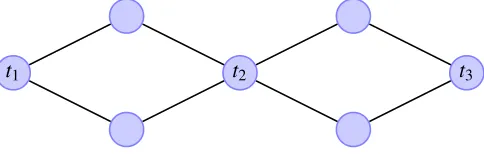
Elem-SNDP was introduced in [16] as a problem of intermediate difficulty between edge-connectivity and vertex-connectivity. Similar to edge-connectivity, element-connectivity istransitive, that is, for any three terminalst1,t2,andt3, ift1andt2arek-element connected, andt2andt3arek-element connected, thent1andt3arek-element connected as well. Note that this transitivity property does not hold for vertex connectivity, as illustrated inFigure 1fork=2.
t1 t2 t3
Figure 1: Each pair(ti,tj), 1≤i< j≤3 above is 2-element connected (and hence 2-edge connected). The pairs(t1,t2)and(t2,t3)are 2-vertex connected but the pair(t1,t3)is only 1-vertex connected.
Jain et al. [16] give a primal-dualO(logk)-approximation for this problem. Subsequently, Fleischer et al. [12] and Cheriyan et al. [7] gave a 2-approximation algorithm for Elem-SNDP via the iterative rounding technique, thus matching the 2-approximation guarantee of Jain [15] for EC-SNDP. We use the 2-approximation result for Elem-SNDP as a building block for our algorithms.
1.3 Our Results and Techniques
Our main result is as follows.
Theorem 1.1. There is a polynomial-time randomized O(k3log|T|)-approximation algorithm for VC-SNDP, where k is the largest pairwise connectivity requirement.
The proof of this result is based on a randomized reduction that maps a given instance of VC-SNDP to a family of instances of Elem-SNDP. As noted earlier, the notion of element-connectivity is strictly weaker than vertex-connectivity. Our result shows that, nonetheless, an instance of VC-SNDP can be reduced to a collection of Elem-SNDP instances.
Specifically, given an instance of VC-SNDP, our reduction createsO(k3log|T|)instances of Elem-SNDP, where each instance is defined over an identical copy of the original graph, but with different connectivity requirements. The connectivity requirements for each instance are a carefully selected
of theO(k3log|T|)instances created, and combine them to obtain the desired result. We note here that our reduction also works for the more general variation of VC-SNDP, where the costs are on vertices instead of edges, and the goal is to select a minimum-cost subsetV∗of vertices such that all connectivity requirements are satisfied in the subgraph induced byV∗.
Finally, we show that our ideas also yield a simple algorithm that gives anO(k2log|T|)-approximation for the single-source VC-SNDP problem.
Organization: We present the proof ofTheorem 1.1inSection 2. Section 3presents an alternative proof of theO(k2log|T|)-approximation result for single-source VC-SNDP. InSection 4we show a connection between our techniques and a well-studied notion in combinatorics and coding theory, namely, cover-free families. Using this connection we show that our bounds are essentially tight in that similar techniques cannot give significantly better approximation guarantees. Finally, we conclude inSection 5 with some directions for future work.
2
Algorithm for VC-SNDP
Recall that in VC-SNDP we are given an undirected graphG(V,E)with costs on edges, and an integer connectivity requirementr(u,v)for allu,v∈V. Additionally, we have a subsetT ⊆V of terminals, and
r(u,v)>0 only ifu,v∈T. The pairs of terminals with non-zero connectivity requirements are called
source-sink pairs. The goal is to select a minimum-cost subsetE∗⊆Eof edges, such that in the subgraph ofGinduced by E∗, denotedG[E∗], every pairu,vis r(u,v)-vertex connected. We denote by k the maximum connectivity requirement,k=maxu,v∈V{r(u,v)}, and we will use OPT to denote the cost of an optimal solution to the given VC-SNDP instance. Let(G,T,r)denote the input instance to VC-SNDP.
At a high-level, our algorithm is a polynomial-time randomized reduction from VC-SNDP to Elem-SNDP. Given an instance(G,T,r)of VC-SNDP, we create pidentical copies of our input graphG, say
G1,G2, . . . ,Gp, wherepis a parameter to be specified later. For each copyGi, we define a subsetTi⊆T of terminals. We then viewGi as an instance of element-connectivity SNDP, where the connectivity requirements are induced by the setTi of terminals as follows. For eachs,t∈Tithe new connectivity requirement is the same as the original one, and for all other pairs, the connectivity requirements are 0. Observe that for eachGi the cost of an optimal solution for the induced Elem-SNDP instance is at most OPT. We then apply the 2-approximation algorithm of [12,7] to each one of the pinstances of thek-element connectivity problem. LetEi denote the set of edges output by the 2-approximation algorithm on the instance defined onGi. Our final solution is ˜E=E1∪E2∪ · · · ∪Ep. Since any solution to the original VC-SNDP instance is also a feasible solution for each one of thepelement-connectivity instances created above, the cost of the solution above is bounded by 2p·OPT.
We now show that for p=O(k3log|T|), there exist subsetsT1,T2, . . . ,Tpsuch that the solution ˜E produced above is a feasible solution for VC-SNDP. Moreover, we show a simple randomized algorithm to create the setsT1,T2, . . . ,Tp.
following condition holds: for each subsetX⊆T\ {s,t}of size at most (k−1), there is a subsetTi, 1≤i≤p, such thats,t∈TiandX∩Ti=/0.
We show below that ak-resilient family of subsets exists forp=O(k3log|T|), and give a poly-time randomized algorithm to find such a family with high probability. We start by proving that such a family guarantees that the algorithm produces a feasible solution.
Lemma 2.2. Let{T1, . . . ,Tp}be a k-resilient family of subsets. For each1≤i≤p, let Eibe any feasible solution to the corresponding Elem-SNDP instance defined by Tion Gi, and letE˜ =
Sp
i=1Ei. ThenE is a˜ feasible solution to the input VC-SNDP instance.
Proof. Let(s,t)∈Mbe any source-sink pair, and letX⊆V\ {s,t}be any collection of at most(r(s,t)− 1)≤(k−1)vertices. It is enough to show that the removal ofX from the graphG[E˜]does not separates
fromt. LetX0=X∩T. Since{T1, . . . ,Tp}is ak-resilient family of subsets, there is someTi such that s,t∈TiwhileTi∩X0=/0. ThenXis a set of non-terminal vertices with respect toTi. Recall that setEiof edges defines a feasible solution to the element-connectivity SNDP instance corresponding toTi. Sinces isr(s,t)-element connected totin the graphG[Ei], the removal of setX from the graphG[Ei]can not disconnectsfromt.
We now show how to construct ak-resilient family of subsets{T1, . . . ,Tp}. Letp=128k3log|T|, and setq=p/(2k) =64k2log|T|. Each terminalt∈T selectsqrandom indices uniformly and independently from the set{1,2, . . . ,p}(repetitions are allowed). Let φ(t)denote the set of indices chosen by the terminalt. For each 1≤i≤p, we then defineTi={t|i∈φ(t)}.
Lemma 2.3. With high probability, the resulting family{T1, . . . ,Tp}of subsets is k-resilient. Proof. We extend the definition ofφ()to an arbitrary subsetZof vertices by defining
φ(Z) = [
t∈Z∩T φ(t).
Fix any source-sink pair(s,t). Let X be an arbitrary set of at most (k−1) terminals that does not include s ort. Note that |φ(X)| ≤(k−1)q<p/2. We say that the bad event E1(s,t,X) occurs if |φ(s)∩φ(X)| ≥3q/4. The expected value of|φ(s)∩φ(X)|is at mostq/2 since at least half the indices in{1,2, . . . ,p}are disjoint fromφ(X). Now using Chernoff bounds (see page 72 in [21])
Pr[E1(s,t,X)]≤Pr
|φ(s)∩φ(X)| ≥
1+1 2
q
2
≤e−q2·( 1 2)2·
1 4 ≤e−
q
32.
We say that thebad eventE2(s,t,X)occursifφ(s)∩φ(t)⊆φ(X). We say that the setX is abad setfor a pair(s,t)if the eventE2(s,t,X)occurs. Note that if there is no bad setXof size at most(k−1)for every pair(s,t)∈M, then{T1, . . . ,Tp}is ak-resilient family.
We observe that if eventE1(s,t,X)does not happen, then|φ(s)\φ(X)| ≥q/4, so
Pr h
E2(s,t,X)
E1(s,t,X) i
≤
1−q/4
p q
≤e−q
2
Thus we can bound the probability of the eventE2(s,t,X)as follows: Pr[E2(s,t,X)] = Pr[E2(s,t,X)|E1(s,t,X)]Pr[E1(s,t,X)] +Pr
h
E2(s,t,X)
E1(s,t,X) i
Pr h
E1(s,t,X) i
≤ Pr[E1(s,t,X)] +Pr h
E2(s,t,X)
E1(s,t,X) i
≤ e−32q +e−
q
8k
< |T|−4k.
Hence, using the union bound, the probability that some bad setX of at most(k−1)terminals exists for any pair(s,t)can be bounded by|T|−2k. The lemma follows.
Combining Lemmas2.2and2.3, we thus obtain the following theorem.
Theorem 2.4. Given a VC-SNDP instance(G,T,r), there is a polynomial-time randomized algorithm that creates p=O(k3log|T|) instances of Elem-SNDP, say(G1,T1,r1),(G2,T2,r2), . . . .,(Gp,Tp,rp), such that with high probability the following holds: if we are given, for each1≤i≤p, any feasible solution Eito the Elem-SNDP instance(Gi,Ti,ri), then
Sp
i=1Eiis a feasible solution to the VC-SNDP instance
(G,T,r). Moreover, for1≤i≤p, the graph Gi=G, Ti⊆T , and the requirement function riis obtained by restricting r to Ti.
Our main result follows as an easy corollary.
Corollary 2.5. There is a randomized O(k3log|T|)-approximation algorithm for VC-SNDP.
Proof. With probability at least 1− |T|−2k, the algorithm above generates a feasible solution for the given VC-SNDP instance. We can verify the feasibility of the generated solution by performing a max-flow computation for each source-sink pair. If the solution is not feasible, then we can use the trivial solution that solves optimally for each source-sink pair (a min-cost flow computation) and outputs union of all pairwise solutions. The cost of this trivial solution is at most|T|2·OPT. Thus the expected approximation ratio of the combined algorithm is bounded by
1− 1
|T|2k
O(k3log|T|) +
1 |T|2k
|T|2=O(k3log|T|).
Remark 2.6. We note that this result implies that the standard set-pair relaxation for VC-SNDP [13] has an integrality gap ofO(k3log|T|). This follows from the fact that the 2-approximation result of [12,7] also establishes an upper bound of 2 on the integrality gap of the set-pair relaxation for element-connectivity. We also note that a lower bound of ˜Ω(k1/3)is known on the integrality gap of the set-pair relaxation for VC-SNDP [3].
3
Algorithm for Single-Source VC-SNDP
In this section we show that anO(k2log|T|)-approximation algorithm can be easily achieved using the above ideas for the single-source version of VC-SNDP.
Recall that the input to the single-source VC-SNDP is a graphG(V,E)with a special vertexscalled the source, and a subsetT of terminals, where for eacht∈T, we are given a connectivity requirement
r(s,t)≤k. We assume without loss of generality thats6∈T. The goal is to select a minimum-cost subset
E∗⊆Eof edges, such that in the induced subgraphG[E∗], every terminalt∈T isr(s,t)-vertex connected tos. This is clearly a special case of VC-SNDP, where all source-sink pairs are of the form{(s,t)}t∈T. As before, we create a family{T1, . . . ,Tp}of subsets of terminals, Ti⊆T for all 1≤i≤p. We also createpidentical copies of our input graphG, sayG1, . . . ,Gp. For eachGiwe solve the single-source element-connectivity SNDP instance with connectivity requirements induced by terminals inTi. LetEi be the 2-approximate solution to instanceGi. Our final solution is ˜E=Spi=1Ei. Clearly, the cost of the solution is at most 2p·OPT.
Definition 3.1. A family{T1, . . . ,Tp}of subsets of terminals isweakly k-resilientiff for each terminal t∈T, for each subsetX⊆T\ {t}of at most(k−1)terminals, there isi: 1≤i≤p, such thatt∈Tiand X∩Ti=/0.
Lemma 3.2. Let{T1, . . . ,Tp}be a weakly k-resilient family of subsets. For each1≤i≤p, let Eibe any feasible solution to the corresponding Elem-SNDP instance defined by Ti on Gi, and letE˜ =
Sp
i=1Ei. ThenE is a feasible solution to the input VC-SNDP instance.˜
Proof. Lett∈T and letX⊆V\ {s,t}be any subset of at mostr(s,t)−1≤(k−1)vertices excludings
andt. It is enough to prove that the removal ofX from the graphG[E˜]does not disconnectsfromt. Let
X0=X∩T. Since{T1, . . . ,Tp}is a weaklyk-resilient family, there is somei, 1≤i≤p, such thatt∈Ti andTi∩X0=/0. Consider the solutionEi to the correspondingk-element connectivity instance. Since vertices ofX are non-terminal vertices for the instanceGi, their removal from the graphG[Ei]does not disconnectsfromt.
We now show a randomized algorithm for constructing a weaklyk-resilient family of subsets. Let
p=4k2log|T|andq=p/(2k) =2klog|T|. Each terminalt∈Tselectsqindices from the set{1,2, . . . ,p} uniformly at random with repetitions. Letφ(t)denote the set of indices chosen by the terminalt. For each 1≤i≤p, we then defineTi={t|i∈φ(t)}.
Lemma 3.3. With high probability, the resulting family of subsets{T1, . . . ,Tp}is weakly k-resilient. Proof. Lett∈T be any terminal and letX be any subset of at mostr(s,t)−1≤(k−1)terminals. As before, we extend the functionφ to an arbitrary subsetZof vertices by definingφ(Z) =St∈Z∩Tφ(t). We say thatbad eventE(t,X)occursiffφ(t)⊆φ(X). The probability of the eventE(t,X)is at most
1−kq
p q
=
1 2
q
≤ |T|−2k.
Therefore, by union bound, the probability that the eventE(t,X)happens for some terminaltand a setX
Combining Lemmas3.2and3.3, we obtain the following corollary.
Corollary 3.4. There is a randomized O(k2log|T|)-approximation algorithm for single-source VC-SNDP.
Proof. With probability at least 1− |T|−k, the algorithm above generates a feasible solution for the given single-source VC-SNDP instance. We can verify the feasibility of the generated solution by performing a max-flow computation for each source-terminal pair. If the solution is not feasible, then we can use the trivial solution that solves optimally for each source-terminal pair (a min-cost flow computation) and outputs union of all pairwise solutions. The cost of this trivial solution is at most|T| ·OPT. Thus the expected approximation ratio of the combined algorithm is bounded by
1− 1
|T|k
O(k2log|T|) +
1 |T|k
|T|=O(k2log|T|).
4
Resilient and cover-free families
The notion of ak-resilient and weaklyk-resilient families is closely related to a well-studied notion in coding theory and combinatorics, namely,cover-freefamilies of sets. A familyFof sets over a universe
U={1,2, . . . ,p}is said to ber-cover-freeif for all distinctA,S1, . . . ,Sr∈F, it satisfies the property that A6⊆Sr
j=1Sj. This is precisely the property underlying our construction of a weaklyk-resilient family. In particular,{T1,T2, . . . ,Tp}is weaklyk-resilient iffF={φ(t)|t∈T}is a(k−1)-cover-free family.
LetN(r,λ)denote the smallest integerpsuch that there exists anr-cover-free family withλ sets over a universe ofpelements. It is easy to see that the smaller the valueN(r,λ), the better the approximation guarantee achieved by the algorithm ofSection 3. A classical result of Dyachkov and Rykov [9] (see the note by Füredi [14] for a simple proof of this lower bound result) shows that
N(r,λ) =Ω
r2logλ logr
.
An immediate corollary of this result is that for any weaklyk-resilient family for a setT of terminals, the parameterpmust be
Ω
k2log|T| logk
.
Thus the bound achieved by the simple randomized construction given inLemma 3.3is tight to within an
O(logk)factor.
two distinct polynomials inFq,d can agree on at mostdpoints. Since the size of the underlying universe Uisp=q2and|F|=Ω(qd), we get a deterministic construction for a weaklyk-resilient family with
p=O
k2log2|T|
log2(klog|T|)
.
A natural generalization ofr-cover-free family is a (w,r)-cover-free family that is defined as fol-lows. A familyFof sets over a universeU={1,2, . . . ,p}is said to be(w,r)-cover-freeif for all any
A1,A2, . . . ,Aw∈F and any other S1, . . . ,Sr∈F, it satisfies the property that
Tw
i=1Ai6⊆
Sr
j=1Sj. It is easy to see that{T1,T2, . . . ,Tp}isk-resilient iffF={φ(t)|t∈T}is a(2,k−1)-cover-free family. Let N(w,r,λ)denote the smallest integerpsuch that there exists a(w,r)-cover-free family withλ sets over a universe ofpelements. Stinson, Wei, and Zhu [25] showed that for anyr≥1, there exists aλ0that depends only onr, such that for allλ ≥λ0
N(2,r,λ) =Ω
r3logλ logr
.
An immediate corollary of this result is that for anyk-resilient family for a set T of terminals, the parameterpmust be
Ω
k3log|T| logk
.
Thus the bound achieved by the simple randomized construction given inLemma 2.3is tight to within an
O(logk)factor.
5
Conclusions
We presented a simpleO(k3log|T|)-approximation algorithm for VC-SNDP. Combined with the pre-viously knownkΩ(1)-hardness for this problem, the result presented here clarifies the approximability
threshold of the general VC-SNDP problem. In particular, a polynomial factor dependence onkis both necessary and sufficient (modulo a logarithmic factor). An interesting question is whether VC-SNDP admits a constant factor approximation when the parameterkis a constant.
In contrast to the general VC-SNDP problem, there is a striking gap between upper and lower bounds for single-source VC-SNDP. In particular, whenkis polynomially large inn, the best known hardness factor isΩ(log2−εn) (for any constant ε) while the best currently achievable approximation ratio is
O(klogk). It is an interesting open question to narrow this gap.
Acknowledgements
References
[1] AJIT AGRAWAL, PHILIP KLEIN, AND R. RAVI: When trees collide: An approximation algo-rithm for the generalized Steiner problem on networks. SIAM J. Comput., 24(3):440–456, 1995. Preliminary version inSTOC’91. [doi:10.1137/S0097539792236237] 402
[2] MARSHALL BERN AND PAUL PLASSMANN: The Steiner problem with edge lengths 1 and 2. Inform. Process. Lett., 32(4):171–176, 1989. [doi:10.1016/0020-0190(89)90039-2] 402
[3] TANMOYCHAKRABORTY, JULIACHUZHOY,AND SANJEEV KHANNA: Network design for vertex connectivity. InProc. 40th STOC, pp. 167–176. ACM Press, 2008. [doi:10.1145/1374376.1374403] 402,403,407
[4] CHANDRA CHEKURI AND NITISH KORULA: Single-sink network design with vertex connec-tivity requirements. In IARCS Ann. Conf. on Foundations of Software Tech. and Theor. Com-put. Sci. (FSTTCS’08), pp. 131–142. Schloss Dagstuhl–Leibniz-Zentrum fuer Informatik, 2008. [doi:10.4230/LIPIcs.FSTTCS.2008.1747] 403
[5] CHANDRA CHEKURI AND NITISH KORULA: A graph reduction step preserving element-connectivity and applications. In Proc. 36th Internat. Colloq. on Automata, Languages and Programming (ICALP’09), pp. 254–265. Springer, 2009. [doi:10.1007/978-3-642-02927-1_22] 403
[6] JOSEPHCHERIYAN, SANTOSHVEMPALA,AND ADRIANVETTA: An approximation algorithm for the minimum-costk-vertex connected subgraph. SIAM J. Comput., 32(4):1050–1055, 2003. Preliminary version inSTOC’02. [doi:10.1137/S0097539701392287] 402
[7] JOSEPHCHERIYAN, SANTOSHVEMPALA, ANDADRIANVETTA: Network design via iterative
rounding of setpair relaxations. Combinatorica, 26(3):255–275, 2006. [doi:10.1007/s00493-006-0016-z] 402,404,405,407
[8] JULIACHUZHOY ANDSANJEEVKHANNA: Algorithms for single-source vertex connectivity. In Proc. 49th FOCS, pp. 105–114. IEEE Comp. Soc. Press, 2008. [doi:10.1109/FOCS.2008.63] 402, 403
[9] ARKADI˘IG. D’YACHKOV ANDVYACHESLAVV. RYKOV: Bounds on the length of disjunctive codes. Probl. Peredachi Inf., 18:7–13, 1982. [Math-Net.ru]. 409
[10] JITTATFAKCHAROENPHOL ANDBUNDITLAEKHANUKIT: AnO(log2k)-approximation algorithm for thek-vertex connected spanning subgraph problem. InProc. 40th STOC, pp. 153–158. ACM Press, 2008. [doi:10.1145/1374376.1374401] 402
[12] LISA FLEISCHER, KAMAL JAIN, AND DAVID P. WILLIAMSON: Iterative rounding 2-approximation algorithms for minimum-cost vertex connectivity problems. J. Comput. System Sci., 72(5):838–867, 2006. Preliminary version inFOCS’01. [doi:10.1016/j.jcss.2005.05.006] 404,405, 407
[13] ANDRÁS FRANK AND TIBOR JORDÁN: Minimal edge-coverings of pairs of sets. J. Combin. Theory Ser. B, 65(1):73–110, 1995. [doi:10.1006/jctb.1995.1044] 407
[14] ZOLTÁN FÜREDI: On r-cover-free families. J. Combin. Theory Ser. A, 73(1):172–173, 1996. [doi:10.1006/jcta.1996.0012] 409
[15] KAMALJAIN: A factor 2 approximation algorithm for the generalized Steiner network problem.
Combinatorica, 21(1):39–60, 2001. Preliminary version inFOCS’98. [doi:10.1007/s004930170004] 402,404
[16] KAMALJAIN, IONMANDOIU˘ , VIJAY V. VAZIRANI, ANDDAVIDP. WILLIAMSON: A
primal-dual schema based approximation algorithm for the element connectivity problem. J. Algorithms, 45(1):1–15, 2002. Preliminary version inSODA’99. [doi:10.1016/S0196-6774(02)00222-5] 404 [17] GUYKORTSARZ, ROBERTKRAUTHGAMER,ANDJAMES R. LEE: Hardness of approximation for
vertex-connectivity network design problems. SIAM J. Comput., 33(3):704–720, 2004. Preliminary version inAPPROX’02. [doi:10.1137/S0097539702416736] 402,403
[18] GUY KORTSARZ AND ZEEV NUTOV: Approximating k-node connected subgraphs via
crit-ical graphs. SIAM J. Comput., 35(1):247–257, 2005. Preliminary version in STOC’04. [doi:10.1137/S0097539703435753] 402
[19] RAVIKUMAR, SRIDHAR RAJAGOPALAN, ANDAMITSAHAI: Coding constructions for
black-listing problems without computational assumptions. In 19th Ann. Internat. Cryptology Conf. (CRYPTO’99), pp. 609–623. Springer, 1999. [doi:10.1007/3-540-48405-1_38] 409
[20] YUVAL LANDO AND ZEEV NUTOV: Inapproximability of survivable networks. The-oret. Comput. Sci., 410(21-23):2122–2125, 2009. Preliminary version in APPROX’08. [doi:10.1016/j.tcs.2009.01.036] 403
[21] RAJEEVMOTWANI AND PRABHAKARRAGHAVAN:Randomized Algorithms. Cambridge Univer-sity Press, 1995. 406
[22] ZEEV NUTOV: An almost O(logk)-approximation fork-connected subgraphs. In Proc. 20th Ann. ACM-SIAM Symp. on Discrete Algorithms (SODA’09), pp. 912–921. ACM Press, 2009. [ACM:1496770.1496869] 402
[23] ZEEVNUTOV: Approximating minimum cost connectivity problems via uncrossable bifamilies and
[24] ZEEVNUTOV: A note on rooted survivable networks. Inform. Process. Lett., 109(19):1114–1119, 2009. [doi:10.1016/j.ipl.2009.07.011] 403
[25] DOUGLASR. STINSON, RUIZHONGWEI,ANDLIEZHU: Some new bounds for cover-free families.
J. Combin. Theory Ser. A, 90(1):224–234, 2000. [doi:10.1006/jcta.1999.3036] 410
AUTHORS
Julia Chuzhoy
Toyota Technological Institute at Chicago Chicago, IL 60637
cjulia ttic edu
http://ttic.uchicago.edu/~cjulia
Sanjeev Khanna
Dept. of Computer & Information Science University of Pennsylvania
Philadelphia, PA 19104 sanjeev cis upenn edu
http://www.cis.upenn.edu/~sanjeev
ABOUT THE AUTHORS
JULIACHUZHOYis an Assistant Professor at theToyota Technological Institute at Chicago. She received her Ph. D. fromTechnion-Israel Institute of Technologyin 2004, under the supervision ofSeffi Naor. She spent three years as a postdoc atMIT, theUniversity of Pennsylvania, and theInstitute for Advanced Studybefore joining TTIC in 2007. Her research area is approximation algorithms and hardness of approximation.