71 References
alonso, c., Gallego, d. J., honey, p. (1994).Los Estilos de Aprendizaje: Procedimentos de Diagnostico y Mejora. 4 ed. madrid: ediciones mensajero.
learning styles. presente y futuro. Revista de Estilos de Aprendizaje. n.1, v. 1, apr. 2008. available in: <http://www.learningstylesreview.com/portugues/>. retrieved retrieved:30 may, 2010.
arroyo, m. G. (2004). Imagens quebradas:� trajetórias e tempos de alunos e mestres.petrópolis: Vozes.
assmann, h.(2004). Reencantar a educação: rumo à sociedade aprendente. 8 ed. petrópolis: Vozes.8 ed. petrópolis: Vozes.
bransford, J. d., brown, a. l., cocking, r. r. (2007). Como as pessoas aprendem: cérebro, mente, experiência e escola. são paulo: senac.
claxton, G. (2005). O desafio de aprender ao longo da vida. porto alegre: artmed.
cozby, p. c. (2003). Métodos e pesquisa em Ciências do Comportamento. são paulo: atlas.
fernandez, a. (2004). A mulher escondida na professora: uma leitura psicopedagógica do ser mulher, da corporalidade e da aprendizagem. porto alegre: atmed, 1994.
piaget, J., inhelder, b. (2006). A psicologia da Criança. 2 ed. rio de Janeiro: difel.
portilho, e. (2003).2003). Aprendizaje Universitario: un enfoque metacognitivo. 346 f. thesis (doctorate), universidad complutense de madrid, madrid.
pozo, J. i. (2002). Aprendizes e mestres. A nova cultura da aprendizagem A nova cultura da aprendizagem. porto alegre: artmed.
urbina, s. (2005). Fundamentos da Testagem Psicológica. translation: dornelles, c. porto alegre: artmed.
Advised by Agnaldo Arroio, University of Sao Paulo, Brazil
received: October 14, 2011 accepted: November 05, 2011
Evelise Maria Labatut Portilho Full Professor of Post Graduate Studies in Education,� �ni�ersit�� �at�lica �ni�ersit�� �at�lica do Paraná,� Rua �hichorro Junior,� 220 ap. 1001,� �uritiba/Parana,� Brazil. E-mail: e�[email protected]
Website: http://www.pucpr.br/
Kátia Beltrami MSc,� �oordinator of Pre-School and Pedagogical �oordinator of the Su-perior Institute of Education,� �olégio Nossa Senhora de Sion,� Alameda Julia da �osta,� 1640,� ap. 302 – �EP 80.730-070,� �uritiba,� Brazil. E-mail: [email protected]
Website: http://www.colegiosion.com.br/
QUESTIONING AND ITS TRUE VALUES IN
THE PROCESS OF LEARNING AND
TEACHING TO PROMOTE CRITICAL
THINKING
Shpresa Qatipi U���e������ o�� T�����, T�����, Al�����U���e������ o�� T�����, T�����, Al�����
E-m��l: �hp�e��.q���p�@gm��l.com
Abstract
Questioning stands at the core of massive communication in general and between a teacher and a student in particular. It is a process teachers and students face every day. It is a powerful tool to stimulate and support critical thinking. Being an active element in the whole teaching and learning process, questioning fulfills a fruitful conversation between students and teachers and the whole community. Since ancient times, Socrates, the Greek philosopher tried to lead his students towards the discovery of the truth itself by means of questioning. ‘Six honest servants have taught me everything that I know; their names are: What? Why? When? How? Where? Who? This is homage paid by Kipling to his six teachers (Reference stated in Aspects of Teaching and Learning, AEDP, Tirana, Albania 1997).
People ask but sometimes it is difficult for them to get the right answers they have been looking for. At times this is true because of the lack of knowledge and because of the fact that the question itself is not accurate. Questioning is marked as a component part of the four language skills: reading, writing, speaking and listening. It is of great interest among teachers who want to know more about this issue. This research paper is based on the experience gained by working with teachers who showed enthusiasm and self- confidence for the application of new methodologies and strategies in their classrooms. The attitude of the Albanian teachers towards the concepts of teaching has changed, so they have become well-aware of what and how to ask while trying hard to get integrated in all spheres of European reality. Brainstorming, pair-work, role play, questioning techniques, discovering lessons have now become an inseparable part of teacher’s work and their active vocabulary as well.
Key words: critical thinking, development, didactic, encouragement, questioning, strategies.
Introduction
student-Volume 38, 2011
72 teacher’ has been conceptualized differently; it has been referred to as biased and there have
been moments when it has been neglected or underestimated. this communication which has as its means the language itself, and coats thinking, is realized by means of questioning. every day millions of people explain something to millions of other people. they ask and answer. in addition to what happens outside the walls of schools, there are thousands of teachers working in classrooms who explain new concepts or classroom rules, who clarify confusion, who unlock mysteries by asking and asking time invested in asking in order to improve the ability of students to understand the world around us can be spent well. asking, well-conducted, can motivate people very effectively. it is worth exploring the ways and strategies available to teachers and the pattern of classroom arrangement and management which best assist student learning. at the very heart of education is the ability to make sense of what is going on in a classroom.
today a quiet revolution is being witnessed in many schools across the country. although research remains top priority, many teachers are placing a renewed emphasis on teaching quality. as teachers, if we want to enrich understanding of learning and teaching we need to spend time looking in classrooms (nunan, 1991). they no longer see their students as empty or passive vessels but as active constructers, discoverers and transformers of knowledge. these teachers want to develop talents and abilities so that they can function in real world professional environments. and perhaps most importantly these teachers recognize that to do so they must try to create learning situations that encourage students to become actively involved. in order to achieve this, questioning comes to help. What worries us today? it could be summed up in several questions. Why do students ask? Why do teachers ask? What do we have in mind when asking? should questioning be a monopoly of teachers only? how could questions develop our student’s critical and creative thinking? how could we encourage students to ask? What are the techniques of compiling an effective question? …
another important idea is that questioning is considered as an important ability that a teacher should have. Good questioning is the essence of good teaching. to question well is to teach well. the skillful use of the question, more than anything else lies deep into the fine art of teaching, for in it we have the guide to clear and vivid ideas and the quick spur to imagination, the stimulus to thought, the incentive to action (John dewey referred to by aedp 1999 metoda të mësimdhënies, tiranë, albania)
no lesson can be thought without questions. there are many definitions for the words questioning, to question and question. Questioning is the act of asking questions, the process of asking questions and an enquiry or interrogation. here it is going to be seen as a process of asking questions, which becomes a technique greatly used in the classroom.
Purposes of Questioning
Volume 38, 2011 73
which provide with structures both teachers and students. the teachers ask questions when they are preparing for the lesson; during the lesson and when they are assessing and evaluating.
there is a need to take account of and to respond to the answers the students give to questions asked by the teacher. even if an answer is not what one is hoping to receive, it should not be ignored. exploration of a student’s incorrect or unexpected response can lead to worthwhile discussion and increase both teachers and students’ awareness of specific misunderstanding and misinterpretations. teachers must pay attention to the clarity of the message, whether the student understands explicitly what is being asked. so the teacher should be clear about what the question may present. it is not enough for the teachers to know the range of possible answers to a question. they must appreciate the level of cognitive difficulty involved in the students’ efforts to respond to a particular question. in classes using communicative approach the demands placed on teachers to understand the role of questions is important. different studies show that there are important differences in the impact of different types of questions on learners and the learning process. it is well known that there are questions which require more than simple recall of a phrase, something in general, a detail from a text or a vocabulary item. other questions may require students to formulate and express an opinion, an evaluation of an event or a reading passage. differences such as these affect not only the cognitive complexity of responses but the grammatical complexity as well. usually teachers ask more questions which request the information that students already know rather than questions which ask for new information. the tendency should be towards the latter. they at the same time increase the amount of communication. students follow the teacher naturally. asking questions is better than making a whole speech.
Functions of Questioning
Questioning is an integrated part of any lesson. the skilful questioning of a class performs a number of important functions.
1. Social Function: Questioning creates cooperation between teachers and students and within respective groups. it helps to establish and strengthen relationships between them; it helps to integrate groups through face to face interaction, to express themselves openly and clearly; it incites the spirit of collectivism; it educates the students with the feeling of initiative, courage and sincerity. Questioning in itself is a means that attacks shyness and apathy, it is an optimistic incentive. a good answer brings satisfaction. the problem widely discussed was related to the fact that when teachers do not know the answer to a question, is it the right thing not to admit it? this situation posed problems for the less experienced teachers. the conclusion was: ‘say you will find the answer as soon as you can and do not be afraid to admit it. then you will find time to deal with it in the future lessons’ (a result drawn from research). here the notion of losing face used by Goffman (Goffman, 1959) may be put forward. this has to do with embarrassment and humiliation of both teachers and students if they do not know the right answers to some questions. during the research it was noticed that teachers could overcome this difficulty on the part of their students according to what (norton 1989, ornstein 1990) stated: by increasing wait-time to help them answer the questions fully, prompting by giving hints, probing them in order to have them offer additional information. finally, classroom is an institutional setting with asymmetrical role distribution between the teacher and students. the teacher is the institutional authority to control discourse and there is a social distance between them and their students (fu.2008, pg.78). teachers ask to establish a relationship with their students and try to reduce the social gap between them.
Volume 38, 2011
74 as well as emotive ones. Questioning assists to develop and maintain a healthy emotional and
intellectual climate as well as establishing appropriate levels of motivation. Questioning has a sense of obligation, encouragement. it invites students to ask and answer. it is a psychological incentive. freiberg and stein (1999) put forward the idea of classroom climate which creates the mood, the atmosphere through the rules set out and ways the teacher interacts with students in the physical environment.
3. Educational Function: Questioning gathers, shares, and gives information. it elicits information. it probes student’s prior knowledge before a new subject or area of learning is introduced. it helps check the level of knowledge and understanding. Questioning helps revise previous learning and consolidate recent learning process. it systemizes the knowledge gained. through questions teachers draw conclusions, evaluate lessons and assess their students.as people know, the more students participate in interaction, the more active and positive the atmosphere will be, the more successful the whole process will be and teacher would find it easy to proceed into the hard road of education.
Research Focus
research shows that questioning is popular as a teaching method and technique and that classroom teachers spend about half of their teaching time asking questions. these questions range from low-level cognitive to high-level cognitive ones, which require the students to use high order thinking skills. every day school practice shows that most part of the questions consist of questions that concentrate on factual information and they are mainly asked by the teachers leading to a teacher centered class.
the present study focuses on the main issues surrounding questioning competences at schools namely the reasons teachers and students ask questions and especially why students do not ask questions in our school environment.
Methodology of Research
General Background of Research
in order to meet the needs of teachers with new ideas and teaching techniques, as well as evaluate the situation, which existed in relationship with questioning in the albanian education system, a survey was carried out in albania. the methods employed were both quantitative and qualitative. it covered three areas. the first focused on questioning in general; its purposes and functions. the second referred to research based on data and information gathered from interviews (conducted in the albanian language) in order to analyze the approaches that develop questioning. the third presented problems facing students and teachers in developing questioning techniques in order to enhance critical thinking. the responses obtained were then analyzed and evaluated; figures were interpreted to gain better insights on the tendency related to questioning. all in all, the aim of the survey was to provide a brief overview of the present situation covering questioning as an important element of teaching and learning. as a result objectives were set. they are as follows:
1. to develop the assessment of questioning
2. to hold meetings with teachers and students and conduct interviews so as to review the questioning capacities in albanian high schools
3. to assess the activities related and identify improvement measures
Volume 38, 2011 75
the survey was meant as research exercise and it was undertaken to get the necessary information, facts about their views on questioning and also to compare answers to studies and research done before on this issue. teachers, students and parents ranked as most important the discussions covering the following: describing questioning in general; giving reasons why people ask; using strategies to help students ask questions; giving information about the advantages of questioning, stressing the importance and the functions of questioning; arguing why students hesitate to make questions. the survey and research was concentrated mainly on these four questions:
1. Why do people ask? 2. Why do teachers ask? 3. Why do students ask? 4. Why don’t students ask?
the participants in this survey were asked the above open-ended questions in one-to-one and group interviews. both teachers and students answered the questions differently. but one thing is certain: their attitude towards the concepts of teaching and learning has changed, so they have become well-aware of what and how to ask in order to enhance critical thinking in their classes. brainstorming, pair-work, role play, questioning techniques, discovering lessons have now become an inseparable part of school work being applied in almost all subjects and their active vocabulary as well.
Sample of Research
the sample of the study consisted of 60 people chosen at random in six high schools in albania. these schools were pilot schools assigned by the ministry of education and science in the framework of a project for developing and implementing new teaching and learning methods at schools. three schools were chosen from cities and remote parts of the country. the persons interviewed were 12 parents, 30 teachers, and 18 students. the process included teachers who taught different subjects at school such as teachers of languages, social studies, arts and science.
Instrument and Procedures
students, teachers and parents were asked to sit in for interviews in order to respond to the questions provided. the main focus was on issues surrounding questioning competences at schools and the application of questioning techniques within programs. the interviewees put forward useful items related to questioning, factors believed to enhance or hinder the development of critical thinking in school environment and other opinions about teaching methods and educational goals.
Data Analysis
Volume 38, 2011
76 Results of Research
the answers provided were different. the majority of the interviewees were of the opinion that people ask to know something they do not, get information and knowledge; satisfy their curiosity and clarify difficult problems. it seems people are not so much interested to ask questions to make contact or deepen their understanding of another person, be well-informed or debate. it was obvious why so few people ask questions to avoid embarrassing moments or allay anxiety. they thought it was something personal.
regarding the second question ‘why teachers ask’ all participants expressed the idea that they usually ask to check students’ knowledge and understanding, know their students’ level, most of them said that they evaluate and assess students’ performance, get students’ opinions, see how much information students have on the subject. half of them were of the opinion that questioning makes students speak fluently. it provides feedback and helps them know the social and cultural background of their students. as it is seen, the reasons why the teachers ask questions in their classrooms are different from those asked every day. they may vary even according to the subject or topic being taught. cross questioning, checking up and interrogation are rude in everyday life, but they are the staple, the core of classroom life.
based on research most of the people interviewed were teachers and students, 80% of them, so obviously most of the reasons they give to the first two questions belonged to the educational function; some belonged to the social function; and just few belonged to the psychological function as to avoid embarrassing moments and attract attention or overcome silence. With respect to teaching strategies, emphasis on open-ended questions was suggested. according to them, teaching should reflect student-centered views, as well as provide opportunities for students to engage in a variety of activities.
the third question ‘why students ask’ had the following answers. all students ask to learn and get more information. the majority stressed the idea of expanding knowledge, satisfying their curiosity and clarifying ideas about different problems. next in line were questions students ask to get ready to face the world around, be prepared for a career in the future and know more about them. here comes the saying: “he who asks much knows much (an old albanian saying)”. usually teachers ask more questions than students. this may lead to teacher-centered teaching process which should not be largely practiced. the focus should be directed towards the student-centered process, that is, encourage students to ask and answer questions at a larger scale. When students are being creative in a classroom, they are likely to question and challenge.
(tab.1)
Table 1. Answers to the interview questions.
Results of the interview Nr. Nr. Re-sponses %
I. Answers to question Wh�� people ask
To know something the�� do not know 60 26 43
To get information and knowledge 60 25 41
To satisf�� their curiosit�� 60 22 36
To clarify difficult problems 60 20 33
To make contact or deepen their understanding of another person 60 17 28
To be well informed 60 15 25
To debate 60 11 18
To a�oid embarrassing moments or alla�� anxiet�� 60 4 6
Volume 38, 2011 77
To check students’ knowledge and understanding 60 60 100
To know their students’ le�el 60 55 91
To e�aluate and assess students’ performance 60 50 83
To get students’ opinions 60 45 75
To see how much linguistic,� social and cross-cultural information the�� ha�e 60 40 66
To make students speak fluently 60 35 58
To get feedback 60 30 50
To know their students’ social and cultural background 60 25 41
III. Answers to question Wh�� students ask
To learn and get more information 60 60 100
To expand knowledge 60 50 83
To satisf�� curiosit�� 60 55 91
To clarif�� ideas about different problems 60 45 75
To get read�� to face the world 60 40 66
To be prepared for a career 60 35 58
To know more about themsel�es 60 30 50
another question put forward was: Why don’t students ask? there are a lot of obstacles which interfere with the ability of students to ask. the primary enemies include: disinterest, failure to understand, feelings of isolation and alienation, progress, emotional moods that block learning and cognitive processing of information, the complexity of the material presented and tradition. by tradition parents ask, children no; teachers ask and students answer. this tradition has been too strong in albania; a tradition which surpassed the mentality of people, their homes and finally got deep rooted into classrooms. that is why in some of our observations more than 80% of the questions were asked by the teachers. this was prominent especially in the remote, mountainous places of the country. asking questions is a necessity in a classroom. it does not hinder students from expressing their ideas openly on the contrary it helps a great deal. once questioning was considered as something negative, which limited the active participation of students in activities, thus making the whole class inactive. teachers should not seek negativism in questions but in the techniques they use while asking. a good teacher should see it as his/ her duty to empower a student to ask questions and try to use questions effectively. on the other hand too many questions spoil the whole process, making the lesson boring. in classes surveyed teachers noted some common errors while questioning, such as asking too many questions at once; always asking the same students; asking questions that are too difficult; asking threatening questions; asking the same sort of questions; not giving students enough time to think and ignoring answers. Good questioning is conceptualized as the highest level of mental activities. though the perception is clear and the right one, mostly teachers feel that they lack the necessary teaching and managing skills to teach for creativity and enhance critical thinking. most of the work done is done empirically. What is needed has to do with training in knowledge and skills.
the strategies discussed at the end of the interviews were those which would encourage pair and group work; assign a student to ask questions to the rest of the class; leave questions incomplete and ask students to finish them; help students ask questions to one another through a story, a picture discussion, various types of exercises, role-plays, information gaps…
albanians should never forget the time in which they lived; a hard time conditioned by old ideas when the albanian school experienced different views strongly related to formality in the field of education, which on its part minimized questioning by students and constrained their personality.
Volume 38, 2011
78 discourage by establishing friendly relationship between teacher and students. to carry out their
duty teachers not only take into consideration and discuss these useful ideas, but they try to put forward and share strategies drawn from their experience. it is well-known that the reward principle is important for every learner in the process of questioning. that is why teachers should reward and praise the student after a good question not just after a good answer.
Discussion
The Role of Questioning for Promoting Critical Thinking
critical thinking is an active and complex process which cannot be developed outside content and context. critical thinking is part of the learning process at school. it refers to analyzing and evaluating information presented or information that teachers plan to present to students to support an opinion or a problem. this crucial ability allows the students to know and build some arguments and hypotheses and evaluate findings and conclusions. critical thinking and learning happens when the teachers understand and evaluate the diversity of ideas and experiences (banks, 1988). brookfield’s (1987, 115-116) characteristics of a critical thinker are informative about understanding the illusive process of understanding how people become creative.
in the schools surveyed it was seen that effective management, planning, pace, resourcing, good order and good relationships were widespread. but it was clearly observed that teaching for the development of creative and critical thinking was not an easy task for teachers. it is a reasoning and reflective process. teachers provided time and possibility for students to think. they encouraged their active involvement in the learning process but it was noticed that students’ achievements in this area lagged behind, let’s say, their reading or speaking. however, what is causing a clear measure of current national concern is consideration given to students’ ideas and opinions. When students lack active involvement and participation they also lack critical thinking. bond (2008) emphasized that classroom management problems occur if students are dissatisfied or bored, they may exhibit off-task behavior as a way to let the teacher know that the instructions are failing to meet their needs or students may misbehave if they are not clear about the expected behavior. so in order to overcome such problems and be successful in the development of critical thinking students should develop responsibility, self-confidence, exchange of opinions and experiences, listening to other opinions and making sound judgments. but how can questioning help critical thinking? a very powerful means is the questioning technique. Questions should ask for reflection, thought, imagination, creation and evaluation. the teacher is a model. the most powerful way to develop your students is to be a role model. children develop not when you tell them to, but when you show them (sternberg, rJ, 1999). the types of questions asked make the student able to distinguish the kinds of information provided and what kind of thinking is needed. students reflect the new information and integrate it with their prior knowledge by participating in discussions. the first thing to do in this process is prediction. it is a powerful means that influences the development of critical thinking.
according to surveys teachers in general discuss widely and have become more aware of the importance of the questioning techniques and the types of questions they use which encourage critical thinking.
Volume 38, 2011 79
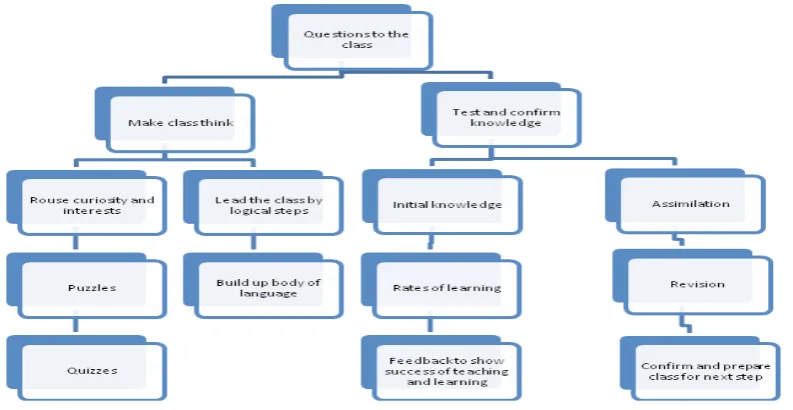
think so? (synthesis); What would you do instead? (application); What difference do you see? (interpretation). this may open a lot of discussions. What really happens during a class in relationship with questioning in general? What questions are asked to a class? then the next step is to make class think. in order to do this effectively it is of importance to rouse the curiosity and interest. it is proved that among best approaches are those applied by puzzles and quizes. as soon as this is done students should be led by logical steps to build up the body of knowledge. but this body then is tested and confirmed, strengthening the initial knowledge and using assimilation techniques. a teacher should be well-aware of what the rates of learning are; feedback best shows whether success has been reached in teaching and learning. revision helps confirm and prepare class for next steps to promote critical thinking. (fig. 1)
Figure 1: Questions to develop critical thinking.
Strategies, Procedures and Techniques of Questioning that Promote Critical Thinking
Volume 38, 2011 80
Conclusions
the thrust of the survey evidence is that schools that were achieving higher standards in questioning did much more than required. indeed it is likely that it was because of policy and practice that these schools were well-placed to handle the specificities of questioning. these essential extras are challenging. the survey suggests that they encompass: effective leadership and management, a passion for knowledge, resourcefulness, inclusive systems for assessment, target setting and monitoring, and effective policies for making links between thinking and planning skills. another problem emphasized once more was that up-to-date methods are mainly student-centered and they aim at involving students in the teaching and learning process. in albania a few years ago a class was teacher-oriented and it was difficult to apply investigative, active and reflective learning. most students learn best when actively involved; when targets are carefully self-selected, there is always room for helping students to give more attention to discussions. investigative questioning provides thought questions. in order to overcome structural difficulties the challenge is to invest questioning with a relevance and purpose that learners can identify with. fortunately Questioning is a challenge that many teachers in albania try to meet with success especially now when we are trying so hard to get integrated into the world of european education.
References
aedp (1997). Metoda të Mësimdhënies (Methods of Teaching). tiranë, albania.
aedp (1999). Aspects of Teaching, tiranë, albania.
bond, n. (2008). Questioning strategies that minimize behavioral problems. Education Digest, Vol.2, p.41-45.
brookfield, s. d. (1987). Developing Critical Thinkers: Challenging adults to explore alternative ways of thinking and acting. san francisco: Jossey-bass.
freiberg, h. J., & stein, t. a. (1999). School Climate: Measuring, Improving and Sustaining Healthy Learning Environments. london.
fu (2008). A Pragmatic Study on the EFL Classroom Question-Answer Discourse. beijing.
Goffman, e. (1959). The presentation of self in everyday life. Garden city, ny: doubleday.
Golloway, ch. (1978). The Psychology for Teaching and Learning. usa.
lynch, t. (1991). Questioning roles in classroom.ELT Journal, 45 (3): 201- 210.
nunan, d. (1991). Language Teaching Methodology. london: prentice-hall.
ornstein, a. (1990). Strategies for Effective Teaching. brown communication inc.brown communication inc.
pollard, a. (1997). Reflective Teaching and Learning in Primary Schools. london.
sternberg, r. J. (1999). Handbook of Creativity.cambridge-new york: cambridge university press.
Volume 38, 2011 81
Advised by Elida Tabaku, University of Tirana, Tirana, Albania
received: September 16, 2011 accepted: November 04, 2011
Shpresa Qatipi PhD,� Lecturer,� �ni�ersit�� of Tirana,� Facult�� of Foreign Languages,� Rruga e Elbasanit,�Tirana,� Albania.