Volume 35: December 2017
ISSN 2414-6633
https://doi.org/10.22151/politikon.35
Editorial Board
Editor-in-Chief:
Jaroslava Barbieri (Italy & Ukraine)
Justinas Lingevičus (Lithuania)
Andrés Lopez Rivera (Ecuador)
Rafael Plancarte (Mexico)
Ana Magdalena Figueroa (Brazil)
Table of Contents
Editorial Note ... 4
Articles
Identity, Securitization, and New Norm Creation: The evolution of US normative
behavior during the Global War on Terror / Filip Svítek ... 5
Moving from a centralised to a network strategy in addressing unemployment: The
Mangaung Metropolitan as a case study /
Lenie Swanepoel
... 30
What kind of foreign policy actor can the EU be defined as in respect to their
sanctions regime against Belarus? /
Anna Lederer
... 52
United in Diversity: A Comparative Analysis of the Voting Behaviours of European
Far-Right Political Parties in the European Parliament between 2009-2014 /
Pınar
Editorial Note
Dear Reader,
We proudly present Vol. 35 of Politikon, the flagship academic journal of the International Association for Political Science Students.
Politikon is open to talented junior scholars regardless of their formal academic status. This can be seen from the rich variety of backgrounds of our authors, whose papers successfully passed our peer-review procedure.
Our first paper adopts a constructivist approach to examine how securitization allowed the US Central Intelligence Agency to introduce controversial tactics such as coercive interrogations and extrajudicial detention as new internal norms, without turning them into fully-fledged rules under the Bush administration. Our second contribution argues that the lack of a network approach in favour of a centralised approach to government in South Africa can explain the weak success of tackling unemployment thus far. A network approach advocates for the inclusion of private actors, which can bring valuable expertise, skills, know-how and credit at the local level. To illustrate this, our author presents the Mangaung Metropolitan Municipality’s Youth Enterprise Development Programme as a case study. Our third paper evaluates the character of the EU as a foreign policy actor by looking at its restrictive measures against Belarus. For this purpose, it analyses documents issued by the European Parliament on sanctions over a ten-year period. Our final contribution also studies the European Parliament, but this time from a different angle. In fact, it analyzes the voting behavior of European far-right parties between 2009 and 2014 on economic and monetary affairs as well as immigration, but also their party programs, election manifestos, parliamentary speeches, statements and media coverage. This article shows that these parties tend to be united on salient issues, while deviations are mostly caused by country-specific reasons.
If you also want to publish an article with us, please visit our website for further information:
http://www.iapss.org/wp/academics/journals/politikon/callfor-papers/
We look forward to reviewing your work!
Identity, Securitization, and New Norm Creation: The evolution of US
normative behavior during the Global War on Terror
Filip Svítek
https://doi.org/10.22151/politikon.35.1
Filip Svítek is a recent Master’s graduate from Univerzita Karlova (Charles University) in Prague. There he
studied international security, and wrote his thesis on non-material motives for conflict. He has published work with STRATPOL on network-centric warfare (ISBN 978-80-972526-0-1) and indirect strategic coercion with Karolinum Press (ISBN 978-80-246-3674-0). His field experience includes praxis with the Czech Foreign Ministry in Los Angeles and the US State Department in Zagreb.
Abstract
This article explores domestic security policy and international threats through a constructivist lens, examining how the US Central Intelligence Agency functionally employs controversial tactics such as coercive interrogations and extrajudicial detention within a society that represents liberal normative democracy – one that in theory should prefer to uphold norms of human rights rather than infringe upon them. There appear to be two main concepts at play: security as an underlying cultural identity (i.e. a product) and security as a subjective act (i.e. a process). In particular, National Security Culture (the product) and securitization (the process) can together allow for the evolution of normative behavior. Empirical results show that techniques of enhanced interrogation, practiced furtively during the Global War on Terror, were introduced as new internal norms due to successful securitization. These norms, however, did not coalesce as rules, and through the President Bush administration remained a distinct
“torture lite.”
Keywords
Introduction
This work aims to use constructivist theory – as a bridge between (neo)realism and (neo)liberalism – to propose the constitutional reality of what is relational. The two theories of realism and liberalism predicate the importance of international anarchy in determining world order, or in other words, the absence of a governing superstructure with the power to reward or punish. But constructivism suggests even international anarchy does not necessarily allow for unrestrained behavior (Wendt 1992). Therefore, and in light of the ongoing Global War on Terror, this paper attempts to analyze the security cultures that states build under the influence of constructivist mindsets, and apply these so-called National Security Cultures to contemporary processes of securitization. In general, the first conceptional part of this paper will focus on US National Security Culture by exploring the construction of perceptions as facilitated by norms, rules, culture, and identity; the second section explores how language transmits these concepts and in particular, how it applies to the securitized threat of terrorism within the Global War on Terror. The case study will apply National Security Culture and securitization specifically to techniques of coercive interrogation, practices that both disrupt but also reflect the normative behavior of the US Central Intelligence Agency. Overall, this work asks: how can a group such as al Qaeda provoke a radical response from the Western world; effectively, was “torture” socialized as acceptable behavior? This study finds that, vis-à-vis international security, external threats (especially combined with extreme events), exacerbated by ideas of identity, have the power to alter normative behavior – but only to a limited extent.
Methodology and operationalization
what comprises these objective realities. This approach blends rational and irrational ontology, as a sort of “nonrational” meaning (Suchman and Eyre 1992: 157). The level of analysis is state-based and state-group-based (e.g. the CIA) – while individuals and the international system have an impact on state preferences, ultimately it is the state that is making the decisions. Because “anarchy is what states make of it” (Wendt 1992: 395; emphasis altered), state perceptions play the largest role. To simplify: ideational terms dictate the social condition of the state. Social conditioning, thereafter, determines materialistic interpretations (Wendt 1992; Mercer 1995; Katzenstein 1996; Desch 1998; Campbell 1998).
The approach rests on a teleological view of identity – that there is intrinsic value in the process of identity formation and maintenance. Analysis rests on a social ontology, such as the creation of social facts via national security, and on a social epistemology: answering for “whom particular forms of knowledge are for, and what function they serve in supporting the interests of those people or groups” (Mutimer 2010: 64) during securitization. Discursive politics play a role in analysis of the formation of both national security culture and, more importantly, in securitization. This method, while allowing for various meanings, can ultimately be traced to determine – though has limits causally linking – policy choices. Concepts such as context and preferences, based on identity, are key. Ultimately, this analysis attempts to bridge national security culture and securitization in a two-step process, integrating interconceptionalization of culture (such as through intertextuality) and intersubjectivity of securitization in a reductionist approach to international security. The mechanism that is used as a bridge between national security culture and securitization is identity (and the corresponding language). These two concepts, plus the bridging process, are applied to a single exploratory case study – the interrogation practices of the US Central Intelligence Agency (CIA) within the Global War on Terror (GWOT).
5). Though, naturally, many documents remain classified and prevent an all-encompassing analysis – blocking a full view of the cube or the circle – some leaked or declassified work, other reports, reviews, statements, laws, and additional sources, together provide sufficient empirics to assemble a largely complete picture of the internal machinations of the CIA with regard to national security.i (see endnote)
There are three main qualitative methods used in this paper: discourse analysis, process-tracing, and content analysis. The former is used during analysis of the concept of National Security Culture – the inductive process that “map[s] the emergence of patterns of representation” (Balzacq 2011b: 39). This process produces a product of cultural identity. Process-tracing involves taking this product in its (tentatively) finalized form – identity – and locates how language prepares and transforms meanings for a certain purpose. The philosophical “what is said” transforms into the sociological “how it is said” through methods other than discourse, such as procedure (e.g. policy-making). The process-tracing involved does not identify a causal link per se, but reinforces the notion that National Security Culture is a necessary but not sufficient independent variable. The content analysis portion takes the independence of the National Security Culture product, and superimposes the process of securitization. In other words, it is a deductive procedure that analyzes how agents can manipulate meaning using the “truth” of National Security Culture. A major research question explored is how normative behavior (that is, the US structure of National Security Culture) connect with agents (that is, CIA agency) (see Checkel 1998).
Defining National Security Culture
National Security Culture (NSC), in short, is a type of domestic social organization, and determines preferences of action – the organization of political strategy from a global perspective. NSC is constructed of “codes, rules, recipes, and assumptions which impose a rough order on conceptions” (Johnston 1995: 45). NSC helps determine order, ideas of causality, and issues of trust, limiting action as a sort of mentality used “instrumentally to eliminate alternative institutions, ideologies or behaviors from the body politic” (Ibid.). While simultaneously accepting certain premises of both structural neorealism (such as the rational egoism of states) and neoliberal institutionalism (such as the power of institutions to dictate state policy), NSC also relaxes the realist focus on material power and liberalist focus on institutional constraints. Blending the two creates an environment of states that operate beyond physical capability and integrate the impact of institutions on states’ interests and identities (Katzenstein 1996: 8-9). NSC constructs, through social process, an assortment of invaluable norms, rules, and culture – in other words, identity – for a state. These ideals are protected values, supported by the state and its domestic constituents. The functioning of NSC can be deconstructed into three main tenents: 1) norms (perscribing current action); 2) rules (proscribing alternatives); 3) culture (preserving previous behavior patterns and predicting future allowed/forbidden actions).
Norms
Norms answer the questions: “Who are we; what do we do?” In essence, norms can be defined as methods of behavior that reflect apparent societal values. Norms within an established identity (elaborated on later) can show who we are (as “constitutive effects”) and how we should act (as “regulative effects”) (Katzenstein 1996), as well as acting as “prescriptive” indicators (Finnemore 1998: 891) – this analysis conflates the three, as norms in general constitute identity at a certain point in time. Norms can also be employed for intrinsic, and not instrumental reasons – for reasons of desirability or appropriateness based on what is evaluated (subjectively) as “good” through a “logic of appropriateness” (March and Olsen 1998). Ideas dominant behavior.
Rules
Rules answer the question: “Why does it matter who we are?” Rules help define models of appropriate behavior, encouraging norms and discouraging deviation. Nicholas Onuf (2014: 1-2) describes rules as “norms…by another name.” A distinction involves applicability: whereas norms constitute characteristics of an actor, rules regulate conduct and constitute the environment, not the actor. A state can and does create norms that it then translates, through rules, how a state might act into how it must act to achieve certain results (or avoid punishments). Rules help institutionalize norms. International rules, often reinforced by both customary and traditional law, shape expectations in a more coercive way. In their legal form, states make rules into laws, and countries use or follow rules to reinforce legitimacy. The assumption follows, that states operate less in an environment of anarchy than in a system of self-imposed limitations; the US, for example, is bound not only by its own domestic rules but also by a tacit, international set that moderates (whether effectively or not will later be explored) its actions. This system is reinforced by communication that either asserts, requests, or promises certain action (Onuf 2014: 4). Legal rules support the adherence to norms under state penalty.
Morality also plays a large role in the construction of rules. A rule-setting state often believes it has the moral imperative to share its norms with other, “lesser” states (with major ideologies such as imperialism, communism, and capitalism as useful examples). NSC in particular relies on audiences accepting the idea that their own states have the right idea and are worth protecting – that people value the identity they are party to. These “standards of appropriateness” (Katzenstein 1996: 14) can change, and historically the world has seen major shifts. Conceptions of morality, and the corresponding rules employed, often can change within one generation. Interpretations of normative values can make rules, but interpretations change.
Culture
state, as constrained by its own domestic rules, compounded throughout its history. Culture is often made up of semi-conscious or unconscious assumptions, defining the environment, “enabling individuals to make much out of little” (Wildavsky 1985: 95). The properties of culture are transitive and dynamic, though at any one point they can be considered objective variables.
The idea of culture borrows from institutional context as a social determinant (Katzenstein 1996). In other words, political context limits behavior, blinding societies to a universal reality and focusing on specific, subjective problems, as well as what might be appropriate solutions (Johnston 1995). Institutions and organizations, in this context, do not just produce regimes of norms and rules, but act as active cultural units in their own right. Governments can create an agency, while the same agency can reappropriate perspective and pressure the same governments – or domestic populations – into considering a shift in values. This process morphs into political action facilitated through communication. Discourse in this way allows “statesmen and societies [to] actively shape the lessons of the past in ways they find convenient” (Snyder 1991: 30).
Using norms, rules, and culture to define the national interest and identity
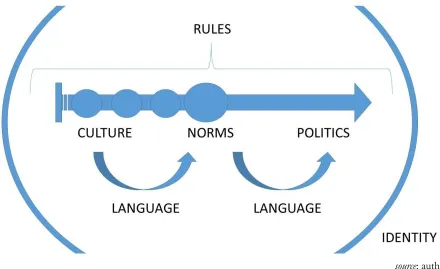
Culture (as past behavior), norms (as current behavior), and rules (as prescribed behavior), compound over time into a domestic identity. This identity – with its corresponding values and interests – produces inherent meaning, but also risk, for constituents. National (or sovereign) interests involve defending against this risk to inherent value and protecting the territory, continuity, and belonging of a society from threatening elements of a social world. This national interest, and by extension foreign policy, produces boundaries (Campbell 1998). These interests manifest themselves with labels such as citizenship and ethnicity: “very much a response to the need for identity” (Roe 2010: 168). Ideational factors represent the underlying motor of this emergence. In an increasingly globalized world, however, there is greater chance of external input from other actors or events – billiard balls that bump up against one other, but also have the power to exchange information or alter perspective. Socially, power and agency lie in ideas. Major external events, threats, or attacks (actual or perceived), provide windows to change ideational values.
is possible. But the ideational starting point – NSC as a product – is the basis of each state’s milieu, a packaged culture that a nation-state can represent symbolically to the world. This representation is visualized in Figure 1.
Figure 1
Ideational National Security Culture (NSC) as a product
source: author
Creating Identity
ethnic cleansing justified in the eyes of the cleansers, from infanticide in Grecian Sparta, to Joseph Goebbels’ surgical analogies, to George Kennan’s “malignant parasite” of communism. A series of dichotomies illustrates the spectrum: subject/object, inside/outside, self/other, rational/irrational, healthy/sick, true/false, and others. While the former are internalized and idealized, the latter represent threats to identity: “the outcome of this is that boundaries are constructed, spaces demarcated, standards of legitimacy incorporated, interpretations of history privileged, and alternatives marginalized” (Campbell 1998: 65; 68). The protection of an established identity requires the co-establishment of boundaries that outline where concepts of identity lie, and where they may change. Losing identity leads to loss of purpose (especially evident, for example, in extreme nationalist ideologies, where identity is significantly more important than life). Identity, through its subjectivity, can foster fear and drive foreign policy. Identity is especially useful for states when it, through language, outlines the possible perceptions and constructions of reality in new, unprecedented situations (Wendt 1992).
Using Language
heuristic that simplifies complex environments; because environments are subjectively constructed, language socializes. Language is thus especially useful when discussing goals and threats within a context of uncertainty or change: the ideal context for securitization.
The securitization of identity
Securitization is the process that mobilizes immediate support for a decision made in response to an apparently existential threat, as communicated through cultural and societal methods such as language. As best articulated by Thierry Balzacq:
“…securitization [is] an articulated assemblage of practices whereby heuristic artefacts (metaphors, policy tools, image repertoires, analogies, stereotypes, emotions, etc.) are contextually mobilized by a securitizing actor, who works to prompt an audience to build a coherent network of implications (feelings, sensations, thoughts, and intuitions), about the critical vulnerability of a reference object, that concurs with the securitizing actor’s reasons for choices and actions, by investing the
referent subject with such an aura of unprecedented threatening complexion that a customized policy must be undertaken immediately to block its development.”
(Balzacq 2011a: 3; italics in original)
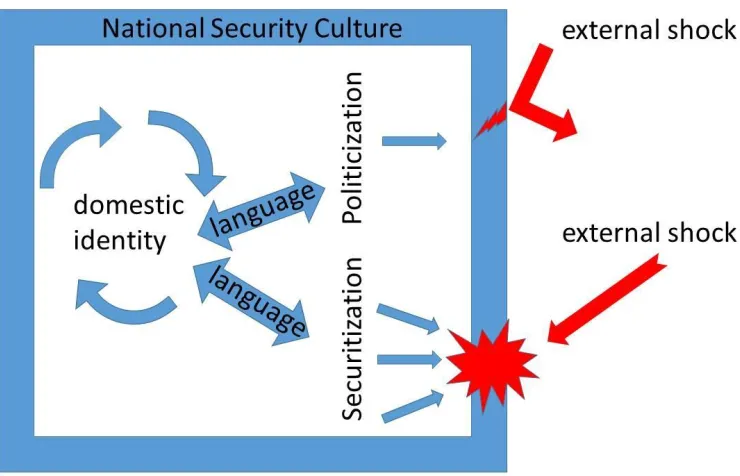
Securitization finds its roots in politicization. To politicize a matter is to take the topic at hand and move it beyond its latent status (Buzan et al.: 1998); in other words, finding and arguing importance, followed by offering a resolution. The process is open, and often entails debate. To proceed from politicization to securitization, an existential threat is added. This threat then has the power to legitimize the breaking of rules, acting outside of what was previously normative behavior. Issues can (and do) move along the spectrum of non-politicized, politicized, and securitized. A glaring contrast between politicization and securitization is the audience factor. Securitization involves using language to highlight risk to an audience – especially risk of losing identifying, cultural ideals. Securitization aims to convince an audience of the necessity of an offered solution to an external shock, as visualized in Figure 2.
Barry Buzan, Ole Waever, and Jaap de Wilde elaborate the dialectic process of securitization (1998: 31; italics in original): “securitization is intersubjective and socially constructed…This
normative behavior during securitization is thus done under the cover of bombastic, high-stakes language such as the speech act.
Figure 2
Ideational securitization as a process
source: author Speech acts
The main functional aspect of securitization is the speech act. Buzan et al. (1998) cite the most successful speech acts as claiming a middle-level referent object, such as a state. This unit – including both its sovereignty and domestic culture – takes precedence, especially over system-level and micro-/group-level referent objects. When speech acts successfully convince an audience of legitimacy, securitization can solidify the status of an issue and ensure it receives precedence over others. Securitizing an issue gives it the most attention; contradictorily, once the audience has accepted the speech acts, a securitized issue also receives the least critique. By pointing to an existential risk, there is a rational implication that the threat will be stopped.
Speech acts themselves are not self-referential, and are not done in a vacuum of perception, but in a discursive space filled with prior experience. The speech act can adjust, blur, or repurpose the identity that makes up this experience, and will, most often by pointing to an external threat or stimulus to justify action. The “receptiveness” of the audience can be molded to fit the context (Balzacq 2011a: 11). The power to persuade lies in the mutual, shared knowledge of culture and trust that the threat is real. An external shock will add urgency, compounded by concurrent emotional intensity (as a point of critical mass) and logical calculations that points to impending consequences (Balzacq 2005). Discourse gives agency and language mobilizes identity. The 11 September 2001 attacks in the US produced a major shock to American identity; in response, organizations within the US perceived the need for alternative normative behavior. When a collective group, such as the Bush administration during the Global War on Terror, worked to securitize this issue in its political capacity, it can – and has – utilized functional groups, such as the US Central Intelligence Agency, to offer new normative tools as a solution.
Fear and (in)security
The Bush Administration and the Global War on Terror
The framing and “interpretive dominance” (Paris 2002: 425) securitizing actors such as President Bush are able to promote during the GWOT – focusing on an eschatological outlook – create the exceptional situation that allows for exceptional solutions, especially by controlling the flow of information and meaning. Framing the threat as an existential threat to domestic culture (as later elaborated) opens the same cultural actors to reconsider what might be appropriate normative action. Coercive interrogations, in the context of US liberal democracy, as well as biblical concepts of justice, are one such manifestation. Following 11 September 2001, the fear of culturecide communicated and induced a “cultural nationalism” (Roe 2010: 172), where the preservation of Self dominated all else. “Collateral damage” – an important indicator of self-aggrandizement – became a part of everyday vocabulary (Kurtulus 2012: 48) as a price to pay for complete victory. Discourse in the GWOT activated conscious, subconscious, and emotional feelings, based on an underlying national culture, to “‘limit what we notice, highlight what we see, and provide part of the inferential structure that we reason with’” (Paris 2002: 428). Possible alternatives are discarded when US representatives claim – with democratic justification – that they are most qualified to interpret the situation and prescribe a response. The president and his administration was thus able to morph the reality of a threatening environment (whether via terrorist tribes or scheming despots) by defining the world around him in culturally identifying terms (Murphy 2003).
Defining the US Central Intelligence Agency
US President Franklin D. Roosevelt coordinated the first recognizable US intelligence community in the midst of World War II as the Office of Strategic Services. The US responded to increasing terrorist incidents with its 1972 Cabinet Committee to Combat Terrorism, to “include such activities as the collection of intelligence worldwide and the physical protection of U.S. personnel and installations abroad and foreign diplomats, and diplomatic installations in the United States” (Nixon 1972). Important reforms came to the intelligence community in 2004 when President Bush restructured the system with the Intelligence Reform and Terrorism Prevention Act.
The CIA defines terrorism as “premeditated, politically motivated violence perpetrated against noncombatant targets by subnational groups or clandestine agents” (USC Title 22, §2656f(d)). This mandate, to prosecute terror, is imposed on an independent and non-departmental CIA that works “primarily for the president…each White House and NSC [National Security Council] has pressed CIA and now the DNI to adapt its intelligence support and priorities to match the president’s style and interest,” whether explicitly willing or not (George 2011: 164). Historically, even “CIA directors have found themselves becoming policy advocates” (Ibid.: 172). Culturally, operatives in the CIA cultivate an “image of a can-do culture, not unlike the Marine Corps” and “a sense of independence,” both which encourage it to execute presidential directives in its own unique fashion (Ibid.: 160). On the one hand, the CIA receives orders from and reports to the US president; simultaneously, its independence gives it latitude to introduce what it might perceive to be the best solution to a threat. While instances of violent terrorism has dramatically decreased in the past decades (Jenkins 2015), the critical figure of approximately 3,000 casualties on 11 September 2001, galvanized the nation by invoking – largely through President Bush’s discursive GWOT – a perceived threat to the cultural identity of Americans. The 2001 terrorist attacks, even as a lesser threat to US civilians, refocused, through securitization, the functional agency of the CIA on a newly defined societal threat. Threats to political security were translated into an insecure society. According to the Bush administration, American identity composed a society of certain cultural values; this identity (and thus culture) were penetrated by the Other, through an alternate identity and conflicting values. The threat of terror was presented discursively by the Bush administration as an external, existential issue – our values or theirs – allowing for the introduction of radical solutions.
All-but-innocent terrorists
after the 11 September attacks and signed by President Bush on 18 September 2001 (later supplemented by the 2002 Authorization for Use of Military Force Against Iraq), to provide the legal justification for “prosecuting” international terror. As of 2017, the 2001 AUMF was still in effect. According to the AUMF, this allows for military and coercive action against “acts of treacherous violence” committed by international terrorist organizations, including perhaps unintentionally (15 years later) groups in the Middle East such as Daesh. Though explicitly intended to destroy the perpetrators of the 11 September attacks – cutting off the head of the snake, that is, of al Qaeda and its affiliates – the legislation has been used as an effective instrument in extrajudicially capturing enemies of the state and encouraging them to reveal information. It was the critical event of the 11 September attacks that started the search for this new normative action. Before 11 September 2001: “the idea of holding terrorists outside the U.S. legal system was not under consideration…not even for Osama bin Laden” (Priest 2005: 3). The external shock was deemed threatening enough by US leadership, and conveyed convincingly enough to a US audience, that an exceptional solution was necessary. Between 2002 and 2003, US Secretary of Defense Donald Rumsfeld sanctioned 24 of 35 “enhanced” interrogation methods (Bellamy 2006: 122) as a corollary to the AUMF. The CIA was tasked with applying these new norms.
Coercive Interrogation as Enhanced Torture
Coercive interrogation begins with extraordinary rendition. Rendition and prolonged detention during emergency is not an unprecedented norm; US President Abraham Lincoln suspended due process for Confederate detainees during the US Civil War, and President Franklin D. Roosevelt did the same to more than 100,000 Japanese-Americans in the initial stages of World War II. And “given the large number of democracies involved in the extraordinary rendition of terrorism suspects, including several ostensibly liberal states such as Sweden, it is possible to conclude that this type of extra-legal procedures has become a normalized aspect of post-11 September counterterrorism operations of democracies” (Kurtulus 2012: 43). Locations to which suspects are rendered are widespread, and include Saudi Arabia, Egypt, Sudan, Syria, Jordan, Morocco, Yemen, Singapore, the Philippines, Thailand, and Iraq in general, as well Bagram airbase in Afghanistan, the island of Diego Garcia, and Guantánamo Bay in Cuba in particular, and even mobile sites on US Navy warships and other undisclosed locations (Bowden 2003: 54; Kurtulus 2012: 43).
regional or other edicts – and domestically by the US Constitution and other legislation. The US Joint Chiefs of Staff, in the midst of the Afghanistan and Iraq wars, prohibited inhumane treatment of detainees (Joint Chiefs of Staff 2005). The US Uniform Code of Military Justice prohibits US forces from “cruelty,” “maltreatment,” or “oppression” of detainees (Mayer 2005). President Bush declared in 2002: “‘I call on all governments to join with the United States and the community of law-abiding nations in prohibiting, investigating, and prosecuting all acts of torture…and we are leading this fight by example’” (Bush cited in Bowden 2003: 56). Torture is thusly labeled, legally and morally, as a “crime against humanity” and protected as a negative human right (i.e. the right not to be tortured). The core debate has been definitional (that is, discursive): “the key legal question in relation to torture is therefore not so much whether it is legal, but whether specific acts that stop short of causing life-threatening pain, such as sensory deprivation and placing people in so-called ‘stress positions’, are properly defined as torture” (Bellamy 2006: 127). And in a single discursive sweep, the Bush administration used the term “unlawful combatants” to exclude detainees from what might have been due legal process with a (definitive) judicial answer to the torture question.
As such, even these coercive techniques, though definitely abusive in a broad sense, are a far cry from traditional methods involving burning, cutting, shocking, pulling, screwing, branding, impaling, and other painful mutilations still used, even today, by certain other states. Instances of “full” torture, to highlight the contrast, deserve to be quoted at length:
“Saddam Hussein’s police force burned various marks into the foreheads of thieves and deserters, and routinely sliced tongues out of those whose words offended the state. In Sri Lanka prisoners are hung upside down and burned with hot irons. In China they are beaten with clubs and shocked with cattle prods. In India the police stick pins through the fingernails and fingers of prisoners. Maiming and physical abuse are legal in Somalia, Iran, Saudi Arabia, Nigeria, Sudan, and other countries that practice sharia; the hands of thieves are lopped off, and women convicted of adultery may be stoned to death. Governments around the world continue to employ rape and mutilation, and to harm family
members, including children, in order to extort confessions or information from those in captivity.”
(Bowden 2003: 53)
When compared to the above, the isolating, shouting at, pushing, degrading, and other “torture lite” (Ibid.) abuse of detainees held by the US can be considered relatively mild. If the CIA employed similar methods as common in more authoritarian regimes, it could not point with sincerity to a desire to uphold liberal norms; it would have no excuse to mistreat its prisoners. But because of US ideas of culture and normative identity – as this analysis argues – even in a successfully securitized environment, the US and its citizens sanction only a lighter form of torture that might batter suspected terrorists a bit, while causing no long-lasting physical or serious mental harm. In logs of interrogation released by TIME Magazine in 2002, the “20th hijacker” detainee,
Mohammed al Qahtani, receives both coercive abuse but also homemade meals and electrocardiographic, computerized axial tomographic (CAT), and ultrasound scans by a medical specialist flown-in from abroad – treatment resulting overall in not much more than moderate mental strain and gratuitous tears. According to The New Yorker, some statistics show “Guantánamo detainees got more frequent medical treatment than most Americans” and that suspected terrorists received “honey-glazed chicken” or “lemon-baked fish” as rations (Mayer 2005).
unregistered (and thus unchecked by medical personnel) at Abu Ghraib, perished after wounds sustained during arrest (Johnston 2004). Others have attempted (or succeeded in committing) suicide, including at Guantánamo Bay (Mayer 2006).
The power of language lubricates the sidestepping of the entire international legal system; language allows the certain activities in the interest of US cultural norms to continue, and prevents obstacles from intruding on the implementation of its national security interests and the securing of its cultural priorities. By being “unlawful” combatants, regulation regarding their torture need not apply. Historically, other state authorities have attempted similar maneuvers, with different results – French commissions on acts in Algeria (see the Wuillaume Report) and the UK authorities on Northern Ireland (see the Compton Committee) concluded that the simulated drownings and sleep deprivation used in the respective conflicts (among other similar techniques also used by the CIA), ultimately, were abusive and illegitimate. The European community confirmed this conclusion in 1976, claiming that the systematic institutionalization of torturous techniques were a violation of human rights (Bellamy 2006: 128-129). Regardless, certain European Union countries have hosted CIA blacksites where coercive interrogation took place, and countries such as the UK have refused “to rule out information extracted from torture in court proceedings” (Kenneth Roth of Human Rights Watch cited in Slater 2006: 213). Meanwhile, in Israel, torture under emergency circumstances is circumstantially condoned (see Landau Commission). Each state has taken a slightly different approach, while the US and Israel have lead liberal international society in liberalizing “torture” regimes. A majority of Americans (55%) agreed with this approach as it occurred, and supported keeping Guantánamo Bay even a decade after the 11 September attacks (Condon 2010). Similarly, within the GWOT, US polls confirmed widespread domestic support of the “torture” of terrorist suspects (Kurtulus 2012: 46). In places such as Guantánamo, coercive interrogation can make its impermanent mark while essentially occurring without a trace – as part serious response to domestic threat and part protection of domestic ideals.
Conclusion
study, the CIA established a new norm of enhanced interrogation within the context of the GWOT. Because of internal consensus (and secrecy), the new norm was able to advance quickly, with little public resistance, to the rule-making phase of identity formation. But even the schism in normative behavior – that securitization legitimized – only allowed a modified form of enhanced interrogation to enter (that is, ultimately, only “torture lite”). This demonstrates that ideas, along with perceptions and interpretations, play a major role in international security.
References
Adler, Katya. 2009. “The rise of Israel’s military rabbis.” The BBC, 7 September. Accessed 08 May 2016. http://news.bbc.co.uk/2/hi/programmes/newsnight/8232340.stm.
Balzacq, Thierry. 2005. “The Three Faces of Securitization: Political Agency, Audience and Context.” European Journal of International Relations 11, no.2: 171-201. https://doi.org/10.1177/1354066105052960
Balzacq, Thierry. 2011a. “A theory securitization: origins, core assumptions, and variants.” In: Thierry Balzacq, ed., Securitization Theory: How security problems emerge and dissolve, 1st ed. New York: Routledge: 1-30.
Balzacq, Thierry. 2011b. “Enquiries into methods: a new framework for securitization analysis.” In: Thierry Balzacq, ed., Securitization Theory: How security problems emerge and dissolve, 1st ed. New York: Routledge: 31-53.
Bellamy, Alex J. 2006. “No pain, no gain? Torture and ethics in the war on terror.” International Affairs 82, no 1: 121-148. https://doi.org/10.1111/j.1468- 2346.2006.00518.x
bin Laden, Osama. 2002. “Full text: bin Laden’s ‘Letter to America’.” The Guardian, November 24. Accessed January 20, 2016. http://www.theguardian.com/world/2002/nov/24/theobserver.
Bowden, Mark. 2003. “The dark art of interrogation.” Atlantic Monthly 292, no.3: 51-76.
Bush George W. 2014. “A Message from President George W. Bush on Memorial Day 2014.”
George W. Bush Presidential Center. Accessed 12 May 2016.
http://www.bushcenter.org/publications/articles/2014/05/a-message-from-president-george-w-bush-on-memorial-day-2014-.html.
Bush, George W. 2001a. “Address to a Joint Session of Congress and the American People.”
White House. Accessed 12 May 2016.
https://georgewbush-whitehouse.archives.gov/news/releases/2001/09/20010920-8.html
Bush, George W. 2001c. “Remarks by the President Upon Arrival.” White House. Accessed 12 May 2016. http://georgewbush-whitehouse.archives.gov/news/releases/2001/09/20010916-2.html.
Bush, George W. 2001d. “Transcript of President Bush's address.” CNN. Accessed 12 May 2016. http://edition.cnn.com/2001/US/09/20/gen.bush.transcript/.
Buzan, Barry, Jaap De Wilde, and Ole Wæver. 1998. Security: A New Framework for Analysis. Boulder: Lynne Rienner Publishers.
Campbell, David. 1998. Writing Security: United States Foreign Policy and the Politics of Identity. Minneapolis: University of Minnesota Press.
Central Intelligence Agency. 2016. Website. Accessed 13 May 2016. https://www.cia.gov/.
Central Intelligence Agency. 2013. “CIA Comments on the Senate Select Committee on Intelligence Report on the Rendition, Detention, and Interrogation Program.” News & Information.
Accessed 13 May 2016.
https://www.cia.gov/library/reports/CIAs_June2013_Response_to_the_SSCI_Study_on_the_Fo rmer_Detention_and_Interrogation_Program.pdf.
Central Intelligence Agency. 2008. “A Look Back … The National Security Act of 1947.” News & Information. Accessed 11 May 2016. https://www.cia.gov/news-information/featured-story-archive/2008-featured-story-archive/national-security-act-of-1947.html.
Checkel, Jeffrey T. 1998. “Review: The Constructivist Turn in International Relations Theory.” World Politics 50, no 2: 324-348. https://doi.org/10.1017/S0043887100008133
Cohn, Carol. 1987. “Sex and Death in the Rational World of Defense Intellectuals.” Signs 14, no. 4: 687-718. https://doi.org/10.1086/494362
Condon, Stephanie. 2010. “Poll: Most Americans Say Keep Gitmo Open.” CBS News, 11 January. Accessed 08 May 2016. http://www.cbsnews.com/news/poll-most-americans-say-keep-gitmo-open/.
Desch, Michael C. 1998. “Culture Clash: Assessing the Importance of Ideas in Security Studies.” International Security 23, no 1: 141-170. https://doi.org/10.1162/isec.23.1.141
Dubin, Martin David. 1956. “The American Tradition in Foreign Policy, by Frank Tannenbaum.” Indiana Law Journal 32, no. 1: 111-117.
Emmers, Ralf. 2010. “Securitization.” In: Alan Collins, ed., Contemporary Security Studies, 2nd ed. Oxford: Oxford University Press: 109-125.
Geertz, Clifford. 1973. The Interpretation of Cultures. New York: Basic Books.
George, Roger Z. 2011. “Central Intelligence Agency: The President’s Own.” In Roger Z. George and Harvey Rishikof, eds., The National Security Enterprise: Navigating the Labyrinth. Washington, DC: Georgetown University Press: 157-175.
George, Roger Z., and Harvey Rishikof, eds. 2011. The National Security Enterprise: Navigating the Labyrinth. Washington, DC: Georgetown University Press.
Gilpin, Robert. 1981. War and Change in World Politics. New York: Cambridge University Press: 30-31. https://doi.org/10.1017/CBO9780511664267
Goodstein, Laurie. 2001. “As Attacks' Impact Recedes, a Return to Religion as Usual.” New York Times, 26 November. http://www.nytimes.com/2001/11/26/national/26FAIT.html.
Goodwin, Jeff. 2006. “A Theory of Categorical Terrorism,” Social Forces 84, no. 4: 2027-2046. https://doi.org/10.1353/sof.2006.0090
Gronke, Paul, Darius Rejali, Dustin Drenguis, James Hicks, Peter Miller, and Bryan Nakayama. 2010. “US public opinion on torture, 2001–2009.” PS: political science & politics 43, no. 3: 437-444. https://doi.org/10.1017/S1049096510000697
Groves, Bryan. 2013. America's Trajectory in the Long War: Redirecting Our Efforts Toward Strategic Effects Versus Simply Tactical Gains. Studies in Conflict & Terrorism 36, no. 1: 26-48. https://doi.org/10.1080/1057610X.2013.739078
Gray, Colin S. 1981. “National Style in Strategy: The American Example.” International Security 6, no. 2: 21-47. https://doi.org/10.2307/2538645
Hobbes, Thomas. 1968. C. B. Macpherson, trans., Leviathan. Harmondsworth: Penguin Books Limited: chapter 13.
Huntington, Samuel. 1993. “The Clash of Civilizations?” Foreign Affairs 72, no. 3: 22-49. https://doi.org/10.2307/20045621
Huntington, Samuel. 2004. Who Are We? The Challenges to America’s National Identity. New York: Simon & Schuster.
Jehl, Douglas. 2004. “Captured Terrorists Hint at New Plan, Officials Say.” New York Times, 13 July.
Johnson, Lyndon B. 1966. “Special Message to the Congress on Crime and Law Enforcement.”
The American Presidency Project, March 9. Accessed 13 May 2016.
http://www.presidency.ucsb.edu/ws/?pid=27478.
Johnston, Alastair Iain. 1995. “Thinking about Strategic Culture.” International Security 19, no. 4: 32-64. https://doi.org/10.2307/2539119
Johnston, David. 2004. “CIA Expands Its Inquiry into Interrogation Tactics.” New York Times, 29 August.
Joint Chiefs of Staff. 2005. Joint Doctrine for Detainee Operations, Joint Publication 3–63, 23: para. 1-4.
Joscelyn, Thomas. 2010. “Osama bin Laden's spokesman freed by Iran.” Long War Journal, 28
September. Accessed 04 May 2016.
http://www.longwarjournal.org/archives/2010/09/osama_bin_ladens_spo.php
Katzenstein, Peter J. 1996. The Culture of National Security: Norms and Identity in World Politics. New York: Columbia University Press.
Kier, Elizabeth. 1995. “Culture and military doctrine: France between the wars.” International Security 19, no. 4: 65-93. https://doi.org/10.2307/2539120
Kissinger, Henry. 2002. Does America Need a Foreign Policy: Toward a Diplomacy for the Twenty-First Century. New York: Simon & Schuster.
Kratochwil, Friedrich. 2007. “Of false promises and good bets: a plea for a pragmatic approach to theory building.” Journal of International Relations and Development 10: 1-15. https://doi.org/10.1057/palgrave.jird.1800111
Kurtulus, Ersun N. 2012. “The new counterterrorism: Contemporary counterterrorism trends in the United States and Israel.” Studies in Conflict & Terrorism 35, no. 1: 37-58. https://doi.org/10.1080/1057610X.2012.631456
Lantis, Jeffrey S. 2002. “Strategic Culture and National Security Policy.” International Studies Association 4, no. 3: 87-113. https://doi.org/10.1111/1521-9488.t01-1-00266
Lawrence, Bruce, ed., 2005. Messages to the World: The Statements of Osama bin Laden. Verso.
Le Bon, Gustave. 2001. The Crowd: A Study of the Popular Mind. Kitchener: Batoche.
March, James G., and Johan P. Olsen. 1998. “The Institutional Dynamics of International Political Order.” International Organization 52, no. 4: 943-969. https://doi.org/10.1162/002081898550699
Mayer, Jane. 2005. “The experiment.” The New Yorker, 11 July.
Mercer, Jonathan. 1995. “Anarchy and Identity.” International Organization 49, no. 2: 229-252. https://doi.org/10.1017/S0020818300028381
McCarthy, Niall. 2015. “The War On Terror Has Cost Taxpayers $1.7 Trillion.” Forbes, 3 February. Accessed 29 April 2016. http://www.forbes.com/sites/niallmccarthy/2015/02/03/the-war-on-terror-has-cost-taxpayers-1-7-trillion-infographic/#7995690c5cf0.
McIntosh, Christopher. 2015. “Counterterrorism as War: Identifying the Dangers, Risks, and Opportunity Costs of US Strategy Toward Al Qaeda and Its Affiliates.” Studies in Conflict & Terrorism 38, no. 1: 23-38. https://doi.org/10.1080/1057610X.2014.974408
Morgenthau, Hans. 1952. “Another ‘Great Debate’: The National Interest of the United States.” The American Political Science Review 46, no. 4: 961-988. https://doi.org/10.2307/1952108
Murphy, John M. 2004. “Our mission and our moment: George W. Bush and September 11th.” Rhetoric & Public Affairs 6, no. 4: 607-632. https://doi.org/10.1353/rap.2004.0013
Mutimer, David. 2010. “Critical Security Studies: A Schismatic History.” In: Alan Collins, ed., Contemporary Security Studies, 2nd ed. Oxford: Oxford University Press: 53-74.
Nixon, Richard. 1972. “Memorandum Establishing a Cabinet Committee to Combat Terrorism.” The American Presidency Project, September 25. Accessed 13 May 2016. http://www.presidency.ucsb.edu/ws/?pid=3596.
Office of the Director of National Intelligence. 2012. “Central Intelligence Agency Act of 1949.” Accessed 10 May 2016. https://www.dni.gov/index.php/about/organization/ic-legal-reference-book-2012/ref-book-central-intelligence-agency-act-of-1949.
Office of the High Commissioner. 1984. “Convention against Torture and Other Cruel, Inhuman or Degrading Treatment or Punishment.” The United Nations. Accessed 10 May 2016. http://www.ohchr.org/EN/ProfessionalInterest/Pages/CAT.aspx
Onuf, Nicholas. 2014. “Rule and Rules in International Relations.” Lecture Series: Beyond Anarchy: Rule and Authority in the International System. University of Helsinki.
Paris, Roland. 2002. “Kosovo and the metaphor war.” Political Science Quarterly 117, no. 3: 423-450. https://doi.org/10.2307/798263
Pfaff, William. 2005. “What We’ve Lost: George W. Bush and the price of torture.” Harper’s
Magazine: 50-56.
Priest, Dana, and William M. Arkin. 2010. “Top Secret America: A Hidden World, Growing Beyond Control.” Washington Post, 19 July.
Rapoport, David C. 2004. “The Four Waves of Modern Terrorism.” In: Audrey K. Cronin, and James M. Ludes, eds., Attacking terrorism: Elements of a Grand Strategy. Washington, D.C: Georgetown University Press: 46-73.
Rishikof, Harvey, and Roger Z. George. 2011. “Conclusion: Navigating the Labyrinth of the National Security Enterprise.” In: Roger Z. George and Harvey Rishikof, eds., The National Security Enterprise: Navigating the Labyrinth. Washington, DC: Georgetown University Press: 331-350.
Risse, Thomas. 2000. “‘Let’s Argue!’: Communicative Action in World Politics.” International Organization 54, no. 1: 1-39. https://doi.org/10.1162/002081800551109
Roe, Paul. 2010. “Societal Security.” In: Alan Collins, ed., Contemporary Security Studies, 2nd ed. Oxford: Oxford University Press: 164-181.
Rosen, Stephen P. 1995. “Military effectiveness: Why society matters.” International Security 19, no. 4: 5-31. https://doi.org/10.2307/2539118
Slater, Jerome. 2006. “Tragic choices in the war on terrorism: Should we try to regulate and control torture?” Political Science Quarterly 121, no. 2: 191-215. https://doi.org/10.1002/j.1538-165X.2006.tb00569.x
Sorenson, Theodore C. 1990. “Rethinking National Security.” Foreign Affairs 69, no. 3: 1-18. https://doi.org/10.2307/20044397
Snyder, Jack. 1991. Myths of Empires: Domestic Politics and International Ambition. Ithaca: Cornell University Press: 17-30.
Svítek, Filip. “Securitizing Culture: Normative Behavior and the US Central Intelligence Agency in the Global War on Terror.” Prague, 2016. 82 p. Diploma work (Mgr.) Charles University, Faculty of Social Sciences, Institute of Political Studies. Department of Security Studies. Diploma work supervisor JUDr. PhDr. Tomáš Karásek, Ph.D.
Suchman, Mark C., and Dana P. Eyre. 1992. “Military procurement as rational myth: Notes on the social construction of weapons proliferation.” Sociological Forum 7, no. 1: 137-161. https://doi.org/10.1007/BF01124759
Tannenbaum, Frank. 1952. “The Balance of Power Versus the Coördinate State.” Political Science Quarterly 67, no. 2: 173-197. https://doi.org/10.2307/2145721
Thornton, Patricia H., and William Ocasio. 2008. “Institutional Logics.” In: Royston Greenwood, Christine Oliver, Kerstin Sahlin and Roy Suddaby, eds., Handbook of Organizational Institutionalism. Sage: 99-129. https://doi.org/10.4135/9781849200387.n4
Time Magazine. 2002. “Interrogation Log: Detainee 063.” April 09. Accessed 09 May 2016. http://content.time.com/time/2006/log/log.pdf.
United States 114th Congress. 2003. H.R.2048 – Uniting and Strengthening America by Fulfilling Rights and Ensuring Effective Discipline Over Monitoring (USA FREEDOM) Act of 2015. Accessed 02 May 2016. https://www.congress.gov/bill/114th-congress/house-bill/2048.
United States 107th Congress. 2001. H.R.3162 - Uniting and Strengthening America by Providing Appropriate Tools Required to Intercept and Obstruct Terrorism (USA PATRIOT ACT) Act of 2001. Accessed 02 May 2016. https://www.congress.gov/bill/107th-congress/house-bill/3162.
United States Congress. 2005. “The Commission on Intelligence Capabilities of the United States
Regarding Weapons of Mass Destruction.” Accessed 12 May 2016.
https://fas.org/irp/offdocs/wmd_report.pdf.
United States Congress. 2004. “9/11 Commission Report.” National Commission on Terrorist Attacks
Upon the United States. Accessed 10 May 2016.
http://govinfo.library.unt.edu/911/report/911Report.pdf.
Wendt, Alexander. 1992. “Anarchy is what States Make of it: The Social Construction of Power Politics.” International Organization 46, no. 2: 391-425. https://doi.org/10.1017/S0020818300027764
Western, Jon. 2005. “The war over Iraq: Selling war to the American public.” Security Studies 14, no.1: 106-139. https://doi.org/10.1080/09636410591002518
White House. 2002. "President Bush Outlines Iraqi Threat Remarks." 7 October 2002. http://www.whitehouse.gov/news/releases/2002/10/200221007-8.html.
Wildavsky, Aaron. 1985. "Change in Political Culture," Politics 20, no. 2: 95-102. https://doi.org/10.1080/00323268508401968
Wilson, James Q. 1989. Bureaucracy: What Government Agencies Do and Why They Do It. New York: Basic Books.
Woodward, Bob. 2002. Bush at War. New York: Simon and Schuster.
Moving from a centralised to a network strategy in addressing
unemployment: The Mangaung Metropolitan as a case study
Lenie Swanepoel
https://doi.org/10.22151/politikon.35.2
Dr Lenie (MP) Swanepoel, 48, from Bloemfontein (South Africa) is a graduate who received her Bachelor’s degree in “Communication” at the University of Johannesburg in 1991. In 2004 she obtained her Masters Degree from
the University of the Free State’s Governance and Political Transformation Programme. She wrote her Masters Thesis on Vigilantism as a feature of political decay: Tendencies and case studies in the post-1994 South African political dispensation. In 2009 she obtained her PhD under the title “Vigilantism as a feature of political decay in
the post-1994 South African dispensation: A theoretical perspective”. She lectured in the same programme during
2010 to 2015 the module “South African Governance and Political Transformation and has been a research fellow
from 2009 to 2017.
Abstract
Unemployment is a challenge for the South African government, including of the Local Government. Many strategies were developed to do so, but with little success. This article argues that this is due to the application of a centralised approach instead of a network one. The centralized strategy is depleting state resources, whilst the private sector has expertise, skills, know-how and credit that could be used. The theory of network governance reiterates that partners are equal and function horizontally, which provides a safe environment for private partners in the network with the government structure retaining the responsibility of coordination and being at the centre of decision-making. This framework is applied to the Mangaung Metropolitan Municipality’s Youth Enterprise Development Programme where the private sector was drawn in in line with the network approach. The article concludes that the mode of governance within local government needs to be transformed.
Keywords
1.
Background
One of the main objectives of local government is to promote economic development (RSA Constitution 1996: Section 152). With that said, one of South Africa’s governance challenges is unemployment, which also drives poverty, and with it inequality. The level of this challenge is illustrated by the fact that 60% of South Africa’s unemployed have never been employed (Schwella 2015: 145). South Africa has nearly 36 million employable people, but only 15.5 million have jobs, 5.5 million are out of work, and the rest are not economically active (eNCA money 2015). Government has developed many strategies since the country’s democratisation in 1994, but it was accentuated that unemployment remains rife by it being emphasised in the election manifestos of all participating opposition political parties in the run-up to the 2016 Local Government Elections (LGE).
The failure of successfully addressing this challenge cannot be attributed to the lack of strategizing by government, as numerous policies have been developed since 1994. These policies include the Growth, Employment and Redistribution (GEAR) strategy, the Local Government Turnaround Strategy (LGTS) and the Economic Growth Path Strategy (EGPS). It will be argued in this article that the government’s failure to address unemployment can be ascribed to a lack of networking. The governance strategy applied here addresses how the challenge of unemployment has been centralised within the structures of government, depleting resources without providing the results set out in its objectives.
The article will analyse how the Mangaung Metropolitan Municipality (MMM) managed the Youth Enterprise Development Programme (YEDP) as a governance structure and, as will be argued, the need for transformation in the thinking of local governments by involving the public sector when it comes to Local Economic Development (LED).
1.1 Purpose
The purpose of the article is to assess the utilisation of network governance principles to address the challenge of unemployment. The principles of network governance allow for the utilisation of both public and private resources, which will increase the resource base in addressing the challenge. To assess this probability the criteria for network governance will be identified and applied to a programme with the aim of developing Small, Medium and Micro Enterprises (SMME). One of the smaller metropolitan municipalities of South Africa was selected for this analysis, the MMM.
LED is outcomes-based, with the aim of creating employment for local residents, and can be defined as a participatory, not coordinating, process. The process encourages and facilitates partnerships between local government and actors from the private sector with a joint design strategy (Canzanelli 2001: 9; Mufamadi 2000: 1; Blakely 1989: 58). Definitions of LED emphasise partnerships and support the principles of the theory of network governance. In a World Bank report (Rodriquiz-Pose & Tijmstra 2005: 5), it was determined that South Africa’s pro-poor LED strategies at local government level do not involve the local business community in developing strategies; thus, limited pro-poor strategies are implemented because of the lack of information-sharing. The SALGA position paper of March 2010 (Cohen 2010: 25) reiterated that LED projects in the Free State seldom succeed and rarely involve the private sector as an actor within these strategies, resulting in poverty not being addressed.
MMM’s YEDP fell within the criteria of LED, specifically regarding the involvement of the private sector from the beginning. It also showed potential to have a long-term effect on those provided with the opportunity. This made it vital to explore for the purpose of this article to determine what mistakes MMM made and the successes achieved in its approach in addressing unemployment, using the principles of governance network theory.
1.2 Problem Statement
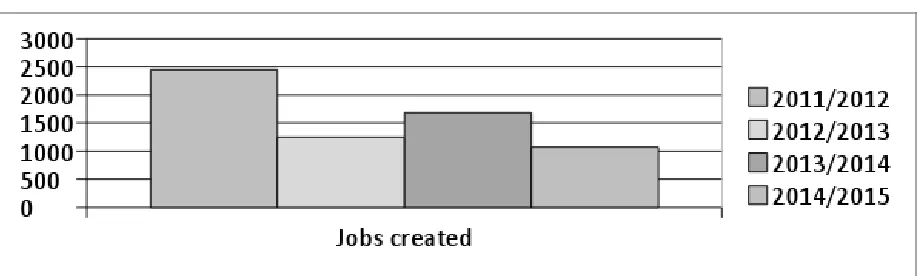
There has been a steady increase in unemployment in Mangaung, with a decline in job creation. According to the Quarterly Labour Force Survey of the first quarter of 2016 (Stats SA a 2016: xiii), MMM provided 251 000 jobs in the first quarter of 2016 in comparison to 266 000 in 2015. This is a 5.7% decline in employment opportunities. The Free State’s official unemployment rate also increased from 30.4% in the first quarter of 2015 to 33.9% in the first quarter of 2016 (Stats SA a 2016: xiii).
MMM has been unable to meet its target for job creation, as set out in its Integrated Development Plan (IDP). In fact, there has been a steady as illustrated in the following table:
In April 2015, the Metro launched a project to register all unemployed youth living in Mangaung on the Municipal Data Register, initiated by the then Executive Mayor. This was done through the SMME Support Division, which invited all unemployed youth from all regions to register. The aim of these efforts was directed at ensuring employment and economic participation among its young people (MMM 2015). The project fell under the IDP objective for 2014/2015 under economic development with the strategy to support viable and sustainable SMMEs (MMM a 2016: 65 & 131). The aim of this strategy was to strengthen support systems for SMMEs in Mangaung so as to create a small business sector. This would increase the sustainability of the local economy, increase the competitiveness of local businesses, generate jobs and broaden the tax base of the Municipality (Seda 2015).
The question that needs to be answered is how best the local sphere of government can address the critical problem of unemployment and if the application of the principles of the theory of governance network may be considered as an effective counter measure to the problem. The value of the application of network governance within local governments will therefore be argued as a viable strategy but that the challenges the MMM experienced be presented as a guidance for future application.
1.3 Methodology
A literature review was conducted to determine the efforts undertaken by MMM to address unemployment up until the 2016 LGE. The theory of network governance was studied as the framework around which the research problem of this article was developed and to develop an understanding of what role MMM is expected to play within such a network to achieve its set programme goals within the YEDP.
Criteria will be identified that will be utilised to measure the level of successful application of network governance. The criteria will be utilised to assess MMM’s YEDP so as to determine the mistakes made in the attempt to follow a network approach, and also the successes, to indicate that this approach may be more effective in addressing the challenge of unemployment as joblessness is becoming an indication that South Africa is on the path of political decay, rather than political development.
2.
Theory of Network Governance
South Africa shows characteristics of political decay: incompetent civil servants, corruption, and insufficient procedures and control measures that inhibit continuous and quality service delivery (Duvenhage, 2003: 47, 51-53) and government struggles to correct these symptoms. These characteristics results in a situation of “politics of survival” where government structures rely only on themselves to solve governance challenges, such as unemployment, due to the fear of losing power or acknowledgement if successes are achieved if entering into equal partnerships. Benvir (2011: 11) explain that governance involves constant movement with a dependent nature of practical political activity. Governance network according to Considine (2013: 443-444) is a structured institutional space and may assist in resolving the problem of transformational change. He concluded that the critical parties need to be included and the authorising environment must be somewhat “insulated from party-political processes”.
Governance is an attempt to steer society and the economy through collective actions and forms of regulation that link values and objectives to outputs and outcomes. Governance networks can be seen as a particular mode of governance in which interdependent actors contribute to the production of public governance. Key actors involved should be from the state, economy and civil society. Governance networks are part of the transition from government to governance. It forces focus on political processes and not institutional structures (Torfling 2012: 99-101). Local Government has a degree of independence from central government and therefore ideal for the implementation of network governance.
with a minimal structural requirement of scheduled meetings to ensure regular interaction (Torfling 2012: 101; Klijn & Koppenjan 2012: 591; Considine 2013: 442).
Networks increase connectedness among participating actors, linking structures, and thus giving them access to different resources. It provides the opportunity to bridge social groups, making the network a crucial phenomenon to government (Considine 2013: 442). According to Denters (2011: 315), widespread participation provides policy makers with extensive information, which makes it easier to better gear local policies and services to the preferences of the citizenry. Therefore, governance can benefit from network governance.
Interaction is through negotiations that involve conflicts, power, and compromise formation. At the beginning, there is no common constitution to regulate the negotiation. Over time, governance networks will become more institutionalised (Torfling 2012: 101). Networks that have a higher chance of succeeding therefore develop over a period of time, have regular interaction with all the actors, show a willingness to compromise and share, and are well facilitated. As Klijn & Koppenjan (2012: 591) indicate, facilitation is needed between the actors in networks, which is done by public authorities. The self-regulatory capacity of networks is therefore limited and constrained by public authorities, who often threaten to take over if governance networks fail to deliver (Torfling 2012: 102). In addition, governance networks operate in the shadow of a hierarchy (Scharpf 1994: 27), which may have a political undertone.
Governance networks are stronger at the local level, where public policies are formulated and implemented in collaboration between the public and private sectors (Torfling 2012: 102). Local government authorities often seek to create sustainable new forms of governance so as to perform practical service and build new forms of capacity. Governance networks, in theory, could be applied to achieve this responsibility. This type of network is typically organised around local development. These structures are best underpinned by a “good governance” discourse so as to ensure accountability to citizens and the provision of better services to those in need (Considine 2013: 441).