https://doi.org/10.26637/MJM0601/0011
Numerical solution of nonlinear fractional
integro-differential equation by Collocation method
S. I. Unhale
1and S. D. Kendre
2*
Abstract
In this paper, we presents the Collocation Method with the help of shifted Chebyshev polynomials and shifted Legendre polynomials for the numerical solution of nonlinear fractional integro-differential equations (NFIDEs). The method introduces a promising tool for solving many NFIDEs with the help of Newton’s iteration method. Keywords
Fractional Integrodifferential Equations, Collocation method, Chebyshev Polynomials, Legendre polynomials.
AMS Subject Classification
34A08, 65L05, 65L20
1Department of Mathematics, C.K. Thakur Arts, Commerce and Science College, New Panvel 410 206, India (M.S.) 2Department of Mathematics, Savitribai Phule Pune University, Pune-411007, India (M.S.)
*Corresponding author:2[email protected],2[email protected]; 1[email protected]
Article History: Received12October2017; Accepted26December2017 c2017 MJM.
Contents
1 Introduction. . . 73
2 Preliminaries and Definitions. . . 74
3 Solution of NFIDEs by Collocation method with the help of shifted Chebyshev polynomials. . . 74
4 Solution of NFIDEs by Collocation method with the help of shifted Legendre polynomials. . . 75
5 Applications. . . 76
6 Conclusion. . . 78
Acknowledgments. . . 79
References. . . 79
1. Introduction
It is now a days well established that several real life phe-nomena are better described by fractional differential equa-tions and hence the study of these type of equaequa-tions is very important due to their frequent appearance in various appli-cations in fluid mechanics, biology, physics and engineering see [1,2,4]. Most of the fractional differential equations do not have exact analytic solutions and therefore, approximating or numerical techniques are generally applied. Consequently, considerable attention has been given to the solutions of frac-tional differential equations and fracfrac-tional integral equations using different numerical methods such as Predictor Correc-tor method, Quadrature methods, Fractional Euler, Fractional
Trapezoidal method, Legendre spline interpolation method, Adomain decomposition method, Taylor series method, Pi-card’s iterative method, Variational principle method, Iterative methods, Laplace transform, Mellin transform, Collocation method, Galerkin method and many others. Many recent pa-pers have dealt with the solutions of fractional differential equations by using above methods, see [5–7,9,14,20,21] and some of the references cited therein.
As Chebyshev polynomials and Legendre polynomials are well known family of orthogonal polynomials on the interval
[−1,1]that have many applications and widely used because of their good properties in the approximation of functions. This motivated to find a numerical solution of nonlinear fractional integrodifferential equations using Collocation method with the help of Chebyshev polynomials and Legendre polynomials to reduce to system of nonlinear equations and which can be solved by Newtons Iterative method.
The aim of the present paper is to determine the numerical solution of the nonlinear fractional integrodifferential equation of the type
Dαy(x) =g(x) +
Z 1
0
K(x,t)f(y(t))dt, (1.1)
y(i)(0) =δ(i), i=0,1, . . . , (1.2)
in the interval[0,1]andy(x)is the unknown function to be determined.
The paper is organized as follows: Section 2, presents the preliminaries and definitions. Section 3, dedicates the solution of nonlinear fractional integrodifferential equation by Colloca-tion method with the help of shifted Chebyshev polynomials. Section 4, obtains the solution of nonlinear fractional integrod-ifferential equation by Collocation method with the help of shifted Legendre polynomials. Section 5, focuses on some examples to illustrate the theory.
2. Preliminaries and Definitions
In this section we recall some definitions and properties of fractional derivatives and fractional integrals [13,16].
Definition 1. A real function f(x),x>0, is said to be in the space Cµ,µ∈R, if there exists a real number p>µsuch that
f(x) =xpf1(x), where f1(x)∈C[0,1).
Definition 2. A real function f(x),x>0, is said to be in the space Cm
µ,m∈NU{0}if and only if f (m)∈C
µ.
Definition 3. The fractional integral of orderαwith the lower limit zero for a function f is defined as
Iαf(x) = 1
Γ(α) Z x
0
f(t)
(x−t)1−αdt, x>0,α>0, (2.1)
provided the right side is point-wise defined on [0,∞), where Γ(·)is the gamma function.
Definition 4. The Riemann-Liouville derivative of orderα with the lower limit zero for a function f :[0,∞)→R can be written as
LDαf(x) = 1
Γ(n−α) dn dxn
Z x
0
f(t)
(x−t)α+1−ndt,x>0, (2.2)
for n−1<α<n.
Definition 5. The Caputo derivative of orderαfor a function f :[0,∞)→R can be written as
Dαf(x) =
In−αfn(x), n−1<α≤n, n∈N, Dnf(x)
Dxn , α=n.
(2.3)
3. Solution of NFIDEs by Collocation
method with the help of shifted
Chebyshev polynomials
The well known Chebyshev polynomials are defined on the interval [−1,1] and can be determined with the use of the following recurrence formula
Tn(z) =2zTn−1(z)−Tn−2(z), n=2,3, . . .
with
T0(z) =1, T1(z) =z.
The analytic form of the Chebyshev polynomials Tn(z)of degreenis given by
Tn(z) =n [n2]
∑
i=0(−1)i2n−2i−1(n−i−1)!
(i)!(n−2i)!z
n−2i (3.1)
where[n
2]denotes the integer part ofn/2.
The orthogonality condition is
Z 1
−1
Ti(z)Tj(z)
√
1−z2 dz=
π, f or i=j=0;
π
2, f or i=j6=0; 0, f or i6= j.
(3.2)
In order to use these polynomials on the interval [0,1] we define the so called shifted Chebyshev polynomials by intro-ducing change of variablesz=2x−1. The shifted Chebyshev polynomialsTn(2x−1)be denoted byTn∗(x). ThenTn∗(x)can be obtained as follows
Tn∗(x) =2(2x−1)Tn−∗1(x)−Tn−∗2(x), (3.3) forn=2,3, . . .with initial conditions
T0∗(x) =1, T1∗(x) =2x−1. (3.4) The analytic form of shifted Chebyshev polynomialsTn∗(x)of degree n is given by
Tn∗(x) =n
n
∑
k=0(−1)n−k2
2k(n+k−1)!
(2k)!(n−k)! x
k, (3.5)
forn=2,3, . . .
The functiony(x), which is square integrable functions in[0,1], may be expressed in terms of shifted Chebyshev polynomials as
y(x) =
∞
∑
i=0aiTi∗(x), (3.6)
where the coefficientsaiare given by
a0=
1
π Z 1
0
y(x)T0∗(x)
√
x−x2 dx, ai=
2
π Z 1
0
y(x)Ti∗(x)
√
x−x2 dx,
for i=1,2, . . .. In practice, only the first (n+1)terms of shifted Chebyshev polynomials are considered. Then we have
yn(x)∼= n
∑
i=0aiTi∗(x), 0≤x≤1. (3.7)
Theorem 3.1 (Chebyshev Truncation Theorem). [12] The error in approximating y(x)by the sum of its first n terms is bounded by the sum of the absolute values of all the neglected coefficients. If
yn(x)∼= n
∑
k=0then
ET(n) =|y(x)−yn(x)| ≤ ∞
∑
k=n+1|ak| (3.9)
for all y(x), all n and all x∈[−1,1].
The main approximate formula of the fractional derivative ofyn(x)is given in the following theorem.
Theorem 3.2. [12] Let y(x)be approximated by shifted Cheby-shev polynomials and also supposeα>0, then
Dα(y n(x)) =
n
∑
i=dαei
∑
k=dαeaiw (α) i,k x
k−α (3.10)
where w(α)i,k is given by
w(α)i,k = (−1)i−k 2
2ki(i+k−1)!Γ(k+1)
(i−k)!(2k)!Γ(k+1−α) (3.11) The numerical solution of nonlinear fractional integrodif-ferential equation (1.1) using collocation method with the help of shifted Chebyshev polynomials is discussed below. This method is based on approximating the unknown functiony(x)
as
yn(x)∼= n
∑
i=0aiTi∗(x), 0≤x≤1 (3.12)
whereTi∗(x)is the shifted Chebyshev polynomial andai, i= 0,1,2, . . .are constants.
Making use of (3.12) into (1.1), following equation is obtained
n
∑
i=dαei
∑
k=dαeaiw(α)i,k xk−α
=g(x) + Z 1
0
K(x,t)f(
n
∑
i=0aiTi∗(t))dt (3.13)
We now collocate equation (3.13) at (n+1− dαe) points xp,p=0,1, . . .n− dαeas
n
∑
i=dαei
∑
k=dαeaiw(α)i,k xk−αp
=g(xp) +
Z 1
0
K(xp,t)f( n
∑
i=0aiTi∗(t))dt (3.14)
for suitable collocation points we use roots of shifted Cheby-shev polynomialsTn+∗1−dαe(x).
Also substituting equation (3.12) in the initial condition (1.1), we have
n
∑
i=0(−1)iai=0. (3.15)
From equation (3.14) and equation (3.15), we obtain(n+1)
system of nonlinear equations ina0,a1, . . . ,angiven by
F0(a0,a1, . . . ,an) =0
F1(a0,a1, . . . ,an) =0
.. .
Fn(a0,a1, . . . ,an) =0
, (3.16)
which can be solved by using the Newton’s iteration method for system of nonlinear equation.
To develop the iterative scheme, the system of nonlinear equation (3.16) can be written in the vector form asF(a) =0,
wherea= (a0,a1, . . . ,an)andF= (F0,F1, . . . ,Fn). The Taylor series expansion is
F(ak+1) =F(ak) + (∂F ∂a)(a
k+1−ak) +· · ·. (3.17)
Truncating the Taylor’s series following equation is obtained
F(ak) + (∂F(a
k)
∂a )(a
k+1−ak) =0, (3.18)
which gives
ak+1=ak−
∂F(ak)
∂a −1
F(ak) (3.19)
provided that the inverse of Jacobian Matrix ∂F(a k)
∂a exists. First we solve the equation
∂F(ak)
∂a 4x=−F(a
k) (3.20)
where
4x=ak+1−ak. (3.21)
Since ∂F(a k)
∂a is a known matrix andF(a
k)is a known vector,
the equation (3.20) is just a system of linear equations, which can be solved efficiently and accurately. Once we have the solution vector4x, we can obtain improved estimateak+1by equation (3.21).
4. Solution of NFIDEs by Collocation
method with the help of shifted Legendre
polynomials
The well known Legendre polynomials are defined on the interval [−1,1] and can be determined with the use of the following recurrence formula
Ln(z) = 2n+1
n+1 zLn−1(z)−
n
forn=2,3, . . .
with
L0(z) =1, L1(z) =z.
In order to use these polynomials on the interval[0,1], we define the so called shifted Legendre polynomials by intro-ducing change of variablesz=2x−1. The shifted Legendre polynomialsLn(2x−1)be denoted byLn∗(x). ThenL∗n(x)can be obtained as follows
L∗n(x) =(2n+1)(2x−1) n+1 L
∗ n−1(x)−
n (n+1)L
∗
n−2(x), (4.1)
forn=2,3, . . .
with initial conditions
L∗0(x) =1, L∗1(x) =2x−1. (4.2) The analytic form of shifted Legendre polynomialsL∗n(x)of degreenis given by
L∗n(x) =
n
∑
i=0(−1)n+i (n+i)! (n−i)((i)!)2x
i, n=2,3, . . . (4.3)
The orthogonality condition is
Z 1
0
L∗i(x)L∗j(x)dx=
1
2i+1, f or i=j; 0, f or i6=j.
(4.4)
The functiony(x), which is square integrable in[0,1], may be expressed in terms of shifted Legendre polynomials as
y(x) =
∞
∑
i=0aiL∗i(x), (4.5)
where the coefficientsaiare given by
ai= (2i+1)
Z 1
0
y(x)L∗i(x)dx, i=0,1,2, . . .
In practice, only the first(n+1)terms of shifted Legendre polynomials are considered. Then we have
yn(x)∼= n
∑
i=0aiL∗i(x). (4.6)
The main approximate formula of the fractional derivative of
yn(x)is given in the following theorem.
Theorem 4.1. [3] Let y(x)be approximated by shifted Legen-dre polynomials and supposeα>0
Dα(y n(x)) =
n
∑
i=dαei
∑
k=dαeaiw(α)i,k x
k−α (4.7)
where w(α)i,k is given by
w(α)i,k = (−1)i+k (i+k)!Γ(k+1)
(i−k)!(k!)2Γ(k+1−α) (4.8)
The numerical solution of nonlinear fractional integrod-ifferential equation (1.1) using collocation method with the help of shifted Legendre polynomials is discussed below. This method is based on approximating the unknown functiony(x)
as
yn(x)∼= n
∑
i=0aiL∗i(x), 0≤x≤1 (4.9)
whereLi∗(x)is the shifted Legendre polynomial. Using (4.9) in (1.1), we obtain
n
∑
i=dαei
∑
k=dαeaiw (α) i,k x
k−α
=g(x) + Z 1
0
K(x,t)f(
n
∑
i=0aiL∗i(t))dt (4.10)
Now we collocate equation (4.10) at(n+1− dαe) points xp, p=0,1,· · ·n− dαeas
n
∑
i=dαei
∑
k=dαeaiw(α)i,k xk−αp
=g(xp) +
Z 1
0
K(xp,t)f( n
∑
i=0aiL∗i(t))dt. (4.11)
For suitable collocation points we use roots of shifted Legendre polynomials L∗n+1−dαe(x)and the initial condition (1.1), we obtain(n+1)system of nonlinear equations ina0,a1, . . . ,an. These system of nonlinear equations can be solved by using the Newton’s iteration method discussed above section.
5. Applications
In this section, we give some numerical examples of nonlinear fractional integrodifferential equations to illustrate the above results.
Example 5.1. Consider the following nonlinear fractional integrodifferential equation
Dαy(x) =1−1 4x+
Z 1
0
xt(y(t))2dt, (5.1)
y(0) =0. (5.2)
where0≤x<1, α=12. The differential equation (5.1)-(5.2) has the exact solution y(x) =x,ifα=1.
Method I: Collocation method with the help of shifted Chebyshev polynomials
The suggested method is implemented forn=3 and approxi-mate the solution as follows
y2(x)∼= 3
∑
i=0aiTi∗(x), 0≤x≤1. (5.3)
An application of Collocation method with the help of shifted Chebyshev polynomial to (5.1)-(5.2), following nonlinear sys-tem of equations is obtained,
F0(a0,a1,a2,a3) =−0.25a20−0.166667a1a0 +0.166667a2a0+0.1a3a0
−0.0833333a21−0.116667a22
−0.121429a23+1.59577a1
−0.0333333a1a2−2.12769a2 +0.1a1a3−0.0714286a2a3
−0.957461a3−0.875
F1(a0,a1,a2,a3) =−0.0334936a20−0.0223291a1a0 +0.0223291a2a0+0.0133975a3a0
−0.0111645a21−0.0156304a22
−0.0162683a23+0.584092a1
−0.00446582a1a2−2.12769a2 +0.0133975a1a3−0.00956961a2a3 +4.07187a3−0.983253
F2(a0,a1,a2,a3) =−0.466506a20−0.311004a1a0 +0.311004a2a0+0.186603a3a0
−0.155502a21−0.217703a22
−0.226589a23+2.17986a1
−0.0622008a1a2+2.12769a2 +0.186603a1a3−0.133288a2a3 +3.11441a3−0.766747
F3(a0,a1,a2,a3) =a0−a1+a2−a3.
Using Newton’s iteration method for nonlinear system of equa-tions, we obtain
a0=0.832197311166694
a1=0.5989063759298973
a2=−0.14392391710534502
a3=0.08936701813145172,
(5.4)
making use of the (5.4) into (5.3), following solution is ob-tained
y(x) =0.83219731+0.5989063759298973(2x−1)
−0.14392391(8x2−8x+1)
+0.089367(4(2x−1)3−3(2x−1)), (5.5)
which is approximate solution of (5.1)-(5.2).
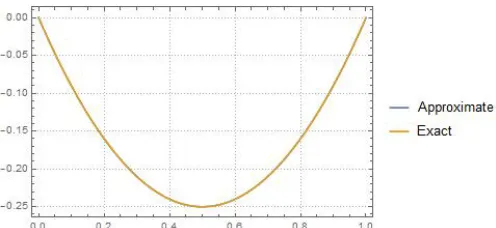
In Figure 1, we plot the approximate solution obtained by Method I and the exact solution for Example5.1.
Figure 1.Approximate and Exact solution of Example 5.1 by Method I
Method II: Collocation method with the help of shifted Legendre polynomials
The suggested method is implemented forn=3 and approxi-mate the solution as follows
y2(x)∼= 3
∑
i=0aiL∗i(x), 0≤x≤1. (5.6)
whereL∗i(x)is the shifted Legendre polynomial andai, i= 0,1,2,3 are constants.
An application of Collocation method with the help of shifted Legendre polynomials to (5.1)-(5.2), following nonlinear sys-tem of equations is obtained,
F0(a0,a1,a2,a3) =−0.25a20−0.166667a1a0
−0.0833333a21−0.05a22
−0.0357143a23+1.59577a1
−0.0666667a1a2−1.59577a2
−0.0428571a2a3+1.88411095∗10−15a3
−0.875
F1(a0,a1,a2,a3) =−0.0563508a20−0.0375672a1a0
−0.0187836a21−0.0112702a22
−0.00805012a23+0.757618a1
−0.0150269a1a2−1.93131a2
−0.00966a2a3+2.99198a3−0.971825 F2(a0,a1,a2,a3) =−0.443649a20−0.295766a1a0
−0.147883a21−0.0887298a22
−0.0633785a23+2.12579a1
−0.118306a1a2+1.16747a2
−0.076054a2a3+1.8086a3−0.778175
F3(a0,a1,a2,a3) =a0−a1+a2−a3
Using Newton’s iteration method for nonlinear system of equa-tions, we obtain
a0=0.7765706927568846
a1=0.5681834659041213
a2=−0.12918879599732455 a3=0.07919843085543878
making use of (5.7) into (5.6), following solution is obtained
y(x) =0.776571+0.568183(2x−1)
−0.129189(6x2−6x+1)
+0.0791984(20x3−30x2+12x−1) (5.8) which is approximate solution of (5.1)-(5.2).
In Figure 2, we plot the approximate solution obtained by Method II and the exact solution for Example5.1.
Figure 2.Approximate and Exact solution of Example 5.1 by Method II
Example 5.2. Consider the following nonlinear fractional integrodifferential equation
Dαy(x) =
8x3/2
3 −2
√
x
√
π −
1 1260x+
Z 1
0
xt(y(t))4dt,
(5.9)
y(0) =0. (5.10)
where0≤x<1,α=12. The differential equation (5.9)-(5.10) has the exact solution y(x) =x2−x,ifα=1.
Method I: Collocation method with the help of shifted Chebyshev polynomials
Similarly as in Example 5.1 applying the Collocation method with the help of shifted Chebyshev polynomial to (5.9)-(5.10), we obtain,
a0=−0.12500000268834607 a1=−3.2462632438396387∗10−9 a2=0.12499999951591143
a3=7.382860772130038∗10−11
(5.11)
Hence the approximate solution of (5.9)-(5.10) is
y(x) =−0.125−3.24626∗10−9(2x−1) +0.125(8x2−8x+1)
+7.38286∗10−11(4(2x−1)3−3(2x−1)).
(5.12)
In Figure 3, we plot the approximate solution obtained by Method I and the exact solution for Example5.2.
Figure 3.Approximate and Exact solution of Example 5.2 by Method I
Method II: Collocation method with the help of shifted Legendre polynomials
Similarly as in Example 5.1 applying the Collocation method with the help of shifted Legendre polynomial to (5.9)-(5.10), we obtained,
a0=−0.16667380012560998 a1=3.971261224148561∗10−6 a2=0.16667060752789342
a3=−7.16385894071834∗10−6
(5.13)
Hence the approximate solution of (5.9)-(5.10) is
y(x) =−0.166674+3.97126∗10−6(2x−1) +0.166671(6x2−6x+1)
−7.16386∗10−6(20x3−30x2+12x−1). (5.14) In Figure 4, we plot the approximate solution obtained by Method II and the exact solution for Example5.2.
Figure 4.Approximate and Exact solution of Example 5.2 by Method II
6. Conclusion
and Legendre polynomials are used to reduce nonlinear frac-tional integrodifferential equation to the solution of system of algebraic equations. The solution obtained using this method is in excellent agreement with the exact solution and show that this method is effective.
All numerical results are obtained using Mathematica 11.
Acknowledgments
The authors would like to express sincere gratitude to the reviewers for his/her valuable suggestions.
References
[1] G. Adomain; Solving Frontier Problems of Physics: The
Decomposition Method,Kluwer, Boston, (1994). [2] G. Adomain; A review of the decomposition method in
applied mathematics,J. Math. Anal. Appl., 135 (1988), 501-544.
[3] Rubayyi T. Alqahtani; Approximate Solution of non-linear
fractional Klein-Gordon equation using Spectral Colloca-tion mehtod,J. Appl. Math., 6 (2015), 2175-2181. [4] R.L. Bagley and P.J. Torvik, A theoretical basis for the
application of fractional calculus to viscoelasticity,J. Rhe-ology, 27(3), (1983), 201-210.
[5] X. Cao and Y. Li; Fractional Runge-Kutta methods for
nonlinear Fractional differential equations,J. Nonl. Syst. Appl.(2011), 189-194.
[6] V. Daftardar-Gejji and H. Jafari; Adomian
decomposi-tion: a tool for solving a system of fractional differential equations,J. Math. Anal. Appl., 301 (2005), 508-518. [7] V. Daftardar-Gejji and H. Jafari; An iterative method for
solving nonlinear functional equations, J. Math. Anal. Appl., 316 (2006), 753-763.
[8] K. Diethelm and Yu. Luchko, Algorithms for the fractional
calculus: A selection of numerical methods,J.Comput. Methods Appl. Mech. Eng., 194, (2005), 743-773. [9] E. A. Ibijola and B. J. Adegboyegun; A comparison of
Adomain’s decomposition method and Picard iterations method in solving nonlinear differential equations,Global J. Sci. Frontier Research Math. Deci. Sci., 12 (7), (2012). [10] A. Kadem and D. Baleanu, Fractional radiative
trans-fer equation within Chebyshev spectral approach, J. Compu.and Math. with Appl., 59, (2010), 1865-1873. [11] M. M. Khader and A. S. Hendy, The approximate and
exact solutions of the fractional order delay differential equations using Legendre pseudospectral method,Int. J. Pure and Appl. Math., 74(3),(2012), 287 – 297.
[12] M. M. Khader, N. H. Sweilam and A. M. S. Mahdy,
Nu-merical study for the fractional differential equations gen-erated by optimization problem using Chebyshev colloca-tion method and FDM,J. Appl. Math. and Info. Sci., 7(5), (2013), 2011-2018.
[13] A. A. Kilbas, H. M. Srivastava and J. J. Trujillo; Theory
and applications of fractional differential equations,
North-Holland Mathematics Studies, vol. 204, Elsevier Science B. V., Amsterdam, (2006).
[14] D. Sh. Mohammed; Numerical solution of fractional
integrodifferential equations by Least squares method and shifted Chebyshev polynomial,Math. Probl. Engg., (2014),1-5.
[15] Necati Ozisik; Finite Difference Methods in Heat Transfer
CRC Press, (1994).
[16] I. Podlubny; Fractional differential equations,Academic
Press, San Diego, (1999).
[17] E.A. Rawashdeh, Numerical solution of fractional
integro-differential equations by collocation method,J. Appl. Math. Comput., 176, (2006), 1-6.
[18] M. A. Snyder, Chebyshev Methods of Partial Differential
Equations, Oxford University Press, (1965).
[19] S. Momani, M.A. Noor, Numerical methods for
fourth-order fractional integro-differential equations, Appl. Math. Comput., 182, (2006), 754-760.
[20] Abdul-Majid Wazwaz; Linear and Nonlinear Integral
equations, Methods and Applications,Springer, (2011). [21] C. Yang and J. Hou; Numerical solution of
integrodiffer-ential equations of fractional order by Laplace decomposi-tion method,Wseas Transactions on Mathematics,12 (12), (2013), 1173-1183.
? ? ? ? ? ? ? ? ?
ISSN(P):2319−3786
Malaya Journal of Matematik
ISSN(O):2321−5666