United Kingdom Vol. III, Issue 3, March 2015
Licensed under Creative Common Page
1
http://ijecm.co.uk/
ISSN 2348 0386
EVALUATION OF THE STUDENTS’ EXPECTATIONS FOR AN
EDUCATIONAL INSTITUTION USING QUALITY
FUNCTION DEPLOYMENT METHOD
Eylem Koç
Department of Econometrics, Dumlupınar University,
Faculty of Economics and Administrative Sciences, Turkey [email protected]
Abstract
In today’s market environment where there is an intense competition, products that fully meet
customer expectations must be produced for the survival and growth of the companies.
Therefore, determining, analyzing and adapting customer expectations are critical problems. In
recent years, one of the commonly and effectively used methods for the solution to this problem
is Quality Function Deployment (QFD). As a customer-oriented method that reveals customer
expectations, QFD provides planning/improvement of the process’ by taking advantage of this
information. In this study, QFD method is used in order to determine and analyze the
expectations of the students enrolled in a language school. Firstly, related data concerning
students' expectations were obtained. House of quality was created and evaluated, and as the
result of this study, managers have been informed that teaching techniques applied by the
teachers and equipment features of the school should be developed by taking new trends into
account. In accordance with these results, managers were offered suggestions for the
improvement of student’s satisfaction. This study provides important tips for researchers and
decision makers who work on QFD method and its applications in the field of education.
Keywords: Quality function deployment, students’ expectations, voice of customer, quality,
Licensed under Creative Common Page
2
INTRODUCTION
Today, variety of goods and services offered to customers in all areas increased due to globalization and technological developments. This situation leads to ascending customer expectations and continuous changes in these expectations. It can be said that the quality of the physical properties of a product is no longer a competitive advantage. Yet today's customers give importance to the physical characteristics of quality when buying a product as well as satisfaction of their expectations. It can be stated that, the ever-changing customer expectations have become a major force in directing the global market in every sector. Therefore companies should analyze changes in customer expectations in the market environment and must adapt to these changes in order to be preferred by the customers.
As in many business lines, service diversity is increasing day by day also in the education field. Hence determining students' needs and expectations and giving adequate service to meet these expectations is important for organizations that operate in this field. However, to produce information related to the students’ expectations and to plan/develop
educational services by taking advantage of this information is a very difficult problem. In the literature, Quality Function Deployment (QFD) method is used effectively in order to solve such problems (Chan and Wu, 2002; Aytaç and Deniz, 2005). QFD is a quality improvement methodology used in revealing expectations of customers that they are aware of and express; and/or they are not even aware of therefore cannot be expressed. QFD also has a key role in connecting these expectations with the specifications of the products (Mazur, 1997).
In this study, the problem of the determining expectations of students in a language school and improving the quality of the institution in relation to these expectations is solved by using QFD method. Firstly, the data related to student expectations and their importance levels were obtained by questionnaires. The QFD method was applied according to the obtained data and house of quality was constructed. The results were interpreted considering the house of quality and were shared with the managers. The study consists of four sections. The first section includes an introduction to the subject. Brief information regarding QFD method and its applications are given in the second section. In the third section, our QFD study which is carried out in a language training institution is presented and the house of quality is given. The last section consists of results and the recommendations relating to the results from the application.
QUALITY FUNCTION DEPLOYMENT (QFD) AND ITS APPLICATIONS
Licensed under Creative Common Page
3
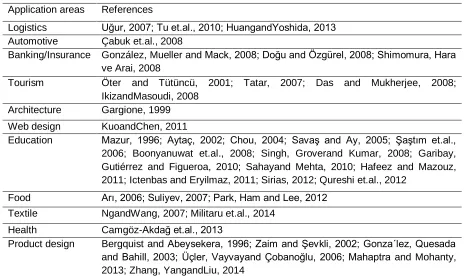
applied successfully in many areas up to the present (Jaiswal, 2012). Some of the successful QFD applications in the literature were classified according to their application areas and given in Table.1 (for further review, see: Chan and Wu, 2002; Aytaç and Deniz, 2005; Shahin, 2008).
Table 1. QFD studies in theliterature Application areas References
Logistics Uğur, 2007; Tu et.al., 2010; HuangandYoshida, 2013 Automotive Çabuk et.al., 2008
Banking/Insurance González, Mueller and Mack, 2008; Doğu and Özgürel, 2008; Shimomura, Hara ve Arai, 2008
Tourism Öter and Tütüncü, 2001; Tatar, 2007; Das and Mukherjee, 2008; IkizandMasoudi, 2008
Architecture Gargione, 1999
Web design KuoandChen, 2011
Education Mazur, 1996; Aytaç, 2002; Chou, 2004; Savaş and Ay, 2005; Şaştım et.al., 2006; Boonyanuwat et.al., 2008; Singh, Groverand Kumar, 2008; Garibay, Gutiérrez and Figueroa, 2010; Sahayand Mehta, 2010; Hafeez and Mazouz, 2011; Ictenbas and Eryilmaz, 2011; Sirias, 2012; Qureshi et.al., 2012
Food Arı, 2006; Suliyev, 2007; Park, Ham and Lee, 2012
Textile NgandWang, 2007; Militaru et.al., 2014
Health Camgöz-Akdağ et.al., 2013
Product design Bergquist and Abeysekera, 1996; Zaim and Şevkli, 2002; Gonza´lez, Quesada and Bahill, 2003; Üçler, Vayvayand Çobanoğlu, 2006; Mahaptra and Mohanty, 2013; Zhang, YangandLiu, 2014
As it can be seen in Table.1, QFD is used in the solution of problems in so many different areas such as product design, banking, healthcare, textile etc. Also, it can be seen that QFD is used by many researchers in the field of education. While some of these studies used QFD method in evaluation of the quality of education (Chou, 2004; Singh, Grover and Kumar, 2008; Sahay and Mehta, 2010; Qureshi et.al., 2012) some of them used this method in evaluation of the course curriculums (Mazur, 1996; Aytaç, 2002; Şaştım et.al., 2006; Boonyanuwat et.al., 2008; Hafeez and Mazouz, 2011; Sirias, 2012). For more detailed review on applications of the method in the field of education, see (Aytaç and Deniz, 2005).
QFD is based on the philosophy of designing and evaluating the products by taking the expectations of the customers into account (Uğur, 2007). Customer expectations are primarily
Licensed under Creative Common Page
4
product quality is obtained. The process of QFD method basically consists of four steps (Leber, Polajnar and Buchmeister, 2000; Vurmaz, 2009): (i) Planning, (ii) Determination of the customer expectations, (iii) Creation of house of quality and (iv) Obtaining and interpreting the results. These steps are described below.
(i) Planning: The first step of the QFD process is planning. This step starts with the provision of organizational support. In order to do this, planning of financial resources that are necessary in the operation of QFD and scheduling must be done with the help of company management. Technical support must be provided by establishing a QFD team. QFD team consists of the members of associated sections such as marketing, design, quality, finance and production (Suliyev, 2007). Also, the product and target customers are determined at this stage. During the planning phase, it is an important issue to express target customers, the product and all decisions taken in a clear manner. Yet all topics planned at this stage will ensure a consensus for further subjects among the QFD team.
(ii) Determination of the customer expectations: Determination of the customer expectations is the most critical step of QFD. This step is referred as listening to the voice of the customer. Voice of the customer can be defined as all of the expressions that the customers use in order to indicate their expectations. While customers express some of these expectations clearly, they are not even aware of some of them. QFD team’s mission is also to uncover these expectations.
A variety of techniques such as Gemba analysis, focus group work, brainstorm meetings, survey technique, face-to-face interviews, market researches can be used in determining the expectations (Ronney, Olfe and Mazur, 2000; Olcay, 2007; Çabuk et.al., 2008; Koç, 2009). At this stage, in addition customers' importance values given to the aforementioned expectations are also determined. Importance values can be obtained directly from customers as well as by using techniques such as the analytic hierarchy process and conjoint analysis (Tuet.al., 2010; Prasad et.al., 2010; Karimi, Mozafari and Asli, 2012).
Licensed under Creative Common Page
5
Figure.1. The common representation of house of quality
As seen in Figure.1, house of quality is a matrix which consists of several different sections. This five-step process is given below:
Step.1-The creation of customer expectations: The column located on the left of house of quality is the customer expectations section. In this section, there is a list of customer expectations revealed by the QFD team by using a variety of techniques (Savaş and Ay, 2005). If the number
of customer expectations is high, reduction are usually made in accordance with the number of the expectations. There are two fundamental reasons for reduction of the number of expectations. First, some of the expectations generally have similar or identical meanings. The second is the removal of difficulties that may be encountered during determination of the importance level of expectations and technical requirements associated with them. If the number of expectations is high, these two cases will increase the amount of time that will be spent significantly and complicate the process. Therefore, if the number of customer expectations is high, it can be reduced by using a number of various appropriate techniques such as factor analysis, cluster analysis, principal components analysis, neural networks, affinity diagram (Grimsaeth, 2005). The similar or identical customer expectations are collected in the same group by using these techniques. Each group represents a determined expression referred to the groups. In this next section of QFD, group names are used as the expectations of customers.
1
23
4 5
6 4
1: Customer requirements
2: Planning matrix
Licensed under Creative Common Page
6
Step.2-The creation of the technical requirements section: On the second floor of the house of quality, characteristics named as the technical requirements section takes place. Technical requirements show how customer expectations can be met in technical sense (Adhaye, 2013). This section of the house of quality is created by QFD team by converting expectations of the customers to the technical requirements. Therefore, all technical requirements described in this section must be associated with at least one expectation.
Step.3-The creation of the relationship matrix: Relationship matrix is located in the body of the house of quality. This matrix shows the relationship between customer expectations which are located on the left side of the house of quality and the technical requirements which are located on the second floor of the house of quality. Therefore in this step, the association of technical requirements and customer expectations and to what extent these requirements are effective in meeting these expectations are shown (Suliyev, 2007). This relationship between expectations and technical requirements are usually rated in the three levels as strong, middle and weak by the QFD team. To illustrate these relationships, symbols, points or letters are used (Arı, 2006).
These scoring systems are given in Table.2.
Table.2.Scoring systems
Relationships Americanscoring system Symbol Letter
Strong 9 G
Middle 3 M
Weak 1 △ V
Each cell does not have to be full in the relationship matrix. Aside from that, an expectation may be related to one or more technical requirement as well as a technical requirement may be related to one or more expectations. Blank rows and columns must be checked after setting up the relationship matrix. Blank rows indicate customer expectations which are not associated with any technical requirement; blank columns indicate requirements that do not affect any customer expectations. If there is a blank row, a new technical requirement which is related to the unsatisfied customer expectation must be added. If there is a blank column, the technical requirement must be re-examined and removed from the matrix if there is no association found after re-examination (Yıldız and Baran, 2011).
Licensed under Creative Common Page
7
requirements of higher priority. These values are found by multiplying the degree of correlation showing the correlation between the expectations and the technical requirements and importance percent score. The normalized importance values are calculated for each important technical requirement after determining the technical significance. The technical requirements with high-normalized importance values will be given the first priority during development (Zaim and Şevkli, 2002).
Step.4- Creating correlation matrix: The correlation matrix illustrating the internal relationships among the technical requirements is located on the roof section of the house of quality. Each cell in this matrix shows the positive or negative correlation between two technical requirements. The cell indicating technical requirements with positive correlation is indicated by "+" sign and a negative correlation with "-" sign (González, Mueller, andMack, 2008). If there are technical requirements with negative correlation, the importance of these requirements will be checked. The technical requirements with negative correlation other than ones correlated with a significant expectation will be ignored the improvements are made in the important technical requirement.
Step.5-Creating the competition and planning matrix: Competition matrix demonstrates the difference between the products of the enterprise and the rival product(s) considering customer expectations. Thereby missing and superior aspects of the enterprise in the market are determined. These matrices are placed in the columns to the right of house of quality. In the evaluation scores 1-5 (1:worst, 5:best) are given for determining the degree of meeting customer expectations of the company's own products and rival products (Zaim and Şevkli,
2002).
Licensed under Creative Common Page
8
between the current state of the product and the target status and to determine the characteristics to be improved. Sales point is the column where an increase or decrease in the sales is evaluated if customer expectations are satisfied or not. Three scoring levels including "1", "1.2" and "1.5" are taken into consideration for the assessment of the sales point. These ratings are done by the QFD team. If it is expected that a meeting of an expectation have no effect on the sales the sales point is deemed to be "1", if a small amount of increase in sales is considered the sales point is deemed to be "1.2" and if much impact on the sales is considered, it is deemed to be "1.5". The absolute weight located in the last column of the house of quality are determined separately for each individual customer expectations listed in the left side of the house of quality. These values are calculated by multiplying importance value, improvement rate and sales point value (Ikiz and Masoudi, 2008). (iv) Obtaining and interpreting the results: Final house of quality is obtained by the creation and placement of each part of the house of quality. In the final step of the QFD process, results on the final house of quality are yielded and interpreted. These results provide useful and introductory information about technical requirements that need to be improved by considering customers' expectations. It also yields importance levels of customers' expectations and leads to determination of the situation in the market of competing products.
THE ANALYSIS OF THE STUDENTS’ EXPECTATIONS OF AN EDUCATIONAL INSTITUTION USING QFD METHOD
In this study, ways of giving high-quality education in a language school was researched using QFD method. The institution did not want its name to be mentioned due to confidentiality policy. Therefore, the institution will be referred to as "X language school” for the latter part of this
study. X language school offers language education at all levels with experienced staff and technical equipment. The management has an approach that aims to provide training at a grade that meets the expectations of the students and wants to increase the number of students. Therefore, school administrators are aware that the key point of this goal is the students and this goal can only be achieved by listening to their voices. Listening to the voice of the students and to learn their expectations is a difficult task. Therefore, in the study, QFD method, which is a method commonly used to listen to the voice of customers is selected to reach the target of the school management. Process carried out in this study is mentioned below.
Planning
Licensed under Creative Common Page
9
the QFD study. Consequently, in this study, X language school’s ways of delivering education of
English in better quality and meeting the student expectations were investigated. A QFD team that includes a manager from the X language school, an experienced teacher of English courses and two students was created. Thereby both technical and management support have been provided for QFD study.
Determination of the students’ expectations
In this study, student expectations have been identified with a brainstorm meeting which is organized by QFD team and included a group of 15 students enrolled in the English course. First of all, information about the objective of the study was given to students at this meeting. Then students were asked to express their opinions about their expectations from a language school. Meeting lasted about two hours. At the end of the process, specified expectations were determined and students were asked to check and confirm these expectations. After confirmation of all matters, 10 expectations were obtained. After determining the expectations, a survey was held in order to find out the importance values that are related to these matters and to what extent these were met by the school. For this purpose, a questionnaire consisting of two parts was developed. In the first part of the questionnaire, there were 10 questions with 5 Likert-type scale (1:not important, 5:very important) that provides the evaluation of student expectations. In the second part of the questionnaire, situation regarding to what extent the school meets the expectations (1:never satisfied, 5:fully met) was measured by using 5 Likert-type scale. The questionnaire was applied to 250 students of English classes. Due to incomplete filling, 21 questionnaires were eliminated and the data were obtained from 229 students. After testing the reliability of the data, Cronbach's alpha value was found 0.91. As this value is larger than 0.70, it can be said that obtained data is reliable (Özdamar, 1999; Yıldız, Ayhan and Erdoğmuş, 2009).
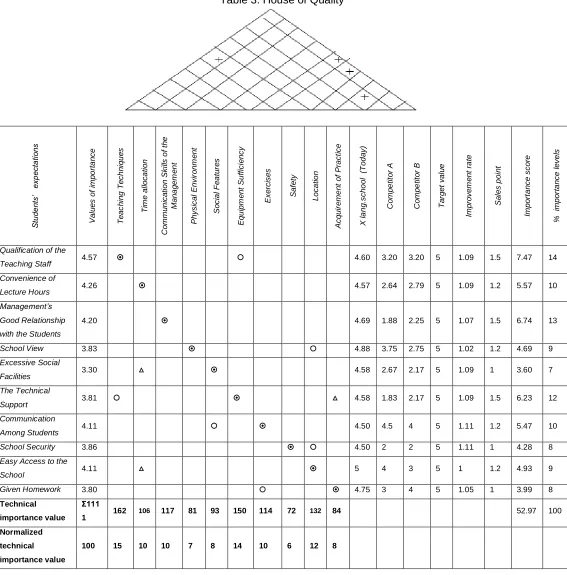
After the survey, arithmetic mean value was calculated by considering importance values that were given to every expectation and mean values were obtained for each expectation. Students’ expectations and importance values are given in Table.3.
Establishment of house of quality
Final house of quality obtained in this study is given in Table.3. The steps in the creation of the final house of quality are as follows:
Step.1: Establishment of customer expectations section: Students’ expectations that were
Licensed under Creative Common Page
10
Step.2: Establishment of technical requirements section: Student expectations were transformed into technical requirements by the QFD team. These technical requirements and related student expectations were given on the second floor of the house of quality.
Step.3: Establishment of the relationship matrix of students’ expectations and technical
requirements: The relationship between expectations and technical requirements were examined by the QFD team and the relationship matrix is formed. The symbols which is given in Table.2 was used in grading relationships. Moreover, importance values for technical requirements were determined and normalized importance values were calculated by considering these values. The relationship matrix is given in the body part of house of quality and importance values for requirements were given in the last two rows.
Step.4: Creating the correlation matrix between the technical requirements: The QFD team examined the relations of technical requirements and correlation matrix was placed on the roof of the house of quality in Table.3 (see next page).
Step.5: Creating the competition and planning matrix: In this step, a comparison is made between X language school and two competitor language schools. Competition matrix has been determined after a meeting with three teachers whom worked for other language schools and two students who also studied there. For this purpose, participants were asked to compare X language school with its competitors by considering student expectations in mind. The obtained data were given on "X lang. school (Today)", "Competitor A" and "Competitor B" columns on the house of quality in Table.3.
The values in the “Today” column show the expectation’s degree of fulfillment by X
Licensed under Creative Common Page
11
Table 3: House of Quality
St u de nt s’ e xp ec ta tio ns Va lu e s o f im p o rt a n c e T e a c h in g T e c h n iq u e s T im e a llo c a ti o n C o m m u n ic a ti o n Sk ill s o f th e M a n a g e m e n t Ph y s ic a l En v ir o n m e n t So c ia l F e a tu re s Eq u ip m e n t Su ff ic ie n c y Ex e rc is e s Sa fe ty L o c a ti o n Ac q u ir e m e n t o f Pra c ti c e X la n g .s c h o o l (T o d a y ) C o m p e ti to r A C o m p e ti to r B T a rg e t v a lu e Im p ro v e m e n t ra te Sa le s p o in t Im p o rt a n c e s c o re % im p o rt a n c e l e v e ls
Qualification of the
Teaching Staff 4.57 4.60 3.20 3.20 5 1.09 1.5 7.47 14 Convenience of
Lecture Hours 4.26 4.57 2.64 2.79 5 1.09 1.2 5.57 10 Management’s
Good Relationship
with the Students
4.20 4.69 1.88 2.25 5 1.07 1.5 6.74 13
School View 3.83 4.88 3.75 2.75 5 1.02 1.2 4.69 9
Excessive Social
Facilities 3.30 △ 4.58 2.67 2.17 5 1.09 1 3.60 7 The Technical
Support 3.81 △ 4.58 1.83 2.17 5 1.09 1.5 6.23 12 Communication
Among Students 4.11 4.50 4.5 4 5 1.11 1.2 5.47 10 School Security 3.86 4.50 2 2 5 1.11 1 4.28 8
Easy Access to the
School 4.11 △ 5 4 3 5 1 1.2 4.93 9 Given Homework 3.80 4.75 3 4 5 1.05 1 3.99 8
Technical
importance value Σ111
1 162 106 117 81 93 150 114 72 132 84 52.97 100
Normalized
technical
importance value
Licensed under Creative Common Page
12
The first column of the planning matrix, values of importance for the customers, are the values for each of the expectations obtained in the survey. These values are listed in the second column of house of quality. The target value column is determined by the QFD team. X language school aims to provide highest quality education therefore the highest level "5" is selected. Improvement rate column is obtained by dividing the values in the target column by the value in the Today column. Sales point values were determined by the QFD team as a result of discussions on taking expectations and how a development on these expectations will affect the sales point. For example, as a result of the meeting, it can be stated that developing expectations of “qualification of the teaching staff” has an effect on preferring X language school. Therefore, sales point value is determined as 1.5 for this forecast. Importance score column is calculated by multiplying the values of importance and improvement rate and sales point value. The percentage importance levels column is calculated by dividing each importance score to the total importance score.
CONCLUSION AND RECOMMENDATIONS
In this study, we aimed to reveal students' expectations for a foreign language school and improve the service quality of the institution. QFD method was used for the realization of these objectives. First, the student expectations were determined and importance values were obtained with the help of the developed questionnaire. Then expectations were converted into technical requirements, competitive analysis was done and house of quality has been created. House of quality is given in Table.3.
When house of quality is examined, it is observed that the most important student expectation is the “qualification of the teaching staff” (importance score=7.47; percent importance=14). The second important expectation is “management’s good relationship with the
students”. “The technical support” is ranked third important point among student expectations.
Therefore, these expectations with high importance should be given priority when developing students expectations and there needs to be focused on these expectations. Besides, expectations with low importance points are “excessive social facilities” and “given homework”. Other students' expectations can be interpreted in a similar manner according to the importance score and/or percent importance.
Licensed under Creative Common Page
13
expectation "qualification of the teaching staff". When the normalized importance value of
"teaching techniques" is examined, it is seen that technical requirements (normalized importance=15) is the most important technical requirement. Also, there is a moderate correlation between the expectation of "qualification of the teaching staff" and "equipment sufficiency" technical requirement. It is observed that "equipment sufficiency" is the second most important technical requirement in the house of quality (normalized importance=14). Therefore, especially improvements on “teaching techniques” and "equipment sufficiency" will play an important role in the development of the institution's quality.
When correlation matrix on the roof section of the house of quality is examined, it can be observed that there is a positive correlation between technical requirements of (i) “teaching
techniques” and "equipment sufficiency", (ii) “social features” and “acquirement of practice”, (iii)
"equipment sufficiency" and “acquirement of practice” and (iv) “safety” and “location”. So when the "equipment sufficiency" is developed, “teaching techniques” and “acquirement of practice” will also be affected positively from this development. Likewise, providing an improvement on the “acquirement of practice” will improve the “social features”. It can be argued that the improvements on “location” will provide a positive contribution to “security”. As all the correlations between technical requirements are positive in correlation matrix, there is no point of trade-off among requirements.
When the competitive matrix in the house of quality is examined, it occurs that X language school is superior than its competitors in terms of student expectations. For example, satisfaction degree of X language school for the "qualification of the teaching staff" is 4.60. The degree of satisfaction of both competitors for this expectation is the same as 3.20. So, the X language school is superior to Competitor A and Competitor B according to these expectations. Other cells in the competition matrix can be interpreted in a similar way taking into account each student's expectations.
The improvement rate column in the planning matrix located in the last four columns of house of quality is calculated by dividing the value in the target column by the value in the today column. This value shows what percentage of the institution's current performance will be upgraded. When the corresponding values are observed, it can be seen that “communication
among students” and “school security” must be improved. Sales point values are determined by
Licensed under Creative Common Page
14
Based on the results obtained from the house of quality, it has been reported to the managers of X language school that their approach is correct and the quality of education is adequate. However, in order to improve the quality, managers have been informed that teaching techniques applied by the teachers and equipment features of the school should be developed by taking new trends into account. Consequently, this study will contribute to both academic researchers working on this topic and to managers and decision-makers who target improving quality in education. The limitation of this study is the application of QFD process in a specific educational institution. Therefore students’ expectations and technical requirements were
presented in accordance with this field.
REFERENCES
Adhaye, A., 2013, Overview of QFD- A concept and implementation, International Journal of Engineering
Research &Technology (IJERT), 2, 9, 671-676.
Arı, S., 2006, Müşteri beklentilerini ürün karakteristiklerine dönüştürme aracı olarak Kalite Fonksiyon Göçerimi ve bir gıda işletmesine uygulama denemesi, Master thesis, SelçukUniversity, Institute of
SocialSciences, 130p.
Aytaç, A., 2002, Kalite Fonksiyonu Yayılımı yöntemi’nin eğitimde kullanımı: Ders müfredatının gözden
geçirilmesi, Master thesis, Kocaeli University, Institute of Science, 102p.
Aytaç, A., and Deniz, V., 2005, Quality function deployment in education: A curriculum review,
Quality&Quantity, 39, 507-514.
Bergquist, K., and Abeysekera, J., 1996, Quality Function Deployment(QFD)- A means for developing
usable products, International Journal of Industrial Ergonomics, 18, 269-275.
Boonyanuwat, N., Suthummanon, S., Memongkol, N., and Chaiprapat, S., 2008, Application of Quality
Function Deployment for designing and developing a curriculum for Industrial Engineering at Prince of
SongklaUniversity, Songklanakarin Journal of Science and Technology, 30, 3, 349-353.
Camgöz-Akdağ, H., Tarım, M., Lonial, S., and Yatkın, A., 2013, QFD application using SERVQUAL for
private hospitals: a casestudy, Leadership in Health Services, 26, 3,175-183.
Chan, L.,andWu, M., 2002, Quality function deployment: A literature review, European Journal of
Operational Research, 143, 463-497.
Chen, L., and Ko, W., 2008, A fuzzy nonlinear model for quality function deployment considering Kano’sconcept, Mathematical and Computer Modelling, 48, 581-593.
Chou, S., 2004, Evaluatingthe service quality of undergraduate nursing education in Taiwan–using Quality Function Deployment, NurseEducationToday, 24, 310–318.
Licensed under Creative Common Page
15
Das, D.,andMukherjee, K., 2008, A QFD approachtoaddressingtheimpacts of tourismdevelopment,Journal of QualityAssurance in Hospitality&Tourism, 8, 3, 1-38.
Doğu, E.,and Özgürel, B., 2008, Kalite Fonksiyon Göçerimi ile bireysel emeklilik sistemleri pazarlayan sigorta şirketlerinin teknik özelliklerinin incelenmesi üzerine bir çalışma, İşletme Fakültesi Dergisi, 9, 1,
33-45.
Gargione, L.A., 1999, Using Quality Function Deployment (QFD) in the design phase of an apartment
construction project, Proceedings IGLC-7, University of California, Berkeley, CA, USA, 357-368.
Garibay, C.,Gutiérrez, H., and Figueroa, A., 2010, Evaluation of a digital library by means of Quality
Function Deployment (QFD) and the Kano Model, The Journal of Academic Librarianship, 36, 2, 125-132.
Gauthier, B.,Sodhi, M., and Dewhurst, P., 2000, On optimization methods in the house of quality: Facilitating the early stages of product design, Proceedings of DETC’00 ASME 2000 Design Engineering
Technical Conferences and Computersand Information in Engineering Conference, Baltimore, Maryland,
1-8.
Gonza´lez, M.E.,Quesada, G., and Bahill, A.T., 2003, Improving product design using Quality Function
Deployment: The school furniture case in developing countries, QualityEngineering, 16, 1, 47-58.
González, M.E.,Mueller, R.D., and Mack, R.W., 2008, An alternative approach in service quality;
e-banking case, Quality Management Journal, 15, 1, 41-58.
Grimsaeth, K., 2005, Kansei Engineering- linkinge motions and product features, Undergraduate Thesis,
Norwegian University of Science and Technology, 45p.
Hafeez, K., and Mazouz, A., 2011, Using Quality Function Deployment as a higher education
management and governance tool, CurrentIssues of Business and Law, 6, 1, 31-52.
Huang, S.T., and Yoshida, S., 2013, Applying Quality Function Deployment (QFD) approach to the study
on improving service quality of logistics service: An empiricalstudy of home delivery industry in East Asia,
International Journal of Transport and logistics, 22, 23, 1-8.
Ictenbas, B.D., and Eryilmaz, H., 2011, Linking employers’ expectations with teaching methods: Quality
Function Deployment approach, Procedia-Social and Behavioral Sciences, 28, 568-572.
Ikiz, A.K., and Masoudi, A., 2008, A QFD and SERVQUAL approachto hotel service design, İşletme
Fakültesi Dergisi, 9, 1, 17-31.
Jaiswal, E.S., 2012, A casestudy on Quality Function Deployment (QFD), IOSR Journal of Mechanical
and Civil Engineering, 3, 6, 27-35.
Karimi, B.H., Mozafari, M.M., and Asli, M.N., 2012, Applying a hybrid QFD-TOPSIS method to design
product in the industry (Case study in sum service company), Research Journal of Applied Sciences,
Engineering and Technology, 4, 18, 3283-3288.
Koç, E., 2009, Kansei Mühendisliği kullanılarak müşteri odaklı ürün tasarımı: Web sayfası tasarımında uygulanması, Doctoralthesis, Eskişehir Osmangazi University, Institute of Science, 183p.
Kuo, H.,and Chen, C., 2011, Application of Quality Function Deployment to improve the quality of internet
shopping websitei nterface design, International Journal of Innovative Computing, Information and
Licensed under Creative Common Page
16
Leary, M., Burvill, C., and Weir, J., 2005, Proposed Quality Function Deployment Enhancements,International Conference On Engineering Design, Iced 05, Melbourne, August 15-18, 1-13.
Leber, M., Polajnar, A., and Buchmeister, B., 2000, Using benchmarking and QFD in the product
development, 16th. International Measurement Confederation (IMEKO).
Mahaptra, S.S, and Mohanty, P.P., 2013, Design of office chair: A Quality Function Deployment
approach, Advanced Materials Manufacturing &Characterization, 3, 1, 131-136.
Mazur, G., 1996, The application of Quality Function Deployment (QFD) to design a course in total quality management (TQM) at the university of Michigan College of Engineering, ICQ’96, Yokohama, 1-8. Mazur, G., 1997, Voice of customer analysis: A modern system of front-end QFD tools, with casestudies.
AQC, QFD Institute.
Militaru, C., Burghelea, C., Ştefan, D.L., Zanfir, A., 2014, QFD- A modern method of products
development in the textile and clothing industry, International Journal of Academic Research in
Accounting, Finance and Management Sciences, 4, 3, 89-96.
Ng, M.C.F., and Wang, X., 2007, Collaborative decision-making: Design process toward integrated
product design, IASDR07, International Association of Societies of Design Research, The Hong Kong
Polytechnic University.
Olcay, E., 2007, TS EN ISO IEC 17025 standardının Kalite Fonksiyonu Yayılımı ve çok ölçütlü karar
verme teknikleri ile analizi, Master thesis, Gazi University, Institute of Sciences, 180p.
Öter, Z.,and Tütüncü, Ö., 2001, Turizm işletmelerinde Kalite Fonksiyon Göçerimi: Seyahat acentelerine yönelik varsayımsal bir yaklaşım, Dokuz Eylül Üniversitesi Sosyal Bilimler Enstitüsü Dergisi, 3, 3, 95-117. Özdamar, K., 1999, Paket programlar ile istatistiksel veri analizi, Cilt 1-2, Eskişehir, Kaan Kitabevi.
Park, S., Ham, S., and Lee, M., 2012, How to improve the promotion of Koreanbeefbarbecue, bulgogi, for
international customers. An application of Quality Function Deployment, Appetite, 59, 324-332.
Prasad, K.G.D., Subbaiah, K.V., Rao, K.N., and Sastry, C.V.R.S., 2010, Prioritization of customer needs
in house of quality using Conjoint Analysis, International Journal for Quality Research, 4, 2, 145-154.
Qureshi, M.I., Khan, K., Bhatti, M.N., Khan, A., and Zaman, K., 2012, Quality Function Deployment in
higher education institutes of Pakistan, Middle-East Journal of Scientific Research, 12, 8, 1111-1118.
Ronney, E.,Olfe, P., and Mazur, G., 2000, Gemba research in the Japanese cellular phone market, Nokia
and QFD Institute, 17p.
Sahay, A.,and Mehta, K., 2010, Assisting higher education in assessing, predicting, and managing issues
related to student success: A web-based software using Data Mining and Quality Function Deployment,
Academic and Business Research Institute Conference,1-12, LasVegas.
Savaş, H.,and Ay, M., 2005, Üniversite kütüphanesi tasarımında Kalite Fonksiyon Göçerimi uygulaması, Dokuz Eylül Üniversitesi Sosyal Bilimler Enstitüsü Dergisi, 7, 3, 80-98.
Shahin, A., 2008, Quality Function Deployment (QFD): A comprehensive review, in: Total Quality
Management-Contemporary Perspectives and Cases, Rajmanohar, T.P. (ed), 1st edition,
Licensed under Creative Common Page
17
Shimomura, Y., Hara, T., and Arai, T., 2008, A service evaluation method using mathematicalmethodologies, CIRP Annals-Manufacturing Technology, 57, 437-440.
Singh, V.,Grover, S., and Kumar, A., 2008, Evaluation of quality in an educational institute: a Quality
Function Deployment approach, Educational Research and Review, 3, 4, 162-168.
Sirias, D., 2012, An experiential learning activity to teach the main Quality Function Deployment matrix,
International Journal of Business, Humanities and Technology, 2, 1, 76-81.
Suliyev, T., 2007, Müşteri beklentilerinin Kalite Fonksiyon Yayılımı ile analiz edilmesi ve gıda ambalajı
sanayinde örnek bir uygulama, Master thesis, Gazi University, Institute of SocialSciences, 127p.
Şaştım, Ö.,Yüzükırmızı, M., Ersöz, S., Türker A.K., Birgören, B., and Toklu, B., 2006, Kalite Fonksiyon Göçerimi tekniğinin endüstri mühendisliği eğitim müfredatında uygulanması, 2. Ulusal Mühendislik Kongresi Bildiriler ve Poster Kitabı, 181-191, Zonguldak.
Tatar, E., 2007, Konaklama işletmelerine dönük bir Kalite Fonksiyon Yayılımı uygulaması, Master Thesis, Dumlupınar University, Institute of Science, 72p.
Tu, C.,Chang, C., Chen, K., and Lu, H., 2010, Applying an AHP-QFD conceptual model and Zero-One
Goal Programming to requirement-based site selection for an airport cargologistics center, International
Journal of Information and Management Sciences, 21, 407-430.
Uğur, N., 2007, Bir üçüncü parti lojistik şirketinde Kalite Fonksiyonu Yayılımı uygulaması, Istanbul
Technical University, Institute of ScienceandTechnology, Master thesis, 269p.
Üçler, Ç.,Vayvay, Ö., and Çobanoğlu, E., 2006, Customer-focusedproductdevelopmentand a casestudy in Turkishrefrigerator market, İstanbul Ticaret Üniversitesi Fen Bilimleri Dergisi, 5, 10, Fall 2006/2, 81-97. Vurmaz, Y., 2009, Hizmet kalitesinin iyileştirilmesinde Kalite Fonksiyon Yayılımı yaklaşımı ve Otokoç uygulaması, Master thesis, Eskişehir Osmangazi University, Institute of SocialScience, 114p.
Yıldız, Z., Ayhan, S., and Erdoğmuş, Ş., 2009, The impact of nurses' motivation to work, job satisfaction, and sociodemographic characteristics on intention to quit their current job: An empirical study in Turkey,
Applied Nursing Research, 22, 113-118.
Yıldız, M.S.,and Baran, Z., 2011, Kalite Fonksiyon Göçerimi ve homojenize yoğurt üretiminde uygulaması, Ege Akademik Bakış, 11, 1, 59 -72.
Zaim, S.,and Şevkli, M., 2002, The methodology of Quality Function Deployment with crisp and fuzzy
approaches and an application in the Turkish shampoo industry, Journal of Economic and Social
Research, 4, 1, 27-53.
Zhang, F., Yang, M., and Liu, W., 2014, Using integrated Quality Function Deployment and theory of
innovation problem solving approach for ergonomic product design, Computers & Industrial Engineering,