Licensed under Creative Common Page 1
http://ijecm.co.uk/
ISSN 2348 0386
EVOLUTION OF THE CONCEPT OF INNOVATION AND ITS
RELATIONSHIP WITH PRODUCTIVITY & COMPETITIVENESS
Jefferson Lopes La Falce
FUMEC University, Brazil [email protected]
Cristiana Fernandes De Muylder
FUMEC University, Brazil [email protected]
Maria Barbosa Lima Toivanen
VTT - Technical Research Center of Finland, Finland [email protected]
Abstract
This theoretical essay is focused on the Innovation theme, its evolution and impacts over
productivity and competitiveness. It started revisiting a literature, which confirmed that
innovation covers several knowledge areas and, under an economical perspective, it is an
important factor to analyze the development and growth of a country. Throughout of studies and
researches about innovation, which started with Schumpeter, innovation has been studied
mostly in function of its impacts, its diffusion, its absorption capacity, differentiated as to its
typology and its relationship with the government and industry. Throughout these years of study,
several measuring methods have been proposed, being that its relation with productivity and
competitiveness is still highlighted in the academy’s researches. However they stress the need
of a model for an empirical evaluation of the relation between these constructs. It is proposed,
at the end, an analysis’ model to measure the innovation’s impacts on productivity and
competitiveness.
Licensed under Creative Common Page 2
INTRODUCTION
Innovation is still an important issue in the discussion, both in the academy and in the public and private spheres. However, the there is still a lack of comprehensive models of how to measure impacts of investments in innovation over several topics that interest industries, just to mention a sphere of the productive sector, such as productivity, competitiveness, economic spillovers, even though the theme has been the object of study throughout the last century up to the present date. It is the intention, by means of a theoretical essay, to describe and discuss innovation, it evolution and impacts on productivity and competitiveness.
The term innovation appeared around 1912, when Schumpeter incorporated it in the economic concepts of the time, in the article “The theory of economic development”. Although the innovation’s concept that was proposed by him has evolved throughout the years, the original ideas were maintained, especially the importance of innovation as an inducer to the economic development, both to an industry as also to a country.
Some researches about the theme tried to understand the causes and consequences of the adoption of innovation in an organization, among them the ones of Boyne, Farrell, Law, Powell and Walker (2003), Osborne and Gaebler (1992) and Tidd, Bessant and Pavitt (2005), while other researches are focused on a favorable or unfavorable scenario for innovation, as the ones cited by Damanpour and Schneider (2006), Kearney, Barry and Carmine, (2000), Kimberly and Evanisko (1981), Moon and deLeon (2001). It is noteworthy to point out here the understanding of the causes and consequences could be impracticable if it were not for the efforts to create an innovation’s taxonomy and the future developments of this field, such as the typologies that are presented in the Oslo Manual (2007), that allow a better empirical evaluation of this area’s studies.
Licensed under Creative Common Page 3
It is possible to verify, throughout this essay, that innovation is descripted in an ample manner in the literature and that the studies can be done in several levels of analysis, such as microeconomic, macroeconomic, within a systemic approach, in an organizational level, addressing methodological issues, among other perspectives (Castellacci et al., 2005).
Joseph Schumpeter’s work is one of the studies that inspired the innovation researches within the mainstream’s field in the economic area. This has been developed as a multidisciplinary field with the objective of understanding and studying the relationships between the economic performance, technologies, organizations and institutions (Castellacci et al., 2005). Schumpeter (1934) points out that the businessman’s function, in a role of combining the existing resources with the objective of seeking innovation, as a form to obtain new products, new processes, and new sources to supply raw material, new markets and organizational changes.
Corroborating with Schumpeter’s, Castellacci et al. (2005) conclusions confirmed that the great interest about this author’s theories started in the in the beginning of the 80s, with the contribution of several authors, such as Dosi (1982), Nelson and Winter (1982), and also a line of study called Neo-Schumpeterian with its representatives (Freeman, 1982). These last ones tried to understand the economic growth and the innovation’s role in the economic development process.
Castellacci et al. (2005) discussed what they considered the four research lines that were done up to then, as follows: innovation in the organizations, the innovation’s systemic levels, the sectorial innovations and the macro-economic innovations. However, the authors also highlight the researches that have being neglected and the methodological challenges made to compose the researches’ agenda in innovation. The author cites as examples of future studies the globalization and the relationship with the innovation systems, the innovation in the organization’s different levels, the innovation in industries with low technology called “Low Tech”, the innovation in services, the innovation’s sectorial differences, the innovation’s impacts, always giving emphasis in productivity and competitiveness as important indicators of the construct and lastly, he highlights innovation and employability as themes that should compose this area’s research agenda.
Licensed under Creative Common Page 4
DEVELOPMENT
It is quite common to find in the academic literature innovation being treated by two economic approaches: the Schumpeterian approach and the neo-Schumpeterian approach. Both approaches highlight the importance of innovation in the economic scenario. However, the difference between the two of them is that the neo-Schumpeterian line of study starts by understanding the technical progress as an important part of the economic activity. The competition has also a new perception for the neo-Schumpeterian line of thought; according to Kupfer and Hasenclever (2002) it is in constant transformation and adaptation due to the changes in the external environment. Another important contribution from this line of study was the studies about the innovation’s diffusion and adaptation.
Understanding that the difference of these lines of thought are available in the academic literature, the objective of this theoretical essay was to show innovation by the construct’s evolution perspective, suggesting in this manner, a new way of seeing this theme.
A bibliometric research, carried out by Fagerberg and Sapprasert (2011), which evaluated the ISIS WEB publications of 1994 up to 2010, shows that most of the scientific publications about innovation are divided in four lines of study, the first being more focused on the innovation’s evolutionary conceptual base, with authors like Schumpeter (1911); Nelson and Winter, (1982); Rosenberg, (1982). They addressed the role of this theme in the companies and its impact in the long term economic changes. The second line can be classified as interpretive, being composed by researches that reflect accumulated knowledge up to that moment, which was about innovation and/or diffusion, being that this line of thought has authors that defend it, such as Freeman (1974) and Rogers (1962). The third line, which addresses innovation as a competitive advantage for a company, has Freeman (1987) as its most important author, who evaluated the impacts of the Japanese organizations’ innovation systems. Finally, there is the line of study that evaluates the impacts of innovation in the countries’ political and economic development. Nelson (1959), Freeman (1987) and Lundvall (1988) are authors that can be recognized as part of this line of study, which has the objective of evaluating the economic growth as the result of innovation and the diffusion of technologies.
Licensed under Creative Common Page 5
Table 1 - The 10 most important publications about innovation before 1985
Authors Title Year of
Publication
Impact Factor J-Index
Nelson, R R e Winter, S An Evolutionary Theory of Economic Change 1982 18.66
Rogers, E M Diffusion of Innovations 1962 17.22
Freeman, C The Economics of Industrial Innovation 1974 16.27
Schumpeter, J A The Theory of Economic Development 1912 14,83
Pavitt, K Sectorial Patterns of Technical Change: Towards Taxonomy and a Theory
1984 11.96
Arrow, K Economic Welfare and the Allocation of
Resources for Invention
1962 11
Rosenberg, N Inside the Black Box 1982 11
Schumpeter, J A Capitalism, Socialism, and Democracy 1942 8.61
Nelson, R R The Simple Economics of Basic Scientific Research
1959 8.13
Solow, R M Technical Change and the Aggregate
Production Function
1957 7.66
Burns, T and G M Stalker The Management of Innovation 1961 7.66
Source: Fagerberg and Sapprasert (2011, p.5)
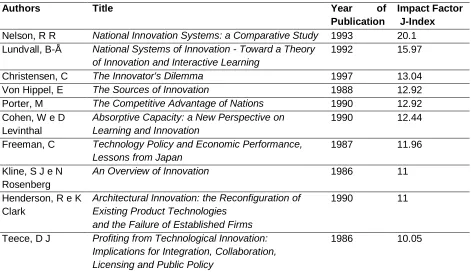
The following Table shows the authors who addressed innovation as the main focus of their publications after an ample propagation of the theme (after 1985) (Fagerberg and Sapprasert, 2011).
Table 2 – The 10 most important publications about innovation after 1985
Authors Title Year of
Publication
Impact Factor J-Index
Nelson, R R National Innovation Systems: a Comparative Study 1993 20.1 Lundvall, B-Å National Systems of Innovation - Toward a Theory
of Innovation and Interactive Learning
1992 15.97
Christensen, C The Innovator's Dilemma 1997 13.04
Von Hippel, E The Sources of Innovation 1988 12.92
Porter, M The Competitive Advantage of Nations 1990 12.92
Cohen, W e D Levinthal
Absorptive Capacity: a New Perspective on Learning and Innovation
1990 12.44
Freeman, C Technology Policy and Economic Performance, Lessons from Japan
1987 11.96
Kline, S J e N Rosenberg
An Overview of Innovation 1986 11
Henderson, R e K Clark
Architectural Innovation: the Reconfiguration of Existing Product Technologies
and the Failure of Established Firms
1990 11
Teece, D J Profiting from Technological Innovation: Implications for Integration, Collaboration, Licensing and Public Policy
1986 10.05
Licensed under Creative Common Page 6
As the result of several researches, the innovation theme has been associated with variables that try to evaluate and explain its impacts and possibilities, such as: competitiveness, R&D, learning, knowledge and productivity (Fagerberg e Sapprasert, 2011).
It is possible to observe with what was exposed by Fagerberg and Sappraset (2011) that the discussions about innovation initiated its evolution using the economic perspective by the theorists quoted in Frame 1. For this reason, it is interesting to deal with this perspective, which will be the object of the next subchapter.
Innovation and economy
From the economy’s standpoint, it is important to point out that it is not possible to state exactly when the innovation term was initially used, for there are several examples in history that could be considered as innovation. However, with regards to the use of the word in the literature, it is speculated that Schumpeter was the first to use formally the word innovation. Nevertheless, Adam Smith had already spoke about innovation (even that he did not specifically use the word innovation) when he defended free trade.
Adam Smith (1983) defended the idea of liberal economy so that the private industries could have autonomy and conditions to develop without the State’s direct participation and intervention. For him, the market would be regulated by free competition, which would leave the companies in a constant search of competitiveness, in other words, they would have to adapt themselves to the market’s needs and to be in a continuous search for adequate prices, products and processes in development (this can be considered as an innovation and new production processes’ techniques). Even so, Smith (1983) did not deny the State’s importance for, in some cases, the author considers its participation important. According to the author, “the State would have three important functions: 1. defend the nation; 2. promote justice; 3. carry out the necessary social work that what the private initiative could not promote on their own” (Smith, 1983, p. 28).
Licensed under Creative Common Page 7
discusses about the changes in the production processes, whether in technology-based or in working processes, and their positive impacts on the economy. The author also points out that these impacts can provide development as a discontinuity of a current situation that occurs in an industry or market. For him the capacity to implement changes can differentiate an organization and this will allow the organization to establish a more competitive position, and lastly, these changes will also have an impact on the economy and the growth of a country.
Schumpeter (1930) states that technological innovation, after being introduced into products and absorbed by the market, ceases to contribute to the economic strength. After the innovation’s diffusion and absorption by the other market’s companies, a recessive process will begin, with a low offer of jobs and a reduction of investments. In this sense, he highlights the importance of a cyclic innovation process. The author introduces the fundamental impulse concept in the economy, where this impulse becomes necessary to maintain the capitalism’s movement by means of new inputs, consumers’ goods and new production methods, processes, new markets and that also includes new organization forms, that can be industries or other organization forms of the capitalism system
About innovation, Schumpeter (1930) still highlighted that the production process is a combination of forces from the productive chain that is composed by the sum of materials and of part of the “immaterial”, or in other words, the intangible. The innovation described by Schumpeter (1930) can happen by several forms:
a) New goods made available to the consumer;
b) New production methods, currently considered new processes; c) New inputs, raw-material or semi-finished products;
d) Reorganization of an industry; creation of a new organization or dismemberment of a monopolistic structure.
Schumpeter (1949) further differentiates the innovation from adaptation. For the author, adaptation is a process that an organization seeks for what is essential for its productive processes, since innovation seeks for the differentiation, being this considered a competitive advantage.
Licensed under Creative Common Page 8
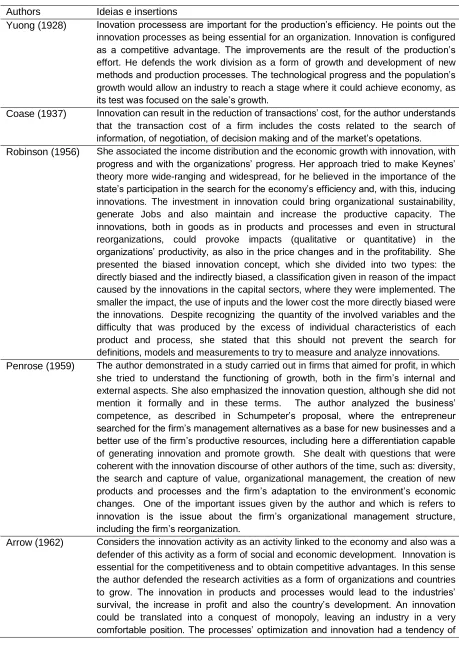
Table 3 – The evolution of the lines of thought about innovation
Authors Ideias e insertions
Yuong (1928) Inovation processess are important for the production’s efficiency. He points out the
innovation processes as being essential for an organization. Innovation is configured as a competitive advantage. The improvements are the result of the production’s effort. He defends the work division as a form of growth and development of new methods and production processes. The technological progress and the population’s growth would allow an industry to reach a stage where it could achieve economy, as its test was focused on the sale’s growth.
Coase (1937) Innovation can result in the reduction of transactions’ cost, for the author understands
that the transaction cost of a firm includes the costs related to the search of information, of negotiation, of decision making and of the market’s opetations.
Robinson (1956) She associated the income distribution and the economic growth with innovation, with progress and with the organizations’ progress. Her approach tried to make Keynes’ theory more wide-ranging and widespread, for he believed in the importance of the state’s participation in the search for the economy’s efficiency and, with this, inducing innovations. The investment in innovation could bring organizational sustainability, generate Jobs and also maintain and increase the productive capacity. The innovations, both in goods as in products and processes and even in structural reorganizations, could provoke impacts (qualitative or quantitative) in the organizations’ productivity, as also in the price changes and in the profitability. She presented the biased innovation concept, which she divided into two types: the directly biased and the indirectly biased, a classification given in reason of the impact caused by the innovations in the capital sectors, where they were implemented. The smaller the impact, the use of inputs and the lower cost the more directly biased were the innovations. Despite recognizing the quantity of the involved variables and the difficulty that was produced by the excess of individual characteristics of each product and process, she stated that this should not prevent the search for definitions, models and measurements to try to measure and analyze innovations.
Penrose (1959) The author demonstrated in a study carried out in firms that aimed for profit, in which she tried to understand the functioning of growth, both in the firm’s internal and external aspects. She also emphasized the innovation question, although she did not mention it formally and in these terms. The author analyzed the business’ competence, as described in Schumpeter’s proposal, where the entrepreneur searched for the firm’s management alternatives as a base for new businesses and a better use of the firm’s productive resources, including here a differentiation capable of generating innovation and promote growth. She dealt with questions that were coherent with the innovation discourse of other authors of the time, such as: diversity, the search and capture of value, organizational management, the creation of new products and processes and the firm’s adaptation to the environment’s economic changes. One of the important issues given by the author and which is refers to innovation is the issue about the firm’s organizational management structure, including the firm’s reorganization.
Licensed under Creative Common Page 9
using in a more efficient way the human resources, having as result an improvement in the industry’s production activities. For him the radical innovations made it possible to have higher gains with fewer resources.
Richardson (1972)
Richardson (1972) had his attention on the relationships and in the coordination’s forms, interaction and planning mechanisms that were used by the industry. According to the author, this interaction process had an impact on the market’s actions and in its relationship with the economy. He adds that the organizations that have relationships with other organizations also present growth through the synergy between them and the sharing among them of resources, here it is highlighted the role of technology transfer and joint innovation processes. He states that every structuring of the production chain, which includes the productive, technological and institutional factors, produces new forms of organizations (organizations within organizations) that should be understood in order to understand the economic dynamic. The understandings of innovative activities, for these are the result of this cooperation.
Rosenberg (1979)
For him, both Schumpeter as also the neoclassic theory left aside important aspects, such as the innovations’ singularities and their transformations. The radical innovations as the source of explanations of the economic process did not explain totally the economy’s variations. Thus, he identified the innovations’ singularities and their transformations, which appear over time. The political and socioeconomic contexts are also considered by Rosenberg as determinants for the occurrence of innovations. He presented four types of instruments that, from an historical point of view, have influence over the decision process within the industries, about the direction towards innovation: the interdependence of the industrial processes, or as called by him, the technological bottlenecks; the interest in substituting the capital by work, present in the capitalist point of view to reduce the risks associated with the workers’ resistance; the access to raw-material; and, lastly, the technological regulation, especially the ones that have the objective of protecting human health and the reduction of the environmental impacts. Being able to overcome and manage these variables determined and had influence over the technological path that was taken by the organization, making it necessary, in this manner, to also understand these variables in order to understand how the innovations appear.
Licensed under Creative Common Page 10
advantages. The macro-economic efficiency, generated by the comparative advantages, will also depend of the micro-economic factors, highlighting, for example, price and income. Thus the trade-offs of this relationship depend in the technological capacity of each culture or country. He also proposes a manner to understand how economic and technological dynamics of a country happens. His taxonomy uses the following variables:
a) capacity building of a scientific and technological system to organize and facilitate the innovative activities;
b) innovative and technological capacity building of the economic agents; c) the pattern of economic signals that can standardize the agents responses. d) the market’s organizational forms (competition, cooperation) and its
interaction, incentives and restrictions to the economic agents for innovation.
The economic perspective tried to understand the innovation’s role and its contribution in the economic scenario, as it is possible to observe in Frame 3. But it was not only by the economic focus that the innovation was treated to better understand this phenomenon. The theme had also as a debate the forms that innovation is propagated and its absorption’s capacity.
Innovation: Dissemination and Absorption
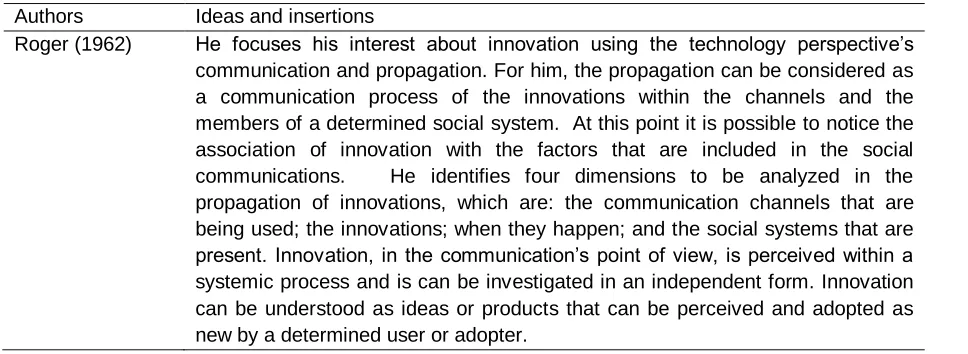
With the proliferation of innovation studies, several elements have been studied with the objective of filling gaps about this theme. An example of this point of view is the studies that are focused in the propagation of knowledge and of the innovations that are generated and the need to understand the capacity of absorption of the innovations that are generated. It is an important theme with regards to the innovation’s management practices within the organizations. Table 4 presents the authors that contributed to the development and understanding of how the innovations are propagated and what is its absorption capacity and its importance for the organizations.
Table 4 – Propagation and absorption capacity of innovation
Authors Ideas and insertions
Licensed under Creative Common Page 11 Silverberg, Dosi
and Orsenigo (1988)
They sought to understand the relation between innovation and the dissemination process of new technologies. To do this they elaborated 4 dimension of understanding. The first one is that the heterogeneity (1) of the several firms that form the market, transforms the propagation as also the innovation processes into variables, and the results, such as productivity and quality of the goods that were produced, are related to the organizations that are ahead of the others in their management models.
Competitiveness varies according to the asymmetry (2) of the many management models in the firms and of the constant search for new technology (3) that can keep them in a prominent position with competitive advantage. The authors also identified that the firms that can be considered imitators or reactive try to absolve and improve the innovations that were produced by the firms that introduced these innovation, which makes the market innovative competitive and, at the same time risky, for these new innovative imitations (4) absolve the first firms’ profits but, according to the authors, they also contribute for the propagation process of this innovation. Another important point covered by the authors is about the intensity of the other points that were mentioned by them, asymmetry, imitation process and the innovations’ propagation. This intensity is determined by other variables, suffers constant changes and makes the technologies propagation a non-static process and, at this point, the authors state that the measuring instruments should be adapted to be able to interpret the reality.
Arthur (1989) The numbers of adopters has influence in the decision to adopt a determined technology in the future. If an organization launches a technological product and if this product has a positive share in the market, or has a large number of adopters, it will have a great influence over the launches of future innovations, working as a type of reference for the consumers. The entrapment in a determined technological trajectory is something that the companies should pay attention to; the author states that an important strategy is the external stimuli, such as how to purchase from a determined sector or government, which can generate “exogenous shocks” that stimulate a possible adoption of new users and generate an entrapment, in other words, an external interference on the proposed model, trying to make an innovation a reference to “lock-up a technology”, that is, to make it a permanent standard.
Cohen and
Levinthal (1990)
For an innovation to occur, it is important that the industries have a wide range of knowledge and that they also have the capacity to absolve new knowledge. They present a new concept, the one of absolving capacity, which is fundamental for the organizations to be capable of understanding the learning and assimilation process of the knowledge that was generated. For them, the industries should keep in mind that the innovations of products and processes do not only originate from research and development (R&D), but also from the capacity to absolve information and develop abilities within their task environment. The codification of knowledge into tacit and explicit makes the absolving easier and, therefore, the practice of knowledge management should be stimulated by the organization.
Licensed under Creative Common Page 12
Among these studies it is still possible to highlight Cohen and Levinthal’s (1990) ideas, which include there important points for understanding the innovation generation context within the organization. The first is how an organization learns, understanding here the absolving capacity generated by the activities that were undertaken by the organization. The ability of how the firm obtains technology is the second point that was discussed by them and is linked with learning by doing, learning to learn and with exploring opportunities in the task environment. The last is the question of the organizations’ institutional decisions in favor of developing innovation. The authors also warn the industries that they should consider the efforts to obtain knowledge and how to apply it also as a main activity (Cohen and Levinthal, 1990).
As the theme progressed, it became an important issue to further develop the phenomenon’s classification. The group of researchers that dealt with this subject contributed with the development of the innovation’s typologies. This will be the object of study in the next subchapter.
Innovation’s Taxonomy
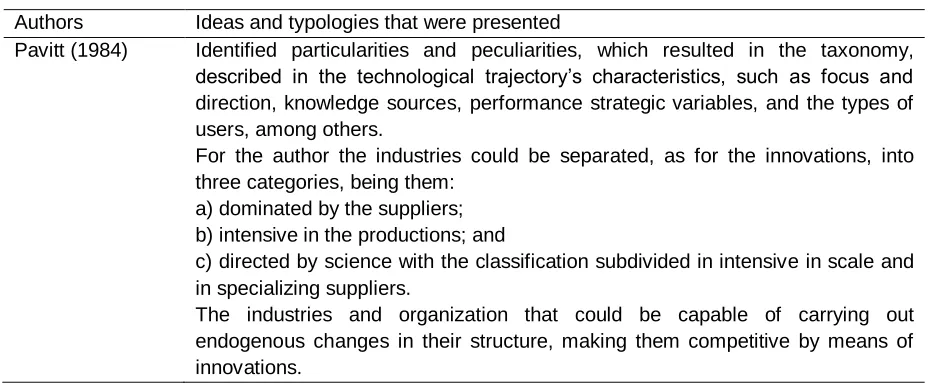
In this subchapter, the innovation’s taxonomy will be presented, which was proposed by Pavitt in 1984 and complemented by several authors and is currently part of the Oslo’s manual, an important publication to regulate the different types of innovation. Pavitt (1984) modernized the literature about innovation when he inserted the innovation’s sectorial taxonomy and technologies standards, filling a theoretical gap that existed at the time. The objective of Table 5 is to present the taxonomy’s evolution proposed by Pavitt (1984) and its evolution up to this present moment.
Table 5 – Innovation’s Taxonomy proposed by Pavitt
Authors Ideas and typologies that were presented
Pavitt (1984) Identified particularities and peculiarities, which resulted in the taxonomy, described in the technological trajectory’s characteristics, such as focus and direction, knowledge sources, performance strategic variables, and the types of users, among others.
For the author the industries could be separated, as for the innovations, into three categories, being them:
a) dominated by the suppliers; b) intensive in the productions; and
c) directed by science with the classification subdivided in intensive in scale and in specializing suppliers.
Licensed under Creative Common Page 13 Freeman (1987) Incremental
Radical
Changes in the technological system
Changes in the Techno-economic paradigm. Carvalho (2009)
and Coral (2009)
Radical Incremental Damanpour
(1991)
Administrative Technological Of product Of process Radical Incremental Manual de Oslo
(2007)
Product Process Marketing Organizational
Tidd (2008) Product
Process Position Paradigm
It is possible to notice that the innovations’ typifying process has been structured over the past decades. Although it is possible to notice small differences in the nomenclatures and proposals and of the authors, one can say that their ideas are similar and strengthen the typologies that exist in the Oslo’s manual, which the most recent edition is of 2007, descripted in Table 5.
As defended by Pavitt (1984) it is understood that the taxonomy process and the innovations’ typification contribute in understanding this construct and also in evaluating the innovations’ impact in the organizations and in the economy.
Research and Innovation
It is believed that innovation and research activities are interconnected, however it is not known for certain when the theoretical discussion about this relationship began. It was Mees (1920) that presented a debate about the importance of research with improvements and, even that he did not use the word innovation, it is possible to perceive the same meaning in his work.
Licensed under Creative Common Page 14
The relationship between the scientific researches’ results and the industries performance, as well as the importance of the academic results’ alignment and the market and industries’ demands still was not consolidated in the literature. Nelson (1959) contributed taking advantage of this gap and points out the importance of investments in scientific research aligned with the industry’s needs. For him, however, it is necessary to have a cost planning for investment in research. If the costs are considered relatively low, the organization should have a commitment with these values in order to be able to search for innovation. He does not state that when the costs are high, this investment should be avoided, but he instigates about the importance of the government’s participation with the investment focused of science, technology and economic development. In other words, he suggests that when the costs are considered high for the industry, they should be claimed or stimulated by public policies to promote and encourage the development of researches.
The State, universities and industries’ joint action forms the development component that Nelson (1959) claims to be the base for innovation. He defends the necessity to strength the research areas in the universities and industries and declares that a strengthened science is capable of making inventions and new products feasible and, in this manner, make it possible for the industry to be more productive and, consequently, more competitive.
The relation between science, research and industry proposed by Mees (1920) and improved by Nelson (1959) had its continuity in Rosenberg’s (1982) works. The importance of this author is in the understanding of the relationship between science and technology in the industries. This author tries to explore the interactions which the science and its institutionalization have to go through in the industrial and economic context. For him, the scientific questions are formed starting from the industrial structure. In this sense, the technological advances can generate economic progress, based on the scientific knowledge generated in favor of the society’s development, having, however, to be originated from a programmed science function based on the need of technological development and the industry’s demands. Innovation is fundamental for productivity and financial profitability, being also important to consider innovation as an alternative that has been generated but also remembering the problems that can result from it (Rosenberg, 1982).
Licensed under Creative Common Page 15
Innovation’s Determinants and the National System of Innovation and Triple Helix
From where does the necessity of innovation come from? From Private or Public Initiative? From the market’s demand or from the government’s guidance? These are questions that Freeman(1976) studied to understand the behavior and direction of the innovation phenomenon and the researches that generate new ideas. Some authors, such as Freeman (1974), Lundvall (1988), Leydesdorff and Etzkowitz (1996, 1998); Leydesdorff (1997) dedicated themselves to study these issues, being possible to identify among them the representatives of two lines of thought. One claims that the market’s demand was the inducer of innovation and the other, which claimed that the government’s interactions had an impact in the development of innovation, hence the need for stimuli given by the State for the economic development.
The following objective is to present the consolidation of ideas of some of the authors that contributed with the innovation’s construct. One realizes advances starting from Freeman’s proposal in 1976 and the emergence of models focused in explaining the innovation’s determinants, being the focus of this section the discussion about the National Innovation System (NIS) and the triple Helix model that, according to Fargerberg and Sapprasert (2011), are mentioned in several of the academy’s studies. It was not the intention to declare that these are the best or the most used models. Table 6 shows the authors and their contribution.
Table 6 – Contributions about the National Innovations’ System and the Triple Helix Model
Authors Ideas and Contribuitions Freeman (1974;
1976)
Licensed under Creative Common Page 16 unplanned or disarticulated decisions, which can also boost the countries’ technological progress. It incorporates the intellectual capital as one of the countries’ constant indicators with regards to the nations’ wealth.
Lundvall (1988) He stated that innovation cannot be explained in a simple manner, for, since it is focused on micro-economy, which uses static incipient information for decision making, would not be adopting an adequate model of evaluating the innovations. However, he defends the State’s intervention as an inductor of innovations in the economy, as the actor responsible in promoting, stimulating the innovation and the cooperation as a form of promoting the country’s economic and social development. He further observes that the universities would have a more important and useful role if they interacted more with the industries. This type of interaction, in the author’s vision, would have the capacity of producing the necessary innovations. What is important to point out in this sense is the importance of knowledge, with the learning focused on the industrial’s necessity. Leydesdorff and
Etzkowitz (1996, 1998);
Leydesdorff (1997)
They claim that the innovation process is very complex and that it needs a definition of the limits in the generated production of knowledge. For them, the model proposed by Freeman (1974) in the NIS is not capable of capturing all the interactions that are present in the environment. The idea of the model called triple helix is to identify the three spheres’ interfaces and boundaries: the authors’ proposed by the authors, universities, industries and government. For them the understanding of the role of each sphere will allow the understanding of the role and communication flow and exchange of knowledge of each actor involved in developing innovations. They also claim that this understanding allows that each participant to assume the others role due to the model’s transparency. They still declare that it is an innovation analysis model inserted in an economic environment and based on knowledge.
It is possible to observe that the discussions about NIS and the triple helix model are not congruent and it is noticeable that both lines of thought differ over which is the most appropriated model and that represents the perceived reality. However, it is possible to notice here some of the interaction points, such as the interaction between the public and private sectors generating innovation and also the importance of the universities as a support to generate innovation. It is believed that this theme is still in discussion and still represents an area of possible studies in the academy.
Defending the importance of measuring the results in innovation
Licensed under Creative Common Page 17
As the discussions of theoretical, epistemological and economic nature related to innovation were expanding, there was the need of understanding the innovation’s impact both in the economy in general, as also in the industries, specifically in terms of technological development. One of the authors that contributed towards this discussion was Mansfield. Mansfield (1968; 1972; 1977; 1982) shows the importance of measuring the impact caused by innovation and its propagation within the economic activities. In this sense the propagation was perceived by him as a mimetic process of an existing technology.
Mansfield developed a quantitative model that tried to explain the innovation’s impacts and his main result was to obtain the propagation’s rate as the profitability generated by the produced innovation. His model showed the innovation’s impacts over the demand’s price and also over the reduction of the production cost. Considering these results, innovation started to be perceived not only in the morphological aspect, but it can also be understood and explained as a measurable economic variable.
Despite giving importance to the innovation’s metrics, Mansfield (1977) was critical about the econometrics that were carried out in his time because he thought that the form that it was used was well below from what was really needed. For him the relationship descripted by the economists at that time, between economy and technology, was not capable of explaining with precision this relationship. According to Mansfield (1977) it is not possible to understand or explain a growth of productivity only with relation to new inputs or technology, but that it is important to consider the context of these occurrences.
Another important point noticed by Mansfield (1977) is the complexity of the innovation delineated in several sectors, having these sectors distinct characteristics and, therefore, capable of having influence over the technological changes. The author defended the innovation’s analysis and explanation, covering several factors and perspectives, where hybrid models were needed. One of Mansfield’s (1982) important points is the need to measure the successful innovations together with innovations that were not a success.
Licensed under Creative Common Page 18
Nelson and Winter (1982) studied the innovations within the production perspective and the transformation generated by it, in search of evidences that would prove the innovation’s impact over the productivity in firms, industries and in some specific sectors of the economy. The study also tried to identify the articulation of evidences that were found under a new perspective, that being that the innovations are influenced by an environment of uncertainty and that is also highly competitive, being that the first aspect makes the decision process difficult for the managers and the second aspect is an environment that has disequilibrium and is considerably complex for the analysis of innovations. In this sense the authors’ idea was to construct a form of analyzing innovations, considering these two aspects. This new perspective was then divided into two phases: the first being the understanding of the innovations’ generation and propagation process and the second, the understanding of the competitive process where the firms have as characteristics the complexity and the organizational diversity.
With regards to the limited rationality, Nelson and Winter (1982) declare that the maximization occurs from the objective function, in other words, profit versus usefulness as a fundamental factor of the decision making process by the economic agents. For the authors, the innovation context deals with the decision making for innovation within a limited rationality process and with imperfect information. These two assumptions were particularly indefensible in the innovation context, having to use heuristic to make decisions where the actors coexist in conditions of uncertainty.
The technology’s characteristics, according to Nelson and Winter (1982), follow a pattern made up by rules and peculiar processes in an environment in which the firm is inserted. For them, the technological environment that the firm is inserted helps to explain whether innovation responds to the demand’s incentives and which are the limits and restrictions imposed by the technology that is present in the sector. Part of this analysis, carried out by the both authors, served as basis for the creation of the technological paradigm’s and technological trajectories’ concepts, proposed by Dosi (2000), which are used to demonstrate how the technology and the economy interact in the innovation perspective.
Licensed under Creative Common Page 19
Innovation and competitiveness
Worried with the issues about the innovation’s impact, mainly those of the competitiveness’ perspective, Teece (1986) sought to identify and explain the factors that had influence over the distribution of profit and which occurred due to the innovation. Although his concern was to identify which players obtained more advantages with the innovation that came from the industries, the author also identified the importance of innovation and its impact on the organizations’ competitiveness. Teece shoes that not always the innovating companies do better than the imitating companies. Important elements that he points out as being important for the success are the partnerships and collaborations.
According to Teece (1986) it is not the introduction of innovation that guarantees to the innovator the market’s dominance, but rather their capacity in inserting innovative products, as well as a legal management towards innovation, for in the market there are imitators and innovation followers. The success of an innovation will depend, according to him, of the management of the appropriability of the new products and services, mainly from the access to the market, where it is possible to notice the use of the transaction cost’s approach proposed by Williamson (1981). For Teece (1986) the innovating industries can use collaboration, vertical integration and alliances in order to reduce the risks of the innovating activity.
Another important factor pointed out by Teece (1986) is the management of the intellectual propriety, considered by him as one of the factors that has a larger impact on the innovation’s success and profitability. It is also possible to notice that Teece (1986) does not see innovation from a radical point of view, in other words, the introduction of totally new products and ready for use, but its conception is mainly focused towards the opportunities generated by the incremental innovations. For him, an innovation should be difficult to imitate, for in this manner they will have a better chance to obtain profit due to its degree of innovation. Innovation consists in the technological knowledge of how these are better than the current state of art. For the success of a research that is focused in generating innovation, it should be directly linked to the market strategies’ analysis (Teece, 1986).
Innovation and Productivity
To understand and analyze the innovation’s effects on productivity should be considered as one of the most challenging tasks. Studies, such as those of Griliches (1979) and Griliches and Pakes (1980), try to develop a model to understand the relationship between innovation and its determinants in the production and productivity.
Licensed under Creative Common Page 20
data and indicators to understand the relationships of the recursive model, which allows the innovation’s estimation in the investment function. The research’s results show that productivity correlates positively with innovation, showing that the company’s decision to invest in innovation leads to the increase of productivity, to positive impacts in the market and also causes pressure for the adoption of innovating technologies. Based on these assays a new demand for innovation studies that corroborate with the results of Crepon’s et al. (1998) researches arises.
Researches, as those of Loof and Heshmati (2002), Loof et al. (2003), Janz, Loofand Peters (2004), Van Leeuwen and Klomp (2006), Monhen, Mairesse and Dagenais (2006) e Crespi and Zuniga (2012) had as their objective to evaluate the relathionship between productivity and innovation by using economic indicators, such as companies’ productivity, the relationship between productivity and work, the multifactorial productivity, sales, profit and market value, to evaluate their impact of this relationship with the European companies’ economic performance. Another factor that was discovered by them is the companies’ heterogeneity as an important factor that explains the innovation’s actvities and their effects over the companies’ performance.
The studies of Griffith, Redding and Van Reenen (2006) and also the OCDE (2009) aimed to establish a correlation between innovation in products and productivity, with the intention of verifying the effect of innovation in some of the economy’s sectors, such as of manufacture and services, Also, in these studies, the relationship of the R&D’s impact on the innovation’s results, demonstrated a positive association. In this sense, once the innovation strategies on products and processes are defined, the investment in R&D makes it possible to develop new inventions and innovations, and, consequently, the produtivity’s improvement.
Licensed under Creative Common Page 21
Part of this unsuccessfulness in the correlation of the results of innovation and productivity were reported in Acemoglu’s et al. (2006) studies, where these authors showed that the companies in developing countries have a large technological gap and very few incentives to make investments in innovation. The authors also show that the focus in innovations in Latin American countries still concentrate on incremental innovations with little or no insertion in the international markets. These assertions are also present in the studies of Anlló and Suárez (2009) and Alvarez, Ortega and Navarro (2010).
In this theoretical revision an attempt was made to show the paths that were taken during the construction and strengthening of the innovation’s construct over the years. It was perceived here that innovation became important as the technological knowledge generated impact on all of the economy, as idealized by Schumpeter (1930) and other authors that were here described. The taxonomy initiated by Pavitt (1984) and the future typologies, including here the Oslo manual (2007) have provided the concept’s evolution and helped to understand the degree of novelty and the innovation’s impacts on the economic systems.
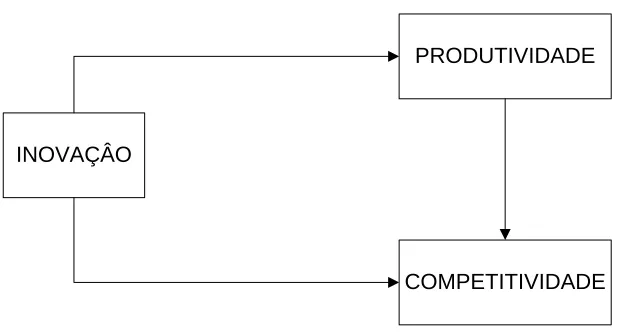
During the studies of the cited authors, the innovation’s impact measurement at the firm’s level shows that the studies still happen in an attempt to relate innovation with its impacts on productivity and competitiveness, although it is possible to notice a gap as for the measurement of this relationship, which instigates new studies. As result in this studies the author´s propose the model as describe in figure 1.
Figure 1: Model of analysis of the impact of innovation on productivity and competitiveness proposed by the authors
INOVAÇÂO
PRODUTIVIDADE
Licensed under Creative Common Page 22
DISCUSSION
This theoretical essay had as its objective to discuss and describe innovation, its evolution, the analysis of the theoretical contributions in researches, literature and organizations and its impacts, mainly with regards to productivity and competitiveness, that according to Castellacci
et al. (2005,Fagerberg and Sapprasert (2011) and Crespi and Zuniga (2012) still configures itself as a theoretical gap.
It is possible to observe that the path that was followed by the theoretical propositions made innovation a more ample concept that covers several knowledge areas. Innovation starts having a major role in the economic scenario, as highlighted in the studies of Schumpeter (1930; 1942; 1949), Young (1928), Coase (1937), Robinson (1956), Penrose (1959, Arrow (1962), Richardson (1972), Rosenberg (1979), Dosi (1982; 2000), being its application partly responsible for the development and growth of a country and also of the industry, when observing the construct by different perspectives and levels.
Innovation was also studied with the intention of understanding its propagation and its absorption capacity by Roger (1962), Silverberg et al. (1988), Arthur (1989) and Cohen and Levinthal (1990) and it is possible to perceive, today, the importance of these studies for the comprehension of the marketing strategies and organizational learning.
It is also possible to notice that although the authors, initiated by Pavvit (1984), had created a specific typification of each analysis for the innovation, one can notice that the different typologies have common point that indicates a taxonomy with alignment in four types: products/services, processes, organizational and marketing, as found in the Oslo manual (2007). The evolution of this concept can help to understand the degree of novelty and the innovation’s impacts on the economic systems. This progress in the typification contributes with the search of empirical evidences in the innovation field.
Throughout the studies about innovation and the measurement of the construct’s impacts that were treated in this theoretical essay, Mansfield (1968; 1972; 1977; 1982), Nelson and Winter (1982), Teece (1986) became part of the field research’s agenda, being that, specifically, in the economic perspective, the relationship of innovation and its impact on productivity and competitiveness shows itself to be yet an object of study by part of the academics. In this sense, it is possible to verify using the studies of Griliches (1979) and Griliches and Pakes (1980), Crepon et al. (1998), Loof and Heshmati (2002), Loof et al. (2003), Janz et al. (2004), Acemoglu et al. (2006), Van Leeuwen and Klomp (2006), Monhen et al.
Licensed under Creative Common Page 23
competitiveness and productivity’s indicators, since it makes it possible to have gains in costs and to have competitive advantages, although it has not been verified a model proved empirically that addresses the relationship between the three constructs that were jointly analyzed. Since this has only been verified theoretically and the empiric studies are still being carried out, it shows an interesting and challenging path to be covered as a field research’s agenda.
It is important to point out, how a future study and an important advance starting from the theoretical confirmation of the relationship between the constructs of innovation, productivity and competitiveness, for the elaboration of a model that will contribute for the understanding of the innovation’s impacts on productivity and competitiveness, since there is an absence of models about this relationship.
It is also important to point out that other relationships with innovation can be found in the literature, and that the choice of the productivity and competitiveness’ themes cannot be considered the only relationship and research objects, being only an initial proposal measuring model.
ACKNOWLEDGEMENT
Authors express a sincere thanks to CAPES/BRAZIL process 99999.011696 / 2013-03 FAPEMIG
REFERENCES
ACEMOGLU, D. AGHION, P. & ZILIBOTTI, F.. (2006). Distance to Frontier, Selection, and Economic Growth. Journal of the European Economic Association p. 37-74.
ALVAREZ, R., ORTEGA, C. B. & NAVARRO, L. (2010) Innovation, R&D Investment and Productivity in Chile, IDB Publications 44318, Inter-American Development Bank.
ANLLÓ, G. &, SUÁREZ, D. (2009). Innovación: Algo más que I+D. Evidencias ibero-americanas a Partir de las Encuestas de Innovación: Construyendo las Estrategias Empresarias competitivas. Buenos Aires, Argentina: CEPAL-REDES.
ARROW, K. (1962a). Economic Welfare and the Allocation of Resources for Invention, in Arrow K. (ed.), The Rate and Direction of Inventive Activity : Economic and Social Factors, Princeton University Press, Princeton, pp. 609- 625, reprinted in Arrow, Collected Papers, Vol. 5, pp. 104-120.
ARROW, K. (1989). Competing technologies, increasing returns, and lock in by historical events. The Economic Journal, v. 99, n. 394, p. 116-131, Mar.
BERMAN, E., BOUND, J. & MACHIN, S. (1998). Implications of Skill-Biased Technological Change: International Evidence. Quarterly Journal of Economics vol.113 nr.4, p.1245-1280.
BOYNE, G. A., FARRELL, C., LAW, J., POWELL, M., & WALKER, R. M. (2003). Evaluating public management reforms. Phildelphia, Pa.: Open University Press.
Licensed under Creative Common Page 24 CASTELLACCI, F., GRODAL, S., MENDONCA, S., WIBE, M & WIBE, M. D. (2005). Advances and challenges in innovation studies. Journal of Economic Issues.
COASE, R. H. (1937). The nature of the firm.
COHEN, W. M. & LEVINTHAL, D. A. (1990). Absorptive Capacity: A New Perspective on Learning and Innovation, Administrative Sciences Quarterly nr.35, p.569-596.
CRESPI, G. & ZUNIGA, P. (2012). Innovation and Productivity: Evidence from Six Latin American Countries, World Development Elsevier, vol. 40. p. 273-290.
CREPON, B.,. DUGUET, E. & MAIRESSE, J. (1998). Research, Innovation and Productivity: An Econometric Analysis at the Firm Level. Economics of Innovation and New Technology nr7 vol2 p.115-158.
DAFT, R. L. A (1978). Dual-core model of organizational innovation. Academy of Management Journal.
Nr. 21. p.193-210.
DAMANPOUR, F. (1991). Organizational innovation: a meta-analysis of effects of determinants and moderators. Academy of Management Journal, v. 34, n. 3, p. 555-590.
DAMANPOUR, F. & SCHNEIDER, M. (2006). Phases of the adoption of innovation in organizations: Effects of environment, organization, and top managers. British Journal of Management. Nr. 17. p.215-236.
DAMANPOUR, F.,WISCHNEVSKY, J. & WISCHNEVSKY, D. (2006). Research on organizational innovation: Distinguishing innovation-generating from innovation-adopting organizations. Journal of Engineering and Technology Management. Nr. 26. p.269-291.
DOSI, G. (1982). Technological Paradigms and Technological Trajectories.
DOSI, G. (2000). Institutions and markets in a dynamic world. The Manchester School, vol. LVI, n. 2. Reimpresso em: DOSI, G. Innovation, organization and economic dynamics: selected essays. Cheltenhand, UK: Edward Elgar.
FAGERBERG, J., MOWERY, D.C & NELSON, R.R. (2005). The Oxford Handbook of Innovation. New York: Oxford University Press. 655p.
FAGERBERG, J. & SAPPRASERT, K. (2011).National innovation systems: the emergence of a new approach, Science and Public Policy, Oxford University Press, vol. 38, p.669-679, November.
FAGERBERG. J., SRHOLEC, M. &VERSPAGEN, B. (2009). Innovation and Economic Development.
Working Papers on Innovation Studies 20090723. Oslo, Norway: Centre for Technology, Innovation and Culture, University of Oslo.
FREEMAN, C. (1974). The ‘National System of Innovation’ in historical perspectiveCamb. J. Econ. 5-24. FREEMAN, C. (1979). The Determinants of Innovation: Market Demand, Technology and the Response to Social Problems, Futures, Vol.11, No. 3.p.206-215.
FREEMAN, C. (1987). Technology Policy and Economic Performance. Londres: Pinter Publishers London and New York.
FREEMAN, C. (1982).The economics of industrial innovation. London: Frances Pinter.
GRIFFITH, R. et al. (2006). Innovation and Productivity across Four European Countries. Oxford Review of Economic Policy 22,4. p.483-498.
GRIFFITH, R., REDDING,S. & VAN REENEN, J. (2004) Mapping the Two Faces of R&D: Productivity Growth in a Panel of OECD Industries. Review of Economics and Statistics n86 vol. 4. p. 883-895. GARTUA, J. I. , GARRIGÓS, J. A. & HERVAS-OLIVER, J. L. (2010). How Innovation Management Techniques Support an Open Innovation Strategy, Research-Technology Management, Vol. 53, Nr. 3, May-June.
Licensed under Creative Common Page 25 KIMBERLY, J. R. & EVANISKO, M. J. (1981). Organizational innovation: The Influence of Individual, Organizational, and Contextual Factors on Hospital Adoption of Technological and Administrative Innovations. The Academy of Management Journal, vol. 24 nr.4, p. 689-713
KUPFER, D. & HASENCLEVER, L.. (2002). Economia industrial: fundamentos teóricos e práticas no Brasil. Rio de Janeiro: Campus.
HEGDE, D. & SHAPIRA, P. (2007). Knowledge, Technology Trajectories, and Innovation in a Developing Country Context: Evidence from a Survey of Malaysian Firms. International Journal of Technology Management n. 40 vol.4 p. 349-370.
JACOBSON, R. (1992) The “Austrian” school of strategy. The Academy of Management Review, v.17, n.4.
JANZ, N., LOOF, H. & PETERS, B. (2004). Innovation and Productivity in German and Swedish Manufacturing Firms: Is There a Common Story? Problems and Perspectives in Management n. 2. p.184–204.
JEFFERSON, G. H. et al. (2006).R&D Performance in Chinese Industry. Empirical Studies of Innovation in the Knowledge Driven Economy, Guest eds. B. Hall and J. Mairesse, Economics of Innovation and New Technologies n. 15, vol. 4. p.345–366.
KEYNES, J. M. (1936). The General Theory of Employment, Interest, and Money. New York: Harcourt Brace.
LEE, K. & KANG, S. M. (2007). Innovation Types and Productivity Growth: Evidence from Korean Manufacturing Firms. Global Economic Review nr. 36 vol.4, p.343-359.
LEYDESDORFF, L. (1997). The New Communication Regime of University-Industry-Government Relations, 1997. pp. 106-117 in: Etzkowitz and Leydesdorff.
LEYDESDORFF, L. & ETZKOWITZ, H. A. (1996). Emergence of a Triple Helix of University-Industry-Government Relations, Science and Public Policy 23. p.279-86.
LEYDESDORFF, L. & ETZKOWITZ, H. A. (1998). Triple Helix of University-Industry-Government Relations, Industry & Higher Education 12, nr. 4p.197-258; 12p., nr. 5. p. 270-89.
LOOF, H., & HESHMATI, A. (2002). Knowledge Capital and Performance Heterogeneity: A Firmlevel Innovation Study. International Journal of Production Economics n. 76 vol.1. p.61-85.
LOOF, H. et al. (2003). Innovation and Performance in Manufacturing Industries: A Comparison of the Nordic Countries. Icfaian Journal of Management Research n.2, vol 3. p.5-35.
LUNDVALL, B.-Åke (1998). Technical Change and Economic Theory.
MANSFIELD, E (1977). Social and private rates of return from industrial innovations New York: Norton. MANSFIELD, E. (1968). Industrial research and technological innovation: an econometric analysis. New York: W.W. Norton.
MANSFIELD, E. (1972).Contribution of R&D to economic growth in the United States. Science, v. 175, p. 487-94, Feb.
MANSFIELD, E., RAPOPORT, J. ROMEO, A., VILLANI, E., WAGNER,S. & HUSIC, F. (1977). The production and application of new industrial technology. New York: Norton.
MANSFIELD, E, ROMEO, A., SCHWARTZ, M., TEECE, D.VILLANI, E. &WAGNER, S. (1982).
Technology transfer, productivity, and economic policy. New York: Norton. MARX, K. (1988) O Capital. Vol. 2. 3ª edição, São Paulo, Nova Cultural.
MEES, C. E. K. (1920). The Organization of Industrial Scientific Research. New York, McGraw-Hill Book Co.
METCALFE, J. S. (2003). Equilibrium and evolutionary foundations of competition and technology policy: new perspectives on the division of labour and the innovation process. Revista Brasileira de Inovação,
Licensed under Creative Common Page 26 MOHNEN, P., MAIRESSE, J.& DAGENAIS, M. (2006). Innovativity: A Comparison Across Seven European Countries. in Empirical Studies of Innovation in the Knowledge Driven Economy, Guest eds. B. Hall and J. Mairesse, Economics of Innovation and New Technologies Nr. 15 vol.4. p.391–413.
MOON, J. M. & DELEON, P., (2001).Municipal reinvention: Managerial values and diffusion among municipalities. Journal of Public Administration Research and Theory. Nr. 15. 43-60.
NELSON, R.R. (1959). The simple economics of basic research, Journal of Political Economy, v.67, n.3, p.297-306, jun..
NELSON, R. R & Winter, S. (1982). An Evolutionary Theory of Economic Change, The Belknap Press of Harvard University Press.
OECD and Eurostat (2007). The Oslo Manual: The Measurement of Scientific and Technological Activities. Guidelines for Collecting and Interpreting Innovation Data. 3rd edition. Paris, France: Organization for Economic Cooperation and Development/Eurostat.
OSBORNE, D. & GAEBLER, T. (1992). Reinventing Government: How the Entrepreneurial Spirit is Transforming the Public Sector, Reading, MA: Addison-Wesley,
PAVITT, K. (1984). Sectoral Patterns of Technical Change: Towards a Taxonomy and a Theory, in Research Policy, 13, p.343-373.
PAVITT, K. (1989). The intellectual patterns and determinants of technological activities. In: research system in transition. In: COZZENS, S.; S. Cozzen et al. Londres: Kluwer Academic Publishers.
PAVITT, K. (2005). Innovation Process. In: FAGERBERG, J.; MOWERY, D.; NELSON, R. The Oxford Handbook of Innovation. (Orgs). Oxford, Cap. 4.
PENROSE, E. (1995). The Theory of the Growth of the Firm. New York: Oxford University Press. RICHARDSON, G. B. (1972). The Organization of Industry, in Economic Journal, 82,. p.883-96 ROBINSON, J. (1956). The Accumulation of Capital. London: Macmillan & Co. Ltd.
ROGERS, E.M. (1962). Diffusion of Innovations, The Free Press, New York, NY.
ROGERS, E.M. (2003). Diffusion of Innovations, 5th ed., The Free Press, New York, NY. 2003. ROSENBERG, N. (1979). Tecnology and Economy. New York.
ROSENBERG, N.. (1982). Inside the black box: technology and economics. Cambridge:Cambridge University. 304p.
SALTER, A. (1932). Recovery, the Second Effort. Century Co., New York.
SCHUMPETER, J. A. (1911) The Theory of Economic Development: An inquiry into profits, capital, credit, interest and the business cycle. translation, Cambridge, Mass: Harvard University Press.
SCHUMPETER, J. (1930). ATeoria do Desenvolvimento Econômico.
SCHUMPETER, J. A. (1934). History of Economic Analysis. Edited from the Manuscript by Elizabeth Boody Schumpeter. London: George Allen & Unwin Ltd.
SCHUMPETER, J. A. (1942). Capitalismo, socialismo e democracia.
SCHUMPETER, J.A.(1949). Economic Theory and Entrepreneurial History Reunidos e reproduzidos na coletânea organizada por Clemence, Richard V., Essays on Entrepreneur: Postulates and Patterns of Entrepreneurial History, Cambridge-Mass.: Harvard University Press.
SILVERBERG, G., DOSI, G. & ORSENIGO, L. (1988). Innovation, diversity and diffusion: a self-organisation model. Economic Journal, Royal Economic Society, vol. 98, pages 1032-54, December. SMITH, A. (1983) A Riqueza das Nações. Editora Abril Cultural.
Licensed under Creative Common Page 27 TIDD, J., BESSANT, J. & PAVITT, K. (2005). Managing innovation. 3.ed. England: Wiley.
VAN de VEN, A. H., ANGLE, H. & POOLE, M.S. (2000). Research on the management of innovation: The Minnesota studies. New York: Oxford University Press.
VAN LEEUWEN, G. & KLOMP, L. (2006). On the Contribution of Innovation to Multi-factor Productivity Growth. In: Empirical Studies of Innovation in the Knowledge Driven Economy, Guest eds. B. Hall and J. Mairesse, Economics of Innovation and New Technologies, Nr.15 vol.4, p.367-390.
WILLIAMSON, O. E. (1981). The Modern Corporation: Origins, Evolution, Attributes. Journal of Economic Literature, Vol. 19, December. pp. 1537-1568.
YAN Aw, B., M. J. ROBERTS, and D. Yi Xu. (2008). R&D Investment, Exporting, and Productivity Dynamics. University Park, Pennsylvania, United States: Pennsylvania State University.