370 | P a g e
COMPARATIVE STUDY OF VARIOUS DATA
COMPRESSION TECHNIQUES & AN ITERATIVE
ALGORITHM TO COMPRESS REAL TIME DATABASE
1
Anupam Dwivedi (M.Tech EC) &
2Dr.AjitaPathak
1,2
Department of Electronics and Communication Engineering,
Amity University, U.P (India)
ABSTRACT
Data available in real time database are highly valuable. Data stored in databases keep growing as a result of business requirement and user need. Transmission of such a large quantity of data requires more money.
Managing such a huge amount of data in real time environment is a big challenge. Traditionally available methods faces more difficultly in dealing with such a large databases. In this Research Paper we provide an overview of various data compression techniques and a solution to how to optimize and enhance the process to compress the real time databases and achieve better performance than conventional database system. This research paper will provide a solution to compress the real time data more effectively and reduce the storage requirement, cost and increase speed of backup. The compression of data for real time environment is developed with Iterative length Compression Algorithm. This Algorithm provide parallel storage backup for real time database system .
Keywords:-Database Compression, Database Decompression, Backup Optimization, Compression
Ratio.
1 INTRODUCTION
371 | P a g e
1.1Types of Data Compression
Lossy data compression
Lossless Data compression
1.1.1 Lossy Data Compression
This technique is most commonly used to compress multimedia data ( Audio, Video & Images).Lossy compression is irreversible compression technique which uses inexact approximations and partial data discarding to represent the content.The amount of data reduction possible using lossy data compression is often much higher than through lossless techniques.The original data contains a certain amount of information basic information theory says that there is an absolute limit in reducing the size of this data. When data is compressed, its entropy increases, and it cannot increase open-endedly. For example, a ZIP file is smaller than the original file, but repeatedly compressing the same file will not reduce the size but instead will increase the size.
Methods of Lossy Data Compression
i)AUDIO DATA -A-Law, µ-law, Algebraic code excited linear prediction(ACELP), Adaptive differential pulse code modulation(ADPCM),Fourier Transform, Differential pulse code modulation (DPCM).
ii) VIDEO DATA – Lapped transform, Discrete cosine transform(DCT), DE blocking filter, Motion compensation.
iii) IMAGE DATA –Chain code, Discrete cosine transform(DCT),Embedded zero trees of wavelet transform.
1.1.2 Lossless Data Compression
Unlike lossy data compression where some loss is acceptable in number of bits received , Lossless data compression system is one where data recovered after de- compression must contain exactly same number of bits as the input. If there is any loss in no of bits received after de- compression then this will corrupt the resulting information being conveyed by input stream.
Methods of Lossless Data Compression
i) ENTROPY TYPE: Unary, Arithmetic, Huffman(Adaptive, Canonical, Modified), Shanno-fano. ii) DICTIONARY TYPE:: Byte pair, Encoding, Lempel-ziv (LZ77/LZ78), LZJB,LZMA.
II COMPRESSION OPTIMIZATION USING ILC ALGORITHM
372 | P a g e
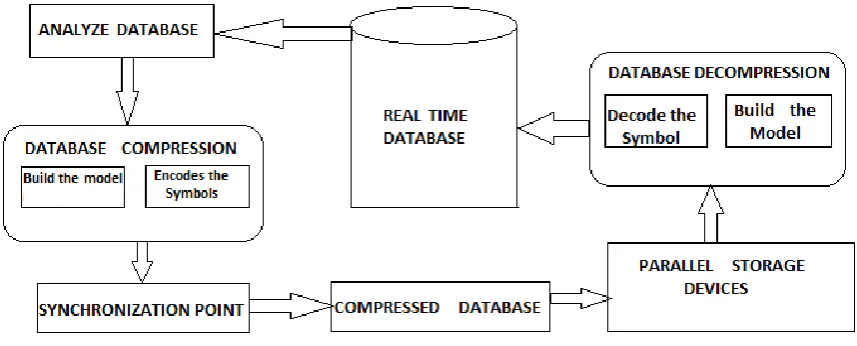
take backups and the last step is to store the compressed backups in multiple storages in parallel. The assembly of the proposed ILC based real time database compression optimization is shown in fig 1.The first phase is to analyse the database environment in which it was created. At forts,the attributes present in the database systems are analysed and identify.
The second phase defines the process of compression and decompression of the database using Iterative Length Compression (ILC) algorithm. The ILC algorithm is used to offer a good compression technique by allowing access to the database level and enhances the compression ratio for easy backup of database systems.
The third phase defines the process of storing the compressed backups at different levels of storages in parallel. The copies of compressed backups are alwaysaccessible at any system, and there is less chance of database systems to be lost and hence can easily be recovered.
Fig 1:-Structure of Database Compression and Decompression
III EXPERIMENTAL EVALUATION
373 | P a g e
Compression Ratio: is the ratio of size of the compressed database system with the actual size of the uncompressed database systems. Also known as compression power is a computer-science term used to measure the reduction in data-representation size produced by a data compression algorithm. Compression ratio is defined as follows:Compression Ratio = Uncompressed Size / Compressed Size
Disk Storage & Space Savings: When either type of compression is used, there is a multi-way trade-off involved between storage space (disk and buffer pool) and I/O reduction (due to better memory caching. Sometimes the space savings is given instead, which is defined as the reduction in size relative to the uncompressed size.
Space Savings = 100 * (1 - Compressed Size / Uncompressed Size).
IV RESULTS AND DISCUSSION
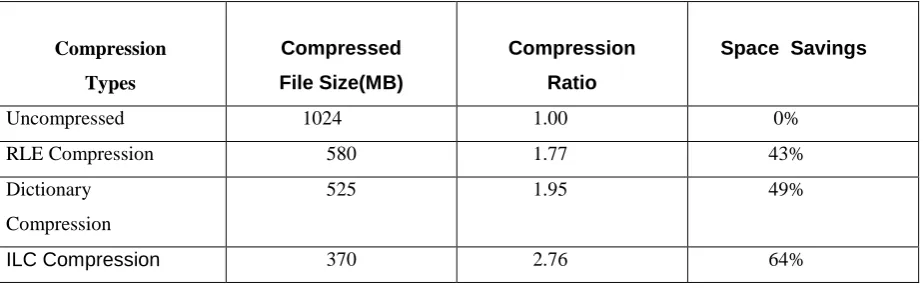
In this paper, we have seen how the database is efficiently compressed using backup compression process for real-time database systems using ILC algorithm.In order to check the efficiency of proposed ILC Algorithm for backup compression process for real-time database system we used a real time 1GB sample database for an experimentation. The backup compression storage space savings for theuncompressed database is more than twice the backup compression space savings for the compressed database, which is to be predicted, given that the latter database is already compressed. The table and diagram given below defined the compression ratios and storage space savings of the proposed backup compression process for real-time database systems using ILC Algorithm.
Compression Types
Compressed
File Size(MB)
Compression
Ratio
Space Savings
Uncompressed 1024 1.00 0%
RLE Compression 580 1.77 43%
Dictionary Compression
525 1.95 49%
ILC Compression 370 2.76 64%
Table 1Compression Ratio vs Space Savings
374 | P a g e
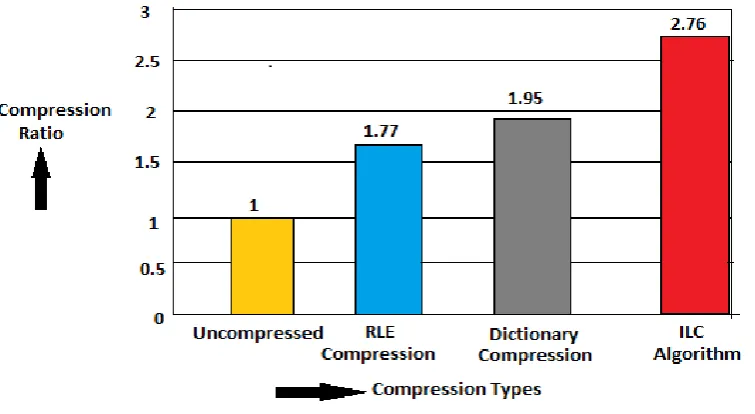
holding the database. The following graph depicts how much compression can reduce the amount of disk storage needed.Fig. 2 Compression Types vs Compression Ratio
Fig.2 defines the process of compression ratio based on different types of existing compressionalgorithms. As size of the database increased the compression ratio of the database is decreased in the proposed compression algorithm. So, the compression ratio becomes less in the planned backup compression process for real-time database systems with parallel multi-storageprocess. The compression ratio is measured in terms of megabyte (M byte). Compared with existingcompression algorithms, the proposed ILC algorithm achieves good compression rate of 50%more.
375 | P a g e
Fig.3. defines the process of space savings based on different types of existing compression algorithms. The space savings is measured in terms of megabyte (M byte). Compared to an existing compression algorithm, the planned ILC algorithm attains less storage space and the variancewould be about 60% better.Compression Types
Compressed
File Size(MB)
Compression
Time
(mm:ss)
Decompression
Time
(mm:ss)
Uncompressed 1024 2.35 1.22
RLE Compression 580 1.40 1.06
Dictionary Compression
525 1.27 0.58
ILC Compression 370 1.04 0.39
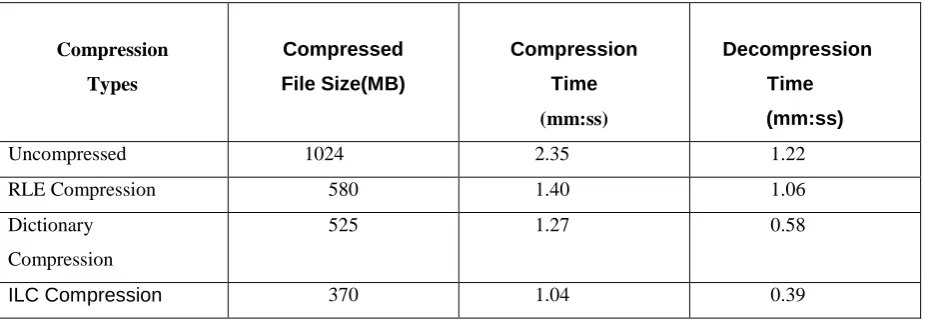
Table 2: Performance Testing of Data Compression
The above table defines the time consumed for compression and decompression of theproposed backup compression method. The result of performance test is shown in table 2. The compression algorithm achieves good performance.In this test we compared existing algorithms and ILC algorithm. As shown in table 1 and 2, the new compression algorithm is superior in all respects in comparison to existing compression algorithm in the real-time database.
V CONCLUSION
Proposed compression approach will allow efficient recovery of the compressed data, as well asyield a valuable saving in storage costs. Experimental results have shown that the proposed backup compression method for real-time database systems using ILC algorithm are effective in terms of storage space, compression ratio and backup processing compared to an existing compression algorithms.Proposed compression algorithm also improves CPU performance by allowing database operators to operatedirectly on compressed data and provides good compression of large databases.
REFERENCES
[1] Sushila Aghav, “Database compression techniques for performance optimization”, proceedings in 2ndinternational conference on Computer Engineering and Technology (ICCET), 2010.
[2] Adam Cannane , Hugh E. Williams “A Compression Scheme for Large Databases” proceedings in 11th international conference on ADC, 2010.
376 | P a g e
[4] Wenjun Huang, Weimin Wang, HuiXu, “A Lossless Data Compression Algorithm for Real-time Database”,Sixth world congress, Intelligent Control and Automation, 2006.
[5] W. P. Cockshott, D. McGregor, N. Kotsis, J. Wilson “Data Compression in Database Systems”, proceedings in 9th international workshop on Database and Expert Systems Applications, 1998.
[6] ChenggangZhen ,BaoqiangRen, “Design and realization of data compression in Real-time database”, proceedings in 10th international conference on Computational Intelligence and Software Engineering , 2009.
[7]Veluchandhar,RV.Jayakumar,M.muthuvel,K.Balasubramanian,A.Karthi,Karthikesan, G.Ramaiyan, ,A.Deepa.S.AlBertRabara, “A Backup Mechanism with Concurrency Control for Multilevel Secure Distributed Database Systems”, proceedings in 3rd international conference on Digital Information Management (ICDIM) , 2008.
[8] Hung-Yi Lin and Shih-Ying Chen, “High Indexing Compression for Spatial Databases”, proceedings in IEEE 8th international conference on Computer and Information Technology Workshops, 2008.
[9] IoannisKontoyiannis and Christos Gioran “Efficient Random Codebooks and Databases for LossyCompression in Near-Linear Time”, proceedings in IEEE Information Theory Workshops on Networking and Information Theory, 2009.