45
Ultrasonic Characterization And Micro-Structural
Studies On 2205 Duplex Stainless Steel In
Thermal Variations
Bernice Victoria, Dr. Gene George, Kevin Ark Kumar
Abstract: Due to increasing concern on potential impact of materials on human health and environment, the materials used in hygienic applications should be durable, corrosion resistant, clean surface etc. Type 2205 duplex stainless steel is a preferred material for use in biomedical, pharmaceutical, nuclear pressure vessels, chemical tankers etc., it exhibits good mechanical strength and high resistance to corrosion. The strength, toughness, hardness of such materials are usually determined by destructive tests. However continuous destructive measurements are generally difficult to perform during the productive process, which creates a need for a fast and easy nondestructive method of material characterization. Microstructural changes in duplex stainless steel due to changes in annealing temperature are characterized by ultrasonic pulse –echo technique and optical microscopy. Type 2205 duplex stainless steel are heat treated at 1000 deg C, 1050 deg C, 1100 deg C, 1150 deg C and 1200 deg C for 15 min and water quenched. There is an appreciable change in the morphology of all the heat treated samples, and the ultrasonic velocity is dependent on both ferrite and austenite ratio and the grain size.
Index Terms: duplex steel, heat treatment, hygienic applications, microstructure, nondestructive, SAF, ultrasonic.
————————————————————
1 INTRODUCTION
THE processing equipments and flow systems in biomedical, pharmaceutical, beverage, drinking water, food and diary industries requires high standard of cleanliness due to hygienic needs. The materials used in the vessels and pipelines must be uncontaminated and exhibit high corrosion resistance for producing hygienic end product. Apart from these requirements, the materials must withstand high temperatures and high pressure during the manufacturing process. Yet another requirement of such material is good weld ability. The type 316L austenitic stainless steel (ASS) was the widely used material for pharmaceutical and biomedical industries, however the maintenance cost of type 316L ASS is high [1]. In recent days the equipments and flow systems of biomedical manufacturing plants and other hygiene applications are constructed using type 2205 duplex stainless steel (DSS), which also meet all the above mentioned requirements and has relatively low maintenance cost. A two phase microstructure with similar quantities are represented by austenite and ferrite in Duplex stainless steel (DSS)[2]. Due to high concentration of chromium and molybdenum ,the two phase microstructure has special mechanical properties such as high mechanical strength, high resistance to stress corrosion cracking thus used in aggressive environments [3]. fatigue resistance, high energy absorption and low thermal expansion .As a
result of these DSS becomes highly superior to other types of stainless steel. Due to the presence of austenite and ferrite in DSS, It is used in fuel gas cleaning, chemical tankers sea water systems, pressure vessels, heat exchangers, offshore platforms, paper and pulp and marine industries, among others [4-7]. The mechanical properties of type 2205 DSS is shown in table 1.
1.1 Hot forming of Duplex SS
The duplex stainless steel is appropriate for all forming processes as of stainless steel. The high proof strength of DSS has an increased tendency to spring back [7]. An excellent interplay between high proof strength, elongation and work hardening rate exhibited by DSS promote them in light weight and cost-efficient applications. Hot forming of type 2205 DSS is performed at the temperatures illustrated in table 2. Hot forming is normally followed by quench annealing. Both the solution annealing and stress relieving should be followed by subsequent rapid cooling in air or water.
1.2 Ultrasonic Nondestructive Testing
Non destructive material testing with ultrasonic is a very effective method to detect defects, to evaluate power plant components and structures, to characterize microstructural features and to evaluate mechanical properties. Moreover microstructural variations cause the scattering of the sound wave causing an increased attenuation of the material. To characterize materials by using ultrasonic technique, the wave propagation speed and energy losses through interactions with the microstructure are the fundamental factors. [8, 9] In the present study ultrasonic parameters have been employed to characterize the various microstructural features in SAF. 2205 duplex stainless steel. In order to generate specimen with different microstructures the DSS was heat treated at 1000 deg C, 1050 deg C, 1100 deg C, 1150 deg C, 1200 deg C for 15 min in an electrically heated muffle furnace followed by water quenching. The changes in ultrasonic longitudinal and shear velocities are able to characterize the hardness variation with phase transformation due to heat treatment. ___________________________
Bernice Victoria is currently pursuing doctoral
degree program in Physical Sciences in
Bharthidasan University, India,
mail:[email protected]
Dr.Gene George is currently working as an
Associate Professor in Department of Physics, TBML College, Tamilnadu, India.
Kevin Ark Kumar is currently as Senior Engineer
TABLE 1
MECHANICAL AND PHYSICAL PROPERTIES AT 20 DEGC
Property Hot rolled plate
Hot rolled strip Proof strength 510 MPa 630 MPa Tensile strength 750 MPa 840 MPa Elongation 35 % 30 % Hardness 230 250 Density 7.8g/cm3 Modulus of elasticity 200 GPA Poisson ratio 0.3 Thermal conductivity 15 W/moC Electrical resistivity 0.8 m
TABLE 2
DSS HEAT TREATMENT TEMPERATURES
Process Temperature in deg C Hot forming 1150-950
Quench annealing 1020-1100 Stress relieving 1020-1100
2 EXPERIMENTAL PROCEDURES
2.1 Specimen Preparation
The chemical composition of SAF 2205 duplex stainless steel is given in table.3. SAF 2205 duplex stainless steel received in the form of 5mm thick sheet were cut into coupons of 50mmx50mmx5mm. Test specimens were heated in an electric muffle furnace at 1000 deg C, 1050 deg C, 1100 deg C, 1150 deg C and 1200 deg C for 15 min followed by water quenching. Special environmental situation was not employed during heating the samples. BAINCUT –M abrasive cut off machine was used to cut the samples for the metallographic studies from the heated specimens. Temperature was not raised while cutting as it might affect the microstructure. Samples were prepared by following the standard metallographic mechanical polishing practice .Polished specimens were etched using Beraha’s colour etchant.METSCOPE-1 microscope and Envision 3.0 series image analyzer were used to study the microstructure and to capture the image.
2.2 Hardness Measurement
Vicker’s hardness tester was employed to measure the hardness of the samples by using a test load of 5kg at room temperature. The surface of the specimen has to be polished and a diamond indenter was used on the polished surface of the specimen Five indentation were made on each polished specimen and the average value of the diagonal length of the indentations was used for the hardness measurements [10-12]. The following equation is used for estimation of the hardness.
HV = F/A ≈ 0.1891 F/d2
(1) Here d is the diagonal length of the indentation and F is the applied load.
TABLE 3
CHEMICAL COMPOSITION
Material Weight % C 0.02 S 0.02 P 0.03 Si 0.6 Mn 1.4 Cr 22.2 Ni 5.9 Mo 2.9 N 0.15
2.3 Ultrasonic Velocity Measurement
For any frequency and wavelength of the sound, Velocity is a characteristic of the material concerned and is consultant for the material. Ultrasonic testing parameters undergo tremendous changes due to the changes in micro structural or mechanical properties of the materials [13]. Using contact pulse echo method, time of flight measurements was made and this measurement was used to measure the ultrasonic velocity and can be estimated from the relationship:
Velocity =2 x thickness/time (2)
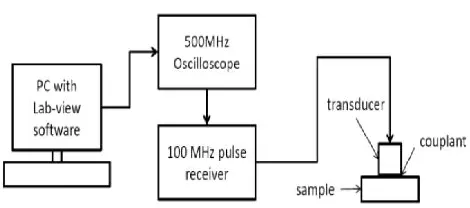
The experimental setup used for the ultrasonic measurement is shown in Fig.1.To test the samples by ultrasonic technique the contact pulse-echo method in an Olympus Panametrics NDT model 5800 unit using both 5MHz longitudinal and shear wave probe at room temperature was used.. Ultrasonic contact pulse–echo technique is a technique in which the search unit makes contact directly with the test specimen through a thin layer of couplant agent. The couplant agent eliminates the air gap between the transducer and the test specimen and provides efficient transmission of waves from the transducer into the material. Ultragel was used as a couplant for the longitudinal probe because it provides slightly higher acoustic impedance and are less likely to drip making it suitable for vertical mounting. For the shear wave probe pure honey was used as a couplant because it provides highly viscous contact and a good coupling of transverse forces.
47
3 EXPERIMENTAL RESULTS AND
DISCUSSIONS
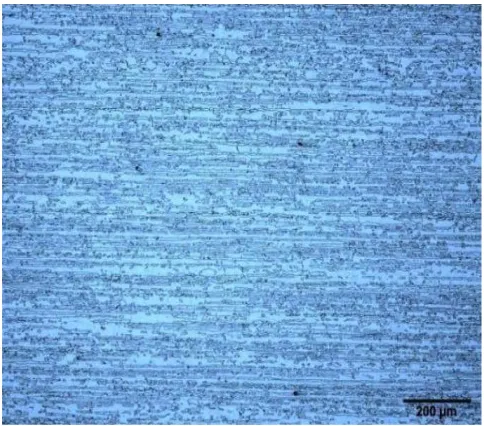
For industrial applications of DSS, different heat treatment cycles were imposed on the base metal. The microstructures of DSS heat treated at 1000 deg C, 1050 deg C, 1100 deg C, 1150 deg C and 1200 deg C are presented in this section. The microstructures of the DSS heat treated at 1000 deg C, 1050 deg C, 1100 deg C, 1150 deg C and 1200 deg C are given in fig.2 to fig.6 respectively. The photograph shows that the proportion and morphology of ferrite in the heat treated DSS materials are different with respect to the reference material. The elements present in DSS are classified as ferritisers and austentisers and their microstructure comprises of approximately equal proportions of ferrite and austentite. Heat treatment of 15 min in 1000 degree is not sufficient to restore austenite and ferrite microstructure and this can be observed in Fig 2. Increasing the holding time may restore the microstructure with ferritite and austentite. By increasing the temperature to 1050 deg C it can be observed that this temperature is sufficient to restore austentite and ferrite microstructure. The microstructure at this temperature shows fine grained banded structure with austenite in a continuous ferrite matrix. This is shown in Fig.3. Higher solution annealed temperature produces higher ferrite content. At about 1100 deg C the solidification of duplex stainless steel takes place. When duplex stainless steel is melted it solidifies from the liquid phase to completely ferritic structure and as the material cool down to room temperature, about half of the ferritic grains transforms to austentic grains. This phase transformation is well observed in Fig.4. With further increase of temperature the solidification of SAF 2205 duplex stainless steel is very appreciable and the ferrite content in the material increases. Austenite is not so hard as ferrite so dissolution of austenite and grain growth takes place. The change can be seen in Fig.5. By further increase in temperature by 50 deg C, there is no appreciable change in the content and morphology. The microstructure at 1200 deg C depicted in Fig.6 show that there is no appreciable change.
Fig. 2. Microstructure at 1000 deg C
Fig. 3. Microstructure at 1050 deg C
Fig. 4. Microstructure at 1100 deg C
Thus different ferrite-austenite ratio, morphology and varying grain size, could be the result of heat treatment cycles in the microstructure. It was observed by Radenkovie et.al [14]. that the continuous grain boundary morphology was formed in the morphology of austenite as the temperature increases. Above 1150 deg C the grain size increased rapidly, and lower hardness was observed. The trend of variation in ultrasonic velocity and hardness with temperature is shown in the fig.8. For the sample heat treated below 1050 deg C both longitudinal and transverse velocities were found to decrease. The increase in the volume of the ferrite may decrease the sonic speed. Then it is observed that a sudden increase in both longitudinal and shear wave velocity occurs. This is due to the formation of fine grain ferrite. With further increase in temperature longitudinal and shear wave velocity decreases due to the increase in the amount of ferrite.
Fig. 6. Microstructure at 1200 deg C
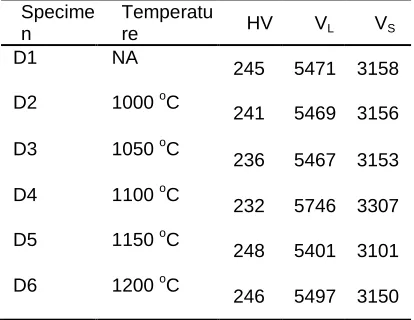
The hardness (HV) and ultrasonic longitudinal (VL) and shear velocity (VS) of DSS at different heat treated temperatures are tabulated in Table 4.
TABLE 4
VELOCITY AND HARDNESS
Specime n
Temperatu
re HV VL VS
D1 NA
245 5471 3158
D2 1000 oC
241 5469 3156
D3 1050 oC
236 5467 3153
D4 1100 oC
232 5746 3307
D5 1150 oC
248 5401 3101
D6 1200 oC
246 5497 3150
Fig. 7. Variation of hardness with temperature
Fig. 8. Variation of longitudinal velocity with temperature
For the sample heat treated below 1100 deg C, the hardness decreases in the phase region. As the heat treatment increases at 1150 deg C, there is a sudden increase of hardness. This was due to the solidification of DSS and the increase in the content of ferrite. With further increase of temperature hardness decreases this was similar to the results of Tavares et.al [15].
49
4 CONCLUSIONS
The ultrasonic and micro structural characteristics at different temperatures on SAF 2205 duplex stainless steel were studied. From the microstructure obtained, there is an appreciable change in the morphology of all the heat treated samples.11500C is the preferred temperature at which dissolution of austenite takes place. The results further shows that ultrasonic velocity is found to be dependent both on ferrite-austenite ratio and the grain size.
REFERENCES
[1] M. Lewus, T. Newson, B Lee and D Dulieu, ―Review of metal release from ferritic, austenitic and duplex stainless steel grades exposed to potable water and related adverse environments‖, Proc of 4th European Stainless Steel Science and Market Congress, June 2002.
[2] IMA. ―The use of 2205 duplex stainless steel for pharmaceutical and biotechnology applications‖, published by International molybdenum association, London, ISBN 978-1-907470-25-7.
[3] Badija R, Bouabdallah M, Bacroix B, Kahloun C, Bettahar K, Kherrouba, ―Effect of solution treatment temperature on the precipitation kinetic of phase in 2205 duplex stainless steel welds.‖ Mater Sci Eng A, 2008;(1-2); 447-54
[4] Deng B Jiang Y, Gong J, Zhong C, Gao J, Li J. ―Critical pitting and repassivation temperatures for duplex stainless steel in chloride solution‖, Elecrochim Acta 2008;53(16);5220-5
[5] Tavares SSM, Terra Vf, Neto PL Matos DE, ―Corrosion resisance evaluation of the UNS S31803 duplex stainless steel aged at low temperatures (350-550) under DLEPR tests‖, J Mater Sci , 40, pp. 4025-4028, 2005.
[6] Jiang ZhL Chen XY, Huang H, Liu XY. ―Grain refinement of cr25Ni 5 Mo1.5 duplex stainless steel by heat treatment‖, Mater Sci Eng A, 2003; 363(1-2);263-7 [7] Duplex stainless steel datasheet, Outokumpu.
http://www.outokumpu.com
/sitecollectiondocuments/outokumpu-duplex-stainless-steel-data-sheet.pdf. accessed on May 23, 2015 [8] Chen TH Weng KL, Yang JR. ―The effect of high
temperature exposure on the microstructural stability and toughness property in a 2205 duplex stainless steel ―. Mater Sci Eng A, 2002.338 (1-2);259-70 [9] L.F Garfias-Mesias, J.M Sykes, ―Metastable pitting in
25 Cr duplex stainless steel‖, Corrosion Science, Volume 41, Issue 5, 1 May 1999, Pages 959-987, ISSN 0010-938X, http://dx.doi.org/10.1016/S0010-938X(98)00165-6.
[10]J. Stella, J. Cerezo, E. Rodríguez, ―Characterization of the sensitization degree in the AISI 304 stainless
steel using spectral analysis and conventional ultrasonic techniques‖, NDT & E International, Volume 42, Issue 4, June 2009, Pages 267-274.
[11]Nishara Begum, V. Rajendran, T. Jayakumar, P. Palanichamy, N. Priyadharsini, S. Aravindan, Baldev Raj, ―On-line ultrasonic velocity measurements for characterisation of microstructural evaluation during thermal aging of β-quenched zircaloy-2‖, Materials Characterization, Volume 58, Issue 6, June 2007, Pages 563-570.
[12]Ashok kumar, Nidhi Gupta, Reeta gupta, Yudhisther kumar, ―Effect of coupling conditions on ultrasonic echo parameters‖, Ultrasonic, vol. 27 (2009) pp.70-79 [13]P. Palanichamy, A. Joseph, T. Jayakumar, Baldev Raj,
―Ultrasonic velocity measurements for estimation of grain size in austenitic stainless steel‖, NDT & E International, Volume 28, Issue 3, 1995, Pages 179-185.
[14]G. Radenkovic, Cvijovic, D. Mihajlovic, ―Effect of quenching temperature on micro-structure and properties of cast stainless steels‖, Acta Stereol. 13 (2), pp. 439-444, 1994.