COVID-19 Serological Tests: How well do they actually perform? Abdi Ghaffari1,2, Robyn Meurant3, and Ali Ardakani1
1. Novateur Ventures Inc., Vancouver, BC CANADA
2. Department of Pathology and Molecular Medicine, Queen’s University, Kingston, ON, Canada 3. NSF Health Sciences, Kirkbymoorside, York, United Kingdom
Corresponding authors:
Abdi Ghaffari ([email protected]), Ali Ardakani ([email protected]) Novateur Ventures Inc.
1055 W Georgia Street, Suite 2100 Vancouver, BC, V6E 3P3
Canada
T: +1-844-200-6682 ABBREVIATIONS
COVID-19, Coronavirus Disease 2019 SARS, Severe Acute Respiratory Syndrome
SARS-CoV, Severe Acute Respiratory Syndrome Coronavirus SARS-CoV-2, Severe Acute Respiratory Syndrome Coronavirus 2 MERS, Middle East Respiratory Syndrome
BAL, Bronchoalveolar Lavage EUA, Emergency Use Authorization
E, SARS-CoV-2 Envelope protein M, SARS-CoV-2 Membrane protein NP, SARS-CoV-2 Nucleocapsid protein RBD, Receptor-Binding Domain
ELISA, Enzyme-Linked Immunosorbent Assay RDT, Rapid Diagnostic Test
CLIA, Chemiluminescence Immunoassay LFIA, Lateral Flow Immunoassay
PoC, Point-of-Care
ABSTRACT
In only a few months after initial discovery in Wuhan, China, SARS-CoV-2 and the associated COVID-19 disease has become a global pandemic causing significant mortality and morbidity. In the absence of vaccines and effective therapeutics, reliable serological testing can be a key element of public health policy to control further spread of the disease and gradually ease quarantine measures. However, prior to launch of large-scale seroprevalence studies to assess herd immunity, it is critical to understand the limits and potential of current SARS-CoV-2 serological tests on the market. In this study, we provide an overview of serological testing and conduct a systematic review of independent evaluations of SARS-CoV-2 serological tests performance. Our findings show significant variability in the accuracy of marketed tests and highlight several lab-based and point-of-care rapid diagnostic tests with high performance level in detecting SRAS-CoV-2 specific antibodies. The findings of this review highlight the need for ongoing independent evaluations of commercialized COVID-19 diagnostic tests.
A. BACKGROUND
respectively[1, 2]. Like SARS-CoV and MERS-CoV, SARS-CoV-2 is a single-stranded RNA virus
belonging to the beta genus Coronavirus in the Coronaviridae family[3].
As SARS-CoV-2 can be transmitted from human to human, the disease has spread swiftly to over 200 countries, infecting nearly 6 million people, and resulting in at least 350,000 deaths worldwide (as of May 27, 2020)[4]. An unprecedented and rapidly growing global effort is
underway for the development of COVID-19 vaccines and therapeutics, but at the time of this review there are no vaccines and only one antiviral drug (Remdesivir) approved under the FDA Emergency Use Authorization (EUA), with modest clinical benefit[5, 6]. Under these
circumstances, countries were forced to implement physical distancing measures to control the outbreak and in the process place approximately 3 billion people under lockdown.
B. COVID-19 DIAGNOSTIC TESTS
In any infectious disease outbreak, accurate and accessible diagnostic testing must be one of the pillars of control measure policies to understand the spread of disease and minimize it. The epidemiological studies of the outbreak in China estimated the proportion of undetected COVID-19 cases to be as high as 86%[7]. As asymptomatic or mild cases could play a significant
role in the transmission and spread of the SARS-CoV-2 virus[7, 8], symptoms alone are not
reliable diagnostic markers. There are two major types of diagnostic technologies available to address this: molecular and serological tests. Currently, much of the focus is on the SARS-CoV-2 molecular test, which can detect, with high accuracy, the viral-specific RNA molecules
reverse-transcriptase-polymerase chain reaction (RT-PCR) technology. However, the PCR test is not useful in
distinguishing between highly infective viruses versus ones that have been neutralized by the host, and it cannot assess immunity status against SARS-CoV-2 [9]. Serological-based antibody
tests can complement molecular-based tests in providing a more accurate estimate of SARS-CoV-2 incidence and potentially detect individuals with immunity against the disease as these tests detect markers of the immune response.
C. HUMORAL IMMUNE RESPONSE TO SARS-COV-2
In humoral immune response to infection, pathogen-specific antibodies, produced by B cells, neutralize and prevent further spread of the disease. The activation and differentiation of B cells into antibody-secreting plasma B cells are triggered by a cascade of events involving virus digestion by antigen-presenting cells (e.g. dendritic cells, macrophages) and presentation of virus-specific antigen(s) to helper T cells (Fig 1). Antibodies protect the host by binding to specific antigens (proteins) on the virus to neutralize its fusion and entry into the host cell and facilitate recognition and killing by phagocytic immune cells[10]. In humans, three types of
antibodies or immunoglobulins have been the target for COVID-19 serological tests: IgM, IgG, and IgA. Although the dynamics of the immune response in COVID-19 are not fully understood, typically IgM antibody is produced by host immune cells during the early stages of a viral infection. IgG is often the most abundant antibody in the blood and plays a more prominent role in the later stages of infection and in establishing long-term immune memory[11]. While
development, recent studies show that IgA, predominately present in the mucosal tissue, may also play a critical role in the immune response and disease progression[12].
D. SEROLOGICAL ANTIBODY TEST
Serological or antibody tests detect immunoglobulins produced by the host’s plasma B cells following exposure to foreign antigens. The SARS-CoV-2 genome encodes approximately 25 proteins that are required for infection and replication, including four major structural proteins: spike (S), envelope (E), membrane (M), and nucleocapsid (N) (Fig 1). The S protein plays a critical role in fusion and entry into the host cell and it comprises an N-terminal S1 subunit (RBD and NTD domains) and a C-terminal S2 subunit. The primary function of the SARS-CoV-2 N protein (NP) is binding to the viral RNA genome and packing them into a helical nucleocapsid structure during viral replication[13, 14]. Studies on the serum of recovered COVID-19 patients
suggest that host neutralizing antibodies are primarily against S and N proteins[15, 16].
Consequently, the likelihood of predicting immunity status could increase in serological tests that target various regions of S or N proteins. Therefore, the characterization of specific SARS-CoV-2 antigen domains targeted by the humoral immune response becomes an integral part of the serological test development.
There are four major types of serological diagnostic tests: rapid diagnostic test (RDT), enzyme-linked immunosorbent assay (ELISA), chemiluminescence immunoassay (CLIA), and
culture methods to determine if patient antibodies can prevent viral infection in vitro. This test must be performed in laboratories with designated biosafety certificates to culture SARS-CoV-2-infected cells and has a time-to-result of 3-5 days. RDT is a simple and rapid test based on lateral flow immunoassay (LFIA) technology, commonly found in pregnancy test kits for example. RDT can potentially be administered as a point-of-care (POC) or self-test. Typically, RDT test strips use a drop of blood to detect the presence of patient antibodies (IgG, IgM, or IgA) produced against a specific SARS-CoV-2 antigen (Fig 2A). RDT test is simple to use with time-to-result anywhere between 10-30 minutes. Therefore, it has the potential to be deployed in large-scale serological surveys. ELISA assay, currently the most commonly used format of the serological test, is a lab-based test with an average time-to-results of 2-5 hours. ELISA typically uses a surface coated with specific viral antigen(s), to bind and detect the corresponding patient antibodies (IgG, IgM, IgA) in blood, plasma, or serum samples. The bound antigen-antibody complex is then detected by using a second antigen-antibody and a substrate that produces a color or fluorescent-based signal. ELISA assays can be found in different formats including direct, competitive, and the most commonly used sandwich or double antigen bridging assay (DABA) (Fig 2B). CLIA technology follows a similar concept to ELISA by taking advantage of high binding affinity between the viral antigen(s) and host antibodies but uses chemical probes that yield light emission through a chemical reaction to generate a positive signal. CLIA has an average time-to-result of 1-2 hours. CLIA and ELISA are both suitable for large throughput lab-based analysis and show good analytical agreement[17, 18].
Knowledge of virus and host immune response dynamics are essential in formulating diagnostic test and treatment strategies. Studies of COVID-19 disease suggest that seroconversion, when antibody levels become detectable in the blood, may take place days after the viral load has peaked[19]. Therefore, serological tests would be less effective in the early stages of COVID-19
disease. Wolfel and colleagues further confirmed these findings by reporting IgM and IgG seroconversion in 50% of the patients at one week after the onset of symptoms[20]. The median
time for the detection of IgM and IgG in COVID-19 patients was reported to be 5 and 14 days, respectively[21]. Yu and colleagues detected the seroconversion of IgA on day 2 and IgM/IgG on
day 5 post onset of symptoms. Furthermore, the study reported 100% of cases had detectable levels of IgA, IgM, and IgG on day 32 post onset of symptoms[12]. Their findings also revealed
that IgM and IgG levels to be significantly higher in severe COVID-19 cases compared to patients with the mild or moderate disease[12], suggesting that serological tests require high
sensitivity in detecting lower levels of antibodies in mild cases. Studies on the persistence of antibodies in blood suggest that high levels of IgG are detectable for at least 49 days after the onset of symptoms, while IgM levels declined rapidly on day 35 post infection[22]. The diagram
in Figure 3 depicts the relative timelines and peak levels for SARS-CoV-2 viral load relative to blood IgM, IgG, and IgA antibodies. Improved understanding of humoral antibody response time kinetics in COVID-19 is crucial in the correct application of serological tests.
F. SEROLOGICAL TEST PERFORMANCE
programs to expedite the commercialization process of these tests. In light of this, independent and robust post-market evaluations of COVID-19 serological tests are needed to confirm
manufacturers’ performance claims. The basic measures of quantifying a diagnostic test performance are sensitivity and specificity. Sensitivity is the ability of a test to detect the
disease agent or host response to the disease (i.e., antibodies) when it is truly present, whereas specificity is the probability of a test to correctly return a negative result when disease or host response is absent[23].
In this review, we conducted a systematic review of independent studies that assessed the performance of currently available SARS-CoV-2 serological tests. We included studies that reported sensitivity and specificity, stage of disease (early, intermediate, and late), the test format (CLIA, ELISA, RDT), and target antibody target (IgA, IgG, IgM, or IgG+IgM)[24, 25]. Where
possible, we recorded the SARS-CoV-2 antigens used for antibody detection, although this information was made readily available by all manufacturers. The studies that did not specify the disease stage of test samples were grouped under the “overall” category and assessed separately. In total, we reviewed performance data on 5 CLIA, 15 ELISA, and 42 RDT serological tests currently on the market (see Table S1 in supplementary file).
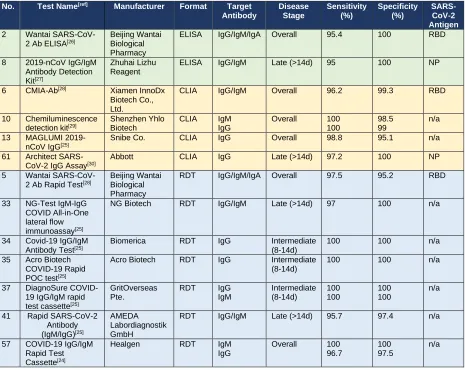
serological tests are more effective in later stages of the disease when higher IgG and IgM levels are present in the blood (Fig 5). The heatmap of tests in the “overall” category ranks the highest performing test in each target antibody category based on sensitivity followed by specificity (Fig 6). Top-performing COVID-19 serological tests (>95% sensitivity and specificity) from xy plots and heatmap are summarized in Table 1.
Table 1. Top-performing COVID-19 serological tests based on independent evaluations of sensitivity/specificity.
No. Test Name[ref] Manufacturer Format Target
Antibody Disease Stage Sensitivity (%) Specificity (%) SARS-CoV-2 Antigen
2 Wantai SARS-CoV-2 Ab ELISA[26]
Beijing Wantai Biological Pharmacy
ELISA IgG/IgM/IgA Overall 95.4 100 RBD
8 2019-nCoV IgG/IgM Antibody Detection Kit[27]
Zhuhai Lizhu Reagent
ELISA IgG/IgM Late (>14d) 95 100 NP
6 CMIA-Ab[28] Xiamen InnoDx
Biotech Co., Ltd.
CLIA IgG/IgM Overall 96.2 99.3 RBD
10 Chemiluminescence detection kit[29]
Shenzhen Yhlo Biotech
CLIA IgM
IgG
Overall 100
100
98.5 99
n/a
13 MAGLUMI 2019-nCoV IgG[25]
Snibe Co. CLIA IgG Overall 98.8 95.1 n/a
61 Architect SARS-CoV-2 IgG Assay[30]
Abbott CLIA IgG Late (>14d) 97.2 100 NP
5 Wantai SARS-CoV-2 Ab Rapid Test[28]
Beijing Wantai Biological Pharmacy
RDT IgG/IgM/IgA Overall 97.5 95.2 RBD
33 NG-Test IgM-IgG COVID All-in-One lateral flow immunoassay[25]
NG Biotech RDT IgG/IgM Late (>14d) 97 100 n/a
34 Covid-19 IgG/IgM Antibody Test[25]
Biomerica RDT IgG Intermediate
(8-14d)
100 100 n/a
35 Acro Biotech COVID-19 Rapid POC test[25]
Acro Biotech RDT IgG Intermediate
(8-14d)
100 100 n/a
37 DiagnoSure COVID-19 IgG/IgM rapid test cassette[25]
GritOverseas Pte.
RDT IgG
IgM Intermediate (8-14d) 100 100 100 100 n/a
41 Rapid SARS-CoV-2 Antibody (IgM/IgG)[25]
AMEDA Labordiagnostik GmbH
RDT IgG/IgM Late (>14d) 95.7 97.4 n/a
57 COVID-19 IgG/IgM Rapid Test Cassette[24]
Healgen RDT IgM
IgG
Overall 100
96.7
100 97.5
n/a
In light of policies to ease the lockdown and re-open the economy, large-scale seroprevalence studies to screen for immunity status are being implemented in several jurisdictions. Critics point to gaps in our understanding of immune response to COVID-19 infection including the ability of serological tests in detecting neutralizing antibodies and the capacity of the immune system in providing long-term immunity against SARS-CoV-2. However, some argue that in the context of a global viral outbreak with a relatively high mortality rate, inaction due to
uncertainty can have negative consequences compared to the harm caused by serological test false positive and false negative results [31]. Several jurisdictions have initiated seroprevalence
studies to provide a more accurate estimate of cases with positive SARS-CoV-2-specific antibodies, irrespective of disease symptoms. In Los Angeles County, the prevalence of SARS-CoV-2 antibodies in the community was estimated to be 4.65%, equivalent to 367,000 adults, which was substantially greater than 8430 confirmed cases in the same county at the time of the study[32]. In New York City, 19.9% of the population has been estimated to have SARS-CoV-2
antibodies, compared to 2.1% confirmed cases as of May 2, 2020[33]. Similar studies from
Germany, UK, Singapore, and China show significantly higher estimates of positive SARS-CoV-2 antibody cases compared to symptomatic cases confirmed by molecular tests[34]. As undetected
cases, with mild or no symptoms, can transmit the virus, it is not surprising that countries (e.g., South Korea, Germany, or Singapore) with large-scale and well-organized testing program, combined with extensive isolation and contact tracing of infected, have had some success in minimizing COVID-19 related death in their population[35].
As serology tests are in high demand, in part due to an increase in large-scale seroprevalence studies, it is imperative for the national and regional governments to continue coordinated efforts to independently validate serology tests performance and also partner with industry to scale-up manufacturing and production capacity. Also, existing emergency authorization programs, intended to accelerate the manufacturing of diagnostic tests, must be accompanied by informed and clear guidelines on preferred and minimally acceptable profiles of the COVID-19 serological test designed for a specific indication.
Despite the unprecedented response to the outbreak, there remain major gaps in our understanding of the interaction between SARS-CoV-2 and the immune system, which can negatively impact the utilization of serological testing. Coordinated research efforts are urgently needed to investigate some of the key gaps in our knowledge, including:
1. Which serological tests can identify SARS-CoV-2 neutralizing antibodies?
2. Is there cross-reactivity between neutralizing antibodies to other coronaviruses? 3. What are optimal SARS-CoV-2 antigens for the detection of neutralizing antibodies? 4. What is the correlation between SARS-CoV-2-specific antibodies and protective
immunity status?
5. How long does protective immunity last in recovered patients? Are individuals susceptible to re-infection with SARS-CoV-2?
6. Is humoral antibody response the best indicator for protective immunity or are there other immune cell-based mechanisms?
In the context of the COVID-19 outbreak and execution of return-to-work policies, failing to take advantage of available diagnostic tools due to uncertainty can have profound
director-general of the World Health Organization “countries cannot fight this pandemic blindfolded.
Figure Legends
Figure 1. The human antibody response to SARS-CoV-2 infection. (1) The SARS-CoV-2 virus enters the host cell via interaction between viral spike (S) and host Angiotensin-converting Enzyme-2 (ACE2) proteins. (2) Following replication and release from the host cells, a subset of viruses will be engulfed and digested by antigen-presenting cells (APC) like macrophages or dendritic cells (3). Fragmented SARS-CoV-2 antigen(s) will be presented to T helper cells, which in turn will interact and activate B cells (4). Activated B cells will proliferate and differentiate into plasma or memory B cells with a high-affinity binding receptor for the original SARS-CoV-2 antigen (5). Plasma cells secrete their SARS-CoV-2-specific receptors in the form of IgM, IgG, or IgA antibodies. Antibody-mediated neutralization occurs when SARS-CoV-2-specific antibodies bind to viral antigen(s) and prevent virus interaction and entry into host cells (6).
Figure 2. Serological diagnostic tests.
Panel A: Rapid diagnostic test (RDT) are typically based on a colorimetric lateral flow
Panel B: Enzyme-linked immunosorbent assay (ELISA) can be presented in different formats based on differences in antigen immobilization and antibody labeling. In Direct ELISA, SARS-CoV-2 antigen(s) attach to a plastic solid phase and detected by the addition of a conjugated antibody. In Sandwich ELISA, the capture antibody is attached to the plastic solid phase. Antigen(s) in the sample will bind to the capture antibody and detected by a second enzyme-labeled antibody. In Competitive ELISA, sample SARS-CoV-2 antigen is pre-incubated with the primary antibody and then added to a well coated with a secondary antibody along with an enzyme-conjugated antigen that competes with sample antigen for binding with the primary antibody. The more SARS-CoV-2 antigen in the sample, the less conjugated antigen will be bound, and lower the signal.
Figure 3: Time kinetics of antibody response in COVID-19. illustration on the relative levels of host immunoglobulins (IgM, IgG, IgA) in relation to SARS-CoV-2 viral load and onset of
symptoms. Specific antibody seroconversion occurs when it reaches the detectable level. Disclaimer: for illustrative purposes only and does not represent actual levels of each antibody.
Figure 5. Independent evaluation of COVID-19 serological tests at various stages of the disease. XY plots of reported sensitivity and specificity in detection of IgM, IgG, or IgG/IgM antibodies were generated at different stages of the disease include early (1-7 days post symptom onset), intermediate (7-14 days post symptoms onset), and late (>14 days post symptom onset). ELISA: enzyme-linked immunosorbent assay; CLIA: chemiluminescence immunoassay; RDT: rapid diagnostic test (lateral flow immunoassay). Refer to Figure 6 for test names and manufacturer corresponding to each number shown here.
Figure 6. Independent evaluation of SARS-CoV-2 serologic test overall performance. Sensitivity and specificity data from studies that did not specify the COVID-19 disease stage
(”overall” group) are represented in a heat map. The heatmap is ordered according to the antibody target (IgG, IgM, and IgG/IgM) followed by sensitivity and specificity values. All analyses were conducted using software R version 3.6.3. Heatmaps were generated using the gplots and RColorBrewer packages. ELISA: enzyme-linked immunosorbent assay; CLIA:
CONFLICT OF INTEREST STATEMENT
References
1. Zhu, N., et al., A Novel Coronavirus from Patients with Pneumonia in China, 2019. N Engl J Med, 2020. 382(8): p. 727-733. DOI: 10.1056/NEJMoa2001017
2. Zhou, P., et al., A pneumonia outbreak associated with a new coronavirus of probable bat origin. Nature, 2020. 579(7798): p. 270-273. DOI: 10.1038/s41586-020-2012-7 3. Lu, R., et al., Genomic characterisation and epidemiology of 2019 novel coronavirus:
implications for virus origins and receptor binding. Lancet, 2020. 395(10224): p. 565-574. DOI: 10.1016/S0140-6736(20)30251-8
4. World Health Organization COVID-19 Situation Report 127.
https://www.who.int/docs/default-source/coronaviruse/situation-reports (accessed
May 27, 2020).
5. Wang, Y., et al., Remdesivir in adults with severe COVID-19: a randomised, double-blind, placebo-controlled, multicentre trial. Lancet, 2020. 395(10236): p. 1569-1578. DOI: 10.1016/S0140-6736(20)31022-9
6. Grein, J., et al., Compassionate Use of Remdesivir for Patients with Severe Covid-19. N Engl J Med, 2020. DOI: 10.1056/NEJMoa2007016
7. Li, R., et al., Substantial undocumented infection facilitates the rapid dissemination of novel coronavirus (SARS-CoV-2). Science, 2020. 368(6490): p. 489-493. DOI:
10.1126/science.abb3221
9. Winter, A.K. and S.T. Hegde, The important role of serology for COVID-19 control. Lancet Infect Dis, 2020. DOI: 10.1016/S1473-3099(20)30322-4
10. Janeway C.A., e.a., Immunobiology, 5th edition: The Immune System in Health and Disease. 2001: Garland Publishing.
11. Azkur, A.K., et al., Immune response to SARS-CoV-2 and mechanisms of
immunopathological changes in COVID-19. Allergy, 2020. DOI: 10.1111/all.14364 12. Yu, H.Q., et al., Distinct features of SARS-CoV-2-specific IgA response in COVID-19
patients. Eur Respir J, 2020. DOI: 10.1183/13993003.01526-2020
13. Parks, J.M. and J.C. Smith, How to Discover Antiviral Drugs Quickly. N Engl J Med, 2020. DOI: 10.1056/NEJMcibr2007042
14. Cong, Y., et al., Nucleocapsid Protein Recruitment to Replication-Transcription Complexes Plays a Crucial Role in Coronaviral Life Cycle. J Virol, 2020. 94(4). DOI: 10.1128/JVI.01925-19
15. Ni, L., et al., Detection of SARS-CoV-2-Specific Humoral and Cellular Immunity in COVID-19 Convalescent Individuals. Immunity, 2020. DOI: 10.1016/j.immuni.2020.04.023 16. Jiang, S., et al., Neutralizing Antibodies against SARS-CoV-2 and Other Human
Coronaviruses: (Trends in Immunology 41, 355-359; 2020). Trends Immunol, 2020. DOI: 10.1016/j.it.2020.04.008
18. Yan, Y., et al., Laboratory testing of SARS-CoV, MERS-CoV, and SARS-CoV-2 (2019-nCoV): Current status, challenges, and countermeasures. Rev Med Virol, 2020: p. e2106. DOI: 10.1002/rmv.2106
19. To, K.K., et al., Temporal profiles of viral load in posterior oropharyngeal saliva samples and serum antibody responses during infection by SARS-CoV-2: an observational cohort
study. Lancet Infect Dis, 2020. 20(5): p. 565-574. DOI: 10.1016/S1473-3099(20)30196-1 20. Wolfel, R., et al., Virological assessment of hospitalized patients with COVID-2019.
Nature, 2020. DOI: 10.1038/s41586-020-2196-x
21. Guo, L., et al., Profiling Early Humoral Response to Diagnose Novel Coronavirus Disease (COVID-19). Clin Infect Dis, 2020. DOI: 10.1093/cid/ciaa310
22. Tan W, L.Y., Zhang J, et al., Viral Kinetics and Antibody Responses in Patients with COVID-19. medRxiv (preprint), 2020. DOI: https://doi.org/10.1101/2020.03.24.20042382
23. Mandrekar, J.N., Simple statistical measures for diagnostic accuracy assessment. J Thorac Oncol, 2010. 5(6): p. 763-4. DOI: 10.1097/JTO.0b013e3181dab122
24. U.S. Food & Drug Administratin. Independent Evaluations of COVID-19 Serological Tests. (Accessed June 6, 2020).https://open.fda.gov/apis/device/covid19serology/.
25. FINDDx - SARS-COV-2 DIAGNOSTICS: PERFORMANCE DATA (Accessed May 20, 2020).
https://www.finddx.org/covid-19/dx-data/
26. Ria Lassaunière, A.F., Zitta B. Harboe, Alex C.Y. Nielsen, Anders Fomsgaard, Karen A. Krogfelt, Charlotte S. Jørgensen, Evaluation of nine commercial SARS-CoV-2
immunoassays. medRxiv (preprint), 2020. DOI:
27. Liu, W., et al., Evaluation of Nucleocapsid and Spike Protein-Based Enzyme-Linked Immunosorbent Assays for Detecting Antibodies against SARS-CoV-2. J Clin Microbiol, 2020. 58(6). DOI: 10.1128/JCM.00461-20
28. Lou, B., et al., Serology characteristics of SARS-CoV-2 infection since the exposure and post symptoms onset. medRxiv (preprint), 2020. DOI:
https://doi.org/10.1101/2020.03.23.20041707
29. Jin Zhang, J.L., Na Li, Yong Liu, Rui Ye, Xiaosong Qin, Rui Zheng, Serological detection of 2019-nCoV respond to the epidemic: A useful complement to nucleic acid testing.
medRxiv (preprint), 2020. DOI: https://doi.org/10.1101/2020.03.04.20030916
30. Bryan, A., et al., Performance Characteristics of the Abbott Architect SARS-CoV-2 IgG Assay and Seroprevalence in Boise, Idaho. J Clin Microbiol, 2020. DOI:
10.1128/JCM.00941-20
31. Weinstein, M.C., et al., Waiting for Certainty on Covid-19 Antibody Tests - At What Cost?
N Engl J Med, 2020. DOI: 10.1056/NEJMp2017739
32. Sood, N., et al., Seroprevalence of SARS-CoV-2-Specific Antibodies Among Adults in Los Angeles County, California, on April 10-11, 2020. JAMA, 2020. DOI:
10.1001/jama.2020.8279
33. New York State Governor Website (posted May 2, 2020).
34. Popovich, N., , Sanger-Katz, M., The World Is Still Far From Herd Immunity for
Coronavirus.
https://www.nytimes.com/interactive/2020/05/28/upshot/coronavirus-herd-immunity.html, May 28, 2020.