Research Article
Augmented Filtering Based on Information
Weighted Consensus Fusion for Simultaneous Localization and
Tracking via Wireless Sensor Networks
Xiangyuan Jiang,
1Baozhou Lu,
1Peng Ren,
1Chunbo Luo,
2and Xinheng Wang
21China University of Petroleum (East China), Qingdao 266580, China
2University of the West of Scotland, Paisley PA1 2BE, UK
Correspondence should be addressed to Peng Ren; [email protected]
Received 11 June 2015; Accepted 6 September 2015
Academic Editor: Melike Erol-Kantarci
Copyright © 2015 Xiangyuan Jiang et al. This is an open access article distributed under the Creative Commons Attribution License, which permits unrestricted use, distribution, and reproduction in any medium, provided the original work is properly cited.
This paper develops a novel augmented filtering framework based on information weighted consensus fusion, to achieve the simultaneous localization and tracking (SLAT) via wireless sensor networks (WSNs). By integrating augmented transition and observation models, we formulate a dynamical system that encodes both the target moving manners and coarse sensor locations in an augmented state. We then conduct augmented filtering based on augmented extended Kalman filters to estimate the augmented state. We further refine our target estimate according to information weighted consensus filtering which fuses the target information obtained from neighboring sensors. The fused information is fed back as the target estimate to the augmented filter. Our framework is computationally efficient because it only requires neighboring sensor communications. Experiments on SLAT problem validate the effectiveness of the proposed algorithm in terms of tracking accuracy and localization precision in limited ranging conditions.
1. Introduction
Simultaneous localization and tracking (SLAT) has gained great research interest recently. It is popular to formulate SLAT framework using a centralized architecture, where all the sensors transmit their measurements to a central node that fuses the received information and computes target tra-jectories. One typical example is the SLAT framework based on Bayesian inference proposed in [1], in which the sensor positions are assumed unknown and thus moment matching is required to obtain the position information. Similarly, in non-line-of-sight environments, cubature Kalman filters have been developed for SLAT [2], with augmented state vector constructed by concatenating a target state and a sensor location. Traditional SLAT frameworks rely on centralized fusion of sensor-based target state estimation, and they suffer from heavy communication overheads and are thus inefficient. Furthermore, the performance of a centralized SLAT solution is significantly affected by the central sensor, which limits the robustness of the whole sensor network.
Distributed SLAT frameworks can possibly overcome the aforementioned problems and have attracted increasing research interest. For one thing, they show significant poten-tial in improving individual sensor functionalities that are usually limited by their simple hardware implementations. For another, they can thoroughly exploit the advantages supported by distributed sensing [3]. One early attempt of the distributed strategies is the decentralized data fusion method with all-to-all sensor communications [4], where a decentralized version of the recursive maximum likelihood for Hidden Markov Model and belief propagation message passing algorithms have been exploited to localize the sensor network simultaneously with target tracking. Almost at the same time, a distributed variational filter for SLAT has been proposed [5], which takes the messages with both belief propagation and bandwidth consumption into consideration. However, these distributed frameworks rely on a specific communication network topology and are not generally applicable to arbitrarily connected networks. Most of them are derived based on the belief propagation method in
Bayesian filtering framework, which may lead to heavy computation costs. Moreover, these methods heavily rely on distance measurements, which, however, are not always guaranteed in practice due to the limited sense range (LSR) of individual sensors [6].
The difficulty of sensor localization lies in the fact that a target may not be observed by some or all sensors in a practical network. To overcome this limited observability, many strategies have been proposed, such as the distributed sensor localization framework with weighted consensus [7], the hybrid peer-to-peer tracking architecture with Kalman consensus filter [8], and the information weighted consensus filter [9]. In particular, particle-based distributed message passing algorithms for SLAT have been employed to solve the LSR problem. Here, one representative study is the intersensor measurements composed of nonparametric belief propagation with a likelihood consensus scheme [10]. How-ever, LSR conditions are task-specific and these methods are not applicable to a general SLAT scenario.
In order to solve the practical SLAT problem with LSR constraints, we propose a distributed SLAT algorithm for the networks whose sensors can cooperate by exchanging mes-sages among neighbors. Specifically, we design a distributed augmented consensus estimator for SLAT under LSR con-ditions. Our framework inherits some desirable properties from the information weighted filter (ICF) [9]. The errors in the information held by each sensor become highly correlated with each other as consensus approaches. We thus utilize the cross-covariances of the information to estimate the optimal weights of prior states and measurements. By employing a general state evolution model, we are able to characterize the coupling state for both the target and one activated sensor and then estimate the model state through augmented filtering based on the augmented extended Kalman filter. We then update the target state through consensus filtering by fusing the distributed filtering information and the weighted consensus information.
Comparing with the belief propagation schemes, our framework has the advantage of low computation cost because it reduces the unnecessary communication over-heads. Furthermore, it addresses the error decoupling prob-lem, which is usually unavoidable in the algorithms that dis-tributively estimate sensor positions and target trajectories, by proposing a two-stage filtering architecture.
The structure of the paper is as follows. We begin with the specifications of the statistical model for the localization and tracking problem in Section 2. Section 3 proposes the dis-tributed augmented filter with consensus. Section 4 presents numerical examples on small sized networks and validates the proposed framework. Section 5 discusses and concludes the paper.
2. Preliminaries
Consider one wireless sensor network consisting of a set of
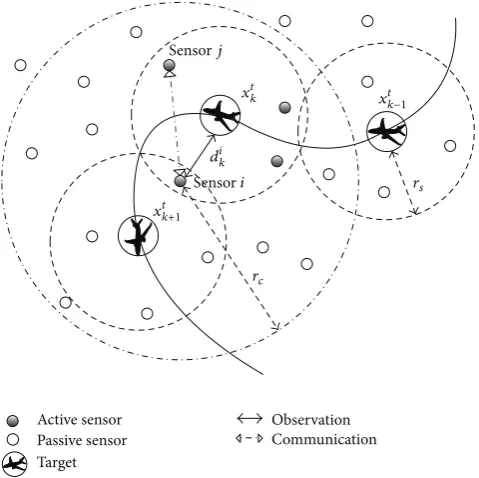
𝑁sensors. Assume that the sensor network is an undirected graph and the communication range of the sensors deter-mines the topology of the network. As illustrated in Figure 1, we denote the communication range and sensing range of
Active sensor Passive sensor Target
Observation Communication Sensorj
Sensori
rc
rs
xtk+1
xtk−1 xtk
dik
Figure 1: A typical SLAT scenario.
the sensors as 𝑟𝑐 and 𝑟𝑠, respectively. For LSR, ratio 𝑟𝑠/𝑟𝑐 is sufficiently smaller than0.5[8]. Notation𝑑𝑖𝑘 denotes the measured distance between a sensor𝑖and the target at the time step𝑘. If𝑑𝑖𝑘 < 𝑟𝑠, the sensor is active; otherwise, it is in a passive status.
We denote the state vector of a target as𝑥𝑡𝑘 = [𝑙𝑡𝑥,𝑘, 𝑙𝑡𝑦,𝑘,
V𝑡
𝑥,𝑘,V𝑡𝑦,𝑘]𝑇 ∈ R4×1, where superscript 𝑡 implies that 𝑙𝑡𝑥,𝑘 or𝑙𝑦,𝑘𝑡 describes atargetstate and subscript𝑘indicates the
timestep. Under the distributed estimation architecture, we give a more explicit definition of the target state as 𝑥𝑡,𝑖𝑘 =
[𝑙𝑡,𝑖
𝑥,𝑘, 𝑙𝑡,𝑖𝑦,𝑘,V𝑡,𝑖𝑥,𝑘,V𝑡,𝑖𝑦,𝑘]𝑇 ∈ R4×1with respect to sensor𝑖. Specif-ically, for a moving target on a 2D plane,(𝑙𝑥,𝑘𝑡,𝑖, 𝑙𝑦,𝑘𝑡,𝑖)denote the target position and(V𝑡,𝑖𝑥,𝑘,V𝑡,𝑖𝑦,𝑘)denote the target velocities along 𝑥-axis and 𝑦-axis, respectively. In ideal conditions, when the distributed system achieves convergence for a long time, we could get the relationship as
𝑥𝑡,1∞= 𝑥𝑡,2∞= ⋅ ⋅ ⋅ = 𝑥𝑡,𝑖∞= ⋅ ⋅ ⋅ = 𝑥𝑡∞. (1) We use a linear Gaussian model to formulate the target state transition:
𝑥𝑡,𝑖𝑘 = 𝜙𝑡𝑘−1𝑥𝑘−1𝑡,𝑖 + 𝐺𝑡𝑘−1𝑤𝑡,𝑖𝑘−1, (2)
where 𝑤𝑡,𝑖𝑘−1 ∈ R4×1 is zero-mean Gaussian additive noise with variance𝑄𝑡,𝑖𝑘−1∈R4×4,𝜙𝑘−1𝑡 ∈R4×4is the state transition matrix, and𝐺𝑡𝑘−1 ∈ R4×4 is the noise distribution matrix. In practice, every sensor maintains an individual state for the target. These states are then fused to achieve a consensus subject to certain optimizing rules.
asensor state. As the sensors are randomly deployed, self-localization is required for each sensor. In this context, the state transition for sensor𝑖is formulated using a static model:
𝑥𝑘𝑠,𝑖= 𝑥𝑠,𝑖𝑘−1+ 𝑤𝑘−1𝑠,𝑖 , (3) where𝑤𝑘−1𝑠,𝑖 ∈ R2×1is zero-mean white Gaussian noise with covariance matrix𝑄𝑠,𝑖𝑘−1∈R2×2, which is used to describe the uncertainty of sensor localization.
3. Augmented Filtering Based on Information
Weighted Consensus Fusion
This section proposes an augmented filtering framework based on information weighted consensus fusion, for the purpose of target tracking and sensor localization. We first introduce the augmented transition and measurement mod-els and then describe how to exploit augmented filtering to update the coupling information of the target state and sensor localization of each node. We establish the framework by developing an information weighted consensus filtering scheme which exploits online consensus fusion of local neighboring information to refine the target states. As an integrated framework, each augmented filter is specific to a separate sensor subsystem and gets feedback from the local information weighted consensus filter. Such structure enables the elimination of coupling errors for localization and tracking and thus improves the system accuracy.
3.1. Augmented Models. In this subsection, we introduce the
basic augmented model used in our framework. Specifically, the distance between a target state described in (2) and the sensor location of𝑖described in (3) is given as follows:
𝑑𝑘𝑖 = √(𝑙𝑡,𝑖 𝑥,𝑘− 𝑙𝑥,𝑘𝑠,𝑖)
2
+ (𝑙𝑡,𝑖 𝑦,𝑘− 𝑙𝑠,𝑖𝑦,𝑘)
2
. (4)
For a sensor network with LSR, sensor𝑖can sense a target only if it falls within its sensing range at time step𝑘, that is,𝑑𝑖𝑘≤ 𝑟𝑠. The group of these sensors𝑉𝑎 = {𝑖 | 𝑖 ∈ 𝑉and𝑑𝑖𝑘 ≤ 𝑟𝑠}is referred to as the active nodes subset. The remaining sensors form the passive sensor subset𝑉𝑝, which does not obtain any meaningful measurement of the target because it is beyond their sensing ranges.
We can integrate the position information of a target and a sensor into one augmented vector𝑥𝑖𝑘 = [(𝑥𝑡,𝑖𝑘)𝑇, (𝑥𝑠,𝑖𝑘 )𝑇]𝑇 ∈ R6×1. Similarly, we define the following parameters of an augmented system,𝜙𝑘−1 =diag{𝜙𝑡𝑘−1, 𝐼2×2},𝑤𝑖𝑘−1= [(𝑤𝑘−1𝑡,𝑖 )𝑇,
(𝑤𝑠,𝑖
𝑘−1)𝑇]𝑇, 𝑄𝑖𝑘−1 = [(𝑄𝑡,𝑖𝑘−1)𝑇, (𝑄𝑠,𝑖𝑘−1)𝑇]𝑇, and 𝐺𝑘−1 = diag{𝐺𝑡𝑘−1, 𝐼2×2}. Then the augmented state transition is for-mulated as follows:
𝑥𝑖𝑘= 𝜙𝑘−1𝑥𝑖𝑘−1+ 𝐺𝑘−1𝑤𝑖𝑘−1. (5) We assume the measurement model as a linear Gaussian model over a set of range measurements under measurement noise. Therefore, the measured receiving power by sensor𝑖at time stamp𝑘,𝑧𝑘𝑖, can be denoted as follows:
𝑧𝑘𝑖 = 𝑇𝑝− 10𝜂log10(𝑑𝑖𝑘) +V𝑖𝑘, (6)
where𝑇𝑝and𝜂denote the transmission power and the path loss exponent, respectively. They are determined subject to the radio environment and the antenna characteristics [11].
V𝑖
𝑘is the measurement noise with covariance𝑅𝑖. Following the relations in (4)–(6), we obtain
ℎ (𝑥𝑖𝑘) = 𝑇𝑝− 10𝜂log10√(𝑙𝑡,𝑖𝑥,𝑘− 𝑙𝑥,𝑘𝑠,𝑖)2+ (𝑙𝑦,𝑘𝑡,𝑖 − 𝑙𝑠,𝑖𝑦,𝑘)2. (7)
Based on (7), measurement (6) is converted to
𝑧𝑘𝑖 = ℎ (𝑥𝑖𝑘) +V𝑖𝑘. (8)
The aim of our study is to develop a distributed consensus estimator for the system characterized by (5) and (8), which are introduced in the following subsections.
3.2. Preliminary Augmented Filtering. In order to estimate the
states of a sensor and the target in a fully decentralized man-ner, an extended Kalman filter based estimator for augmented state (EKFAug) is applied. This procedure is referred to as augmented filtering where the estimator receives feedback from the information weighted consensus filter.
In this scenario, we assume that the one-step estimate of the augmented state ̂𝑥𝑘−1𝑖 and the error covariance ̂𝑃𝑘−1𝑖 is updated with information weighted consensus filtering for sensor𝑖at time step𝑘 − 1. We adopt a linear approximation of observation model (8) for sensor 𝑖, which uses Taylor expansion on the argument of the predicted mean 𝑥𝑖𝑘−1 as follows:
𝑧𝑘𝑖 ≈ ℎ (𝑥𝑖𝑘−1) + 𝐻𝑘𝑖(𝑥𝑘𝑖 − 𝑥𝑖𝑘−1) +V𝑖𝑘, (9)
where
𝐻𝑘𝑖 = 𝜕ℎ 𝜕𝑥𝑖 𝑘
𝑥𝑖
𝑘−1
= 10𝜂 [ [ [ [ [ [ [ [ [ [ [ [ [ [ [ [ [ [ [ [ [ [ [ [ [ [ [ [ [ [ [ [
(𝑙𝑠,𝑖𝑥,𝑘−1− 𝑙𝑡,𝑖𝑥,𝑘−1)
[(𝑙𝑡,𝑖𝑥,𝑘−1− 𝑙𝑠,𝑖𝑥,𝑘−1)2+ (𝑙𝑡,𝑖𝑦,𝑘−1− 𝑙𝑠,𝑖𝑦,𝑘−1)2] (𝑙𝑠,𝑖𝑦,𝑘−1− 𝑙𝑡,𝑖𝑦,𝑘−1)
[(𝑙𝑡,𝑖𝑥,𝑘−1− 𝑙𝑠,𝑖𝑥,𝑘−1)2+ (𝑙𝑠,𝑖𝑦,𝑘−1− 𝑙𝑡,𝑖𝑦,𝑘−1)2] 0
0 (𝑙𝑡,𝑖𝑥,𝑘−1− 𝑙𝑠,𝑖𝑥,𝑘−1)
[(𝑙𝑡,𝑖𝑥,𝑘−1− 𝑙𝑠,𝑖𝑥,𝑘−1)2+ (𝑙𝑡,𝑖𝑦,𝑘−1− 𝑙𝑠,𝑖𝑦,𝑘−1)2] (𝑙𝑡,𝑖𝑦,𝑘−1− 𝑙𝑠,𝑖𝑦,𝑘−1)
[(𝑙𝑡,𝑖𝑥,𝑘−1− 𝑙𝑠,𝑖𝑥,𝑘−1)2+ (𝑙𝑡,𝑖𝑦,𝑘−1− 𝑙𝑠,𝑖𝑦,𝑘−1)2] ] ] ] ] ] ] ] ] ] ] ] ] ] ] ] ] ] ] ] ] ] ] ] ] ] ] ] ] ] ] ] ]
𝑇
.
(10)
Step 1. Prediction is as follows:
𝑥𝑖𝑘= 𝜙𝑘̂𝑥𝑘−1, (11)
𝑃𝑖𝑘= 𝜙𝑘̂𝑃𝑘−1𝑖 𝜙𝑘𝑇+ 𝐺𝑘𝑄𝑘−1𝑖 𝐺𝑘𝑇. (12)
Step 2. Estimation is as follows:
𝐾𝑘𝑖 = 𝑃𝑖𝑘𝐻𝑇(𝐻𝑃𝑘𝑖𝐻𝑇+ 𝑅𝑖𝑘)−1, (13)
̂𝑥𝑖𝑘= 𝑥𝑖𝑘+ 𝐾𝑘𝑖(𝑧𝑖𝑘− ℎ (𝑥𝑖𝑘)) , (14)
̂𝑃𝑖 𝑘= 𝑃
𝑖
𝑘− 𝐾𝑘𝑖𝐻𝑃 𝑖
𝑘, (15)
where𝐻𝑘𝑖 is the Jacobian transformation of functionℎ(𝑥𝑖𝑘), which calculates the derivative for each variable of the pre-dicted nonlinear observation of the augmented state.𝑃𝑖𝑘is the predicted covariance of the filter and𝑅𝑖𝑘is the measurement noise. For the active and passive scenarios, it is formulated separately as follows:
𝐻𝑘𝑖 ={{{{ { 𝜕ℎ 𝜕𝑥𝑖 𝑘 𝑥𝑖 𝑘 𝑖 ∈ 𝑉𝑎
0 𝑖 ∈ 𝑉𝑝.
(16)
3.3. Fusion Based Refinement. The EKFAug discussed in the
previous subsection is specific to one individual sensor. The estimate of an augmented state based on (14) and (15) is only concerned with the individual sensor and does not explore information exchange between neighboring sensors. In order to characterize local neighboring information, we fuse their estimates by developing a distributed information filter with weighted consensus fusion and feed such information to the previous extended Kalman estimator. We refer to the overall framework as EKFAug-ICF, which stands for extended Kalman filter based estimator for augmented state with information weighted consensus fusion.
Given the condition that the sensor state prediction𝑥𝑠,𝑖𝑘 is available from the EKFAug, Taylor expansion of (8) is used to approximate observation of sensor𝑖. Based on state𝑥𝑡,𝑖𝑘 of the information weighted consensus filter, we have
𝑧𝑖𝑘≈ ℎ (𝑥𝑡,𝑖𝑘) + 𝐻𝑘𝑡,𝑖(𝑥𝑡,𝑖𝑘 − 𝑥𝑡,𝑖𝑘) +V𝑖𝑘, (17) where 𝐻𝑡,𝑖 𝑘 = 𝜕𝑥𝜕ℎ𝑡,𝑖 𝑘 𝑥𝑡,𝑖 𝑘−1 = 10𝜂 [ [ [ [ [ [ [ [ [ [ [ [ [ [ [ [
(̂𝑙𝑠,𝑖𝑥,𝑘− 𝑙𝑡,𝑖𝑥,𝑘−1)
[(𝑙𝑡,𝑖𝑥,𝑘−1− ̂𝑙𝑠,𝑖 𝑥,𝑘)
2
+ (𝑙𝑡,𝑖𝑦,𝑘−1− ̂𝑙𝑠,𝑖 𝑦,𝑘) 2 ] (̂𝑙𝑠,𝑖 𝑦,𝑘− 𝑙 𝑡,𝑖 𝑦,𝑘−1)
[(𝑙𝑡,𝑖𝑥,𝑘−1− ̂𝑙𝑠,𝑖𝑥,𝑘)2+ (𝑙𝑡,𝑖𝑦,𝑘−1− ̂𝑙𝑦,𝑘𝑠,𝑖)2] 0 0 ] ] ] ] ] ] ] ] ] ] ] ] ] ] ] ] 𝑇 . (18)
Note that observation model (17) is different from (9) in terms of augmented filtering. In (17) only the target states are used to approximateℎ(⋅); in (9), both the target states and sensor locations are used.
Let𝑁𝑖denote the set of neighboring sensors of sensor𝑖. Each sensor in 𝑁𝑖 has a direct communication channel to sensor𝑖. Neighboring sensors can communicate with each other either directly or through the central node in such a way that information is allowed to be passed between them. In the SLAT scenario, messages can be exchanged between a sensor𝑖and all of its neighbors in𝑁𝑖. Given𝑥𝑡,𝑖𝑘 and𝑃𝑡,𝑖𝑘 of sensor𝑖, the consensus fusion is conducted as follows.
Step 1. Prepare data for fusion:
𝑏𝑡,𝑖
0,𝑘= 𝑁1𝑃𝑡,𝑖𝑘𝑥𝑡,𝑖𝑘 + (𝐻𝑘𝑡,𝑖) 𝑇 (𝑅𝑖 𝑘) −1 (𝑧𝑖 𝑘− 𝑦𝑡,𝑖𝑘) ,
𝐵𝑡,𝑖0,𝑘= 𝑁1𝑃𝑡,𝑖𝑘 + (𝐻𝑘𝑡,𝑖)𝑇(𝑅𝑖𝑘)−1𝐻𝑘𝑡,𝑖,
(19)
where 𝐻𝑘𝑡,𝑖 = (𝜕ℎ/𝜕𝑥𝑡,𝑖𝑘)|𝑥𝑡,𝑖
𝑘 and 𝑦
𝑡,𝑖 𝑘 = ℎ(𝑥𝑡,𝑖𝑘, 𝑘) − (𝜕ℎ/𝜕𝑥𝑡,𝑖 𝑘)|𝑥𝑡,𝑖 𝑘𝑥 𝑡,𝑖 𝑘.
Step 2. Perform information weighted consensus fusion on
𝑏𝑡,𝑖
0,𝑘and 𝐵𝑡,𝑖0,𝑘 separately. At every iteration𝑚, each sensor𝑖 broadcasts𝑏𝑚−1,𝑘𝑡,𝑖 and𝐵𝑡,𝑖𝑚−1,𝑘to all its neighbors𝑗 ∈ 𝑁𝑖and receives𝑏𝑚−1,𝑘𝑡,𝑗 and𝐵𝑡,𝑗𝑚−1,𝑘from them. These are used to fuse and generate the information vectors and matrices of the current step:
𝑏𝑚,𝑘𝑡,𝑖 = 𝑏𝑚−1,𝑘𝑡,𝑖 + 𝜀 ∑
𝑗∈𝑁𝑖
(𝑏𝑚−1,𝑘𝑡,𝑗 − 𝑏𝑚−1,𝑘𝑡,𝑖 ) ,
𝐵𝑡,𝑖𝑚,𝑘= 𝐵𝑡,𝑖𝑚−1,𝑘+ 𝜀 ∑
𝑗∈𝑁𝑖
(𝐵𝑡,𝑗𝑚−1,𝑘− 𝐵𝑡,𝑖𝑚−1,𝑘) . (20)
For all passive sensors, that is, for all𝑗 ∈ 𝑉𝑝, 𝐻𝑘𝑡,𝑗 = 0, because no such information can be obtained. Therefore, their information vector and matrix are defined as zero, that is, for all 𝑗 ∈ 𝑉𝑝, 𝑢𝑡,𝑗𝑘 = 0 and 𝑈𝑘𝑡,𝑗 = 0. In contrast to the all-to-all communication strategies such as the Bayesian filtering framework [5], our broadcasting procedure just exchanges neighboring information with a small amount of communication workloads and thus suffers comparatively lower computational overheads.
Step 3. After𝑀iterations, compute state estimate and
infor-mation matrix:
̂𝑥𝑡,𝑖
𝑘 = (𝐵𝑡,𝑖𝑀,𝑘) −1
𝑏𝑀,𝑘𝑡,𝑖 , (21)
̂𝑃𝑡,𝑖
𝑘 = (𝑁𝐵𝑡,𝑖𝑀,𝑘) −1
. (22)
Input:̂𝑥𝑖0,̂𝑃0𝑖
Output:̂𝑥𝑘𝑡,𝑖,̂𝑥𝑠,𝑖𝑘
for𝑘 = 1, 2, . . ., do
for𝑖 = 1, 2, . . ., do
whilesensor is activateddo
Generate measurement according to (8);
Modify sensor localization with target tracking in augmented filter according to (11)–(16); Compute initial information matrix and vector according to (19);
Perform average consensus;
for𝑘 = 1, 2, . . . , 𝑀do
(a) Send𝑏0,𝑘𝑡,𝑖and𝑏0,𝑘𝑡,𝑖 to all neighbors𝑗 ∈ 𝑁𝑖; (b) Receive𝑏0,𝑘𝑡,𝑖and𝑏0,𝑘𝑡,𝑖 from all neighbors𝑗 ∈ 𝑁𝑖; (c) Update these values according to (20);
Compute fused target-statê𝑥𝑡,𝑖𝑘 and̂𝑃𝑘𝑡,𝑖according to (21)-(22); Updatê𝑥𝑖𝑘,̂𝑃𝑘𝑖with fused target-statê𝑥𝑡,𝑖𝑘 and̂𝑃𝑘𝑡,𝑖.
return ̂𝑥𝑡,𝑖𝑘,̂𝑥𝑠,𝑖𝑘
Algorithm 1: Augmented filtering based on information weighted consensus fusion.
Our framework is suitable for the practical applications which are limited by LSR conditions. The feedback scheme in (21) and (22) enables our framework to have the advantages of fault tolerance and scalability, which are validated in the experimental evaluation.
3.4. Framework Structure and Algorithm. Sections 3.2 and
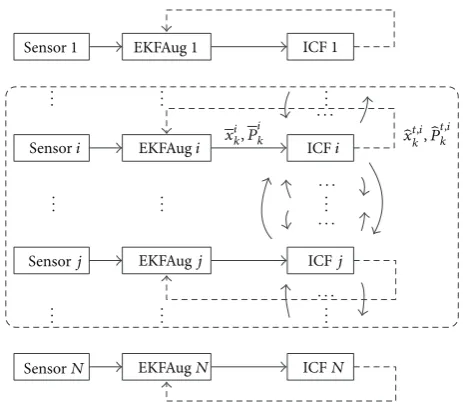
3.3 have presented the two main filtering procedures of the proposed distributed estimation framework of each sensor. The overall diagram of our proposed framework is illustrated in Figure 2. Estimate𝑥𝑖𝑘 and covariance𝑃𝑖𝑘 denoted in (11) and (12), respectively, are obtained from the augmented filters and fed to the information weighted consensus filters; outputs
̂𝑥𝑡,𝑖
𝑘, ̂𝑃𝑘𝑡,𝑖of the weighted consensus filters denoted in (21) and (22) are fed back to the augmented filters as inputs. This closed-loop procedure addresses the coupling problem that normally exists in distributed SLAT and is able to correct the accumulated cross-correlated errors of sensor localization and target tracking.
The pseudo code of the proposed two-stage SLAT algo-rithm is summarized in Algoalgo-rithm 1.
4. Simulation
In this section, we evaluate the performance of the proposed EKFAug-ICF algorithm using simulation experiments and compare it with the centralized matrix weighted fusion approach [12, 13], denoted as EKFAug-MWF. We simulate a wireless sensor network comprising a moving target and a total of𝑁 = 9 sensors in Matlab, which are uniformly deployed with their locations kept unchanged in the exper-iments. Each of them has a set of wireless transceiver.
We commence by demonstrating how to solve the sensor self-localisation and target tracking problem using our frame-work. Dynamical model (2) is used to compute the target state. The process covariance is set to diag{10, 10, 1, 1}. Initial prior state ̂𝑥0𝑡,𝑖and prior covariance ̂𝑃0𝑡,𝑖are set by using the same method for each sensor. For example, ̂𝑃0𝑡,𝑖is given by
Sensor1 EKFAug1 ICF1
Sensori EKFAugi ICFi
SensorN EKFAugN ICFN
Sensorj EKFAugj ICFj
· · ·
· · · · · ·
· · ·
..
. ... ...
..
. ... ...
.. . ..
. ..
.
xik, Pik ̂xt,ik, ̂Pt,ik
Figure 2: Structure of the augmented filtering framework. In the figure, EKFAug denotes the extended Kalman filter based estimator for augmented state 𝑛, 𝑛 = 1, . . . , 𝑖, . . . , 𝑗, . . . , 𝑁, 𝑁 is the total number of sensors, ICF denotes the information weighted filter𝑛,
𝑥𝑖 𝑘,𝑃
𝑖
𝑘denote the predicted state and covariance of augmented filters
(11)-(12), and ̂𝑥𝑡,𝑖𝑘, ̂𝑃𝑘𝑡,𝑖denote estimated state and covariance (21)-(22).
a diagonal matrix diag{100, 100, 10, 10}, and̂𝑥𝑡,𝑖0 is generated by adding zero-mean Gaussian noise with covariance ̂𝑃0𝑡,𝑖to the ground truth state. State transition matrix𝜙is
𝜙 = [ [ [ [ [ [
1 0 1 0 0 1 0 1 0 0 1 0 0 0 0 1 ] ] ] ] ] ]
. (23)
0 100 200 300 400 500 0
100 200 300 400 500
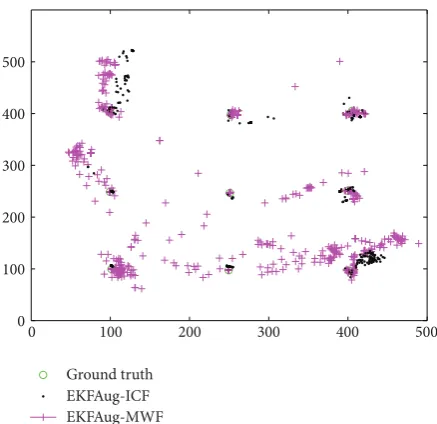
Ground truth EKFAug-ICF EKFAug-MWF
Figure 3: Results of the distributed SLAT tracking experiment.
only if the ground truth position of the target is within its range field. In this case, a measurement is generated using nonlinear observation model (8) with noise covariance𝑅𝑖 =
10𝐼2, where𝑇𝑝 = 100and𝜂 = 2.5[2]. We assume that the sensors are connected using a peer-to-peer topology and the consensus iteration number is set as 𝑀 = 3[14], that is,
𝐶1↔ 𝐶2↔ 𝐶3↔ 𝐶4↔ 𝐶5↔ 𝐶6↔ 𝐶7↔ 𝐶8↔ 𝐶9. An example of the tracking simulation experiment is demonstrated in Figure 3. The experiment results show that EKFAug-ICF performs better than EKFAug-MWF. This is because the estimation fusion with distributed consensus often achieves better error tolerance and robustness than that of the traditional state fusion approach.
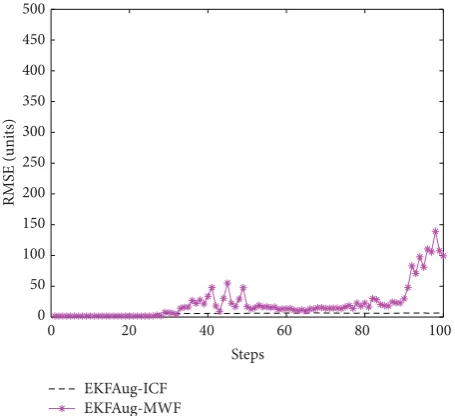
We further investigate the performance of the two approaches through 200 independent trials. The simulation environment is the same with Figure 3. The root mean squared error (RMSE) of𝑥𝑡𝑘for the two approaches is shown in Figure 4. The RMSE at time 𝑘is computed in terms of
√∑𝑖∈𝑉∑200𝑛 ‖𝑥𝑡
𝑘− ̂𝑥𝑘,𝑛𝑡,𝑖‖2, where ̂𝑥𝑡,𝑖𝑘,𝑛 denotes the estimated target state at time step 𝑘 obtained from the 𝑛th run. We observe that in EKFAug-MWF case the RMSE keeps increasing as step increases, and the EKFAug-ICF achieves convergence with better performance.
As target tracking updates online, the positions of sensors, which are prelocalized coarsely beforehand, are modified simultaneously. The ground truth and the estimated sensor locations of EKFAug-ICF and EKFAug-MWF are illustrated in Figure 5, which shows that the precision of sensor localiza-tion with EKFAug-ICF is greater than that of EKFAug-MWF. Figure 6 shows the estimated errors sensor positions using the two approaches, where EKFAug-ICF provides almost identical position estimations to the ground truth.
0 20 40 60 80 100
0 50 100 150 200 250 300 350 400 450 500
Steps
RMS
E (uni
ts)
EKFAug-ICF EKFAug-MWF
Figure 4: The average error of target estimation.
0 100 200 300 400 500
0 100 200 300 400 500
Ground truth EKFAug-ICF EKFAug-MWF
Figure 5: The ground truth and estimated sensor positions.
Both EKFAug algorithms work well in SLAT and ICF per-forms better. It can be seen that the proposed algorithm is able to accurately locate sensors within a wireless sensor network.
5. Discussion and Conclusion
0 20 40 60 80 100 0
50 100 150 200 250 300 350 400 450 500
Steps
RMS
E (uni
ts)
EKFAug-ICF EKFAug-MWF
Figure 6: The average error of sensor position estimation.
system is mainly targeting a typical indoor environment, where the settings are similar to those from [2] and the network setup is the same with [14]. The effect of𝜂in different scenarios, such as outdoor, will be considered in the future research.
This paper proposes a filtering architecture based on extended Kalman filtering for characterizing the correlation of target tracking and sensor localization with augmented states. Specifically, we have described how to refine aug-mented filtering through the fusing information obtained from neighboring sensors based on the weighted informa-tion consensus filtering strategy. Our new scheme not only improves the performance of estimation through the fusion and feedback strategy but also reduces the computational overheads in sensor communication via the neighborhood confinement. The experiment results have shown that our novel framework exhibits robustness in the LSR situations.
Conflict of Interests
The authors declare that there is no conflict of interests regarding the publication of this paper.
Acknowledgments
This work was partially supported by the National Natural Science Foundation of China (Grant nos. 61503413 and 61411130134), the National Science and Technology Pillar Program (Grant no. 2013BAH54F03), Shandong Provin-cial Natural Science Foundation (Grant no. ZR2015FL027), Shandong Outstanding Young Scientist Fund (Grant no. BS2013DX006), the UK Royal Society (Grant no. IE131036), and the Fundamental Research Funds for the Central Uni-versities.
References
[1] C. Taylor, A. Rahimi, J. Bachrach, H. Shrobe, and A. Grue, “Simultaneous localization, calibration, and tracking in an ad hoc sensor network,” inProceedings of the 5th International Conference on Information Processing in Sensor Networks (IPSN ’06), pp. 27–33, IEEE, Nashville,Tenn, USA, April 2006. [2] W. Li, Y. Jia, J. Du, and J. Zhang, “Distributed multiple-model
estimation for simultaneous localization and tracking with NLOS mitigation,”IEEE Transactions on Vehicular Technology, vol. 62, no. 6, pp. 2824–2830, 2013.
[3] Z. Xiahou and X. Zhang, “Adaptive localization in wireless sensor network through bayesian compressive sensing,” Inter-national Journal of Distributed Sensor Networks, vol. 2015, Article ID 438638, 13 pages, 2015.
[4] N. Kantas, S. S. Singh, and A. Doucet, “Distributed maximum likelihood for simultaneous self-localization and tracking in sensor networks,”IEEE Transactions on Signal Processing, vol. 60, no. 10, pp. 5038–5047, 2012.
[5] J. Teng, H. Snoussi, C. Richard, and R. Zhou, “Distributed variational filtering for simultaneous sensor localization and target tracking in wireless sensor networks,”IEEE Transactions on Vehicular Technology, vol. 61, no. 5, pp. 2305–2318, 2012. [6] S. Grime and H. F. Durrant-Whyte, “Data fusion in
decentral-ized sensor networks,”Control Engineering Practice, vol. 2, no. 5, pp. 849–863, 1994.
[7] G. Soatti, M. Nicoli, A. Matera, S. Schiaroli, and U. Spagnolini, “Weighted consensus algorithms for distributed localization in cooperative wireless networks,” inProceedings of the 11th International Symposium on Wireless Communications Systems (ISWCS ’14), pp. 116–120, IEEE, Barcelona, Spain, August 2014. [8] R. Olfati-Saber and N. F. Sandell, “Distributed tracking in sensor networks with limited sensing range,” in Proceedings of the American Control Conference (ACC ’08), pp. 3157–3162, Seattle, Wash, USA, June 2008.
[9] A. T. Kamal, J. A. Farrell, and A. K. Roy-Chowdhury, “Infor-mation weighted consensus filters and their application in distributed camera networks,”IEEE Transactions on Automatic Control, vol. 58, no. 12, pp. 3112–3125, 2013.
[10] F. Meyer, O. Hlinka, H. Wymeersch, E. Riegler, and F. Hlawatsch, “Cooperative simultaneouslocalization and track-ing in mobile agent networks,” http://arxiv.org/abs/1403.1824. [11] X.-Y. Jiang, H.-S. Zhang, and W. Wang, “NLOS error mitigation
with information fusion algorithm for UWB ranging systems,”
The Journal of China Universities of Posts and Telecommunica-tions, vol. 19, no. 2, pp. 22–29, 2012.
[12] Y. Bar-Shalom, “On the track-to-track correlation problem,”
IEEE Transactions on Automatic Control, vol. 26, no. 2, pp. 571– 572, 1981.
[13] J. Ma and S. Sun, “Centralized fusion estimators for multisensor systems with random sensor delays, multiple packet dropouts and uncertain observations,”IEEE Sensors Journal, vol. 13, no. 4, pp. 1228–1235, 2013.