http://www.sciencepublishinggroup.com/j/ijalt doi: 10.11648/j.ijalt.20190503.11
ISSN: 2472-1166 (Print); ISSN: 2472-1271 (Online)
A Mixed Approach to the Contrastive Analysis of C-E and
E-C Translation Unit
Hulin Zhao
Faculty of International Studies, Henan Normal University, Xinxiang City, China
Email address:
To cite this article:
Hulin Zhao. A Mixed Approach to the Contrastive Analysis of C-E and E-C Translation Unit. International Journal of Applied Linguistics and Translation. Vol. 5, No. 3, 2019, pp. 36-40. doi: 10.11648/j.ijalt.20190503.11
Received: April 10, 2019; Accepted: May 31, 2019; Published: August 12, 2019
Abstract:
Translation unit research can be divided into the process-oriented and the product-oriented perspective The current research belongs to the former one. With 7 juniors of English majors as participants, the current research probes into student translators’ translation process through TAM based on a mixed analysis of TAPs. Research question is: What similarities and differences can be found between C-E and E-C translation unit? It is hoped that research findings can shed some light on the translation unit research and education of student translators’ translation competence.Keywords:
Translation Unit, Student Translator, Translation Competence1. Introduction
1.1. Background
The term translation unit was first used by Vinay and Darbelnet (1965) in their Stylistique compare du fancais et de l’anglais. [1] Since its introduction, it has sparked much interest. It is Luo Jinde who brings the term into the translation community of China. Many works and papers published in China and other countries have involved the discussion of the translation unit from either the product-oriented or the process-oriented perspective. [2, 3] Some typical definitions of what the translation unit is can be found. For example, the unit of translation is the stretch of source text on which the translator focuses attention in order to represent it as a whole in the target language. [4]
In the article herein, it is interpreted as the attention unit that the participants can sustain during the Think-aloud experiment. The article adopts a mixed approach to the contrastive analysis of Chinese-English (C-E) and English-Chinese (E-C) translation unit. Research question is: What similarities and differences can be found between C-E and E-C translation unit?
1.2. Reliability and Validity of Think-Aloud Method
1.2.1. Debates on Its Reliability and Validity
Think-aloud method (TAM), refers to a kind of
data-collecting method that asks the participants to verbalize simultaneously what they are thinking about as they are working on a particular task. Borrowed from psychology and increasingly applied into translation studies, it is one method that is believed to demystify the thought process of the human brain. It has been one of the empirical methods used in the investigation of the psychological aspect of the translation process. Participants who face the task of producing a translation are asked to speak aloud whatever comes into their minds while they are working on it. Their verbalizations, also called think-aloud protocols (TAPs), are recorded and then meticulously analyzed. Consequently, inferences are actually indirectly made about the cognitive processes that produce the verbalizations.
TAM is a well defined methodology, underlying which is the assumption that “human cognition is information processing”. [5] And translation is also assumed to be one of the general phenomena of the information processing, which takes place in the working memory of the human brain and in turn, what is stored in it can be verbalized. [6] A further assumption is that the think-aloud itself does not “interfere with the cognitive process itself, the only effect being to slow down the task performance”. [7] In this sense, it is believed what the participants verbalize reflects or even stands for an accurate record of what they think in reality.
studies, however, have pointed out the problems in the application of TAPs. [8-11] The problems identified can be summarized as 1) the think-aloud data gathered through TAPs may be incomplete; 2) it is not plain what influences the methodology of TAPs itself will exert on the translation process; 3) how the two translation modes of verbal report and translation interfere with each other; 4) how the validity and reliability of the experiment is assured.
In response to the controversies, many other researches contend that TAPs can be relied on to disclose the translation process. Benefiting from the process model proposed by Ericsson and Simon, Bernardini holds that “only concurrent verbalization of thoughts [TAPs] can be claimed to exhaustively reflect the mental state of a participant carrying out a relatively long task (let us say, longer than ten seconds)”; a single think-aloud will not distort the mental state. [7]
1.2.2. Safeguards of Its Reliability and Validity
TAM is said to be one of the most powerful means of revealing the translation process. It can yield rich data, provided that the procedure of data-collection, data coding and analysis observes certain principles. However, no method comes without its deficiencies.
Arguably the biggest drawback in using TAPs is that the entire process of collecting and analyzing think-aloud data consumes a great deal of time and energy. Moreover, the verbal report may, to some extent, slow down the translation, so the participants often take more time than usual to complete the translation task. Last but not least, it is still not clear till today how the verbalization and translation work with each other. Anyhow, the methodology will not lose its advantage even if it still needs improving. And the researcher has made painstaking effort to minimize the impact of the external factors and in this way, to maximize the validity and reliability of the think-aloud procedure, thus the quality of the collected data can be guaranteed.
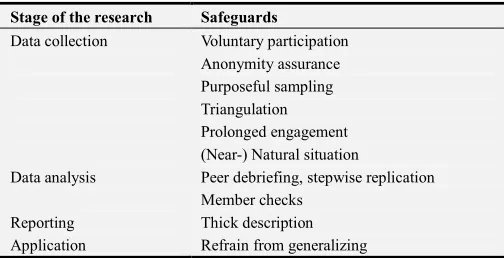
Building on Guba’s criteria for ensuring the quality of naturalistic [qualitative] inquiries, Li Defeng (2004) outlines his 8 safeguards for the trustworthiness of TAM. [12] Jointly combining the safeguards discussed by Li and the nature of the current research, the author summarized the safeguards as shown in Table 1. The current research obeys the table to conduct the research design.
Table 1. Safeguards for the trustworthiness of the research design.
Stage of the research Safeguards
Data collection Voluntary participation
Anonymity assurance Purposeful sampling Triangulation Prolonged engagement (Near-) Natural situation
Data analysis Peer debriefing, stepwise replication
Member checks
Reporting Thick description
Application Refrain from generalizing
2. Research Design
2.1. Participants Selection
11 English major juniors are selected according to their TEM (Test for English Majors) 4 score, scores of C-E and E-C translation, and their overall rank of the 5th semester. They volunteer to participate in the experiment. 7 of them survive the training session and are considered to be eligible for the think-aloud experiment, three of which are males, the rest females. The participants are assured of their anonymity. All the participants are top students in the same grade, for the simple fact that to think-aloud poses great challenges to the participants and it is out of the reach of students with poor performance. Besides, the thesis will not make any comparison between top students and underdeveloped students.
2.2. Participants Training
The participants should be well-informed about what they are expected to do, the methodology itself as well as the reasons for conducting; therefore, the following instructions are delivered. The training material used at this stage is similar to that at the think-aloud phase.
In this research, I take interest in what you think about as you carry out the tasks I am going to give you. To do this, you are asked to think aloud as you work through the tasks. By “think aloud” I mean that I want you to say everything that you are thinking from the very first beginning you start the task until you finish it. Please do not explain your thought process or why you have such thought. You are advised to speak constantly during the whole process. The current experiment is an essential part of my MA thesis which hopes to provide some suggestions on the TEM 8 translation test design, test preparation and the translation teaching and learning.
2.3. Test Material
The test material employed in this research is picked up from the sample paper of TEM 8, which is considered “ideal sample”.[13, 14] It covers C-E and E-C translation. It is chosen obeying by the following principles:
1)The test material should mirror the test itself.
2)It should be neither too difficult nor too easy for the participants to complete.
3)The test types should include selections both from literature works and English periodicals.
2.4. Pilot Study
2.5. TAPs Collection
The sheet of instructions is shown to the participants once more. And the researcher briefs them on the think-aloud procedure, and prompts in case that their pause intervals exceed 5 seconds. Then the participants are provided with some practice tasks such as the multiplicity by numbers and the translation task. Finally comes the actual think-aloud phase.
During this phase, the participants are given the translation materials chosen from a TEM 8 sample test paper. They are asked to write down their translated versions, and at the same time, express what is coming into their brains. And the voice-recording device is available to keep record of what they have verbalized. Thus, two types of data will be obtained as soon as the experiment is completed; one is the translated version, the other think-aloud protocols. Each participant performs his or her task individually in a small secluded classroom. There is no time limit and the use of dictionaries is not allowed even if the participants encounter new words or phrases.
2.6. TAPs Transcription
The initial data transcription, including both the think-aloud data and the translated version, is assisted by some classmates of the researcher, but it is the researcher himself who edits and determines the final version. Not only the participants’ words but also sighs, laughs, etc. are transcribed to obtain the full and comprehensive data.
2.7. TAPs Coding
Data coding is crucial to abstracting useful and valid information from think-aloud protocols. A good coding scheme achieves a balance between specificity and generalizability. That is to say, the coding scheme can be
neither too general nor too detailed, which otherwise would either fail to capture adequately the cognitive activity involved in carrying out a task or not succeed in representing the typical behavior.
The coding scheme shapes and constrains the inferences that may be drawn from the data. A unit for analysis will usually comprise a phrase, clause or sentence. As for the segmentation of the protocols, each segment should be representative of a single specific process. The researcher intends to encode the data based on 3 types of data, self-report, self-evaluation and self-revelation, proposed by Cohen. [15] The coding scheme is illustrated at length in the following part. One segment which is coded between the sign // represents a single process.
The unit of translation (UT) is grouped into subjective (SUT) and objective type (OUT). Thus, combining the current research purpose, the simultaneous data elicited in this thesis are coded according to the five levels, word, phrase, clause, sentence and discourse for UT. Its coding scheme can be summarized as SW, SP, SC, SS and SD for the SUT of the word, phrase, clause, sentence and discourse, and OW, OP, OC, OS and OD for the OUT.
3. Research Results
The data analysis has two parts included, qualitative and quantitative analysis. Each further contains the analysis of UT and ST. The qualitative analysis primarily relies on the case study, selecting two samples from the 7 sets of protocols. Moreover, the analysis adopts a bottom-up method to search for whether any trend can be traced. The existing research is primarily qualitative, and in this sense, its theme should be the case analysis of the protocols. Besides, the case analysis is supplemented by the quantitative analysis of the whole set of data produced by all the 7 participants.
3.1. Quantitative Analysis of UT
Table 2. UT statistics.
UT Type SUT OUT
SW SP SC SS SD OW OP OC OS OD
C-E translation N 0 43 31 5 0 225 96 28 3 1
% 0 54.4 39 6.6 0 64 27 8 0.8 0.2
E-C translation N 0 18 24 21 0 244 128 79 24 2
% 0 28.7 38 33.3 0 51 27 16.6 5 0.4
At first sight, one may find that the total segments in the E-C translation far outweigh those in the C-E translation. As illustrated in the table above, the number of SUT (79) in C-E translation is 16 more than that (63) in E-C translation. Nevertheless, the number of OUT in C-E translation (353) is 124 less than that of the OUT (477) in E-C translation. In both of the cases, the number of OUT exceeds that of the SUT. On the one hand, it can be interpreted that the translation process is an actual process of solving concrete problems one encounters in the process; one the other, the participant aims high but ends low, i.e., the participant intends to grapple with
the translation at the higher UT whereas ends up with the lower UT.
At the OUT level, the OW makes up the biggest proportion of the entire segments, whereas the OW in the C-E translation (64%) is higher than that in the E-C translation (51%). The percentage of OP is 27% for both of them. The proportion of OW and OP adds up to 91% and 78% respectively in the C-E translation and the E-C translation. It can be said that whatever the C-E translation or the E-C translation, the actual translation is carried out at the lower level of the UT. One difference lies in the OC which accounts for 8% and the OS (0.8%) in the C-E translation, a little lower than that (16.6% and 5%) in the E-C translation.
In brief, the general quantitative analysis illustrates that the C-E translation and the E-C translation enjoy the similarities and differences in UT:
1)The participant intends to deal with the translation at the higher UT of SC and SS, while the translation process ends up at the lower level of OW and OP.
2)The number of SUT in C-E translation is a little bit more than that in E-C translation, whereas the number of OUT in C-E translation is much less than that of the OUT in E-C translation.
3)SP consists of the majority of the SUT in C-E translation and SC in E-C translation, though the proportion in the latter is not so prominent. However, OW makes up the largest part of the OUT in both kinds of translation.
3.2. Qualitative Analysis of UT
This part makes a detailed categorization of each segment produced by participant 1 (P1). It is analyzed with the original verbalization and the categorization of UT.
In conducting the C-E translation, P1 catches a glimpse of the test material and then directly follows the streamline of the original passage. It is proved by the first two identical segments of P1, demonstrating that P1 stops and proceeds to the actual translation process after a quick glimpse of the whole passage.
One characteristic identified from the segments is that P1 begins at the higher SUT level which is intermitted with the lower SUT level or OUT level, the SUT-OUT pattern in short. However, the pattern here is not a linear but a recursive one. The participant may backwards and forwards resort to the SUT and OUT, whereas the resolution usually comes to an end at the OUT level. Take segment 2 for instance. P1 first reads the sentence “My supervisor, an Asian American, was addicted to drinking and smoking”. And below are three concrete segments “…I will take ‘my supervisor’ as subject…, to have ‘be addicted to’ collocated with drinking and smoking. Piqi Baozao can be translated into ill tempered” at the OP level, two “… ‘an Asian American’ acts as appositive…” at the OW level, and one “My supervisor was addicted to drinking and smoking, and was ill tempered…” at the SP level. The only intertwined SUT segment “My supervisor was addicted to drinking and smoking, and was ill tempered… ” appears in the middle of the OUTs. Segments to illustrate this SUT-OUT pattern are abundant in the protocols, such as “He greatly appreciated industriousness and good command of encyclopedic knowledge, and understood them well”, “Hence,
among all the students enrolled in his lab, five were from Asia, only one from Germany”.
New words or phrases can interrupt the thought process of P1; nevertheless, P1 counts on the context to decide how to translate. Segment 30 to segment 42 are an example in point. After browsing segment 30 “On the door of his lab there was even an eye-catching notice…”, P1 pauses to deal with the translation of “even” before continuing to read the content of notice. Similarly, P1 is not familiar with how to interpret “assistant” and stops to think prior to finishing reading the whole segment 34 “Lab assistants must work with devotion from 10 a.m. to 12 p.m., 7 days a week”. Now comes segment 35, which shows that P1 is still bewildered about the interpretation of “assistant”. Segment 36 goes to the content of the “notice”. Segment 37 is verbalized to confirm the translation of the word “even”. It is the same with segment 40, which echoes segment 36. Segment 41, responding to segment 34, is the verbalization of the original sentence. Finally, P1 determines the translation of “assistant” in segment 42. The above analysis illustrates that the context performs an essential role in comprehending and coping with the translation.
It can be summarized from the preceding qualitative analysis that 1) the translation process is not a linear but a recursive one; 2) the SUT-OUT pattern is prevalent in the protocols; 3) context helps the participant understand the passage. Next is the qualitative approach to the protocols in E-C translation.
Similarly, the SUT-OUT pattern is applicable to the segments in E-C translation. For instance, segment 4 is about the reading of the whole sentence, and the subjective sentence unit is then divided into from segment 5 to segment 9. Different from the segments in the C-E translation, one segment (23) in the E-C translation deals with the translation at the discourse level, “In general, the text is about opera…”. And P1 at first browses through the whole passage and returns to some segments that are difficult to comprehend to ascertain their meaning. This point can be best illustrated with segment 24 “abdicate” and 25 “expensive things are not inevitably the province of the rich…”, which follows segment 23 marking the end of P1’s comprehension with the whole passage, and is followed by segment 26 marking P1’s formal translation of the material.
It can be seen that the E-C segments carry the following characteristics: 1) the general translation process is non-linear but recursive; 2) the SUT-OUT pattern is applicable to the E-C translation; 3) context is conducive to understanding some segments; 4) P1 first reads through the whole passage before his concrete translation.
4. Conclusion
The qualitative analysis shows that the translation process in general is non-linear but recursive. It is not the novel finding of the current research but the further testification.
In terms of UT, 1) the participant intends to deal with the translation at the higher UT of SC and SS, while the translation process ends up at the lower level of OW and OP. 2) The number of SUT in C-E translation is a little bit more than that in E-C translation, whereas the number of OUT in C-E translation is much less than that of the OUT in E-C translation. 3) SP consists of the majority of the SUT in C-E translation and SC in E-C translation, though the proportion in the latter is not so prominent. However, OW makes up the largest part of the OUT in both kinds of translation.
The future studies are advised to be undergone from a larger perspective such as larger samples, more translation aspects. Moreover, efforts should be made to improve TAM itself.
Acknowledgements
The research is sponsored by Educational Research Project of China National Committee for Translation & Interpreting Education (No. MTIJZW201807), Project for Young Scholars of Henan Normal University and Startup Project for Recruit with Ph. D Degree of Henan Normal University (qd17156).
References
[1] Vinay, J & C. Darbelnet. Stylistique comparee du fransais et de l’anglais [M]. Paris: Paris Didier. 1965.
[2] Si, Xianzhu. A Review of the Research on Translation Unit in Recent Twenty Years in China [J]. Foreign Language Research, 2001 (1): 96-101.
[3] Wang, Fuxiang. & Zheng, Binghan. A Review of the Research on Translation Unit in Recent 60 Years [J]. Foreign Language Research, 2019 (2): 99-105.
[4] Thunes, M. The Concept of Translation Unit Revisited [J].
Bergen Language and Linguistics Studies, 2017 (1): 241-259.
[5] Ericsson A. & Simon, A. Protocol analysis (2nd ed.) [M]. Cambridge, MA: MIT Press. 1993.
[6] Ericsson A. & Simon, A. Verbal protocols as data [M]. Cambridge, MA: MIT Press. 1984.
[7] Bernardini, S. Think-aloud protocols in translation research [J].
Target, 2001 (2): 241-263.
[8] Muhammad, M. & M, Latif. Using Think-aloud Protocols and Interviews in Investigating Writers’ Composing Processes [J].
International Journal of Research & Method in Education, 2019 (2): 111-123.
[9] Obead, A. & M, Pam. To Intervene or Not to Intervene: An Investigation of Three Think-aloud Protocols in Usability Testing [J]. Journal of Usability Studies, 2017 (3): 111-132.
[10] Sofie, H. et al. Profiling Upper Primary School Students’ Self-Regulated Learning through Self-Report Questionnaires and Think-aloud Protocol Analysis [J]. Learning & Individual Differences, 2019 (2): 155-168.
[11] Trapsilo, P. A Think-aloud Protocols as a Cognitive Strategy to Increase Students’ Writing Narrative Skill at EFL Classroom [J]. Premise Journal, 2017 (2): 81-90.
[12] Li, Defeng. Trustworthiness of Think-aloud Protocols in the Study of Translation Processes. International Journal of Applied Linguistics, 2004 (3): 301-313.
[13] Zou, Shen. Sample Test Papers for TEM 8 [M]. Shanghai: Shanghai Foreign Languages Education Press. 2005.
[14] Zheng, Binghan. The Triangulation Module in Process-oriented Translation Studies [J]. Shanghai Journal of Translators, 2008 (3): 36-41.