Donovan, Tim, Felix, Lambert M., Chalmers, James D., Milan, Stephen J.,
Mathioudakis, Alexander G. and Spencer, Sally (2018) Continuous versus
intermittent antibiotics for bronchiectasis. Cochrane Database of Systematic
Reviews, 6 . CD012733.
Downloaded from: http://insight.cumbria.ac.uk/id/eprint/3921/
Usage of any items from the University of Cumbria’s institutional repository ‘Insight’ must conform to the
following fair usage guidelines.
Any item and its associated metadata held in the University of Cumbria’s institutional repository Insight (unless
stated otherwise on the metadata record) may be
copied, displayed or performed, and stored in line with the JISC
fair dealing guidelines (available here) for educational and notforprofit activities
provided that
• the authors, title and full bibliographic details of the item are cited clearly when any part
of the work is referred to verbally or in the written form
• a hyperlink/URL to the original Insight record of that item is included in any citations of the work
• the content is not changed in any way
• all files required for usage of the item are kept together with the main item file.
You may not
• sell any part of an item
• refer to any part of an item without citation
• amend any item or contextualise it in a way that will impugn the creator’s reputation
• remove or alter the copyright statement on an item.
The full policy can be found here.
Cochrane
Database of Systematic Reviews
Continuous versus intermittent antibiotics for bronchiectasis
(Review)
Donovan T, Felix LM, Chalmers JD, Milan SJ, Mathioudakis AG, Spencer S
Donovan T, Felix LM, Chalmers JD, Milan SJ, Mathioudakis AG, Spencer S.
Continuous versus intermittent antibiotics for bronchiectasis.
Cochrane Database of Systematic Reviews2018, Issue 6. Art. No.: CD012733. DOI: 10.1002/14651858.CD012733.pub2.
T A B L E O F C O N T E N T S
1 HEADER . . . .
1 ABSTRACT . . . .
2
PLAIN LANGUAGE SUMMARY . . . .
2
BACKGROUND . . . .
4
OBJECTIVES . . . .
4 METHODS . . . .
8 RESULTS . . . .
Figure 1. . . 9
10
DISCUSSION . . . .
11
AUTHORS’ CONCLUSIONS . . . .
11
ACKNOWLEDGEMENTS . . . .
12 REFERENCES . . . .
20 CHARACTERISTICS OF STUDIES . . . .
26 CONTRIBUTIONS OF AUTHORS . . . .
26 DECLARATIONS OF INTEREST . . . .
27 SOURCES OF SUPPORT . . . .
27
[Intervention Review]
Continuous versus intermittent antibiotics for bronchiectasis
Tim Donovan1, Lambert M Felix2, James D Chalmers3, Stephen J Milan4, Alexander G Mathioudakis5, Sally Spencer6
1Medical and Sport Sciences, University of Cumbria, Lancaster, UK.2Nuffield Department of Orthopaedics, Rheumatology and
Musculoskeletal Sciences (NDORMS), University of Oxford, Oxford, UK.3University of Dundee, Ninewells Hospital and Medical
School, Dundee, UK.4Medical School, Lancaster University, Lancaster, UK.5Division of Infection, Immunity and Respiratory
Medicine, University of Manchester, Manchester, UK.6Postgraduate Medical Institute, Edge Hill University, Ormskirk, UK
Contact address: Tim Donovan, Medical and Sport Sciences, University of Cumbria, Lancaster, [email protected].
Editorial group:Cochrane Airways Group.
Publication status and date:New, published in Issue 6, 2018.
Citation: Donovan T, Felix LM, Chalmers JD, Milan SJ, Mathioudakis AG, Spencer S. Continuous versus intermit-tent antibiotics for bronchiectasis. Cochrane Database of Systematic Reviews 2018, Issue 6. Art. No.: CD012733. DOI: 10.1002/14651858.CD012733.pub2.
Copyright © 2018 The Cochrane Collaboration. Published by John Wiley & Sons, Ltd.
A B S T R A C T
Background
Bronchiectasis is a chronic airway disease characterised by a destructive cycle of recurrent airway infection, inflammation and tissue damage. Antibiotics are a main treatment for bronchiectasis. The aim of continuous therapy with prophylactic antibiotics is to suppress bacterial load, but bacteria may become resistant to the antibiotic, leading to a loss of effectiveness. On the other hand, intermittent prophylactic antibiotics, given over a predefined duration and interval, may reduce antibiotic selection pressure and reduce or prevent the development of resistance. This systematic review aimed to evaluate the current evidence for studies comparing continuous versus intermittent administration of antibiotic treatment in bronchiectasis in terms of clinical efficacy, the emergence of resistance and serious adverse events.
Objectives
To evaluate the effectiveness of continuous versus intermittent antibiotics in the treatment of adults and children with bronchiectasis, using the primary outcomes of exacerbations, antibiotic resistance and serious adverse events.
Search methods
On 1 August 2017 and 4 May 2018 we searched the Cochrane Airways Review Group Specialised Register (CAGR), CENTRAL, MED-LINE, Embase, PsycINFO, CINAHL, and AMED. On 25 September 2017 and 4 May 2018 we also searchedwww.clinicaltrials.gov, the World Health Organization (WHO) trials portal, conference proceedings and the reference lists of existing systematic reviews.
Selection criteria
We planned to include randomised controlled trials (RCTs) of adults or children with bronchiectasis that compared continuous versus intermittent administration of long-term prophylactic antibiotics of at least three months’ duration. We considered eligible studies reported as full-text articles, as abstracts only and unpublished data.
Data collection and analysis
Two review authors independently screened the search results and full-text reports.
Main results
Authors’ conclusions
No randomised controlled trials have compared the effectiveness and risks of continuous antibiotic therapy versus intermittent antibiotic therapy for bronchiectasis. High-quality clinical trials are needed to establish which of these interventions is more effective for reducing the frequency and duration of exacerbations, antibiotic resistance and the occurrence of serious adverse events.
P L A I N L A N G U A G E S U M M A R Y
Are antibiotics more effective when given continuously or intermittently to people with bronchiectasis?
Background
Bronchiectasis is an incurable lung disease characterised by repeated chest infections. Antibiotics are a main form of treatment and can be taken long term to prevent chest infections from developing. This could be continuously or intermittently for a fixed period of time. However, we do not currently know which approach is the most effective for reducing the frequency and duration of exacerbations, managing antibiotic resistance and minimising side effects.
Study Characteristics
On 1 August 2017 we searched a wide range of sources to find clinical trials for our review. We found 268 potentially relevant results but on closer examination none of the studies met our review criteria and none could be included.
Authors’ conclusions
There is no high-quality evidence about whether continuously administered or intermittently administered antibiotics are safer and more helpful for people with bronchiectasis. More research is needed to evaluate which one of these methods is better for reducing chest infections, limiting resistance to antibiotic therapy and reducing serious side effects.
B A C K G R O U N D
Description of the condition
Bronchiectasis is a chronic airway disease characterised by abnor-mal destruction and dilation of the large airways, bronchi and bronchioles (Pasteur 2010). It is characterised radiologically by permanent dilation of the bronchi, and clinically by a syndrome of cough, sputum production and recurrent respiratory infections (Chalmers 2014). The pathogenesis of bronchiectasis can be ex-plained by the vicious cycle theory, whereby an initial insult to the airway leads to bronchial wall inflammation and damage, and dis-ordered mucociliary clearance, predisposing the patient to chronic or recurrent infection resulting in further airway damage (Cole 1986;Chalmers 2013). An understanding of this cycle of persis-tent bacterial colonisation, chronic inflammation of the bronchial mucosa, and progressive tissue destruction is central to the man-agement of bronchiectasis as strategies to arrest both inflamma-tory and bacterial components are required to limit the progres-sion of lung injury (Cole 1997;Pasteur 2010). Bacteria most
com-monly isolated from the airways of patients with bronchiectasis include non-typeableHaemophilus influenzae,Pseudomonas aerugi-nosa,Streptococcus pneumoniae,Staphylococcus aureusandMoraxella catarrhalis (Foweraker 2011). Colonising pathogens such as P aeruginosa,H influenzaeandM catarrhalisalso commonly display antimicrobial resistance arising from intrinsic resistance mecha-nisms or frequent exposure to antimicrobial agents.
in women and those aged over 60 years (Weycker 2005;Roberts 2010;Seitz 2010), and higher prevalence rates in low- and mid-dle-income countries (Habesoglu 2011). Prevalence in Germany in 2013 was estimated at 67 cases per 100,000 general popula-tion (Ringshausen 2015). In the UK, point prevalence rates per 100,000 rose from 350.5 to 566.1 in women and from 301.2 to 485.5 in men over a nine-year period, reflecting an increase of more than 60% and approximately 263,000 adults living with bronchiectasis in 2013 (Quint 2016). Similarly, incidence rates per 100,000 person-years over the same period rose from 21.2 to 35.2 in women and from 18.2 to 26.9 in men, a 63% increase, with over 15,000 new cases in 2013. Average European mortal-ity rates per 100,000 general population are estimated at 0.3 in 27 of the 28 EU countries and at 0.2 in nine non-EU countries, based on 2005 to 2009 data (European Lung White Book 2013). Recent UK age-adjusted mortality rates are 2.26 times higher in women and 2.14 times higher in men compared with the general population (Quint 2016).
The disease has a significant impact on children, with worse qual-ity of life in younger children and those with more frequent exac-erbations (Kapur 2012). Bronchiectasis is also more common in some indigenous groups where prevalence may be as high as 16 per 1000 among southwest Alaskan children and 15 per 1000 in Australian Aboriginal and Torres Strait Islander children (Chang 2002). Furthermore, one study reported an incidence of 3.7 per 100,000 per year among New Zealand children aged under 15 years. This equates to an overall prevalence of 1 per 3000 children and 1 per 625 Pacific children (Twiss 2005). It also demonstrates that the incidence rate among children in New Zealand is almost seven times higher than those from Finland (Twiss 2005). An improvement in diagnosis resulting from easier access to high-quality CT scanners, and increased awareness of symptoms com-mon to bronchiectasis and other lung diseases, have been cited as factors contributing to increased prevalence (Goeminne 2016). Bronchiectasis places an increasing burden on healthcare systems internationally (Chalmers 2015;Redondo 2016), with patients experiencing a high rate of exacerbations, hospital admissions and attributable mortality (Chalmers 2015). Data from the European bronchiectasis registry show that approximately half of bronchiec-tasis patients have two or more exacerbations per year and a third are hospitalised at least once a year (Polverino 2017). Patients colonised withP aeruginosaand those with a more frequent an-nual exacerbation rate have an accelerated decline in lung func-tion, reduced health-related quality of life (measured using the St George’s Respiratory Questionnaire, SGRQ), increased risk of hospitalisation and increased mortality risk (Evans 1996;Wilson 1997;Martínez-García 2007,Polverino 2017). A history of ex-acerbations, and particularly severe exex-acerbations, low body mass index, chronic bacterial infection, low forced expiratory volume
in one second (FEV ) per cent of predicted, a higher propor-tion of affected lobes and more breathlessness are also associated
with an increased risk of hospitalisation and mortality (Seitz 2010;
Chalmers 2014;Rogers 2014).
This is particularly the case withP aeruginosainfection. A sys-tematic review of observational studies identified thatP aeruginosa
infection is associated with a three-fold increase in mortality risk, an almost seven-fold increase in risk of hospital admission and an average of one additional exacerbation per patient per year. Bronchiectasis care is associated with substantial resource use. A recent Spanish study reported a mean direct annual medical cost for adult patients with bronchiectasis of EUR 4671, escalating with disease severity (de la Rosa 2016). Furthermore, factors such as FEV percentage predicted, age,Pseudomonascolonisation and hospitalisation may independently influence health care costs. A USA-based study reported an annual increase of USD 2319 in overall costs and USD 1607 in respiratory-related costs in pa-tients with bronchiectasis compared with matched case-controls, attributed primarily to an increase of two outpatient visits and 1.6 respiratory-related visits per patient per year (Joish 2013).
Description of the intervention
Antibiotics aiming to treat bacterial infections of the respiratory tract, or to control bacterial colonisation, or both, represent a cen-tral component of the treatment of bronchiectasis, as they reduce bacterial load, inflammation and consequent tissue destruction in the airways (Chalmers 2012). Long-term prophylactic antibiotics, administered for more than three months, have proved effective for patients with frequent bronchiectasis exacerbations or those with fewer exacerbations causing significant morbidity, as they ap-pear to decrease the frequency and severity of exacerbations, at the expense of a significant increase in the risk of emerging drug resistance (Hnin 2015). Patients taking continuous antibiotics are more than three times at risk of bacterial resistance compared to those who do not (Hnin 2015). Pathogens isolated in the spu-tum cultures of these patients during an exacerbation or at stable disease, such asP aeruginosa, H influenzae or M catarrhalis, com-monly display antimicrobial resistance arising from intrinsic resis-tance mechanisms or frequent exposure to antimicrobial agents. There is also risk of antibiotic-related adverse effects, such as hear-ing impairment and cardiotoxicity (Serisier 2013).
ther-apy where administration is at predefined regular intervals over a duration of at least three weeks, and where patients are not receiv-ing concomitant prophylactic antibiotics. We intended to com-pare continuous versus intermittent administration of long-term prophylactic antibiotics for at least three months.
How the intervention might work
There is a strong relationship between airway bacterial infection and disease morbidity in bronchiectasis; for example, patients chronically infected withP aeruginosahave a three-fold increase in mortality, a 6.5 times increase in hospital admission rate and an average of one additional exacerbation per patient per year, when compared to patients not chronically infected withP aeruginosa
(Finch 2015). Other commonly isolated bacteria such asH in-fluenzaeandM catarrhalisalso drive an increase in neutrophilic inflammation (Chalmers 2012); and they are associated with an increased risk of severe exacerbations (Chalmers 2014). Antibiotic treatment aims to suppress neutrophilic inflammation, reduce bac-terial load and thereby improve clinical outcomes (Brodt 2014). Continuous administration of antibiotic treatment is based on the assumption that chronic infection cannot be eradicated, and must therefore be continuously suppressed to prevent a return of bac-terial load, increased inflammation and a recurrence of symptoms (Haworth 2014).
The argument against continuous exposure to antibiotics is that it leads to increased bacterial resistance and consequently treatment may lose its effectiveness (Chalmers 2015). On the contrary, in-termittent administration of antibiotics might remove or limit the antibiotic selection pressure and, consequently, prevent the devel-opment of resistance, although intermittent antibiotics could also be less effective. While data are lacking on the impact of intermit-tent versus continuous administration of antibiotics on the devel-opment of antibiotic resistance among patients with bronchiecta-sis, there is some indirect evidence. For example, in a large retro-spective analysis of mechanically-ventilated patients with nosoco-mial infections (40% chronic lung disease), an interval of at least 20 days between serial courses of antibiotics was associated with a 24% reduction in development of resistance (Hui 2013). An additional advantage of intermittent antibiotic administration is a reduced treatment burden to patients, as continuous adminis-tration may result in more side effects as a result of higher cumu-lative exposure of the patient to antibiotics.
Why it is important to do this review
While long-term antibiotic treatments given both orally and via in-halation are part of the standard care for patients with bronchiecta-sis (Chalmers 2015), there is no agreement on the optimal method of delivery of antibiotic therapies. It is common practice to ad-minister both oral and inhaled antibiotics daily (Altenburg 2013;
Haworth 2014), on alternate days (Wong 2012), month on and month off (Barker 2014), or during the winter months when pa-tients may experience more exacerbations. International guide-lines are unable to comment on which method of antibiotic ad-ministration is most effective or is associated with the lowest rates of adverse events or antibiotic resistance. A European Respiratory Society/European Bronchiectasis Network (EMBARC) task force produced 22 consensus recommendations for future research into bronchiectasis, including “Studies should evaluate whether cyclic or continuous administration of long-term antibiotics is superior both in terms of clinical efficacy and the emergence of resistance” (Aliberti 2016). As this was determined to be an important clin-ical question by both patients and physicians, this systematic re-view was intended to evaluate the current evidence for continu-ous versus intermittent administration of antibiotic treatment in bronchiectasis.
O B J E C T I V E S
To evaluate the effectiveness of continuous versus intermittent an-tibiotics in the treatment of adults and children with bronchiec-tasis, using the primary outcomes of exacerbations, antibiotic re-sistance and serious adverse events.
M E T H O D S
Criteria for considering studies for this review
Types of studies
We planned to include randomised controlled trials (RCTs) and cluster-randomised trials. We also planned to include cross-over studies, but to only use data from the first pre-cross-over phase to eliminate potentially irreversible carry-over effects (e.g. antibiotic resistance). We also planned to include studies reported as full text, those published as abstract only, and unpublished data.
Types of participants
Types of interventions
We aimed to compare continuous versus intermittent administra-tion of long-term prophylactic antibiotics of at least three months’ duration. The delivery method was to be the same in all study groups, e.g. nebulised versus nebulised, in order to isolate the ef-fect of the antibiotic rather than the delivery device.
We considered intermittent administration of antibiotics, pro-vided that there were predefined regular intervals of antibiotic ad-ministration followed by a duration of at least three weeks when participants did not receive prophylactic antibiotics (e.g. one short course of antibiotics every month; month on and month off; or during the winter months). We considered antibiotics delivered without intervals of no antibiotics for the duration of the study to be continuous.
Types of outcome measures
Primary outcomes
1. Exacerbations (frequency, proportion with one or more, duration, time to next exacerbation), defined using study authors’ criteria.
2. Antibiotic resistance, defined as either the presence of antibiotic resistance after the administration of antibiotics for at least three months, or the development of antibiotic resistance within at least three months of antibiotic administration. We planned to only evaluate resistance to the antibiotic(s) being investigated.
3. Serious adverse events.
Secondary outcomes
1. Health-related quality of life using measures validated in a clinical setting (e.g. SGRQ, Leicester Cough Questionnaire (LCQ), Quality of Life-Bronchiectasis (QoL-B) questionnaire).
2. Hospital admissions due to exacerbations (frequency, duration), defined using study authors’ criteria.
3. Mortality (we planned to extract and report whether mortality is defined as all-cause or bronchiectasis-related in the individual studies).
4. Sputum volume and colour.
5. Symptoms (cough, dyspnoea, wheeze).
6. Lung function measured as forced expiratory volume in one
second (FEV ) (litres or per cent of predicted).
7. Exercise capacity (e.g. Six-Minute Walk Test or Incremental Shuttle Walk Test).
8. Adverse events/side effects.
We planned to use the definitions fromEdwards 2000andHansen 2015for serious adverse events and adverse events as follows.
1. Serious adverse events are those that result in death or life-threatening events; requirement for hospitalisation or
prolongation of existing hospitalisation; persistent or significant disability; or congenital anomalies; or are events considered medically important.
2. Adverse events are any untoward occurrence that presents while a patient is taking a drug but does not necessarily have a causal relation to the treatment. They are undetectable by the patient; usually identified by laboratory tests (e.g. biochemical, haematological, immunological, radiological, and pathological tests); or by clinical investigations (e.g. gastro-intestinal endoscopy, cardiac catheterisation).
Reporting one or more of the outcomes listed here in the study was not an inclusion criterion for the review.
Search methods for identification of studies
Electronic searches
We identified studies from the Cochrane Airways Group Register of Trials, which is maintained by the Information Specialist for the Group. The Cochrane Airways Trials Register contains studies identified from several sources, as follows.
1. Monthly searches of the Cochrane Central Register of Controlled Trials (CENTRAL, in the Cochrane Library), through the Cochrane Register of Studies Online (crso.cochrane.org);
2. Weekly searches of MEDLINE Ovid SP 1946 to date; 3. Weekly searches of Embase Ovid SP 1974 to date; 4. Monthly searches of PsycINFO Ovid SP;
5. Monthly searches of CINAHL EBSCO (Cumulative Index to Nursing and Allied Health Literature);
6. Monthly searches of AMED EBSCO (Allied and Complementary Medicine); and
7. Handsearches of the proceedings of major respiratory conferences.
We identified studies contained in the Trials Register through search strategies based on the scope of the Cochrane Airways Group. Details of these strategies, as well as a list of handsearched conference proceedings, are in Appendix 1. See Appendix 2 for search terms used to identify studies for this review.
We searched the following trials registries.
1. US National Institutes of Health Ongoing Trials Register ClinicalTrials.gov (www.ClinicalTrials.gov);
2. World Health Organization International Clinical Trials Registry Platform (apps.who.int/trialsearch).
We searched the Cochrane Airways Trials Register and additional sources from inception to 1 August 2017 and registries on 25 September 2017, with no restriction on language of publication.
We checked the reference lists of all primary studies and review articles for additional references. We searched relevant manufac-turers’ websites for study information.
We planned to search for errata or retractions from included studies published in full text onPubMedand to report the date this was done within the review.
Data collection and analysis
Selection of studies
Two review authors (SM and TD) independently screened the ti-tles and abstracts of the search results and coded them as ’retrieve’ (eligible or potentially eligible/unclear) or ’do not retrieve’. We retrieved the full-text study reports of all potentially eligible stud-ies and two review authors (SM and TD) independently screened them for inclusion, recording the reasons for exclusion of ineligible studies. We resolved disagreement through discussion or, if it had been necessary, we planned to consult a third review author (JC). We identified and excluded duplicates and collated multiple re-ports of the same study so that each study, rather than each report, was the unit of interest in the review. We recorded the selection process in sufficient detail to complete a PRISMA flow diagram and ’Characteristics of excluded studies’ table (Moher 2009).
Data extraction and management
We planned to use a data collection form for study characteristics and outcome data, that had been piloted on at least one study in the review. One review author (TD) would have extracted the following study characteristics from included studies.
1. Methods: study design, total duration of study, details of any ’run-in’ period, number of study centres and location, study setting, withdrawals and date of study.
2. Participants: N, mean age, age range, gender, severity of condition, diagnostic criteria, baseline lung function, smoking history, inclusion criteria and exclusion criteria.
3. Interventions: intervention, comparison, concomitant medications and excluded medications.
4. Outcomes: primary and secondary outcomes specified and collected, and time points reported.
5. Notes: funding for studies and notable conflicts of interest of trial authors.
We planned for two review authors (TD and LF) to independently extract outcome data from included studies. We planned to note in the ’Characteristics of included studies’ table where outcome data were not reported in a usable way. We planned to resolve disagreements by consensus or by involving a third review author (JC). We also planned for one review author (TD) to transfer data into the Review Manager 5 file (Review Manager 2014); and to double-check that data were entered correctly by comparing the
systematic review with the study reports. We planned for a second review author (LF) to spot-check study characteristics for accuracy against the study report.
Assessment of risk of bias in included studies
We planned for two review authors (LF and TD) to independently assess risk of bias for each study using the criteria outlined in theCochrane Handbook for Systematic Reviews of Interventions(
Higgins 2011); and to resolve disagreements by discussion or by involving another author (SM). We planned to assess the risk of bias according to the following domains.
1. Random sequence generation. 2. Allocation concealment.
3. Blinding of participants and personnel. 4. Blinding of outcome assessment. 5. Incomplete outcome data. 6. Selective outcome reporting. 7. Other bias.
We planned to judge each potential source of bias as high, low or unclear and provide a quote from the study report together with a justification for our judgement in the ’Risk of bias’ table. We also planned to summarise the risk of bias judgements across different studies for each of the domains listed. We planned to consider blinding separately for different key outcomes where necessary (e.g. for unblinded outcome assessment, risk of bias for all-cause mortality may be very different than for a patient-reported pain scale). Where information on risk of bias related to unpublished data or correspondence with a trialist, we planned to note this in the ’Risk of bias’ table.
When considering treatment effects, we planned to take into ac-count the risk of bias for the studies that contributed to that out-come.
Assessment of bias in conducting the systematic review
We conducted the review according to the published protocol and planned to justify any deviations from it in the ’Differences between protocol and review’ section of the systematic review.
Measures of treatment effect
We planned to analyse dichotomous data as odds ratios, and con-tinuous data as mean differences or standardised mean differences. We planned to enter data presented as a scale with a consistent direction of effect.
If multiple trial arms had been reported in a single trial, we planned to include only the relevant arms. If two comparisons (e.g. drug A versus placebo and drug B versus placebo) had been combined in the same meta-analysis, we planned to halve the control group to avoid double-counting.
Unit of analysis issues
If we had included any studies, the unit of analysis would have been the participant. In terms of exacerbation rates and hospitalisation rates, we planned to focus on the number of events experienced by the participant during the trial and to analyse the results using rate ratios if possible. We planned to use adjusted data where it was available (e.g. rate ratios from Poisson regression models, or mean differences from ANOVA or results from cluster randomised studies adjusted for cluster effect) as a first choice, followed by change scores and final scores as last choice.
Dealing with missing data
We planned to contact investigators or study sponsors in order to verify key study characteristics and to obtain missing numerical outcome data where possible (e.g. when a study was only identified as an abstract). Where this was not possible, and missing data were thought to introduce serious bias, we planned to take this into consideration in the GRADE rating for affected outcomes.
Assessment of heterogeneity
We planned to use the I² statistic to measure heterogeneity among the studies in each analysis; and if we had identified substantial heterogeneity, to report it and explore possible causes using the prespecified subgroup analyses.
Assessment of reporting biases
If we had been able to pool more than 10 studies, we would have created and examined a funnel plot to explore possible small-study and publication biases.
Data synthesis
We planned to conduct meta-analyses when the population, inter-ventions, outcomes and study designs were similar. In the presence of substantial heterogeneity (> 50%), we planned to report out-comes in the text, giving direction and size of the effect along with the strength of the evidence (risk of bias). We envisaged that an-tibiotic studies would vary by population, design, and outcomes, and therefore meta-analysis using a random-effects model would be most appropriate. However, where there are few studies or the effects of interventions across studies are not randomly distributed (e.g. with publication bias), the estimates from a random-effects model may be unreliable or biased. It was likely that this review
would only include a small number of low-powered studies, and we had therefore planned to use a fixed-effect model, reported with 95% confidence intervals (CI), and to evaluate the impact of model choice using a sensitivity analysis. We planned to synthe-sise and report dichotomous and continuous data separately for each outcome (e.g. exacerbation/no exacerbation or exacerbation duration). Where end-of-study point estimates and change from baseline scores were reported, we planned to analyse these sepa-rately. Furthermore, we planned to use standardised mean differ-ences (SMD) when outcomes were measured using different scales (e.g. health-related quality of life measures) and to use the baseline standard deviation (SD) for SMD analyses.
’Summary of findings’ table
We planned to create a ’Summary of findings’ table using the fol-lowing outcomes: exacerbations; antibiotic resistance; serious ad-verse events; hospitalisations; mortality; symptoms; and quality of life. We planned to use the five GRADE considerations (risk of bias, consistency of effect, imprecision, indirectness and publi-cation bias) to assess the overall quality of the evidence in terms of the studies that contributed data to the prespecified outcomes. We planned to use the methods and recommendations described in Section 8.5 and Chapter 12 of theCochrane Handbook for Sys-tematic Reviews of Interventions(Higgins 2011), using GRADE-pro software (GRADEpro GDT); and to justify all decisions to downgrade the quality of studies using footnotes. We planned to include comments to aid the reader’s understanding of the review where necessary.
Subgroup analysis and investigation of heterogeneity
We planned to carry out the following subgroup analyses. 1. Mode of delivery (e.g. oral, nebulised).
2. Antibiotic class (e.g. macrolide).
3. Duration participants colonised withP aeruginosa.
4. Specifically for the outcome antibiotic resistance, we planned subgroup analyses according to the definition of antibiotic resistance (presence of antibiotic resistance versus development of antibiotic resistance, following at least three months’ administration of antibiotics).
We planned to use the following outcomes in subgroup analyses. 1. Exacerbations.
2. Antibiotic resistance. 3. Serious adverse events.
We planned to use the formal test for subgroup interactions in Review Manager 5 (Review Manager 2014).
Sensitivity analysis
1. Random sequence generation. 2. Allocation concealment.
We planned to compare the results from a fixed-effect model with the random-effects model.
R E S U L T S
Description of studies
Results of the search
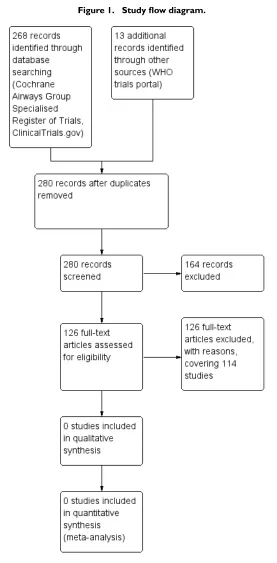
We identified 268 study reports in our database searches on 1 Au-gust and 25 September 2017, and 4 May 2018. We also searched the USA National Institutes of Health Ongoing Trials Register (
Included studies
We did not identify any studies relevant to our inclusion criteria.
Excluded studies
One hundred and twenty-six study reports (covering 114 studies) were excluded, with reasons, from original database searches fol-lowing inspection of the study report (Characteristics of excluded studies). Sixty-seven (59%) were not randomised studies (and were also otherwise not relevant to our inclusion criteria), 23 (20%) compared an antibiotic versus placebo, 12 (10%) compared dif-ferent antibiotics, five (4%) made a comparison between doses of the same antibiotic, two (2%) were excluded on the basis of the study having no relevance to the condition. The following were also excluded: Juqin mixture (Chinese medicine) aerosol inhala-tion plus standard care versus standard care alone, one (1%); parison between Pidotimod versus no treatment, one (1%); com-parison between herbal decoction with standard decoction, one (1%); comparison between colistimethate sodium versus saline so-lution, one (1%); and the one remaining record (1%) was a letter.
Risk of bias in included studies
No studies met the review inclusion criteria (Criteria for considering studies for this review). We were therefore unable to conduct the planned assessment risk of bias.
Effects of interventions
We were unable to evaluate the effectiveness of continuous versus intermittent antibiotics for bronchiectasis given the absence of studies meeting our inclusion criteria.
D I S C U S S I O N
Summary of main results
We planned to evaluate the effectiveness of continuous versus in-termittent antibiotics for bronchiectasis with respect to our pre-defined outcomes. Despite a comprehensive search, we identi-fied no randomised trials meeting our predefined inclusion cri-teria (Criteria for considering studies for this review), revealing a paucity of evidence in this area.
Overall completeness and applicability of evidence
We were unable to assess completeness and applicability of evi-dence as no studies met our inclusion criteria.
Quality of the evidence
We were unable to consider the quality of the evidence as no studies were included in this review.
Potential biases in the review process
We carried out an extensive and comprehensive search for relevant studies, with expert support from the Cochrane Airways Group. We conducted searches in nine databases, and obtained translation of all potentially relevant non-English publications identified in our searches.
Agreements and disagreements with other studies or reviews
bronchiectasis exacerbations are seasonal; for example Bibby and colleagues showed that admissions for bronchiectasis were more frequent in the winter and spring (Bibby 2015). Therefore it is common practice in some countries to give prophylactic antibi-otics only during the winter.
Conversely, the argument in favour of continuous administration of antibiotics is that airway bacterial load, which is suppressed by antibiotics, rebounds back to baseline levels after approximately 14 days of antibiotic discontinuation, and this provokes increased airway inflammation (Chalmers 2012;Wilson 2013). Studies of azithromycin and nebulized gentamicin have shown that treat-ment benefit is lost once the drug is discontinued, although fol-low-up in both studies was only three months.(Murray 2011;
Altenburg 2013).
A U T H O R S ’ C O N C L U S I O N S
Implications for practice
Our review revealed a lack of relevant high-quality evidence, as thorough systematic searches failed to yield any randomised con-trolled trials comparing continuous versus intermittent prophy-lactic antibiotic administration for bronchiectasis.
Due to lack of scientific evidence on the comparative risks and ben-efits of continuous versus intermittent antibiotics for this popula-tion, British, European and Spanish guidelines have made recom-mendations based on the available literature, which at the moment are the only available guide for the management of patients with bronchiectasis (Pasteur 2010; Polverino 2017; Martínez-García 2018). For example, the European guidelines recommend long-term antibiotics for people with three or more exacerbations per year but make no recommendations regarding a continuous or intermittent therapeutic regime (Polverino 2017).
Implications for research
Although cystic fibrosis research may provide some insight it is likely bronchiectasis has different patterns of efficacy and partic-ularly antibiotic resistance for continuous or intermittent antibi-otics. They are different clinical entities and a direct extrapolation of clinical beneficial treatments in cystic fibrosis may not apply to bronchiectasis (Barker 2014). In identifying the most important research priorities for bronchiectasis, the European Bronchiecta-sis Network (EMBARC) reported the following as a key research question: “Studies should ideally evaluate whether cyclic or con-tinuous administration of long-term antibiotics is superior both in terms of clinical efficacy and the emergence of resistance” (Aliberti 2016). This question is important because long-term antibiotic
prophylaxis is widely used, and resolving this question has impor-tant implications for both efficacy and antibiotic resistance. Our review identified no studies that could answer this question.
It is evident that there is urgent need for robust randomised trials to evaluate continuous versus intermittent antibiotics for bronchiec-tasis with respect to: exacerbations (frequency, proportion with one or more, duration, time to next exacerbation) ideally defined using a new international consensus definition (Hill 2017); an-tibiotic resistance (defined as either the presence of anan-tibiotic re-sistance after the administration of antibiotics for at least three months, or the development of antibiotic resistance within at least three months of antibiotic administration); and serious adverse events.
Similarly, consideration of the benefits of continuous versus inter-mittent antibiotics with respect to the following outcomes would also be especially helpful: health-related quality of life using mea-sures validated in a clinical setting (e.g. SGRQ, LCQ, QoL-B); hospital admissions due to exacerbations (both in terms of fre-quency and duration); mortality; sputum volume and colour; symptoms (cough, dyspnoea, wheeze); lung function measured as
forced expiratory volume in one second (FEV ); exercise capacity (e.g. Six-Minute Walk Test); and adverse events/side effects.
A C K N O W L E D G E M E N T S
We would like to thank Edge Hill University for supporting this study. We would also like to thank the Cochrane Airways Group for its support.
We would especially like to thank Dr Chris Cates for his support; Chris was the Editor for this review and provided helpful, critical comments on the review and guidance. We would also particularly like to thank Emma Dennett, Liz Stovold, Emma Jackson and Rebecca Normansell.
We are most grateful to the following with the translation of non-English study reports: Usama Al-Sari, Adelina Angusheva-Tihanov, Paul Ashton, Romain Bardot, Jane Dennis, Sylvia El-lis, Guillermo Guerra, Akira Kuriyama, Michela Masci, Georgi Popivanov, Laura Sansum, Marion Schulze, Birgit Smith, Daichi Suzuki and Joana Terzieva
TheBackgroundandMethodssections of this protocol are based on a standard template used by Cochrane Airways.
R E F E R E N C E S
References to studies excluded from this review
Aksamit 2016 {published data only}
Aksamit TR, De Soyza A, Operschall E, Bandel T-J, Krahn U, Montegriffo E, et al. Baseline demographic profile of subjects of the phase 3 RESPIRE 2 trial of ciprofloxacin dry powder for inhalation (DPI) in non-cystic fibrosis bronchiectasis (NCFB).American Journal of Respiratory and Critical Care Medicine2016;193:A1768.
Aksamit 2017 {published data only}
Aksamit T, Bandel TJ, Criollo M, De Soyza A, Elborn JS, Operschall E, et al. The RESPIRE trials: two phase III, randomized, multicentre, placebo-controlled trials of ciprofloxacin dry powder for inhalation (ciprofloxacin dpi) in non-cystic fibrosis bronchiectasis. Contemporary Clinical Trials 2017; Vol. 58:78–85.
Aksamit TR, Bandel T-J, Criollo M, Elborn JS, Lau M, Operschall E, et al. Respire 2: ciprofloxacin dpi 32.5 mg b.i.d. administered 14 days on/off or 28 days on/off vs. placebo for 48 weeks in patients with non-cystic fibrosis bronchiectasis (NCFB).American Journal of Respiratory and Critical Care Medicine2017;195:A7642.
De Soyza A, Aksamit T, Operschall E, Bandel T-J, Krahn U, Criollo M, et al. Baseline demographic profile of subjects of the phase 3 RESPIRE 1 trial of ciprofloxacin dry powder for inhalation (DPI) in non-cystic fibrosis bronchiectasis (NCFB).European Respiratory Journal2015;46:PA2617. De Soyza A, Aksamit TR, Bandel T-J, Criollo M, Elborn JS, Krahn U, et al. RESPIRE 1: ciprofloxacin DPI 32.5mg b.d. administered 14 day on/off or 28 day on/off vs placebo for 48 weeks in subjects with non-cystic fibrosis bronchiectasis (NCFB).European Respiratory Journal2016;48:OA272. NCT01764841. Ciprofloxacin dry powder for inhalation in non-cystic fibrosis bronchiectasis (non-cf BE) [Randomized, double–blind, placebo–controlled, multicenter study comparing ciprofloxacin dpi 32.5 mg bid (twice a day) intermittently administered for 28 days on / 28 days off or 14 days on / 14 days off versus placebo to evaluate the time to first pulmonary exacerbation and frequency of exacerbations in subjects with non–cystic fibrosis bronchiectasis]. clinicaltrials.gov/ct2/show/NCT01764841 (first received 10 January 2013).
NCT02106832. Ciprofloxacin dry powder for inhalation (dpi) in non-cystic fibrosis bronchiectasis (non-CF BE) (RESPIRE 2) [Randomized, double–blind, placebo– controlled, multicenter study comparing ciprofloxacin dpi 32.5 mg bid (twice a day) intermittently administered for 28 days on / 28 days off or 14 days on / 14 days off versus placebo to evaluate the time to first pulmonary exacerbation and frequency of exacerbations in subjects with non–cystic fibrosis bronchiectasis]. clinicaltrials.gov/ ct2/show/NCT02106832 (first received 8 April 2014). Quittner A, De Soyza A, Aksamit TR, Bandel T-J, Criollo M, Elborn JS, et al. Effects of ciprofloxacin dry powder for inhalation (ciprofloxacin DPI) on health-related quality
of life in patients with non-cystic fibrosis bronchiectasis (NCFB): results from the Phase III RESPIRE 1 study.
American Journal of Respiratory and Critical Care Medicine
2017;195:A7303.
Alberto 1968 {published data only}
Alberto S, Colongo PG, Brusasco L, Frigerio G. Studies of the clinical and respiratory functional effects of a mucolytic-antibiotic preparation in chronic bronchopulmonary diseases. Controlled double-blind single code studies.
Minerva Medica1968;59(53):2995–3002.
Alekseenko 1978 {published data only}
Alekseenko AV, Sokolov SB, Kobrin LI, Opalinskii VN, Lavrent’ev IuA. Direct current in the overall treatment of inflammatory suppurative diseases of the lungs [Voprosy Kurortologii, Fizioterapii, i Lechebonoi].Fizicheskoi Kultury
1978;2:44–6.
Alekseenko 1980 {published data only}
Alekseenko AV. Effectiveness of conservative treatment of disseminated forms of chronic inflammatory-suppurative lung diseases.Terapevticheskii Arkhiv1980;52(1):57–9.
Aliberti 2016 {published data only}
Aliberti S, Masefield S, Polverino E, De Soyza A, Loebinger MR, Menendez R, et al. Research priorities in bronchiectasis: a consensus statement from the EMBARC Clinical Research Collaboration. European Respiratory Journal2016;48(3):632–47. PUBMED: 27288031]
Al-Mobeireek 1998 {published data only}
Al-Mobeireek A, Kambal AM, Al-Balla SR, Al-Sawwaf H, Saleemi S. Pseudomonas aeruginosa in hospitalized patients with infective exacerbations of bronchiectasis: clinical and research implications.Annals of Saudi Medicine1998;18(5): 469–71.
Antoniu 2013 {published data only}
Antoniu S, Azoicai D. Ciprofloxacin dpi in non-cystic fibrosis bronchiectasis: a phase II randomized study.Expert Opinion on Investigational Drugs2013;22(5):671–3.
Cherniack 1959 {published data only}
Cherniack NS, Vosti KL, Dowling HF, Lepper MH, Jackson GG. Long-term treatment of bronchiectasis and chronic bronchitis; a controlled study of the effects of tetracycline, penicillin, and an oleandomycinpenicillin mixture.Archives of Internal Medicine1959;103(3):345–53.
ChiCTR-IOR-16008910 2016 {published data only} ChiCTR-IOR-16008910. Effectiveness of procalcitonin-guided antibiotic therapy in acute exacerbations of bronchiectasis: a randomized controlled trial. www.chictr.org.cn/showprojen.aspx?proj=15079 (first received 26 July 2016).
Chonabayasi 1988{published data only}
Choo 2018 {published data only}
Choo JM, Abell GCJ, Thomson R, Morgan L, Waterer G, Gordon DL, et al. Impact of long-term erythromycin therapy on the oropharyngeal microbiome and resistance gene reservoir in non-cystic fibrosis bronchiectasis.mSphere
2018;3(2):e00103–18. Cseri 1975 {published data only}
Cseri T, Kelemen S. Treatment with sumetrolim in chronic non-specific respiratory tract infections.Therapia Hungarica
1975;23(3):115–7.
Currie 1987 {published data only}
Currie DC, Garbett ND, Chan KL, Higgs E, Todd H, Nunn AJ, et al. Double blind randomised placebo controlled study of long term high dose antibiotic in patients with bronchiectasis [abstract].Clinical Research
1987;72(s16):79P.
Currie DC, Gargett ND, Cole PJ. Penetration of antibiotics into the respiratory tract.British Medical Journal (Clinical Research Ed.)1987;295(6590):119. EMBASE: 10.1136/ bmj.295.6590.119]
Dimakou 2017 {published data only}
Dimakou K, Kaponi M, Karampitsakos T, Tzouvelekis A, Chrysikos S, Melachroinidou M, et al. Eradication treatment in Non CF bronchiectasis: the effect of inhaled antibiotics (tobramycin and colistin) on patients with pseudomonas aeruginosa. European Respiratory Journal
2017;suppl 61:OA1971.
Dimakou K, Liapikou A, Triantafilidou C, Chrysikos S, Kaponi M, Melachroinidou M, et al. Non cf bronchiectasis: the effect of inhaled antibiotics (tobramycin and colistin) in patients with pseudomonas aeruginosa in sputum.American Journal of Respiratory and Critical Care Medicine2017;195: A1518.
Douglas 1957 {published data only}
Douglas AC, Somner AR, Marks BL, Grant IWB. Effect of antibiotics on purulent sputum in chronic bronchitis and bronchiectasis.Lancet1957;273(6988):214–8. Hayashi 1989 {published data only}
Hayashi T, Yamada H, Yasuoka A, Sasayama K, Doutsu Y, Kohno S, et al. Basic and clinical studies on cefdinir.
Chemotherapy1989;37(Supplement 2):565–78.
Hill 1992 {published data only}
Hill SL, Bilton D, Johnson MM, Pye A, Mitchell JL, Stockley RA. Sputum and serum pharmacokinetics of loracarbef (a new carbacephem antibiotic) in patients with bronchiectasis [Abstract]. European Respiratory Journal
1992;5:142s.
Howie 1976 {published data only}
Howie JG. Antibiotics and purulent sputum. British Medical Journal1976;2(6040):882.
Huang 2018 {published data only}
Huang H, Yang P, Wang J, Wu Y, Zi S, Tang J, et al. Investigation into the individualized treatment of traditional chinese medicine through a series of n-of-1 trials. Evidence-based Complementary and Alternative Medicine : ECAM
2018;2018:Article Number: 5813767.
Hughes 1973 {published data only}
Hughes DT. Use of combinations of trimethoprim and sulfamethoxazole in the treatment of chest infections.
Journal of Infectious Diseases1973;128(Suppl):701–5. Hughes DT. Use of combinations of trimethoprim and sulphamethoxazole in the treatment of chest infections.
Medical Journal of Australia1973;1(2):58–61.
Iglauer 1973 {published data only}
Iglauer E, Wieser O. Parenteral treatment of severe bronchopulmonary infections using trimethoprim and sulfamethoxazole. Wiener Medizinische Wochenschrift (1946) 1973; Vol. 123, issue 20:322–3.
Inoue 1989 {published data only}
Inoue Y, Masuyama Y, Dotsu Y, Kaku M, Suyama N, Hayashi T, et al. Basic and clinical studies on 7432-S. [Japanese].Chemotherapy1989;37:285–97.
Irabu 1989 {published data only}
Irabu Y, Tamaki K, Fukuhara H, Nakamura H, Kaneshima H, Shimoij K, et al. Laboratory and clinical studies on cefdinir. [Japanese].Chemotherapy1989;37:603–11.
Irabu 1992 {published data only}
Irabu Y, Fukuhara H, Nakamura H, Kaneshima H, Simoji K, Kitsukawa K, et al. Laboratory and clinical studies of ME1207. [Japanese].Chemotherapy1992;40:452–8.
Juthong 2011 {published data only}
Juthong S, Eiamsa-ard S. The effects of roxithromycin as anti-inflammatory agent on clinical outcomes in patient with bronchiectasis: A double blinded randomized controlled study [Abstract]. European Respiratory Journal
2011;38:819s.
Kanai 1963 {published data only}
Kanai J, Tanaka S, Matsumoto T, Noda S. Clinical trial use of phenoxypropyl penicillin.Journal of Antibiotics1963;16: 25–6.
Kawano 1974{published data only}
Kawano M, Irimajiri K, Higuchi J, Uchiyama T, Tsubura E. Studies on amikacin (BB-K8), a new aminoglycoside antibiotic (author’s transl). Japanese Journal of Antibiotics
1974;27(4):446–50.
Kawashima 1989 {published data only}
Kawashima K, Yamamoto H, Kadoya M, Kato M, Nata T, Iida E, et al. Clinical role of Branhamella catarrhalis infection in pulmonary disorders. [Japanese].Saishin Igaku [Modern Medicine]1989;44(6):1268–72.
Koyama 1992 {published data only}
Koyama M. ME1207: a clinical study. [Japanese].
Chemotherapy1992;40:692–5.
Krawczyk 1981 {published data only}
Kudo 1992 {published data only}
Kudo K, Ishii A, Kabe J. ME1207 in respiratory infections. [Japanese].Chemotherapy1992;40:696–9.
Kurishima 1992 {published data only}
Kurishima S, Hirose H, Fukui T, Katsu M. Basic and clinical studies on cefclidin. [Japanese]. Chemotherapy
1992;40:273–9.
Kuze 1988 {published data only}
Kuze F, Kurasawa T, Kato M, Kagioka A, Inaba N, Kuroda N, et al. Cefodizime (THR-221) in respiratory tract infections. [Japanese].Chemotherapy1988;36:467–72.
Lamotte 1981 {published data only}
Lamotte A. Bronchiectasis [French].Ouest-medical1981;34 (14):969–72.
Ledson 2000 {published data only}
Ledson MJ, Cowperthwaite C, Walshaw MJ, Gallagher MJ, Williets T, Hart CA. Nebulised taurolidine and B cepacia bronchiectasis.Thorax2000;55(1):91–2.
Lunacharskaia 1968 {published data only}
Lunacharskaia TV, Kopeiko IP. Intratracheal use of morphocycline. [Russian]. Antibiotiki1968;13(12): 1123–6.
Maekawa 1967 {published data only}
Maekawa N, Tsukuma S, Nakanishi M, Yamashita M, Kanda M. Clinical results of the use of cephaloridine in lung diseases, especially pulmonary tuberculosis. [Japanese].
Journal of Antibiotics. Ser. B1967;20(2):140–4.
Masuno 1992 {published data only}
Masuno T, Ikeda T, Kishimoto S, Morimoto Y, Tsujimoto T, Igarashi T, et al. A clinical study of cefclidin.Chemotherapy
1992;40:331–40.
Matsumoto 1984 {published data only}
Matsumoto K, Nagatake T, Shishido H. Laboratory and clinical evaluation of lenampicillin (KBT-1585) in respiratory infection. [Japanese]. Chemotherapy1984;32: 397–411.
Matsumoto 1992 {published data only}
Matsumoto M, Koga Y, Ando M, Araki S. Clinical studies on ME1207 in the treatment of respiratory tract infections. [Japanese].Chemotherapy1992;40:740–3.
Matsuura 1993 {published data only}
Matsuura T, Suzuki K, Yamamoto T. Clinical studies of S-1108 in elderly patients.Chemotherapy1993;41:795–9.
May 1974 {published data only}
May JR, Ingold H. Amoxicillin in the treatment of lower respiratory infections.Advances in Clinical Pharmacology
1974;7:85–90.
Mazzei 1993 {published data only}
Mazzei JA, Vujacich P, Fernandez A, Tanco J. Ciprofloxacin in the treatment of lower respiratory tract infections.Drugs
1993;46:407–9.
Messens 1973 {published data only}
Messens Y, Oger A, Cornette M, Calay G. Double-blind study of the sulfamethoxazole-trimethoprim association in
the treatment of pulmonary infections. Acta Clinica Belgica
1973;28(2):92–9.
Milcev 1985 {published data only}
Milcev M, Ovcarova H, Ivanov S. Antibacterial treatment of anaerobic lung infections. [Bulgarian]. Pnevmologiya i Ftiziatriya1985;22(3):20–4.
Ming 2005 {published data only}
Ming O, Yong Li, Zhang W. Efficacy of macrolide and theophylline in the management of bronchiectasis.
Respirology2005;10:A168.
Molodtsova 1980 {published data only}
Molodtsova VP, Fedoseev GB, Gerasin VA. Cleansing of the bronchial tree in treating chronic inflammatory lung diseases. [Russian]. Sovetskaia Meditsina1980;11(11): 90–2.
Morrone 1989 {published data only}
Morrone N, Saito M, Brito VC, Hayashi F. Pulmonary infections in adults: two therapeutics regimens of ofloxacin.
Folha Medica1989;98(4):253–8.
Murayama 1992 {published data only}
Murayama T, Kuze F, Oida K, Nanbu Y, Iwata T, Ikeda N, et al. A clinical study of the effects of ME1207 on respiratory infections [Japanese].Chemotherapy1992;40:724–7.
Nagy 1968{published data only}
Nagy M, Meszaros G. Late results of the conservative treatment of bronchiectasis in adults. [German].Zeitschrift fur Tuberkulose und Erkrankungen der Thoraxorgane1968; 127(5):283–90.
Nakagawa 1989 {published data only}
Nakagawa Y, Niki Y, Hino J, Kishimoto T, Kawane H, Soejima R. Bacteriological and clinical studies of cefdinir. Chemotherapy 1989; Vol. 37:518–24.
Nakagawa 1993 {published data only}
Nakagawa M, Tsubura E. Clinical study of S-1108 in respiratory infections.Chemotherapy1993;41:803–6.
Nasu 1988 {published data only}
Nasu M, Yamazaki T, Yamazaki H, Kuroda Y, Goto Y, Shigeno H, et al. T-3262 in respiratory tract infections [Japanese].Chemotherapy1988;36:699–709.
NCT00415350 {published data only}
NCT00415350. Bronchiectasis and long term azithromycin treatment [Bronchiectasis and long term azithromycin treatment: a randomised placebo–controlled trial studying disease modifying effects of immunomodulating treatment]. clinicaltrials.gov/ct2/show/NCT00415350 (first received 22 December 2006).
NCT00524095 {published data only}
NCT00775138 {published data only}
NCT00775138. A study to determine the safety and tolerability of arikace versus placebo in patients who have bronchiectasis [A placebo controlled, randomized, parallel cohort, safety and tolerability study of 2 dose levels of liposomal amikacin for inhalation (Arikace™) in patients with bronchiectasis complicated by chronic infection due to pseudomonas aeruginosa]. clinicaltrials.gov/ct2/show/ NCT00775138 (first received 17 October 2008).
NCT00889967 {published data only}
NCT00889967. Safety and efficacy study of ciprofloxacin for inhalation in patients with non-cystic fibrosis bronchiectasis “ORBIT-1” [An international, multicenter, randomized, double–blind, placebo–controlled study to evaluate the efficacy, safety, and tolerability of once daily administration of two strengths of ciprofloxacin for inhalation compared with placebo for inhalation in the management of pseudomonas aeruginosa in patients with non cystic fibrosis bronchiectasis]. clinicaltrials.gov/ct2/ show/NCT00889967 (first received 29 April 2009).
NCT00930982 {published data only}
NCT00930982. Evaluation of cipro inhale in patients with non-cystic fibrosis bronchiectasis [Randomized, placebo–controlled, double–blind, multi–center study to evaluate the safety and efficacy of ciprofloxacin inhale compared to placebo in patients with non–cystic fibrosis bronchiectasis]. clinicaltrials.gov/ct2/show/NCT00930982 (first received 2 July 2009).
NCT01313624 {published data only}
NCT01313624. A study to see if AZLI (an inhaled antibiotic) is effective in treating adults with non-cf bronchiectasis - AIR-BX1 [A phase 3, double–blind, multicenter, randomized, placebo–controlled trial evaluating repeated courses of aztreonam for inhalation solution in subjects with non–cf bronchiectasis and gram–negative endobronchial infection]. clinicaltrials.gov/ ct2/show/NCT01313624 (first received 14 March 2011).
NCT01515007 {published data only}
NCT01515007. Phase 3 Study With Ciprofloxacin Dispersion for Inhalation in Non-CF Bronchiectasis (ORBIT-3). ClinicalTrials.gov 2012.
NCT01538667 {published data only}
NCT01538667. Study to characterize lung deposition, pharmacokinetics, safety and tolerability of single inhalations of radiolabeled ciprofloxacin dry powder in healthy subjects and patients with chronic lung diseases [Non–blinded, single dose, single centre trial to assess the pulmonary deposition as well as pharmacokinetics, safety and tolerability of 99mTc labeled ciprofloxacin when delivered as a single dose from a dry powder inhaler to healthy subjects with and without charcoal block and patients suffering from bronchiectasis and COPD]. clinicaltrials.gov/ct2/show/NCT01538667 (first received 24 February 2012).
NCT01761214 {published data only}
NCT01761214. Bacteriology and inflammation in bronchiectasis [Bacteriology and sputum and systemic inflammation in steady–state, acute exacerbation and recovery of bronchiectasis]. clinicaltrials.gov/ct2/show/ NCT01761214 (first received 4 January 2013).
NCT02035488 {published data only}
NCT02035488. Pharmacokinetic evaluation and tolerability of dry powder tobramycin by a novel device in patients with non cystic fibrosis bronchiectasis. clinicaltrials.gov/ct2/show/NCT02035488 (first received 14 January 2014).
NCT02047773 {published data only}
NCT02047773. Bacterial load guided therapy for severe bronchiectasis exacerbations [Bacterial load guided therapy for severe exacerbations of bronchiectasis requiring intravenous antibiotic therapy– BLT Br IV study]. clinicaltrials.gov/ct2/show/NCT02047773 (first received 28 January 2014).
NCT02081963 {published data only}
NCT02081963. Combined administration of nebulized amikacin in patients with acute exacerbation of non-cystic fibrosis bronchiectasis [A randomized, controlled study of combined administration of nebulized amikacin in patients with acute exacerbation of non–cystic fibrosis bronchiectasis]. clinicaltrials.gov/ct2/show/NCT02081963 (first received 7 March 2014).
NCT02102152 {published data only}
NCT02102152. Efficacy & tolerability of tobramycin podhaler in bronchiectasis patients with chronic pseudomonas aeruginosa infection. clinicaltrials.gov/ct2/ show/NCT02102152 (first received 2 April 2014).
NCT02104245 {published data only}
NCT02104245. Phase 3 Study With Ciprofloxacin Dispersion for Inhalation in Non-CF Bronchiectasis (ORBIT-4). ClinicalTrials.gov 2014.
NCT02107274 {published data only}
NCT02107274. Efficacy of azithromycin in treatment of bronchiectasis. clinicaltrials.gov/ct2/show/NCT02107274 (first received 8 April 2014).
NCT02315547 {published data only}
NCT02315547. Sputum microbiota and the association with clinical parameters in steady-state, acute exacerbation and convalescence of bronchiectasis (BISER-2). clinicaltrials.gov/ct2/show/NCT02315547 (first received 12 December 2014).
NCT02491723 {published data only}
NCT02491723. Macrolide mediates pulmonary infection of pseudomonas aeruginosa [Macrolide mediates pulmonary infection of pseudomonas aeruginosa via NLRC4 inflammasome signaling pathway]. clinicaltrials.gov/ct2/ show/NCT02491723 (first received 8 July 2015).
NCT02509091 {published data only}
of bronchiectasis [Clinical efficacy and safety of therapy of bronchoalveolar lavage and local amikacin injection in patients with acute exacerbation of bronchiectasis: an open–label randomized parallel controlled study]. clinicaltrials.gov/ct2/show/NCT02509091 (first received 27 July 2015).
NCT02657473 {published data only}
NCT02657473. Inhaled nebulized tobramycin in non-cystic fibrosis bronchiectasis (BATTLE) [Long–term inhaled nebulized tobramycin in patients with non–cystic fibrosis bronchiectasis. A randomized placebo controlled trial. The BATTLE study bronchiectasis and tobramycin solution inhalation therapy]. clinicaltrials.gov/ct2/show/ NCT02657473 (first received 15 January 2016).
NCT02661438 {published data only}
NCT02661438. Summative usability study of ciprofloxacin dry powder for inhalation using placebo [Multicenter summative usability study of ciprofloxacin dry powder for inhalation in subjects with non–cystic fibrosis bronchiectasis (NCFB) or chronic obstructive pulmonary disease (COPD) using matching placebo]. clinicaltrials.gov/ct2/show/ NCT02661438 (first received 22 January 2015).
NCT03058718 {published data only}
NCT03058718. Procalcitonin-guided antibiotic therapy in bronchiectasis [Effectiveness of procalcitonin–guided antibiotic therapy in acute exacerbations of bronchiectasis: a randomized controlled trial]. clinicaltrials.gov/ct2/show/ NCT03058718 (first received 23 February 2017).
NCT03093974 {published data only}
NCT03093974. Trial in non-cystic fibrosis bronchiectasis patients with chronic lung infections treated with colistimethate sodium (PROMIS-I). clinicaltrials.gov/ct2/ show/NCT03093974 (first received 28 March 2017).
NCT03460704 {published data only}
Trial in non-cystic fibrosis bronchiectasis patients with chronic lung infections treated with colistimethate sodium (PROMIS-2). https://clinicaltrials.gov/show/ NCT03460704.
Neumayr 1963 {published data only}
Neumayr A, Stoefler G. Clinical trials of the new antibiotic, rifamycin sv: preliminary report.Chemotherapy1963;12: 437–8.
O’Donnell 2016 {published data only}
O’Donnell AE, Bilton D, Serisier D, Wanner A, Froehlich J, Bruinenberg P, et al. ORBIT-3 and ORBIT-4: design of a phase 3 program to investigate safety and efficacy of pulmaquin in non-cystic fibrosis bronchiectasis (NCFBE) patients chronically colonized with pseudomonas aeruginosa (PA).American Journal of Respiratory and Critical Care Medicine2016;193:A1775.
Obana 1992 {published data only}
Obana M, Matsuoka Y, Irimajiri S, Yoshioka I. Clinical study on ME1207 in respiratory tract infections.
Chemotherapy1992;40:700–2.
Odagiri 1992{published data only}
Odagiri S, Suzuki K, Murohashi K, Takahashi H, Takahashi K. Clinical study of ME 1207 in respiratory tract infections.
Chemotherapy1992;40:703–7.
Oizumi 1978 {published data only}
Oizumi K, Watanabe A, Konno K, Hayashi I, Kawamorida K, Nagai K, et al. Therapeutic effect of amikacin for infections with gram-negative bacilli, especially for stubborn respiratory infections (author’s transl). [Japanese].Japanese Journal of Antibiotics1978;31(1):15–23.
Pezza 1983 {published data only}
Pezza A, Giacomelli P, Montella R, Casino G. Clinical study of a new cephalosporin: ceftriaxone (RO 13-9904) in resurgent acute and chronic bronchopneumopathies. [Italian]. Archivio Monaldi per la Tisiologia e le Malattie dell’Apparato Respiratorio1983;38(1):17–24.
Rikitomi 1988{published data only}
Rikitomi N, Shishido H, Nagatake T, Mbaki U, Matsumoto K. Preclinical and clinical studies on TE-031 (A-56268) in treatment of bacterial respiratory tract infections.
Chemotherapy1988;36:715–28.
Saito 1993 {published data only}
Saito A, Kusano N, Fukuhara H, Soejima R, Nakahama C, Niki Y, et al. A study of the clinical effects of clindamycin on respiratory infections - Focusing on inhibition of beta-lactamase production. [Japanese]. Chemotherapy1993;41 (11):1232–45.
Santiveri 1995 {published data only}
Santiveri C, Orriols R, Roig J, Balcells E, Bellver P, Ferrer A, et al. Effectiveness of inhaled antibiotic treatment for pseudomonas aeruginosa in outpatients with colonized bronchiectasis without mucoviscidosis. Archivos de Bronconeumologia1995;31:42.
Schulz 1972 {published data only}
Schulz G. Comparative studies on the toxicity of tetracyclines and chloramphenicol in the treatment of nonspecific bronchopulmonary infections. [German].
Zeitschrift fur Erkrankungen der Atmungsorgane Mit Folia Bronchologica1972;136(2):185–96.
Serisier 2011 {published data only}
Serisier DJ, Thompson PJ, Greville H, Kolbe J, Bruinenberg PR. Dual release ciprofloxacin for inhalation (DRCFI) reduces sputum pseudomonas aeruginosa (Pa) density and delays time to infective pulmonary exacerbation in non-cystic fibrosis (CF) bronchiectasis (BE) [Abstract].European Respiratory Journal2011;28:334s.
Serisier 2012 {published data only}