R E S E A R C H A R T I C L E
Open Access
Development methods of guidelines and
documents with recommendations on
physical restraint reduction in nursing
homes: a systematic review
Ralph Möhler
1,2*and Gabriele Meyer
1,2Abstract
Background:Physical restraint, e.g. bedrails or belts in beds or chairs, are commonly used in nursing homes. However, there have been reports of pronounced differences in the prevalence between different facilities. Guidelines or other documents with recommendations for clinical practice are one approach to overcome centre variation and improve the quality of care. Rigorous development methods are deemed to ensure the validity, clarity and clinical applicability of practice recommendations. This study aims at describing the development methods of documents offering recommendations on physical restraint reduction in geriatric long-term care.
Methods:We performed a systematic search (February 2014) in electronic databases (PubMed, CINAHL, Gerolit, Carelit), the World Wide Web (via google.de) and on the homepages of 34 international scientific or healthcare organisations, using various terms related to documents offering guidance for clinical practice and physical restraints. All German and English language documents with recommendations for clinical practice aimed at reducing physical restraints’in nursing homes were included. Documents targeting mental health or acute care settings were excluded. Two reviewers independently selected the documents and extracted data, using a self-developed and piloted data extraction form.
Results:We identified 28 documents from Germany, USA, Australia, Switzerland, Canada and UK, published between 2002 and 2014. The documents were developed or published by governmental organisations, nursing or healthcare organisations, non-profit organisation, research institutions and private organisations. Two documents were developed mono-disciplinary (nursing) and eight documents interdisciplinary (including different healthcare professionals, lawyers or other stakeholders). In 18 documents the composition of the development group was not described. Two documents described the methods used for developing the recommendations. In both documents, the recommendations were based on a systematic literature search, critical appraisal of the evidence and developed in a consensus process. Materials or tools supporting the implementation were mentioned in 18 documents.
Conclusions:This review shows that most of the identified documents with recommendations to reduce physical restraints in nursing homes did not adhere to rigorous scientific development methods. Only two documents
comprised a systematic literature search and critical appraisal. Guidance aimed to inform clinical practice should rely on transparent and evidence-based methodologically with sound developed recommendations.
Keywords:Physical restraint, Nursing homes, Practice recommendations, Evidence-based guidelines, Systematic review
* Correspondence:[email protected]
1
School of Nursing Science, Faculty of Health, Witten/Herdecke University, Stockumer Straße 12, D-58453 Witten, Germany
2
Institute of Health and Nursing Science, Medical Faculty,
Martin-Luther-University Halle-Wittenberg, Magdeburger Straße 8, D-06112 Halle (Saale), Germany
Background
The use of physical restraints (PR) in nursing homes is common practice in numerous countries [1, 2]. The main reasons for using PR are safety issues, e.g. to pre-vent falls or fall-related injuries; other reasons include the control of challenging behaviours and maintenance of medical therapy [3, 4]. However, there is clear evi-dence that PR use does not lead to a decrease of falls or fall-related injuries [5–7]. Furthermore, the use of PR is associated with several adverse events, i.e. direct injuries like entrapment or strangulation and indirect events like decreased mobility or reduced psychosocial wellbeing [8–11]. Therefore, restraint-free nursing care is recom-mended by various international nursing organisations, in numerous statements (e.g. [5, 12, 13]) and scientific publications [14–16].
Epidemiological studies revealed pronounced differences in the prevalence of PR between nursing homes [1, 2, 17]. These differences cannot be explained by characteristics of the residents or the facilities (such as staffing level or staff training) [1, 2]. Evidence-based guidelines can be a powerful tool to reduce inappropriate variation in clinical practice and to increase the quality and efficiency of healthcare [18]. Evidence-based guidelines are systematic-ally developed statements offering recommendations to healthcare professionals to select the best available, effect-ive interventions. The validity, clarity and clinical applic-ability of the recommendations should be guaranteed by a systematic identification and appraisal of the available evi-dence and by the development of the recommendations by a multidisciplinary expert panel [19]. The U.S. Institute of Medicine proposes the following standards for trust-worthy guideline development: 1) establishing transpar-ency, 2) management of conflict of interest, 3) guideline development group composition, 4) clinical practice guideline–systematic review intersection, 5) establishing evidence foundations for and rating strength of recom-mendations, 6) articulation of recomrecom-mendations, 7) exter-nal review and 8) updating [20]. When clinical practice guidelines are not available, other guiding documents are needed in order to inform clinical practice. However, the recommendations of such documents are often not based on the evidence but on opinions of experts or the position of an organisation.
In 2009, a German evidence-based guideline [21] was developed, during which a systematic search for guide-lines and other documents with recommendations was performed. To this date, no evidence-based guidelines aiming to prevent or reduce physical restraints had been identified [22]. The German evidence-based guideline has recently been updated. The systematic review of guidelines and other documents with recommendations aimed at reducing the use of physical restraints in nurs-ing homes has also been updated.
Methods
The aim of this systematic document analysis is to de-scribe the development methods used in guidelines and other documents with recommendations aimed at inform-ing clinical practice how to reduce the use of physical re-straints in geriatric care.
Systematic search of documents
A systematic search was performed (Febuary 2014) to identify documents which focus on reducing the use of physical restraints in nursing homes by offering recom-mendations for clinical practice. Documents were sys-tematically searched in electronic databases (PubMed, CINAHL, Gerolit, Carelit), websites of 34 international scientific or health care organisations (see Additional file 1) and the World Wide Web (via search engines google.de). Inclusion criteria for documents were as fol-lows: offering recommendations for clinical practice to prevent or reduce the use of physical restraints in nursing homes (other settings could also be targeted), published in German or English, and freely available. Documents such as guidelines, policy papers, standards, code of practice, position papers were eligible for inclusion. Documents specifically developed for psychiatric, acute care or hos-pital settings were excluded.
The following search terms were used: “evidence based, (clinical practice) guideline, recommendations, standards, principles, nursing homes, long-term care, aged, elderly, geriatric care, physical restraints, bedrails and side rails”both in German and English.
Study selection
Two reviewers independently assessed all titles/abstracts or documents identified by the search for inclusion according to the inclusion criteria. Disagreements were resolved by discussion or, if necessary, referred to a third reviewer.
Data extraction and analysis
Two reviewers extracted data independently from all in-cluded documents using a self-developed data extraction form. The results were checked for accuracy and in the case of disagreement a third reviewer was called in to reach consensus.
In this systematic review, we focus on the develop-ment methods of the identified docudevelop-ments; the content of the recommendations is not part of the analysis.
Results
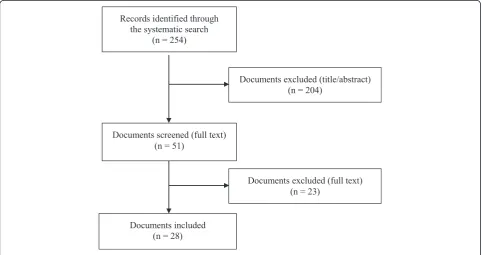
The search identified a total of 254 documents (see Fig. 1), of which 203 were excluded in the first step. From the 51 documents screened in full text, 28 docu-ments were included in the analysis. The main reasons for exclusion in the second screening were the lack of recommendations and the setting or target group.
Formal criteria of documents
The documents were developed in Germany (n = 11), USA (n = 6), Australia (n = 5), Switzerland (n = 3), Canada (n= 2), and UK (n= 1) and published between 2002 and 2014. The documents were developed or pub-lished by governmental organisations (n = 12), nursing or healthcare organisations (n= 7), non-profit organisa-tion (e.g. foundaorganisa-tions) (n = 4), research institutions (e.g. Universities) (n = 2), private organisations (n = 1) and others (n= 2). Information about the authors was avail-able in 13 documents. Seven documents were publicly funded (e.g. by nursing organisations, ministries) and 21 documents did not offer information about the funding.
Scope and purpose were mentioned in 26 and 27 doc-uments respectively. The motivation for the docdoc-uments’ development were high prevalence rates of PR in nurs-ing homes, risks and adverse effects of PR use, ethical is-sues like the respect for human rights.
All but one document described one or more target groups: nursing staff (n = 22), health care professionals (n = 5), relatives (n = 4), stakeholders (n = 2), or legal guardians (n= 1).
Most documents (n = 26) comprised a definition of PR, 17 documents described risks or adverse effects of PR use and 20 documents the legal aspects of PR use in the country in which the document was developed.
Methodological characteristics of documents
Two documents were developed mono-disciplinary (nurs-ing), eight documents interdisciplinary (including different healthcare professionals, lawyer, or other stakeholders), but 18 documents comprised no information about the development group. Three documents aimed to include the interests and perspectives of people suffering from PR. For two documents, patient-representatives were part of the development group (one of these documents addition-ally performed a literature search on the residents’ per-spective) and for one document a patient-representative had the opportunity to comment the draft. Most docu-ments offered no information about conflicts of interest of the development group, or on the role of the funding bod-ies in the development process.
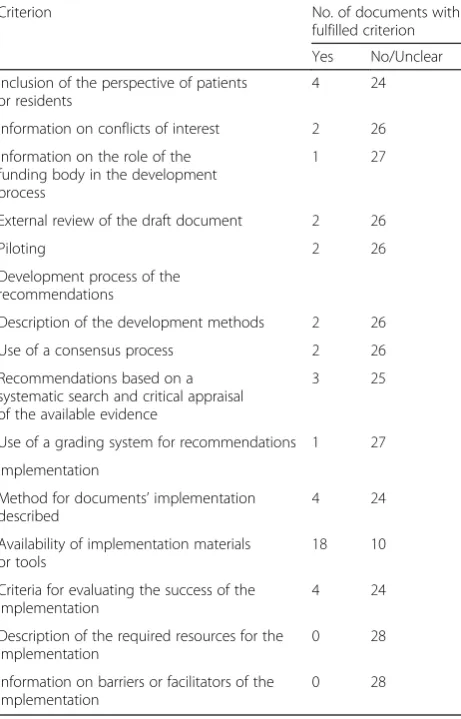
The description of the methods used to develop the doc-uments’ recommendations was mainly lacking (Table 1). Only two documents described the method used for devel-oping the recommendations (both documents were evidence-based guidelines) and the recommendations of these documents were the only ones based on a systematic
literature search and critical appraisal of the available evi-dence. Both used a consensus process to develop the rec-ommendations but only one of these documents included a grading system for the recommendations.
A structured approach for the implementation and cri-teria for evaluating the implementation process were de-scribed in four documents. Materials or tools supporting the implementation (e.g. short versions, information leaflets, checklists or flow charts) were available for 18 documents. Information of resources required for the implementation of the documents as well as information on barriers or facilitators of the implementation were lacking in all documents.
Discussion
This systematic review identified 28 documents with practical recommendations aimed to reduce the use of PR in nursing homes. In most of the documents the de-velopment methods were not sufficiently described. For the most part, the recommendations were not based on
a systematic literature search or on a critical appraisal of the evidence. Two documents were evidence-based guidelines [12, 20]. In both of these documents the de-velopment methods were clearly described and the rec-ommendations were based on both a systematic search and a critical appraisal of the literature.
The reduction of PR was identified as an important issue in the improvement of the quality of nursing [12, 13, 25, 26]. However, the lack of scientific rigour in the development of the recommendations does not reflect the importance of this topic for clinical practice. There is evidence that the implementation of evidence-based guidelines can improve the quality of care [27]. This was confirmed by our own study, which revealed that the im-plementation of the German evidence-based guideline in nursing homes was effective in reducing PR without in-creasing adverse effects like falls or fall-related injuries [5]. Currently, the effectiveness and safety of a large-scale implementation of the updated German evidence-based guideline is being investigated in a pragmatic trial [28]. This indicated that the PR use can be reduced by offering recommendations for nursing staff, based on the best available evidence.
Studies investigating the effectiveness of other docu-ments with recommendations for clinical practice are lacking. Evidence-based guidelines using one of the established frameworks for guideline development are expected to ensure valid, transparent, clear and clinically applicable recommendations [20]. Therefore, documents with recommendations on the reduction of PR use in geriatric care should adhere to a methodological frame-work and rigorous development methods.
This study shows that governmental and professional authorities or initiatives were predominant in initiating the development of the included documents. It remains unclear why these authorities did not initiate the devel-opment of evidence-based guidelines. However, the de-velopment of a high-quality guideline is a time and cost consuming process. Smaller or local organisations might lack of financial or personal resources. Here, larger net-works or cooperation with national agencies like the In-stitute of Medicine (IOM) or the National InIn-stitute for Health and Care Excellence (NICE) might be useful to support the development of guidelines for PR reduction.
We used the criteria of AGREE II [24] to describe the development methods of the included documents. How-ever, most of the included documents were not devel-oped by the use of the methods for evidence-based guidelines. Since the methods recommended for the de-velopment of evidence-based guidelines should ensure the validity and clinical relevance of recommendations, the use of these criteria can be judged as a gold standard for developing practice recommendations. Therefore, the criteria used in our analysis reflect the methodological
Table 1Development methods of the included documentsa
Criterion No. of documents with
fulfilled criterion
Yes No/Unclear
Inclusion of the perspective of patients or residents
4 24
Information on conflicts of interest 2 26
Information on the role of the funding body in the development process
1 27
External review of the draft document 2 26
Piloting 2 26
Development process of the recommendations
Description of the development methods 2 26
Use of a consensus process 2 26
Recommendations based on a systematic search and critical appraisal of the available evidence
3 25
Use of a grading system for recommendations 1 27
Implementation
Method for documents’implementation described
4 24
Availability of implementation materials or tools
18 10
Criteria for evaluating the success of the implementation
4 24
Description of the required resources for the implementation
0 28
Information on barriers or facilitators of the implementation
0 28
a
standard and can also be used for other documents of-fering recommendations for clinical practice.
The reduction of physical restraints has become an important issue for clinical practice in Germany in the last ten years, induced by broad media coverage on this topic. This might be one reason for the large number of documents developed in Germany. Most of the German documents are policy statements made by governmental initiatives or non-profit organisations and often lack a structures dissemination strategy. This fact and the lack of a rigorously developed method might have hampered the national dissemination of most of the German do-cuments. To overcome this gap, several attempts have been made to disseminate the first German evidence-based guideline [21]. The guideline and all correspond-ing material are freely available; the document has been presented at several scientific conferences; publications addressing nursing and other healthcare professionals as well as informal carers or relatives have been published; and the authors of the guideline have been in contact with other important stakeholders in the field of physical restraints’ reduction in Germany. The same strategy is currently used to support the dissemination and the im-plementation of the recently updated version of this guideline [26] into clinical practice.
We used a broad search strategy, including databases, relevant organisations and the World Wide Web to iden-tify the documents and included only English and German documents. It is possible that we did not identify all the documents available. However, we identified documents developed in several countries and no further evidence-based guideline was recently listed in the GIN-database. Therefore, chance of missing relevant documents is low.
Conclusions
This study revealed that the majority of publically avail-able documents with recommendations to reduce the use of PR in geriatric care were not developed by the use of recommended scientific rigorous methods. Since the reduction of PR in geriatric care was identified in many countries as an important indicator for a high quality of care for people with dementia, documents with recom-mendations for clinical practice should adhere to the methodological standards of evidence-based guidelines.
Additional file
Additional file 1:Websites of German and international scientific or health care organisations included in the search.(DOCX 23 kb)
Competing interests
The authors declare that they have no competing financial interests. GM and RM were involved in the development and evaluation of an evidence-based guideline on physical restraints in nursing homes in Germany, which was included in this analysis.
Authors’contributions
GM initiated the study. RM performed the search update supported by a student SN. RM, SN and GB extracted data and RM, GB and RM analysed the data. RM and GB prepared the draft manuscript. Both authors commented on the draft and approved the final manuscript.
Acknowledgements
We acknowledge the work of Antonie Haut and Gabriele Bartoszek by conducting the initial search and analysis of the documents. We also thank Stephan Nadolny for his contributions to the search update and data extraction process.
Received: 28 October 2015 Accepted: 16 November 2015
References
1. Feng Z, Hirdes JP, Smith TF, Finne-Soveri H, Ch I, Du Pasquier JN, et al. Use of physical restraints and antipsychotic medications in nursing homes: a cross-national study. Int J Geriatr Psychiatry. 2009;24:1110–8. 2. Meyer G, Köpke S, Haastert B, Mühlhauser I. Restraint use among nursing
home residents: cross-sectional study and prospective cohort study. J Clin Nurs. 2009;18:981–90.
3. Evans D, FitzGerald M. Reasons for physically restraining patients and residents: a systematic review and content analysis. Int J Nurs Stud. 2002;39:735–43.
4. Goethals S, Dierckx de Casterlé B, Gastmans C. Nurses’decision-making in cases of physical restraint: a synthesis of qualitative evidence. J Adv Nurs. 2012;68:1198–210.
5. Köpke S, Mühlhauser I, Gerlach A, Haut A, Haastert B, Möhler R, et al. Effect of a guideline-based multicomponent intervention on use of physical restraints in nursing homes: a randomized controlled trial. JAMA. 2012;307:2177–84.
6. Möhler R, Richter T, Köpke S, Meyer G. Interventions for preventing and reducing the use of physical restraints in long-term geriatric care - a Cochrane review. J Clin Nurs. 2012;21:3070–81.
7. Tang WS, Chow YL, Koh SSL. The effectiveness of physical restraints in reducing falls among adults in acute care hospitals and nursing homes: a systematic review. JBI Libr Syst Rev. 2012;10:307–51.
8. Berzlanovich A, Schöpfer J, Keil W. Deaths due to physical restraint. Dtsch Arztebl Int. 2012;109:27–32.
9. Castle NG, Engberg J. The health consequences of using physical restraints in nursing homes. Med Care. 2009;47:1164–73.
10. Engberg J, Castle NG, Mc Caffrey D. Physical restraint initiation in nursing homes and subsequent resident health. Gerontologist. 2008;48:442–52. 11. Evans D, Wood J, Lambert L. A review of physical restraint minimization in
the acute and residential care settings. J Adv Nurs. 2002;40:616–25. 12. Registered Nurses’Association of Ontario. Promoting safety: alternative
approaches to the use of restraints. Toronto, 2012. http://rnao.ca/sites/rnao-ca/files/Promoting_Safety_-_Alternative_Approaches_to_the_Use_of_ Restraints_0.pdf. Accessed 21 Sep 2015.
13. Royal College of Nursing consultation. Draft guidance on the minimisation of and alternatives to restrictive practices in health and adult social care, and special schools. Royal College of Nursing, 2013. http://www.rcn.org. uk/__data/assets/pdf_file/0004/554044/Use_of_restrictive_practices_in_ health_and_adult_social_care_and_special_schools_-_draft_guidance.pdf. Accessed 21 Sep 2015.
14. Flaherty JH. Zero tolerance for physical restraints: difficult but not impossible. J Gerontol A Biol Sci Med Sci. 2004;59:M919–20.
15. Hamers JP, Huizing AR. Why do we use physical restraints in the elderly? Z Gerontol Geriatr. 2005;38:19–25.
16. Gastmans C, Milisen K. Use of physical restraint in nursing homes: clinical-ethical considerations. J Med Ethics. 2006;32:148–52.
17. Hofmann H, Schorro E, Haastert B, Meyer G. Use of physical restraints in nursing homes: a multicentre cross-sectional study. BMC Geriatr. 2015;15:129.
18. Woolf SH, Grol R, Hutchinson A, Eccles M, Grimshaw J. Clinical guidelines: potential benefits, limitations, and harms of clinical guidelines. BMJ. 1999;318:527–30.
20. Institute of Medicine. Clinical practice guidelines we can trust. Washington, DC: The National Academies Press; 2011.
21. Köpke S, Gerlach A, Möhler R, Haut A, Meyer G. Evicence-based guideline for preventing the use of physical restraints in geriatric long-term care. University Hamburg & University Witten/Herdecke. Hamburg: 2009. 22. Möhler R, Haut A, Bartoszek G, Meyer G. Analysis of international guidelines
and standards on physical restraint use in nursing homes. JNHA. 2009;13:S469.
23. Collaboration AGREE. Development and validation of an international appraisal instrument for assessing the quality of clinical practice guidelines: the AGREE project. Qual Saf Health Care. 2003;12:18–23.
24. Brouwers MC, Kho ME, Browman GP, Burgers JS, Cluzeau F, Feder G, et al. AGREE II: advancing guideline development, reporting and evaluation in health care. CMAJ. 2010;182:E839–42.
25. Tolson D, Rolland Y, Andrieu S, Aquino JP, Beard J, Benetos A, et al. International association of gerontology and geriatrics: a global agenda for clinical research and quality of care in nursing homes. J Am Med Dir Assoc. 2011;12:184–9.
26. Köpke S, Möhler R, Abraham J, Henkel A, Kupfer R, Meyer G. Evidence-based guideline for preventing of physical restraints in geriatric long-term care. First update. University of Lübeck & Martin Luther University Halle-Wittenberg. Lübeck: 2015. http://www.leitlinie-fem.de/download/LL_FEM_ 2015_Internet_gesamt.pdf. Accessed 21 Sep 2015.
27. Lugtenberg M, Burgers JS, Westert GP. Effects of evidence-based clinical practice guidelines on quality of care: a systematic review. Qual Saf Health Care. 2009;18:385–92.
28. Abraham J, Möhler R, Henkel A, Kupfer R, Icks A, Dintsios CM, et al. Implementation of a multicomponent intervention to prevent physical restraints in nursing home residenTs (IMPRINT): study protocol for a cluster-randomised controlled trial. BMC Geriatr. 2015;15:86.
• We accept pre-submission inquiries
• Our selector tool helps you to find the most relevant journal
• We provide round the clock customer support
• Convenient online submission
• Thorough peer review
• Inclusion in PubMed and all major indexing services
• Maximum visibility for your research
Submit your manuscript at www.biomedcentral.com/submit