R E S E A R C H A R T I C L E
Open Access
Time-dependent postural control
adaptations following a neuromuscular
warm-up in female handball players:
a randomized controlled trial
Simon Steib
1*, Peter Zahn
1, Christine zu Eulenburg
2, Klaus Pfeifer
1and Astrid Zech
3Abstract
Background:Female handball athletes are at a particular risk of sustaining lower extremity injuries. The study examines time-dependent adaptations of static and dynamic balance as potential injury risk factors to a specific warm-up program focusing on neuromuscular control.
Methods:Fourty one (24.0 ± 5.9 years) female handball athletes were randomized to an intervention or control group. The intervention group implemented a 15-min specific neuromuscular warm-up program, three times per week for eleven weeks, whereas the control group continued with their regular warm-up. Balance was assessed at five time points. Measures included the star excursion balance test (SEBT), and center of pressure (COP) sway velocity during single-leg standing.
Results:No baseline differences existed between groups in demographic data. Adherence to neuromuscular warm-up was 88.7 %. Mean COP sway velocity decreased significantly over time in the intervention group (−14.4 %;p< .001), but not in the control group (−6.2 %;p= 0.056). However, these effects did not differ significantly between groups (p= .098). Mean changes over time in the SEBT score were significantly greater (p= .014) in the intervention group (+5.48) compared to the control group (+3.45). Paired t-tests revealed that the first significant balance improvements were observed after 6 weeks of training.
Conclusions:A neuromuscular warm-up positively influences balance variables associated with an increased risk of lower extremity injuries in female handball athletes. The course of adaptations suggests that a training volume of 15 min, three times weekly over at least six weeks produces measurable changes.
Trial registration:Retrospectively registered on 4th October 2016. Registry: clinicaltrials.gov. Trial number: NCT02925377.
Keywords:Balance, Postural control, Sensorimotor training, Neuromuscular training, Injury prevention
Background
Team ball sports athletes, such as handball players, are at a high risk of injury [1]. Female players are at a particular risk of sustaining ligamentous injuries to the knee and ankle joint. Long-term studies suggest a 3- to
5-times increased risk of sustaining ACL injuries in team ball sports [2, 3]. Deficits in static and dynamic balance, indicating the athletes’ ability to control their center of mass over the base of support during standing (static) or moving (dynamic), have been discussed as important intrinsic risk factors of sustaining lower extremity in-juries [4, 5].
Neuromuscular training programs are increasingly im-plemented in professional and amateur team sport ath-letes [6–8]. They are widely accepted to be effective for the prevention of lower extremity injuries [9–12].
* Correspondence:[email protected]
1Institute of Sport Science and Sport, Division of Exercise and Health,
Friedrich-Alexander University Erlangen-Nürnberg, Erlangen, Germany Full list of author information is available at the end of the article
However, the underlying mechanisms are not yet fully understood. Preventive effects are generally attributed to a modification of various intrinsic injury risk factors, in-cluding static and dynamic balance [13–16].
The individual components of preventive neuromuscu-lar training interventions, as well as their dosage vary substantially between trials [11, 17, 18]. The regular in-corporation of neuromuscular training components into the athletes’ warm-up routine as a frequent and eco-nomic alternative to high volume programs has become increasingly popular and has demonstrated promising ef-fects [19, 20]. However, to date only little evidence exists regarding the dimensions, time course, and magnitude of adaptations to neuromuscular warm-up programs. Preliminary findings suggest that adaptations of balance appear to vary depending on content and dosage of in-terventions, as well as the population trained [13, 14, 16, 21]. Thus, the identification of causal relations between neuromuscular training specifications and adaptations in individual injury risk factors is a vital step in promoting a more differentiated and mechanism-based application of training interventions to prevent specific injuries in different sports [11]. Specifically, it is unclear whether the timing and magnitude of underlying adaptations are noticeably different in regimes with higher training fre-quencies but low volume. Further, the potential benefits in high-risk populations, particularly female team sport athletes, are yet to be fully understood. Such knowledge would help to develop customized injury prevention programs in professional and recreational sports.
Thus, our aim was to investigate the effects of a neuromuscular warm-up intervention targeting lower extremity injury prevention on static and dynamic balance in competitive female team sport athletes. A sec-ondary aim was to explore the time course of adapta-tions to the warm-up program. For this, balance was examined continuously at five different time points throughout the course of the neuromuscular training phase. Based on previous studies, it is hypothesized that all balance measures will improve with increasing time but may respond differently to progression of neuromus-cular training.
Methods
Participants
Fourty-one female handball players (age: 24.0 ± 5.9 years; height: 170.2 ± 6.0 cm; weight: 65.7 ± 7.2 kg) were ran-domly allocated into an intervention and a control group using a simple coin toss. Athletes were recruited from three local handball teams (4th division). Exclusion cri-teria were any lower extremity injury (acute or overuse) that prevented the player from regular participation in competition or practice at the time of the study. Assess-ments were performed before team practice sessions. All
athletes were given detailed information on the study and written informed consent was obtained. The study was approved by the local ethics committee (FAU Erlangen-Nürnberg, Ref.-No. 155_15Bc) and conducted in accordance with the Declaration of Helsinki. The trial was retrospectively registered (trial registration number NCT02925377).
Neuromuscular training program
The neuromuscular training program was implemented in each of the three participating handball teams. One week before the start of the neuromuscular training period athletes were informed which group they were assigned to. All of them were instructed to follow their usual physical activity routine and not to start new exercises or training programs outside their regular handball practice during the study period. The interven-tion group replaced their regular warm-up routine with neuromuscular warm-up exercises performed for 15 min prior to each practice session (3x/week) over a period of eleven weeks. The exercise components were based on a soccer-specific warm-up program [7, 22, 23] which was adapted to the handball setting. Accordingly, the neuromuscular training protocol included running, agility, balance, strength and plyometric components (see supplementary data).
protocol, the intervention group continued with regu-lar handball practice.
Athletes in the control group followed their regular 15 min warm-up routine provided by the team coaches. The content varied across the teams, but typically included repeated running exercises at moderate inten-sity, followed by handball-unspecific warm-up exercises (without balancing, jumping or strengthening compo-nents). Due to organisational constraints, both the inter-vention and control groups in each team performed the warm-up exercises in the same location. The subsequent regular handball-specific training was performed with both groups together.
Balance assessments
Static and dynamic balance tests were performed at baseline (T0), after three (T1), six (T2), and nine (T3) weeks, as well as post-intervention at week eleven (T4). An additional measurement was performed one week before baseline testing in order to familiarize partici-pants to the testing protocol. The variables used for data analysis were: 1) dynamic: Maximum reach distances in the star excursion balance test (SEBT), and 2) static: Center of pressure (COP) sway velocity during single-leg quiet standing. All tests were performed barefooted on the athlete’s take-off leg and conducted in a fixed order by the same assessors. The assessors were not blinded to group assignment.
Dynamic balance was assessed using the SEBT. We performed four of the original eight directions: anterior, medial, lateral, posterior [24]. The athlete stood with the hands on the hips on the take-off leg in the center of a grid placed on the floor with four lines extending in an-terior, posan-terior, medial and lateral direction. The ath-letes were instructed to reach the free leg as far as possible in each of the four directions, touch lightly on the line, and return to a double-leg stance in the center. Each individual completed one familiarization trial in each direction before the actual measurement. Two tri-als were recorded for each direction and the examiner manually recorded the maximum distance (cm). If ath-letes lost balance and touched the floor with the free limb before reaching start position or lifted hands off their iliac crests, the trial was discarded and repeated.
Postural sway, as a measure of static balance, was assessed on a Kistler force plate (model 9260AA6; Kistler Instrumente GmbH, Germany). The athlete had to stand on the take-off leg quietly for 20 s with eyes open, hands in hips, and the free foot touching the standing leg at the medial side of the shank. Failed attempts (non-balancing foot touched the floor or hands off hips, lifting hands off iliac crests, stepping, stumbling, falling, lifting the forefoot or heel) were discarded and repeated.
Data analysis
The SEBT maximum reach distances in anterior, medial, lateral and posterior directions were normalized for indi-vidual leg length: normalized reach distance = reach dis-tance (cm) * 100/leg length (cm). The average of the two measurements was used for data analysis.
Force plate data were used to calculate COP velocity (vCOP). Data were sampled at 180 Hz (Bioware, Kistler Instruments AG, version 4.0.1.2) and low-pass filtered at a cut-off frequency of 14 Hz using a second-order But-terworth filter [24]. vCOP (cm/s) was defined as the sum of the cumulated mean of medial-lateral and anterior-posterior COP displacement divided by the total time. The average of the two measurements was used for data analysis.
Statistics
Linear mixed models were specified for each of the dependent variables. Maximum SEBT reach distances and COP sway velocity were defined as dependent variables and analyzed separately in linear regression models. The experimental factors‘group’and‘time’ (con-tinuously) as well as two-way interactions (group*time) were included as fixed factors. Athletes were included as a random factor and a random intercept model was computed to allow for individual variability. Restricted maximum likelihood was used to estimate variance com-ponents. Baseline differences between groups in demo-graphic and balance measures were analysed using student’s t-tests. In an exploratory analysis, paired t-tests were used to investigate univariate level changes be-tween baseline and the different time points within each treatment group. All statistical analyses were performed with SPSS statistics (IBM, version 22.0) software.
Results
Participant characteristics
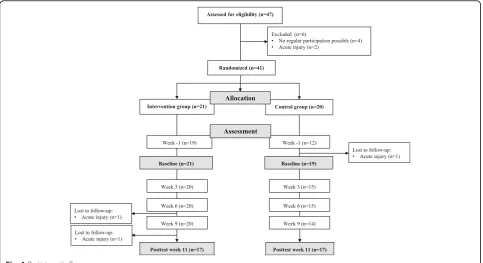
21 participants were randomized to the intervention group and 20 to the control group. Table 1 demonstrates the participant’s characteristics. At baseline, there were no statistically significant differences between groups in age, mass, height, and body mass index.
Compliance
Balance outcomes
At baseline, COP sway velocity (p= 0.02) differed signifi-cantly between groups. Figure 2 illustrates the time course of the different balance measures. SEBT and vCOP responded differently to the neuromuscular inter-vention (Table 2).
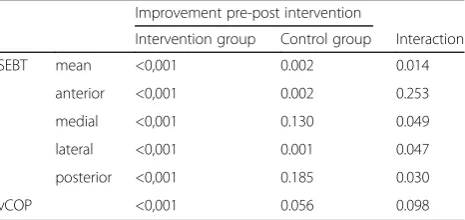
In the intervention group, measures for all SEBT reach directions improved over time. In the control group, this was the case for anterior and lateral direction but not for medial and posterior direction (Table 2). A signifi-cant group by time interaction was found for the SEBT mean score (p= .014), indicating greater improvements
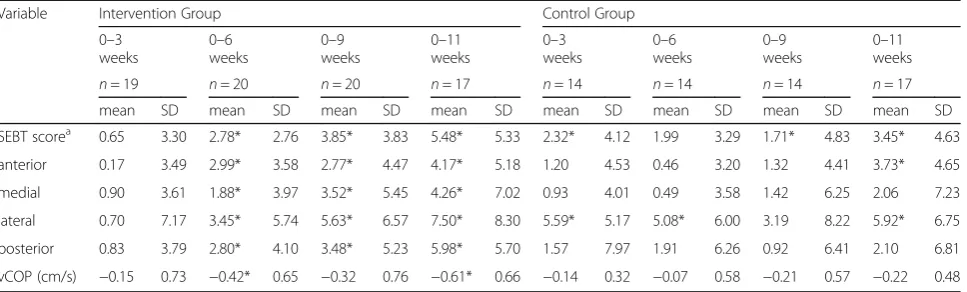
in the intervention group compared to the control group. The largest improvements existed from baseline to week 11 with an average improvement in SEBT score of 5.48 (±5.3) in the intervention group, compared to 3.45 (±4.6) in the control group. Paired t-tests revealed that the first significant improvements in the interven-tion group (p< .001) were observed after 6 weeks of training (Table 3). Linear trends differed significantly between groups for all individual SEBT reach directions (p< .05) except for anterior SEBT, with the largest improve-ments observed in lateral direction (intervention: +7.50; control: +5.92).
Table 1Participant's demographics (mean, SD)
Controls Intervention group Group difference
(n= 20) (n= 21)
mean SD mean SD Pvalue
Age (years) 24.00 5.59 23.95 6.27 0.98
Mass (kg) 65.90 6.77 65.52 7.69 0.87
Height (cm) 168.95 4.57 171.43 7.02 0.19
BMI (kg/m2) 23.08 2.13 22.28 2.05 0.23
SEBT (% leg length) 95.75 6.68 96.64 9.50 0.74
posterior 106.80 8.49 107.18 9.30 0.90
anterior 92.26 7.12 91.49 10.87 0.79
medial 100.96 7.74 101.29 11.37 0.92
lateral 82.99 8.95 86.60 11.17 0.27
vCOP (cm/s) 3.13 0.45 3.76 1.03 0.02
BMIBody mass index,SEBTstar excursion balance test,vCOPcenter of pressure sway velocity
Assessed for eligibility (n=47)
Excluded (n=6)
• No regular participation possible (n=4)
• Acute injury (n=2)
Week -1 (n=19) Intervention group (n=21)
Week -1 (n=12) Control group (n=20) Allocation
Assessment Randomized (n=41)
Baseline (n=21) Baseline (n=19)
Week 3 (n=20) Week 3 (n=15)
Week 6 (n=20) Week 6 (n=15)
Week 9 (n=20) Week 9 (n=14)
Posttest week 11 (n=17) Posttest week 11 (n=17) Lost to follow-up:
• Acute injury (n=1)
Lost to follow-up:
• Acute injury (n=1)
Lost to follow-up:
• Acute injury (n=1)
Mean COP sway velocity improved significantly over time in the intervention group (−14.4 %;p< .001), and a trend for improvements existed in the control group (−6.2 %; p = 0.056). Tested effects did not differ signifi-cantly between groups (p= .098). Paired t-tests revealed that the first significant improvement in the intervention group (p< .001) was observed after 6 weeks of training (Table 3).
Discussion
Our primary aim was to investigate the effects of a high frequency (3x per week), low volume (15 min) neuro-muscular warm-up program on intrinsic injury risk factors in female team handball players. The results con-firmed that eleven weeks of neuromuscular warm-up in-corporated in the regular team routine was effective in improving dynamic, but not static balance in this popu-lation. Additionally, as a unique feature of this trial, we obtained balance outcomes repeatedly throughout the intervention. In agreement with previous trials [13, 16, 21], the time course of adaptations revealed that training effects appeared to occur not before 6 weeks of training and further progressed in the following.
The results of this study suggest that short bouts of neuromuscular training incorporated into regular warm-up routine can positively influence intrinsic injury risk factors in female handball players. In accordance with
our findings, Holm et al. [13] reported dynamic balance improvements after eight weeks of low-volume neuro-muscular training in female handball players. Exercises were performed three times a week for 15 min. Two other studies [15, 16] reported improvements of dy-namic balance after six and eight weeks of neuromuscu-lar training in female team sport athletes, however, training volume was much higher in these trials. Daneshjoo et al. [14] and Zech et al. [21] reported im-proved dynamic balance with short-term (10–12 weeks) neuromuscular warm-up programs in male team sport athletes. Taken together, the above-described findings suggest that the incorporation of neuromuscular training components regularly into the team warm-up routine may be a promising strategy to positively influence injury risk factors in ball sport athletes. Further, they provide a potential explanation for the success of neuro-muscular warm-up programs in reducing injury rates in various team sport [9–12]. They would consequently result from improvements in neuromuscular control, leading to enhanced dynamic balance and movement coordination, which in turn would decrease the risk of harmful joint loading.
A unique feature of this trial was the repeated assess-ment of balance throughout the intervention phase in order to explore the time course of adaptations. Based on our exploratory analysis of the data, we found that the first significant balance improvements in the inter-vention group appeared to occur after six weeks of neuromuscular training and continued to improve until week 11. This is supported by findings from McLeod et al. [16] showing balance improvements after six weeks of neuromuscular training in female athletes. It is inter-esting to note, that the training had a much higher vol-ume, but was performed less frequently (90 min, 2x/ week). Our results indicate that lower exercise durations but higher weekly training frequencies might be suffi-cient to obtain meaningful balance improvements. This is further supported by a recent study demonstrating im-provements after ten weeks of a neuromuscular warm-90
92 94 96 98 100 102 104 106 108
baseline week3 week 6 week 9 week11
SEBT
score (% leg length)
2.0 2.4 2.8 3.2 3.6 4.0 4.4
baseline week3 week 6 week 9 week11
COP
sw
ay
velocity (cm/s)
intervention group control group *
* *
*
* *
#
*
Fig. 2Time course of changes in the SEBT score and COP sway velocity in the intervention group (bold line) and controls (dotted line). Error bars indicate 95 % confidence intervals. * indicates significantly different from baseline (p≤.05). # indicates significant group * time interaction effect (p≤.05)
Table 2Statistical (fixed) effects (p- values) for time and group
by time interactions
Improvement pre-post intervention
Intervention group Control group Interaction
SEBT mean <0,001 0.002 0.014
anterior <0,001 0.002 0.253
medial <0,001 0.130 0.049
lateral <0,001 0.001 0.047
posterior <0,001 0.185 0.030
up training in male athletes [21]. Consequently, the overall training volume seems to be a key factor for ad-aptations in balance control and short but frequent training bouts a promising strategy. Thus, the incorpor-ation of neuromuscular training components into the regular warm-up routine seems to be a practicable and efficient approach for injury prevention.
We investigated time-dependent changes in both, static and dynamic balance in this trial. Our results indi-cate that dynamic, but not static balance adapted to the neuromuscular warm-up program. Our results are in line with findings from two recent trials showing en-hanced dynamic, but not static balance with a neuro-muscular warm-up [21, 25]. This fact adds to a growing body of evidence suggesting that static and dynamic bal-ance may respond differently to exercise interventions [13, 21, 25]. The neuromuscular warm-up program was developed on the basis of effective injury prevention in-terventions described in previous studies [7, 8, 11, 23]. Hence, the use of multiple exercise components (i.a. strength, plyometrics, flexibility) may not have been ad-equate to cause improvements in dynamic but not static balance. It is important to note that SEBT and postural sway also showed an improvement over time in the con-trol group. We found a similar trend in a comparable trial [21]. Thus, it seems plausible that the repetitive measurement of balance variables may have introduced a test learning effect, which needs to be considered when interpreting the improvements of the interven-tion group.
The limitations of this study include the lack of as-sessor blinding, as well as blinding of the participants. Further, the intervention and control groups of each team performed their warm-up programs in the same gym, which may have led to a contamination effect. Additionally, improvements over time in the control group indicate a potential test learning effect, intro-duced by the repeated test sessions. This could have blurred the intervention effects to some extent. Lastly,
it was not possible to collect data for each participant at all time points, which lowers the statistical power of our analyses.
Conclusions
Eleven weeks of neuromuscular warm-up had benefi-cial effects on selected balance measures in female team handball players, indicating that this type of intervention can successfully modify an important injury risk factor. The course of adaptations suggests that a training volume of three times weekly over six weeks is effective to produce measurable improve-ments. Our findings suggest that neuromuscular training components improve dynamic rather than static balance. Further, in this specific population, the SEBT appears to be a sensitive measure to detect training related improvements in injury risk factors. It remains speculative whether a long-term use of the intervention will further increase the training benefits. In consideration of the specificity of the population and dose of intervention, more studies with athletes at an increased injury risk are needed to allow individualized neuromuscular training inter-ventions to improve intrinsic injury risk factors.
Additional files
Additional file 1:Master data. The file includes a table with the full dataset of this study. (XLSX 22 kb)
Additional file 2:Training program. The file includes a detailed description of the neuromuscular warm-up program implemented in this study. (DOCX 17 kb)
Abbreviations
ACL:Anterior cruciate ligament; BMI: Body mass index; COP: Center of pressure; SEBT: Star excursion balance test; vCOP: Center of pressure sway velocity
Table 3Changes (mean, SD) between baseline (week 0) and weeks 3, 6, 9, and 11
Variable Intervention Group Control Group
0–3 weeks
0–6 weeks
0–9 weeks
0–11 weeks
0–3 weeks
0–6 weeks
0–9 weeks
0–11 weeks
n= 19 n= 20 n= 20 n= 17 n= 14 n= 14 n= 14 n= 17
mean SD mean SD mean SD mean SD mean SD mean SD mean SD mean SD
SEBT scorea 0.65 3.30 2.78* 2.76 3.85* 3.83 5.48* 5.33 2.32* 4.12 1.99 3.29 1.71* 4.83 3.45* 4.63
anterior 0.17 3.49 2.99* 3.58 2.77* 4.47 4.17* 5.18 1.20 4.53 0.46 3.20 1.32 4.41 3.73* 4.65
medial 0.90 3.61 1.88* 3.97 3.52* 5.45 4.26* 7.02 0.93 4.01 0.49 3.58 1.42 6.25 2.06 7.23
lateral 0.70 7.17 3.45* 5.74 5.63* 6.57 7.50* 8.30 5.59* 5.17 5.08* 6.00 3.19 8.22 5.92* 6.75
posterior 0.83 3.79 2.80* 4.10 3.48* 5.23 5.98* 5.70 1.57 7.97 1.91 6.26 0.92 6.41 2.10 6.81
vCOP (cm/s) −0.15 0.73 −0.42* 0.65 −0.32 0.76 −0.61* 0.66 −0.14 0.32 −0.07 0.58 −0.21 0.57 −0.22 0.48
a
Acknowledgements
We acknowledge support by Deutsche Forschungsgemeinschaft and Friedrich-Alexander-Universität Erlangen-Nürnberg (FAU) within the funding programme Open Access Publishing.
Funding
Not applicable.
Availability of data and materials
The dataset supporting the conclusions of this article is included within the article and its Additional files 1 and 2.
Author’s contributions
SS contributed to the conception and design of the study, the analysis and interpretation of results, and preparation of the manuscript. PZ was involved in the design of the study, the data acquisition and the interpretation of results. CE carried out the statistical analyses and was involved in interpretation of results and drafting the manuscript. KP participated in the design of the study, the interpretation of data and critically revised the manuscript draft. AZ contributed to the conception and design of the study, the interpretation of results and critical revision of the manuscript. All authors read and approved the final manuscript.
Competing interests
The authors declare that they have no competing interests.
Consent for publication
Not applicable.
Ethics approval and consent to participate
The study was approved by the local ethics committee (FAU Erlangen-Nürnberg, Ref.-No. 155_15Bc) and conducted in accordance with the Declaration of Helsinki. All athletes were given detailed information on the study and written informed consent was obtained.
Author details
1
Institute of Sport Science and Sport, Division of Exercise and Health, Friedrich-Alexander University Erlangen-Nürnberg, Erlangen, Germany.
2
University Medical Center Groningen, Faculty of Medical Sciences, University of Groningen, Groningen, Netherlands.3Department of Sport Science,
Friedrich Schiller University Jena, Jena, Germany.
Received: 1 September 2016 Accepted: 8 October 2016
References
1. Fong D, Hong Y, Chan L, Yung P, Chan KM. A Systematic Review on Ankle Injury and Ankle Sprain in Sports. Sports Med. 2007;37:73–94.
2. Agel J, Arendt EA, Bershadsky B. Anterior cruciate ligament injury in National Collegiate Athletic Association basketball and soccer: A 13-year review. Am J Sports Med. 2005;33:524–30.
3. Myklebust G, Maehlum S, Holm I, Bahr R. A prospective cohort study of anterior cruciate ligament injuries in elite Norwegian team handball. Scand J Med Sci Sports. 1998;8:149–53.
4. Witchalls J, Blanch P, Waddington G, Adams R. Intrinsic functional deficits associated with increased risk of ankle injuries: a systematic review with meta-analysis. Br J Sports Med. 2012;46:515–23.
5. Dallinga JM, Benjaminse A, Lemmink KA. Which screening tools can predict injury to the lower extremities in team sports?: a systematic review. Sports Med. 2012;42:791–815.
6. Hewett TE, Ford KR, Myer GD. Anterior cruciate ligament injuries in female athletes: Part 2, a meta-analysis of neuromuscular interventions aimed at injury prevention. Am J Sports Med. 2006;34:490–8.
7. Junge A, Lamprecht M, Stamm H, Hasler H, Bizzini M, Tschopp M, Reuter H, Wyss H, Chilvers C, Dvorak J. Countrywide campaign to prevent soccer injuries in Swiss amateur players. Am J Sports Med. 2011;39:57–63. 8. Steffen K, Emery CA, Romiti M, Kang J, Bizzini M, Dvorak J, Finch CF,
Meeuwisse WH. High adherence to a neuromuscular injury prevention programme (FIFA 11+) improves functional balance and reduces injury risk in Canadian youth female football players: a cluster randomised trial. Br J Sports Med. 2013;47:794–802.
9. Aaltonen S, Karjalainen H, Heinonen A, Parkkari J, Kujala UM. Prevention of sports injuries: systematic review of randomized controlled trials. Arch Intern Med. 2007;167:1585–92.
10. Grimm NL, Jacobs JC, Kim J, Denney BS, Shea KG: Anterior Cruciate Ligament and Knee Injury Prevention Programs for Soccer Players: A Systematic Review and Meta-analysis. Am J Sports Med. 2015;43:2049-56. 11. Hübscher M, Zech A, Pfeifer K, Hänsel F, Vogt L, Banzer W. Neuromuscular
training for sports injury prevention: a systematic review. Med Sci Sports Exerc. 2010;42:413–21.
12. Verhagen EA, Bay K. Optimising ankle sprain prevention: A critical review and practical appraisal of the literature. Br J Sports Med. 2010;44:1082–8.
13. Holm I, Fosdahl MA, Friis A, Risberg MA, Myklebust G, Steen H. Effect of Neuromuscular Training on Proprioception, Balance, Muscle Strength, and Lower Limb Function in Female Team Handball Players. Clin J Sport Med. 2004;14:88–94.
14. Daneshjoo A, Mokhtar AH, Rahnama N, Yusof A. The effects of
comprehensive warm-up programs on proprioception, static and dynamic balance on male soccer players. PLoS One. 2012;7:e51568.
15. Filipa A, Byrnes R, Paterno MV, Myer GD, Hewett TE. Neuromuscular training improves performance on the star excursion balance test in young female athletes. J Orthop Sports Phys Ther. 2010;40:551–8.
16. McLeod TC, Armstrong T, Miller M, Sauers JL. Balance improvements in female high school basketball players after a 6-week neuromuscular-training program. J Sport Rehabil. 2009;18:465–81.
17. Bien DP. Rationale and implementation of anterior cruciate ligament injury prevention warm-up programs in female athletes. J Strength Cond Res. 2011;25:271–85.
18. Risberg MA, Mørk M, Jenssen HK, Holm I. Design and implementation of a neuromuscular training program following anterior cruciate ligament reconstruction. J Orthop Sports Phys Ther. 2001;31:620–31.
19. Barengo NC, Meneses-Echavez JF, Ramirez-Velez R, Cohen DD, Tovar G, Bautista JEC. The impact of the FIFA 11+ training program on injury prevention in football players: a systematic review. Int J Environ Res Public Health. 2014;11:11986–2000.
20. Al Attar WSA, Soomro N, Pappas E, Sinclair PJ, Sanders RH. How Effective are F-MARC Injury Prevention Programs for Soccer Players? A Systematic Review and Meta-Analysis. Sports Med. 2016;46:205–17.
21. Zech A, Klahn P, Hoeft J, zu Eulenburg C, Steib S. Time course and dimensions of postural control changes following neuromuscular training in youth field hockey athletes. Eur J Appl Physiol. 2014;114:395–403. 22. Soligard T, Myklebust G, Steffen K, Holme I, Silvers H, Bizzini M, Junge A,
Dvorak J, Bahr R, Andersen TE. Comprehensive warm-up programme to prevent injuries in young female footballers: cluster randomised controlled trial. BMJ. 2008;337:a2469.
23. Eils E, Schröter R, Schröder M, Gerss J, Rosenbaum D. Multistation proprioceptive exercise program prevents ankle injuries in basketball. Med Sci Sports Exerc. 2010;42:2098–105.
24. Steib S, Hentschke C, Welsch G, Pfeifer K, Zech A. Effects of fatiguing treadmill running on sensorimotor control in athletes with and without functional ankle instability. Clin Biomech (Bristol, Avon). 2013;28:790–5.
25. Sefton JM, Yarar C, Hicks-Little CA, Berry JW, Cordova ML. Six weeks of balance training improves sensorimotor function in individuals with chronic ankle instability. J Orthop Sports Phys Ther. 2011;41:81–9.
• We accept pre-submission inquiries
• Our selector tool helps you to find the most relevant journal
• We provide round the clock customer support
• Convenient online submission
• Thorough peer review
• Inclusion in PubMed and all major indexing services
• Maximum visibility for your research
Submit your manuscript at www.biomedcentral.com/submit