Open Access
R E S E A R C H
© 2010 Twork et al; licensee BioMed Central Ltd. This is an Open Access article distributed under the terms of the Creative Commons Attribution License (http://creativecommons.org/licenses/by/2.0), which permits unrestricted use, distribution, and reproduction in any medium, provided the original work is properly cited.
Research
Disability status and quality of life in multiple
sclerosis: non-linearity of the Expanded Disability
Status Scale (EDSS)
Sabine Twork
†1, Susanne Wiesmeth
†1, Milena Spindler
†2, Markus Wirtz
1, Sabine Schipper
1, Dieter Pöhlau
3,
Jörg Klewer
1and Joachim Kugler*
1Abstract
Background: Progression in disability as measured by increase in the Expanded Disability Status Scale (EDSS) is commonly used as outcome variable in clinical trials concerning multiple sclerosis (MS). In this study, we addressed the question, whether there is a linear relationship between disability status and health related quality of life (HRQOL) in MS.
Methods: 7305 MS patients were sent a questionnaire containing a German version of the "Multiple Sclerosis Quality of Life (MSQOL)-54" and an assessment of self-reported disability status analogous to the EDSS. 3157 patients participated in the study. Patients were allocated to three groups according to disability status.
Results: Regarding the physical health composite and the mental health composite as well as most MSQOL-54 subscales, the differences between EDSS 4.5-6.5 and EDSS >= 7 were clearly smaller than the differences between EDSS <= 4 and EDSS 4.5-6.5.
Conclusion: These results indicate a non-linear relationship between disability status and HRQOL in MS. The EDSS does not seem to be interval scaled as is commonly assumed. Consequently, absolute increase in EDSS does not seem to be a suitable outcome variable in MS studies.
Introduction
Progression in disability as measured by increase in the Expanded Disability Status Scale (EDSS) is a frequently used outcome variable in clinical trials concerning multi-ple sclerosis (MS) [1-5].
However, EDSS represents only a part of health related quality of life (HRQOL) in MS. HRQOL comprises sev-eral domains in addition to physical impairments like social functioning and psychological well-being [6,7]. There is a growing interest in HRQOL in MS patients and several studies have been performed addressing this topic [8-18]. MS-patients have reduced quality of life within the different aspects of HRQOL in comparison to the general population [17,19-23]. There appears to be a rela-tionship between EDSS and HRQOL, although some
studies find a relationship only with physical functioning, rather with psychological functioning or psychological well-being [9,11,22,24-29].
Results from several studies suggest a non-linear rela-tionship between EDSS and HRQOL in MS. In a study by Vickrey et al., the difference between patients who walked with an aid and wheelchair-bound patients was smaller than the difference between patients walking without help and patients being dependent on a walking aid in most HRQOL domains [30]. Similarly, Patti et al. reported no significant difference between a patient group with high EDSS scores and a group with moderate EDSS scores in nearly all domains, whereas groups with low and moderate EDSS scores differed significantly in all domains [26].
In this study, comprising a large sample with a broad spectrum of patients, we addressed the question, whether there is a linear relationship between disability status and HRQOL in patients with MS. We therefore explored the
* Correspondence: [email protected]
1 Faculty of Medicine at the University of Technology Dresden, Department Health Sciences/Public Health, 01307 Dresden, Germany
† Contributed equally
difference regarding HRQOL between patients with dif-fering ambulation status. Three groups of patients were compared for this purpose: patients who are confined to a wheelchair, patients who are impaired in ambulation without being wheelchair-bound, and patients with largely unimpaired ambulation.
Materials and methods Sample
Data were collected using a postal survey of all 7305 MS-patients registered as patient members of the German MS Society in North Rhine-Westphalia. 3157 patients volunteered to participate, giving a response rate of 43.2%.
Questionnaires
The survey included a German version of the Multiple Sclerosis Quality of Life (MSQOL)-54 Questionnaire and a structured demographic and clinical questionnaire [30]. The MSQOL-54 comprises questions from the Short Form 36-Item Health Survey as a generic measure of quality of life, and 18 additional MS specific items [7,31,32]. The MSQOL-54 has high test-retest reliability and high internal consistency. Evidence supports its con-tent and construct validity [30,33]. Persian, Finnish, Greek, and Serbian versions have recently been validated [34-37], as well as Italian, French and Turkish versions have been validated a few years ago [38-40]. There is evi-dence that also the German version used here has satis-factory reliability and validity [41]. The 54 items of the MSQOL-54 are distributed into 12 multi-item scales and two single-item scales [30]. Due to technical and psycho-metric reasons the scale "vitality" was reduced by one item. For statistical analysis scale scores were created by averaging items within scales and transforming average scores linearly to 0-100 possible scores, with higher val-ues indicating better quality of life. Missing valval-ues were replaced by the mean of the remaining items constituting a scale, unless there were missing more than 50% of items in the concerning scale. In addition physical and mental health composite scores were determined as weighted sums of selected scale scores as described by Vickrey et al. [30]. Composite scores, too, had a range of 0-100.
Self-report questions about ambulation status were developed which were analogous to information from the Expanded Disability Status Scale (EDSS) [42]. The EDSS has a possible range from 0, indicating no disability and normal neurological examination, to 10, referring to death due to MS. For this analysis, patients were allocated to one of three groups based on their responses to the self-report questions. Group 1 included patients who were able to walk at least 1000 meters without help (cor-responding to an EDSS score <= 4.0). Group 2 comprised
people able to walk at least 100 metres with or without aid (EDSS score between 4.5 and 6.5). Patients in group 3 were largely confined to a wheelchair (EDSS >= 7.0).
Duration of disease was expressed as years of time since diagnosis instead of time since onset of disease.
Procedures
In July and August 2004, patients were sent the question-naires and a cover letter which asked for participation, explained the importance of participation and clearly stated that all information would be treated in strict con-fidence. A pre-stamped and pre-addressed envelope was included. Patients were invited to call if they required fur-ther information.
Statistical Analysis
Univariate analyses of covariance (general linear model) were computed to evaluate differences regarding MSQOL subscales and composite scores between sub-groups with different ambulation status. Gender was included as an additional factor while age and duration of disease were considered as covariates.
Due to multiple comparisons the results were consid-ered statistically significant only if p values were <.01.
Statistical analysis was performed with the Statistical Package for Social Sciences (SPSS), version 15.
The research protocol of the study was reviewed and approved by the Committee of Research Ethics at the Medical Faculty of the Technical University of Dresden. It was carried out in accordance with the Declaration of Helsinki. All subjects received written information on the study and gave written informed consent prior to partici-pation.
Results
Proportions of missing results varied between 3.8% and 7.8% for the mentioned demographic and disease-related variables and between 1.9% (cognitive function) and 16.5% (sexual function) for MSQOL-54 subscales after replacing missing values as described above.
Demographic and disease related characteristics
Quality of Life
The scores of both MSQOL-54 composites and most subscales were distributed over a broad spectrum. Only in the role limitations (physical) scale and the role limita-tions (emotional) scale, there were so called floor and ceiling effects (i.e., many very low or very high scores).
As shown in figure 1, the physical health composite as well as the mental health composite score of the MSQOL-54 decreased significantly as a function of ambulation status (p = .000). The differences between groups 1 and 2 were clearly larger than those between groups 2 and 3. With regard to the physical health com-posite, group 1 and group 2 differed significantly from each other (p = .000) as well as groups 1 and 3 (p = .000) and groups 2 and 3 (p = .000). The mean scores for the mental health composite differed significantly only between group 1 and group 2 (p = .000) as well as between groups 1 and 3 (p = .000). The difference between groups 2 and 3 was not significant (p = .134).
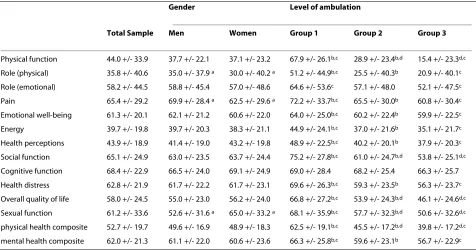
The mean subscale scores of the MSQOL-54 are pre-sented in table 2. The mean scores on all scales decreased with worsening ambulation status. The difference between groups 2 and 3 was smaller than the one between groups 1 and 2 on all of these subscales except for cognitive function. Groups 1 and 2 differed signifi-cantly with regard to all subscales (all p < .010) but
cogni-tive function (p = 1.000) and role limitations (emotional) (p = .017). Between group 2 and group 3, significant dif-ferences were found only in physical function, social function, overall quality of life and sexual function (all p < .010). Regarding the other scales groups 2 and 3 did not differ significantly (p > .016 for pain and p > .055 for the remaining scales, respectively).
Men and women differed significantly in role limita-tions (physical), pain and sexual function (all p < .010), with men having the higher score in pain and the lower scores in role limitations (physical) as well as sexual func-tion (table 2). Gender effects were not significant on the other subscales and on the composite scores (p > .014 for health perceptions and cognitive function, and p > .110 for the remaining scales, respectively).
Regarding sexual function, there was a significant inter-action effect between gender and ambulation status sub-group (p = .000). As can be seen in figure 2, in men the difference between groups 1 and 2 (mean 67.1 and 48.5, respectively) was clearly larger than the difference between group 2 and 3 (42.1), whereas in women groups 1 and 2 differed only slightly (69.1 and 66.8, respectively) in comparison to group 2 and group 3 (59.0). Regarding the other scales, no significant interaction effects were found (p = .028 for health distress and p > .092 for the remaining scales, respectively).
Discussion
The goal of the study was to explore the nature of the relationship between disability as measured by EDSS and HRQOL in MS. Therefore, we assessed the differences between patient groups with differing disability status regarding their MSQOL-54 scale scores.
The physical and the mental health composite of the MSQOL-54 as well as all subscale scores but cognitive function decreased with worsening disability status. However, while patients with an estimated EDSS score between 4.5 and 6.5 differed markedly from patients with a lower EDSS (0 - 4.0), the difference between the two groups of patients with higher EDSS scores (4.5 - 6.5 and 7.0 - 10.0, respectively) was smaller on all of these scales,
Figure 1 Mean MSQOL-54 composite scores (adjusted for effects of age and disease duration; with standard deviations) of the three ambulation status subgroups.
Physical Health Composite Mental Health Composite 0
20 40 60 80 100
Group 1 Group 2 Group 3
***
****** ***
***
*** p < .001
Sc
or
e
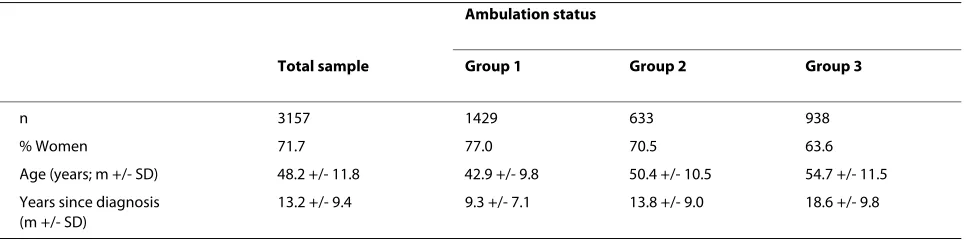
Table 1: Demographic and disease characteristics of the total sample and of the three ambulation status subgroups
Ambulation status
Total sample Group 1 Group 2 Group 3
n 3157 1429 633 938
% Women 71.7 77.0 70.5 63.6
Age (years; m +/- SD) 48.2 +/- 11.8 42.9 +/- 9.8 50.4 +/- 10.5 54.7 +/- 11.5
Years since diagnosis (m +/- SD)
not even being significant on the mental health compos-ite and most of the subscales. Hence, the results suggest, that whereas impaired ambulation (without confinement to a wheelchair) is accompanied by striking deteriora-tions in HRQOL, being bound to a wheelchair does not lead to decisive additional decreases in most HRQOL domains.
The results are in agreement with those of previous studies. In a study by Patti et al. patients with EDSS scores lower 3.0 scored significantly better than two groups with higher EDSS scores in all dimensions of the SF-36 [26]. In
the contrary, there was less difference between these lat-ter two groups. Patients with EDSS scores of 3.0 to 6.0 had markedly higher scores than patients with EDSS scores over 6.0 only for physical functioning. Vickrey et al., too, found larger differences between patients who could walk without help and patients who required assis-tance to ambulate than between this latter group and patients who were confined to a wheelchair on most MSQOL-54 scales [30].
Interestingly, in our study this pattern was found for sexual function only in men. In women the difference between groups 1 and 2 was smaller than in men, whereas the difference between groups 2 and 3 did not differ from the one found in men. Hence, the relationship between ambulation status and sexual dysfunction seems to be dif-ferent in men and in women.
Consistently with the results of other studies, cognitive function scores did not vary significantly between groups [43,44]. Hence, cognitive function and ambulation appear to be independent.
Gender effects were only observed in three subscales. Likewise, other studies reported gender effects in only few or none of the HRQOL domains, respectively [17,21,22,26,44-46].
Table 2: Mean scores on the 12 MSQOL-54 subscales and the two composite scores for the total sample, by gender and by ambulation status (the latter two adjusted for effects of age and disease duration)
Gender Level of ambulation
Total Sample Men Women Group 1 Group 2 Group 3
Physical function 44.0 +/- 33.9 37.7 +/- 22.1 37.1 +/- 23.2 67.9 +/- 26.1b,c 28.9 +/- 23.4b,d 15.4 +/- 23.3d,c
Role (physical) 35.8 +/- 40.6 35.0 +/- 37.9 a 30.0 +/- 40.2 a 51.2 +/- 44.9b,c 25.5 +/- 40.3b 20.9 +/- 40.1c
Role (emotional) 58.2 +/- 44.5 58.8 +/- 45.4 57.0 +/- 48.6 64.6 +/- 53.6c 57.1 +/- 48.0 52.1 +/- 47.5c
Pain 65.4 +/- 29.2 69.9 +/- 28.4 a 62.5 +/- 29.6 a 72.2 +/- 33.7b,c 65.5 +/- 30.0b 60.8 +/- 30.4c
Emotional well-being 61.3 +/- 20.1 62.1 +/- 21.2 60.6 +/- 22.0 64.0 +/- 25.0b,c 60.2 +/- 22.4b 59.9 +/- 22.5c
Energy 39.7 +/- 19.8 39.7 +/- 20.3 38.3 +/- 21.1 44.9 +/- 24.1b,c 37.0 +/- 21.6b 35.1 +/- 21.7c
Health perceptions 43.9 +/- 18.9 41.4 +/- 19.0 43.2 +/- 19.8 48.9 +/- 22.5b,c 40.2 +/- 20.1b 37.9 +/- 20.3c
Social function 65.1 +/- 24.9 63.0 +/- 23.5 63.7 +/- 24.4 75.2 +/- 27.8b,c 61.0 +/- 24.7b,d 53.8 +/- 25.1d,c
Cognitive function 68.4 +/- 22.9 66.5 +/- 24.0 69.1 +/- 24.9 69.0 +/- 28.4 68.2 +/- 25.4 66.3 +/- 25.7
Health distress 62.8 +/- 21.9 61.7 +/- 22.2 61.7 +/- 23.1 69.6 +/- 26.3b,c 59.3 +/- 23.5b 56.3 +/- 23.7c
Overall quality of life 58.0 +/- 24.5 55.0 +/- 23.0 56.2 +/- 24.0 66.8 +/- 27.2b,c 53.9 +/- 24.3b,d 46.1 +/- 24.6d,c
Sexual function 61.2 +/- 33.6 52.6 +/- 31.6 a 65.0 +/- 33.2 a 68.1 +/- 35.9b,c 57.7 +/- 32.3b,d 50.6 +/- 32.6d,c
physical health composite 52.7 +/- 19.7 49.6 +/- 16.9 48.9 +/- 18.3 62.5 +/- 19.1b,c 45.5 +/- 17.2b,d 39.8 +/- 17.2d,c
mental health composite 62.0 +/- 21.3 61.1 +/- 22.0 60.6 +/- 23.6 66.3 +/- 25.8b,c 59.6 +/- 23.1b 56.7 +/- 22.9c
ap < .01 men vs. women (ANCOVA) bp < .01 group 1 vs. group 2 (ANCOVA) cp < .01 group 1 vs. group 3 (ANCOVA) dp < .01 group 2 vs. group 3 (ANCOVA)
Figure 2 Mean sexual function scores (adjusted for effects of age and disease duration; with standard deviations) of the three am-bulation status subgroups for men and for women.
Men Women
0 20 40 60 80 100
Group 1 Group 2 Group 3
Se
xu
al
Fun
ct
ion
Sc
or
The data obtained in this study clearly suggest a non-linear relationship between HRQOL and disability status as measured by EDSS. This is the case for physical as well as for mental quality of life. The EDSS does not seem to be interval scaled as is commonly assumed. The step from largely unimpaired ambulation to impaired ambula-tion status and the next step towards restricambula-tion to a wheelchair are not equal in distance. Therefore, absolute increase in EDSS, e.g. one point per year, is not suited for outcome variable in clinical trials in which the effective-ness of MS immunotherapy is examined. This outcome measure has been used in a number of decisive clinical trials [1-3]. Following the findings of the present study, this is inappropriate, unless the investigators take care of strictly homogenous samples with low variations in base-line disability status. As an alternative, a proportional decrease in disability as assessed relative to the baseline EDSS scores should be used as an outcome measure. In general, MS-specific measure of quality of life should be used for detecting treatment effects [47]. Future research may address the precise definition of such a measure.
Assessing EDSS scores based on self-ratings of ambula-tion status can be seen as one limitaambula-tion of this study. Yet, the EDSS itself relies heavily on ambulation. Besides, a number of authors emphasize that a self-rating of disabil-ity status can be seen as a good substitute for neurological assessment if this is not available [25,26,48]. The advan-tage of this proceeding in the present study was that it was possible to examine a very large sample this way.
The German MS Society is divided into parts similar to the federal states of Germany and supports around 50,000 MS patients. The patients from the North Rhine-Westphalian section represent the largest proportion compared to the other German sections. The question is to which extent these patients are representative for the whole German MS community. On the other hand a pos-sible selection bias has to be discussed. Thus, members of the MS Society could form a special subgroup (maybe older, with longer disease duration) and patients working on the questionnaire could be especially motivated. The response rate obtained in this study was not as high as was hoped for, but the sample nonetheless is relatively large and covers a brought spectrum of patients. With regard to age, gender and duration of disease the distribu-tion given in this sample is in line with the one found in other studies of MS patients [9,22,45,46,49].
Conclusion
In conclusion, the results of the present study indicate a nonlinear relationship between disability status and HRQOL. They therefore contradict the assumption that the EDSS is interval scaled. Consequently, absolute increase in EDSS does not seem to be a suitable outcome variable in MS studies.
Competing interests
The survey was funded by the German MS Society "Deutsche Multiple Sklerose Gesellschaft" (DMSG) in North Rhine-Westphalia, Germany.
There are no redundant publications or conflicts of interest.
Authors' contributions
ST and SW performed the statistical analysis and drafted the manuscript. MS helped to draft the manuscript. MW conceived the study and drafted its design. SS helped to conceive the study and participated in the data collec-tion. DP gave advise and helped to draft the manuscript. JKl developed the design of the questionnaires, helped to conceive the study and managed the project. JKu conceived the study, drafted its design and helped to manage the project.
All authors read and approved the final manuscript.
Acknowledgements
We are grateful to the members of the German MS Society in North Rhine-Westphalia, who volunteered to participate in the study.
Author Details
1Faculty of Medicine at the University of Technology Dresden, Department Health Sciences/Public Health, 01307 Dresden, Germany, 2Department of Medical Psychology, University Clinic of Essen, 45122 Essen, Germany and 3Department of Neurology, Kamillus Hospital, 53567 Asbach, Germany
References
1. Kappos L: Placebo-controlled multicentre randomised trial of interferon [beta]-1b in treatment of secondary progressive multiple sclerosis. The Lancet 1998, 352(9139):1491-1497.
2. Ebers GC: Randomised double-blind placebo-controlled study of interferon [beta]-1a in relapsing/remitting multiple sclerosis. The
Lancet 1998, 352(9139):1498-1504.
3. Hartung H-P, Gonsette R, Konig N, Kwiecinski H, Guseo A, Morrissey SP, Krapf H, Zwingers T: Mitoxantrone in progressive multiple sclerosis: a placebo-controlled, double-blind, randomised, multicentre trial. The
Lancet 2002, 360(9350):2018-2025.
4. Storr LK, Sorensen PS, Ravnborg M: The efficacy of multidisciplinary rehabilitation in stable multiple sclerosis patients. Multiple Sclerosis
2006, 12(2):235-242.
5. Putzki N, Fischer J, Gottwald K, Reifschneider G, Ries S, Siever A, Hoffmann F, Käfferlein W, Kausch U, Liedtke M, Kirchmeier J, Gmünd S, Richter A, Schicklmaier P, Niemczyk G, Wernsdörfer C, Hartung HP, "Mensch im Mittelpunkt" Study Group: Quality of life in 1000 patients with early relapsing-remitting multiple sclerosis. European Journal of Neurology
2009, 16(6):713-720.
6. Berzon R, Hays RD, Shumaker SA: International use, application and performance of health-related quality of life instruments. Quality of Life
Research 1993, 2(6):367-368.
7. Rudick RA, Miller DM: Health-related quality of life in multiple sclerosis: current evidence, measurement and effects of disease severity and treatment. In CNS DrugsVolume 22. ADIS International Limited; 2008:827-840.
8. Miller DM, Rudick RA, Baier M, Cutter G, Doughtery DS, Weinstock-Guttman B, Mass MK, Fisher E, Simonian N: Factors that predict health-related quality of life in patients with relapsing-remitting multiple sclerosis. Multiple Sclerosis 2003, 9(1):1-5.
9. Murphy N, Confavreux C, Haas J, König N, Roullet E, Sailer M, Swash M, Young C, Merot J-L: Quality of life in multiple sclerosis in France, Germany, and the United Kingdom. Journal of Neurology, Neurosurgery &
Psychiatry 1998, 65(4):460-466.
10. Haas J, Kugler J, Nippert I, Pöhlau D, Scherer P: Lebensqualität bei Multipler
Sklerose (Quality of life in multiple sclerosis) Berlin: Walter de Gruyter; 2003.
11. Isaksson A-K, Ahlström G, Gunnarsson L-G: Quality of life and impairment in patients with multiple sclerosis. Journal of Neurology, Neurosurgery &
Psychiatry 2005, 76(1):64-69.
12. Haupts M, Elias G, Hardt C, Langenbahn H, Obert H, Pöhlau D, Sczesni B, v.Wussow P: Lebensqualität bei Patienten mit schubförmiger MS in Deutschland. Der Nervenarzt 2003, 74(2):144-150.
Received: 25 February 2010 Accepted: 7 June 2010 Published: 7 June 2010
This article is available from: http://www.hqlo.com/content/8/1/55 © 2010 Twork et al; licensee BioMed Central Ltd.
This is an Open Access article distributed under the terms of the Creative Commons Attribution License (http://creativecommons.org/licenses/by/2.0), which permits unrestricted use, distribution, and reproduction in any medium, provided the original work is properly cited.
13. Pfaffenberger N, Pfeiffer K-P, Deibl M, Höfer S, Günther V, Ulmer H: Association of factors influencing health-related quality of life in MS.
Acta Neurologica Scandinavica 2006, 114(2):102-108.
14. Miller A, Dishon S: Health-related quality of life in multiple sclerosis: psychometric analysis of inventories. Multiple Sclerosis 2005, 11(4):450-458.
15. Hudson M, Thombs BD, Steele R, Panopalis P, Newton E, Baron M, Group CSR: Health-related quality of life in systemic sclerosis: A systematic review. Arthritis Care & Research 2009, 61(8):1112-1120.
16. Ayatollahi P, Nafissi S, Eshraghian MR, Kaviani H, Tarazi A: Impact of depression and disability on quality of life in Iranian patients with multiple sclerosis. Multiple Sclerosis 2007, 13(2):275-277.
17. Aymerich M, Guillamón I, Jovell AJ: Health-related quality of life assessment in people with multiple sclerosis and their family caregivers. A multicenter study in Catalonia (Southern Europe). Patient
Preference and Adherence 2009, 3:311-321.
18. Jones CA, Pohar S, Warren S, Turpin K, Warren K: The burden of multiple sclerosis: A community health survey. Health and Quality of Life
Outcomes 2008, 6(1):1.
19. Nortvedt MW, Riise T: The use of quality of life measures in multiple sclerosis research. Multiple Sclerosis 2003, 9(1):63-72.
20. Miller A, Dishon S: Health-related quality of life in multiple sclerosis: the impact of disability, gender and employment status. Quality of Life
Research 2006, 15(2):259-271.
21. Alshubaili AF, Ohaeri JU, Awadalla AW, Mabrouk AA: Quality of life in multiple sclerosis: a Kuwaiti MSQOL-54 experience. Acta Neurologica
Scandinavica 2008, 117(6):384-392.
22. Casetta I, Riise T, Wamme Nortvedt M, Economou NT, De Gennaro R, Fazio P, Cesnik E, Govoni V, Granieri E: Gender differences in health-related quality of life in multiple sclerosis. Multiple Sclerosis 2009, 15(11):1339-1346.
23. Krokavcova M, van Dijk JP, Nagyova I, Rosenberger J, Gavelova M, Gdovinova Z, Groothoff JW: Perceived health status as measured by the SF-36 in patients with multiple sclerosis: a review. Scandinavian Journal
of Caring Sciences 2009, 23(3):529-538.
24. Benito-Leon J, Morales JM, Rivera-Navarro J, Mitchell AJ: A review about the impact of multiple sclerosis on health-related quality of life.
Disability & Rehabilitation 2003, 25(23):1291-1303.
25. Rothwell PM, McDowell Z, Wong CK, Dorman PJ: Doctors and patients don't agree: cross sectional study of patients' and doctors' perceptions and assessments of disability in multiple sclerosis. BMJ 1997, 314(7094):1580-1583.
26. Patti F, Cacopardo M, Palermo F, Ciancio MR, Lopes R, Restivo D, Reggio A: Health-related quality of life and depression in an Italian sample of multiple sclerosis patients. Journal of the Neurological Sciences 2003, 211(1-2):55-62.
27. Benedict RHB, Wahlig E, Bakshi R, Fishman I, Munschauer F, Zivadinov R, Weinstock-Guttman B: Predicting quality of life in multiple sclerosis: accounting for physical disability, fatigue, cognition, mood disorder, personality, and behavior change. Journal of the Neurological Sciences
2005, 231(1-2):29-34.
28. Goretti B, Portaccio E, Zipoli V, Hakiki B, Siracusa G, Sorbi S, Amato M: Coping strategies, psychological variables and their relationship with quality of life in multiple sclerosis. Neurological Sciences 2009, 30(1):15-20.
29. Krokavcova M, Nagyova I, van Dijk JP, Rosenberger J, Gavelova M, Middel B, Gdovinova Z, Groothoff JW: Mastery, functional disability and perceived health status in patients with multiple sclerosis. European
Journal of Neurology 2008, 15(11):1237-1244.
30. Vickrey B, Hays R, Harooni R, Myers L, Ellison G: A health-related quality of life measure for multiple sclerosis. Quality of Life Research 1995, 4(3):187-206.
31. Ware JE, Snow KK, Kosinski M, Gandek B: SF-36 Health survey. Manual and interpretation guide. Boston: Nimrod; 1993.
32. Solari A: Role of health-related quality of life measures in the routine care of people with multiple sclerosis. Health and Quality of Life
Outcomes 2005, 3(1):16.
33. Simeoni M, Auquier P, Fernandez O, Flachenecker P, Stecchi S, Constantinescu C, Idiman E, Boyko A, Beiske A, Vollmer T, Triantafyllou N, O'Connor P, Barak Y, Biermann L, Cristiano E, Atweh S, Patrick D, Robitail S, Ammoury N, Beresniak A, Pelletier J, MusiQol study group: Validation of
the Multiple Sclerosis International Quality of Life questionnaire.
Multiple Sclerosis 2008, 14(2):219-230.
34. Ghaem H, Haghighi AB, Jafari P, R NA: Validity and reliability of the Persian version of the multiple sclerosis quality of life questionnaire.
Neurol India 2007, 55(4):369-375.
35. Heiskanen S, Meriläinen P, Pietilä A-M: Health-related quality of life - testing the reliability of the MSQOL-54 instrument among MS patients.
Scandinavian Journal of Caring Sciences 2007, 21(2):199-206.
36. Pekmezovic T, Kisic Tepavcevic D, Kostic J, Drulovic J: Validation and cross-cultural adaptation of the disease-specific questionnaire MSQOL-54 in Serbian multiple sclerosis patients sample. Quality of Life
Research 2007, 16(8):1383-1387.
37. Triantafyllou N, Triantafillou A, Tsivgoulis G: Validity and reliability of the Greek version of the Multiple Sclerosis International Quality-of-Life questionnaire. J Clin Neurol 2009, 5(4):173-177.
38. Solari A, Filippini G, Mendozzi L, Ghezzi A, Cifani S, Barbieri E, Baldini S, Salmaggi A, Mantia LL, Farinotti M, Caputo D, Mosconi P: Validation of Italian multiple sclerosis quality of life 54 questionnaire. Journal of
Neurology, Neurosurgery & Psychiatry 1999, 67(2):158-162.
39. Vernay D, Gerbaud L, Biolay S, Coste J, Debourse J, Aufauvre D, Beneton C, Colamarino R, Glanddier PY, Dordain G, et al.: Qualité de vie et sclérose en plaques: validation de la version francophone d'un
auto-questionnaire, le SEP-59 (Quality of life and multiple sclerosis: validation of the French version of the self-questionnaire (SEP-59)). Rev
Neurol (Paris) 2000, 156:247-263.
40. Idiman E, Uzunel F, Özakbas S, Yozbatiran N, Oguz M, Callioglu B, Gokce N, Bahar Z: Cross-cultural adaptation and validation of multiple sclerosis quality of life questionnaire (MSQOL-54) in a Turkish multiple sclerosis sample. Journal of the Neurological Sciences 2006, 240(1):77-80. 41. Kugler JGM, Kahrmann G, Kiauka S, Kupsch S, Beese R, et al.: Erfassung der
Lebensqualität bei MS-Patienten: Die deutschsprachige Version des MS-QoL54 (Measuring quality of life in MS patients: The German version of the MS-QoL54). Akt Neurologie 1999, 26(Supplement 1):115. (Abstract)
42. Kurtzke JF: Rating neurologic impairment in multiple sclerosis: an expanded disability status scale (EDSS). Neurology 1983, 33:1444-1452. 43. Solari A, Radice D: Health status of people with multiple sclerosis: a
community mail survey. Neurological Sciences 2001, 22(4):307-315. 44. Janardhan V, Bakshi R: Quality of life in patients with multiple sclerosis:
The impact of fatigue and depression. Journal of the Neurological
Sciences 2002, 205(1):51-58.
45. Lobentanz IS, Asenbaum S, Vass K, Sauter C, Klösch G, Kollegger H, Kristoferitsch W, Zeitlhofer J: Factors influencing quality of life in multiple sclerosis patients: disability, depressive mood, fatigue and sleep quality. Acta Neurologica Scandinavica 2004, 110(1):6-13. 46. Pfennings L, Cohen L, Adèr H, Polman C, Lankhorst G, Smits R, van der
Ploeg H: Exploring differences between subgroups of multiple sclerosis patients in health-related quality of life. Journal of Neurology 1999, 246(7):587-591.
47. Özakbas S, Akdede BB, Kösehasanogullari G, Aksan O, Idiman E: Difference between generic and multiple sclerosis-specific quality of life instruments regarding the assessment of treatment efficacy. Journal of
the Neurological Sciences 2007, 256(1-2):30-34.
48. Verdier-Taillefer M-H, Roullet E, Cesaro P, Alperovitch A: Validation of self-reported neurological disability in multiple sclerosis. Int J Epidemiol
1994, 23(1):148-154.
49. Riazi A, Hobart J, Fitzpatrick R, Freeman J, Thompson A: Socio-demographic variables are limited predictors of health status in multiple sclerosis. Journal of Neurology 2003, 250(9):1088-1093.
doi: 10.1186/1477-7525-8-55
Cite this article as: Twork et al., Disability status and quality of life in multiple
sclerosis: non-linearity of the Expanded Disability Status Scale (EDSS) Health