M E T H O D O L O G Y
Open Access
Using the Consolidated Framework for
Implementation Research (CFIR) to produce
actionable findings: a rapid-cycle evaluation
approach to improving implementation
Rosalind E. Keith
1*, Jesse C. Crosson
1, Ann S. O
’
Malley
2, DeAnn Cromp
3and Erin Fries Taylor
2Abstract
Background:Much research does not address the practical needs of stakeholders responsible for introducing health care delivery interventions into organizations working to achieve better outcomes. In this article, we present an approach to using the Consolidated Framework for Implementation Research (CFIR) to guide systematic research that supports rapid-cycle evaluation of the implementation of health care delivery interventions and produces actionable evaluation findings intended to improve implementation in a timely manner.
Methods:To present our approach, we describe a formative cross-case qualitative investigation of 21 primary care practices participating in the Comprehensive Primary Care (CPC) initiative, a multi-payer supported primary care practice transformation intervention led by the Centers for Medicare and Medicaid Services. Qualitative data include observational field notes and semi-structured interviews with primary care practice leadership, clinicians, and administrative and medical support staff. We use intervention-specific codes, and CFIR constructs to reduce and organize the data to support cross-case analysis of patterns of barriers and facilitators relating to different CPC components.
Results:Using the CFIR to guide data collection, coding, analysis, and reporting of findings supported a systematic, comprehensive, and timely understanding of barriers and facilitators to practice transformation. Our approach to using the CFIR produced actionable findings for improving implementation effectiveness during this initiative and for identifying improvements to implementation strategies for future practice transformation efforts.
Conclusions:The CFIR is a useful tool for guiding rapid-cycle evaluation of the implementation of practice transformation initiatives. Using the approach described here, we systematically identified where adjustments and refinements to the intervention could be made in the second year of the 4-year intervention. We think the
approach we describe has broad application and encourage others to use the CFIR, along with intervention-specific codes, to guide the efficient and rigorous analysis of rich qualitative data.
Trial registration:NCT02318108
Keywords:Implementation framework, Barriers and facilitators, Qualitative methods, Practice transformation, Primary care redesign, Rapid-cycle evaluation, Actionable findings
* Correspondence:[email protected]
1Mathematica Policy Research, PO Box 2393, Princeton, NJ 08543, USA
Full list of author information is available at the end of the article
Background
Numerous health care delivery interventions are being implemented across the USA with the aim of achieving better health outcomes for patients at lower costs. These health care delivery interventions are as complex as the issues in health care that they are designed to improve. Further, the contexts in which they are implemented are increasingly complex, involving interdependent interac-tions within and across delivery organizainterac-tions. Under-standing how primary care practices are faring when implementing these multifaceted interventions requires systematic research that yields information on the fac-tors that emerge to influence implementation [1–3]. However, much research does not address the practical needs of the stakeholders responsible for introducing these interventions into the health care delivery organiza-tions working to achieve better outcomes [4, 5]; these stakeholders can include payers and providers, and those helping providers alter care delivery. Rapid-cycle evalu-ation provides stakeholders with timely assessment of intervention effectiveness and ongoing feedback to support continuous improvement of an intervention during the implementation period to maximize its effectiveness [6].
The Consolidated Framework for Implementation Research
The Consolidated Framework for Implementation Re-search (CFIR) is a conceptual framework that was devel-oped to guide systematic assessment of multilevel implementation contexts to identify factors that might influence intervention implementation and effectiveness [7]. A conceptual framework is a system of concepts, assumptions, expectations, beliefs, and theories that“ ex-plains either graphically or in narrative form, the main things to be studied—the key factors, constructs or variables” that influence a phenomenon of interest [8]. Conceptual frameworks increase the efficiency of research and the generalizability and interpretability of research findings. By prespecifying factors demon-strated in prior research to influence the phenomenon of interest, in this case implementation of an inter-vention to improve health care delivery, conceptual frameworks increase the relevance of the research findings for informing implementation practice. To develop the CFIR, Damschroder et al. [7] reviewed many published implementation theories and reports of empirical studies to identify factors associated with effective implementation. They considered a spectrum of construct terminology and definitions, from them com-piled an overarching framework. The 39 CFIR constructs reflect the evidence base of factors most likely to influence implementation of interventions. The CFIR is well suited to guide rapid-cycle evaluation of the implementation of complex health care delivery interventions, because it pro-vides a comprehensive framework to systematically
identify factors that may emerge in various, multi-level contexts to influence implementation. If used to evaluate the initial stages of implementation, the CFIR can help to produce findings to inform stakeholders on improvements to the intervention and its implementation. Since its publication in 2009, the CFIR has been cited in more than 300 published articles [9]. Damschroder and Lowery describe an approach to using the CFIR to explain vari-ation in the implementvari-ation of an intervention and com-pare the influence of CFIR constructs on implementation across studies [10]. However, we are not aware of any other journal articles that describe how to use the CFIR to systematically assess barriers and facilitators to implemen-tation for rapid-cycle evaluation in which actionable find-ings are shared with stakeholders during implementation.
The CFIR is composed of five major domains, each of which may affect an intervention’s implementation [7]:
1. Intervention characteristics, which are the features of an intervention that might influence
implementation. Eight constructs are included in intervention characteristics (e.g., stakeholders’ perceptions about the relative advantage of implementing the intervention, complexity). 2. Inner setting, which includes features of the
implementing organization that might influence implementation. Twelve constructs are included in inner setting (e.g., implementation climate, leadership engagement).
3. Outer setting, which includes the features of the external context or environment that might influence implementation. Four constructs are included in outer setting (e.g., external policy and incentives).
4. Characteristics of individuals involved in implementation that might influence
implementation. Five constructs are related to characteristics of individuals (e.g., knowledge and beliefs about the intervention).
5. Implementation process, which includes strategies or tactics that might influence implementation. Eight constructs are related to implementation process (e.g., engaging appropriate individuals in the implementation and use of the intervention, reflecting, and evaluating).
The CFIR is intended to be flexible in application so that researchers can tailor the framework to the specific intervention design, factors, and context being studied.
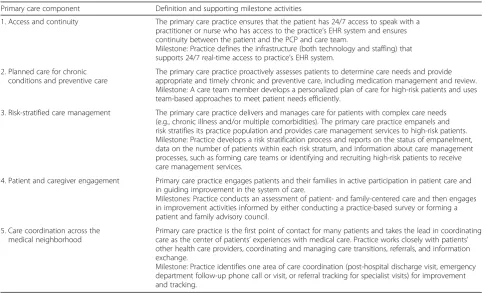
Services (CMS) in 2012, is a 4-year multipayer initiative designed to strengthen primary care to improve health, lower costs, and patient and provider experience. CMS collaborated with 39 commercial and state health insur-ance plans in seven regions across the USA to provide to the 497 participating primary care practices’ financial support in the form of monthly care management fees (in addition to regular fee-for-service payments) and oppor-tunities to share in any savings. In addition to this finan-cial support, CPC provided regular data feedback and learning support focused on guiding required improve-ments in the delivery of five primary care functional areas by participating practices: access to and continuity of care; planned care for chronic conditions and preventive care; risk-stratified care management; engagement of patients and their caregivers; and coordination of care with pa-tients’other care providers [11]. CMS defined nine annual milestones that participating practices were required to meet in the process of implementing CPC, thereby chan-ging care delivery and building capacity across these five functional areas, referred to in this article as program components. In Table 1, we provide a brief overview of the five CPC program components and an illustrative supporting milestone for each.
We demonstrate how our approach facilitated under-standing of practice transformation efforts to support improvements in implementation of the CPC initiative.
We provide examples to illustrate the analytic methods we used to develop our findings, and we reflect on the utility of our approach for producing actionable findings for decision makers and program implementers. Details about the initiative and the results of the evaluation are presented elsewhere [11–14].
Methods
We conducted a formative cross-case qualitative investi-gation of the implementation of the CPC initiative, a primary care practice transformation initiative. We present the steps in our approach to using the CFIR to guide the collection of rich qualitative data, rapid-cycle data analysis, and the reporting of actionable findings about contextual and intervention factors affecting implementation and intervention outcomes during 2013, the 2nd year of our 5-year evaluation.
One of the objectives of the evaluation was to under-stand how participating practices were experiencing the implementation of changes in the five primary care func-tional areas. The specific research objectives around practice transformation were to (1) describe the changes being made by practices to implement the five core pro-gram components; (2) describe tactics used by practices to make those changes; and (3) identify barriers and facilitators’ practices faced when implementing the changes. Our research team was comprised of a medical
Table 1Comprehensive Primary Care components and illustrative supporting milestones for 2013
Primary care component Definition and supporting milestone activities
1. Access and continuity The primary care practice ensures that the patient has 24/7 access to speak with a practitioner or nurse who has access to the practice’s EHR system and ensures continuity between the patient and the PCP and care team.
Milestone: Practice defines the infrastructure (both technology and staffing) that supports 24/7 real-time access to practice’s EHR system.
2. Planned care for chronic conditions and preventive care
The primary care practice proactively assesses patients to determine care needs and provide appropriate and timely chronic and preventive care, including medication management and review. Milestone: A care team member develops a personalized plan of care for high-risk patients and uses team-based approaches to meet patient needs efficiently.
3. Risk-stratified care management The primary care practice delivers and manages care for patients with complex care needs (e.g., chronic illness and/or multiple comorbidities). The primary care practice empanels and risk stratifies its practice population and provides care management services to high-risk patients. Milestone: Practice develops a risk stratification process and reports on the status of empanelment, data on the number of patients within each risk stratum, and information about care management processes, such as forming care teams or identifying and recruiting high-risk patients to receive care management services.
4. Patient and caregiver engagement Primary care practice engages patients and their families in active participation in patient care and in guiding improvement in the system of care.
Milestones: Practice conducts an assessment of patient- and family-centered care and then engages in improvement activities informed by either conducting a practice-based survey or forming a patient and family advisory council.
5. Care coordination across the medical neighborhood
Primary care practice is the first point of contact for many patients and takes the lead in coordinating care as the center of patients’experiences with medical care. Practice works closely with patients’ other health care providers, coordinating and managing care transitions, referrals, and information exchange.
Milestone: Practice identifies one area of care coordination (post-hospital discharge visit, emergency department follow-up phone call or visit, or referral tracking for specialist visits) for improvement and tracking.
anthropologist, two primary care physician researchers, two social scientists with expertise in primary care trans-formation and implementation science, and several research analysts. Three of the authors (REK, JCC, DC) collected, coded, and analyzed the data. Three of the authors (REK, JCC, ASO) reported findings.
Data collection
To select practices, we stratified practices in each region by size (small, medium, and large practices). Within each category in each region, we randomly selected two practices, which we designated as primary, and another practice that we designated as an alternate. We used these 14 primary and 7 alternate practices to roughly approximate the distribution we had for all CPC prac-tices on other characteristics such as ownership, rural or urban location, and previous medical home recognition status. This process ensured that we included roughly equal numbers of small, medium, and large practices. The selected practices were broadly similar to the overall group of CPC participating practices in terms of owner-ship, rural or urban location, and previous medical home recognition status. We then visited each of the 21 selected practices between June and October 2013 for 1 or 2 days (depending on practice size). During these visits, we used semi-structured interview guides to conduct in-depth interviews with multiple respondents, including lead clinicians, practice managers, other clini-cians, and administrative and medical support staff involved in CPC-related practice functions. In small practices, we typically interviewed all available staff; in larger practices, we typically interviewed five to seven respondents to ensure that we had a variety of perspec-tives on CPC implementation. Interviews were 30 to 90 min long. All interviews were audio-recorded and transcribed verbatim.
We designed our interview guide to ensure that we collected data related to our research questions. Our semi-structured interview guide prompted respondents to dis-cuss their practice context as it related to their experiences with implementing individual CPC components, and we probed respondents regarding the challenges and facilita-tors they experienced when implementing each component. We did not ask questions about specific CFIR constructs; rather, we asked respondents questions about their experi-ences with each of the five CPC core components. We asked respondents about (1) how each component was be-ing operationalized in their practice; (2) how practice func-tions and workflows supported (or did not support) each component; (3) what had been challenging with operation-alizing each component; (4) what had been helpful with op-erationalizing each component; and (5) how patients were reacting to each component. We provide an excerpt from the semi-structured interview guide in Additional file 1.
In addition to the in-depth interviews, we developed a checklist to guide observation of the practice context and CPC-related workflows and informal interviews with administrative and medical support staff. Our checklist prompted us to note observations of the practice context by CFIR domain, including (1) the inner setting of the practice context, (2) practice members’ perceptions of CPC milestones, (3) the practice’s process for imple-menting CPC milestones, and to some extent (4) the practice’s outer setting. We shadowed additional clinical and administrative support staff and conducted informal interviews to clarify things that were discussed during the semi-structured interviews. The observations and in-formal interviews provided perspective on the extent to which CPC’s goals and changes in workflows to meet those goals were understood and supported by staff throughout the practice. We obtained as complete of a picture as possible of what CPC implementation looked like in the practice. We documented field notes within 24 h after each site visit. Field notes from these observa-tions and informal interviews were included in our data analysis. We provide an excerpt from the observation checklist in Additional file 2.
We pilot tested the interview guide and observation checklist and made refinements based on pilot respond-ent feedback and research team members’perceptions of the usefulness of the data collection instruments for eliciting information we intended to capture. We then used these refined data collection instruments for the interviews and observations reported on here.
Coding
apply the CFIR code that reflected a potential barrier or facilitator being described, which was the main theoretical driver of our study [8, 16].
During initial coding of six transcripts and following the template analysis approach described above, we adapted the CFIR codes to fit the context of CPC and our study in three ways. First, we removed a small num-ber of CFIR codes that were not reflected in the tran-scripts. For example, we removed codes for“trialability” and “individual stage of change” from the codebook. Second, we made minor modifications to CFIR code def-initions to use language found in our data, but did not change the meaning of any CFIR construct. For example, we modified the definition of“available resources” to fit the context of CPC implementation by creating two add-itional “available resources” codes: “staff resources” and
“health information technology resources.” Third, we added examples in the codebook to ensure consistent application of codes over time and across coders. An example of a data segment we added to the codebook is this segment illustrating the use of the code “patient needs and resources”:
[Interviewer:“What are the challenges with providing care management?”]
Respondent:“We’re working on it slowly, kind of. But one of the things is patient transportation. So many of our patients are elderly, live alone, and have really no
…social outlet, network, or anything like that. So we’ve been working on ways of getting them to appointments…and you get a call a day from them,
with nothing you can really do without seeing them, but they can’t come in, because they can’t get here.”
We then used the adapted codebooks to code the remaining data.
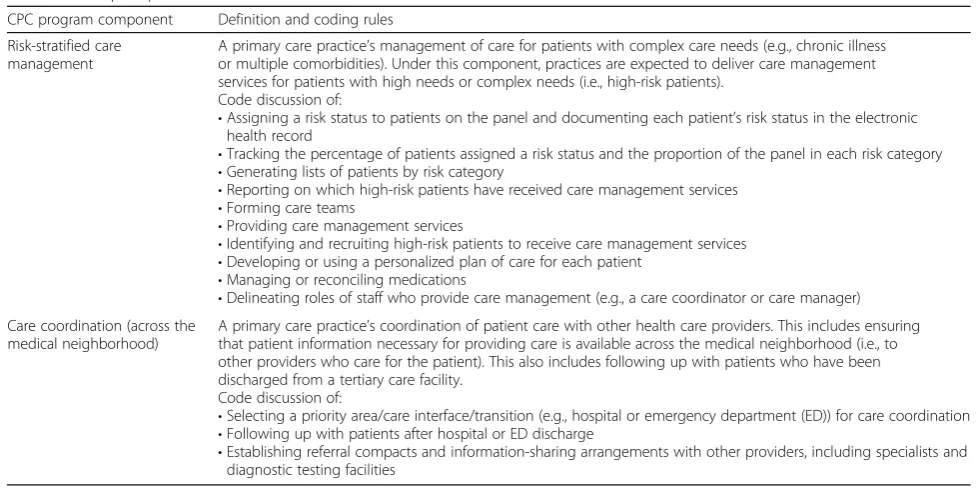
To reduce the data for analysis, coders were judicious in applying the fewest codes possible in interpretation of the meaning of each data segment [17]. When coding the data, coders made three decisions for each data segment. (Data segments typically included an interview question and response or a single paragraph of a field note.) First, the coder determined which of the five CPC components was being discussed and assigned the appropriate operational code (e.g., care coordination). Second, the coder identified which one of the five CFIR domains reflected the principal implementation theme in the data (e.g., intervention characteristic). Third, the coder determined which CFIR code within that identi-fied domain was reflected in the data segment and assigned the appropriate contextual code (e.g., relative advantage). In this third step, coders applied codes to capture the principal implementation theme in the data segment, by applying only one CFIR code per CFIR do-main. While the use of one CFIR domain per data seg-ment was our general rule, coders made exceptions if two CFIR domains were equally reflected in the data segment; specifically, coders selected both domains and applied a CFIR code for each, but did not apply more than one CFIR code per domain. This approach helped us to increase coding consistency and avoid overapplying codes, by focusing our interpretation on the most rele-vant CFIR constructs found in the data. We found that Table 2Example operational codes
CPC program component Definition and coding rules
Risk-stratified care management
A primary care practice’s management of care for patients with complex care needs (e.g., chronic illness or multiple comorbidities). Under this component, practices are expected to deliver care management services for patients with high needs or complex needs (i.e., high-risk patients).
Code discussion of:
•Assigning a risk status to patients on the panel and documenting each patient’s risk status in the electronic health record
•Tracking the percentage of patients assigned a risk status and the proportion of the panel in each risk category
•Generating lists of patients by risk category
•Reporting on which high-risk patients have received care management services
•Forming care teams
•Providing care management services
•Identifying and recruiting high-risk patients to receive care management services
•Developing or using a personalized plan of care for each patient
•Managing or reconciling medications
•Delineating roles of staff who provide care management (e.g., a care coordinator or care manager) Care coordination (across the
medical neighborhood)
A primary care practice’s coordination of patient care with other health care providers. This includes ensuring that patient information necessary for providing care is available across the medical neighborhood (i.e., to other providers who care for the patient). This also includes following up with patients who have been discharged from a tertiary care facility.
Code discussion of:
•Selecting a priority area/care interface/transition (e.g., hospital or emergency department (ED)) for care coordination
•Following up with patients after hospital or ED discharge
limiting the number of codes we applied to each data segment effectively reduced the large amount of data we had to analyze by ensuring that the same data segment was not being analyzed multiple times within different CFIR constructs. In addition, we found that using this hierarchical decision process, and in most cases narrow-ing in on the most relevant CFIR domain, made usnarrow-ing the CFIR codes more manageable, because it helped to reduce the cognitive burden of having to recall all of the CFIR codes from all five domains, while coding.
A concern we had about limiting the number of CFIR codes we applied to each data segment was losing data that potentially reflected more than one CFIR construct. We explain below, under the “Data analysis” section, how we used the operational codes to organize the coded data by program component for analysis. This ensured a comprehensive analysis of all data segments relevant to each program component, while avoiding having to review the same data segment multiple times.
In the initial stages of coding, a team of four re-searchers coded data together. As part of this process, the coders refined code definitions, developed coding rules, and achieved agreement on the application of codes to the data. After this process, the remaining tran-scripts were divided among three coders who, after each coding five different interviews, coded the same sixth interview independently and met to discuss and resolve coding discrepancies to ensure ongoing consistency in the application of the codes. The coders continued this process of each coding five different interviews and then coding and discussing the same sixth interview, until all data were coded. All data were coded in ATLAS.ti [18].
Data analysis
To analyze the coded data, we first generated code reports from ATLAS.ti for each practice that included
all the data segments coded for each combination of program component and CFIR construct. Within each code report, data segments were organized by CFIR domain and construct. For example, the code report for
“care coordination” included all coded data focused on how the practice made changes to implement care coordination and what barriers and facilitators (identi-fied by CFIR construct) that the practice experienced in making those changes, grouped by each of the CFIR domains (e.g., intervention characteristic). We then de-veloped analytic summaries for each combination of program component (e.g., care coordination) and CFIR construct (e.g., relative advantage, complexity) for each of the 21 practices and determined whether the con-struct exerted a negative, positive, or neutral influence on implementation. For example, we considered if the complexity described in the data segment as a feature of CPC reflected a positive or negative influence on the implementation of care coordination. The guidance we developed and used to assess the direction of the influ-ence on implementation is provided in Additional file 3.
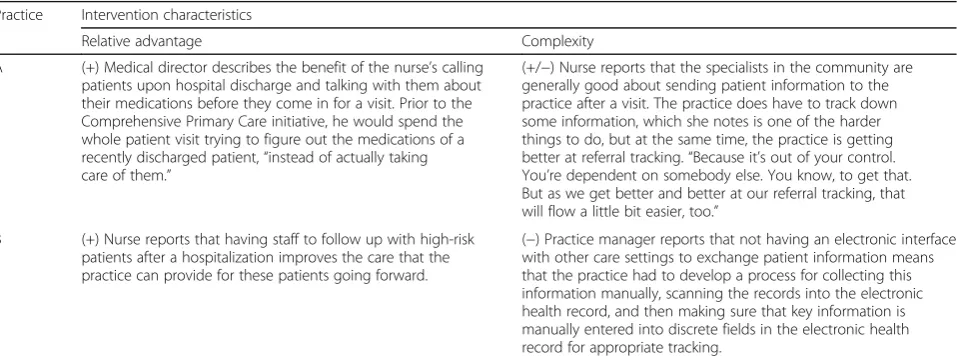
We then populated analytic matrices with this infor-mation for cross-case analysis of patterns of barriers and facilitators relating to each of the program components (see Table 3 for an example analytic matrix display for the care coordination component) [19]. Our analytic matrices facilitated simultaneous viewing of a large volume of data so we could make between-practice com-parisons and identify similarities, differences, and trends in how practices experienced implementation.
In Table 3, the analytic summaries for relative advantage reflect a facilitator that emerged from the data about re-spondents’perceptions regarding the advantages of imple-menting care coordination. The analytic summaries for complexity reflect a barrier that emerged from the data about the challenges with implementing care coordination.
Table 3Example analytic matrix for the care coordination component Practice Intervention characteristics
Relative advantage Complexity
A (+) Medical director describes the benefit of the nurse’s calling patients upon hospital discharge and talking with them about their medications before they come in for a visit. Prior to the Comprehensive Primary Care initiative, he would spend the whole patient visit trying to figure out the medications of a recently discharged patient,“instead of actually taking care of them.”
(+/−) Nurse reports that the specialists in the community are generally good about sending patient information to the practice after a visit. The practice does have to track down some information, which she notes is one of the harder things to do, but at the same time, the practice is getting better at referral tracking.“Because it’s out of your control. You’re dependent on somebody else. You know, to get that. But as we get better and better at our referral tracking, that will flow a little bit easier, too.”
B (+) Nurse reports that having staff to follow up with high-risk patients after a hospitalization improves the care that the practice can provide for these patients going forward.
(−) Practice manager reports that not having an electronic interface with other care settings to exchange patient information means that the practice had to develop a process for collecting this information manually, scanning the records into the electronic health record, and then making sure that key information is manually entered into discrete fields in the electronic health record for appropriate tracking.
Reporting the findings
Drawing on the analytic matrices for each program com-ponent and CFIR domain combination, we described patterns of barriers and facilitators to implementation as they emerged across the 21 practices. Our reporting of findings conveyed the richness of the qualitative infor-mation and preserved the complexity of these patterns while maximizing learning across practices. We did not use CFIR terminology to report our findings but rather we framed key findings in language familiar to our audience.
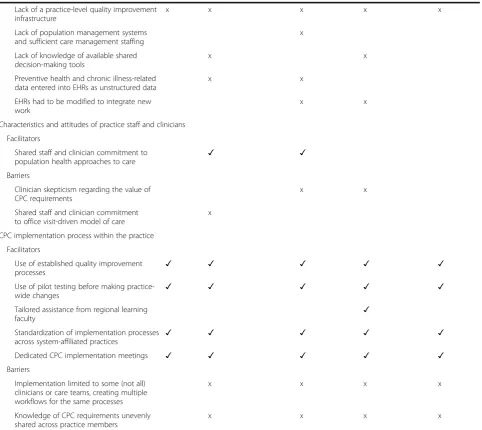
In addition to our narrative report of these findings, we developed a summary table of barriers and facili-tators to implementation as they emerged across the 21 practices, organized by CFIR domain, across each of the five CPC components (Table 4) [12]. This table identifies barriers or facilitators that were common across the program components, as well as those that were unique to each component. Visualizing barriers and facilitators in this manner may be helpful for identifying key areas where additional support could be important for implementation success.
Results
In this section, we provide examples of actionable find-ings that emerged from our analysis. We define an actionable finding as one that provides information about changes that can be made to a program to im-prove its effectiveness or to program implementation to improve its uptake into practice. The actionable findings we present include descriptions of contextual factors important for understanding what happened in the pri-mary care practices during CPC implementation and how those factors influenced the operationalization of CPC components into practice workflows.
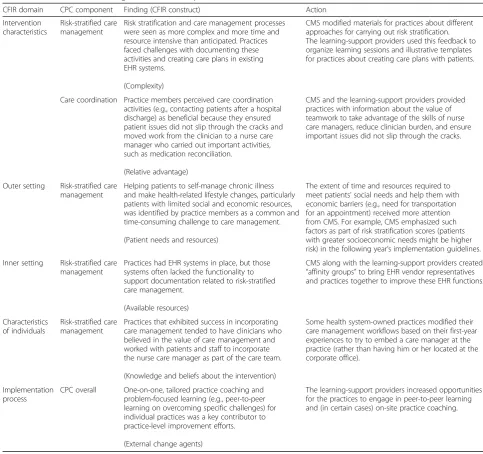
We present example findings related to two CPC com-ponents (risk-stratified care management and care co-ordination) organized by the five CFIRs domains (Table 5). We include the CFIR construct from which the finding emerged in parentheses after each finding and then present how the finding informed actions to improve subsequent implementation of the intervention. One of the example findings we present in Table 5 links to the example analytic summaries that we present in Table 3, regarding respondents’ perceptions of the rela-tive advantages of implementing care coordination. Across the 21 practices, from data segments coded to relative advantage and care coordination, we found that practice members perceived care coordination activities (e.g., contacting patients after a hospital discharge) to be beneficial because they ensured patient issues were not missed and moved work from the clinician to a nurse care manager who carried out important activities such as medication reconciliation. In Table 5, we present the
action that was taken as a result of this finding; CMS and the learning-support providers communicated to practices the value of teamwork to take advantage of the skills of nurse care managers, reduce clinician burden, and ensure that important patient issues were not missed.
The actions described in Table 5 were also informed by findings from the larger evaluation of the CPC initia-tive and by information CMS collected directly from practices, other payers, and other contractors. Overall, our findings and these other sources of feedback facili-tated a collaborative approach to making program refinements over time.
Discussion
In this article, we described our method for identifying and understanding contextual factors that influence the implementation of complex multicomponent health care delivery interventions.
Our approach to using the CFIR to develop interpret-ive codes to assess the influence of implementation con-text, in addition to using descriptive codes to delineate program components, guided us to generate actionable findings relevant to different primary care transform-ation activities. The codes we developed helped us to better understand how barriers and facilitators varied across the required components of the intervention and to discern which ones were common across all com-ponents. Together, this information produced findings that key evaluation stakeholders—CMS, the learning-support providers, and primary care practices—used to adapt intervention implementation guidelines and modify learning activities and supports to make them more relevant to practices.
Using the CFIR ensured that the key barriers and facil-itators to implementation were examined systematically across CFIR domains and constructs, by prompting coders to critically interpret the meaning of each data segment when coding. By using the CFIR to organize the important contextual factors likely to influence the im-plementation of each CPC component, we were able to tell a comprehensive, organized, valid, and compelling story. Moreover, the story we told included actionable information that those supporting the implementation process could use to improve the success of the initiative in real time. Such timely, actionable findings during pro-gram implementation support a rapid-cycle approach to evaluation in which ongoing feedback is provided to program stakeholders to support learning, adaptation, and continuous quality improvement [6].
Table 4Facilitators and barriers to implementation across the five CPC components, as commonly reported or observed in deep-dive practice interviews and visits conducted in 2013
CFIR domain CPC component
Access and continuity
Planned care for chronic conditions and population health
Risk-stratified care management
Patient and caregiver engagement
Coordination of care
Characteristics of the CPC initiative
Facilitators
Adequate resources for new capacities
(both financial and time) ✓ ✓ ✓ ✓ ✓
Compatibility with care improvement objectives
✓
Barriers
Insufficient resources for new capacities (tools, financial, time)
x x
Complex or unclear requirements x x
External environment and context
Facilitators
Effective local electronic HIE ✓ ✓ ✓
HIT“meaningful use”incentives ✓
Regional history of patient-centered medical home programs
✓ ✓ ✓ ✓ ✓
Barriers
Lack of direct electronic access to health information from other care settings
x x x
Delays in access to patient survey results x
Gaps in electronic information available through HIE
x x x
Complexity of needs in patient population x
Internal context and setting of the practice
Facilitators
Prior experience with quality improvement
efforts ✓ ✓ ✓ ✓ ✓
Organizational commitment to population health approaches to care
✓ ✓
Independent practices could make rapid
change ✓ ✓ ✓ ✓ ✓
System-affiliated practices had support for management, HIT, quality improvement
✓ ✓ ✓
Integration of new work with existing
work processes ✓
EHR technology integrated with disease registries and patient reminder systems
✓ ✓
Prior use of shared decision-making tools ✓ ✓
Existing staff trained in patient
self-management approaches ✓
Barriers
Organizational commitment to traditional office visit-driven model of care
x x
Independent practices lacked support for management, HIT, and quality improvement
x
System-affiliated practices had limited local authority to make change
neighborhood. We delineated the influence of different factors on different components to bring clarity to CPC stakeholders about how different practices are experien-cing implementation of different aspects of a multicom-ponent intervention. For example, we described the nuances of challenges that some practices faced when lacking internal resources to document care manage-ment activities in the electronic health record (EHR), which prompted CMS and the learning-support pro-viders to convene EHR vendors together with practices to facilitate problem solving. We described how team-work enabled some practices to facilitate care transitions in the broader medical neighborhood, which helped
learning-support providers promote the value of team-based care in improving care coordination. Decision makers can use such findings to design and improve future health care delivery interventions. Learning-support providers can use such findings to tailor Learning-support to implementing organizations, and implementing orga-nizations can use such findings to avoid pitfalls and try approaches that were successful in other organizations.
The CFIR is a comprehensive typology of contextual factors that have been associated with effective imple-mentation in published impleimple-mentation theories and empirical studies. It provided a taxonomy or common language for our research team to identify, distill, and
Table 4Facilitators and barriers to implementation across the five CPC components, as commonly reported or observed in deep-dive
practice interviews and visits conducted in 2013(Continued)
Lack of a practice-level quality improvement infrastructure
x x x x x
Lack of population management systems and sufficient care management staffing
x
Lack of knowledge of available shared decision-making tools
x x
Preventive health and chronic illness-related data entered into EHRs as unstructured data
x x
EHRs had to be modified to integrate new work
x x
Characteristics and attitudes of practice staff and clinicians
Facilitators
Shared staff and clinician commitment to population health approaches to care
✓ ✓
Barriers
Clinician skepticism regarding the value of CPC requirements
x x
Shared staff and clinician commitment to office visit-driven model of care
x
CPC implementation process within the practice
Facilitators
Use of established quality improvement
processes ✓ ✓ ✓ ✓ ✓
Use of pilot testing before making practice-wide changes
✓ ✓ ✓ ✓ ✓
Tailored assistance from regional learning
faculty ✓
Standardization of implementation processes across system-affiliated practices
✓ ✓ ✓ ✓ ✓
Dedicated CPC implementation meetings ✓ ✓ ✓ ✓ ✓
Barriers
Implementation limited to some (not all) clinicians or care teams, creating multiple workflows for the same processes
x x x x
Knowledge of CPC requirements unevenly shared across practice members
x x x x
Source: [12]. For each CPC component where they apply, facilitators are indicated with a checkmark and barriers are indicated with an x.CPCComprehensive
compare factors influencing primary care transformation across 21 practices, operating in different contexts. This approach is useful for project teams to divide coding and analysis, while maintaining a common orientation to the themes emerging from the data. However, we caution that the application of a large and multi-level codebook to complex data is an inherently difficult process that requires close attention to the quality and consistency of data collection, coding, and analysis.
We think the approach we describe has broad application and encourage others to use the CFIR, along with intervention-specific codes, to guide the efficient and
rigorous analysis of rich qualitative data. As such, we are using this approach to assess barriers and facilitators to implementing a disease registry in the Supporting Practices to Adopt Registry-Based Care (SPARC) study [20]. The SPARC study is a two-armed randomized controlled trial of 30 primary care practices implementing a diabetes registry. Practices randomized to the intervention will receive learn-ing support for registry implementation. Applylearn-ing our ap-proach to this study design will provide us the opportunity to demonstrate its relevance for assessing the tion of a relatively smaller intervention and an implementa-tion strategy designed to guide the implementaimplementa-tion process. Table 5Example actionable findings from selected CPC practices about implementing risk-stratified care management and care coordination and how the findings informed CPC implementation
CFIR domain CPC component Finding (CFIR construct) Action
Intervention characteristics
Risk-stratified care management
Risk stratification and care management processes were seen as more complex and more time and resource intensive than anticipated. Practices faced challenges with documenting these activities and creating care plans in existing EHR systems.
(Complexity)
CMS modified materials for practices about different approaches for carrying out risk stratification. The learning-support providers used this feedback to organize learning sessions and illustrative templates for practices about creating care plans with patients.
Care coordination Practice members perceived care coordination activities (e.g., contacting patients after a hospital discharge) as beneficial because they ensured patient issues did not slip through the cracks and moved work from the clinician to a nurse care manager who carried out important activities, such as medication reconciliation.
(Relative advantage)
CMS and the learning-support providers provided practices with information about the value of teamwork to take advantage of the skills of nurse care managers, reduce clinician burden, and ensure important issues did not slip through the cracks.
Outer setting Risk-stratified care management
Helping patients to self-manage chronic illness and make health-related lifestyle changes, particularly patients with limited social and economic resources, was identified by practice members as a common and time-consuming challenge to care management.
(Patient needs and resources)
The extent of time and resources required to meet patients’social needs and help them with economic barriers (e.g., need for transportation for an appointment) received more attention from CMS. For example, CMS emphasized such factors as part of risk stratification scores (patients with greater socioeconomic needs might be higher risk) in the following year’s implementation guidelines.
Inner setting Risk-stratified care management
Practices had EHR systems in place, but those systems often lacked the functionality to support documentation related to risk-stratified care management.
(Available resources)
CMS along with the learning-support providers created
“affinity groups”to bring EHR vendor representatives and practices together to improve these EHR functions.
Characteristics of individuals
Risk-stratified care management
Practices that exhibited success in incorporating care management tended to have clinicians who believed in the value of care management and worked with patients and staff to incorporate the nurse care manager as part of the care team.
(Knowledge and beliefs about the intervention)
Some health system-owned practices modified their care management workflows based on their first-year experiences to try to embed a care manager at the practice (rather than having him or her located at the corporate office).
Implementation process
CPC overall One-on-one, tailored practice coaching and problem-focused learning (e.g., peer-to-peer learning on overcoming specific challenges) for individual practices was a key contributor to practice-level improvement efforts.
(External change agents)
The learning-support providers increased opportunities for the practices to engage in peer-to-peer learning and (in certain cases) on-site practice coaching.
The findings presented in this table are from 2013. They are also presented in Ref [12].CFIRConsolidated Framework for Implementation Research,CMSCenters
As health care delivery interventions become more widespread, research studies and rigorous evaluations can be better compared when guided by the CFIR. The CFIR allows researchers across studies to use a common language and approach to comprehensively and system-atically study implementation of multicomponent inter-ventions. Researchers can better synthesize across settings, interventions, and studies their findings about factors that influence implementation to develop an evidence base for understanding implementation and developing theories to guide successful change [7, 21].
Conclusion
This article demonstrates how we generated actionable findings that provided our evaluation client, CMS, learning-support providers, and primary care practices with information about the contexts underlying CPC implementation and how factors in those contexts may have influenced implementation progress. Findings derived using our systematic approach can inform stake-holders on how to change or improve implementation of an intervention in the current settings or replication of an intervention in different settings [22]. The CFIR can support the design of implementation studies by guiding analysis and reporting to generate findings that go be-yond the documentation of intervention details and address important research questions about how, why, and under what conditions intervention implementation is effective. Our delineation of the multiple CPC pro-gram components, used in conjunction with CFIR constructs, guided our data collection, data analysis, and reporting and could be adapted to other studies evaluat-ing the implementation of complex multicomponent interventions, within health care delivery and beyond.
Additional files
Additional file 1:Excerpt from interview guide. (DOCX 32 kb)
Additional file 2:Excerpt from observation checklist. (DOCX 27 kb)
Additional file 3:Valence ratings. (DOCX 27 kb)
Abbreviations
CFIR:Consolidated Framework for Implementation Research; CMS: Centers for Medicare and Medicaid Services; CPC: Comprehensive Primary Care; EHR: Electronic health record
Acknowledgements
The authors thank the staff from the 21 participating practices selected for the study described in this article, the Comprehensive Primary Care implementation team for their cooperation and willingness to share information and data, and Tim Day of the CMS Research and Rapid Cycle Evaluation Group of CMS for feedback on an earlier version of the manuscript and input into the overall research design. We also thank the staff from the larger evaluation team at Group Health Research Institute: Clarissa Hsu, Michael Parchman, and James Ralston and at Mathematica Policy Research: Randall Brown, Jasmine Little, Amy Overcash, and Deborah Peikes. The contents of this publication are solely the responsibility of the
authors and do not necessarily represent the official views of the US Department of Health and Human Services or any of its agencies.
Funding
The development and publishing of this manuscript was supported by a grant from the US Department of Health and Human Services, National Institutes of Health, and National Institute of Diabetes and Digestive and Kidney Diseases (Grant number: 7R18DK091810-02).
Availability of data and materials
This is not applicable. Only example data is presented to support the description of our methods.
Authors’contributions
REK led the manuscript production, designed the data analysis, collected, coded, and analyzed the data and reported findings, and contributed to drafting the manuscript. JCC led the design of the study, collected, coded, and analyzed the data and reported findings, and contributed to drafting the manuscript. ASO reported findings and contributed to drafting the manuscript. DC collected, coded, and analyzed the data and contributed to drafting the manuscript. EFT oversaw the design of the study and reporting of findings and contributed to drafting the manuscript. All authors read and approved the final manuscript.
Competing interests
The authors declare that they have no competing interests.
Consent for publication Not applicable.
Ethics approval and consent to participate Not applicable.
Author details
1Mathematica Policy Research, PO Box 2393, Princeton, NJ 08543, USA. 2
Mathematica Policy Research, 1100 1st Street, NE, 12th Floor, Washington, DC 20002, USA.3Group Health Research Institute, 1730 Minor Ave. Ste. 1600, Seattle, WA 98101, USA.
Received: 3 August 2016 Accepted: 4 February 2017
References
1. Alexander JA, Hearld LR. Methods and metrics challenges of delivery-system research. Implement Sci. 2012;7:15.
2. Glasgow RE, Chambers D. Developing robust, sustainable,
implementation systems using rigorous, rapid and relevant science. Clin Transl Sci. 2012;5(1):48–55.
3. Tomoaia-Cotisel A, Scammon DL, Waitzman NJ, Cronholm PF, Halladay JR, Driscoll DL, et al. Context matters: the experience of 14 research teams in systematically reporting contextual factors important for practice change. Ann Fam Med. 2014;11(S1):S115–23.
4. Kessler R, Glasgow RE. A proposal to speed translation of healthcare research into practice: dramatic change is needed. Am J Prev Med. 2011; 40(6):637–44.
5. Peek CJ, Glasgow RE, Stange KC, Klesge LM, Purcell EP, Kessler RS. The 5 R’s: an emerging bold standard for conducting relevant research in a changing world. Ann Fam Med. 2014;12(5):447–55.
6. Shrank W. The Center for Medicare and Medicaid Innovation’s blueprint for rapid-cycle evaluation of new care and payment models. Health Aff. 2013; 32(4):807–12.
7. Damschroder LJ, Aron DC, Keith RE, Kirsh SR, Alexander JA, Lowery JC. Fostering implementation of health services research findings into practice: a consolidated framework for advancing implementation science. Implement Sci. 2009;4:50.
8. Miles MB, Huberman AM. Qualitative data analysis: an expanded sourcebook. 2nd ed. Thousand Oaks: Sage Publications; 1994. 9. Center for Clinical Management Research. Consolidated framework for
10. Damschroder LJ, Lowery JC. Evaluation of a large-scale weight management program using the consolidated framework for implementation research (CFIR). Implement Sci. 2013;8:51.
11. Centers for Medicare & Medicaid Services. Comprehensive primary care initiative. Baltimore: CMS; 2016. Available from: https://innovation.cms.gov/ initiatives/comprehensive-primary-care-initiative/. Accessed 9 Feb 2016. 12. Taylor EF, Dale S, Peikes D, Brown R, Ghosh A, Crosson J, Anglin G, Keith R,
Shapiro R. Evaluation of the Comprehensive Primary Care Initiative: first annual report. Princeton: Mathematica Policy Research; 2015. Report prepared for the U.S. Department of Health and Human Services, Centers for Medicare & Medicaid Services.
13. Dale SB, Ghosh A, Peikes DN, Day TJ, Yoon FB, Taylor EF, Swankoski K, O’Malley AS, Conway PH, Rajkumar R, Press MJ, Sessums L, Brown R. Two-year costs and quality in the Comprehensive Primary Care Initiative. N Engl J Med. 2016;374(24):2345–56.
14. Peikes D, Taylor EF, Dale S, O’Malley A, Ghosh A, Anglin G, Swankoski K, Zutshi A, Converse L, Brown R. Evaluation of the Comprehensive Primary Care Initiative: second annual report. Princeton: v; 2016. Report prepared for the U.S. Department of Health and Human Services, Centers for Medicare & Medicaid Services.
15. King N. Doing template analysis. In: Cassell C, Symon G, editors. Qualitative organizational research: core methods and current challenges. London: Sage; 2012. p. 426–50.
16. Sinkovics RR, Alfoldi EA. Facilitating the interaction between theory and data in qualitative research using CAQDAS. In: Cassell C, Symon G, editors. Qualitative organizational research: core methods and current challenges. London: Sage; 2012. p. 109–31.
17. Mason J. Qualitative researching. 2nd ed. London: Sage Publications; 2002. 18. Friese S. ATLAS.ti 7.5.Version 7. Berlin: ATLAS.ti Scientific Software
Development GmbH; 2015. Available from: http://atlasti.com/. Accessed 23 Mar 2016
19. Miles MB, Huberman AM, Saldaña J. Qualitative data analysis: a methods sourcebook. 3rd ed. Thousand Oaks: Sage Publications; 2014.
20. Etz RS, Keith RE, Maternick AM, Stein KL, Sabo RT, Hayes MS, Sevak P, Holland J, Crosson JC. Supporting practices to adopt registry-based care (SPARC): protocol for a randomized controlled trial. Implement Sci. 2015;10:46. 21. Mendel P, Meredith LS, Schoenbaum M, Sherbourne CD, Wells KB.
Interventions in organizational and community context: a framework for building evidence on dissemination and implementation in health services research. Adm Policy Ment Health. 2008;35(1):21–37.
22. Kottke TE, Solberg LI, Nelson AF, Belcher DW, Caplan W, Green LW, et al. Optimizing practice through research: a new perspective to solve an old problem. Ann Fam Med. 2008;6(5):459–62.
• We accept pre-submission inquiries
• Our selector tool helps you to find the most relevant journal
• We provide round the clock customer support
• Convenient online submission
• Thorough peer review
• Inclusion in PubMed and all major indexing services • Maximum visibility for your research
Submit your manuscript at www.biomedcentral.com/submit